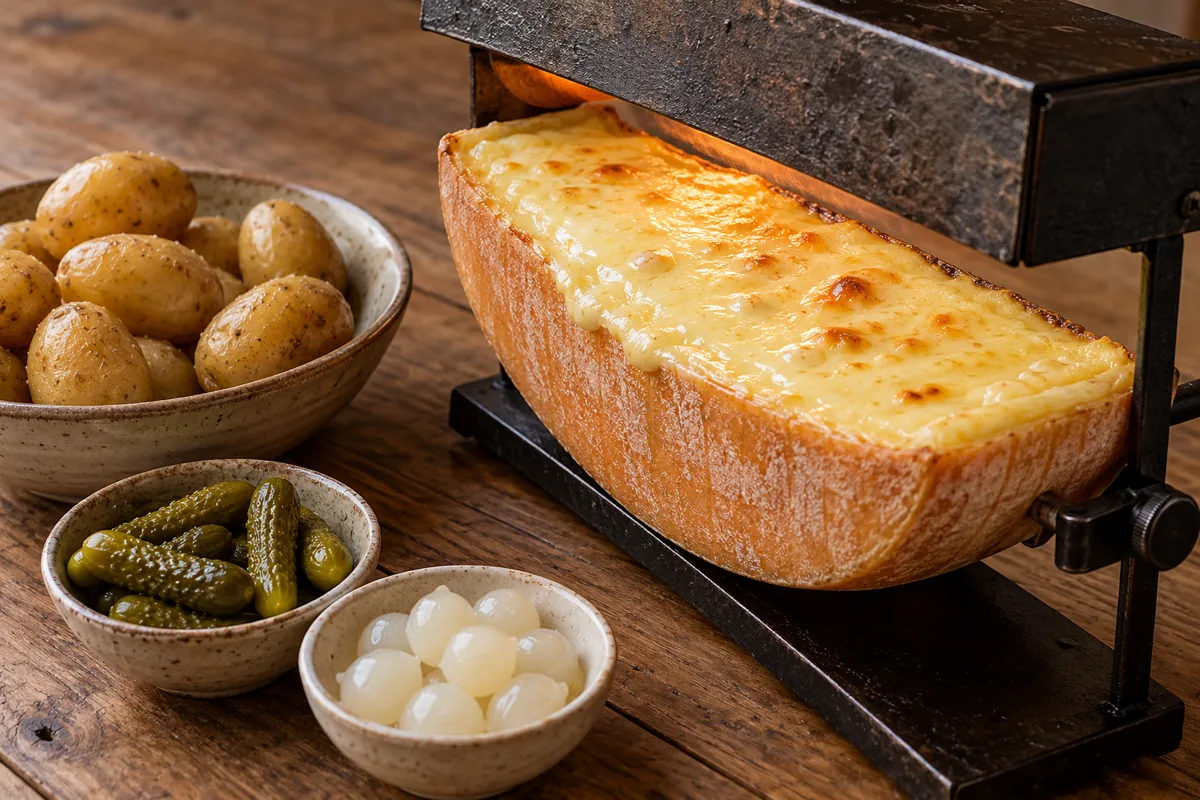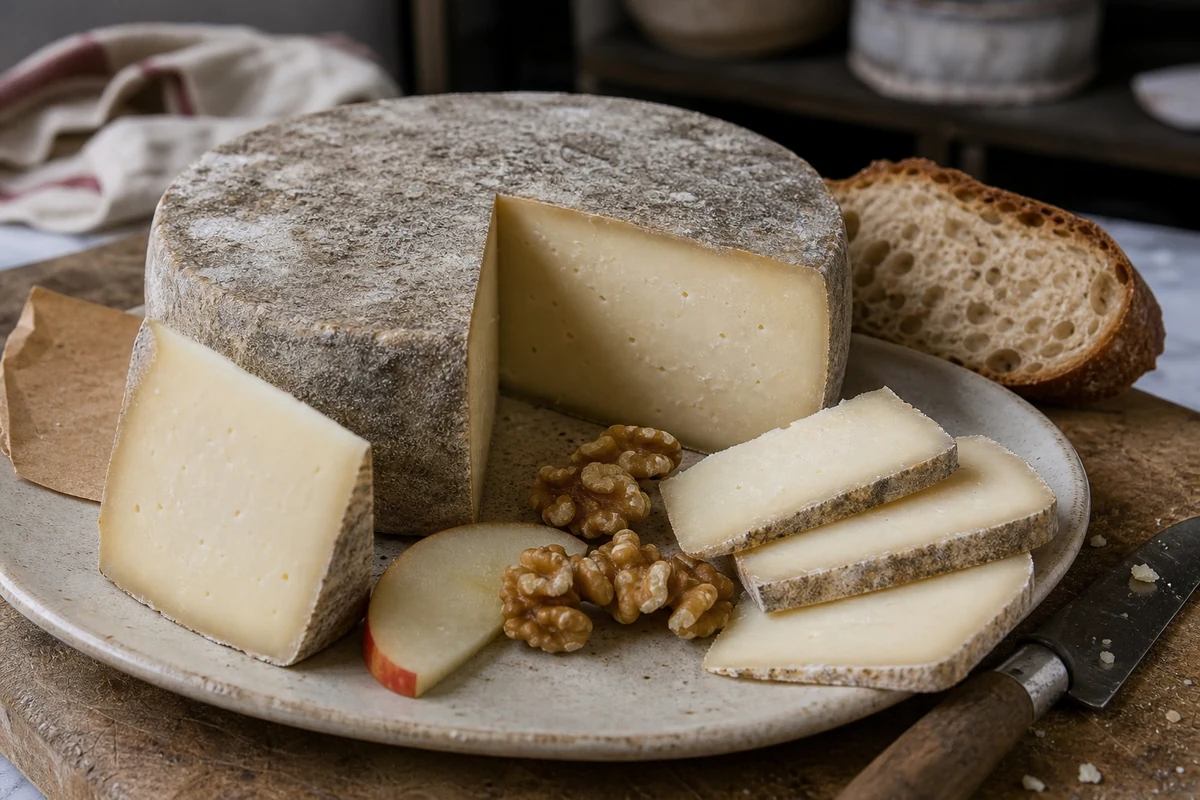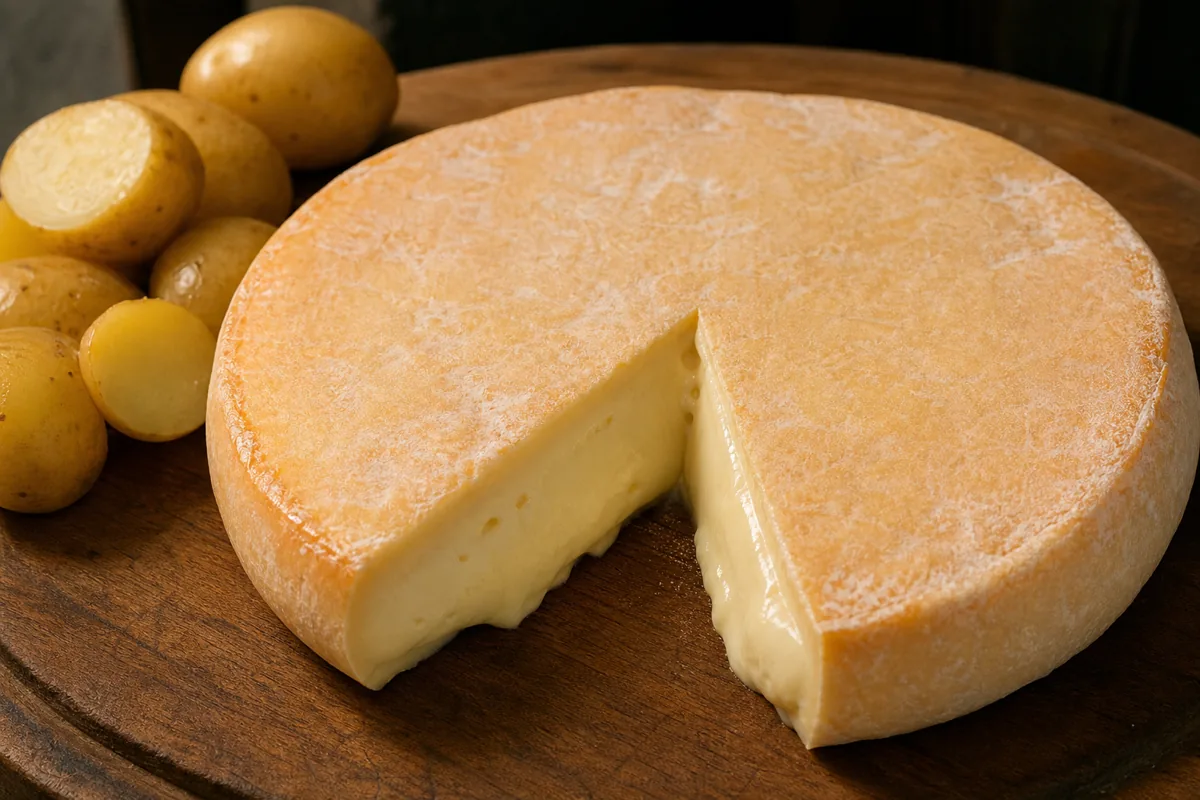
Reblochon is a soft French cheese made from raw whole cow's milk in the mountains of Haute-Savoie and the Val d'Arly in Savoie. Its AOP rules set a minimum ripening of 18 days.
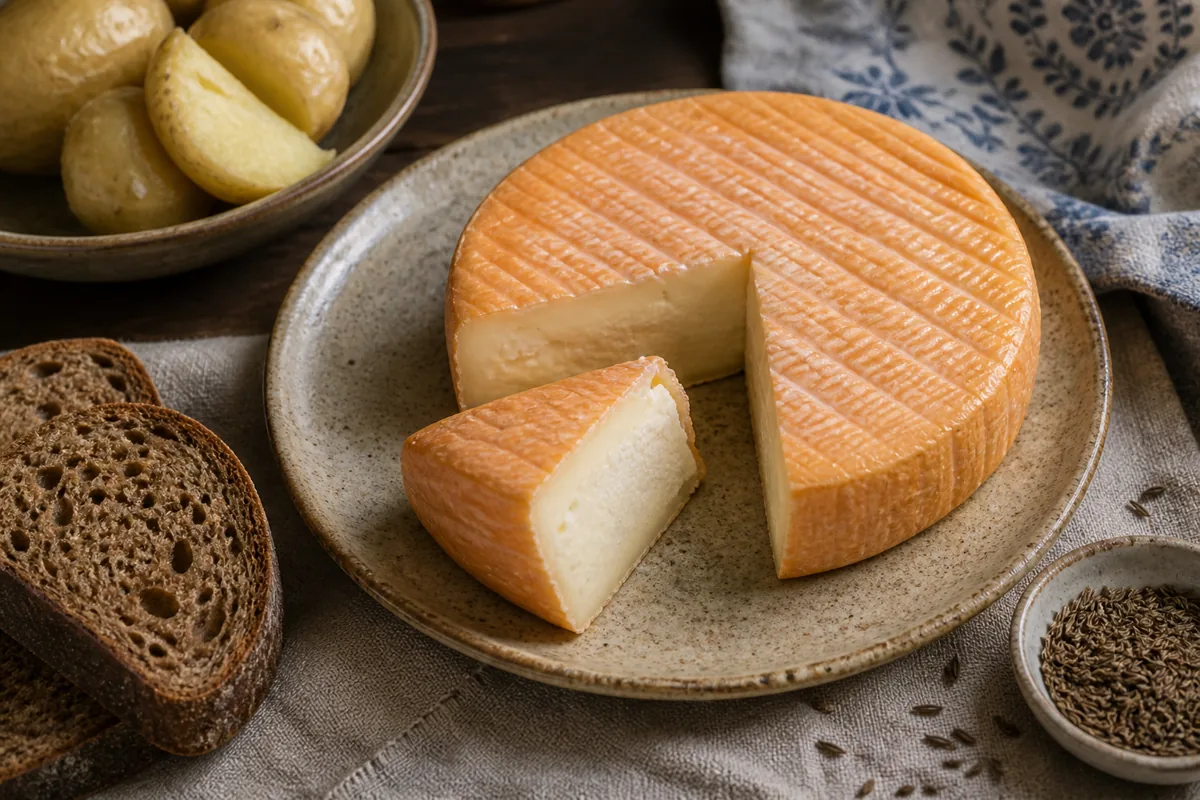
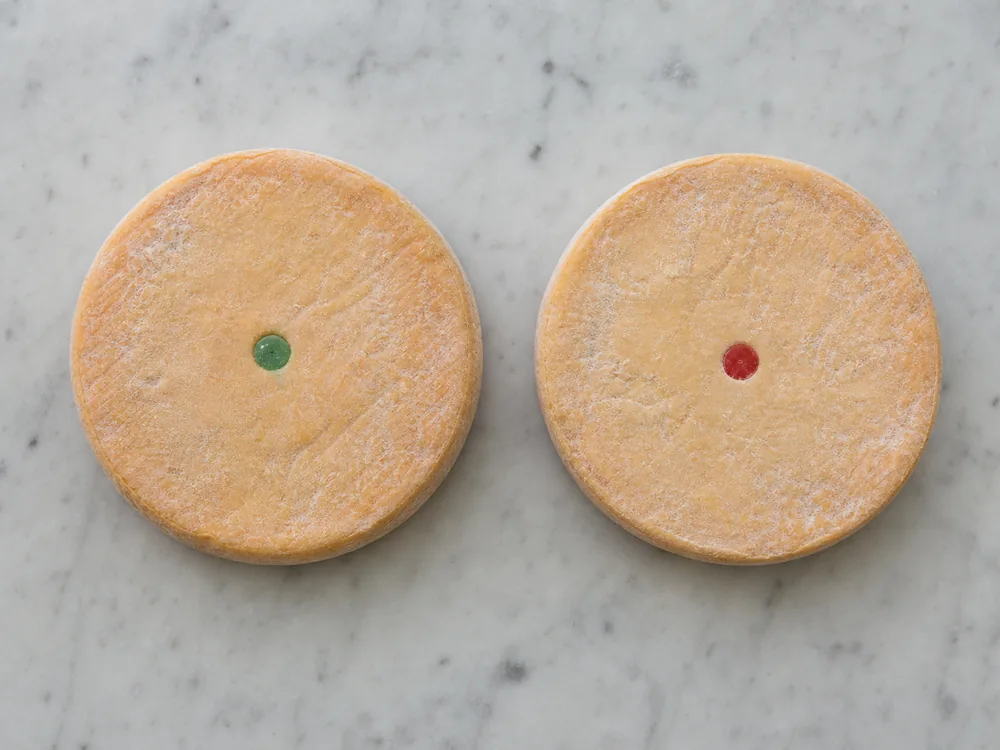
A small casein disc placed on each cheese tells you who made it: green for Reblochon fermier from the farm, red for Reblochon laitier from a dairy.
In This Article
What Is Reblochon Cheese?
AOP Reblochon can only be made in the mountains of Haute-Savoie and the Val d'Arly, and its milk may not be heated above 37 °C at any point in the making. Every AOP Reblochon is therefore a raw-milk cheese.
Only three cattle breeds may supply that milk: Abondance, Montbéliarde and Tarine.
The cows must graze in pastures for at least 150 days a year, eating mainly grass in summer and hay from the appellation area in winter. Fermented feed is banned, and the grain supplements allowed must contain no GMOs.
The herds follow an alpine calendar: they winter at the foot of the mountains and climb to alpine pasture in spring for 4 to 5 months, while the meadows they leave are cut for the next winter's hay.
A standard Reblochon is 13 to 14 cm across and weighs 450 to 550 g, and a petit Reblochon is about 9 cm across and weighs 240 to 280 g.
| Question | Figure | Given by |
|---|---|---|
| How wide is a standard Reblochon? | 13 to 14 cm, or about 14 cm | AOP specification page, Reblochon secrets page and Produits Laitiers AOP (13 to 14 cm); French Wikipedia and English Wikipedia (about 14 cm) |
| How thick is it? | 2 to 4 cm | AOP specification page (about 3.5 cm); Reblochon secrets page (2 to 3 cm); French Wikipedia (3.6 cm high); English Wikipedia (3 to 4 cm) |
| How heavy is it? | 450 to 550 g | AOP specification page and French Wikipedia (450 to 550 g); Produits Laitiers AOP (about 500 g); English Wikipedia (450 g on average) |
| How big is a petit Reblochon? | About 9 cm across, 240 to 280 g | AOP specification page (about 9 cm, 240 to 280 g); French Wikipedia (9 cm across, 3 cm high, 240 to 280 g); Produits Laitiers AOP (9 cm, about 250 g) |
The descriptions agree on the diameter and the weight but give the thickness of a standard cheese as anything from 2 to 4 cm, with about 3.5 cm on the specification page.
Reblochon has held French AOC protection since 7 August 1958, and its European PDO dates from 1996.
An AOC and an AOP carry the same specification: AOC is the French label, from 1935, and AOP the European one, from 1992. Since 2012 only the AOP mention has had to appear on products.
Where Does the Name Reblochon Come From?
The name comes from re-blocher, to pinch the cow's udder again, and its original form was probably rebléchon, from re-bléchier, to milk a second time.
The producers' version places that second milking in the 14th century, when landowners taxed mountain farmers on the milk their herds produced and the farmers did not finish milking until the yield had been measured. In that version, the dues were paid in cheese and butter, and the second milk was small in quantity but very rich in cream, so it could make a fattier cheese.
That version is not agreed. Other accounts describe a devotional cheese, offered each year to the Carthusian monks who blessed fields and chalets, or a privilege that landowners granted to herders.
The historian Arnaud Delerce, in a book first published in 2022, dates the producers' version to the years between 1930 and 1940, when it served to defend the local cheese against imitations. He finds no archaeological or documentary proof that the name came from fraud and judges the devotional version far more plausible.
The producers do not plan to change their version, citing its handing down in families and the specialists' work when the AOP was created.
English Wikipedia places the first Reblochon in the Thônes and Arly valleys of the Aravis massif, with Thônes still the centre of production. Researchers also split on the birthplace, some favouring a clandestine start at Le Grand-Bornand and others regular production tied to the Reposoir charterhouse.
How Do Fermier and Laitier Reblochon Differ?
Both styles follow the same AOP specification, and the disc colour is the quickest way to tell them apart.
| Attribute | Fermier | Laitier |
|---|---|---|
| Casein disc | Green | Red |
| Milk | One herd | Several farms |
| When it is made | Twice a day, right after milking | Once a day, up to 24 hours after milking |
| Method | Entirely by hand | In a cooperative or dairy, can be mechanized |
| Taste, per Grand Frais | More typed, with a varied aroma profile | Milder |
If you want a more typed cheese with a varied aroma profile, Grand Frais points you to fermier, and for a milder one to laitier, which it calls fruitière, the local word for a dairy.
The split in method starts with temperature. Milk leaves the cow at 35 °C, and fermier milk is made into cheese straight after milking, before it can cool.
For laitier, farm milk is chilled in tanks, collected and mixed at the fruitière, pumped to vats and warmed to about 37 °C before the rennet goes in. On the farm, the milk is neither chilled nor reheated.
Only cheese made on a farm for sale may use the words fermier, fromage fermier or produit fermier, and to keep the name, a cheese must spend at least its first eight days on the farm that made it.
After that, farm families sell it at markets, at the farm or in collective shops, or merchant-affineurs, who ripen cheeses bought from farms, buy it and finish the turning and rewetting.
The disc is a small casein button placed on each cheese after moulding, and it carries the number of the workshop and the production lot and the date the milk became cheese. On a fermier cheese, the numbered green disc identifies the farming family behind it.
Fermier is the smaller share: 2,490 tonnes of the 16,700 tonnes made in 2022, or 14.9%. That share fell from 21% in 2002 (3,655 tonnes) to 13.44% in 2014 (2,035 tonnes) and stood at 15.1% in 2024 (2,376 of 15,775 tonnes).
In 2020, Reblochon had 120 farm producers against 487 milk producers, 18 production plants and 11 maturing plants, and 16,934 tonnes were marketed that year.
How Is Reblochon Made and Ripened?
The milk sets in under an hour after natural rennet goes in. The curd is then cut into grains between the size of a wheat grain and a corn kernel, by hand on farms and by machine in dairies.
The grains are spread into moulds, and on farms a linen or cotton cloth over each mould evens out the draining and prepares the rind. The cheeses are then pressed for several hours to drive out whey.
They sit in brine for one to two hours, then spend a week pre-ripening in a drying room, where they are turned every day and their rind is washed.
Each cheese takes 4 litres of raw milk, about four litres for a 500 g Reblochon.
In the cellar, the AOP specification credits the flora of the cave, time and the affineur's work with gradually making the paste creamier and giving it its hazelnut flavour under the rind.
On the laitier route, the cheese gets more than an hour of pressing, salting, four days in a drying room at 16 to 18 °C and at least 15 days in a ripening cellar where it is washed and turned. That adds up to at least 19 days, one more than the 18-day minimum, though the specification page puts the drying-room stage at about a week.
| Question | Figure | Given by |
|---|---|---|
| What is the legal minimum? | 18 days | AOP specification page; French Wikipedia |
| How long can a fermier cheese ripen? | Up to 35 to 40 days | AOP specification page |
| How long is the cellar stage? | At least 15 days | Produits Laitiers AOP; French Wikipedia, for the laitier route |
| How long for an affiné Reblochon? | Six weeks | French Wikipedia |
| What longer ageing is given? | 6 to 8 weeks | English Wikipedia |
The 18 days are the specification's rule, and the 15 days refer to the time in a cellar. Six weeks for an affiné cheese and 6 to 8 weeks describe longer ripening.
By French Wikipedia's account, the original wild starter cultures disappeared within a few years of the European directive 92/46 on raw milk, and the industrial ones that replaced them cost the cheese much of its taste.
The producers' interprofessional union then selected 8 strains from the 477 identified, with 124 kept, and reintroduced them from 2008. By 2010 the cheese had regained characteristics close to the older ones.
What Does Reblochon Taste Like?
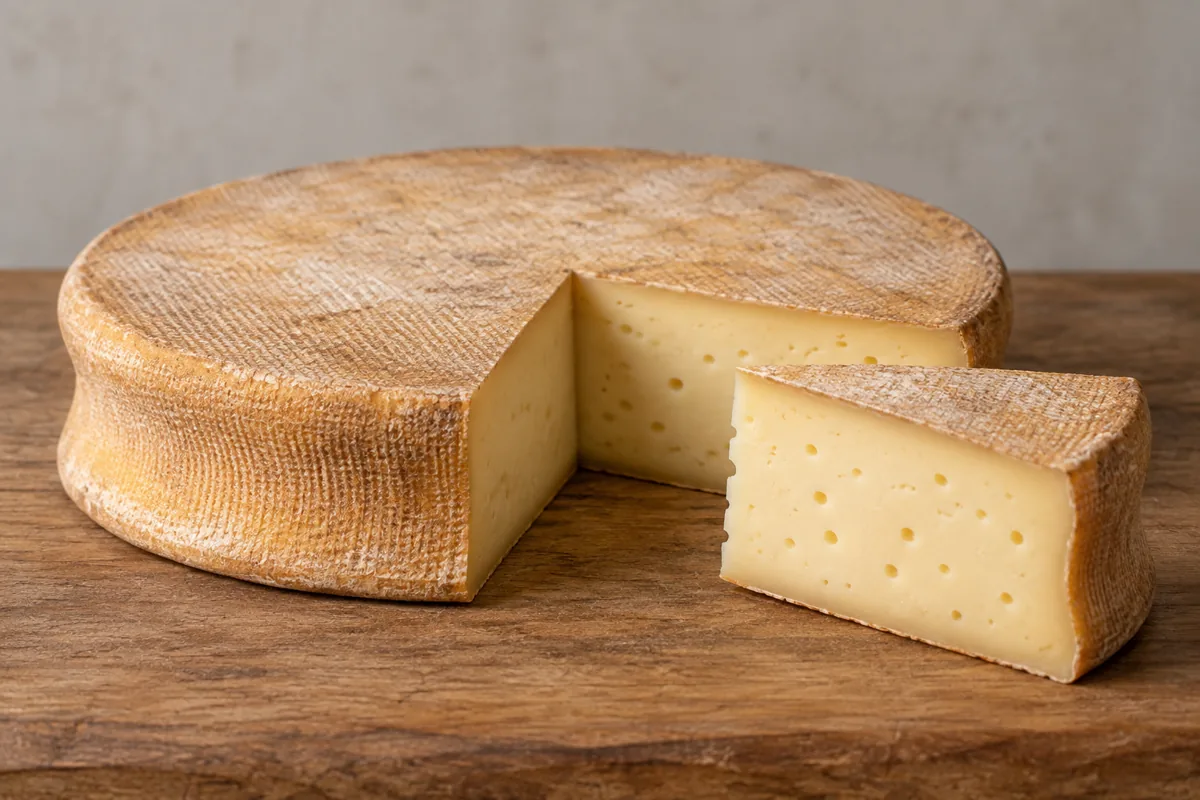
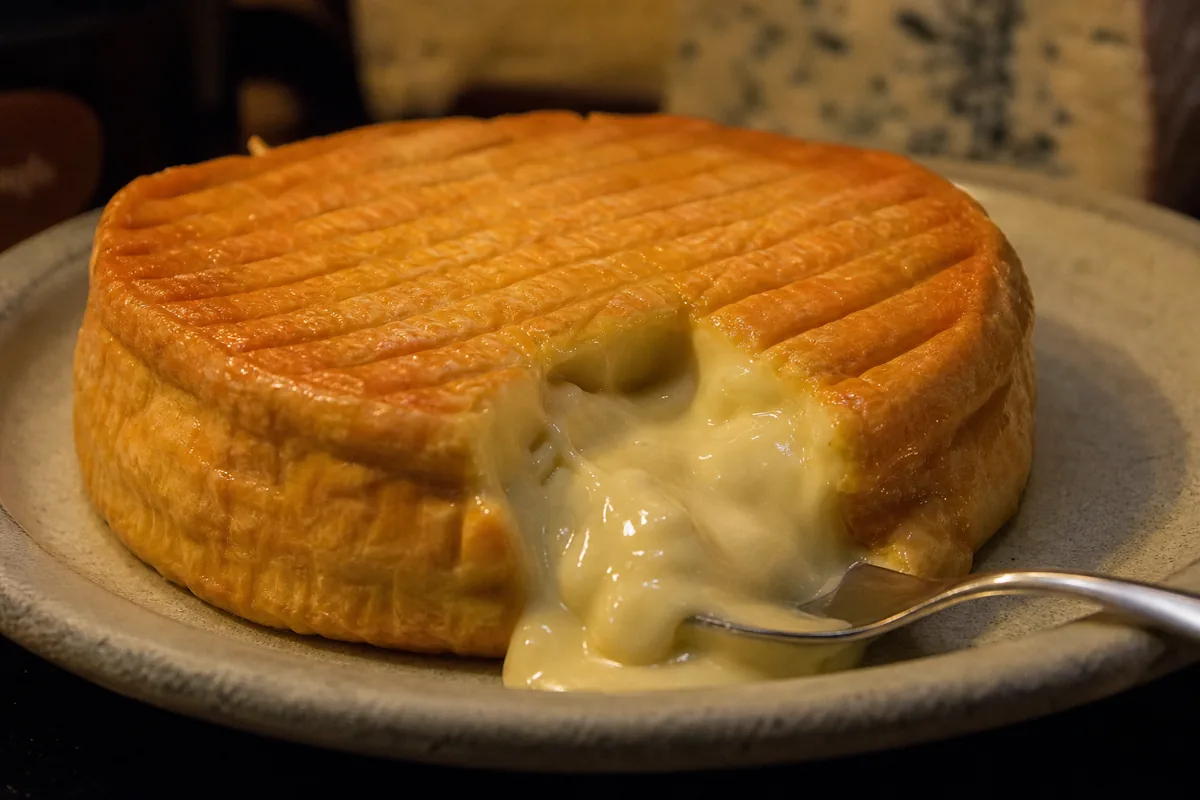
The AOP specification describes a soft, creamy paste, white to ivory, with a few small openings and a taste that recalls cream with a slight hazelnut note. It gives the rind as fine and yellow-orange, covered with a fine white bloom.
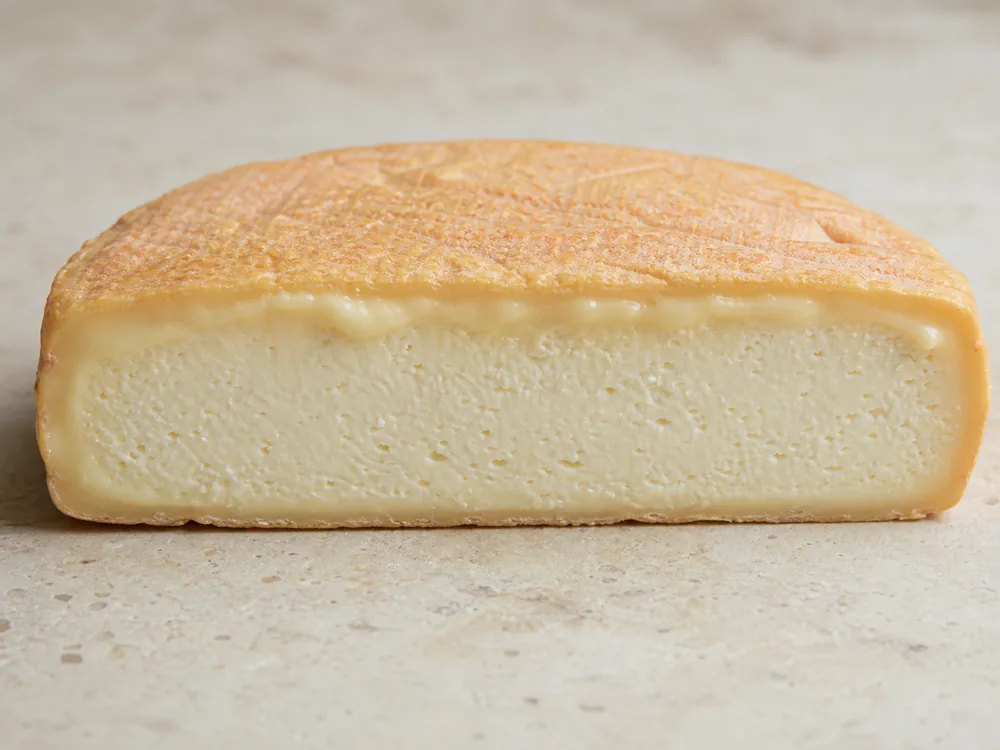
Both Wikipedias say the nutty taste lingers: French Wikipedia calls the hazelnut taste persistent, and English Wikipedia says the nutty taste stays in the mouth after the soft, uniform centre has been enjoyed.
Produits Laitiers AOP adds the detail: a subtle flavour of medium intensity with hot milk, hazelnut, peanut and an animal note, a nose of hot milk, wet earth, animal, hay and roasting, and a saffron-yellow rind with a thin white layer that it compares to the skin of an apricot.
Season changes the cheese as well. The producers say summer flavours are enriched by the flowers and fresh high-altitude grass the herds find in the alpine pastures, and French Wikipedia names May to September as the best time to eat it.
How to Tell When a Reblochon Is Ready to Eat
To choose between a firm and a creamy cheese, look at the heel, the side of the round: it is straight when the cheese is still firm and bulging for creamier eating.
| Where to look | What a ready cheese shows | Given by |
|---|---|---|
| The heel, the side of the round | Straight while the cheese is still firm, bulging for creamier eating | Reblochon secrets page |
| The cut face | A small lip of paste at the cut, which Savoyards say means it is ready | Grand Frais |
| Sides and paste | Swollen, supple sides and a gleaming ivory paste that may have small holes | Produits Laitiers AOP |
| The rind | A fine white bloom, a sign of good ripening in a cool cellar | French Wikipedia |
The depth of yellow-orange on the rind is not a ripeness reading on its own, because the rind may be coloured with carotene or annatto.
The affineur decides when a cheese is ready, wrapping a Reblochon once it is judged ripe and shipping it, generally at least about 20 days after making. The wrapped cheese keeps maturing until it is ready to eat.
How Does the Official Tartiflette Recipe Use Reblochon?
Tartiflette was launched to lift sales of Reblochon in winter, and the producers' official recipe serves four with one whole cheese.
- Cheese: 1 Reblochon
- Potatoes: 1 kg of a firm variety, peeled and cut into pieces
- Bacon: 200 g of smoked lardons
- Onions: 2 large, about 200 g, sliced into rings
- Wine: 10 cl of white wine
- Seasoning: pepper, and nutmeg if you like
The onions and bacon cook for 3 minutes, the potatoes join them for 20 minutes over medium heat, and the white wine deglazes the pan for 5 minutes more. The recipe adds no salt because the bacon brings enough.
The recipe card lists 25 minutes of preparation and 20 of cooking, but its steps add up to 28 minutes on the hob and 15 to 20 in the oven, so allow 43 to 48 minutes of cooking.
The Reblochon is cut in half through its thickness, with the rind kept on both halves. One half is diced into the potatoes, and the other, cut into 2 or 4 pieces to fit the dish, goes on top rind side up.
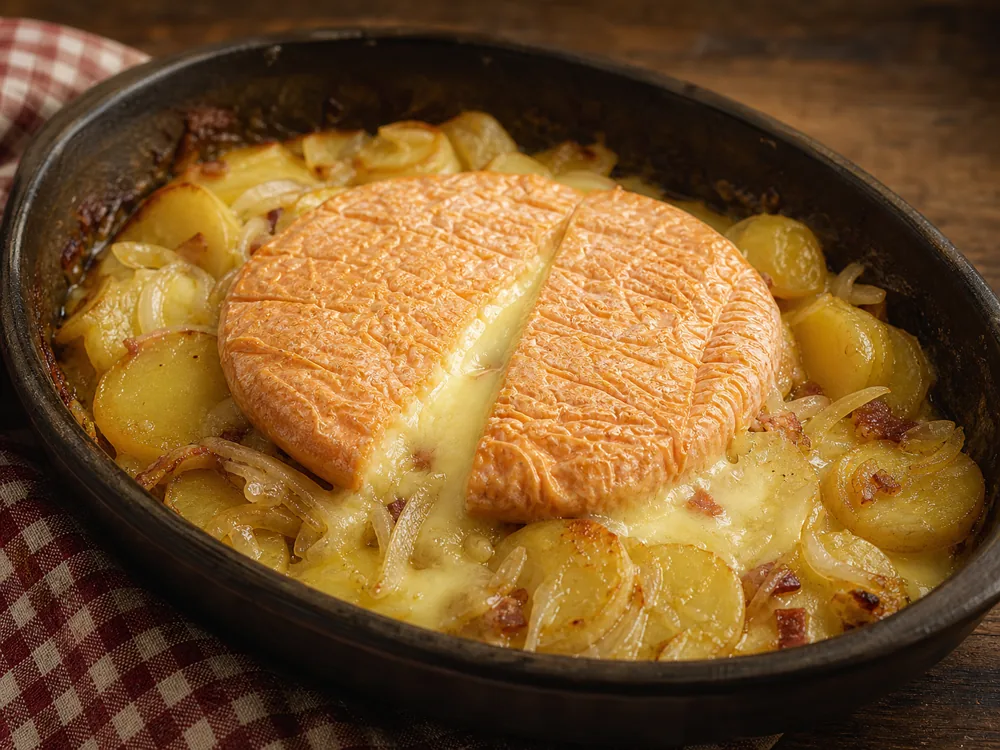
The dish bakes at 200 °C for 15 to 20 minutes until the cheese browns, and the recipe serves it hot with a green salad.
Grand Frais also lists Reblochon as a cheese for fondue and for potato gratins, and péla and reblochonnade are two more dishes built on it.
The producers also publish recipes that run from pear and hazelnut turnovers and an omelette with asparagus to coral lentil patties and a rice pudding with melon and strawberries.
How to Serve Reblochon and What to Pair It With
French Wikipedia gives about 16 °C as the serving temperature, a little cooler than room temperature, and says the cheese can sit in a tempered room for two hours beforehand. Grand Frais says to leave it at room temperature for about 30 minutes.
The CDC counts dairy among perishable foods and says never to leave perishable food out for more than 2 hours (or 1 hour if exposed to temperatures above 90°F), so a cheese that has already sat out for two hours before serving has no time left on the table.
Produits Laitiers AOP says to cut wedges from the centre outwards. Cut this way, each wedge on a cheese board gets some rind and some centre.
| Pairing | Type | Why It Works |
|---|---|---|
| Breads | Food | Nut, cereal, cocoa, Vienna or wholemeal bread, per Produits Laitiers AOP. |
| White wine | Wine | Savoie or Jura whites, per Produits Laitiers AOP. |
| Red wine | Wine | Loire, Jura or Rhône valley red per Produits Laitiers AOP; a fruity red per Grand Frais. |
| Champagne | Wine | Brut, demi-sec or rosé, per Produits Laitiers AOP. |
| Green salad | Food | Served beside tartiflette in the official Reblochon recipe. |
| Spices, jams, nuts and herbs | Food | Cumin and cinnamon; blueberry, apricot, chestnut or strawberry jam; hazelnuts, pistachio, rosemary and tarragon, per Produits Laitiers AOP. |
Beyond wine, Produits Laitiers AOP names amber beer and peated Islay whisky.
How Should You Buy and Store Reblochon?
Keep Reblochon in the paper and thin wooden plate it comes wrapped in, which Grand Frais says keep it at its best. For storing Reblochon at home, the CDC says to keep a refrigerator at 40°F (4°C) or below.
French Wikipedia and Grand Frais describe the plate as thin spruce, and by French Wikipedia's account it regulates the cheese's moisture and lets ripening go on. Produits Laitiers AOP names a thin beechwood ring instead.
In the official tartiflette, one standard 450 to 550 g cheese feeds four, roughly 110 to 140 g of Reblochon a plate. By the producers' figures per 100 g, below, that is about 30 to 38 g of fat and 1.4 to 1.8 g of salt per serving from the cheese alone.
| Nutrient | Per 100 g |
|---|---|
| Energy | 1,360 kJ / 328 kcal |
| Fat | 27.4 g |
| Saturated fat | 18.8 g |
| Carbohydrate | 0.4 g |
| Protein | 19.9 g |
| Salt | 1.3 g |
That fat figure is in line with the 27% fat Produits Laitiers AOP gives, while the English Wikipedia infobox lists 45% fat, which does not match fat as a share of the whole cheese.
How Can You Tell Real Reblochon from a Lookalike?
Look for the casein disc on the cheese and the AOP mention on the pack: a casein disc goes on every Reblochon, and making Reblochon outside the mountains of Haute-Savoie and the Val d'Arly is forbidden, with regular checks both internally and by an independent certification body.
Supermarket cheeses sold for tartiflette as made with mountain milk, with a Savoyard flag on the pack, angered farmers. Their fear is copies that do not follow the strict specification Reblochon producers must meet.
Until 1964, Reblochon was also made in Italian areas of the Alps, and that Italian cheese has since been sold in declining quantities as Rebruchon or Reblò alpino.
Can You Buy Reblochon in the US?
English Wikipedia says Reblochon has not been available in the United States since 2004, because it is unpasteurized and not aged long enough under US rules for soft cheese. That 2004 ban concerns raw-milk cheeses aged less than 60 days.
In the US, the pasteurized Délice du Jura is marketed as a close relative and substitute, and English Wikipedia names Préféré de nos Montagnes and Raclette as other substitutes.
None of them can carry the Reblochon AOP name, which belongs to raw-milk cheese made in Haute-Savoie and the Val d'Arly.
Is Reblochon Safe During Pregnancy?
Every AOP Reblochon is a soft cheese made from raw milk, so the pregnancy answer turns on the agencies' rules for unpasteurised cheese and on cooking.
The NHS says any foods made from unpasteurised milk must be thoroughly cooked, and it warns that unpasteurised or soft ripened dairy foods may contain listeria.
The CDC lists soft cheese made from unpasteurized (raw) milk, for example brie, camembert and blue-veined cheese, as a riskier choice. It says pregnant women are 10 times more likely to get a Listeria infection.
Cooking is where the two lists part: the NHS counts any cheese cooked until steaming hot as safe, soft cheese included. The CDC's safer line for heated soft cheese names pasteurized soft cheeses heated to an internal temperature of 165°F or until steaming hot, and AOP Reblochon is never pasteurized.
Both agencies sort cheese in pregnancy by milk and by cooking, and a doctor or midwife gives the final answer on raw-milk Reblochon eaten uncooked, or eaten cooked under US advice.
SOURCES & REFERENCES
The AOP specification says its taste recalls cream with a slight hazelnut note. Produits Laitiers AOP adds hot milk, peanut and an animal note at medium intensity.
A green casein disc marks Reblochon fermier, made by hand on the farm from one herd. A red disc marks Reblochon laitier, made in a dairy from the milk of several farms.
Yes. The AOP specification bars heating the milk above 37 °C at any stage, so every AOP Reblochon is a raw-milk cheese.
The specification sets a minimum of 18 days, and fermier cheeses can ripen for 35 to 40 days. English Wikipedia gives 6 to 8 weeks.
English Wikipedia says it has not been sold in the US since 2004 and notes that the pasteurized Délice du Jura is marketed there as a close relative and substitute.
It is a raw-milk soft cheese, and the NHS says foods made from unpasteurised milk must be thoroughly cooked and any cheese cooked until steaming hot is safe. The CDC lists soft cheese made from unpasteurized (raw) milk as riskier and its safer line for heated soft cheese names pasteurized soft cheeses, so under US advice ask a doctor or midwife before eating it, even cooked.