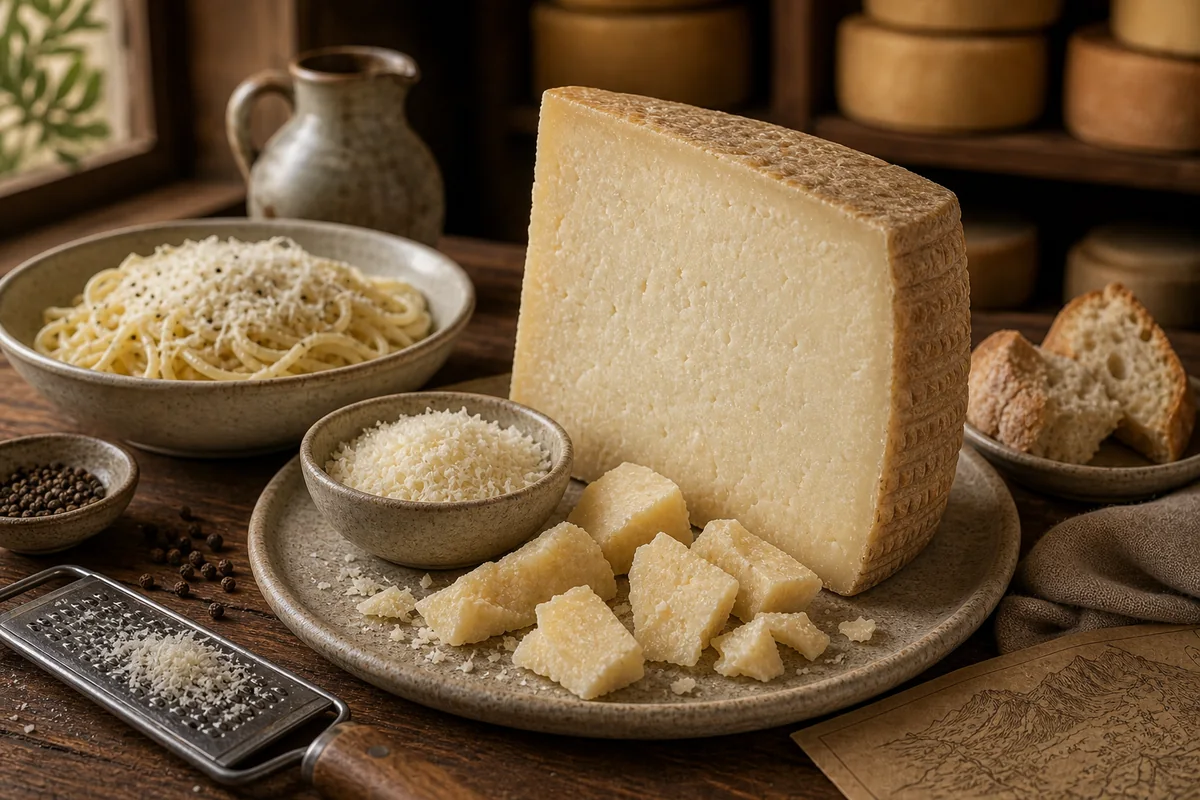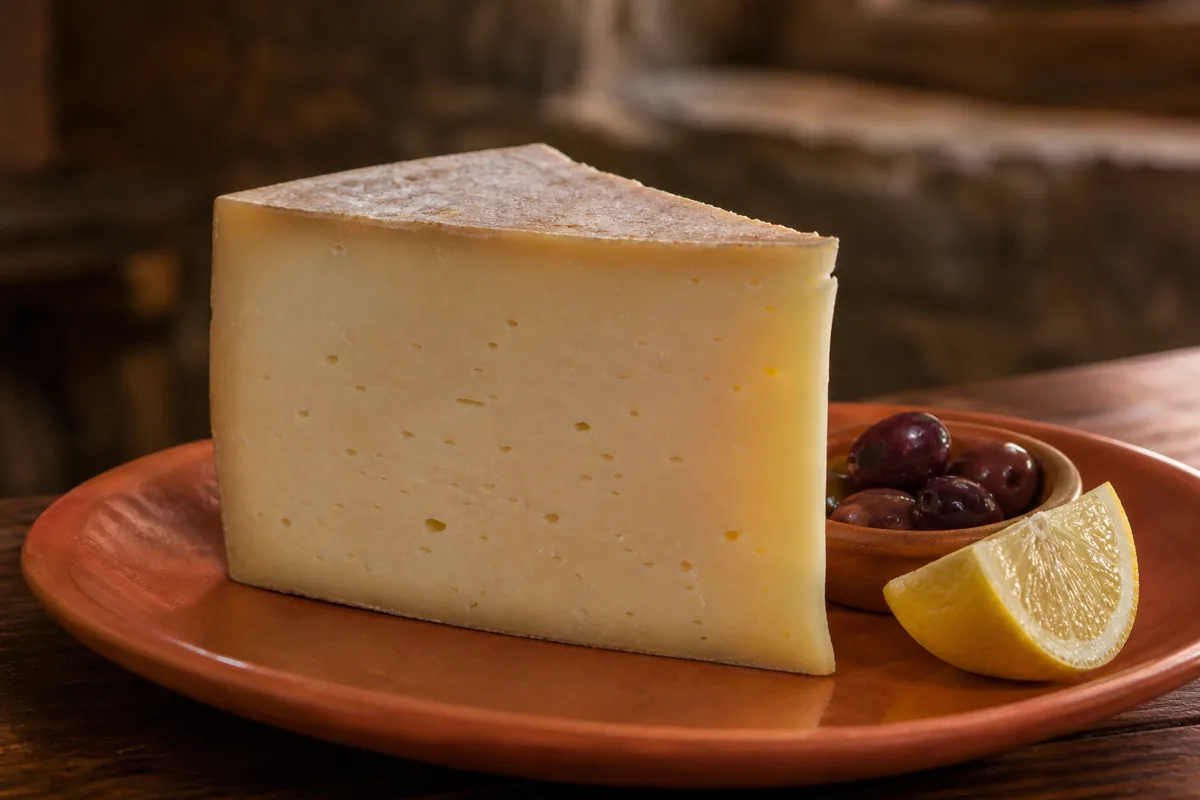
Kefalograviera is a hard Greek table cheese made from sheep's milk, sometimes with a little goat's milk, and English Wikipedia says cooks often cut it into triangles and fry it for saganaki.
The name joins two other Greek cheeses, kefalotyri and graviera. Greek Wikipedia places the taste and texture of kefalograviera somewhere between the two.
In This Article
What Is Kefalograviera Cheese?
English Wikipedia says kefalograviera holds protected designation of origin status in the EU and the UK.
A 2022 study in Foods by Athina Tzora and colleagues says the PDO covers four areas of mainland Greece: Western Macedonia, Epirus, Aetolia-Acarnania and Evrytania. The same study says the cheese is made mainly from ewes' milk, with goat's milk allowed up to 10%.
Greek Wikipedia puts the goat's milk share below 10% by weight, where the Foods study states its limit by volume, so the two figures are close but not measured the same way.
Cheese Atlas dates production to the 1960s, and the Foods study says kefalograviera is becoming one of the most widespread cheeses in Greece, with annual production of around 3,000 tons. Plato's Plate, a Greek food-culture project, gives an earlier start, saying the cheese emerged as a standardised product in the early 20th century.
Plato's Plate describes kefalograviera as a standardised form of older mountain cheesemaking, which could be why its start date comes sooner than Cheese Atlas's.
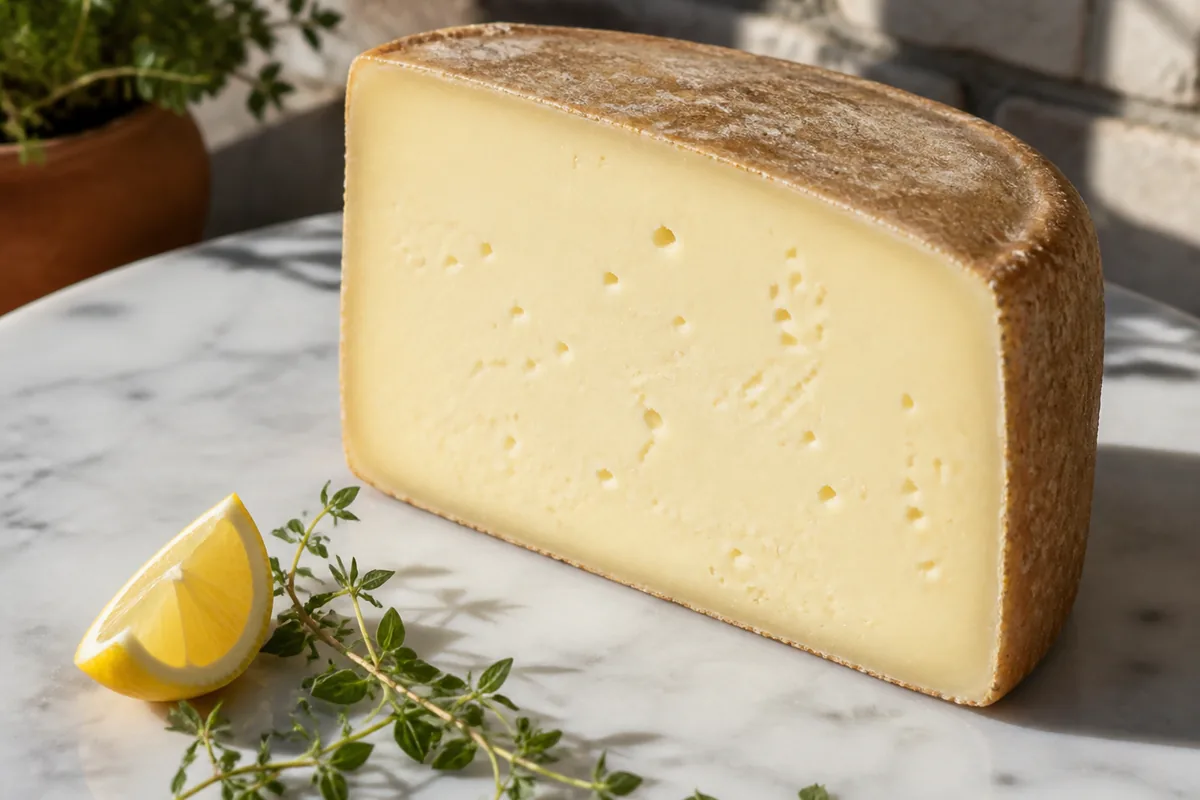
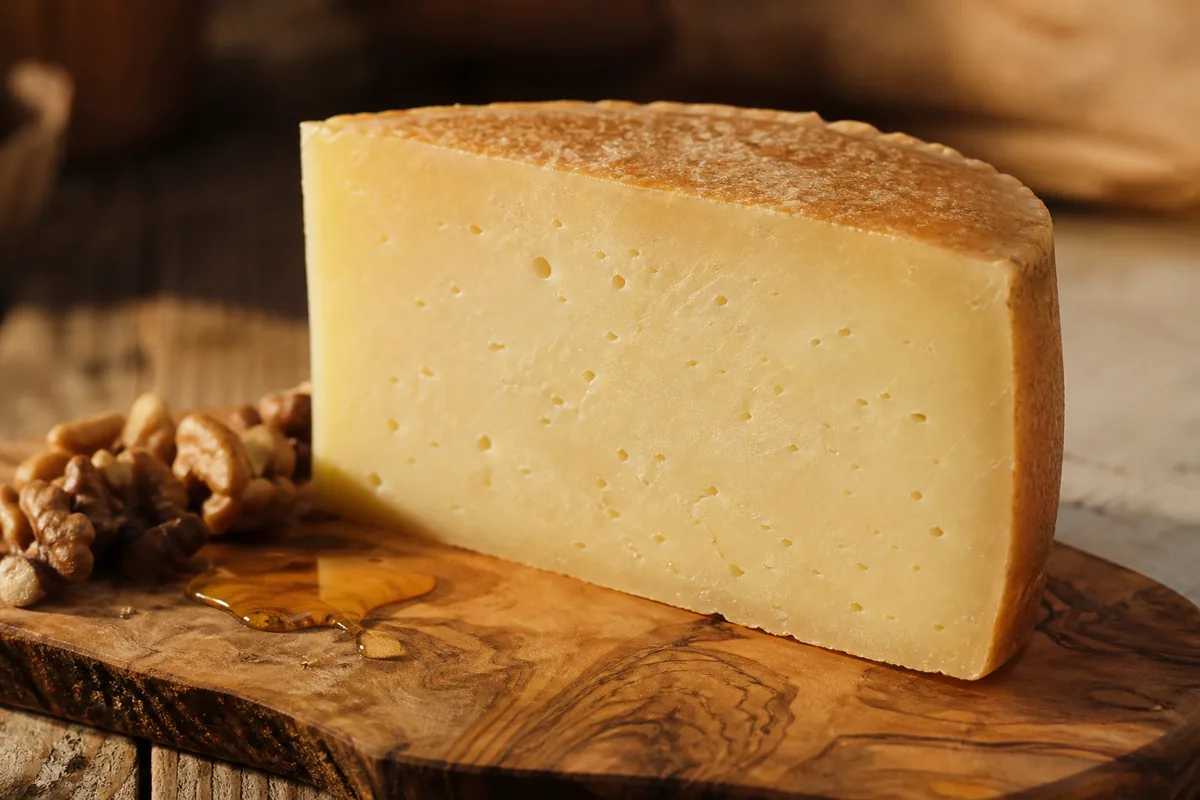
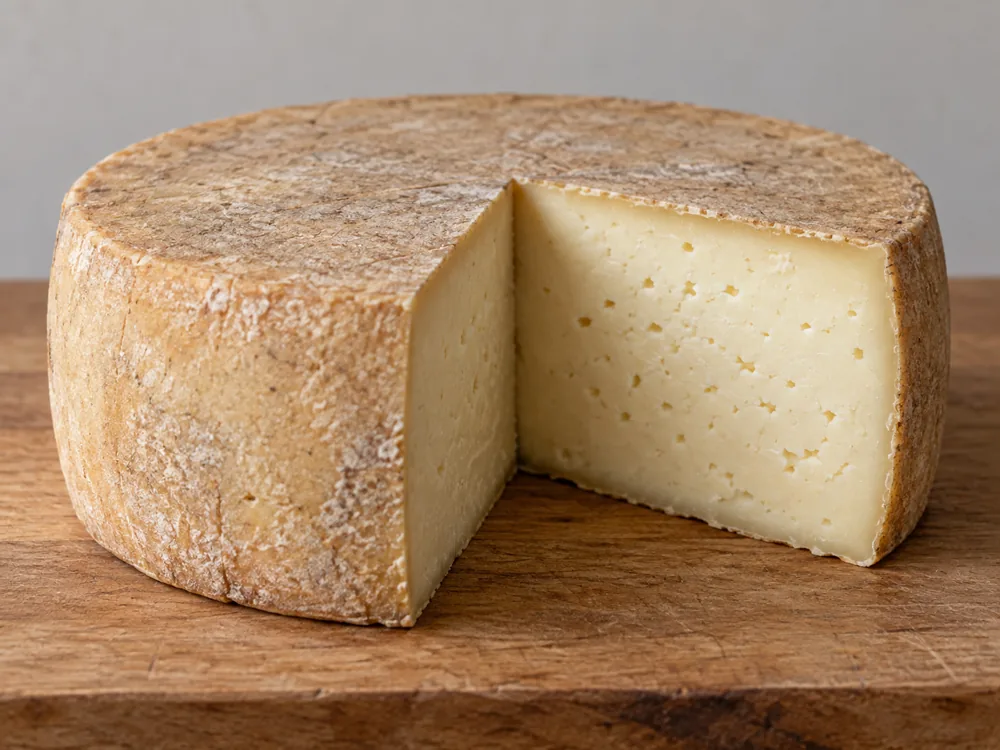
The Foods study says kefalograviera is sold in wheels or wedges and is easy to spot by its firm texture and light-brown rind.
How Does Kefalograviera Taste Next to Graviera and Kefalotyri?
Five of the seven sources below call kefalograviera salty, and they split on how strong it tastes.
| Source | Flavour description |
|---|---|
| English Wikipedia | Salty flavour and rich aroma |
| Greek Wikipedia | Saltier than many graviera cheeses; recalls nuts and butter |
| Foods (2022) | Salty and piquant, with a rich aroma |
| Cheese Atlas | Savoury with a rich aroma |
| Plato's Plate | Salty and piquant in its overview; "slightly salty" in its production notes |
| Kontos | Salty, somewhere between kefalotyri and graviera |
| Greek Flavours (Paramythias wedge) | Bold and savoury, with a subtle spicy finish |
Only Greek Flavours labels its wedge aged, and none of the descriptions is tied to a number of months, so "slightly salty" and "bold" may describe different wheels rather than different opinions.
Greek Wikipedia gives a reason for that middle place. It says kefalograviera sits between Greek graviera and kefalotyri because it is made the same way and eaten the same way.
Cheese Atlas puts that middle position into flavour terms, saying the cheese blends the piquant quality of Greek kefalotyri with the mellowness of graviera. Kontos's product listing makes the same point, saying the taste is somewhere between the two cheeses, which is how the cheese got its name.
English Wikipedia reaches outside Greece for a comparison. A cookbook it quotes rates kefalograviera, at its best, as good as or better than Romano or aged Italian Asiago.
How Is Kefalograviera Made and Aged?
The Foods study gives the commercial ripening period as at least three months, and says the cheese can be kept for a year to reach better quality and flavour.
Age changes the texture. Greek Wikipedia says a fresh cheese is slightly soft and hardens as it matures, at around 3 months.
The Foods study ties flavour to ripening chemistry, saying flavour in hard cheeses such as kefalograviera comes from volatile compounds formed as fat, protein and sugars break down. It adds that enzymes from Lactococcus lactis, a starter bacterium, raise taste and aroma mainly in hard cheeses.
The finished cheese is low in moisture. The same study describes it as under 40% moisture with at least 40% fat in dry matter, and the Paramythias label sold by Greek Flavours prints the same two limits.
The study's own cheeses, tested after six months, averaged 39.2%, 41.0% and 39.7% moisture in its three batches, so one batch sat above the 40% ceiling that the paper quotes. Dividing their 26 to 28% fat by the reported total solids gives about 45% fat in dry matter, above the 40% minimum.
Cheese Atlas classes kefalograviera as a pressed cooked cheese, and the batch Tzora's team made for their study shows what those two words mean in practice.
- Preparing the milk: the milk was kept at 1 to 4°C at the dairy, then preheated to 35°C the next day and filtered.
- Heat treatment: the milk was pasteurized at 69°C for 10 minutes, then cooled to 40°C.
- Setting the curd: a lactic starter went in first, and rennet followed 15 minutes later.
- Cooking the curd: the curd was cut into 2 cm cubes and reheated to 48°C.
- Pressing: the curd went into perforated moulds and was pressed, and the cheeses stayed in the moulds until the next day.
- Brining: the cheeses sat for 3 days in brine of 18 to 20% salt at 12 to 14°C.
- Dry salting: the cheeses were dry-salted for 13 days at 18°C and 80% relative humidity.
- Ripening: the cheeses spent 6 months in a chamber at 1 to 4°C.
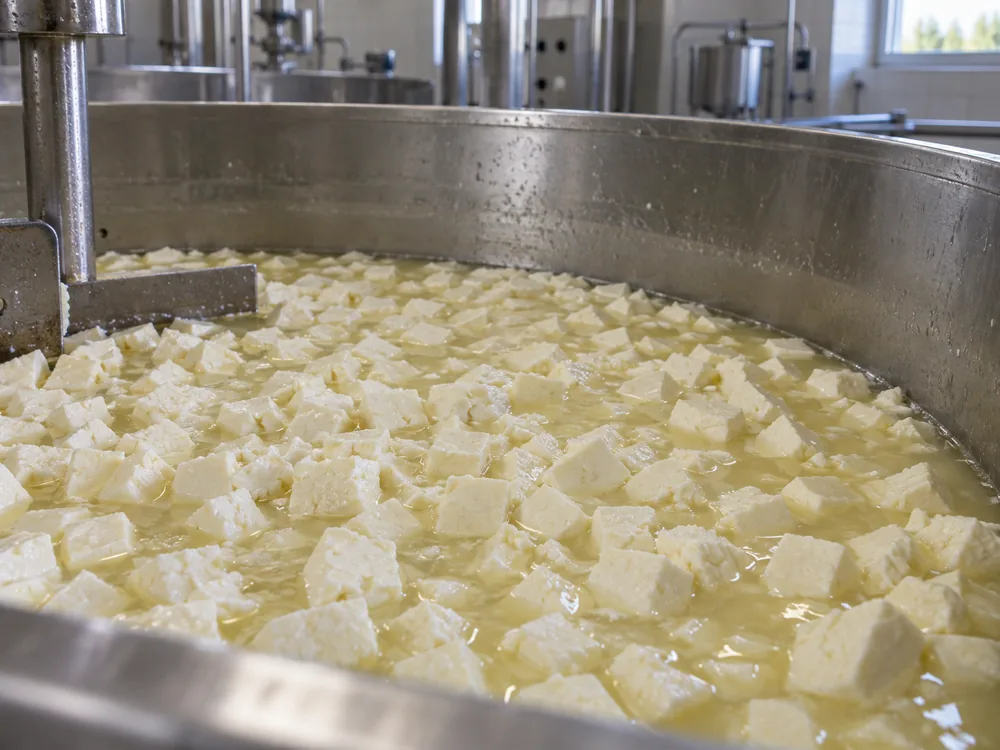
Those times and temperatures come from one research batch, in which each 40-litre lot of milk made six wheels of only 1.1 kg, so another PDO dairy can work to different figures.
What Does the PDO Require of Kefalograviera?
Plato's Plate says PDO kefalograviera is made only in Western Macedonia, Epirus, Aetolia-Acarnania and Evrytania, from the milk of free-range sheep and goats that feed on the natural flora of those areas.
Its production notes give the order of work as coagulation at 32 to 34°C, a heat treatment, draining, salting and at least three months of ripening in specially designed chambers, and they ban colorants, preservatives and antibiotic substances.
The two methods use different terms for their heat steps, so they cannot be laid side by side step for step.
Plato's Plate also says the cheese was recognised as a PDO product in 1994, and it lists an Official Gazette entry dated 11 January 1994 and EU Official Journal L148 of 1996 as the published specifications.
Does What the Ewes Eat Change the Cheese?
The Foods study tested the question with 30 dairy ewes kept in a feedlot, which ate a conventional ration of alfalfa hay, straw and a soybean-meal concentrate for 30 days. For the next 60 days they ate a concentrate with half the soybean meal replaced by flaxseed and lupins.
Milk from days 30, 60 and 90 went to the same dairy, and each lot was made into kefalograviera with the same recipe and analysed after six months.
The cheese carried more omega-3 fat the longer the ewes ate flaxseed and lupins, rising from 0.16% of total fatty acids in the day-30 cheese to 0.72% and then 1.23%, while the omega-6 to omega-3 ratio fell from about 19 to about 4.
Moisture, fat, protein and pH stayed statistically level between the batches, while the mix of bacteria in the cheese shifted.
The feedlot housing differs from the free-range animals Plato's Plate describes for PDO milk, so the result shows that feed can change the cheese, not what any shop wheel contains.
How Do You Cook and Serve Kefalograviera?
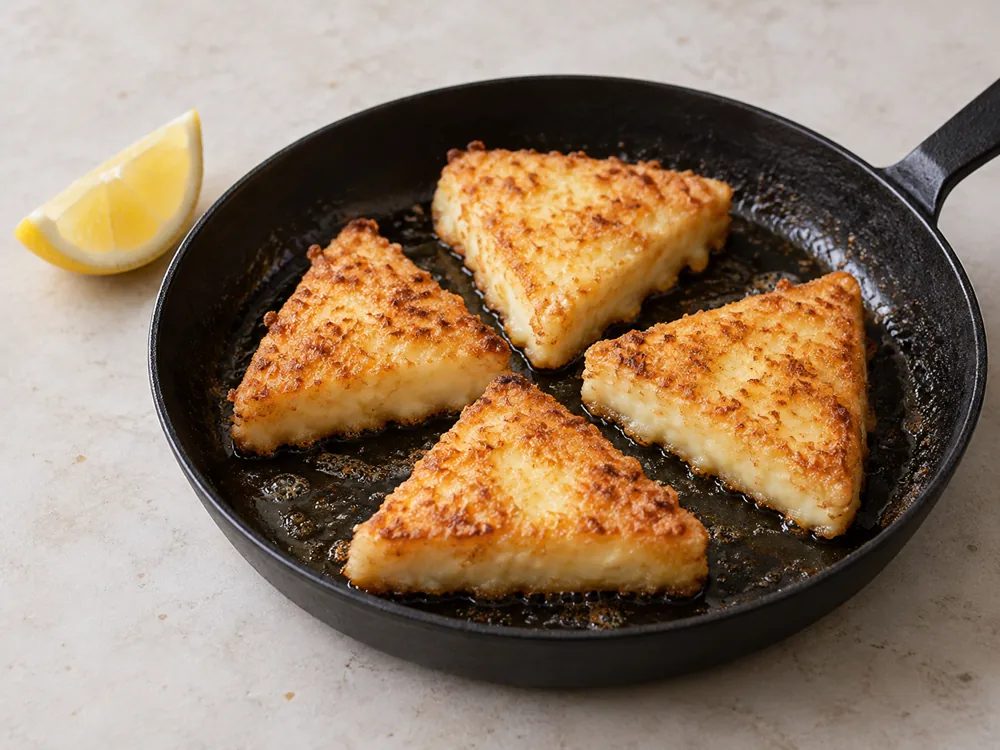
English Wikipedia describes the usual saganaki method: the cheese is cut into triangular pieces, rolled in seasoned flour and lightly fried. Greek Wikipedia gives the same method.
The dish takes its name from the pan. Wikipedia's saganaki entry says the cheese is melted in a small frying pan until it bubbles, then served with lemon juice and pepper and eaten with bread.
Because saganaki names the pan, the entry also lists shrimp and mussels saganaki as dishes cooked in one, and it describes those as typically feta-based with a spicy tomato sauce.
In Greek restaurants in the United States and Canada, the same entry says, saganaki is often flambéed at the table and the flames are put out with lemon juice. The entry says flaming saganaki apparently began in 1968 at the Parthenon restaurant in Chicago's Greektown, after a customer's suggestion.
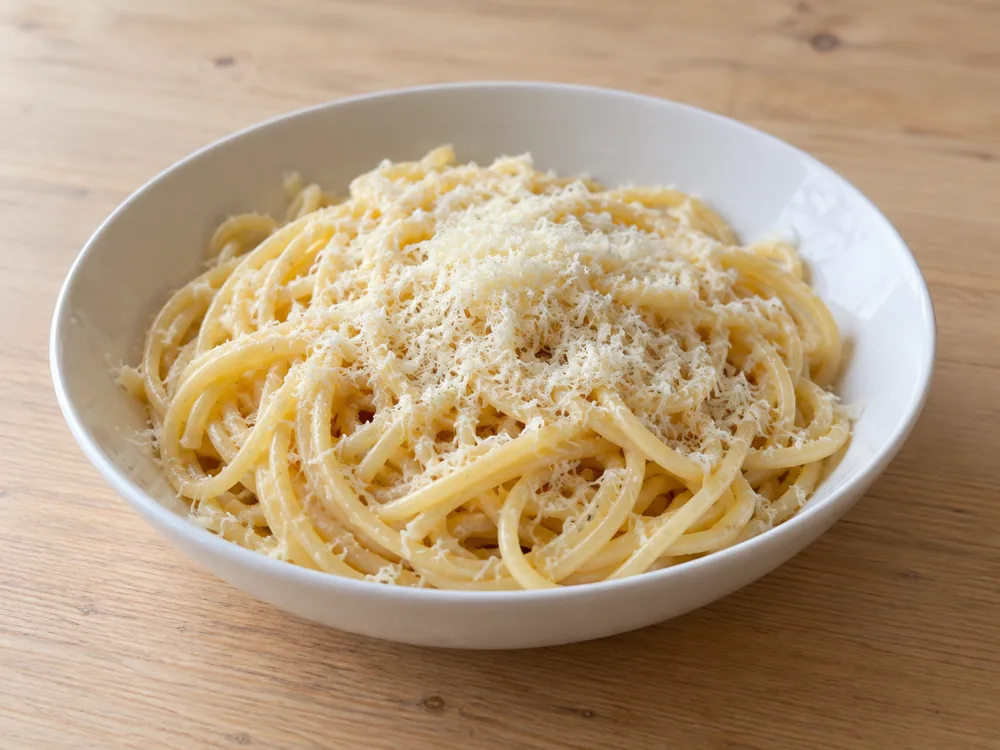
Away from the frying pan, English Wikipedia says kefalograviera grates well and is widely used as a topping for pasta dishes.
Greek Wikipedia describes the cheese by role rather than by dish, as the one a recipe calls for when it asks for a piquant, hard cheese.
| Use | How It Works |
|---|---|
| Table cheese | Greek Wikipedia names this as its first use, and the Paramythias listing suggests slicing or shaving it. |
| Pies | Greek Wikipedia lists pies alongside pasta and saganaki. |
| Baked dishes and roasted vegetables | Greek Flavours lists both next to grated pasta. |
| Meze | Cheese Atlas and the Greek Flavours listing both put it on a meze table. |
Take your wedge out of the fridge 20 to 30 minutes before serving, since Greek Flavours says cold dulls the flavour.
What to Drink With Kefalograviera
Greek Wikipedia ties the wine choice to the salt. It says the saltier cheese calls for dry white wines with good acidity, or for white spirits such as ouzo and tsipouro.
For red wine it suggests the more acidic or sturdier grapes, naming Cabernet and Xinomavro.
The sources rank the colours differently: Greek Wikipedia puts dry whites first and offers red as a second option, while Cheese Atlas puts full-bodied reds first and adds only some local whites, without naming a grape. Ouzo is the one drink that Greek Wikipedia, Cheese Atlas and Greek Flavours all name.
Plato's Plate gives its reason for the sweet pairings: it says honey or fig jam makes a salty-and-sweet combination that highlights the cheese's rich, piquant character.
| Pairing | Type | Why It Works |
|---|---|---|
| Dry white wine with good acidity | Wine | Greek Wikipedia's first choice for this salty cheese. |
| Ouzo or tsipouro | Drink | Named by Greek Wikipedia, Cheese Atlas and the Greek Flavours listing. |
| Full-bodied red wine | Wine | Suggested by Cheese Atlas. |
| Lemon, honey or fig jam | Food | The Greek food-culture site Plato's Plate suggests all three; the Wikipedia saganaki entry serves the fried cheese with lemon juice. |
What Can Replace Kefalograviera?
Cheese Atlas names four substitutes: kefalotyri, Parmigiano Reggiano, Italian Pecorino Romano and mature Gruyère.
Kefalotyri is the closest of the four, since English Wikipedia calls the two cheeses very similar, and Greek Wikipedia says kefalograviera already stands in for kefalotyri at times.
Among cheeses from outside Greece, only Romano turns up twice: Cheese Atlas lists Pecorino Romano, and the cookbook English Wikipedia quotes rates kefalograviera at its best against Romano, while Italian Parmigiano Reggiano and mature Gruyère come from Cheese Atlas alone.
For the saganaki pan, Wikipedia's saganaki entry lists the cheeses cooks fry the same way: graviera, kefalograviera, Cypriot halloumi, kasseri, kefalotyri and sheep's milk feta. Any of the others can stand in when you fry saganaki.
The entry adds regional choices: formaela in Arachova, halloumi in Cyprus and vlahotiri in Metsovo.
What Should You Look for When Buying Kefalograviera?
One US importer, Kontos, sells a wheel of about 10 kg (22 lb) imported from Greece, made from pasteurized sheep's milk, bacterial cultures, salt and rennet. The study's wheels weighed 1.1 kg and the Paramythias wedge below is 300 g, so the size on offer varies with the maker and the seller.
A wedge labelled kefalotyri may actually be kefalograviera, since English Wikipedia says the two names are sometimes swapped.
The Kontos and Paramythias labels differ on milk, with sheep's milk alone at Kontos and sheep's and goat's milk at Paramythias, and both match the milk range Cheese Atlas gives. Neither lists a colorant or preservative, which agrees with Plato's Plate saying the PDO bans them.
One retail pack shows what a label carries. Greek Flavours sells a 300 g PDO wedge from the Paramythias dairy in Epirus, made from pasteurised sheep's and goat's milk, salt and rennet, with this panel per 100 g.
| Nutrient | Amount |
|---|---|
| Energy | 1,577 kJ / 380 kcal |
| Fat | 30 g |
| of which saturates | 23 g |
| Carbohydrate | 1.4 g |
| of which sugars | 0 g |
| Protein | 25 g |
| Salt | 3 g |
The study's six-month cheeses measured about 2.1% salt, 26 to 28% fat and 27 to 29% protein, against 3 g, 30 g and 25 g per 100 g on this panel, so one dairy's numbers do not carry over to another's.
Is Kefalograviera Safe During Pregnancy?
Neither the NHS nor the CDC names kefalograviera, so their lists do not settle it. English Wikipedia calls it a hard cheese, and the NHS counts pasteurised or unpasteurised hard cheeses, such as cheddar, gruyère and parmesan, as safe in pregnancy.
The CDC draws a tighter line, and its safer list covers hard cheese when made with pasteurized milk, so a hard-cheese reading would rest on the label.
The Kontos and Paramythias labels both list pasteurised milk, and the Foods study pasteurized the milk for its batch. Check the label on your wedge for the heat treatment.
SOURCES & REFERENCES
What Else Do People Ask About Kefalograviera?
No. English Wikipedia calls the two very similar and says kefalograviera is sometimes sold as kefalotyri, but kefalograviera has its own PDO.
No. Greek Wikipedia treats them as separate cheeses and places kefalograviera between graviera and kefalotyri.
At least three months for sale, according to the 2022 Foods study, which adds that it can be kept for a year.