Emmental is the cheese most people picture when they think "Swiss cheese," but the factory copies sold under that generic label bear little resemblance to the real thing. Authentic Emmentaler AOP from Switzerland's Emme Valley is a raw-milk alpine cheese with a nutty, buttery depth that no pasteurized imitation matches. The Swiss regional cheese guide maps the full AOP landscape that Emmental sits within. We cover the full family of Swiss and alpine cow's milk cheeses in our directory, and Emmental anchors that group as the largest wheel in regular production. The Emmental vs Gruyere comparison shows exactly how these two alpine AOP cheeses differ in flavor, hole formation, and cooking use.
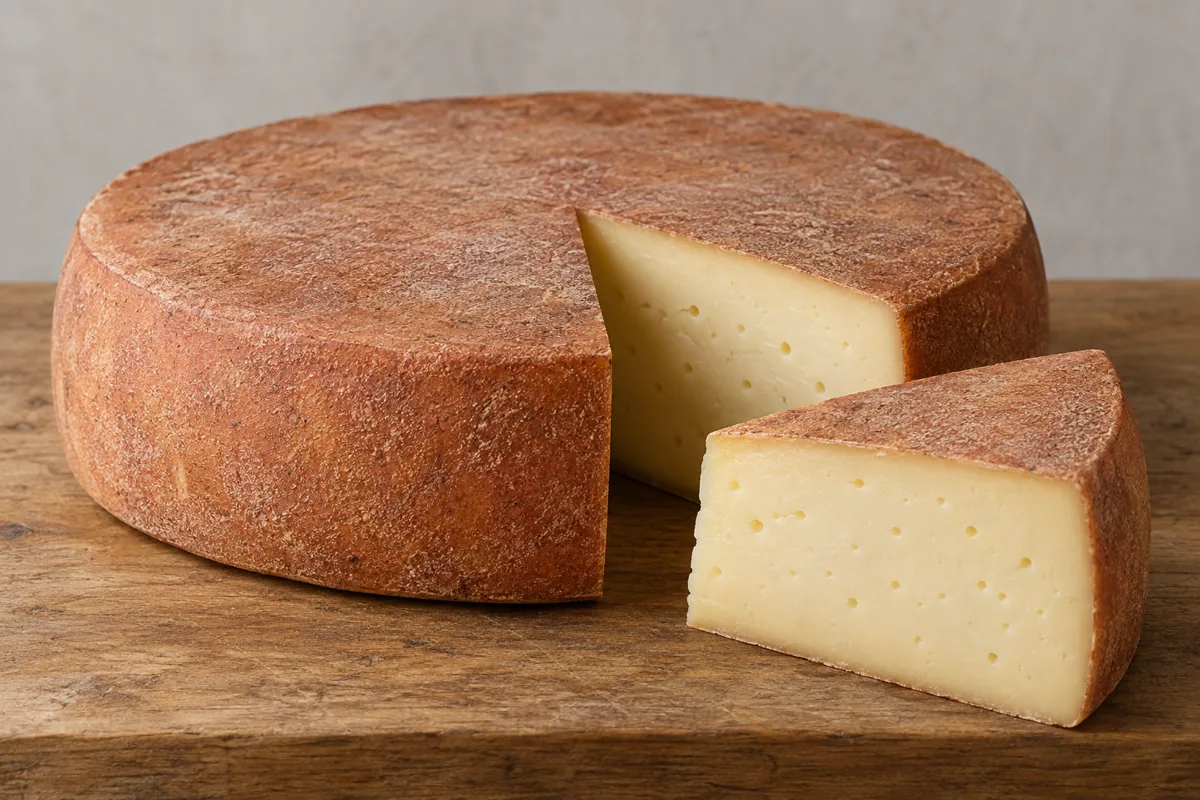
Each wheel weighs between 75 and 120 kilograms, making Emmental one of the heaviest cheeses produced anywhere. The size is not tradition for tradition's sake. Large wheels age more slowly and evenly than small ones, and the thick paste provides the environment for the signature holes to form properly. A small wheel cannot develop Emmental's characteristic eyes because the gas pressure dissipates before the holes reach full size.
In This Article
What Emmental Is
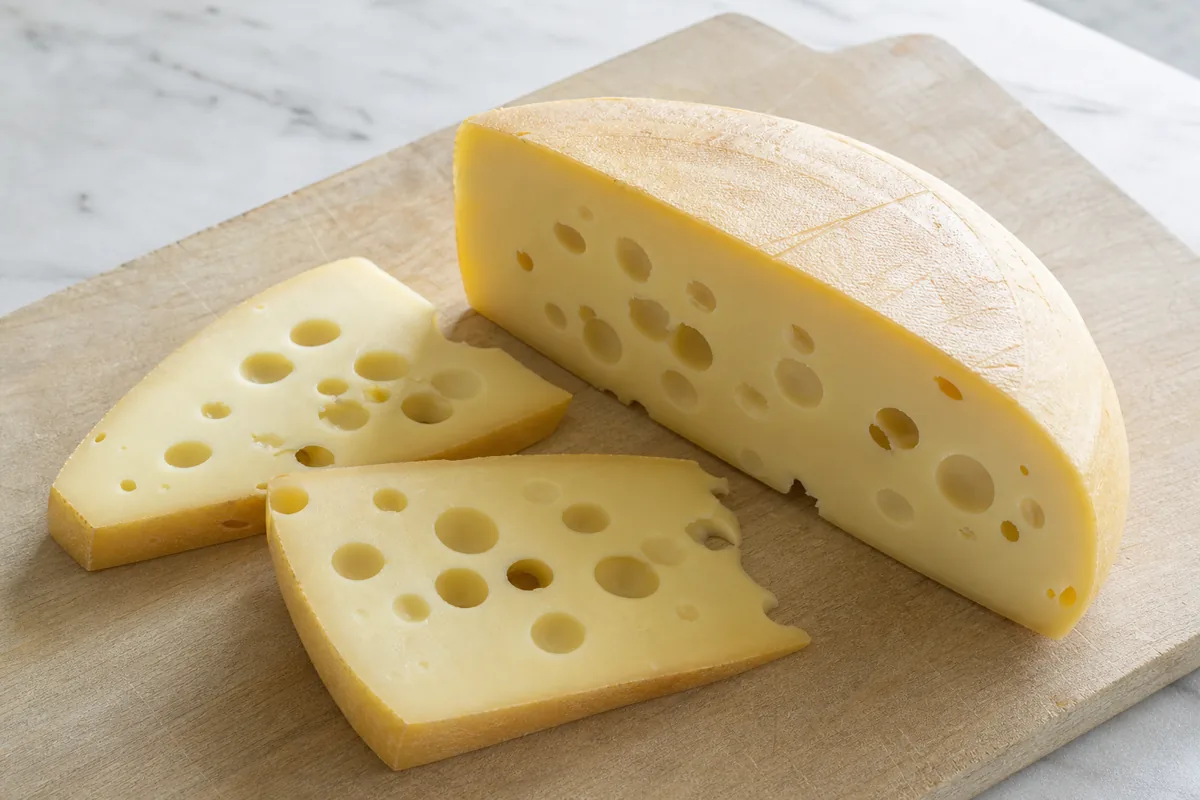
Emmental is a semi-hard cow's milk cheese defined by its large, round holes and its mild, nutty, slightly sweet flavor. The cheese takes its name from the Emme Valley in the Canton of Bern, where production records date to 1293. The valley's dairy farmers developed the large-wheel format to pool milk from multiple farms into a single wheel that could age efficiently through the alpine winter.
The AOC (now AOP) designation protects Swiss-made Emmentaler produced from raw cow's milk in designated regions. The milk must come from cows fed on grass and hay with no silage, because silage can introduce Clostridium bacteria that cause irregular, oversized holes and off-flavors. This silage-free requirement is one of the strictest in European cheesemaking and directly affects the cheese's clean, sweet taste.
Generic "emmental" or "Swiss cheese" is produced worldwide, most notably in France, Germany, Austria, and the United States. These versions use pasteurized milk, smaller wheel sizes, and shorter aging periods. The flavor is milder and the holes are often smaller or more irregular. The price is lower, but the trade-off in flavor depth is significant.
- Origin — Emme Valley, Canton of Bern, with production records from 1293
- Milk — raw cow's milk from silage-free herds, pooled from multiple farms per wheel
- Wheel size — 75-120 kg, one of the largest cheeses in regular production
- AOC since 2006 — protects the name Emmentaler AOP for Swiss production only
- Key trait — large round holes formed by Propionibacterium fermentation, not mechanical
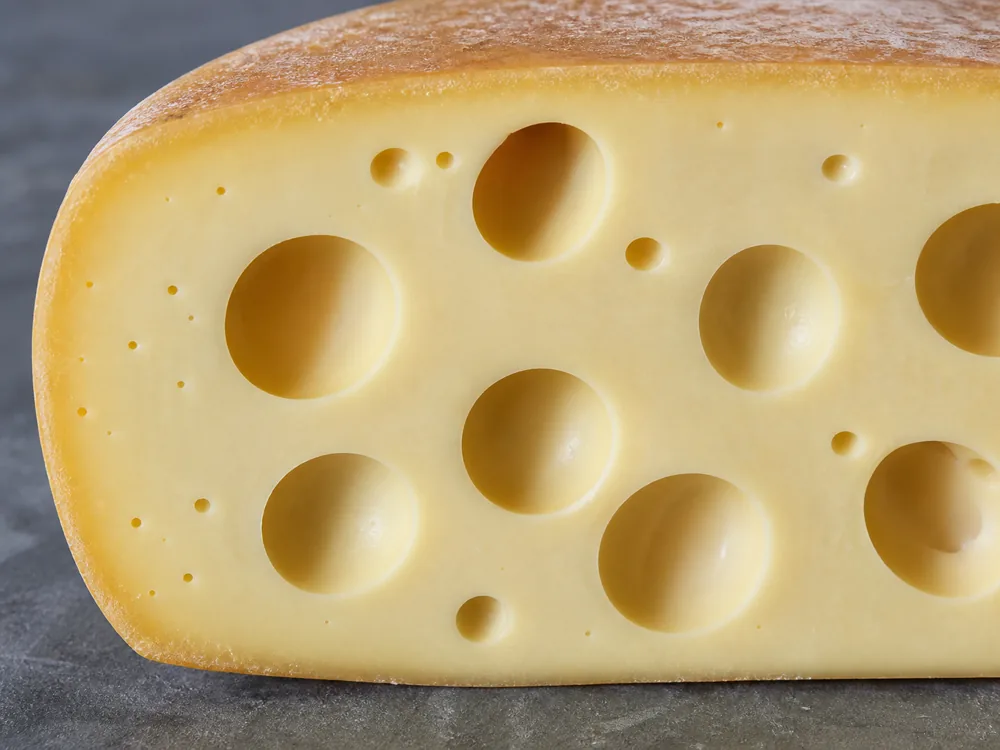
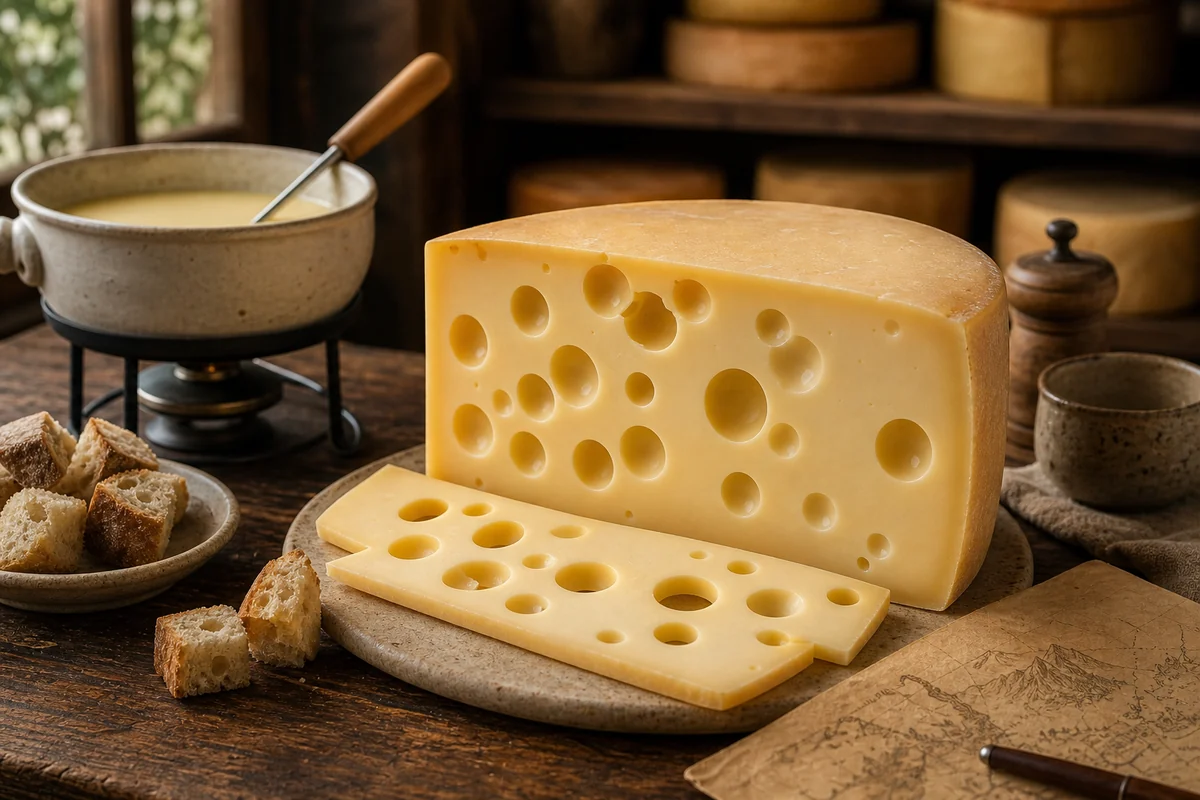
The holes in Emmental are called eyes. They form when Propionibacterium freudenreichii bacteria consume lactic acid and release carbon dioxide gas during a warm-room aging phase. The gas cannot escape the dense, elastic paste, so it collects into bubbles that become the cherry-sized to walnut-sized eyes visible when the wheel is cut. A wheel with no eyes or with irregular, split-shaped holes indicates a fermentation problem.
The term 'Swiss cheese' in the United States refers to any emmental-style cheese with holes, regardless of origin. Real Emmentaler AOP from Switzerland is a specific, protected product. If the label says 'Swiss cheese' without the AOP seal, it is a domestic or imported imitation.
Emmental Flavor and Texture
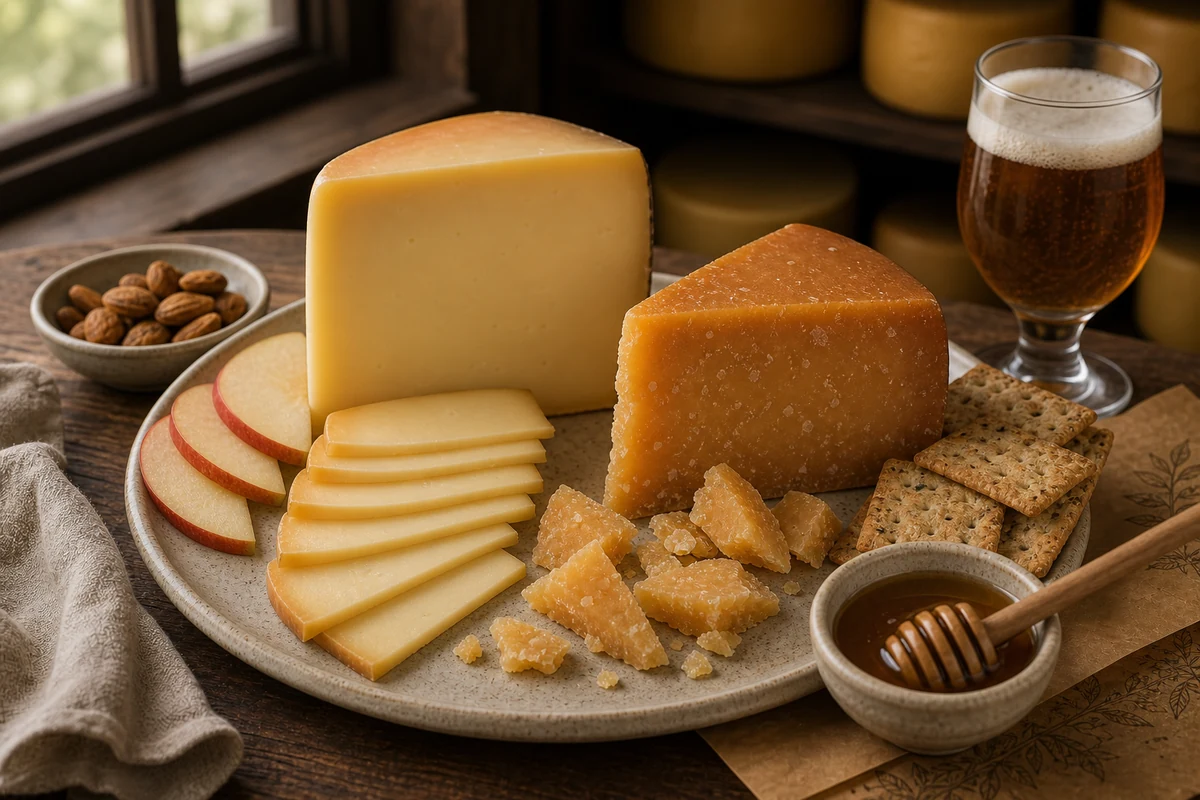
Young Emmental at 4 months is mild, buttery, and slightly sweet. The paste is firm but elastic, with a springy bite that bounces back when pressed. There is no sharpness at this age. The flavor is clean and approachable, which is why Emmental is one of the first cheeses many children enjoy.
As Emmental ages past 8 months, the flavor deepens toward nutty, toasted, and faintly fruity notes. The sweetness persists but picks up a caramel undertone. At 12 months, the paste firms further and the elasticity decreases. The eyes remain stable in size, but the surrounding paste becomes denser and more flavorful.
The radar shows sweetness and creaminess as the dominant notes, which is unusual for a semi-hard cheese. Most cheeses in this texture range lean toward salty or sour. Emmental's sweetness comes from the Propionibacterium fermentation, which converts lactic acid (sour) into propionic acid (sweet, nutty) and CO2 (the holes). This biochemical conversion is unique to Emmental-style cheeses.
- 4 months (AOC minimum): Mild, buttery, clean. Very approachable. Melts smoothly.
- 8 months: Nutty and sweet with a toasted quality. Firmer paste. Good balance of eating and melting.
- 12+ months (Reserve): Complex, caramel-nutty, with faint fruity notes. Dense paste. Best for eating.
The texture around the eyes is slightly softer and moister than the body of the paste. This variation creates a pleasant contrast when eating a slice that includes both eye-adjacent and solid paste. Wheels with very large eyes have more of this softer zone, which is why some affineurs prefer medium-eyed wheels for a more uniform eating experience.
How the Signature Holes Form
The eyes in Emmental are not random. They result from a controlled, two-stage fermentation process that cheesemakers manage by adjusting temperature, timing, and bacterial culture selection.
In the first stage, the cheese ages in a cool cellar at 12 to 14 degrees C for several weeks. During this period, lactic acid bacteria acidify the paste and begin breaking down proteins. The cheese firms and develops its base flavor.
In the second stage, the wheels move to a warm room at 20 to 24 degrees C for 6 to 8 weeks. This heat activates the Propionibacterium freudenreichii that was added during production. The bacteria consume lactic acid and produce propionic acid (responsible for the sweet, nutty flavor) and carbon dioxide gas. The CO2 cannot escape the sealed, elastic paste, so it collects into bubbles. The bubbles grow over weeks into the characteristic eyes.
- Stage 1: Cool cellar — 12-14 degrees C for several weeks; base acidification and firming
- Stage 2: Warm room — 20-24 degrees C for 6-8 weeks; Propionibacterium activates, eyes form
- Stage 3: Cold storage — returned to cool cellar for remaining aging; eyes stabilize, flavor deepens
The cheesemaker monitors eye development by tapping the wheel and listening to the sound. A wheel with good eye formation produces a hollow, resonant tone. A solid tone indicates insufficient gas production. An overly hollow or uneven tone suggests the eyes have grown too large or merged, which creates structural weakness.
Silage (fermented grass stored in plastic bales) can harbor Clostridium tyrobutyricum bacteria. These bacteria also produce gas during aging, but their gas production is uncontrolled and creates irregular, split-shaped holes with off-flavors. The AOP silage ban eliminates this risk at the source. Grass and hay feeding is more expensive for farmers, but it produces milk that ferments predictably in the warm room.
After the warm room, wheels return to cold storage at 10 to 12 degrees C for the remainder of their aging period. The eyes stop growing, and the flavor compounds developed during the warm phase continue to concentrate as moisture slowly leaves the paste. The entire process from fresh curd to finished cheese takes 4 months minimum and up to 14 months for Reserve grade.
Best Uses for Emmental
Emmental's mild flavor and reliable melt make it one of the most versatile cooking cheeses available. It does not overpower other ingredients, which makes it a better team player in mixed-cheese dishes than stronger cheeses that dominate every dish they enter.
- Fondue base — the classic 50/50 blend with nutty alpine cheese for Swiss fondue
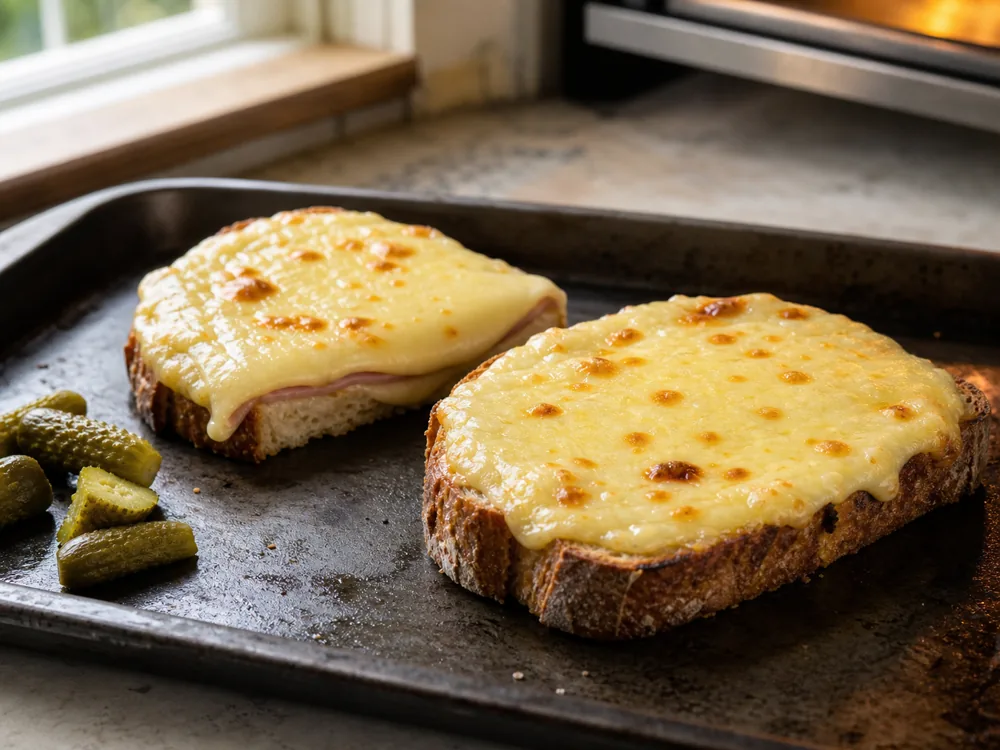
- Sandwiches and melts — smooth, even melt without greasiness or separation
- Quiche and egg dishes — nutty background flavor that supports rather than dominates
- Gratins — golden, even crust with less oil release than many alternatives
For fondue, use Emmental aged 6 to 8 months. Younger wheels melt too loosely and produce a thin fondue. Older wheels melt less smoothly because the lower moisture creates a thicker, less fluid result. The 50/50 Emmental-Gruyere blend works because Emmental contributes smooth melt and sweetness while Gruyere contributes depth and salt.
Pre-sliced Emmental sold in plastic packaging is acceptable for sandwiches but lacks the flavor of cheese cut from a wheel. For any application where Emmental is the featured cheese rather than a background ingredient, buy from a cheese counter and ask for AOP if available.
Wine and Food Pairings
Emmental's mild, sweet flavor makes it a forgiving pairing partner. It rarely clashes with anything because it lacks the salt, acidity, and sharpness that create conflict with bold wines or bitter foods.
- Swiss whites — Chasselas provides regional acid balance without overpowering
- Dry Riesling — stone-fruit notes and firm acidity complement the nutty sweetness
- Light beer — pilsner or pale ale cuts the fat and matches the mild intensity
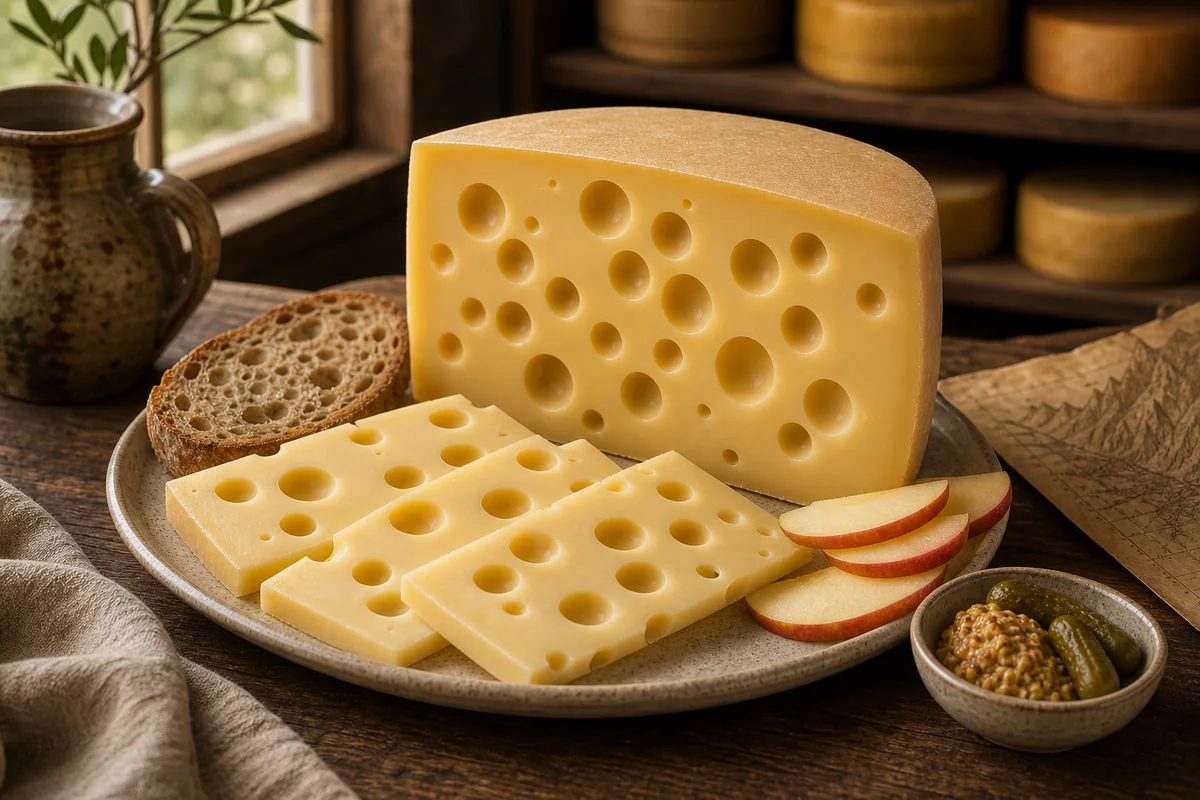
- Pickles and mustard — sharp, acidic accompaniments provide the contrast Emmental needs
Avoid pairing Emmental with heavily tannic reds or bold blue cheeses on the same board. The mild flavor disappears next to anything aggressive. If building a mixed board, serve Emmental first and move to stronger cheeses afterward.
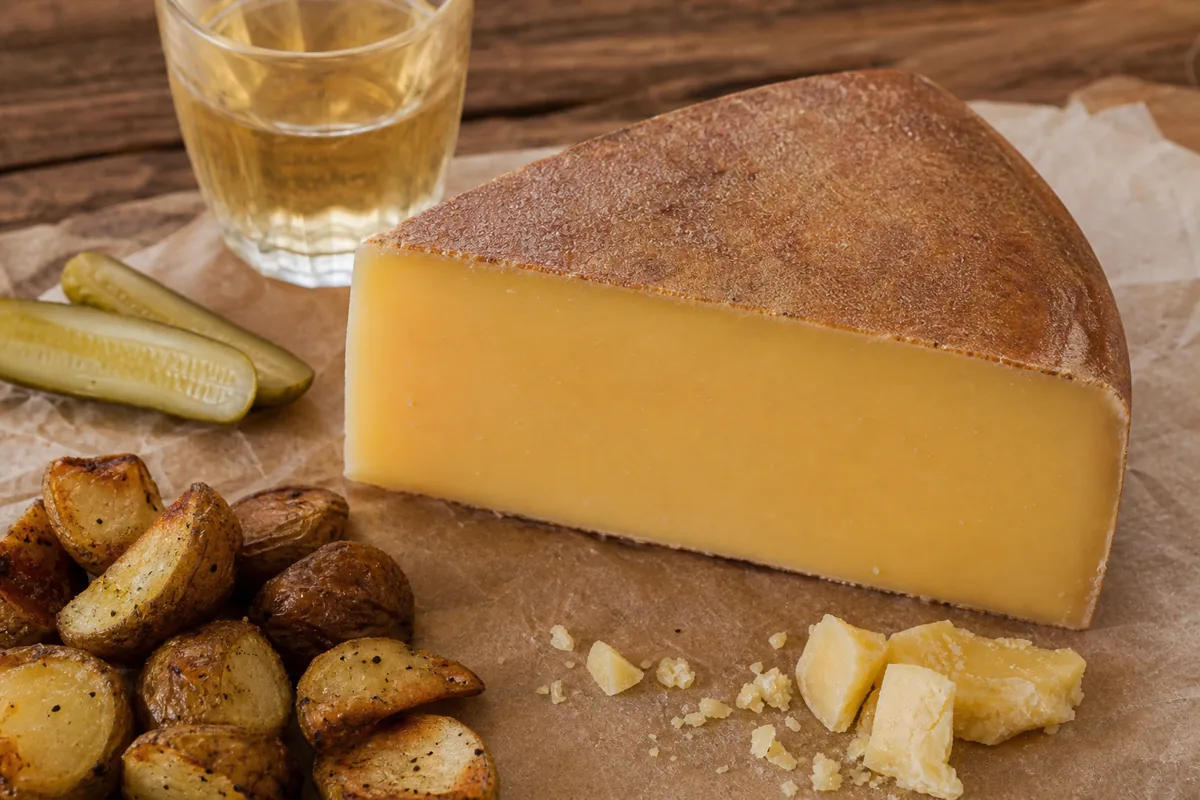
Emmental on a fondue board with cornichons, pickled onions, boiled potatoes, and cured meat is the traditional Swiss winter meal. The pickles are not optional: their acidity balances the richness of the melted cheese and keeps the palate refreshed between bites.
How to Store Emmental
Emmental's semi-hard paste and natural rind give it reasonable shelf life, but the large surface area exposed by the eyes means cut pieces dry out faster than solid-paste cheeses at comparable moisture levels. The interior surfaces around each eye lose moisture to the air inside, which accelerates overall drying.
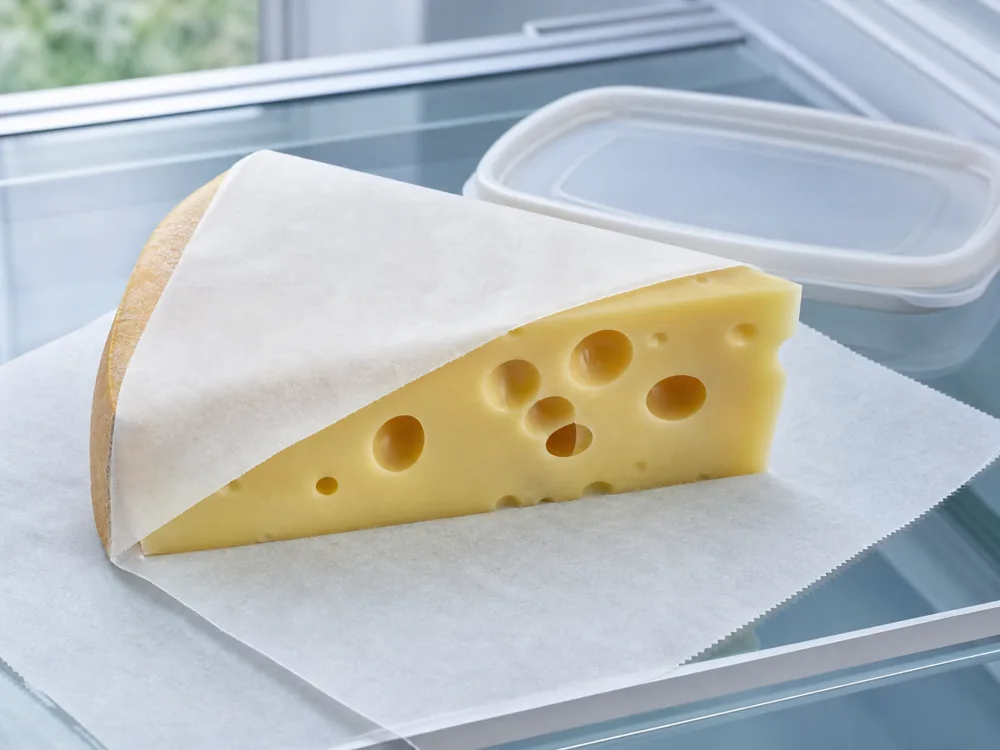
- Wax paper first — breathable protection against the cut face
- Plastic bag second — loose seal to retain moisture without trapping condensation
- Cheese drawer — stable temperature and humidity for consistent storage
- Portion before freezing — cut into cooking-sized pieces before freezing for easy thawing
The eyes in Emmental can trap condensation if the cheese is wrapped too tightly in non-breathable plastic. This moisture collects inside the holes and promotes mold growth in the eye cavities. Wax paper allows enough air exchange to prevent this while still protecting the cut surface from drying.
Surface mold on Emmental appears as white or blue spots, usually near the rind or around the eyes. American Swiss, a pasteurized factory cousin of Emmental, is far more forgiving in home storage because its closed rind slows moisture loss. On AOC wheels with a natural rind, trim 1 inch around the spot and use the rest. If mold appears deep inside an eye cavity, cut the section out entirely. Our cheese storage guide covers safe trimming practices for semi-hard cheeses.
Buying Emmental
The gap between AOP Emmental and generic "Swiss cheese" is one of the largest in the cheese world. Both have holes. The similarity ends there.
- AOP seal — confirms Swiss production from raw, silage-free milk
- Round eyes — cherry to walnut size, evenly distributed, not split or irregular
- Pale yellow paste — firm and elastic, not dry or crumbly
- Clean aroma — mildly nutty and sweet, not sour or ammoniated
French Emmental is the largest producer outside Switzerland. It uses pasteurized milk and ages for shorter periods, producing a milder cheese at a lower price. For cooking applications like fondue and gratins, French Emmental performs adequately. For eating on a board where flavor matters, Swiss AOP is worth the premium.
Avoid buying Emmental that has been pre-sliced and vacuum-packed for extended shelf life. The slicing exposes maximum surface area, and the vacuum packaging compresses the eyes, altering the texture. A fresh-cut wedge from a wheel delivers a noticeably better eating experience.
Emmental Substitutes
For fondue, nutty alpine cheese can replace Emmental's share of the blend if you increase the wine slightly to compensate for Gruyere's denser melt. The wine and cheese pairing guide explains how the acidity in dry white wine keeps a fondue smooth. The fondue will be richer and more savory but less sweet.
For sandwiches, young Gouda (3-4 months) matches Emmental's mild, sweet profile and melts smoothly. Jarlsberg, the Norwegian Emmental-style cheese, is widely available and tastes similar to generic Swiss cheese, though it lacks the complexity of AOP Emmental.
- Gruyere — for fondue and cooking; richer, saltier, no holes
- Jarlsberg — Norwegian Emmental-style; similar holes and mild flavor, widely available
- Young Gouda (3-4 months) — mild, sweet, smooth melt for sandwiches
- Comte (6-8 months) — French alpine cheese with similar nutty-sweet profile, denser paste
None of these substitutes replicate the specific sweet, nutty character created by Propionibacterium fermentation. The holes are cosmetic in terms of substitution, but the flavor chemistry behind them is unique to Emmental-style production.
Nutrition Per Ounce
Emmental is calorie-dense but carries strong protein and calcium numbers for a semi-hard cheese. The mild flavor means people often eat larger portions than they would of a sharp cheese, so watch serving sizes on a board.
- Good protein — 8g per ounce, among the higher levels for semi-hard cheeses
- Strong calcium — 224mg per ounce, 22% of daily value
- Moderate sodium — lower sodium than most hard cheeses, around 190mg per ounce
- Very low lactose — aging reduces lactose to negligible levels
Emmental's lower sodium compared with cheeses like sharp sheep's milk grater or aged Cheddar makes it a reasonable option for people watching salt intake. The pregnancy cheese safety guide also flags Emmental AOP as one to verify for pasteurization status before serving. The mild flavor and moderate salt mean it can be used in larger quantities in cooking without over-salting the dish.
The Propionibacterium fermentation that creates Emmental's holes also produces vitamin B12 as a byproduct. Emmental contains more B12 per ounce than most other cheeses, making it a useful source for vegetarians who include dairy in their diet.
Emmental FAQ
These five questions cover the topics we hear most from readers buying or cooking with Emmental.
The holes form when Propionibacterium freudenreichii bacteria consume lactic acid during a warm-room aging phase and release carbon dioxide gas. The gas cannot escape the dense, elastic paste, so it collects into round bubbles that grow over several weeks. The process also produces propionic acid, which gives Emmental its characteristic sweet, nutty flavor. Without this bacterial fermentation, there would be no holes and no signature taste.
Emmentaler AOP is a specific Swiss cheese made from raw cow's milk in designated Swiss regions, aged at least 4 months. "Swiss cheese" is a generic American term for any emmental-style cheese with holes, usually made from pasteurized milk with shorter aging. The flavor, texture, and hole quality of AOP Emmental are substantially superior to generic Swiss cheese.
Yes. Emmental is half of the classic Swiss fondue blend, paired equally with Gruyere. Emmental contributes smooth melt and a sweet, nutty flavor, while Gruyere adds depth and salt. Use wheels aged 6 to 8 months for the best melting consistency. Younger wheels melt too loosely, and older wheels produce a thicker fondue.
Emmental is one of the best melting cheeses available. Its combination of moderate moisture, high fat, and elastic protein structure produces a smooth, even melt without separation or greasiness. It performs well in fondue, sandwiches, gratins, and quiche. The melt quality decreases in wheels aged beyond 12 months as the paste dries.
A properly wrapped cut piece of Emmental lasts 3 to 4 weeks in the cheese drawer at 35-40 degrees F. Wrap in wax paper first, then loosely in a plastic bag. The eyes in the cheese can trap moisture and promote mold if wrapped too tightly. Emmental freezes well for up to 4 months when cut into portions and tightly wrapped.