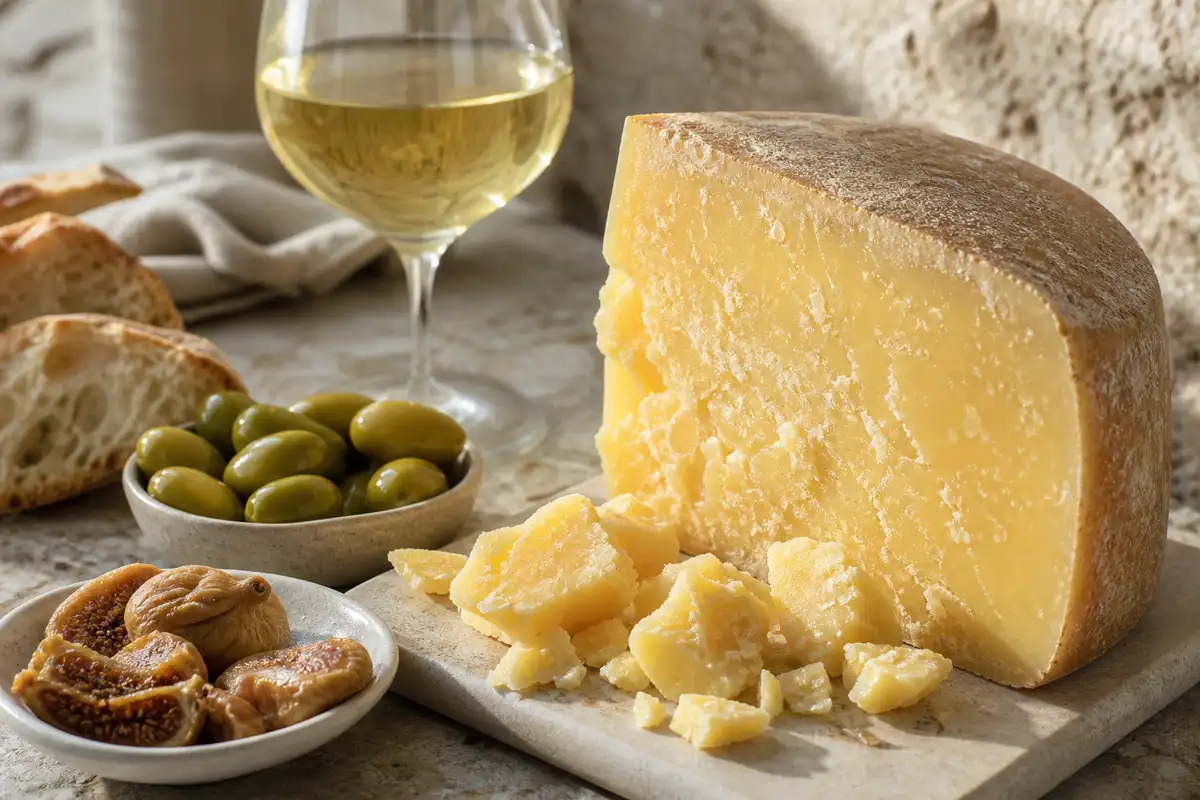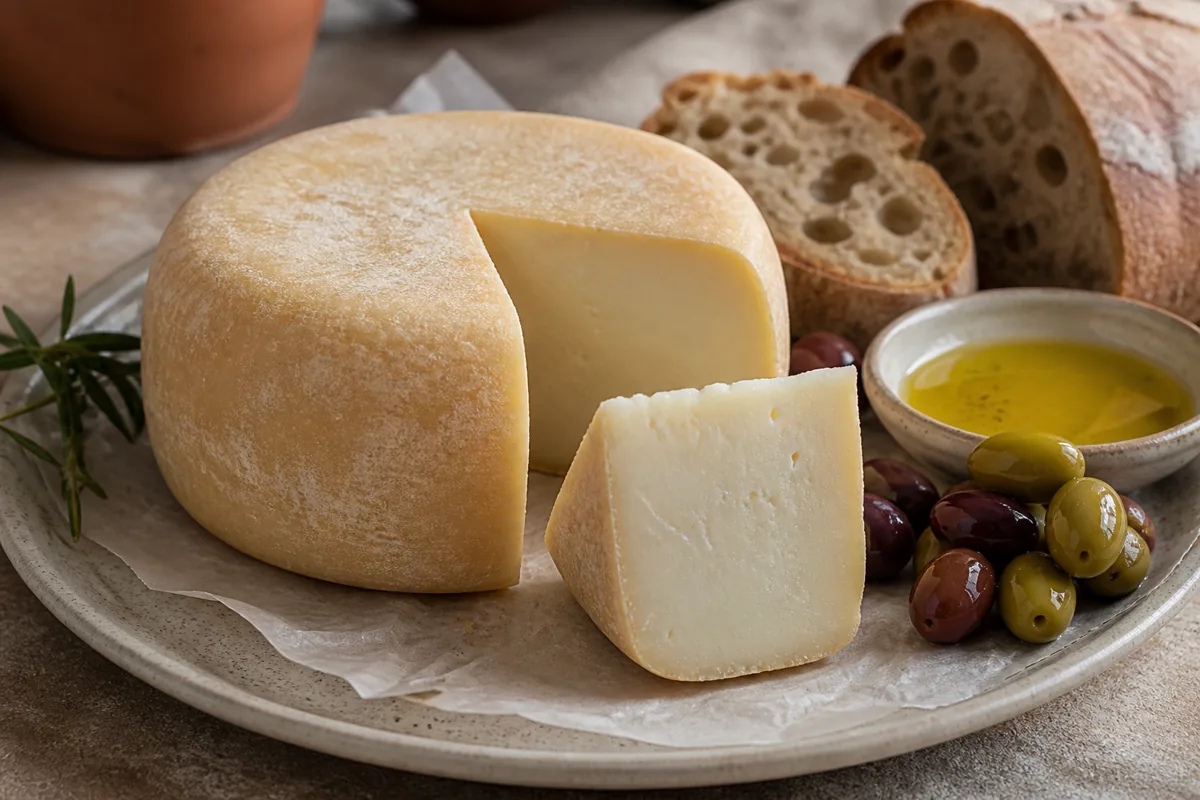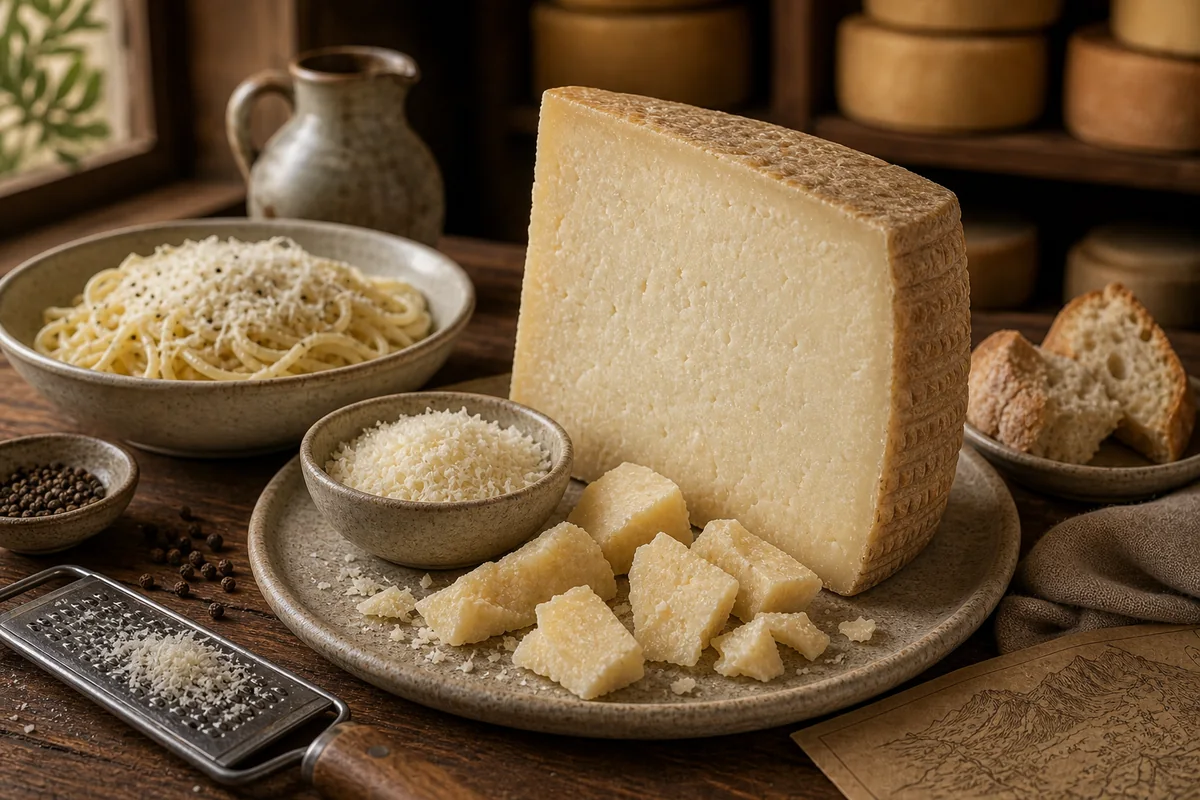
Pecorino Romano is the sharp, salty backbone of Roman and Southern Italian cooking. Cacio e pepe, amatriciana, and carbonara all depend on this cheese for the punch that Parmesan cannot deliver.
Unlike cow-milk hard Italian grating cheeses, Pecorino Romano uses sheep's milk, which changes how it tastes and performs in a recipe.
The cheese dates back over 2,000 years. Roman legions carried it as a ration because the hard, dry paste survived long marches without refrigeration.
The DOP designation protects production in Lazio, Sardinia, and the province of Grosseto in Tuscany. Today, over 90% of DOP Pecorino Romano is made in Sardinia, though the name references Rome and the cheese's cultural origin remains Lazio.
In This Article
What Is Pecorino Romano?
The name fixes milk, place and method. This is a hard sheep's milk cheese defined by three traits: sharp salt, tangy acidity, and a peppery bite that lingers after each piece.
The sheep's milk gives it a distinct gaminess absent from cow's milk cheeses.
That gaminess is polarizing. People who love it find Parmesan bland by comparison.
People who dislike it find Pecorino too aggressive for anything beyond small grated doses.
DOP rules require whole sheep's milk from flocks raised in the designated regions. The milk is thermized (heated to a lower temperature than full pasteurization) and set with lamb's rennet, which contributes to the sharp, peppery flavor profile.
This is not a detail you can replicate with vegetable or microbial rennet. Lamb's rennet contains lipase enzymes that break down sheep's milk fat into short-chain fatty acids responsible for the characteristic tang.
The minimum aging period is 5 months for grating grade and 8 months for table-eating grade. Most commercial Pecorino Romano sold for grating falls in the 8 to 12 month range.
Wheels aged beyond 12 months become extremely hard and intensely salty, suited only to fine grating over finished dishes.
- Origin - Lazio, Sardinia, and Grosseto province. Cultural roots in ancient Rome.
- Milk - whole sheep's milk, thermized, from designated regional flocks
- Rennet - lamb's rennet, which adds lipase-driven tang and peppery bite
- Aging - 5 months minimum for grating, 8+ months for table grade
- Key trait - saltier and sharper than Parmigiano-Reggiano, with a sheep's milk gaminess
The Consorzio per la Tutela del Formaggio Pecorino Romano stamps each wheel with a dotted diamond pattern across the rind. This stamp is the easiest way to verify DOP authenticity.
Domestic American "pecorino" or "romano" without the DOP stamp is a different cheese made from cow's milk with none of the sheep's milk character.
How Salty Is Pecorino Romano?
The flavor is sharp, salty, and tangy with a distinct peppery finish that separates it from every cow's milk grating cheese. The sheep's milk contributes a slightly gamey, lanolin-tinged note that sits beneath the salt.
This note is subtle in younger wheels and more pronounced as the cheese ages past 12 months.
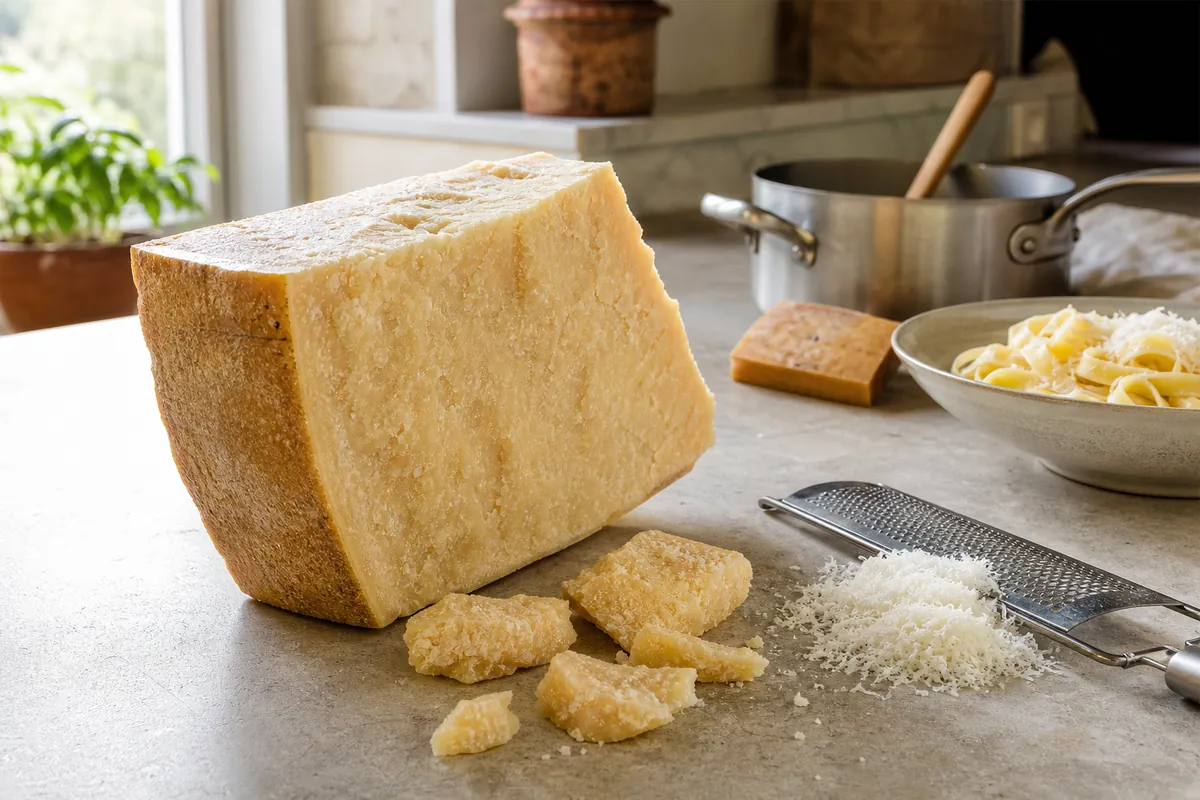
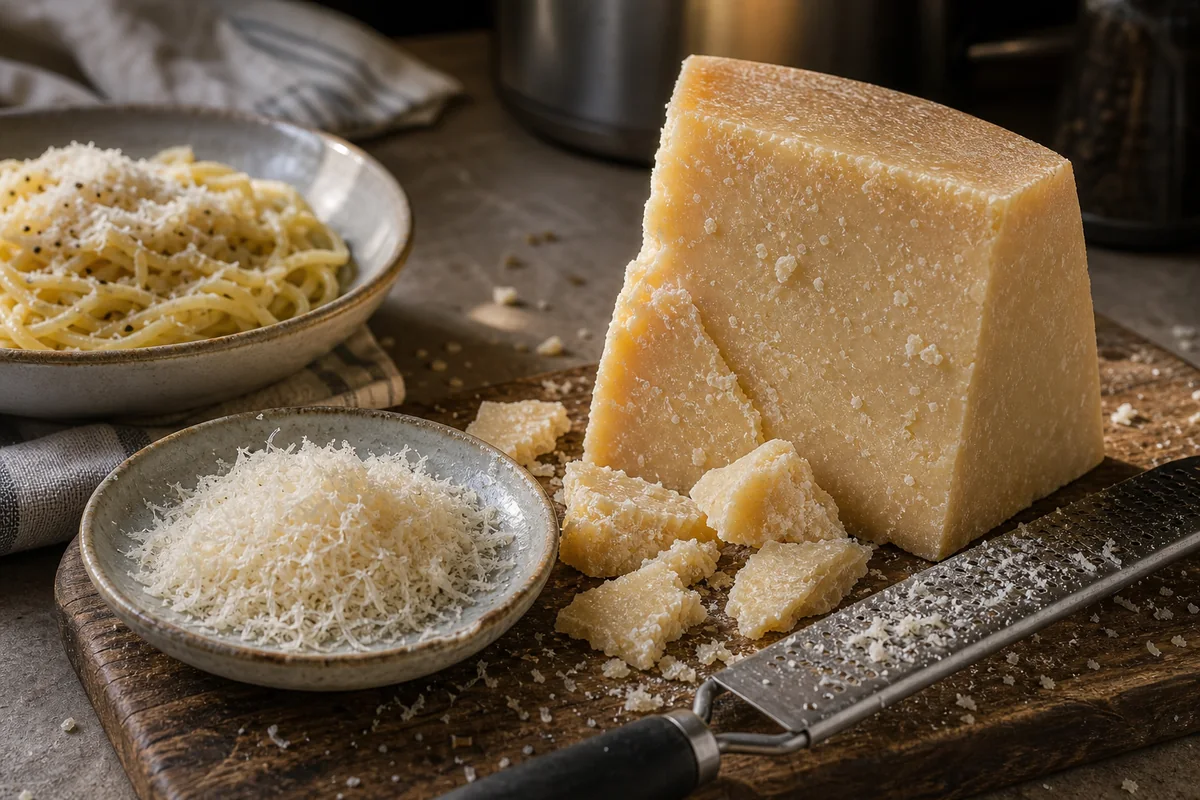
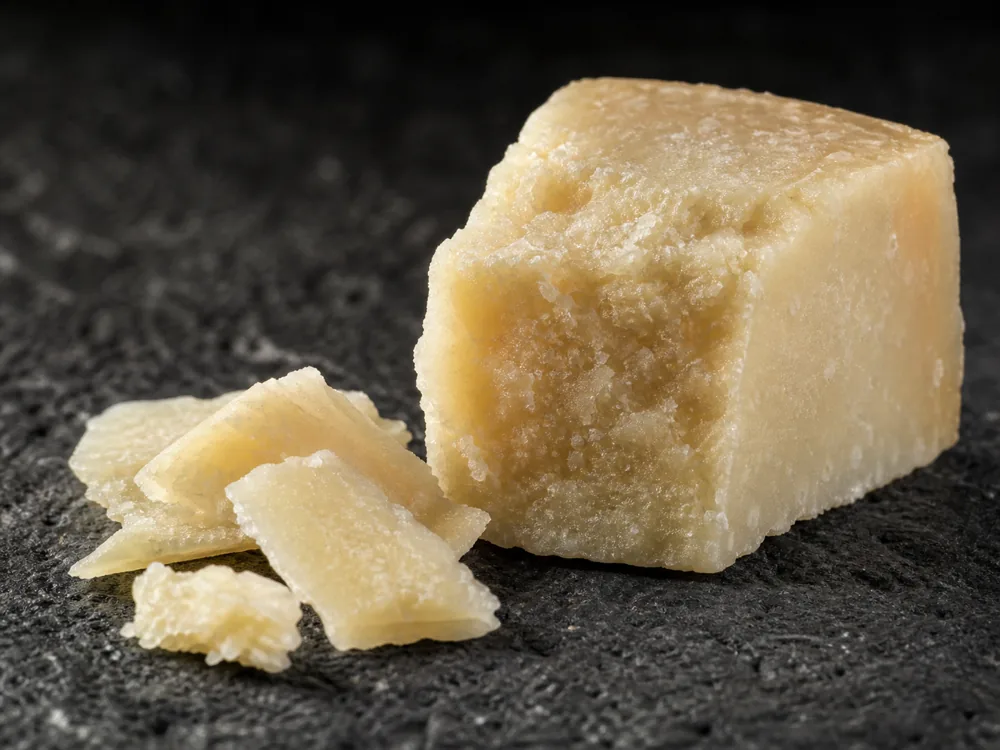
The texture is hard, dense, and granular. It breaks along crystalline lines when cut and crumbles into irregular shards rather than clean slices.
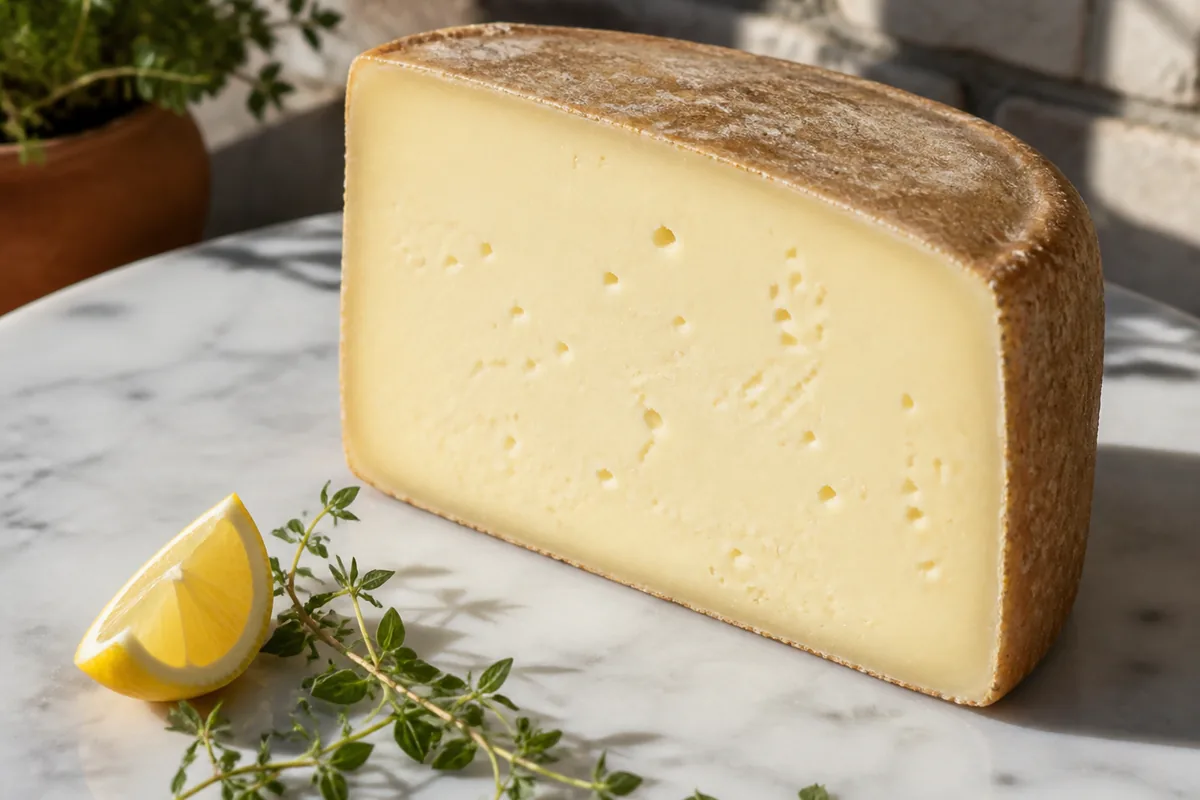
Younger wheels at 5 to 8 months have a slightly more elastic paste that can be sliced thinly for table eating. Beyond 8 months, the cheese becomes a grating-only product for most people.
Salt is the dominant note, and that is measurable. Pecorino Romano contains roughly 30% more sodium per ounce than Parmigiano-Reggiano.
This high salt level is intentional: it was originally a preservation method for military rations and long sea voyages, and it became the defining flavor characteristic that Roman pasta dishes depend on.
- 5-8 months: Sharp and salty but still sliceable. Moderate gaminess. Works on a cheese board.
- 8-12 months: Hard and crumbly. Full peppery bite. The standard grating grade for pasta.
- 12+ months: Very hard and intensely salty. Fine-grate only. Small amounts season entire dishes.
The crystalline texture in aged Pecorino Romano comes from tyrosine deposits, the same amino acid crystals found in aged aged Cheddar crystals and Parmesan. These crunchy white flecks signal proper aging and protein breakdown.
They are safe to eat and add a pleasant mineral crunch.
Pecorino Romano and Parmigiano-Reggiano are not interchangeable in pasta recipes. Pecorino is saltier, sharper, and tangier. Substituting Parmesan in cacio e pepe produces a completely different dish: milder, sweeter, and missing the peppery punch that defines the recipe. Use each where it belongs.
Where Does Pecorino Romano Come From?
The written record stretches back to at least 100 BC. The Roman author Columella described the production method in his agricultural treatise De Re Rustica, and the cheese was a standard ration for Roman legions because its hard, dry paste and high salt content preserved it for months without refrigeration.
Each soldier received a daily allocation of about 27 grams alongside bread and grain.
Production moved largely to Sardinia in the late 19th century when Roman authorities enacted sanitation laws that restricted urban cheesemaking. Sardinian shepherds had the flocks, the pasture, and the tradition of sheep's milk cheesemaking.
Today, over 90% of DOP Pecorino Romano comes from Sardinian dairies, though the Consorzio maintains the DOP designation for Lazio and Grosseto as well.
Sardinia has more sheep per capita than any other region in Europe. The island's dry climate and Mediterranean shrubland produce aromatic milk that gives Pecorino Romano its distinctive flavor. When Roman dairies scaled back in the 1880s, Sardinian producers absorbed the volume and have held it since. The cheese is culturally Roman but practically Sardinian.
The lamb's rennet used in production is another ancient element. Modern cheesemaking often uses microbial or vegetable rennet, but the DOP specification requires lamb's rennet because its lipase enzymes produce the specific sharp, peppery flavor profile.
Changing the rennet changes the cheese fundamentally.
For pasta, Pecorino Romano behaves like seasoning as much as cheese. It belongs with pasta finishing cheeses that dissolve into hot starch instead of forming a melted layer.
What Do You Grate It Over?
Treat it as a finishing cheese in most applications. You grate it over a completed dish rather than melt it into the cooking process.
The high salt and low moisture mean it does not melt into a smooth sauce the way Fontina melts or Gruyere does. Instead, it dissolves into the starchy pasta water and fat emulsion that classic Roman pasta sauces rely on.
| Use | How It Works |
|---|---|
| Pasta | The essential cheese for cacio e pepe, carbonara, amatriciana, and gricia. Finely grated into the pasta water and fat emulsion. |
| Salad | Shaved over arugula, pear, and walnut salads. The sharp salt and tang replace the need for dressing. |
| Soup | Grated over minestrone, ribollita, and bean soups as a finishing salt with umami depth. |
| Bread | Grated into focaccia dough or sprinkled on top before baking for a sharp, salty crust. |
| Vegetable | Finely grated over roasted broccoli, zucchini, or asparagus in place of Parmesan. |
| Cheese Board | Young wheels (5-8 months) sliced thin with honey and fresh figs for a Sardinian-style board. |
- Cacio e pepe - finely grated Pecorino emulsified with pasta water and black pepper
- Carbonara - blended with egg yolks and guanciale fat for the sauce
- Salad finishing - shaved over bitter greens with pear and walnut
- Soup garnish - grated over bean soups and minestrone as a salty, umami finisher
The most common mistake with Pecorino Romano in cooking is adding too much. The salt level is roughly 30% higher than Parmesan by weight.
Start with half the amount you would use for Parmesan and adjust upward. You can always add more, but you cannot remove salt from a finished dish.
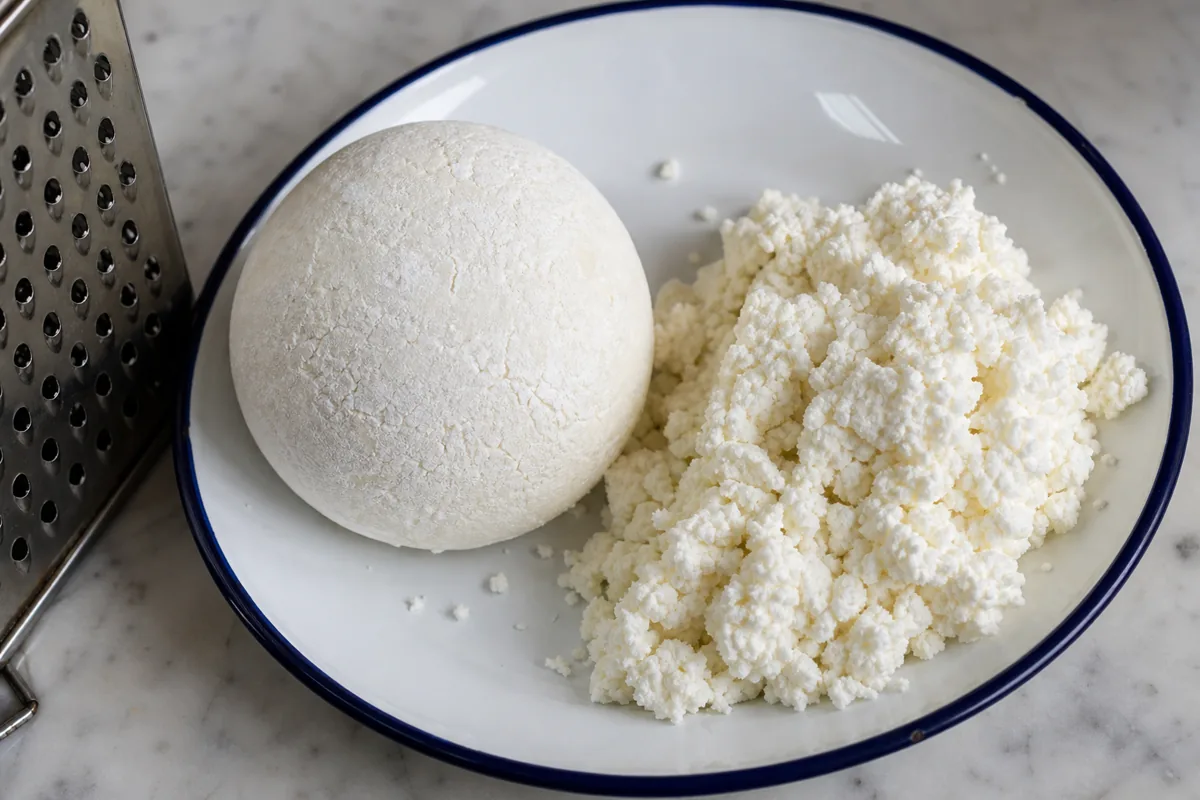
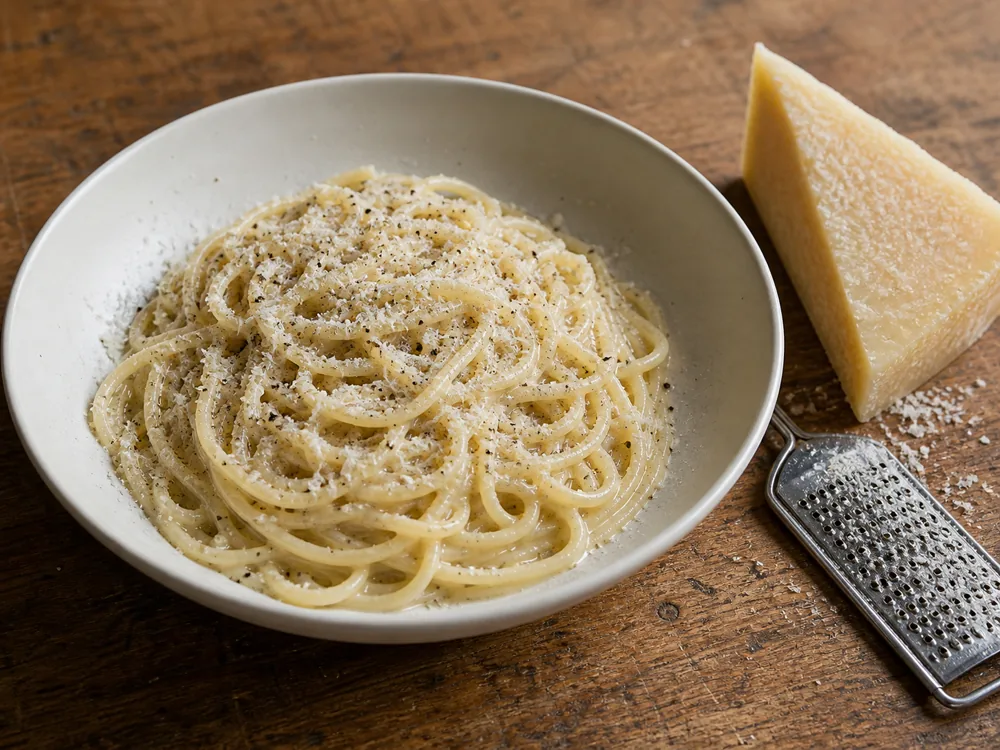
For cacio e pepe specifically, grate the cheese as finely as possible using a Microplane. Coarse gratings clump in the starchy water instead of dissolving into a smooth emulsion.
The best melting cheeses work differently from grating cheeses, and Pecorino Romano belongs firmly in the grating category.
Parmesan and Pecorino tradeoffs come down to milk, salt, and age. Cow's milk brings sweetness, while sheep's milk brings tang and pepper.
What Stands Up to Pecorino Romano?
The intensity of Pecorino Romano limits its pairing range compared with milder cheeses. It needs partners that can stand up to the salt and tang without being overpowered.
| Pairing | Why It Works |
|---|---|
| Cannonau di Sardegna (Red Wine) | The regional Sardinian red. Cannonau's ripe fruit and moderate tannins balance the cheese's salt and sharpen its umami. |
| Fresh Figs or Pears | The natural sweetness of ripe figs or pears cuts through the salt and softens the peppery finish. Classic Sardinian combination. |
| Raw Fava Beans | A traditional Roman spring pairing. Fresh, grassy favas eaten raw with shaved Pecorino and olive oil. |
| Honey (Wildflower or Corbezzolo) | Sardinian corbezzolo (strawberry tree) honey is the traditional match. Any bitter-edged wildflower honey works. |
| Dry Vermentino (White Wine) | Sardinian Vermentino's saline minerality echoes the cheese's salt while the acidity refreshes the palate. |
- Sardinian reds - Cannonau's fruit balances the salt and sharpens the umami
- Fresh fruit - figs and pears cut through the intensity with natural sweetness
- Raw fava beans - the classic Roman spring combination with olive oil
- Bitter honey - corbezzolo or wildflower honey against the sharp, salty paste
Avoid pairing Pecorino Romano with other salty foods. Cured meats high in sodium (like most salami) create an unpleasant salt overload.
Choose lean, mildly cured options like bresaola or prosciutto if you want meat on the same board.
How Do You Keep It From Drying Out?
Low moisture and high salt make it one of the most shelf-stable cheeses you can buy. A properly stored wedge lasts months in the refrigerator.
The main risk is surface drying, which creates a hardened exterior that wastes cheese and makes grating more difficult.
- Wax paper first - prevents moisture loss while allowing slight air exchange
- Zip-lock or plastic second - seals in moisture and prevents odor absorption
- Pre-grate before freezing - frozen gratings thaw instantly for pasta use
- Trim dried edges - hardened surfaces are safe but unpleasant to eat; trim and use the interior
Unlike soft cheeses, Pecorino Romano handles temperature fluctuations well. Taking it in and out of the refrigerator for board service does not degrade the paste.
The low moisture acts as a natural preservative that slows bacterial growth even at room temperature.
Pre-grated Pecorino Romano in a sealed bag is one of the best freezer staples for quick pasta dinners, especially when pasta finishing cheese needs instant dissolve. It thaws in seconds and dissolves into hot pasta water immediately.
Airtight hard-cheese storage keeps grated Pecorino dry, odor-free, and ready for quick pasta.
If you need a milder finish, Parmesan-style substitutes usually bring less salt and less sheep-milk bite. That makes them easier in large quantities.
What Does the PDO Name Guarantee?
The DOP stamp is your guarantee of sheep's milk, lamb's rennet, and proper aging. American "romano" cheese is almost always made from cow's milk and tastes nothing like the original.
The price difference is modest, and the flavor difference is enormous.
Pre-grated DOP Pecorino Romano in shelf-stable tubs has been available for years. The quality is acceptable for cooking but noticeably inferior to freshly grated from a wedge.
The pre-grated product dries out in the container and loses aromatic intensity. For cacio e pepe and carbonara, always grate fresh.
Locatelli is the most widely available DOP brand in the United States. It is a reliable, consistent product.
For a step up, ask your cheese counter for Pecorino Romano from smaller Sardinian producers like Ferruccio Podda or Brunelli, which tend to have a more complex, less one-note salt profile.
For salads, shave Pecorino Romano thinly instead of crumbling it. Brined feta texture gives more moisture and acidity, which changes the dish.
How Much Salt Is in an Ounce?
Sheep's milk changes the numbers, so it runs lower in fat and calories than most hard cow's milk cheeses because sheep's milk protein concentrates more efficiently during aging. The trade-off is sodium: Pecorino Romano is one of the saltiest common cheeses, at roughly 406mg of sodium per ounce.
- High protein - 9g per ounce, among the highest of any common cheese
- Excellent calcium - 298mg per ounce, close to Parmesan levels
- High sodium - 406mg per ounce, adjust recipes to account for the cheese's salt
- Near-zero lactose - extended aging breaks down virtually all milk sugar
The high sodium is the main nutritional consideration. When using Pecorino Romano in cooking, reduce or eliminate added salt from the recipe.
The cheese provides more than enough salt on its own, especially in pasta dishes where the grated cheese is the primary seasoning.
Sheep's milk delivers more protein and calcium per volume than cow's milk, and those concentrations carry through into the finished cheese. Pecorino Romano's 9g of protein per ounce beats most cow's milk hard cheeses, making it a useful protein source in vegetarian diets that include dairy.
SOURCES & REFERENCES
What Else Do People Ask About Pecorino Romano?
Salt runs through nearly every Pecorino Romano question, whether it arrives as seasoning, storage, or substitution.
You can, but the dish will taste different. Parmesan is milder, sweeter, and less salty than Pecorino Romano.
In classic Roman pasta dishes like cacio e pepe and carbonara, Parmesan produces a gentler, less peppery result. For the authentic flavor, use Pecorino Romano.
For a middle ground, try a 50/50 blend.
The high salt content is a preservation method dating back to ancient Rome. Roman legions carried Pecorino Romano as a ration because the salt and low moisture kept it edible for months without refrigeration.
The salt level is now a defining flavor characteristic. Reduce or eliminate added salt in recipes that use Pecorino Romano as a finishing cheese.
Sharp, salty, and tangy with a peppery finish and a slight gamey note from the sheep's milk. The flavor is more aggressive than Parmesan and less sweet.
Younger wheels (5-8 months) are milder and can be sliced for eating. Older wheels (8-12+ months) are intensely salty and best used for grating over pasta and salads.
No. DOP Pecorino Romano requires lamb's rennet, which is an animal product. The lamb's rennet contributes lipase enzymes essential to the cheese's sharp, peppery flavor profile.
Vegetarian "pecorino-style" cheeses exist from non-DOP producers using microbial rennet, but they lack the characteristic tang.
An unopened vacuum-sealed wedge lasts up to 12 months in the refrigerator. Once cut, wrap in wax paper and seal in a zip-lock bag for 4 to 8 weeks of storage.
Pre-grated Pecorino Romano can be frozen for up to 6 months and thaws instantly for pasta use. The low moisture and high salt make it one of the longest-lasting cheeses available.