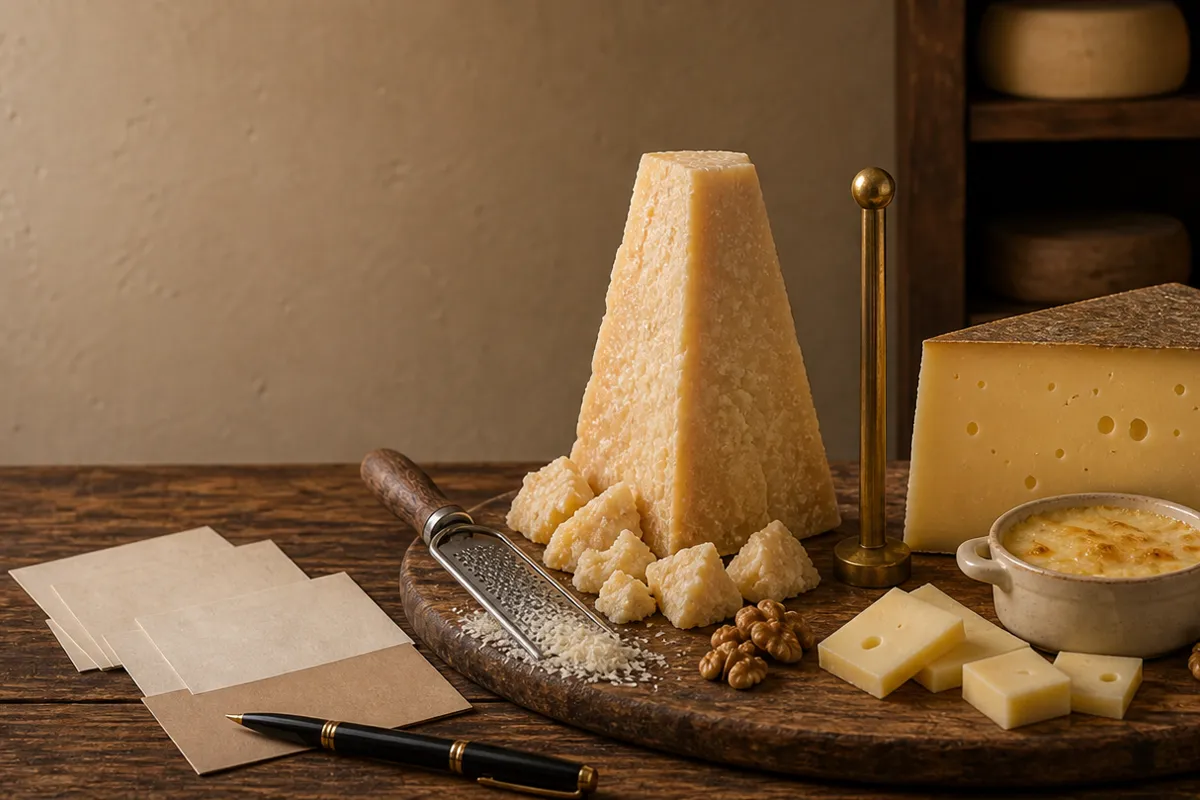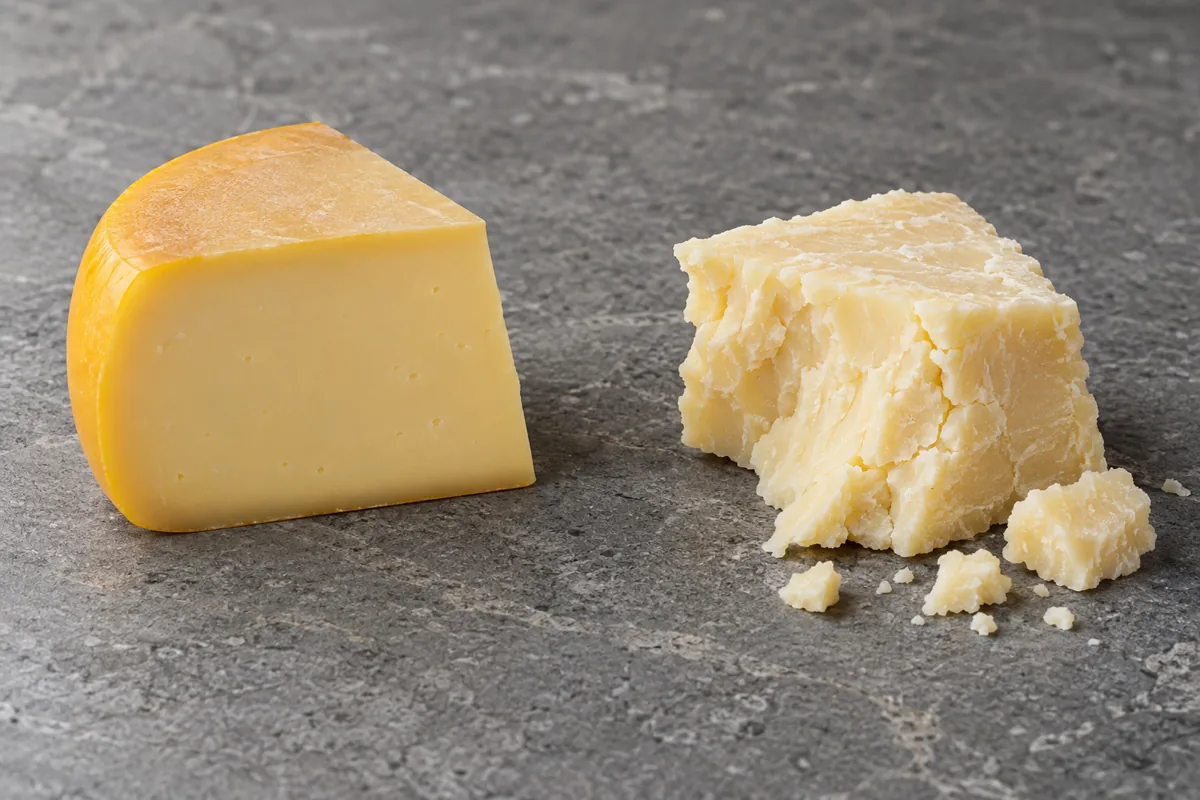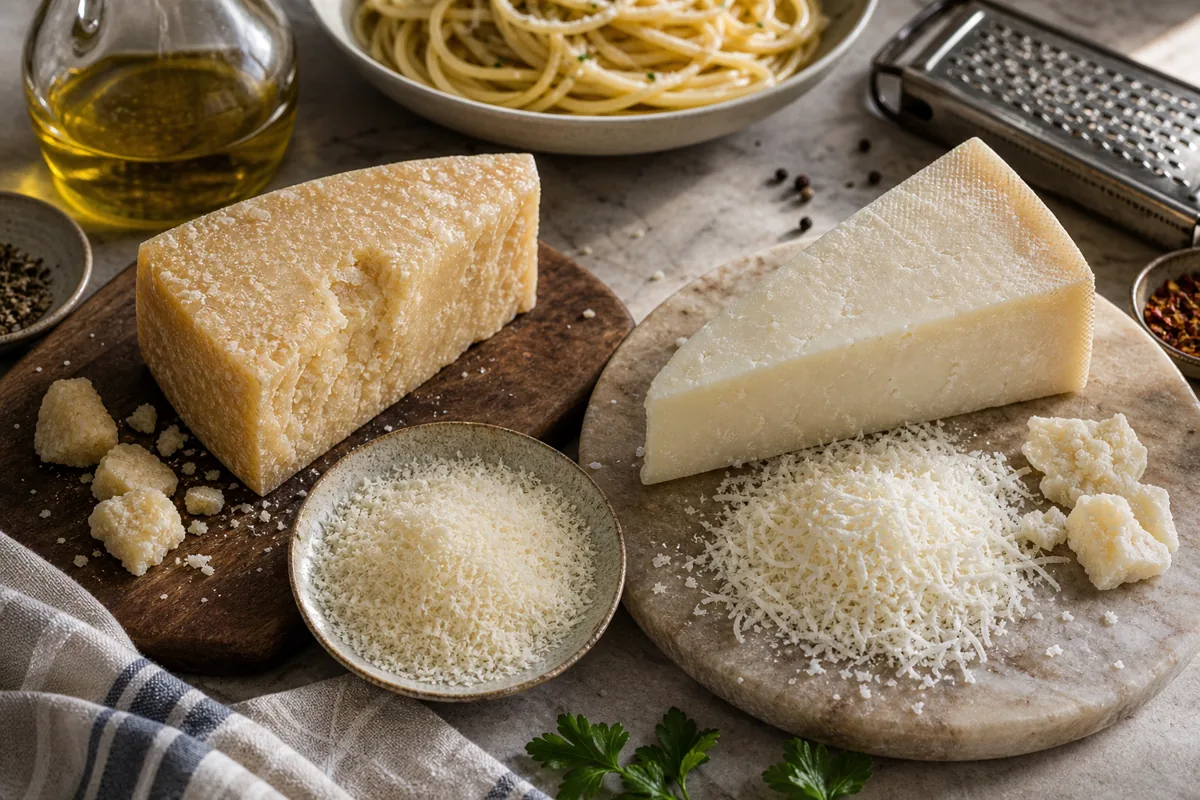
America's Test Kitchen calls both cheeses aged, hard and high in glutamates, then separates them by milk. Parmesan, made from cow's milk, has the more neutral flavour, while Pecorino Romano, made from sheep's milk, is more pungent and assertive.
That gap in strength comes with a large gap in salt, and together they decide which cheese belongs in which dish.
In This Article
What Is the Difference Between Parmesan and Pecorino?
In most recipes, "Pecorino" means Pecorino Romano, the hard sheep-milk grating cheese made under PDO rules in Sardinia, Lazio and the province of Grosseto.
Recipes from Italy notes that both cheeses carry DOP certification, the Italian form of PDO, so each name in the table below is tied to a defined area and method.
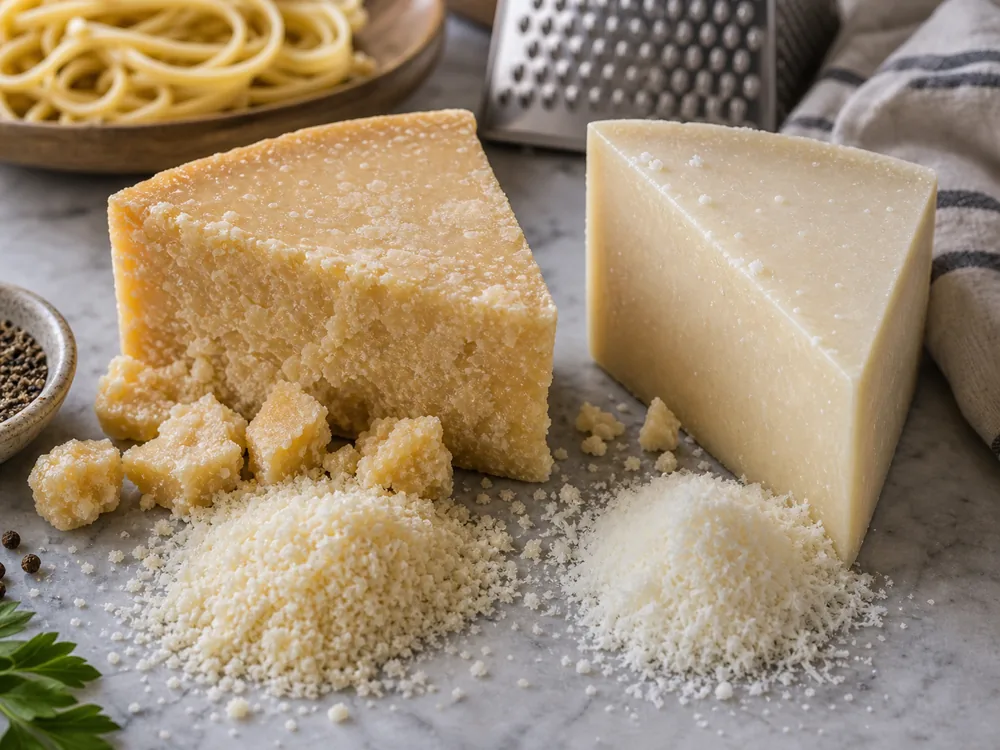
The table below sets the PDO versions side by side, using the two consortia and Wikipedia.
| Attribute | Parmigiano Reggiano | Pecorino Romano |
|---|---|---|
| Milk and rennet | Raw, part-skimmed cow's milk with a natural whey starter, calf rennet and salt (Wikipedia) | Fresh whole sheep's milk from farms in the area, set with lamb's rennet paste |
| Where it is made | Parma, Reggio Emilia, Modena, Bologna west of the Reno, Mantua south of the Po | Sardinia, Lazio and the province of Grosseto |
| Texture | Grainy and crumbly, more so with age | Dense, or with a limited number of holes |
| Flavour | Sweet, salty and faintly bitter, with spice that builds with age | Aromatic, lightly spicy and tangy as table cheese, intensely spicy as grating cheese |
| Wheel | About 38 kg, 40 to 45 cm across (Wikipedia) | 20 to 35 kg, 25 to 35 cm across |
How Is Each Cheese Made?
Parmigiano Reggiano starts with a milk blend. Wikipedia describes the whole milk of the morning milking mixed with the naturally skimmed milk of the previous evening, which gives a part-skim mixture that goes into copper-lined vats holding 1,100 litres, enough for two wheels.
Only a natural whey culture is allowed as the starter, and at 33 to 35°C the milk takes that starter and calf rennet, after which the curd is cut to rice-grain size and heated to 55°C.
Pecorino Romano uses whole sheep's milk only, from flocks that its consortium says are reared in the wild and fed on natural pastures. The cheesemaker adds a starter called scotta innesto, prepared fresh each day from indigenous thermophilic lactic bacteria, and the consortium counts it among the cheese's defining features.
Coagulation runs warmer than for Parmigiano Reggiano, at 38 to 40°C with lamb's rennet in paste form, and the curd is broken to the size of a grain of wheat.
Both cheeses are set with animal rennet, calf rennet for Parmigiano Reggiano and lamb's rennet paste for Pecorino Romano, so neither is a rennet-free choice for a vegetarian.
How Long Is Each Cheese Aged?
Parmigiano Reggiano must mature for at least 12 months, and its consortium says the cheese begins to most fully express its typical character at about 24 months.
The consortium calls that 12-month minimum the longest of any PDO cheese, and Wikipedia puts the average wheel at about two years, so the cheese on a shelf is usually older than the floor.
Wheels also sort into named bands. Wikipedia lists vecchio at 18 to 24 months and stravecchio at 24 to 36 months, while the consortium speaks of "young", "matured" and "extra old" cheese at about 12, 24 and 36 months.
The consortium's sensory guide tracks how the flavour moves with age. Younger wheels taste of milk and fresh fruit, and the oldest turn aromatic and spicy.
Among the basic tastes, the consortium says sweet is usually most pronounced in less-aged wheels, while bitter stays a weak, often herbaceous note. Spiciness is expected to grow with age but should never be excessive.
The driver is protein breakdown. The consortium explains that lactic bacteria release enzymes that split the proteins of raw milk into peptides and amino acids, and that this proteolysis sets both the texture and the flavour of the cheese.
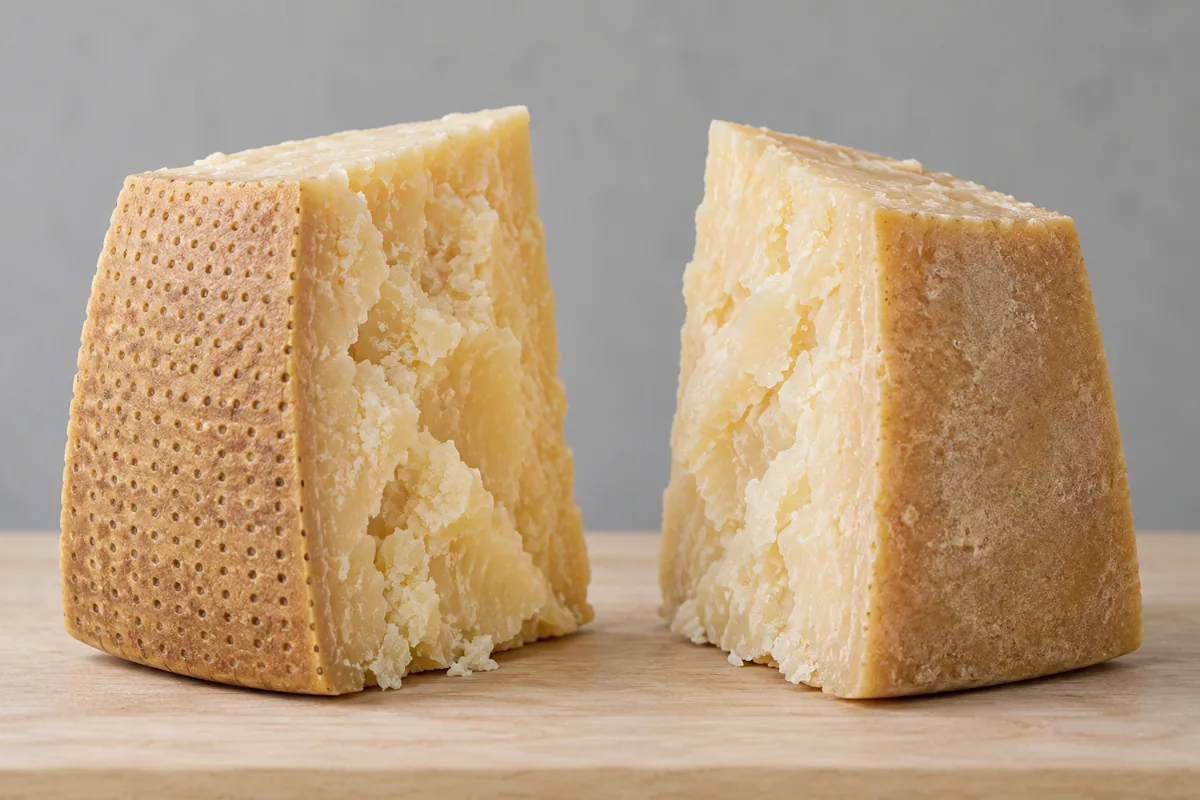
The cut face shows the same progress. Colour deepens from light creamy yellow to intense straw yellow, and the small white dots of tyrosine crystals mark the stage of maturation, while the paste turns more granular, crumbly and soluble the longer it ages.
The consortium also allows small eyes in the paste only when the holes are few and under 2 mm across, so larger or more numerous holes fall outside what it describes.
| Age | Consortium tasting note |
|---|---|
| 12 to 18 months | Balanced and delicate, with hints of milk, yogurt and fresh fruit |
| 22 to 24 months | A balance of mild and strong, with fresh fruit, nuts and meat stock |
| 30 to 36 months | Bold and pronounced, with spices, nuts and meat stock |
| 40 months and older | Aromatic and spicy |
The floor is not shared by its look-alikes. Wikipedia gives Grana Padano a minimum of nine months and says its cows may eat silage as well as grass and its milk may come from several different days.
Pecorino Romano has two floors: its consortium allows sale after 5 months as table cheese and after 8 months as grating cheese.
Past those floors, Recipes from Italy gives a range of 5 to 12 months, so ask the seller how long a wedge has aged when its strength matters.
Which Age of Parmigiano Suits Which Dish?
The consortium ties each age band to dishes and drinks, with lighter partners for the younger wheels and richer ones for the older.
| Pairing | Type | Why It Works |
|---|---|---|
| 12 to 18 months | Wine | Sparkling white wines, or salads and cold dishes, per the consortium. |
| 22 to 24 months | Wine | Medium-bodied wines, and all traditional Italian dishes, according to the consortium. |
| 30 to 36 months | Food | Filled and baked pasta dishes, or an after-dinner tasting with fruit and honey, per the consortium. |
| 40 months and older | Wine | Full-bodied or fortified wines, per the consortium, for these long-aged wheels. |
The consortium does not slice Parmigiano Reggiano but breaks it into chunks with an almond-shaped knife, pressed into the paste and used as a lever, and it notes that a sliver of very long aged cheese often breaks into very small pieces on its own.
It puts the ideal tasting temperature at 60 to 62°F, which means taking a refrigerated piece out at least an hour ahead and opening the vacuum pack at least 30 minutes before tasting.
The rind has a second use. Wikipedia says slivers and chunks of the hardest rind are sometimes simmered in soups, broths and sauces for flavour, and that a piece without wax can be broiled as a snack or infused in olive oil.
Why Does Pecorino Taste Saltier?
The salt goes in by different routes. A Parmigiano Reggiano wheel goes into saturated brine, about 36% salt at 14°C in a 2021 study in Foods by Loffi and colleagues, and Wikipedia gives 20 to 25 days for the bath.
Each dairy sets its own brining time. Loffi and colleagues report that dairies with a floating system average 21 days and those with a fully submerged system average 18.
The choice shows in the cheese. In the study's dairy, wheels brined for 12 days instead of 18 held about 12% less salt, 1.37% against 1.55% at 15 months, and their sensory profiles stayed similar.
Salt also paces ripening. The low-salt wheels showed a slightly faster rise in free amino acids and peptides, which the authors read as a slightly accelerated breakdown of protein.
Age raises the figure too. The conventionally brined wheels lost water as they ripened, from 31.0% moisture at 15 months to 28.3% at 30 months, and their salt rose from 1.55% to 1.67%, in line with the consortium's note that saltiness grows with maturation.
Pecorino Romano has a salter as well as a cheesemaker: its consortium says the basic steps are still entrusted to the expert hands of both. Recipes from Italy lists dry salting among its traditional methods.
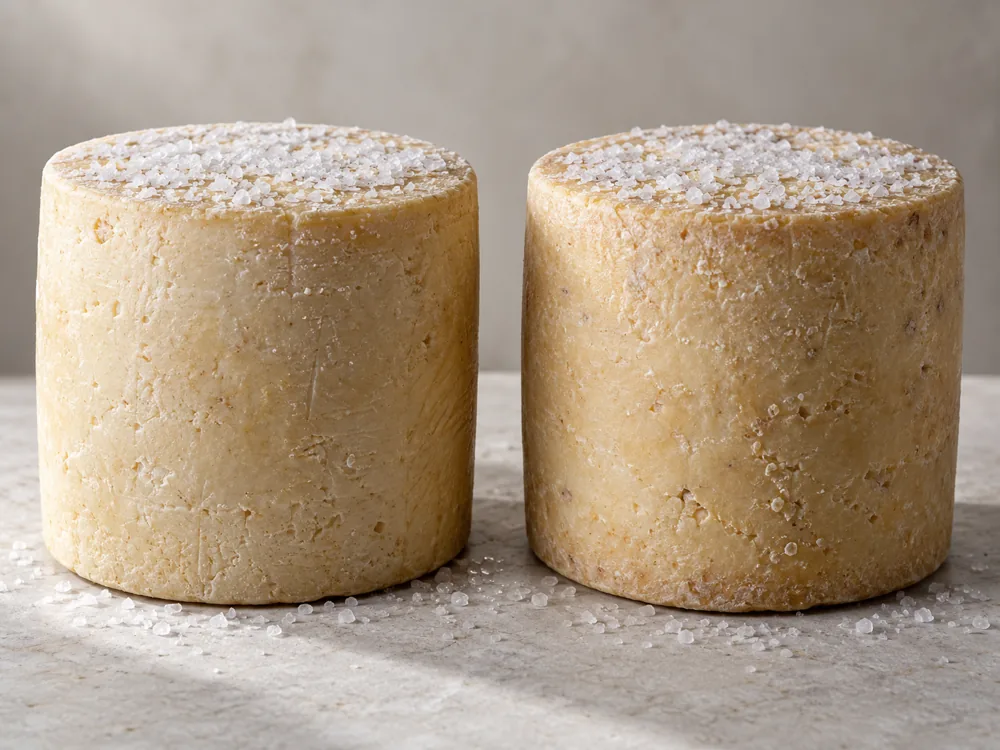
The finished cheeses show the difference in their salt figures.
| Cheese | Source | Salt per 100 g |
|---|---|---|
| Parmigiano Reggiano, 15 months, 12-day brine | Loffi and colleagues, Foods (2021) | 1.37 g |
| Parmigiano Reggiano, 15 months, 18-day brine | Loffi and colleagues, Foods (2021) | 1.55 g |
| Parmigiano Reggiano, 30 months, 18-day brine | Loffi and colleagues, Foods (2021) | 1.67 g |
| Pecorino Romano del Lazio DOP (Fulvi) | Open Food Facts label record | 3 g |
A Fulvi Pecorino Romano label lists 3 g, about 1.8 to 1.9 times the 1.55 g to 1.67 g that Loffi and colleagues measured in conventionally brined Parmigiano Reggiano.
Recipes from Italy points the same way, saying Pecorino Romano usually contains more salt and slightly more fat.
That multiple compares one brand's wedge with wheels from a single dairy, so the salt line on the label of the wedge you buy is the figure to go by.
Which One Should You Use for Pasta?
In Roman pasta the cheese does the seasoning, and Recipes from Italy gives that job to Pecorino Romano, saying the dishes rely on its strong, salty flavour.
| Use | How It Works |
|---|---|
| Cacio e pepe, carbonara, gricia and amatriciana | Pecorino Romano, named by Recipes from Italy as the cheese these dishes rely on. |
| Risotto and soups | Parmesan, listed by Wikipedia and Recipes from Italy. |
| Salads and vegetables | Parmesan, listed by Wikipedia and Recipes from Italy. |
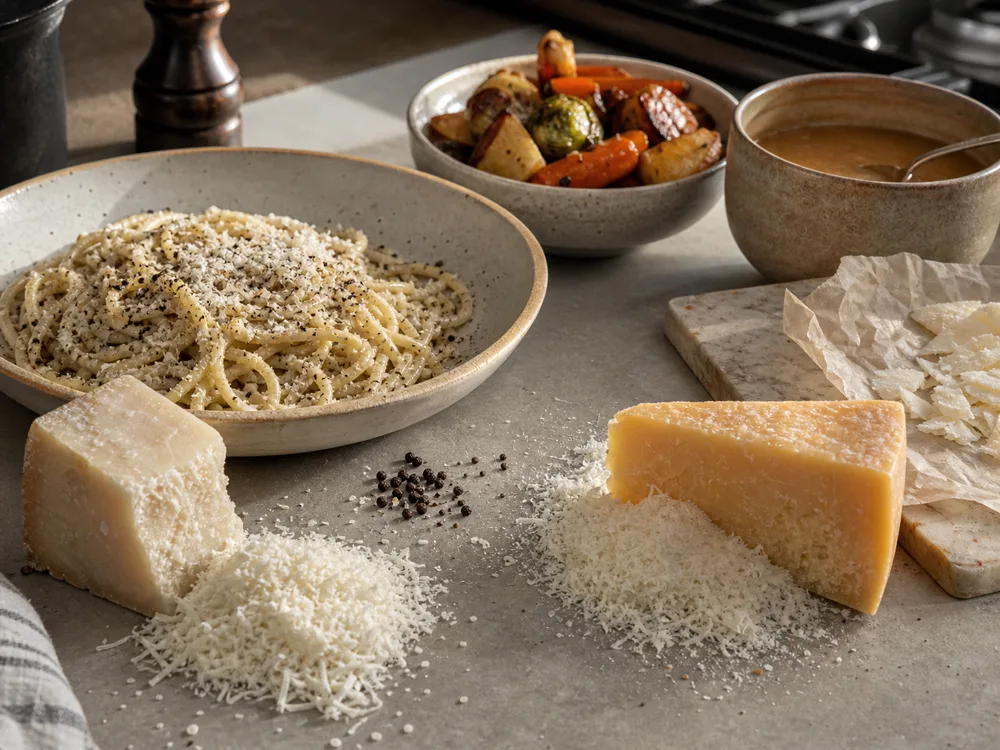
Glutamate gives Parmigiano Reggiano its savory depth. Wikipedia says it can hold as much as 1.2 g of glutamate per 100 g, which explains its strong umami taste.
Barbara Felicità Lucchini of Recipes from Italy calls Parmigiano Reggiano the more versatile of the two, which makes it the easier default for everyday pasta outside the Roman classics.
Can You Substitute One for the Other?
Pecorino Romano works as a Parmesan substitute if you cut it by one-third. America's Test Kitchen settled on 2 ounces of Pecorino Romano for every 3 ounces of Parmesan.
The test used two dishes. In polenta, a straight swap came out too salty, and cutting the Pecorino by a third made the salt acceptable, though the cheese flavour was less distinctive.
In turkey meatballs, where the Parmesan works as a background savory booster, the full swap did not taste too salty, but the Pecorino flavour was more noticeable, and one-third less cheese was again a good workaround.
The other directions come from Lucchini's comparison at Recipes from Italy.
| Swap | What changes |
|---|---|
| Parmigiano Reggiano in place of Pecorino Romano | The dish tastes less intense and slightly sweeter; this works quite well in simple dishes |
| Any swap in Roman pasta | Pecorino Romano plays a key role in the traditional Roman recipes, so the dish changes |
| A blend of both cheeses | A more balanced flavour that keeps some of Pecorino's intensity |
What to Look For When Buying
Ask for the full Italian name. Outside the EU, Wikipedia notes, the name Parmesan is legally used for imitations, and only Parmigiano Reggiano points without doubt to the PDO cheese.
The United States has its own standard of identity. Wikipedia says cheese sold there as Parmesan must be cow's milk cured for 10 months or more, with no more than 32% water and at least 32% milkfat in its solids, and that some pre-grated American Parmesan has aged under 12 months.
Inside the EU the word is protected: Wikipedia says a 2008 court ruling confines Parmesan there to Parmigiano Reggiano, so the same word on a label means different things in Parma and in a US supermarket.
The only additive Parmigiano Reggiano is allowed is salt, according to Wikipedia, whereas US rules for grated cheese allow up to 4% cellulose as an anticaking agent.
The rind carries the proof. Wikipedia describes the words Parmigiano Reggiano written around the side of the wheel, with the dairy's identification number, the production month and year, and a code for the individual wheel.
Pecorino Romano wheels are stamped after cooling with the PDO designation, the consortium's stylised sheep's head logo, the producer's initials and the production date. The logo is a diamond with rounded corners holding the sheep's head, repeated around the side of the wheel with the words Pecorino Romano.
The thin rind is ivory or straw coloured and sometimes sits under a neutral or black protective covering, so rind colour alone does not identify the cheese.
Parmigiano Reggiano also carries grade marks after the consortium inspects each wheel at 12 months. A master grader taps every wheel with a small hammer to find cracks and voids, and the check takes about six or seven seconds.
- Top category: heat-branded on the rind with the consortium's logo.
- Second tier: carries the mark but also has lines or crosses marked all the way around the rind.
- Third category: stripped of all rind markings.
Milk treatment differs as well. Parmigiano Reggiano is made from unpasteurised cow's milk, while Pecorino Romano milk may be used raw or heated to no more than 68°C for 15 seconds, and the Fulvi label lists thermised sheep's milk.
Look for the full Italian name, then the rind: Parmigiano Reggiano is written around the side with the dairy number and date, and Pecorino Romano carries the stylised sheep's head. Milk treatment differs between the two cheeses, so the label is the place to check it.
Parmesan or Pecorino: Which Should You Buy?
Buy Parmigiano Reggiano when a recipe only says grated hard cheese, because it is the less salty cheese and, in ATK's words, the more neutral of the two. Buy Pecorino Romano when the recipe is carbonara, cacio e pepe, gricia or amatriciana.
If one wedge has to cover both jobs, Parmigiano Reggiano is the safer single buy.
Parmigiano Reggiano supports a dish and Pecorino Romano seasons it. Keep Parmigiano as the everyday grating cheese, buy Pecorino Romano for the Roman pasta recipes that name it, and use one-third less Pecorino whenever it stands in for Parmesan.
SOURCES & REFERENCES
Parmesan vs Pecorino FAQ
Yes. A Fulvi Pecorino Romano label lists 3 g of salt per 100 g, while Loffi and colleagues measured 1.55 g to 1.67 g in conventionally brined Parmigiano Reggiano.
Yes, but use one-third less. America's Test Kitchen settled on 2 ounces of Pecorino Romano for every 3 ounces of Parmesan.
Yes, though Recipes from Italy says the dish tastes less intense and slightly sweeter, and the traditional Roman pasta recipes rely on Pecorino Romano.
Recipes from Italy lists carbonara among the Roman dishes that rely on Pecorino Romano.
Parmigiano Reggiano needs at least 12 months. Pecorino Romano can be sold after 5 months as table cheese and 8 months as grating cheese.
Not strictly. Parmigiano Reggiano is set with calf rennet and Pecorino Romano with lamb's rennet paste.