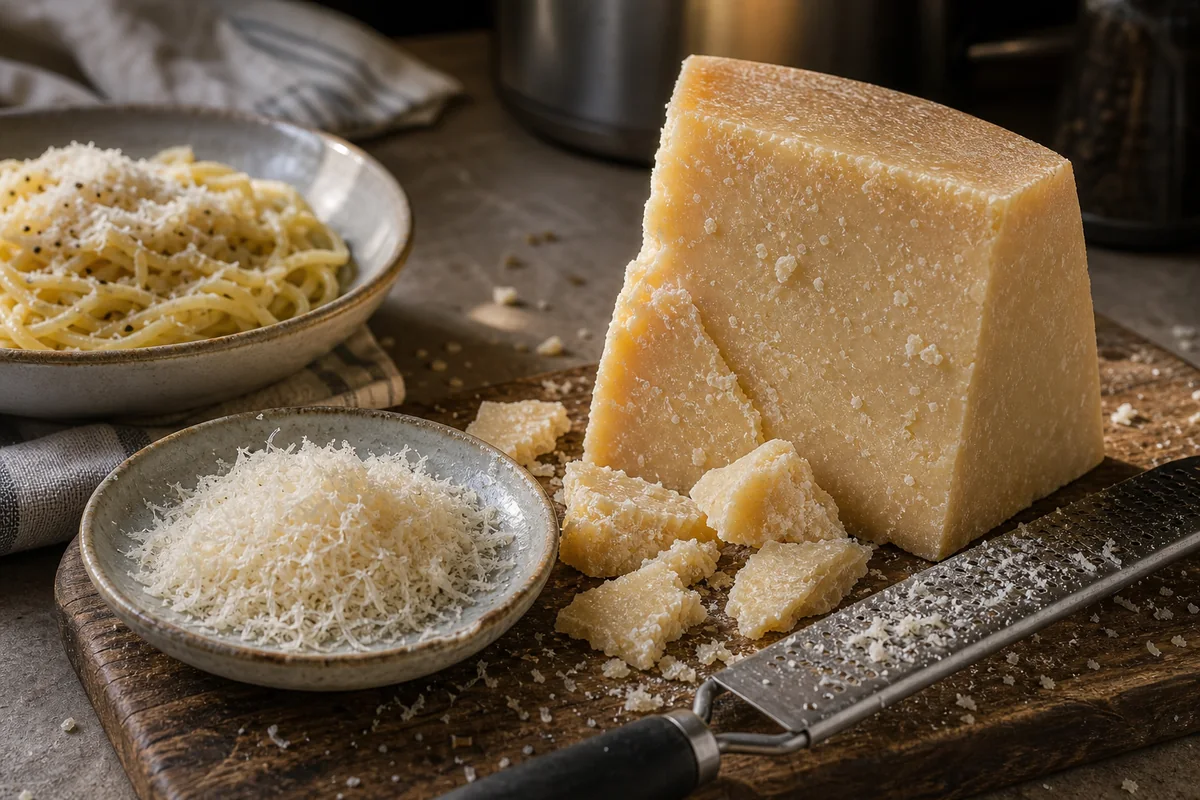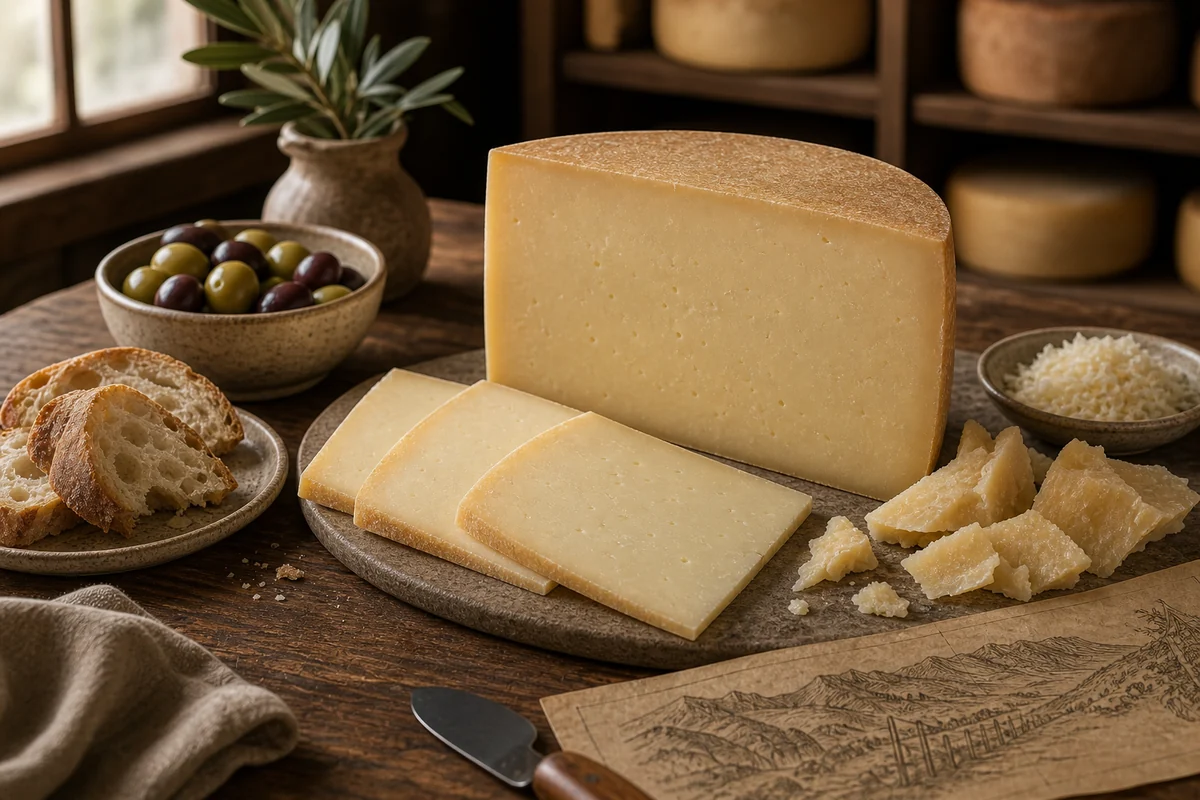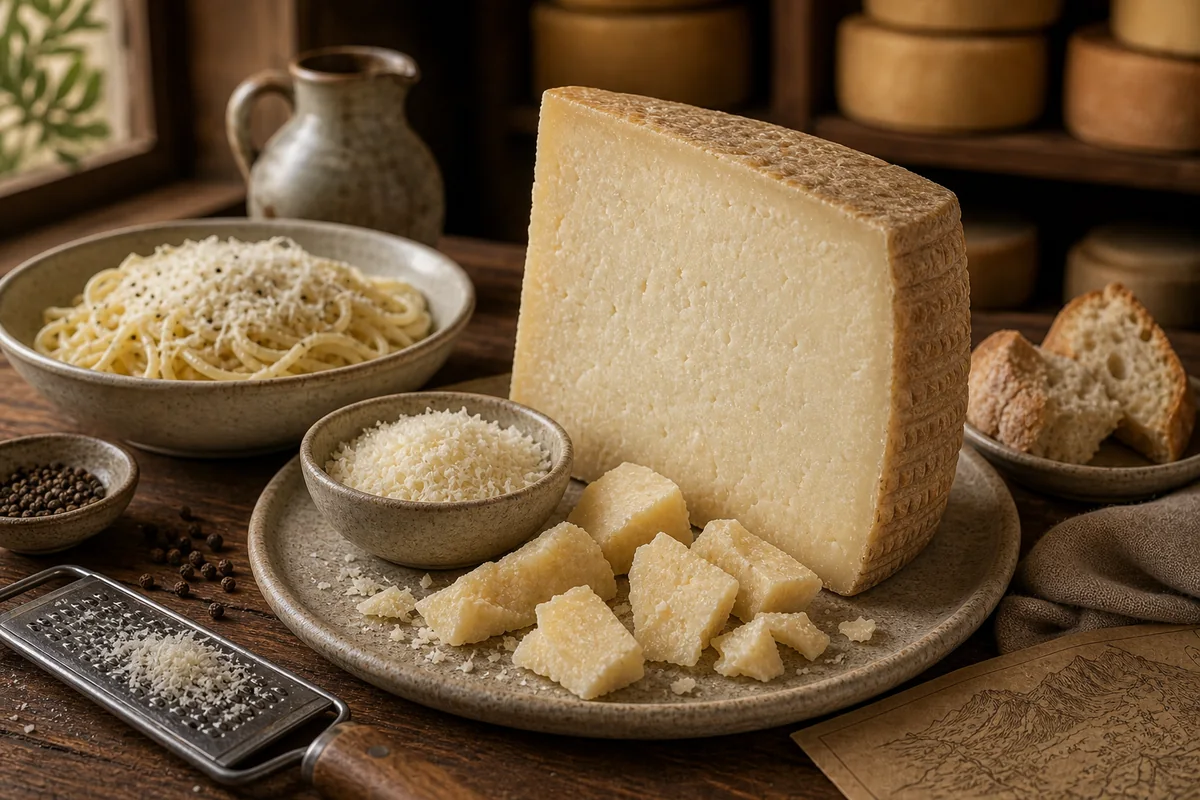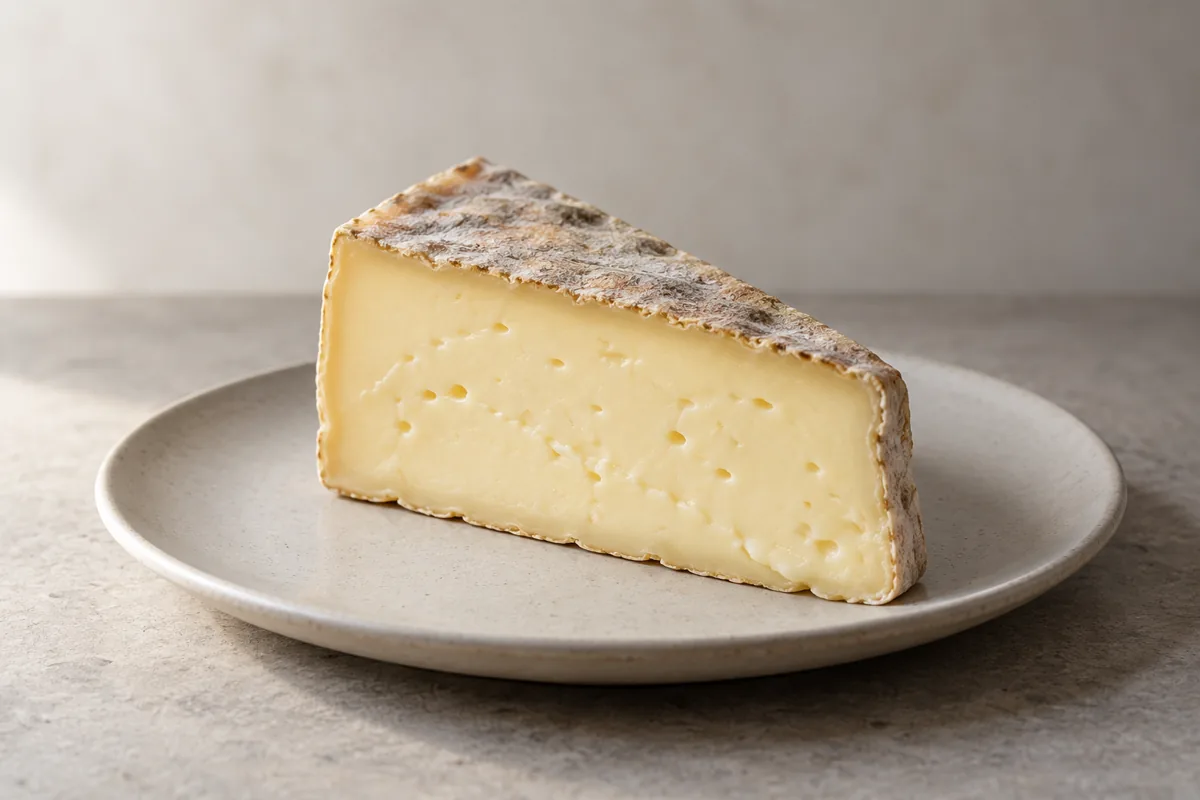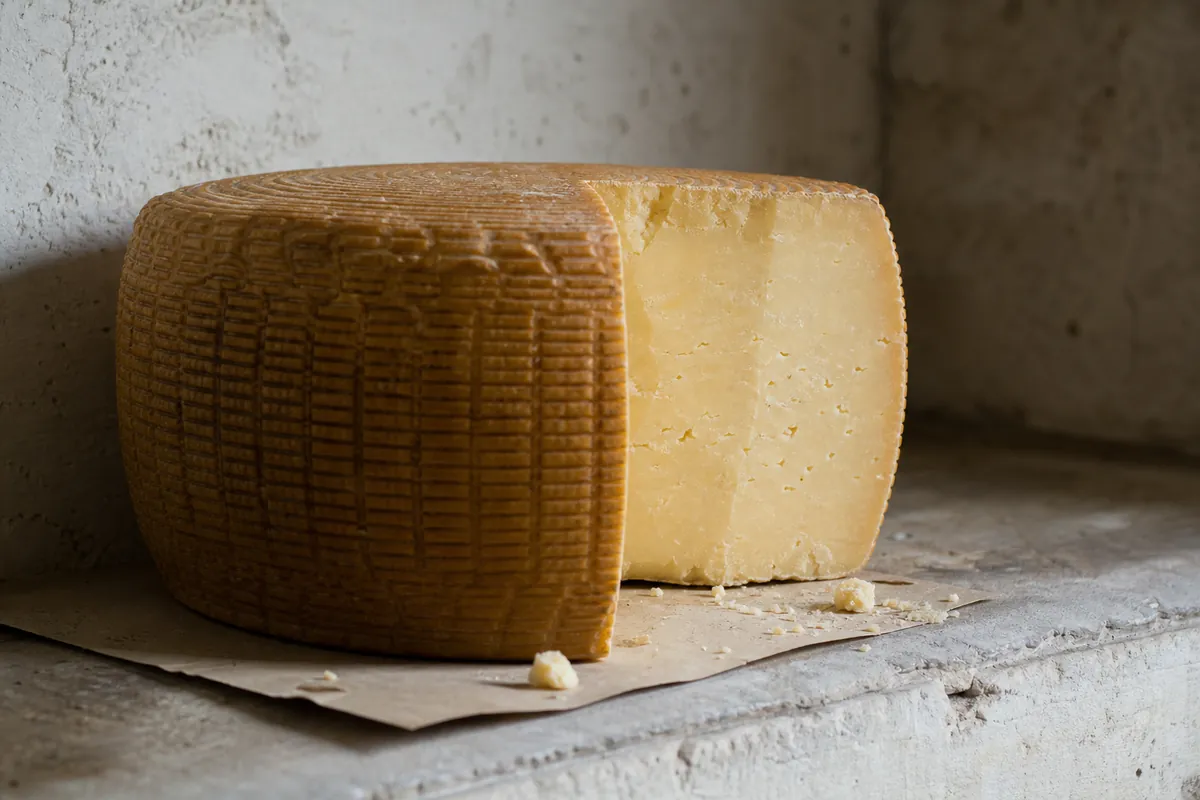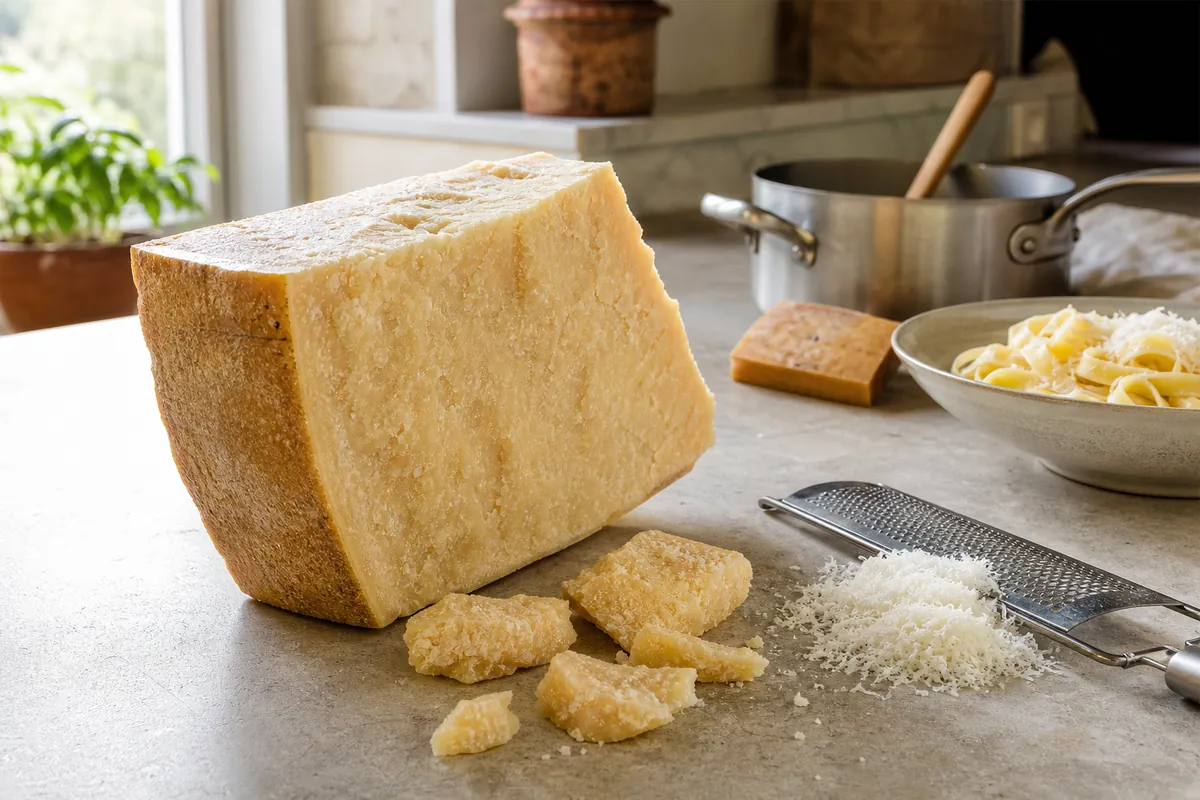
Parmesan can mean two different things at the cheese counter. Parmigiano-Reggiano is a protected Italian cheese made under a detailed PDO specification, while products labeled parmesan outside the European Union may be generic hard grating cheeses with different milk, aging, and additives.
That distinction matters most when you eat the cheese by itself or use a small amount to finish a dish.
A properly matured Parmigiano-Reggiano has a granular break, concentrated savory flavor, and aromas that can suggest warm milk, toasted nuts, broth, fruit, and spice.
Generic parmesan can still be useful for breading, casseroles, or inexpensive pasta dinners. Its quality ranges from respectable domestic wedges to shelf-stable powders that contain anti-caking ingredients and have little of the aroma found in a freshly opened aged wheel.
The quickest buying rule is to match the cheese to its task. Choose a younger protected wedge when you want it to soften into risotto or sauce, a 24-month wedge for general grating, and an older crystalline piece when the cheese itself should be the main flavor.
It also shows how to read age and rind cues, choose a cooking form, store a cut wedge, and select a substitute without assuming every hard Italian cheese behaves the same way.
In This Article
What Is Parmesan Cheese?
Start with the shape it is built for. This is a hard cow's milk cheese made for grating, shaving, and breaking into shards.
It contains little moisture, so its paste feels dense rather than flexible and becomes increasingly granular as proteins and fats change during maturation.
In everyday American use, the word covers a broad family. A package may contain imported Parmigiano-Reggiano, a domestic wheel inspired by the Italian style, a Parmesan and Romano blend, or finely grated shelf-stable cheese intended mainly as a salty topping.
Parmigiano-Reggiano provides the reference point because its name, production area, ingredients, and minimum maturation are protected.
The cheese comes only from Parma, Reggio Emilia, Modena, the part of Bologna west of the Reno River, and the part of Mantua south of the Po River.
The PDO cheese uses raw cow's milk that is partially skimmed by natural creaming. Its permitted ingredients are milk, salt, and calf rennet, with a natural whey culture carried from the previous day's cheesemaking rather than a commercial starter.
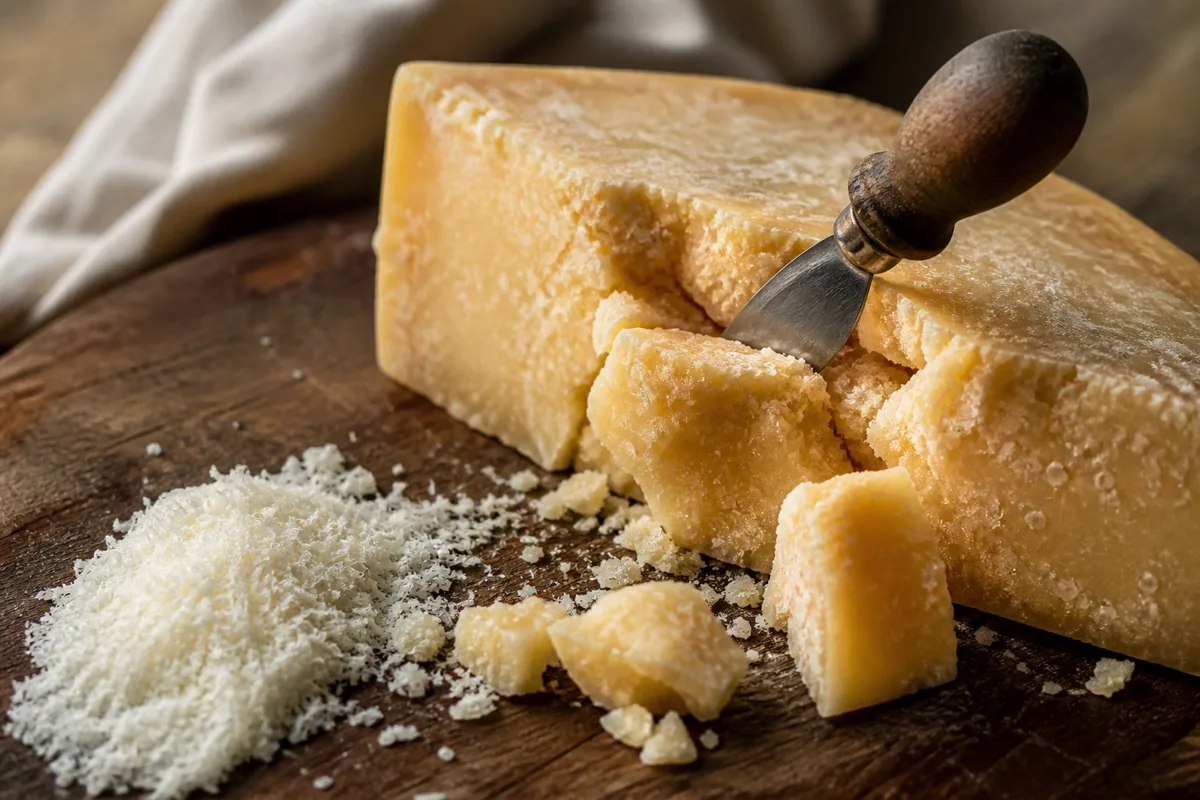
A mature cut face should look straw yellow, compact, and irregularly granular. It should break along natural fissures when opened with a short almond-shaped knife, which produces craggy chunks instead of the smooth, flexible slices associated with younger semi-hard cheeses.
The aroma should be clean and concentrated rather than sharply sour or ammoniated. Younger wheels lean toward milk, yogurt, grass, and fresh fruit, while longer maturation develops toasted nuts, meat broth, dried fruit, spice, and a longer savory finish.
The rind is simply the dehydrated outer layer of the cheese.
It is not waxed or treated with a preservative coating, so you can scrub it, trim any dirty surface, and simmer it in soup or beans for flavor.
A piece without dotted rind is not automatically fake. A wedge may come from the flat face of the wheel or from a small area that the marking band did not cover, so the package label and traceability information still matter.
When a recipe calls for Parmesan without specifying a type, decide how visible the cheese will be. A protected wedge gives the clearest return in a simple pasta, risotto, salad, or tasting plate, while a sound domestic wedge may be adequate inside a strongly seasoned baked dish.
Parmesan vs Parmigiano-Reggiano
Parmigiano-Reggiano is a specific PDO cheese, not a general style name. The protected specification governs the location of farms and dairies, the cows' feed, milk handling, copper-vat process, rind markings, minimum 12-month maturation, inspection, and packing within the area of origin.
Generic parmesan is defined differently according to the country where it is sold.
It may use pasteurized milk, selected commercial cultures, different rennet, shorter aging, or production methods designed for consistent grating rather than the complex development of a large natural-rind wheel.
| Attribute | Parmigiano-Reggiano PDO | Generic Parmesan |
|---|---|---|
| Origin | Defined provinces in northern Italy | Varies by producer and country |
| Milk | Raw cow milk, partly skimmed naturally | Raw or pasteurized cow milk |
| Ingredients | Milk, salt, calf rennet, natural whey culture | Varies and may include approved processing aids or anti-caking ingredients in grated products |
| Minimum Age | 12 months | Depends on local standard and producer |
| Texture | Granular, fissured, increasingly crystalline | Ranges from firm wedge to fine shelf-stable powder |
| Best Use | Finishing, tasting, risotto, pasta, and broths | Budget grating, breading, casseroles, and mixed cooking |
| Buying Proof | PDO label, age statement, traceability, and wheel marks | Ingredient list, producer, age, and format |
The distinction does not mean every generic cheese is poor. Some American and other non-Italian producers make carefully aged hard cheeses with excellent flavor, but the word parmesan alone does not promise the Italian feed rules, raw-milk process, inspection, or origin.
Format also changes the comparison. A freshly cut domestic wedge can preserve more aroma and texture than a protected cheese that was grated months earlier, while a newly grated piece of Parmigiano-Reggiano usually gives the most complex flavor of the group.
Read the ingredient list on grated tubs and shelf-stable cans. Cellulose or another anti-caking ingredient helps particles remain separate, but it also tells you that you are buying a prepared grated product rather than an untouched piece from a wheel.
Pre-grated cheese loses aroma faster because cutting creates far more exposed surface area.
A wedge lets you grate only what the meal needs, adjust the texture from fine snow to broad shavings, and keep the remaining paste protected.
Price should be compared by use rather than only by the pound. A concentrated 24-month cheese can season a plate with a smaller amount, so the difference per serving may be less dramatic than the counter price suggests.
Choose the protected cheese when provenance, maturation, and tasting quality are central to the meal. Choose a generic wedge only after checking its age, ingredients, aroma, and texture, not because the front label uses an Italian-looking design.
How Does Age Change Parmesan?
Parmigiano-Reggiano cannot be sold under the protected name until it has matured for at least 12 months.
There is no maximum age, although most retail wedges fall between 18 and 36 months because that range balances flavor, availability, moisture, and price.
A 12 to 18-month cheese remains relatively pale and cohesive. It has more moisture than an older wheel, with gentle milk, yogurt, herb, and fresh-fruit notes that suit salads, snacks, filled pasta, and dishes where the cheese should soften easily.
At about 24 months, the paste becomes more granular and the aroma gains roasted nuts, broth, melted butter, and ripe fruit. This is the practical all-purpose age because it grates cleanly, seasons assertively, and still incorporates into hot starch and liquid.
Between 30 and 36 months, moisture falls further and natural fissures become more obvious. The wheel develops a craggier break, a deeper straw color, and a longer finish that may suggest spice, dried fruit, stock, and toasted nuts.
White flecks in the paste are commonly tyrosine crystals.
Enzymes free amino acids as milk proteins break down, and tyrosine can crystallize when its concentration increases, so more numerous crystals provide a useful sign of maturation rather than spoilage.
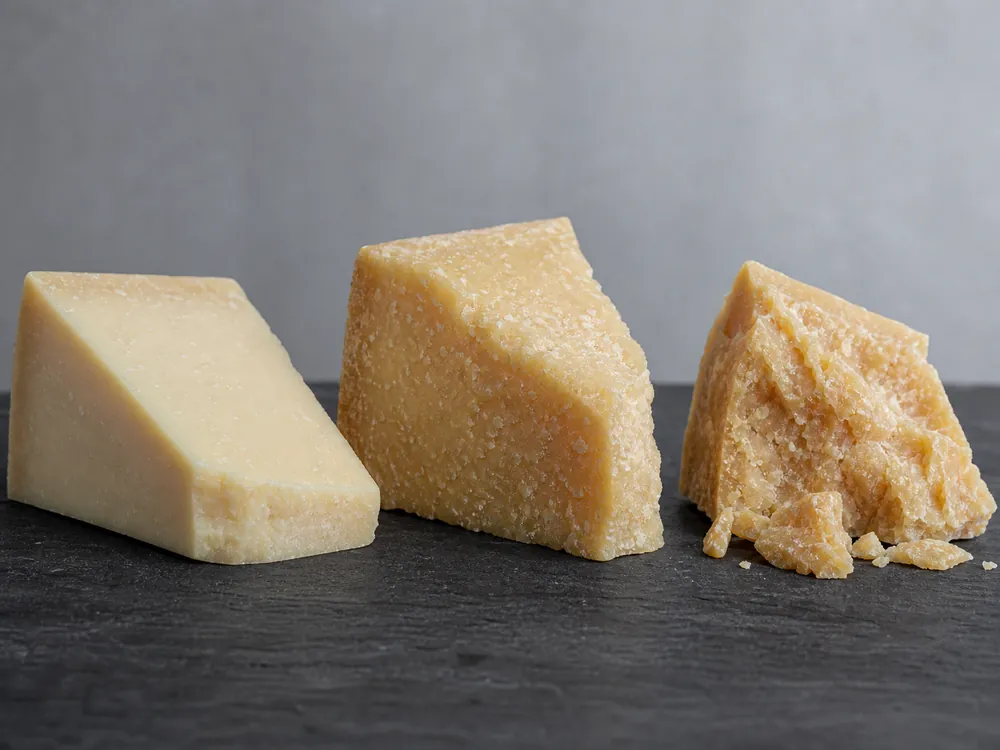
Crystals alone do not prove that a generic cheese is protected Parmigiano-Reggiano. Other aged hard cheeses can crystallize too, so combine the visible texture with the PDO label, minimum age statement, producer information, and any rind marks that remain on the piece.
Older is not automatically better for every task. A 40-month wedge can taste extraordinary in small shards, yet its dry paste may integrate less readily into a delicate sauce and can overwhelm a dish that needs only mild dairy richness.
Taste a small piece before buying a large aged wedge. Two cheeses marked 24 months can differ by dairy, season, milk, and maturation conditions even though both satisfy the same protected specification.
Use the age statement as a starting point, then judge the cut face and flavor.
A moist young piece, balanced 24-month wedge, and deeply crystalline older cheese each solve a different kitchen problem.
How Is Parmigiano-Reggiano Made?
Production begins with two milkings from cows raised in the protected area. Evening milk rests so some cream rises naturally, then the partly skimmed milk is combined with whole morning milk in a traditional copper vat.
The milk is not heat treated before cheesemaking. Natural fermented whey from the previous production day supplies lactic bacteria, and calf rennet coagulates the milk without preservatives or flavor additives.
The cheesemaker breaks the curd into very small grains with a traditional whisk called a spino. The curd and whey are heated until the grains contract, then the cooked mass settles at the bottom of the bell-shaped vat.
Workers lift the mass in cloth and divide it into two portions, each destined to become a wheel.
The fresh cheese enters a mold, receives a casein plate for traceability, and is wrapped with a marking band that presses origin information into the heel.
- Milk Raw cow's milk from the defined production area.
- Starter Natural whey culture from the previous day's cheesemaking.
- Coagulant Calf rennet is the permitted rennet for the protected cheese.
- Vat Copper conducts heat as the curd is broken and cooked.
- Salt Formed wheels absorb salt during an extended brine bath.
- Additives The PDO cheese contains no preservatives or colorants.
After several days, the formed wheel enters brine so salt moves slowly through the rind. It then matures on shelves where workers turn and clean it, allowing moisture to leave gradually while the paste develops its granular structure and aroma.
At 12 months, trained inspectors evaluate every wheel. They tap the rind with a small hammer and listen for differences that can reveal internal openings or structural defects without cutting the cheese apart.
A compliant wheel receives the oval selection mark and may continue maturing.
A wheel with minor defects can be marked as a second category with parallel grooves, while a seriously noncompliant wheel has its protected markings removed and cannot be sold under the name.
The process explains why a cut wedge contains more information than its flavor alone. The dotted heel, dairy number, production date, casein plate, age, and selection marks together allow the cheese to be traced through a production system that begins with the farm.
About 500 liters of milk are commonly associated with a wheel near 38 to 40 kilograms, though exact wheel yield varies. The important buying consequence is that long maturation ties up a large quantity of milk and storage space for at least a year.
Those time and material requirements help explain the price. You are paying for protected milk production, daily cheesemaking, brining, inspection, moisture loss, cellar labor, and the risk that a wheel may not qualify after a year of aging.
Which Parmesan Is Best for Cooking?
The best age depends on whether the cheese must integrate, season, or stand alone. Younger Parmigiano-Reggiano carries more moisture and a gentler flavor, while older cheese grates into drier particles and contributes greater intensity in a smaller amount.
For risotto, stir finely grated 18 to 24-month cheese into the pan after lowering or removing the heat.
Residual heat and starchy liquid help the cheese disperse, while aggressive boiling can tighten proteins and encourage clumps or a greasy surface.
For pasta, grate a 24-month wedge just before serving or emulsify it with warm pasta water. Finely grated cheese melts faster than thick curls, but the water must be warm rather than furiously boiling if you want a smooth coating.
| Use | How It Works |
|---|---|
| Risotto | Use 18 to 24-month cheese and stir it in off heat with butter for a creamy finish. |
| Pasta Sauce | Grate finely and combine with warm pasta water so the cheese disperses before proteins tighten. |
| Salad | Shave broad curls from an 18 to 24-month wedge for salt, texture, and nutty aroma. |
| Soup and Beans | Scrub a natural rind and simmer it slowly to add savory body, then remove or eat it when tender. |
| Tasting Plate | Break 30 to 36-month cheese along its fissures and serve small shards at room temperature. |
| Breading | Use a finely grated domestic or protected wedge with breadcrumbs when the cheese is one seasoning among several. |
Aged Parmesan does not produce the long elastic pull of mozzarella. Its low moisture and mature protein structure make it better at seasoning and thickening than forming a stretchy blanket, although finely grated cheese softens readily in a moist hot dish.
For salads and vegetables, a peeler creates thin curls that retain more texture than powder.
An older wedge gives a sharper, crunchier accent, while a younger piece makes softer shavings that bend over leaves or roasted vegetables.
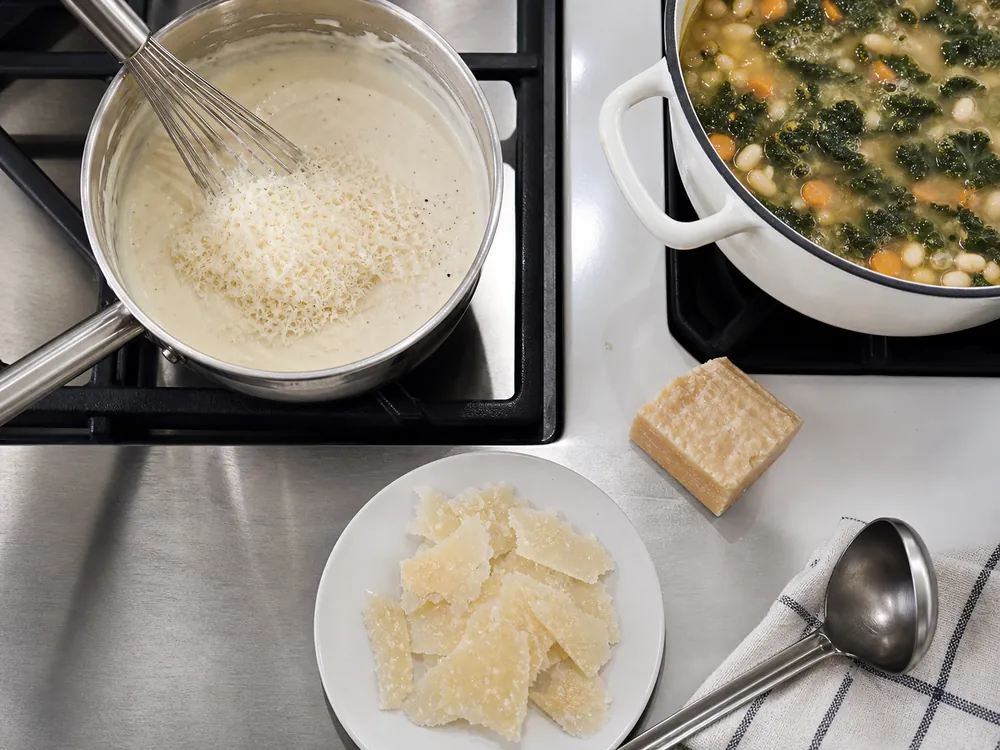
Rinds are valuable because the dried outer layer still contains fat, protein, salt, and flavor compounds. Clean the surface, add a piece to a long-simmered soup, bean pot, tomato sauce, or braise, and check that it does not stick to the bottom.
Break a 30 to 36-month cheese into shards instead of cutting perfect cubes. The natural fissures reveal aroma and crystals, and a small irregular piece warms more quickly at room temperature than a thick block.
Buy a wedge rather than a single-purpose format when you use Parmesan several ways. The same piece can supply fine gratings for sauce, broad curls for salad, rough shards for tasting, and a rind for the stockpot with less waste.
Does Parmesan Melt Smoothly?
Heat does something different here. It softens and disperses in hot moist food, but it does not melt like a young high-moisture cheese.
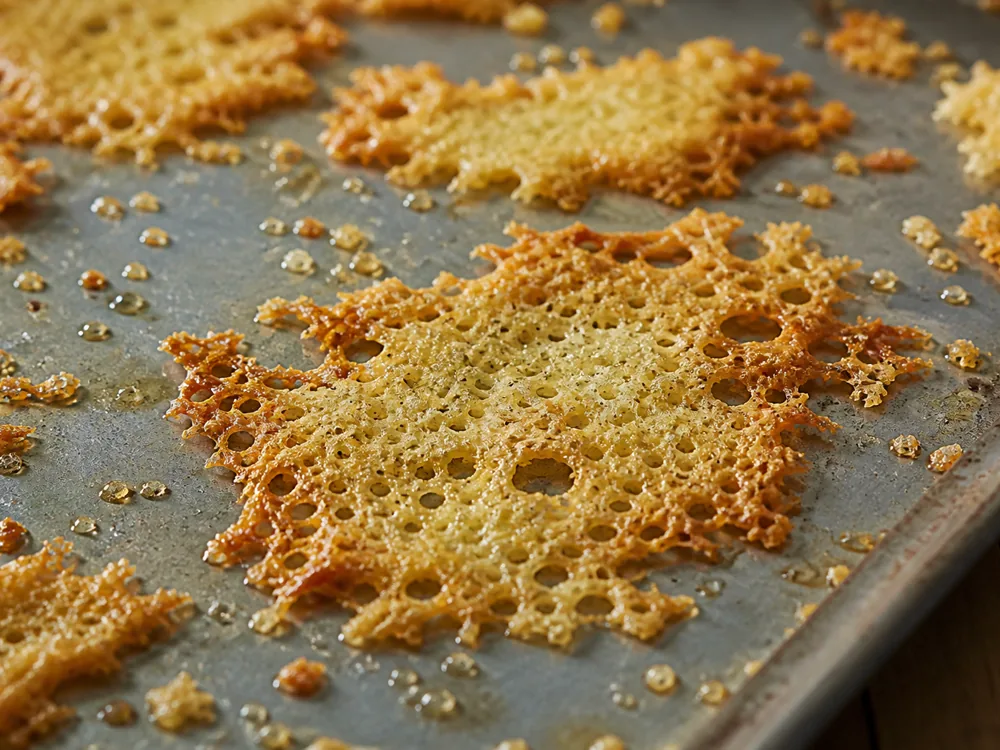
Its concentrated proteins can clump when exposed to excessive heat, and its fat can separate if the grated cheese enters a dry or boiling pan.
Grating size changes the result. A Microplane creates fine, airy particles that disappear quickly into risotto or pasta water, while coarse shreds take longer and are more likely to remain as visible strands or clumps.
Temperature matters even more. Remove a sauce from direct heat or lower the burner, add cheese gradually, and keep enough liquid in the mixture to surround the particles as they soften.
Pre-grated cheese may behave differently because it has lost moisture and can contain anti-caking ingredients.
Those particles are convenient for topping, but they are a weaker choice when the recipe depends on a silky emulsion.
A younger 18 to 24-month Parmigiano-Reggiano generally integrates more easily than a very old dry wedge. Save the oldest cheese for finishing when its concentrated aroma and crunchy texture remain visible rather than asking it to become an invisible sauce base.
When a recipe needs a flowing blanket or strong stretch, use a younger melting cheese and keep Parmesan as a flavor layer. The combination works because one cheese manages texture while Parmesan supplies the concentrated savory finish.
What Pairs Well With Parmesan?
Three things drive the pairing: high savory intensity, firm texture, and a salty impression, so successful pairings add sweetness, acidity, fruit, or enough body to remain noticeable. The best accompaniment depends on the age of the wedge.
A younger cheese suits fresh pears, crisp apples, mild honey, sparkling wine, and lighter cured meat.
Its milky and fruity notes can be covered by very tannic wine or a heavily reduced condiment.
A 24-month wedge works with dry Lambrusco, traditional balsamic vinegar, walnuts, prosciutto, and ripe pear. Bubbles and acidity refresh the palate, while fruit and sweetness reveal the cheese's nutty and caramel-like aromas.
| Pairing | Type | Why It Works |
|---|---|---|
| Dry Lambrusco | Wine | Regional sparkling red brings acidity, fruit, and bubbles to a 24-month wedge. |
| Aged Balsamic | Food | Use a few drops with mature shards so sweetness and acidity frame the savory paste. |
| Pear and Apple | Food | Fresh fruit supplies moisture and crisp sweetness beside younger or mid-aged cheese. |
| Walnuts | Food | Toasted nuts echo the roasted aromas that become stronger during maturation. |
| Prosciutto | Food | Thin slices add sweet cured fat without hiding the granular cheese. |
| Full-Bodied Red | Wine | Structured reds are best reserved for older wheels with enough concentration to remain present. |
Older cheese can handle darker honey, dried figs, mature red wine, and a more concentrated balsamic condiment. Use small portions because several intense ingredients can quickly make the plate feel salty and heavy.
Temperature changes the pairing.
Let the serving portion rest outside the refrigerator for roughly 30 minutes so its fat softens and aromatic compounds become easier to smell, while keeping the remaining wedge chilled.
Avoid covering a rare old cheese with a large amount of jam or vinegar. Taste the shard first, then add a small accompaniment so you can tell whether the pairing clarifies the cheese or simply replaces its flavor.
How Can You Identify Parmigiano-Reggiano?
Start with the package rather than relying on the rind alone. A prepacked protected wedge should show the Parmigiano-Reggiano certification mark, the PDO symbol, the authorized packer's identification, and a minimum maturation statement.
On a piece cut from the heel, the natural rind commonly retains rows of dotted lettering created by the marking band shortly after production. The marks identify the protected name along with the dairy number and production month and year around the complete wheel.
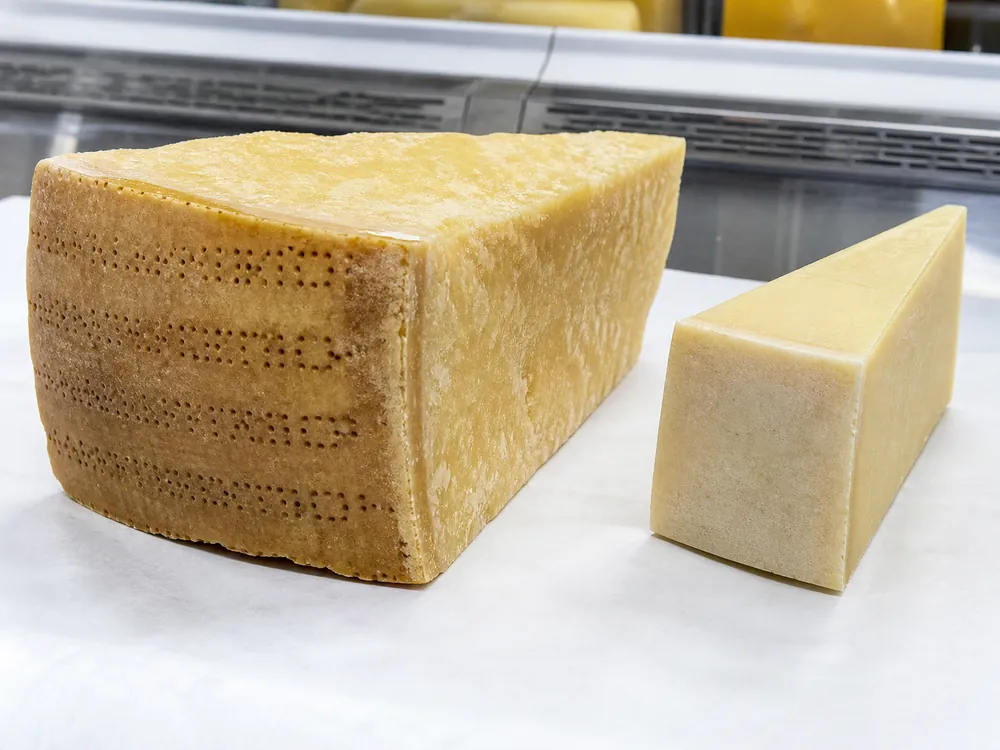
A piece from the flat top or bottom may have no dotted letters, and a large wheel can include a small heel area beyond the marking band's reach.
Missing dots therefore require a closer label check rather than an automatic accusation of fraud.
The cut face should feel hard and granular, not rubbery, spongy, or waxy. Small crystals and irregular fissures become more common with age, while a wet surface or strong ammonia smell suggests poor handling rather than desirable maturation.
For counter-cut cheese, ask the cheesemonger to identify the dairy and age and show the original wheel if practical. A knowledgeable seller should be able to explain whether the piece is protected Parmigiano-Reggiano, domestic parmesan, or another grating cheese.
Do not judge authenticity by price alone.
Promotions, wheel age, portion size, retailer margins, and exchange rates change the tag, while a high price can also be attached to a generic product with elaborate packaging.
Buy enough for your realistic use window. A smaller freshly cut piece preserves more aroma than a large wedge that dries for weeks, even when the larger piece offers a lower price per pound.
How Should You Store Parmesan?
Store Parmigiano-Reggiano in the refrigerator between 4 and 8 degrees Celsius, or about 40 to 48 degrees Fahrenheit. Keep it away from strongly aromatic foods because the fat in cheese can absorb surrounding odors.
An unopened vacuum pack can remain refrigerated until its stated durability date as long as the seal stays intact. Once opened, the best window depends on age, moisture, handling, and how often the package warms during use.
The Consortium's guidance gives about 15 days for opened cheese aged 12 to 18 months and about one month for cheese aged 24 months or more.
These are practical quality windows, not permission to ignore mold, slime, off odors, or a broken cold chain.
Airtight glass or plastic containers limit odor transfer and moisture loss. Food-grade film is also an official option, although cheese paper or parchment inside a loose container can make repeated home use more convenient when you rewrap the cut face cleanly.
Grate only the amount needed for the meal. Once grated, the cheese has much more exposed area, so aroma fades, moisture changes faster, and the particles pick up refrigerator odors more readily.
If a small spot of surface mold appears on a hard wedge, the official guide says it can be removed with a knife.
Discard the piece when contamination is extensive, the paste is slimy, the odor is abnormal, or you are uncertain how the cheese was handled.
The Consortium does not recommend freezing a serving wedge because thawing changes its granular texture. Freezing a cleaned rind for a future soup is a practical cooking choice, but it should not be confused with preserving a premium wedge for table service.
Use clean tools and avoid touching the whole cut face with wet hands. Moisture and food residue introduced during repeated handling can shorten the useful life more than the calendar alone suggests.
What Are the Best Parmesan Substitutes?
Grana Padano is the closest broad substitute for Parmigiano-Reggiano because it is another northern Italian PDO hard cheese with a granular paste and strong grating ability. It is usually milder and can offer a lower-cost option when Parmesan is one ingredient among many.
Pecorino Romano solves a different problem.
The sheep's milk cheese is sharper and commonly tastes saltier, so it suits assertive Roman pasta dishes but can overwhelm a recipe designed around the rounder nutty flavor of Parmigiano-Reggiano.
- Grana Padano Choose it for the closest general flavor, texture, and grating role.
- Pecorino Romano Use less at first when a dish can benefit from sharper salty flavor.
- Piave Vecchio Try it when you want a dense crystalline paste with a sweeter finish.
- Aged Asiago Use the hard aged form for grating, not a young flexible Asiago.
- Domestic Parmesan Choose a sound wedge for breading, casseroles, and budget cooking.
A one-to-one volume substitution can be misleading because salt and density vary. Replace by weight when possible, then taste before adding the full amount of Pecorino or another strongly salted cheese.
Texture determines whether the substitute belongs in a sauce or on top. A very dry cheese may grate beautifully but integrate poorly, while a younger hard cheese can soften more readily and contribute less concentrated flavor.
For eating in shards, choose Grana Padano, Piave Vecchio, or another carefully matured hard cheese rather than a fine grated blend.
The tasting experience depends on fissures, aroma, and crystal texture that a powder cannot reproduce.
For a vegetarian dish, check the rennet statement instead of assuming every hard Italian-style cheese fits. Protected Parmigiano-Reggiano uses calf rennet, so it does not meet a vegetarian requirement that excludes animal rennet.
The best substitute is therefore based on the task. Grana Padano is the balanced default, Pecorino Romano supplies sharper seasoning, and a domestic parmesan wedge covers economical cooking when protected origin is not central.
What Should You Know About Parmesan Nutrition and Pregnancy?
Age is what concentrates the numbers. The cheese is energy dense because ageing removes water and concentrates protein, fat, minerals, and sodium into a small portion.
That concentration is useful when a spoonful seasons a full plate, but it also makes portion size important for people monitoring sodium or saturated fat.
Nutrition varies by product and database entry, especially when a label says parmesan rather than Parmigiano-Reggiano.
Use the package panel for the piece you are eating and treat the figures above as a practical reference for hard Parmesan-style cheese.
Protected Parmigiano-Reggiano is naturally lactose free because lactic bacteria transform milk sugar during the first 48 hours of production. The Consortium reports lactose below its analytical detection limit, and this occurs because of cheesemaking rather than because a very old age is required.
Lactose-free does not mean dairy-free. The cheese still contains cow's milk proteins and is unsuitable for anyone who must avoid milk because of an allergy.
Pregnancy advice differs between public-health authorities.
Current United States guidance emphasizes pasteurized hard cheese as a safer option, while current United Kingdom guidance permits hard cheeses such as Parmesan whether the milk was pasteurized or unpasteurized.
Parmigiano-Reggiano itself is made from raw milk, so a reader following the stricter pasteurized-only interpretation should choose a product that clearly fits that local guidance. Refrigeration, clean cutting, and reliable storage history remain relevant regardless of milk treatment.
Protein and calcium are substantial in a small serving, which makes the cheese an efficient finishing ingredient. The same concentration brings sodium and calories, so a finely grated tablespoon can provide aroma and savoriness without turning the cheese into the bulk of the meal.
Individual dietary needs differ, and a cheese profile cannot replace medical advice.
Use the current package label and local public-health guidance when lactose intolerance, milk allergy, pregnancy, kidney disease, or sodium restriction affects the decision.
Buy a 24-month Parmigiano-Reggiano wedge for the broadest mix of grating, cooking, and tasting. Choose 12 to 18 months for gentler flavor and easier incorporation, or 30 to 36 months for dry crystalline shards and an intense finish. Keep a sound domestic wedge for budget cooking only when protected origin is not important.
SOURCES & REFERENCES
What Are the Most Common Parmesan Questions?
No. Parmigiano-Reggiano is a protected Italian PDO cheese, while parmesan may be used more broadly outside the European Union for hard grating cheeses made under different rules.
Around 24 months is the most versatile age for grating, risotto, pasta, and tasting. Choose 12 to 18 months for milder cooking or 30 to 36 months for a drier crystalline finish.
Yes, the natural rind of Parmigiano-Reggiano is edible after cleaning. Simmer it in soup, beans, tomato sauce, or stock, then remove it or eat it if it becomes tender.
Many white flecks are tyrosine crystals that form as enzymes break down milk proteins during maturation. They are a sign of aging rather than mold or added salt.
Protected Parmigiano-Reggiano is naturally lactose free because lactic bacteria transform lactose during the first 48 hours. Generic parmesan products vary, so check the label when the distinction matters.
The official guide suggests about 15 days for Parmigiano-Reggiano aged 12 to 18 months and about one month for cheese aged 24 months or more. Keep it refrigerated and discard it when handling or spoilage signs make its safety uncertain.