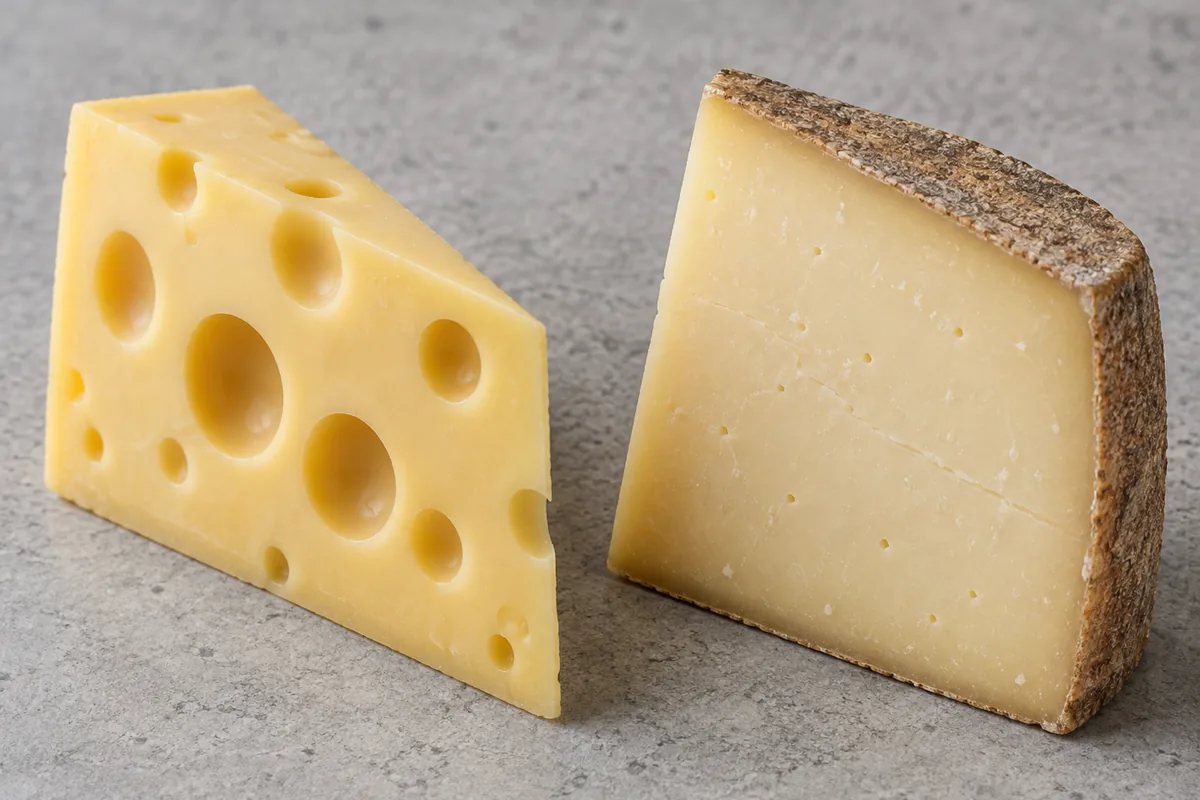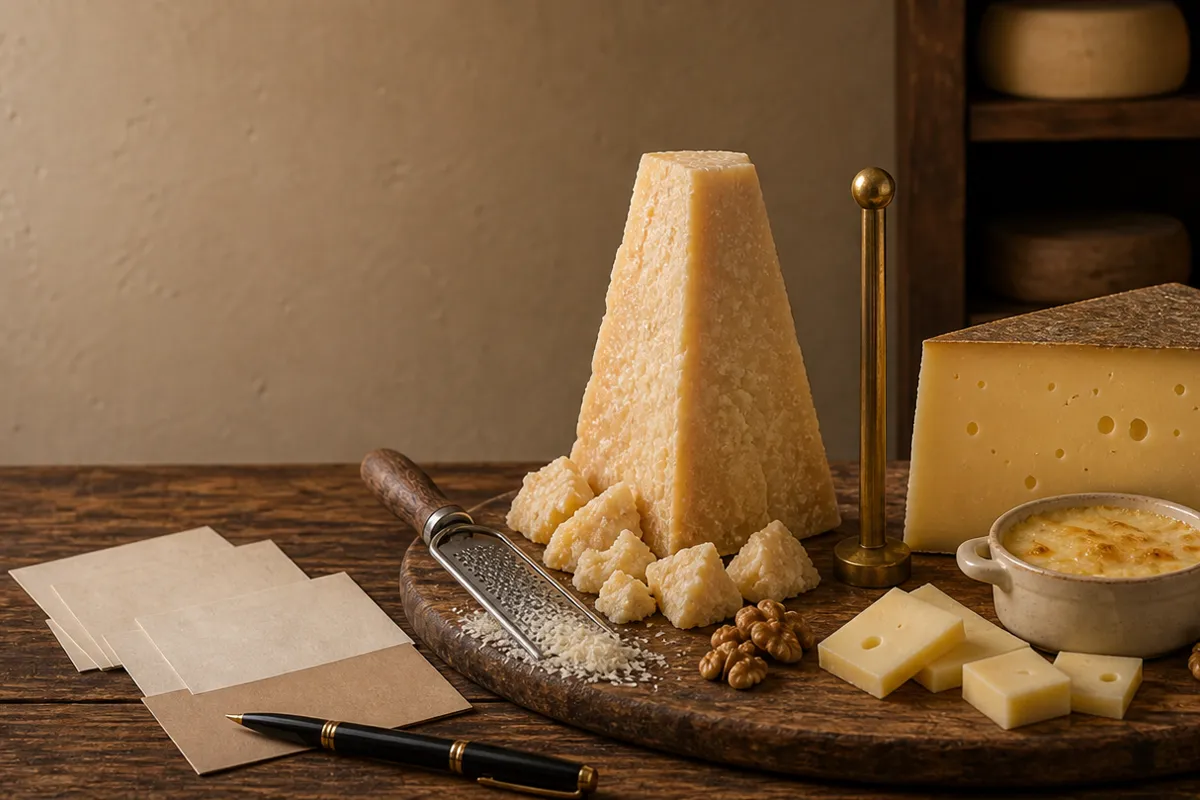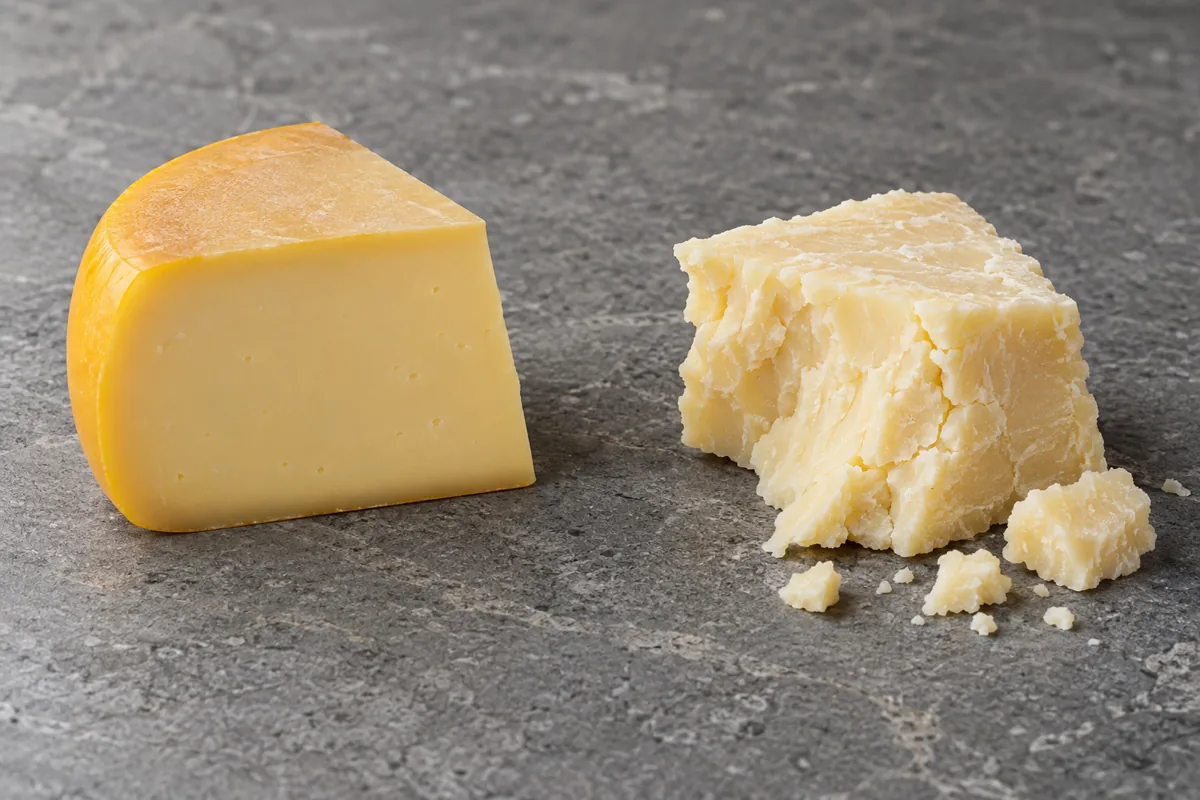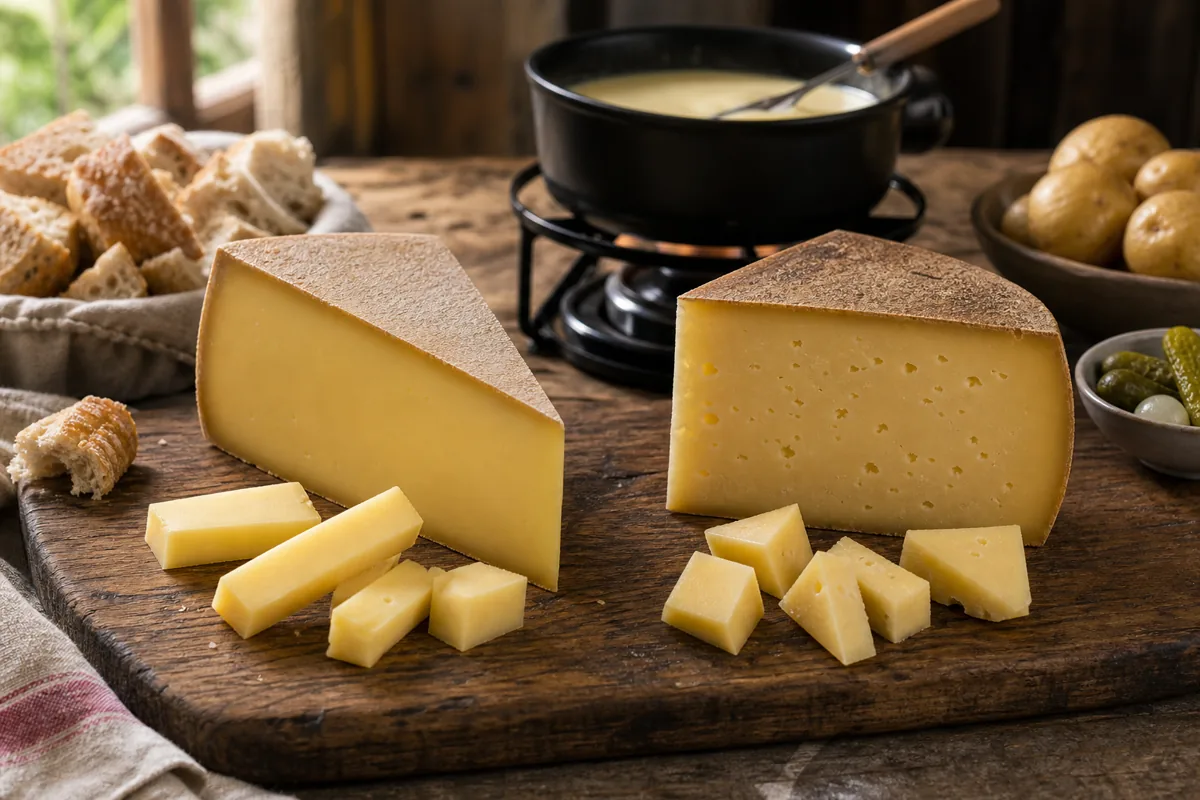
For fondue, buy the cheese your recipe names: Gruyère goes into nine of the 11 Swiss variants on Wikipedia's list, and Comté into fondue jurassienne. Both cheeses are named for quiche, pastas and salads.
Comté comes from the French Jura and is aged at least 4 months, while Le Gruyère AOP comes from Switzerland and is aged at least 5 months. Both are hard cheeses made from raw cow's milk in copper vats.
Comté is made from raw cow's milk in village dairies called fruitières, and Wikipedia counts 160 of them across the Jura Mountains.
The area lies in eastern France, and only Montbéliarde and French Simmental cows, or crosses of the two, may supply the milk.
Le Gruyère AOP is made in the cantons of Fribourg, Vaud, Neuchâtel and Jura and a few communes of Bern, and its name comes from the Gruyère region of Fribourg.
Wikipedia calls it the most popular Swiss cheese in Switzerland and in most of Europe.
In This Article
What Is the Difference Between Comté and Gruyère?
The two are made the same basic way, and they part in the rules each name sets. For both, milk is warmed in copper vats, the curd is cut into small grains and the grains are pressed in moulds into large wheels, as described for Comté and for Gruyère.
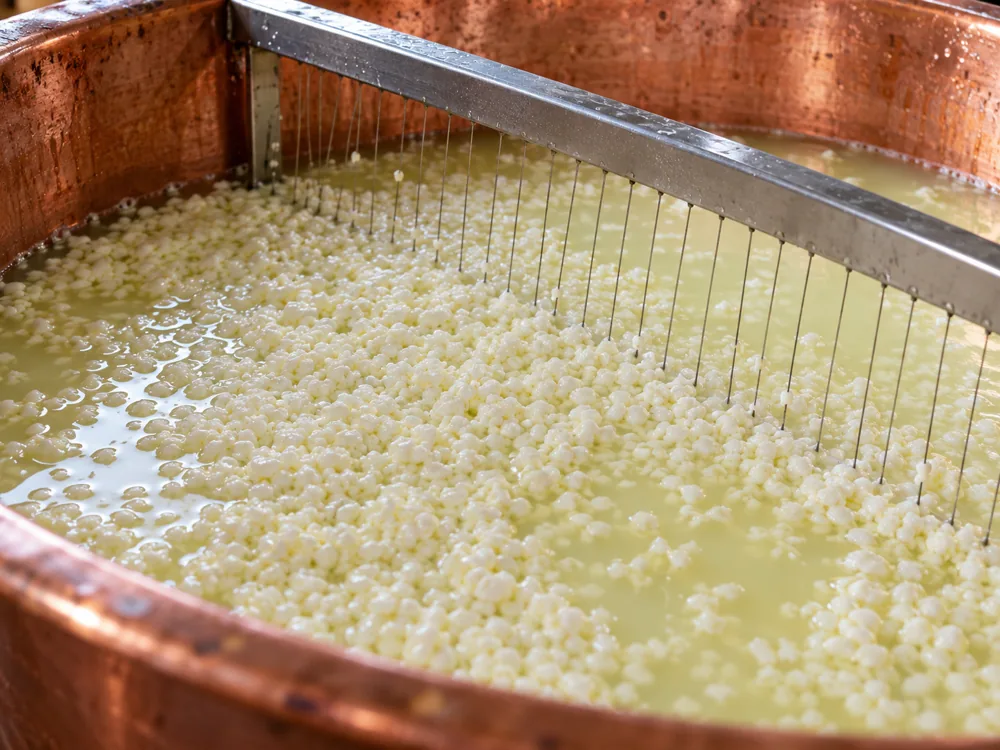
The table sets the rules side by side, with the Comté column from Wikipedia's account of Comté and the Gruyère column from the Gruyère trade body.
| Attribute | Comté | Le Gruyère AOP |
|---|---|---|
| Where it is made | Jura Mountains, eastern France | Fribourg, Vaud, Neuchâtel, Jura and part of Bern, Switzerland |
| Milk | Raw, from Montbéliarde or French Simmental cows or crosses of the two | Raw, from cows fed grass in summer and hay in winter |
| Milk delivery | Taken to the dairy immediately after milking | Delivered twice a day, morning and evening |
| Milk per wheel | Up to 600 litres | 400 litres |
| Wheel size | 40 to 70 cm across, up to 55 kg | 55 to 65 cm across, 25 to 40 kg |
| Minimum age | 4 months | 5 months |
| Quality check | Scored out of 20 after ageing | Checked by a neutral commission at 4 months |
| Protected name since | AOC in 1958 | AOC in 2001 |
Neither cheese may be made from silage-fed milk. The Comté rules allow cows only fresh, natural feed with no silage, and Gruyère milk comes from cows fed without ensilage.
Wikipedia lists Gruyère de Comté as another name for Comté, which is a different cheese from the Swiss Le Gruyère AOP.
How Are Comté and Gruyère Made Differently?
Past the shared outline, the two recipes differ in heat, curd size, pressing and salt.
| Step | Comté | Gruyère |
|---|---|---|
| Heat | One heating of the milk allowed, up to 56°C (133°F) | Milk at 34°C (93°F); curd cooked at 43°C (109°F), then raised quickly to 54°C (129°F) |
| Curd grains | Small white grains the size of rice or wheat | Wheat-grain size (gruyere.com); pea-sized pieces (Wikipedia) |
| Pressing | Mould opened after several hours | Pressed almost 24 hours, with a force of up to 900 kg |
| Salt | Applied only to the surface of the cheese | 24 hours in 22% brine, then smeared with bacteria |
| Rind | Usually dusty brown | Smeared, grainy and uniformly brownish, with a slightly convex edge |
Salt goes on differently. A Comté wheel is turned regularly in the cellar and rubbed with salt, and its rules allow salt only on the surface.
A Gruyère wheel goes into the brine as soon as it leaves the mould, and the trade body says dampness during maturing then helps the protective rind form from the outside in.
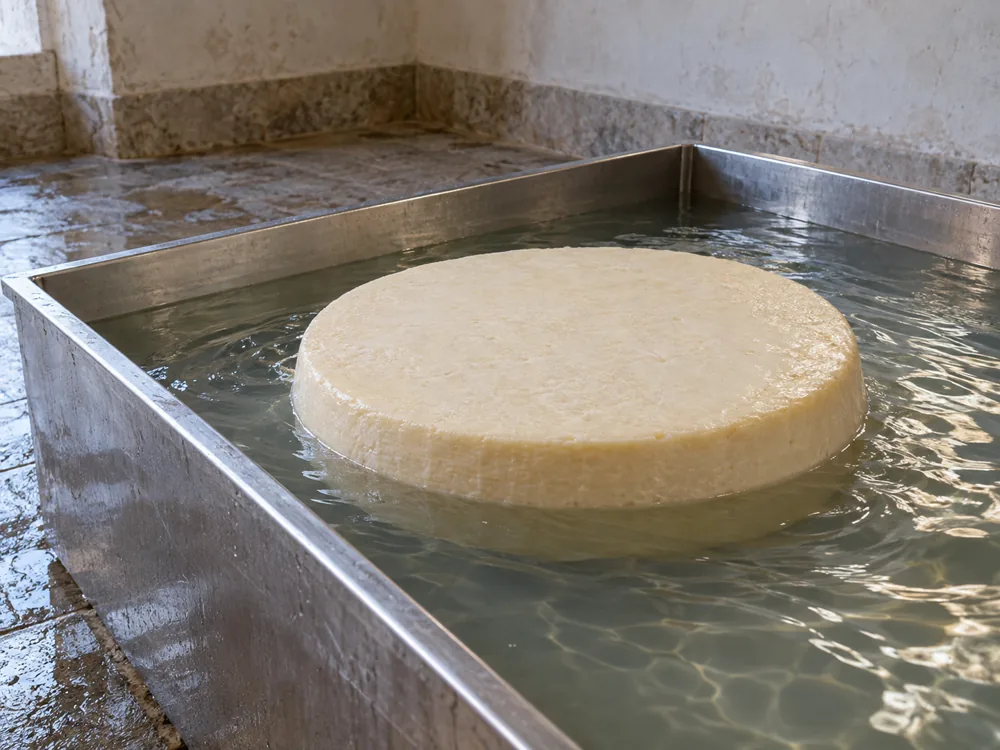
Accounts of the Gruyère curd differ, with wheat grains in the trade body's and pea-sized pieces in Wikipedia's. On the trade body's figure, the Gruyère curd starts out about the size of the rice or wheat grains given for Comté.
The fat and water figures cannot be set side by side, because they measure different things. Wikipedia gives Comté about 45% fat in dry matter, and the Gruyère trade body gives its cheese 34.5 to 36.9% water.
How Do Comté and Gruyère Taste Different?
Descriptions of both cheeses include nuttiness, and the other notes shift with the age of the wedge.
| Age | Comté | Gruyère |
|---|---|---|
| Young | Fresh hazelnuts, soft caramel and cooked milk (Comté USA) | Sweet but slightly salty, creamy and nutty (Wikipedia) |
| Older or mature | More intense nuts, melted butter, citrus fruits and toasted bread (Comté USA) | More assertive, earthy and complex (Wikipedia) |
| No age given | Mild, nutty, salty and slightly sweet (Wikipedia) | Not stated |
In both accounts the stronger notes go with longer ageing, so ask the age of each wedge before you set one cheese against the other.
Where a Comté is made changes it as well. Wikipedia, which calls Comté well known for its terroir, quotes Pierre Androuët's 1983 Guide du fromage: "There is a world of difference between lowland Comté and mountain Comté."
Wikipedia describes the paste of Comté as pale creamy yellow and the texture as fairly hard but flexible.
The Gruyère trade body describes a smooth, slightly damp, moderately firm paste that is not very crumbly, with an ivory colour that varies by season. Wikipedia says fully aged wheels, at five months to a year, tend to have small cracks that give a slightly grainy texture.
For wine, Comté USA suggests Jura whites with dried-fruit and spice aromas, other dry whites, young reds and Champagne.
Which One Is Better for Fondue?
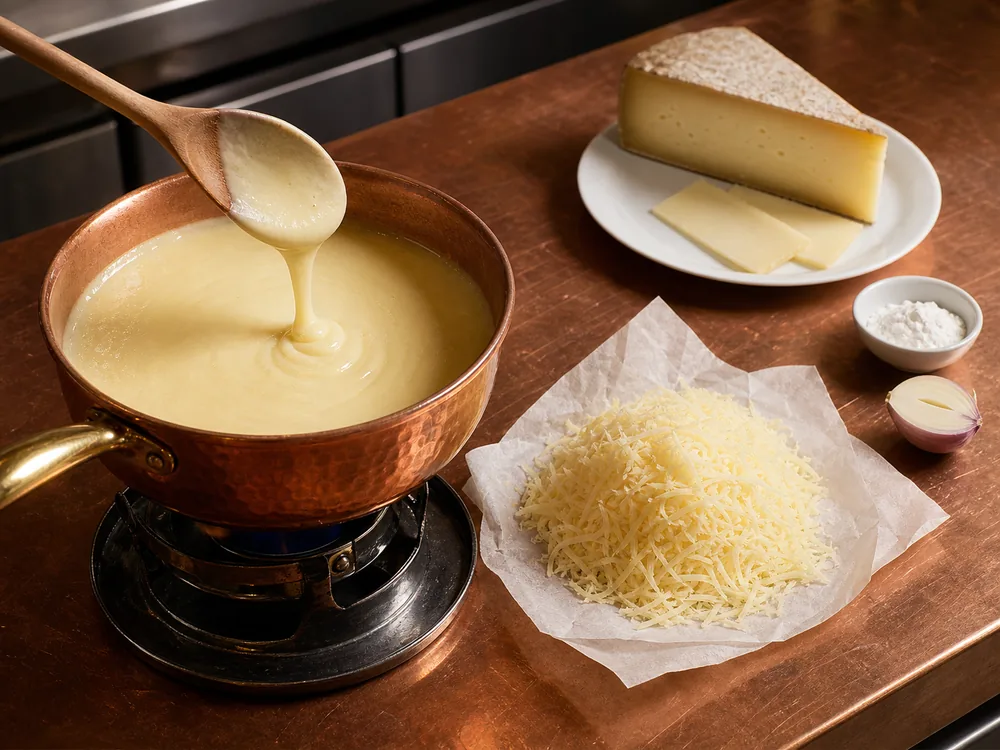
The recipe decides. The Vaudoise cheese fondue uses Gruyère alone, and fondue jurassienne uses mild or mature Comté.
Vacherin Fribourgeois and Gruyère are the cheeses commonly used for fondue, and moitié-moitié combines them half and half.
| Fondue | Group on Wikipedia's list | Cheeses |
|---|---|---|
| Vaudoise | Swiss variants | Gruyère |
| Moitié-moitié | Swiss variants | Gruyère and Vacherin Fribourgeois |
| Neuchâteloise | Swiss variants | Gruyère and Emmental |
| Genevoise | Swiss variants | Gruyère, Emmental and Valais cheese |
| Jurassienne | French variants | Mature or mild Comté |
| Savoyarde | French variants | Beaufort, Abondance, or a French Gruyère or Emmental |
Gruyère appears in nine of the 11 Swiss variants on that list, while Comté appears in only one fondue anywhere on it, the Jura one.
Wikipedia also calls Gruyère a good melting cheese, particularly suited to fondues alongside Vacherin Fribourgeois and Emmental.
Some of the Swiss regional names are invented and do not reflect genuine regional traditions. The Swiss Cheese Union, which promoted fondue as a national dish in the 1930s to raise cheese consumption, created pseudo-regional recipes.
In fondue savoyarde the base is Beaufort or Abondance, and Gruyère appears only as a French equivalent.
How Long Is Each One Aged, and What Does the Band Mean?
Comté ripens for a minimum of 4 months, and Le Gruyère AOP can be sold from 5 months.
The upper ages differ by account. Comté USA takes Comté to 18 or 24 months or longer and Wikipedia gives 4 to 36 months, while the Gruyère trade body gives 5 to 18 months or longer and Wikipedia 5 to 12 months as typical.
Under the Swiss AOC, Gruyère comes in two age profiles: mild (doux), aged at least 6 months, and réserve (surchoix), aged at least 10 months.
Outside the AOC, other age names are used in Switzerland: mi-salé at 7 to 8 months, salé at 9 to 10 months, vieux at 14 months and Höhlengereift, or cave aged. Le Gruyère AOP Premier Cru is a separate variety made and matured only in Fribourg, with 14 months in cellars at 95% humidity and 13.5°C.
A summer-only version, Le Gruyère AOP Alpage, comes from the Swiss Alps, in lighter wheels of 20 to 35 kg.
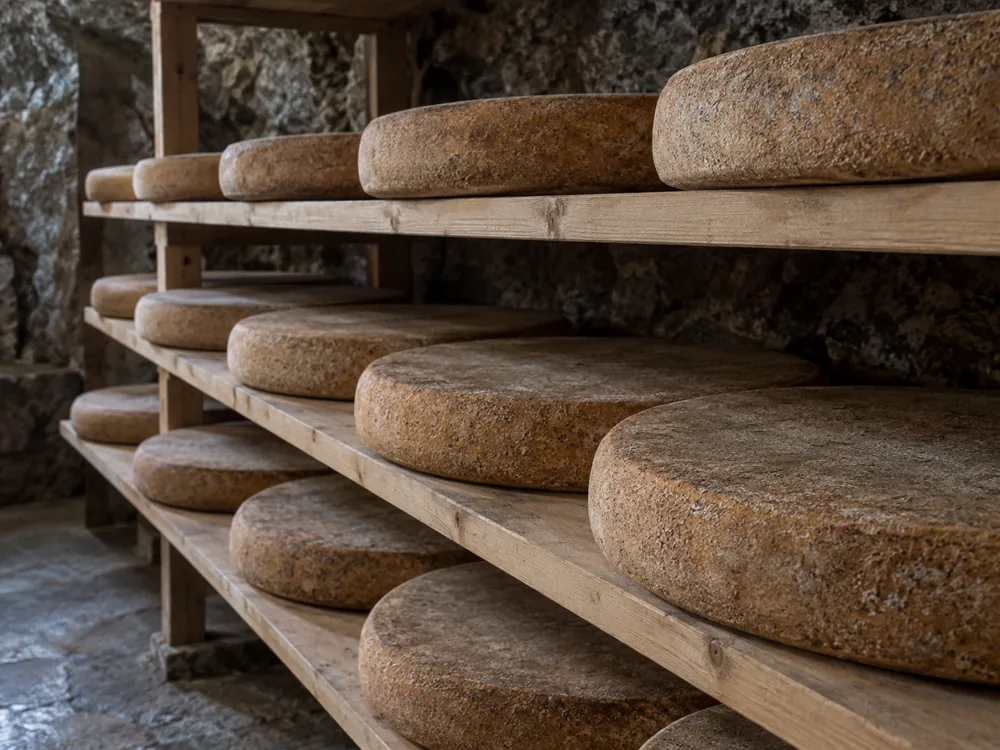
A Comté wheel spends a few weeks at the village dairy and then several months elsewhere, and the Jura Massif's affineurs each use their own ageing techniques.
Comté ages on locally harvested spruce boards, which Comté USA says protect microflora important to its taste. Gruyère generally ripens on wooden boards, turned every couple of days.
Comté affineurs use warm cellars at 57 to 66°F for faster ripening and cold ones at 44 to 57°F for slower change. The lactic microflora of raw milk also shape ripening, so Comté wheels aged in exactly the same way still vary.
Swiss Gruyère cellars run at 13 to 14°C and a humidity of 94 to 98%, where drier air dries the cheese out and too much humidity leaves it smeary and gluey. Wikipedia says cellars at 10 to 12°C produce lower-quality cheese, harder and more crumbly because it matures less.
The coloured band on Comté is a grade, which Wikipedia describes as a casein label, green with a bell logo for Comté Extra. Each wheel is tested after ageing and scored out of 20, and Comté USA gives more than 14 points for a green band and 12 to 14 points for a brown band.
A wheel under 12 points may not carry the Comté label. Wikipedia splits the 20 points into 9 for taste, 5 for texture, 3.5 for internal appearance, 1.5 for the rind and 1 for overall appearance, and bars any wheel with only 1 or 2 taste points.
Comté USA says a brown band may reflect only a small fault in the appearance of an otherwise excellent cheese. The band colour says nothing about the cheese's age or its aromas, so ask for the months separately.
Gruyère is checked at four months, when a neutral commission judges each wheel's holes, texture, outer appearance and taste. Only wheels that pass may carry the name Le Gruyère AOP.
Can You Substitute Comté for Gruyère?
For quiche, pastas and salads, each cheese is a named choice: Comté USA names quiches, pastas and salads for Comté, and Wikipedia names quiche, pastas and salads for Gruyère.
Peter Ungphakorn, a Swiss local and international trade expert whom Wikipedia quotes, says French Comté could be a closer match to the Swiss cheese than the French cheese sold as Gruyère.
Comté USA ties the dish to the age of the wedge: a young Comté melts well in pastas and sandwiches, and an older one adds more intense flavour to dishes from gratins to salads.
Fondue is the exception. Each variant in the fondue table above names its own cheeses, and on that list Comté is named only for fondue jurassienne.
Is French or American Gruyère the Same as Swiss Gruyère?
Not necessarily, because the name is protected differently in each market. In Switzerland the AOC became an AOP in 2013, and every Swiss producer must follow its rules.
French Gruyère is a separate cheese with EU PGI status, and it must state that it comes from France, so it is generally sold as French Gruyère. Its production area can be much larger than the Swiss one, and its rules call for holes from pea to cherry size.
A US district court ruled in 2021 that gruyere is a generic term in the United States, and the Fourth Circuit affirmed in March 2023, so the Swiss and French producers' associations could not register it as a trademark there.
Swiss Gruyère keeps a protected certification mark in the US, Le Gruyère Switzerland AOC, secured in 2013, and the FDA standard of identity for Gruyere requires small holes or eyes.
In the Swiss cheese, holes are optional: openings are possible but not essential, at 4 to 6 mm. Unlike Emmental, with which Gruyère is often confused, modern Gruyère has few if any eyes.
In the 21st century, researchers traced holes partly to microscopic hay dust in the milk, and modern milking lets in less of it. Hay flower powder restores the holes and is added in Germany and France, but additives of that kind are forbidden in Swiss cheeses.
How to Buy Comté and Gruyère
Swiss Gruyère carries its name on the wheel: the heel is embossed with Le Gruyère AOP and the dairy's number, and a casein mark gives the wheel number and the date it was made.
A Comté wheel carries a casein label on the side with the date of production. For either cheese, ask to see the wheel your piece is cut from, since its markings give the date it was made.
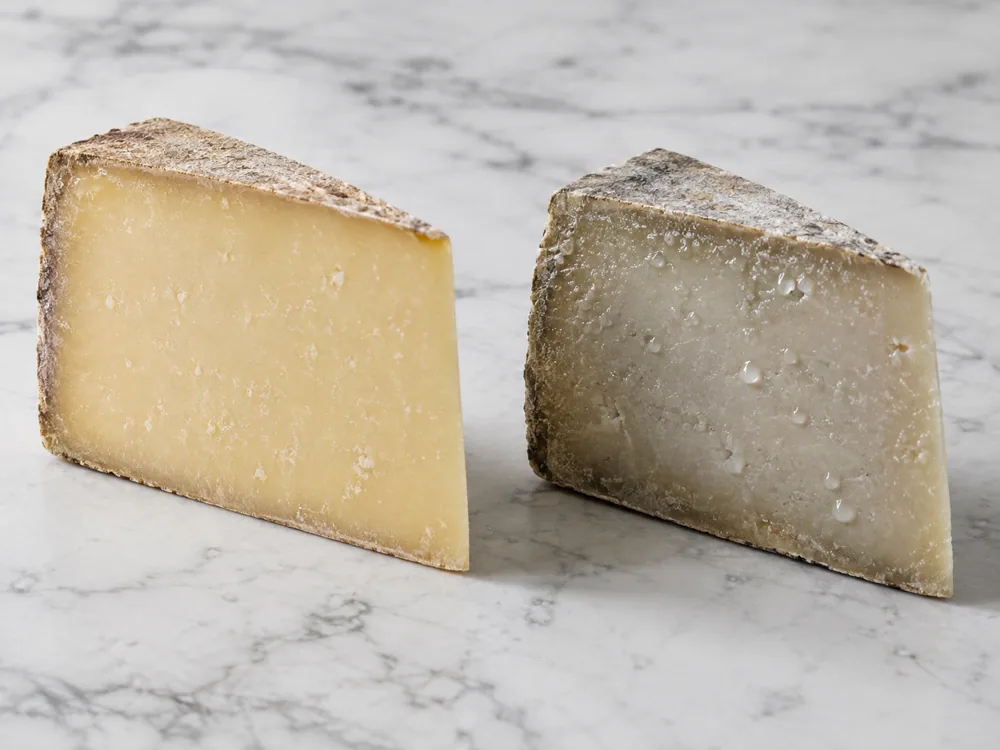
Comté USA recommends buying Comté cut to order and asking for a taste. By its checks, a good piece has a matte, even colour from ivory to straw yellow, while a grey piece or a wet surface points to poor refrigeration.
For storing and serving Comté at home, Comté USA gives these steps.
- Rewrap: move plastic-wrapped Comté into parchment or butcher paper, since long contact with plastic can leave it tasting of plastic or rancid.
- Store: keep the wrapped cheese in a covered container in the refrigerator, avoiding big temperature swings. The CDC says to keep a refrigerator at 40°F (4°C) or below.
- Serve: leave it at room temperature for one hour before a cheese course, Comté USA says.
Can You Eat Comté and Gruyère When Pregnant?
Both cheeses are made from raw cow's milk, and pregnancy advice on cheese from the NHS and the CDC treats raw-milk hard cheese differently. Gruyère is one of the agencies' own examples of a hard cheese, and Wikipedia gives Comté's texture as fairly hard but flexible.
The NHS lists pasteurised or unpasteurised hard cheeses, such as cheddar, gruyère and parmesan, as safe to eat. It also lists any cheese that's been cooked until steaming hot, including soft or blue cheese, as safe to eat.
The CDC lists unpasteurized (raw) milk and dairy products made from raw milk as a riskier choice, and hard cheese, when made with pasteurized milk, as a safer choice. It also says pregnant women are 10 times more likely to get a Listeria infection.
For raw-milk Comté and Le Gruyère AOP, the NHS hard-cheese line and the CDC raw-milk line give different answers, so ask a midwife or doctor if you are unsure.
Comté or Gruyère: Which Should You Buy?
Buy the cheese your recipe names, as the fondue table above shows.
Beyond fondue, the dishes named for each cheese differ: Wikipedia ties Gruyère to French onion soup, croque-monsieur and chicken or veal cordon bleu, and Comté USA lists frittatas, macaroni and cheese, paninis and polenta for Comté.
Choose Gruyère for the Swiss fondues and other recipes that name it, and Comté for fondue jurassienne. For quiche, pasta and salads, both cheeses are named, and Comté USA matches a young Comté to pastas and an older one to salads.
SOURCES & REFERENCES
What Else Do People Ask About Comté and Gruyère?
Short answers to the questions people ask once both wedges are on the counter.
No. Comté is made in the Jura Mountains in France from Montbéliarde or French Simmental milk and aged at least 4 months, while Le Gruyère AOP is Swiss and aged at least 5 months. Both use raw cow's milk and copper vats.
Use the cheese the recipe names. The Swiss variants Wikipedia lists, such as Vaudoise and moitié-moitié, use Gruyère, while fondue jurassienne uses mild or mature Comté.
No. Comté USA says the green band marks a wheel scored above 14 out of 20, and the band colour says nothing about age or aroma.
Both are named for quiche, pastas and salads, Comté by Comté USA and Gruyère by Wikipedia. For fondue, use the cheese the recipe names.