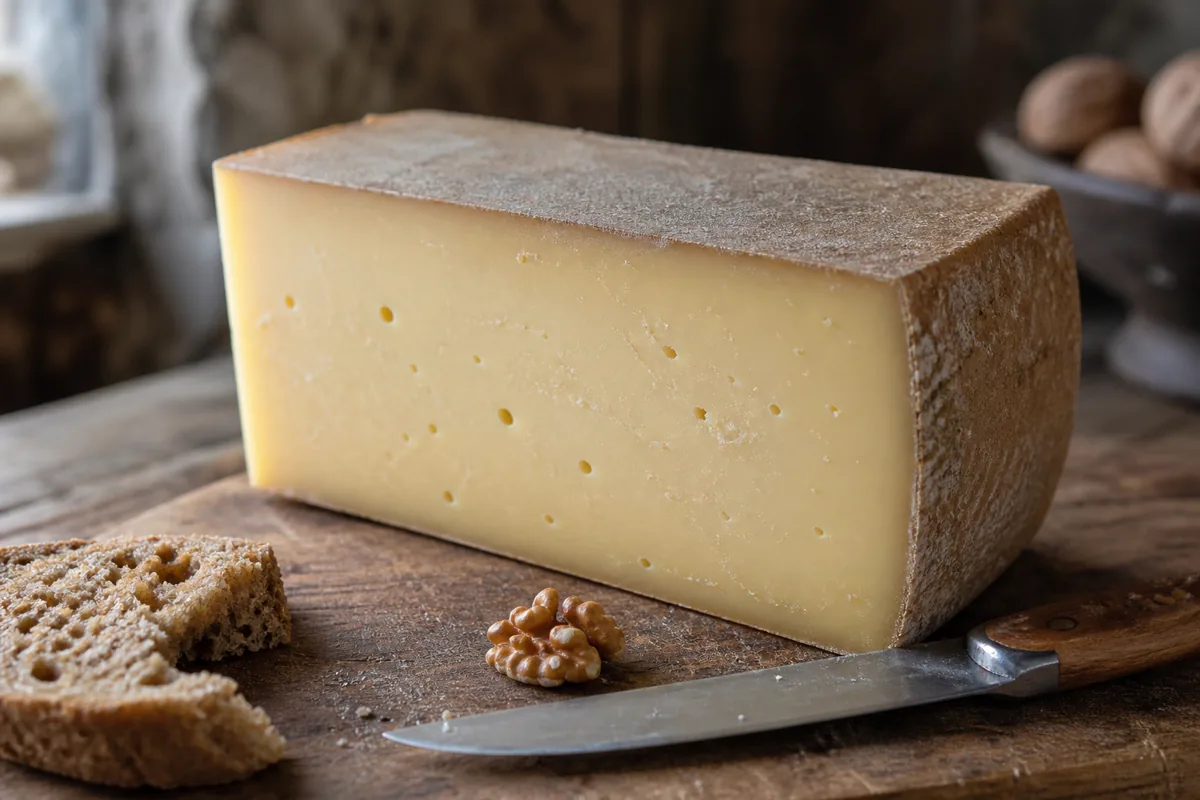
Comté is a French AOP cheese made from raw cow's milk in the Jura Massif, pressed and cooked into wheels of 32 to 45 kilograms. Every wheel ripens for at least 120 days on spruce boards before it can leave the cellar.
When you buy a piece, two things tell you the most about it: the age, when the seller gives one, and the color of the band on the side of the wheel it came from.
In This Article
What Does the Comté Name Guarantee?
A cheese sold as Comté must be a pressed, cooked cheese made only from cow's milk that is worked raw, under the specification France's INAO publishes for the name. Before renneting, that milk may not be heated above 40 degrees Celsius.
The milk must come from Montbéliarde or French Simmental cows, or certified crosses of the two, and silage and every other fermented feed are banned for the dairy herd all year.
The protected area covers nearly all of the Jura department, much of the Doubs and parts of the Ain and Saône-et-Loire in eastern France. Milk production, cheesemaking and ripening all happen inside it, and prepacked portions must be cut there too.
How Big Is a Wheel, and What Does the Paste Look Like?
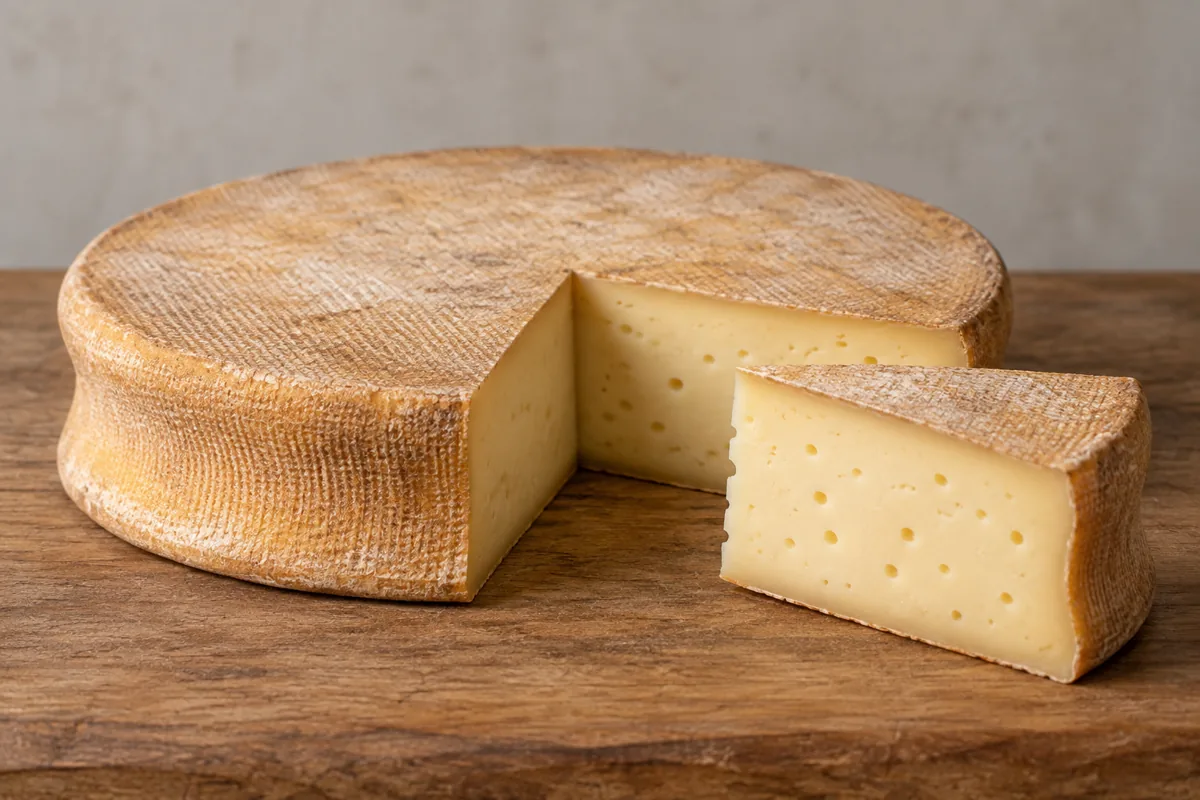
A whole Comté wheel is 55 to 75 centimeters across and 8 to 13 centimeters high at the side, and it weighs 32 to 45 kilograms.
| Question | Answer | Source |
|---|---|---|
| How wide is a wheel? | 55 to 75 cm | INAO specification, 2012 and 2024 texts |
| How tall is it at the side? | 8 to 13 cm | INAO specification, 2012 and 2024 texts |
| How heavy is it? | 32 to 45 kg; about 80 lb (roughly 36 kg) | INAO specification; Taste of Home |
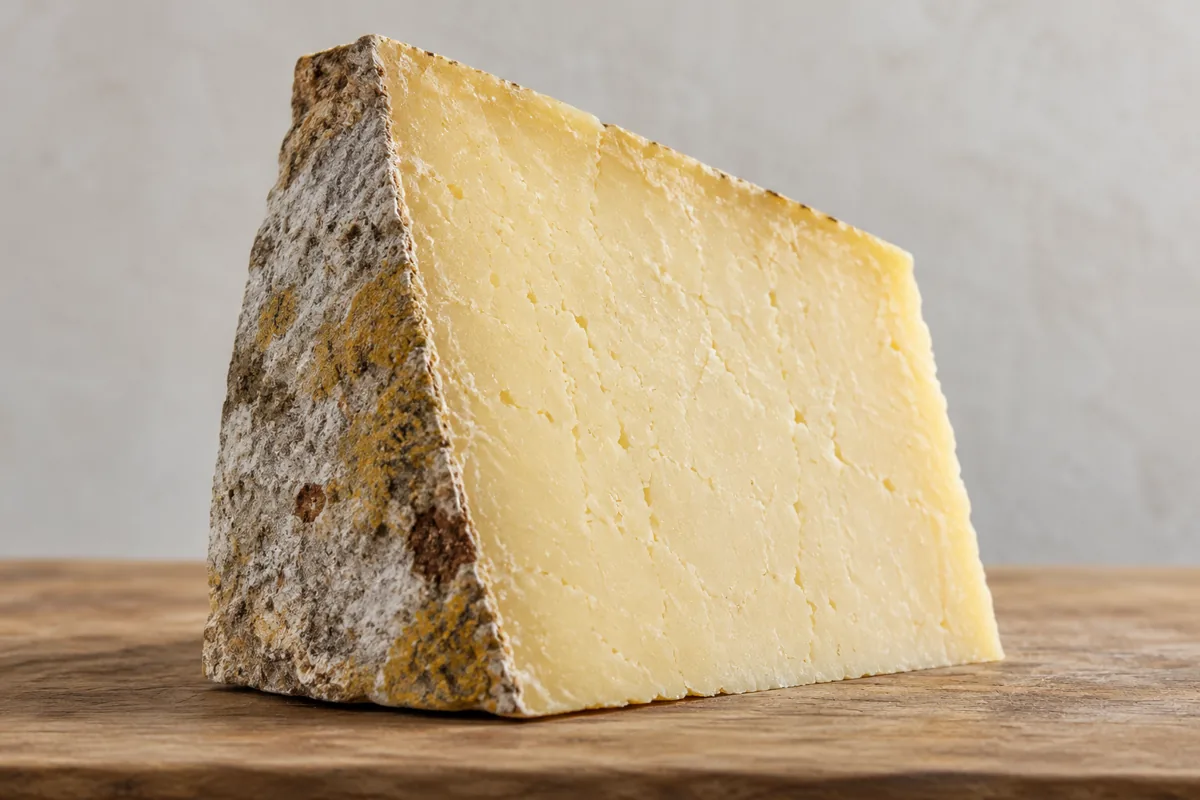
| What does the rind look like? | Rubbed, firm and grainy; golden yellow to brown in the 2012 text, ochre yellow to brown in the 2024 text | INAO specification and 2024 amendment |
| What color is the paste? | Ivory to yellow | INAO specification, 2012 and 2024 texts |
Cut open, the paste generally shows some holes, which can reach the size of a small cherry.
The size follows from the land. On the Jura plateaus, with their poor soils, steep relief and long winters, a large hard cheese was the only way to preserve the abundant summer milk through the cold months.
Farmers pooled their milk each day in village cooperatives to fill one large wheel, and plentiful firewood nearby favored a cooked paste. The long ripening is what makes Comté a keeping cheese.
What Do Comté Cows Eat, and Why Does It Matter?
Almost every dairy cow in the Jura Massif is a Montbéliarde, one of the two permitted breeds, and breeders chose it for the terrain and for making a large cooked, pressed cheese.
Grass comes first. The cows go out to pasture after the snow melts and stay out as long as weather, ground and grass allow, and farms that feed everything at the trough during the growing season are banned.
Extra green fodder is limited to one feeding a day while plants are growing, so the pasture meal must supply at least half of the daily coarse fodder ration.

Silage and plastic-wrapped bales are among the fodders that risk contaminating milk with butyric bacteria, and fermented feed also brings technical risks during cheesemaking and ripening.
Fodder that gives the milk an unwanted smell or taste is barred as well, by name: leeks, cabbage, rapeseed, turnips, beet leaves and mustard, along with flavored forage and flavored concentrates.
| Grass per cow | At least 1 hectare in the 2012 text; 1.3 hectares in the 2024 text |
| Herd density | No more than 1.3 livestock units per hectare of forage land (2012 text) |
| Mineral nitrogen | An average of no more than 50 units per hectare of forage land (2012 text) |
| Milk per hectare | Capped at 4,600 liters a year per hectare of forage land (2012 text) |
| Extra feed | No more than 1,800 kilograms per cow per year (both texts) |
| Local forage | At least 70 percent of the daily ration is forage from the area (2012 text); in the 2024 text, forage is at least 70 percent of the ration and at least 95 percent of it comes from the area |
These limits exist because studies after 1994 showed that intensive farming limits how much of the terroir shows in the cheese, so the rules aim to keep grassland extensively used.
A flower-rich meadow is the other half of the argument. A 1996 survey of the land of 60 fruitières counted 576 plant species, an average of 130 per fruitière.
How Fresh Is the Milk When It Becomes Comté?
Every Comté is made from the mixed milk of several farms and herds, so a farmhouse Comté cannot exist.
A dairy may use the milk of two consecutive milkings per farm at most. Renneting must happen before noon when the oldest milk is from the previous morning, or before midnight when it is from the previous evening.
Each dairy collects its milk within a circle no more than 25 kilometers across, and that short transport spares the milk structural damage, so it can be worked raw and its own lactic flora can develop.
Raw milk carries its own lactic bacteria, and Comté's rules protect their role. A starter grown on raw whey is mandatory, and selected lactic cultures are allowed only if the milk's wild flora keeps the leading part.
How Do Fruitières Make Comté?
The fruitières are the village cheesemaking dairies, usually cooperatives owned by the farms that deliver to them. There are about 140 fruitières, supplied by over 2,000 small dairy farms.
A single wheel takes about 100 gallons of milk, roughly 380 liters, and the vat rules listed below cap each batch at 12 wheels.
| Vat | Copper, and only open vats; at most 12 wheels per vat and three batches per vat in 24 hours, with brushing and washing between batches |
| Vats per dairy | At least 2, and at most 5 per cheesemaker |
| Curd heating | At least 53 degrees Celsius for at least 30 minutes |
| Pressing | At least 100 g per square centimeter for at least six hours, in a room no colder than 12 degrees Celsius |
| Method | Manual; only the heating and the pressing may be pre-programmed |
Those limits are there to protect the cheesemaker's skill. The aroma nuances show only if that skill can express itself, and a limited number of vats plus the open-vat rule preserve it.
What Happens to a Comté Wheel in the Cellar?
Ripening starts at the fruitière and continues with an affineur, the specialist who ripens the wheels, and the move happens after a few weeks. Every wheel must have at least 21 days of pre-ripening at 10 to 15 degrees Celsius and above 90 percent humidity.
Each wheel must be dry-salted on its surface and heel within 24 hours of leaving the mold, then rubbed with morge on both faces and the heel within 36 hours, and the first 72 hours of rubbing must be done by hand.
Morge is the surface smear that forms the rind. Its liquid form is made by rubbing well-covered wheels with clean brine saturated with salt, and wheels are turned, salted and rubbed with brine, with or without morge, throughout ripening.
Only salt and morge strains may touch the rind. Every colorant is banned, along with any antibacterial or antifungal agent that could harm the surface smear, so no dye produces the rind's color.
Every wheel rests on a spruce board from the Jura Massif, washed without any product that could hold back the morge, and boards that carried a batch with an abnormal rind are washed and dried again. Comté USA cites studies that found the wood protects specific microflora that the taste and the sanitary quality of Comté depend on.
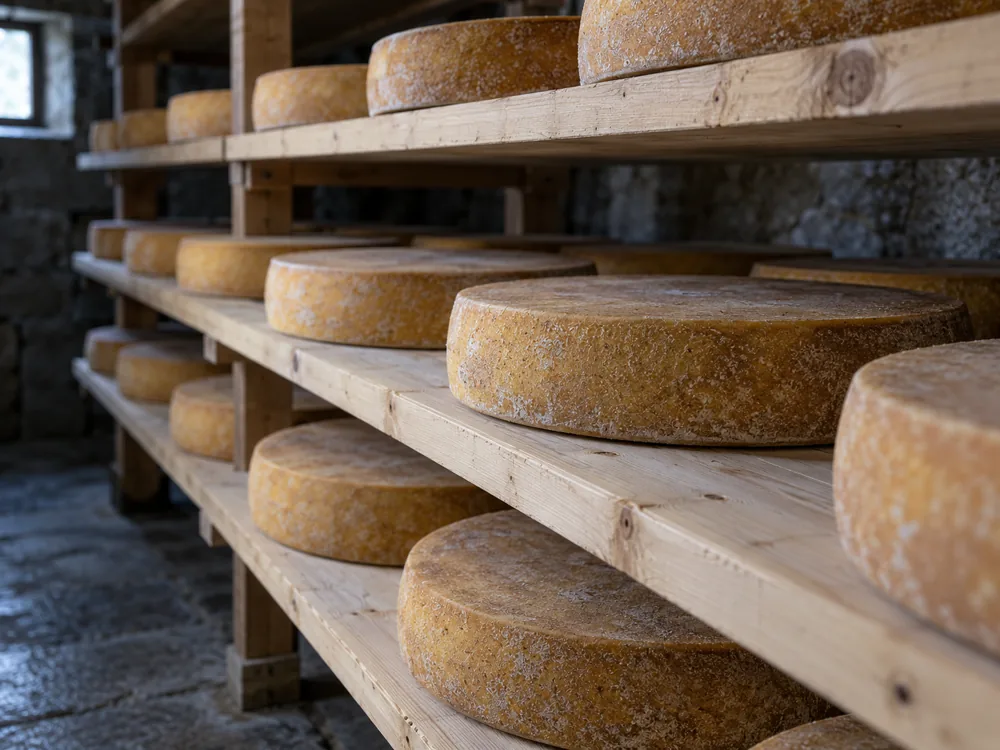
Affineurs run warm cellars at 57 to 66 degrees Fahrenheit, where ripening is faster and certain flavors develop, and cold cellars at 44 to 57 degrees, where it is slower and the flavors differ. The top of the warm range, about 19 degrees Celsius, is also the legal ceiling: no Comté cellar may be warmer than 19 degrees Celsius.
The Jura Massif has 14 affineurs, each with its own techniques shaped by location, cellar atmosphere and style. One of them, Fort des Rousses, ages 100,000 wheels and moves them between rooms with slightly different conditions.
How Old Is Comté When You Buy It?
Every Comté has ripened for at least 120 days, about four months, counted from the day of renneting to the day the wheel leaves the cellar. From there, ripening can run to 18 or 24 months or longer, depending on the wheel, and the average is about eight months, with some wheels past 24.
Shops often carry two ages, with different flavors and textures.
| Younger Comté | Long-matured Comté |
|---|---|
| Fresh butter, dried apricots and soft caramel (Comté USA, flavors page) | More fruity, spicy and nutty (Comté USA, flavors page) |
| Aged only a few months and creamier, the wheels Taste of Home recommends for cooking | Older, firmer profiles that suit a charcuterie board (Taste of Home) |
When you see an age on a Comté label, read it as a minimum. Under the 2024 amendment approved by INAO's national committee, an age is optional, and when one appears it gives the minimum number of months the cheese spent with an approved affineur.
The amendment counts that age up to the date the last operator in the chain put the cheese on the market, and nobody may reinterpret or change the figure. It also reserves the words "affiné par" ("aged by") for approved operators in the protected area.
In older Comté, small white crystals sometimes appear that look like salt but are the amino acid tyrosine.
Amino acids build up as the cheese matures. Comté USA ties that build-up to the rich flavor and says proline, alanine, glycine, serine and threonine give a sensation of sweetness.
What Do the Green and Brown Bands Mean?
The band shows the grade a wheel earned before it left the cellar, where the affineur scores it out of 20 on presentation, paste texture and taste. Wheels scoring 14 or more get a green band.
A score of 12 to 14 still earns the name with a brick-brown band, but only if taste scored at least 6.5 out of 10. Those wheels are reserved for sale cut at the counter, and a wheel below 12 cannot be sold as Comté.
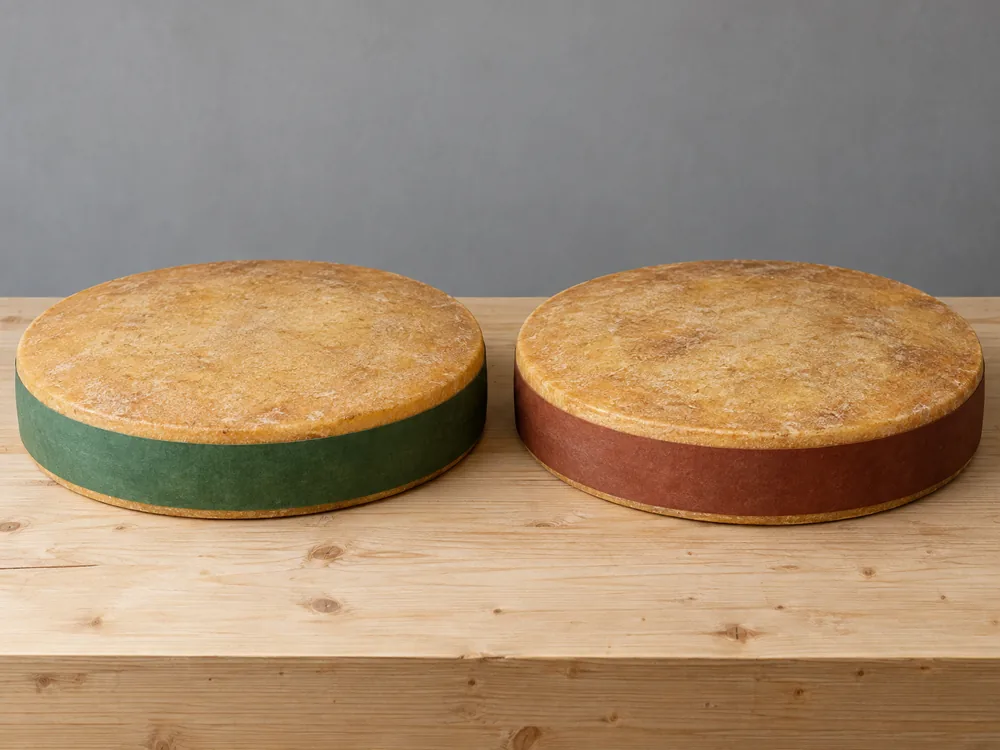
Both bands are authentic Comté, and both mean at least four months of ripening. The band color has no bearing on a cheese's age or aromatic profile.
Comté USA calls the green-band grade Comté Extra and says a brown band may reflect only a small fault in the appearance of an otherwise excellent cheese.
If you want a brown-band piece, look for it at a counter, since brown-band wheels are limited to counter sale and prepacked portions come from green-band wheels. Every consumer portion must carry the green bell logo.
Comté USA words the green band as over 14 points, while the specification says a minimum of 14. The specification draws its lines at 12 and 14 only, so a wheel scoring 14 carries the same green band as one scoring 18.
A whole wheel also carries a green oval casein plate on its side, printed with France, Comté, the dairy's number and the month it was made. A second plate nearby gives the day.
Each wheel carries a sheet naming its affineur as well, and under the 2024 text neither that sheet nor the band may be removed before the cheese reaches the final consumer. At a counter, ask to see the band and the sheet on the wheel your piece is cut from.
Why Do Two Wedges of Comté Taste Different?
No two wheels of Comté are strictly identical, even though every wheel shares the same general sensory range of six aroma families: fruity, lactic, roasted, vegetal, animal and spicy.
The count of nuances inside those families differs: more than 90 in the specification, and 83 descriptors in Comté USA's list. The variation comes from four things: where the milk comes from, the season's feed, the cheesemaker's work and the length of ripening.
Comté's aromas are tied to the many flowering plants in Jura meadows, a link the specification backs with two scientific studies from 1994. The aromas the grass and the microbes produce are complete only after a long ripening.
Where the milk comes from shows in the 1996 survey behind the plant count above, which also found that fruitières in different areas make Comté with distinctly different aromatic profiles, while wheels from one region share certain flavors.
Season shows in color as well as taste: winter wheels, made from the milk of cows fed local hay, are paler than wheels made in spring, summer and autumn, when the cows graze fresh plants high in carotene. Even in one pasture the mix of plants changes from month to month, so the diet keeps shifting.
On a whole wheel at the counter, the casein plate gives the month the cheese was made, so you can tell whether your piece was cut from a winter wheel.
Cheesemakers adapt their techniques to the milk they receive, and affineurs choose the cellars and direct the ripening of each wheel. The raw milk's own lactic bacteria, still alive in the cheese, also steer how a wheel matures, so wheels ripened in exactly the same way can still come out different.
How Do You Cook with Comté and What Do You Serve with It?
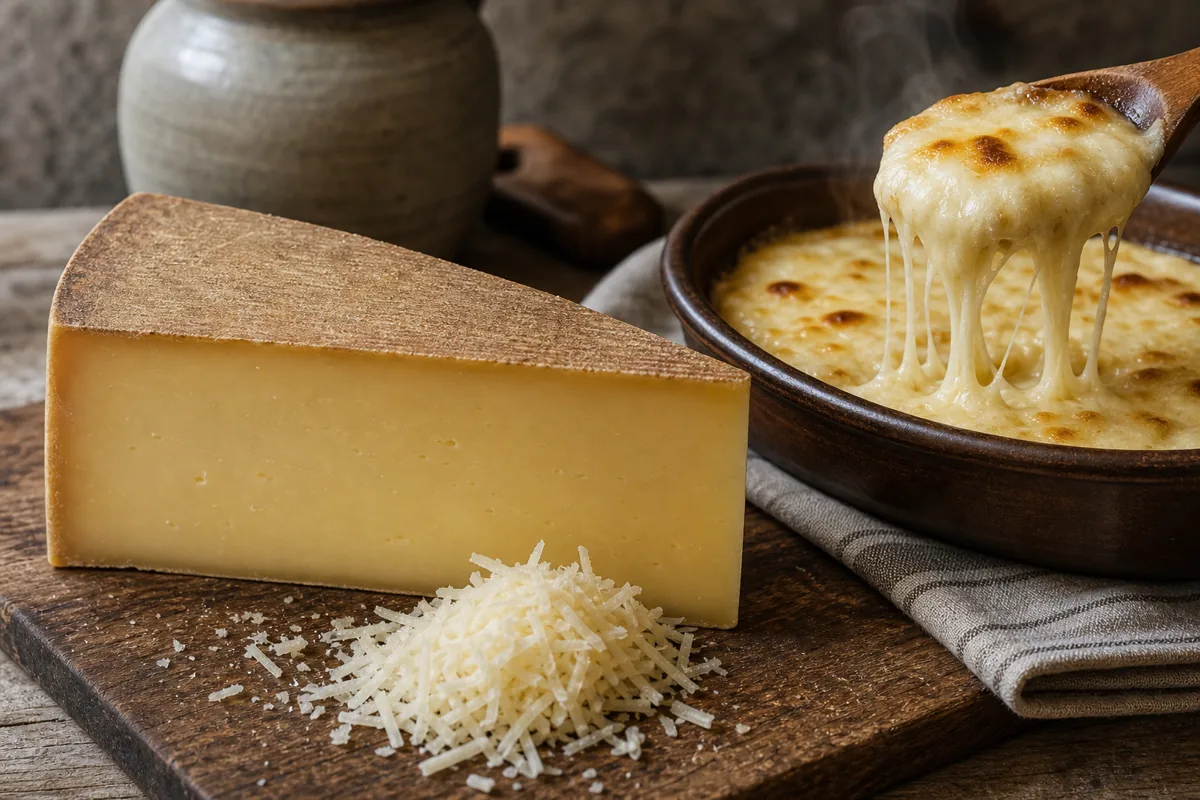
Taste of Home calls Comté a cooking cheese that melts beautifully, recommends wheels aged only a few months for their creamier texture, and says Comté can stand in for any melting cheese in a recipe in equal amounts.
Comté goes into dishes from macaroni and cheese and grilled cheese sandwiches to quiche, au gratin potatoes and croque madame, as well as soufflés and gratins.

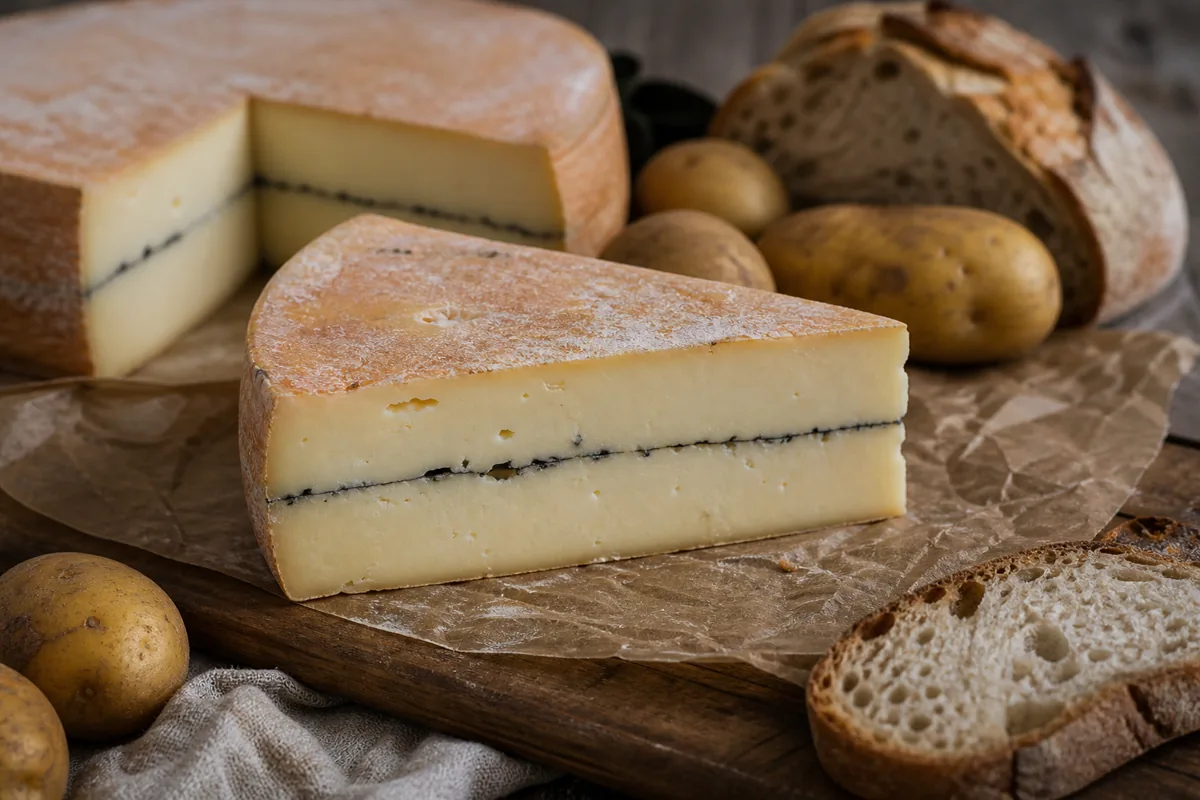
For a charcuterie board, Taste of Home keeps the older, firmer wheels and serves them with simple accompaniments. The first wine it names stays close to home: the white wines of the Jura, the region the cheese comes from, with its other wine suggestions listed below.
| Pairing | Type | Why It Works |
|---|---|---|
| White wines of the Jura | Wine | Taste of Home lists them first. |
| Young fruity red or sparkling wine | Wine | Taste of Home's other wine suggestions. |
| Toasted nuts, rich preserves and cured meats | Food | Taste of Home suggests them with older, firmer wheels on a charcuterie board. |
How Should You Buy, Store and Serve Comté?
Taste of Home advises buying Comté cut to order where you can and asking for a taste, especially when you are deciding between two ages.
A prepacked portion of more than 40 grams must keep a piece of the grainy rind that still shows the imprint of the cloth or mold; smaller portions and grated Comté may be sold without rind.
Grated Comté can carry the name too, but only when it comes from wheels that qualified for it and the grating happens inside the protected area.
For prepackaging, wheels must be cut within 15 days of leaving the cellar under the 2012 text, a window the 2024 text widens to one month.
At home, rewrap a plastic-wrapped piece in parchment or butcher paper and keep it in the refrigerator in a container that lets in a little air. The CDC says to keep a refrigerator at 40 degrees Fahrenheit (4 degrees Celsius) or below.
If your piece has sat in plastic, scrape away the surface that touched it, along with any plastic flavor, and eat cut Comté within a week of buying.
For a cheese board or cheese course, Taste of Home says to let the cheese come to room temperature before serving, and the CDC says never to leave perishable food out for more than 2 hours, or 1 hour above 90 degrees Fahrenheit.
Which Cheeses Can Replace Comté?
If you cannot find Comté, Gruyère is the first substitute Cheese.com names: both cheeses have a rich, nutty flavor with a mild sweetness, and Gruyère, which comes from Switzerland, tastes a little more robust, so it suits dishes where the cheese has to stand out.
For melting, the list turns to Emmental, which has larger eyes and a slightly softer, more pliable texture than Comté and suits dishes such as quiche and croque-monsieur.
Fontina, a mild, buttery Italian cheese with a slightly fruity note, melts well into sauces, risottos and gratins. It may taste milder than Comté, so adjust the amount to taste.
Use Parmesan only as a topping or accent, and slightly less of it than the Comté a recipe calls for, since its flavor is stronger, saltier and more crumbly than Comté's delicate nuttiness.
Cheddar fits dishes where its sharp, tangy taste will not take over the other ingredients, though it is firmer and crumblier than Comté's smoother texture.
Gouda is creamy and buttery and melts well, and it is a little sweeter than Comté, which suits sandwiches and pasta bakes where the sweetness is welcome.
Jarlsberg, a mild, nutty Norwegian cheese with larger holes and a slightly sweeter profile, may also taste milder than Comté.
How Much Fat, Salt and Calcium Is in Comté?
Comté holds 45 to 54 grams of fat per 100 grams of dry matter, and the cap sits at 54 grams because more fat could bring off-flavors from fat breakdown.
That fat figure is measured on the dry matter, and every 100 grams of Comté must hold at least 62 grams of dry matter, so a 100-gram piece carries at least 27.9 grams of fat, which is 45 percent of 62 grams.
| Question | Figure | Source |
|---|---|---|
| How much fat? | 45 to 54 g per 100 g of dry matter | INAO specification |
| How much dry matter? | At least 62 g per 100 g of cheese | INAO specification |
| How much moisture in the fat-free part? | At most 54 percent | INAO specification |
| How much salt? | At least 0.6 g sodium chloride per 100 g as a legal minimum; 0.8 g per 100 g as the producer figure | INAO specification (minimum); Comté USA (producer figure) |
| How much calcium? | 298 mg per 1 oz (30 g) serving, about a third of the daily value | Comté USA |
The dry matter floor and the moisture ceiling work together to limit excess water in the cheese and let the aromas show, and the salt floor serves the same purpose.
Comté USA calls Comté one of the least salty cheeses, setting its 0.8 grams per 100 grams against the 1.5 to 2 grams it says most cheeses contain, and also calls it rich in protein, with every essential amino acid, and in vitamins A, B2, B12 and D.
The low salt figure is somewhat paradoxical: wheels are rubbed with salt throughout ripening to form the rind, yet very little of that salt is absorbed, and certain amino acids heighten the impression of saltiness.
Is Comté Safe During Pregnancy?
The NHS and the CDC answer differently for a raw-milk hard cheese, and Comté is a pressed, cooked cheese made from raw milk.
The NHS lists pasteurised or unpasteurised hard cheeses, such as cheddar, gruyère and parmesan, as safe to eat in pregnancy, and it also lists any cheese cooked until steaming hot as safe.
The CDC lists hard cheese as safer only when it is made with pasteurized milk, and puts dairy products made from raw milk and unheated cheese sliced at a deli on its riskier list. It adds that pregnant women are 10 times more likely to get a Listeria infection.
The CDC also lists deli-sliced cheese heated to 165 degrees Fahrenheit or until steaming hot as safer. For raw-milk Comté, the NHS hard-cheese line and the CDC raw-milk line give different answers on safe cheese during pregnancy, so take the question to your clinician.
SOURCES & REFERENCES
What Else Do People Ask About Comté?
Yes. Comté must be made from cow's milk worked raw, heated to no more than 40 degrees Celsius before renneting.
At least 120 days by rule, and a wheel can go to 18 or 24 months or longer.
Green goes to wheels scoring 14 or more out of 20. Brown goes to wheels scoring 12 to 14 whose taste scored at least 6.5 out of 10, and those are sold only cut at the counter.
The small white crystals sometimes seen in older Comté look like salt but are the amino acid tyrosine.
No. Comté must be made with rennet from a calf's stomach.
Cheese.com names Gruyère first. Emmental and Fontina follow for melting, and Parmesan and cheddar are listed for dishes where a stronger flavor is welcome.
Taste of Home says Comté melts beautifully and recommends wheels aged only a few months for cooking.