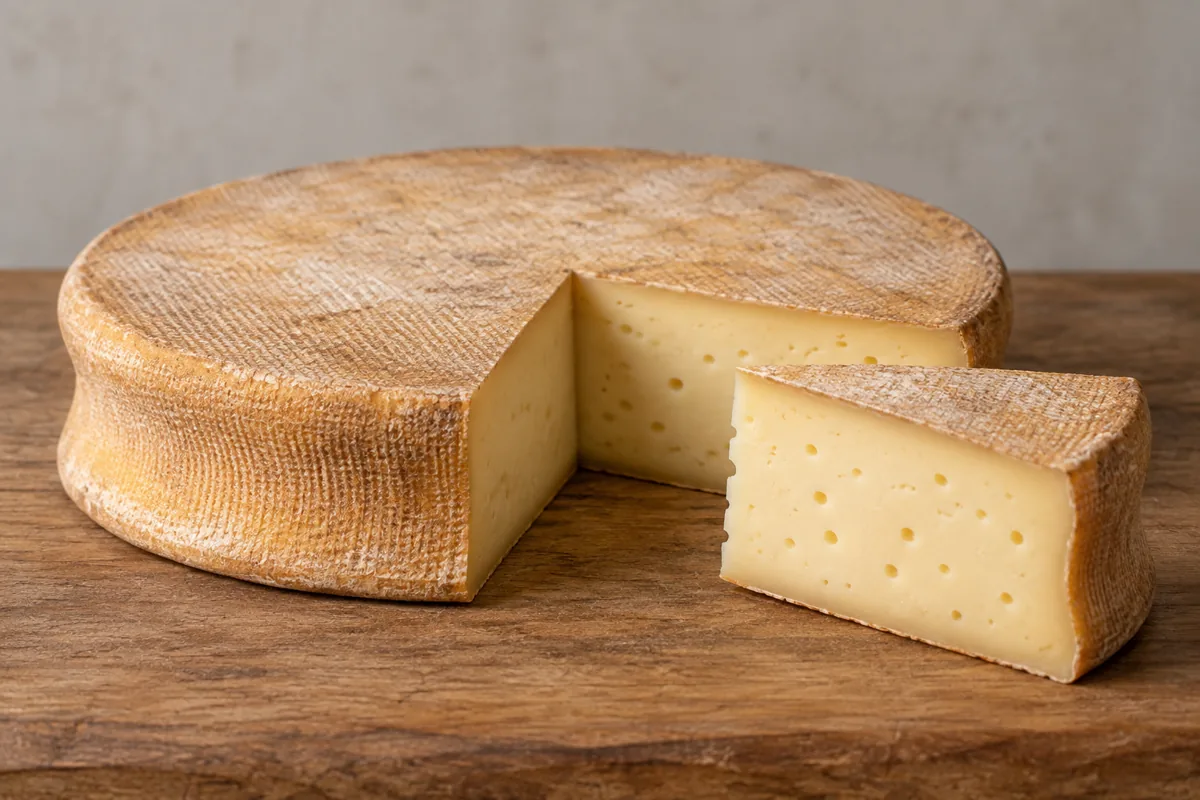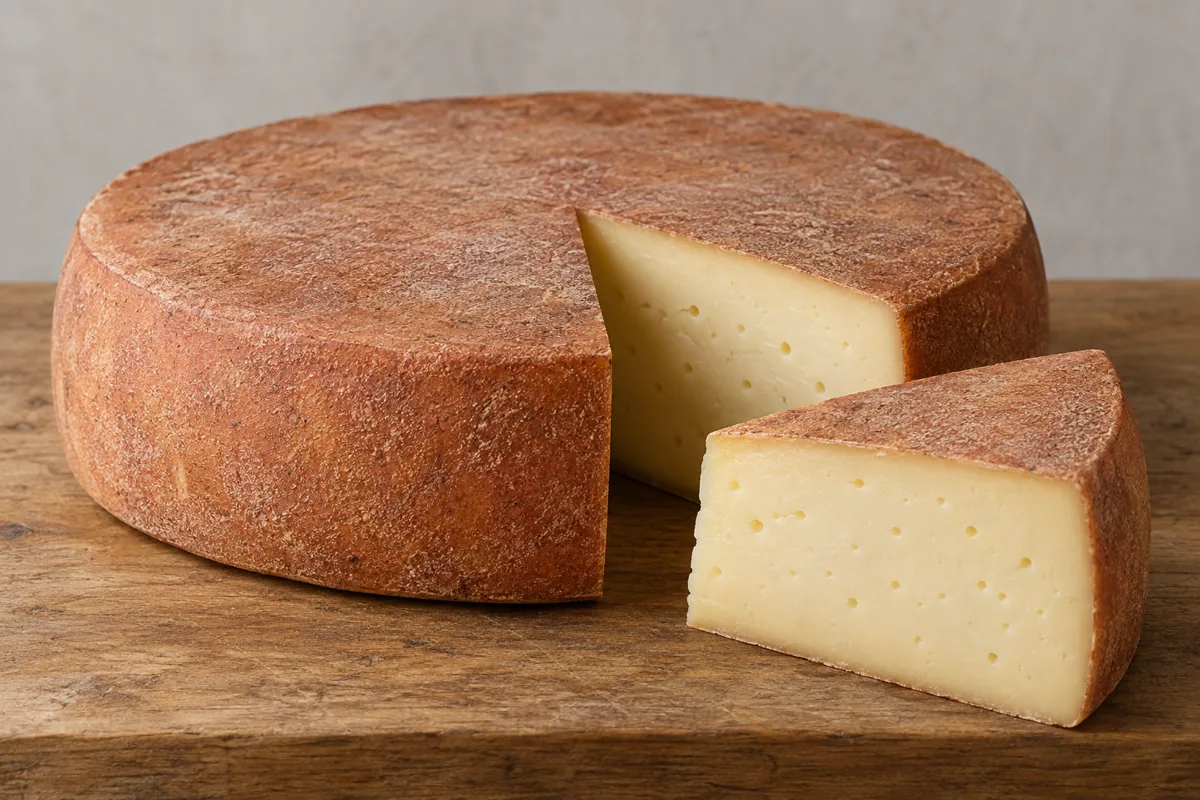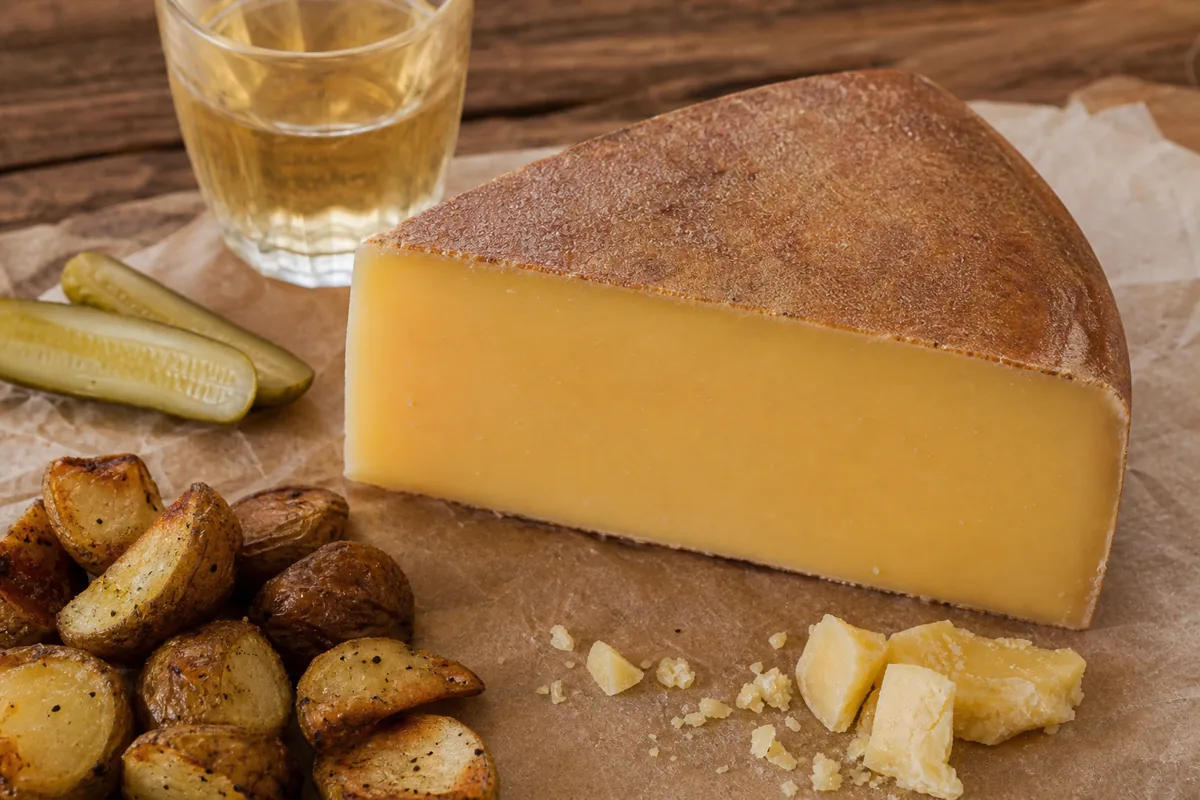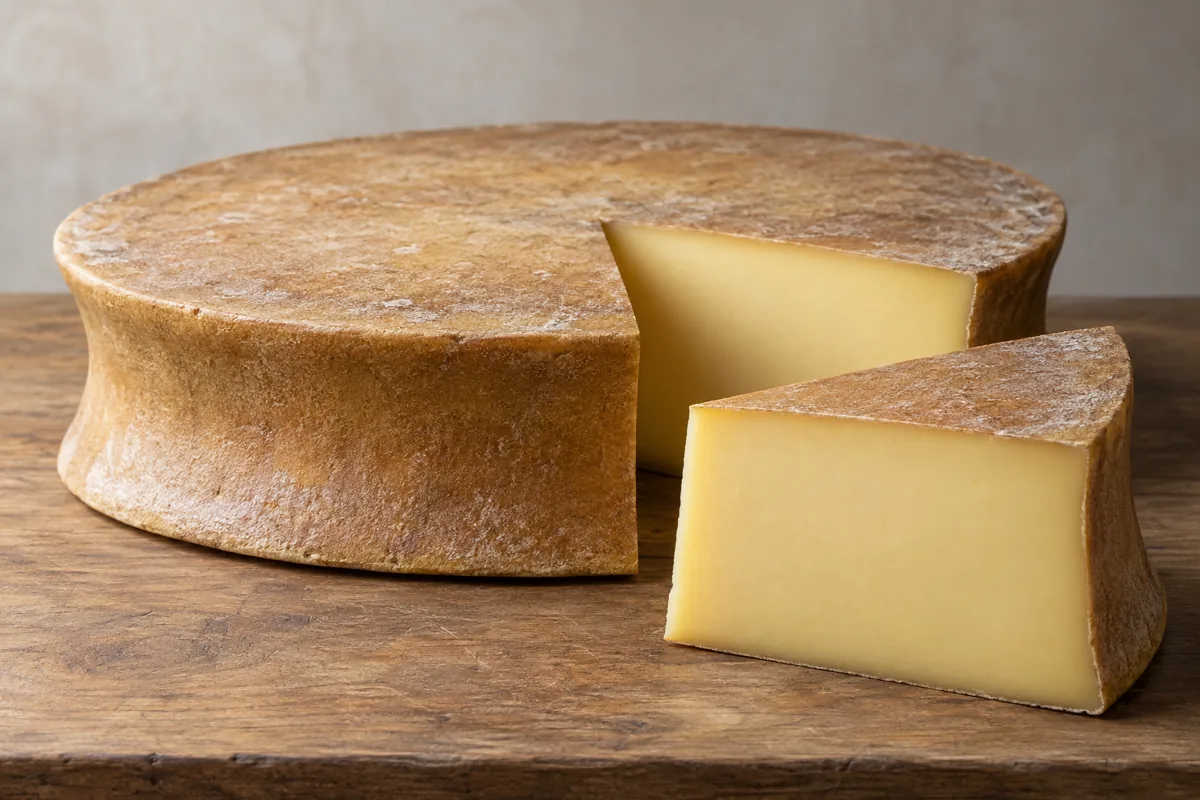
Beaufort is a raw cow's milk cheese from Savoie in the French Alps, protected as an AOC since 1968 and made in flat wheels of about 40 kg whose sides curve inward.
Chalet d'alpage is the rarest of its three sales names. It marks summer cheese made twice a day in a mountain chalet above 1,500 metres, from the milk of a single herd.
The name on a wedge also tells you the season of the milk, and the producers' union says season changes both the colour and the strength of the cheese.
In This Article
What Is Beaufort Cheese?
Beaufort is a cooked pressed cheese made from raw whole cow's milk, and INAO, the French body that manages protected food names, allows milk only from Tarine or Abondance cows.
The union calls the Tarine, a breed from the Tarentaise valley, the symbol of the AOP and describes a sturdy cow with a plain rust-coloured coat, black feet and lyre-shaped horns. French Wikipedia describes the Abondance, the other permitted breed, as a red and white cow with a dark red coat and a white head, belly and legs.
The press kit of the Syndicat de Défense du Beaufort, the union that manages the AOP, says the milk is neither pasteurized nor skimmed.
INAO's specification names the production communes one by one: more than 100 communes in Savoie, spread over the Beaufortain, Maurienne and Tarentaise valleys and part of the Val d'Arly, plus Praz-sur-Arly and part of Les Contamines-Montjoie in Haute-Savoie. The union puts the area at 450,000 of the 630,000 hectares in the Savoie department.
From June to October the herds graze high pastures between 1,500 and 2,500 metres, and hay cut in the valleys feeds them in winter. INAO bans silage and other fermented feed.
INAO also requires that at least 75 percent of the hay and pasture a herd eats come from the production area.
- Weight: 20 to 70 kg per wheel under INAO rules, about 40 kg on average according to the union
- Diameter: 35 to 75 cm
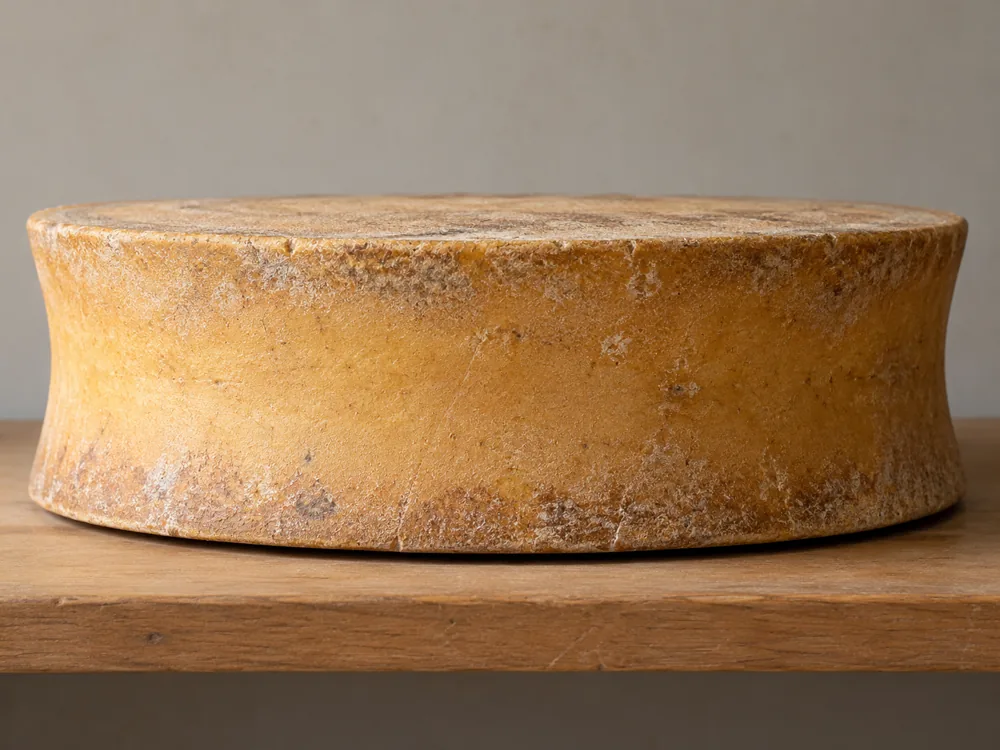
- Side height: 11 to 16 cm, with a concave side
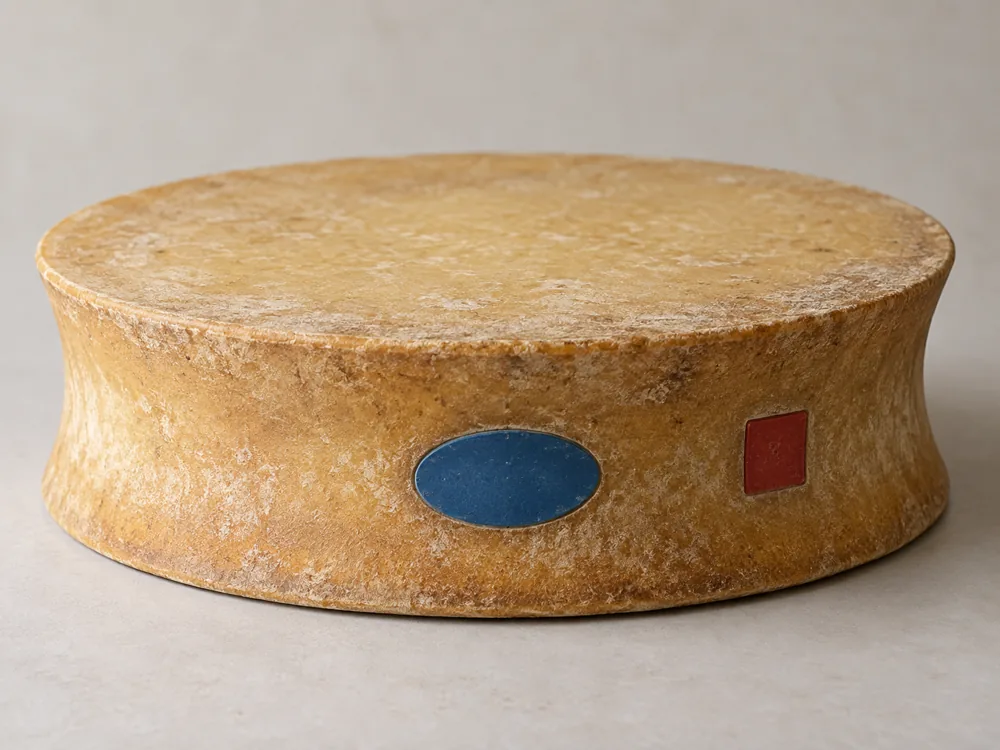
- Identity mark: a blue oval casein plate on the wheel, according to the union's press kit
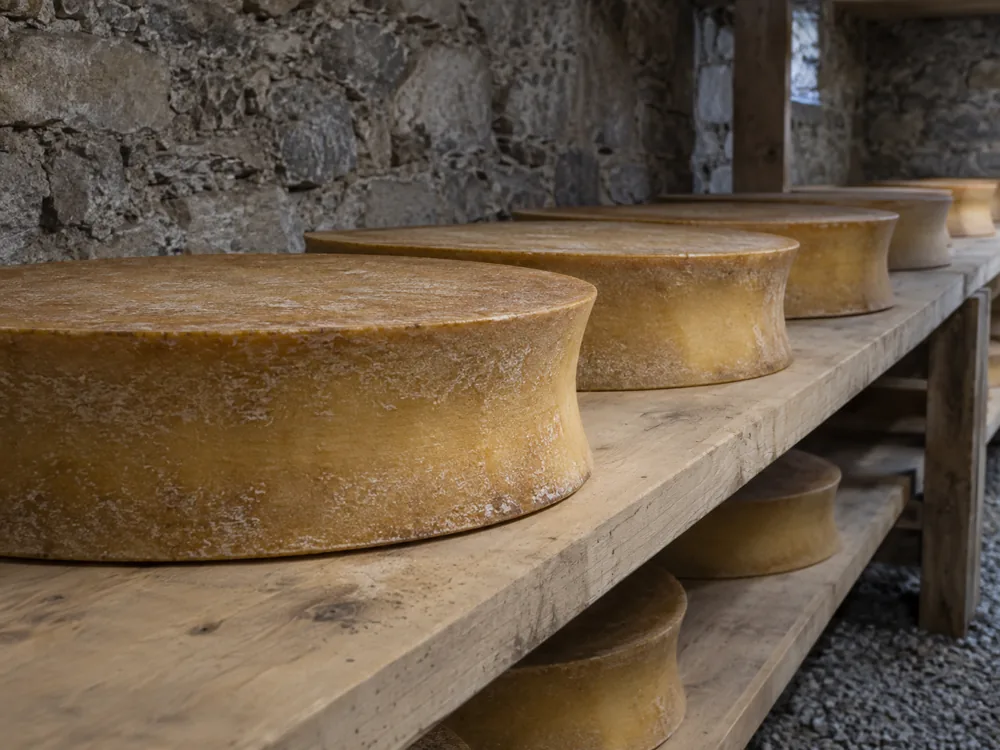
The inward curve of the side is called the talon concave. It comes from the wooden circle that holds the curd during moulding.
INAO's specification adds that the circle's diameter can be adjusted and that a rounded ridge on its inner face presses the curve into the cheese. It names three jobs for the shape: absorbing the large swings in how much milk a mountain chalet makes, keeping heat inside the cheese while it presses, and steadying the form of the wheel.
French Wikipedia gives two possible reasons for the shape: it stops the wheel from sagging while it ages, and it once made it easier to rope wheels onto a mule for the trip down from the high pastures.
What Do Beaufort d'Été and Chalet d'Alpage Mean?
Every wheel is sold under one of three names, and each name fixes when the milk was collected and, for chalet d'alpage, where the cheese was made.
| Name | Milk season | How it is made | Colour and flavour |
|---|---|---|---|
| Beaufort | November to May | Milk from cows back in the barn and fed mainly on hay | Lighter in colour, generally very mild |
| Beaufort d'été | June to October | Includes milk from the mountain pastures | Darker yellow, more pronounced flavours |
| Beaufort chalet d'alpage | June to October | In a chalet above 1,500 m, twice a day, from one herd, with warm milk straight after milking | Usually darker, with stronger flavours that fade slowly |
Chalet d'alpage is the smallest group, at about 400 tonnes a year in the union's press kit. The AOP dairy council counts 5,211 tonnes of all Beaufort sold in 2024.
French Wikipedia puts chalet d'alpage at 7 percent of the 5,029 tonnes made in 2023, a share in line with the union's 400 tonnes.
French Wikipedia links the colour gap to feed: milk from cows eating mostly hay in winter is less rich, which gives a paler paste and slightly milder aromas.
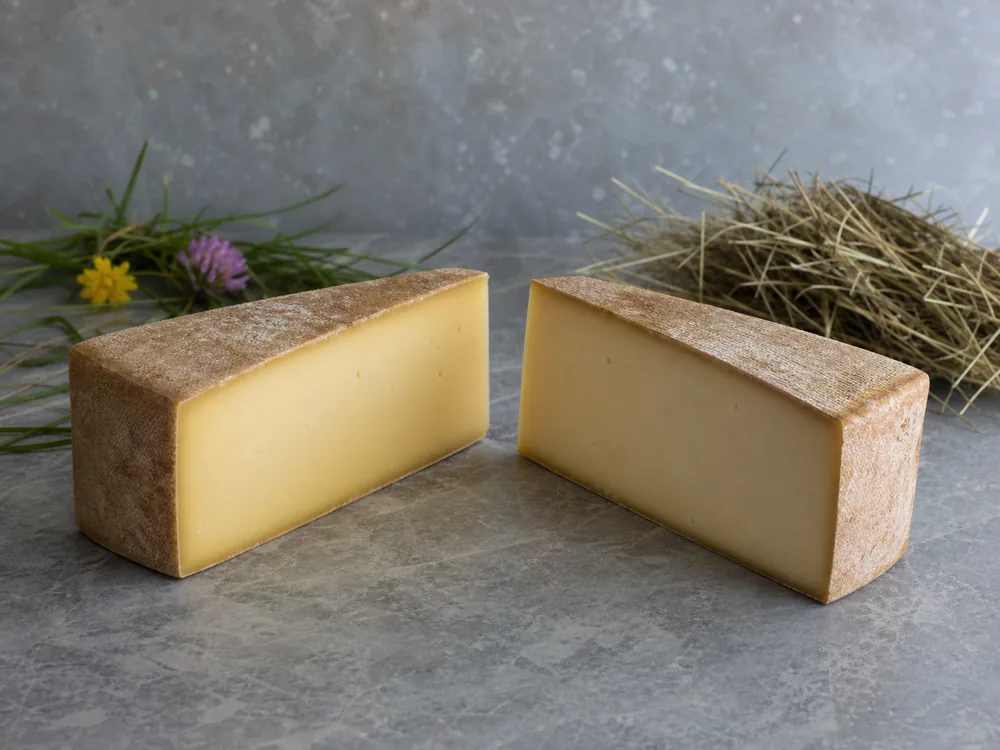
English Wikipedia lists three varieties, summer, alpage and winter, but INAO's labelling rule allows only the words été and chalet d'alpage beside the name, so winter cheese reaches the shop as plain Beaufort.
Most summer cheese is not a chalet cheese. INAO's specification says workshops in the valley bottoms, which run all year, account for 85 to 90 percent of production, and French Wikipedia says d'été Beaufort is made from pasture milk carried down to them.
INAO's specification makes timing the other difference: a chalet must make the cheese as soon as possible after milking and may carry over at most 15 percent of the day's milk, after cooling.
Valley workshops may instead blend a cooled earlier milking with the latest warm one, up to 20 hours after the earlier one.
French Wikipedia says the speed of chalet work preserves part of the aromatic compounds of the alpine flora, and that a chalet cheese may also be sold as farm cheese, fromage fermier.
How Is Beaufort Made?
The union's press kit says the steps are the same whether the cheese is made in a mountain chalet or in a valley dairy.
| Milk | Raw whole milk goes into copper cauldrons holding 400 to 7,200 litres |
| Curdling | Milk heated to 33 °C, then calf rennet added |
| Cooking | Curd stirred constantly at 53 to 54 °C |
| Moulding and pressing | Curd placed in a linen cloth and a wooden circle, pressed for 20 hours and turned regularly |
| Brining | After 24 hours' rest, a brine bath starts the salting and forms the rind |
| Ripening | Below 10 °C for at least 5 months, rubbed and turned twice a week |
The cheesemaker cuts the curd into small pieces to drain as much water as possible, and the press kit says the stirring over heat finishes that draining. Low water content, together with the curdling, the salting and the ripening in a cold, damp cellar, lets a wheel of 40 kg keep for a long time.
The rennet is prepared the traditional way from a calf's stomach, according to the press kit, and the same preparation supplies the lactic starter. INAO's specification requires thermophilic starter cultures, mostly lactobacilli, allows commercial rennet only as a top-up for up to 30 percent of the milk in the vat, and bans any other additive.
The figures differ slightly across sources, mostly where the press kit gives one value and the specification sets a legal range.
| Step | Union press kit | INAO specification | Wikipedia |
|---|---|---|---|
| Renneting | 33 °C | 32 to 35 °C | French: 30 to 32 °C |
| Cooking the curd | 53 to 54 °C | 53 to 56 °C | French: 53 to 56 °C |
| Pressing | 20 hours | At least 15 hours | French: 20 hours; English: 24 hours |
| Brining | Brine bath after 24 hours' rest | 20 to 24 hours at 9 to 12 °C | French: 24 hours |
| Ripening cellar | Below 10 °C, stable humidity | 6 to 12 °C | French: below 12 °C, humidity above 92 percent |
INAO writes ranges that every workshop must respect, and the union's figures overlap them rather than contradict them: 33 °C against 32 to 35 °C, 53 to 54 °C against 53 to 56 °C, and 20 hours of pressing against INAO's minimum of 15.
The union says it takes 10.5 kg of milk to make 1 kg of Beaufort, leaving about 9 kg of whey; French Wikipedia says 10 kg of milk and English Wikipedia 11 litres.
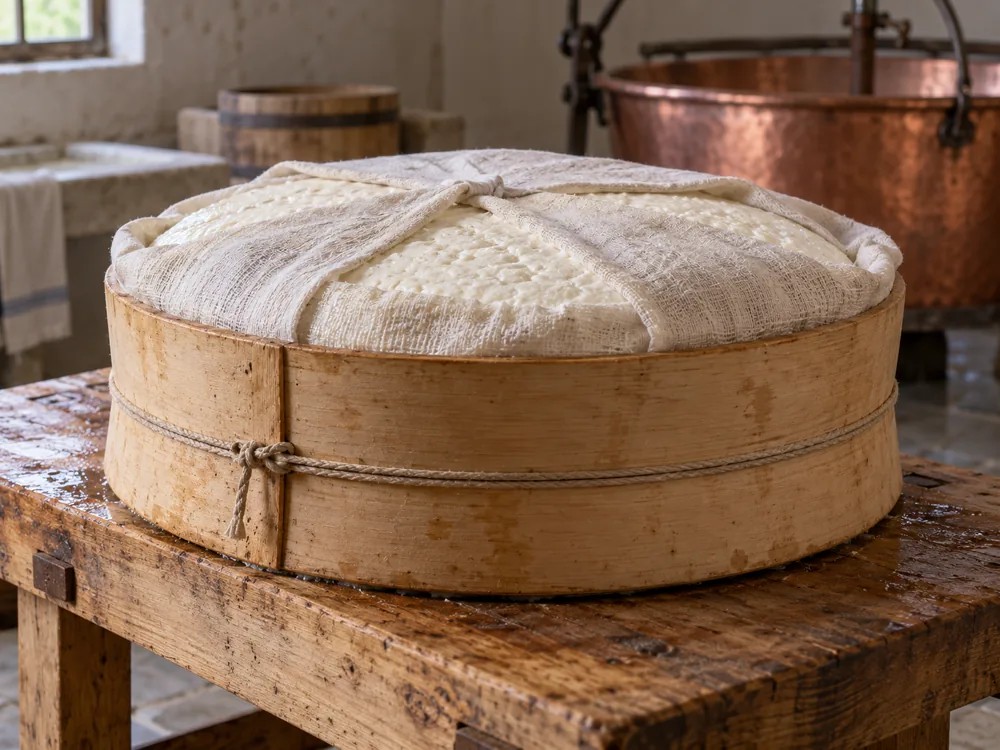
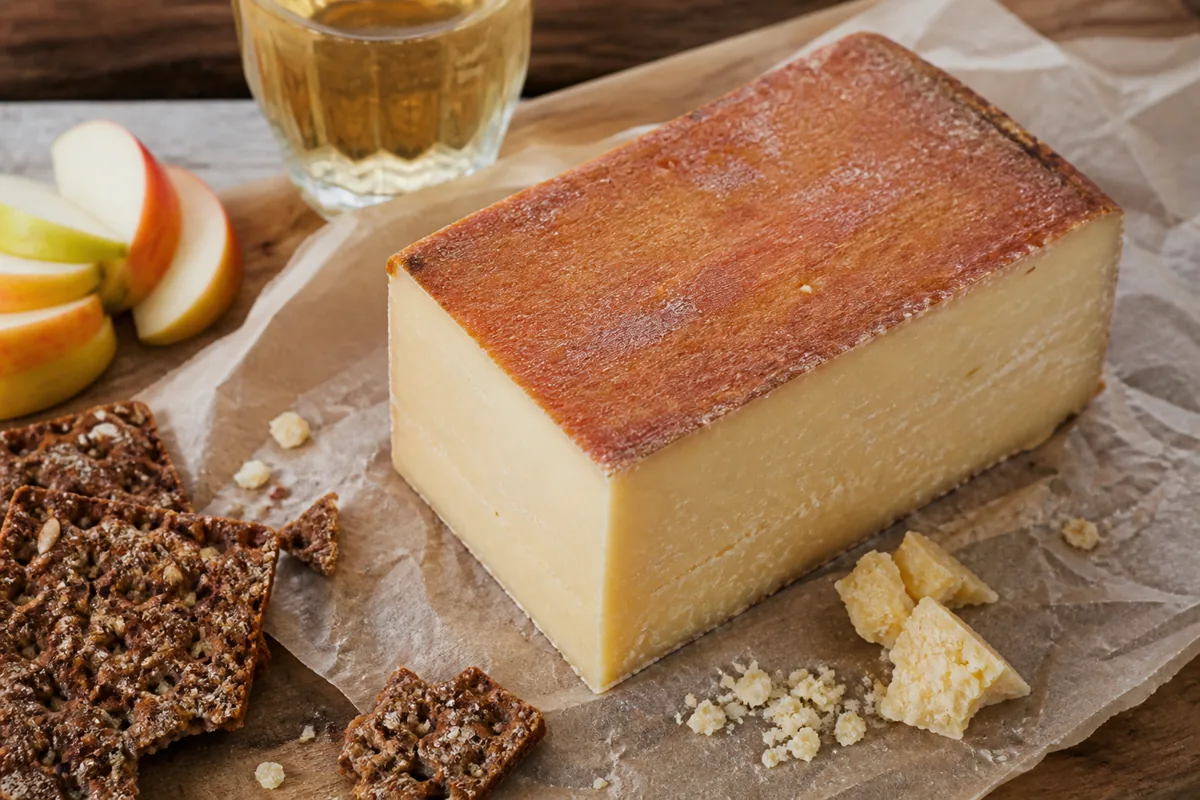
The twice-weekly rubbing builds the rind. English Wikipedia calls Beaufort smear-ripened with a mixture known as morge, and the AOP dairy council describes the finished rind as rubbed, clean, firm and damp, of an even yellow to brown.
INAO requires wheels to be evenly covered with morge within three weeks of making, and its specification defines morge as a bacterial coating, mainly corynebacteria, that gives the rind its colour.
The wheels rest on spruce boards that INAO requires to be washed and dried before use, and once the morge is established the specification asks for rind care at least once a week, a lower floor than the union's twice-weekly rubbing.
What Does Beaufort Taste Like?
INAO describes Beaufort at 7 to 12 months as firm at first before it melts in the mouth, with a subtle, fruity aroma.
English Wikipedia adds that the aroma is distinct, and that some describe it as strong or mildly pungent.
INAO's specification asks for a paste that melts without being too sticky and for aromas that are varied without being too strong, and it has cheeses tasted against that standard once the minimum ageing ends.
The specification also says the aromatic mix of the mountain flora probably shows in the cheese's taste. French Wikipedia reports an INRA study in which the most aromatic and spicy cheeses came mostly from pastures rich in alpine clover.
French Wikipedia cites a separate INRA finding: the Tarine cow produces a typical casein, the beta-casein variant C, which it says gives Beaufort particular taste and texture.
How Long Is Beaufort Aged?
INAO sets the minimum at 5 months, and the sources spread out once you go past that floor.
| Source | Ageing figure |
|---|---|
| INAO | At least 5 months; 7 to 12 months described as typical |
| Beaufort union press kit | 5 to 12 months to maturity; flavour peaks at 7 to 12 months |
| English Wikipedia | 6 to 12 months or longer in the text; 12 to 15 months in the infobox |
| French Wikipedia | 5 months to 1 year for most wheels; chalet d'alpage 5 to 15 months |
The sources overlap more than the table suggests: every range starts at 5 or 6 months and mostly ends at 12, and only English Wikipedia and French Wikipedia's chalet d'alpage figure run to 15.
The fifth month is also a checkpoint: INAO's specification has makers report the technical grading of their wheels then, and the union's press kit says 89 percent of production earned its top, zero-defect classification in 2018, against 40 percent before 1990.
For buying, the union points to wheels aged 8 to 12 months for a cheese that melts in the mouth with a delicate flavour. It adds that younger and older Beaufort suit other tastes, and INAO says the paste and aromas of older cheese move toward more power.
How Do You Eat and Cook With Beaufort?
Beaufort is an everyday cheese in the union's press kit: cubes, strips or slices on a platter or with an aperitif, and cooked into fondues, gratins and pies.
English Wikipedia says Beaufort is commonly used to make cheese fondue because it melts easily. French Wikipedia names its place in Savoie cooking: fondue savoyarde, gratins made with crozets or semolina, and polenta.
French Wikipedia adds that the paler, milder winter cheese is the one traditionally used for fondue savoyarde.
| Use |
|---|
| Autumn and winter: on a cheese platter, in strips through pasta or rice, in an omelet or soup, or in a Savoyard fondue (union press kit) |
| Spring and summer: picnics, salads, sandwiches, and cubes or skewers for an aperitif (union press kit) |
| Regional dishes: fondue savoyarde, crozet or semolina gratin, and polenta (French Wikipedia) |
The same page says Beaufort grates badly, so cooks cut it into thin slices. It adds that Beaufort can replace emmental or parmesan wherever a recipe calls for melted cheese, such as pasta, gratins and risotto, and that shavings or cubes give green salads a salty note.
The press kit also prints a recipe for Beaufort skewers: 100 g of cheese in small cubes mixed with 10 g of flour, spread in 6 cm rings and baked for 15 minutes at 150 °C.
What Should You Drink and Serve with Beaufort?
Both the AOP dairy council and the union's press kit name the same two Savoie wines, Chignin Bergeron and Crémant de Savoie, and both add a craft blond beer.
| Pairing | Type | Why It Works |
|---|---|---|
| Chignin Bergeron | Wine | Named by the AOP dairy council and the union's press kit. |
| Crémant de Savoie | Wine | Named by the AOP dairy council and the union's press kit. |
| Craft blond beer | Drink | The press kit names Yeti from Brasserie des Cimes; the AOP dairy council says a craft blond beer. |
| Apremont | Wine | The Savoie white the press kit serves with its Beaufort skewers. |
| Mondeuse de Savoie, Madiran or red Burgundy | Wine | French Wikipedia calls Mondeuse the regional choice and the other two less local ones. |
| White Burgundy from the Côte chalonnaise or the Mâconnais | Wine | French Wikipedia says these whites bring out more aroma. |
| Fish, especially salmon | Food | English Wikipedia says Beaufort is often eaten with it. |
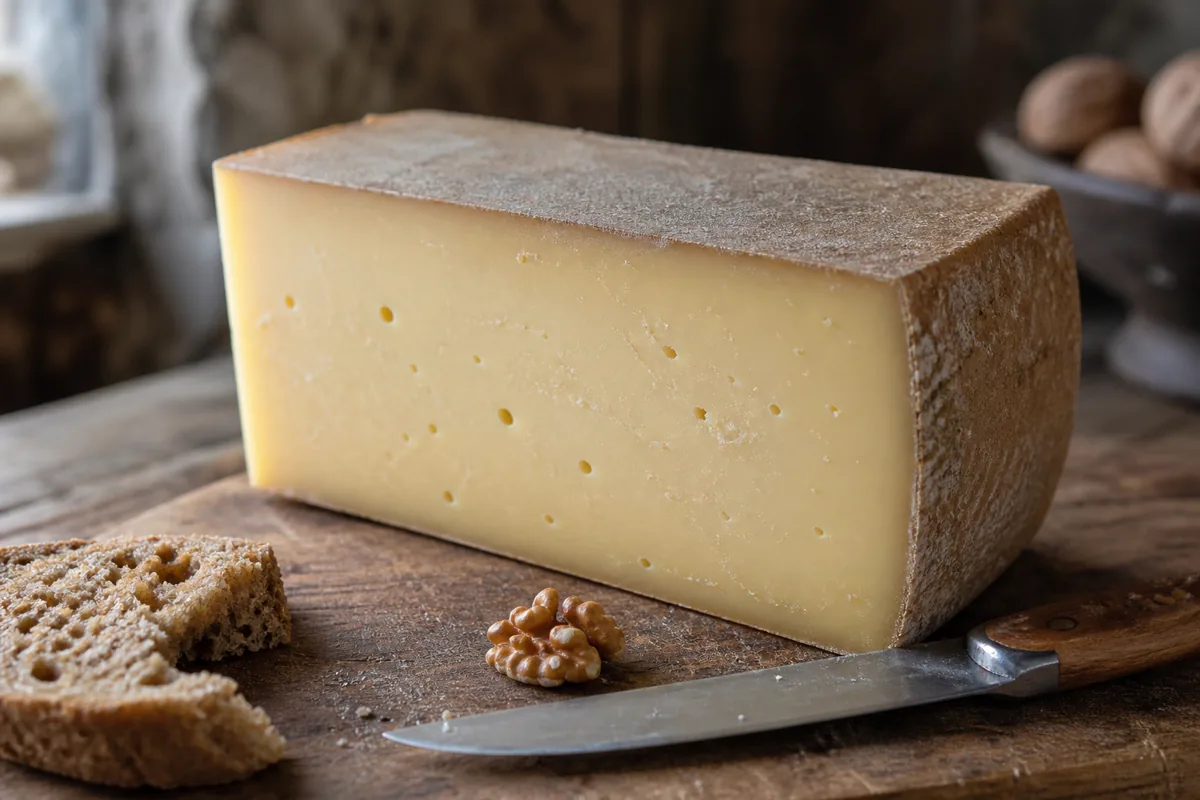
| Walnut bread or seeded baguette | Food | The two breads the AOP dairy council suggests for a tasting. |
French Wikipedia reports that the wine writer Pierre Casamayor recommends bright red wines for cooked pressed cheeses like this one, because the cheese's fat softens their tannins and rounds them out.
The press kit splits its food matches by season. For autumn and winter it suggests blueberry jam on toast, dried fruit or grapes, or a hot dish flavoured with vanilla or curry, and for spring and summer melon, pineapple, berries, or pesto and tapenade on toast.
How Does Beaufort Differ from Comté and Gruyère?
English Wikipedia places Beaufort in the gruyère family, and all three cheeses in the table below are made from raw cow's milk.
| Point | Beaufort | Comté | Swiss Gruyère |
|---|---|---|---|
| Region | Savoie, France | Franche-Comté, France | The Swiss cantons of Fribourg, Vaud, Neuchâtel, Jura and Bern |
| Cows | Tarine or Abondance | Montbéliarde or French Simmental | Not stated by the source |
| Milk | Raw, whole, not skimmed | Raw | Raw |
| Cooking | Curd at 53 to 56 °C | Not stated by the Comté consortium | Not stated by aop-igp.ch |
| Wheel | 20 to 70 kg, concave side | Not stated by the Comté consortium | 25 to 45 kg, 55 to 65 cm across (aop-igp.ch) |
| Ageing | At least 5 months | At least four months | 5 to 18 months |
| Protection | AOC 1968 | AOC 1958 (Comté consortium) | Swiss AOP since 2001 (aop-igp.ch) |
Cooking temperatures are close. Both Beaufort and Comté use raw milk: the Beaufort union confirms its milk is not skimmed, and the Comté association confirms Comté uses raw milk from Montbéliarde or Simmental cows.
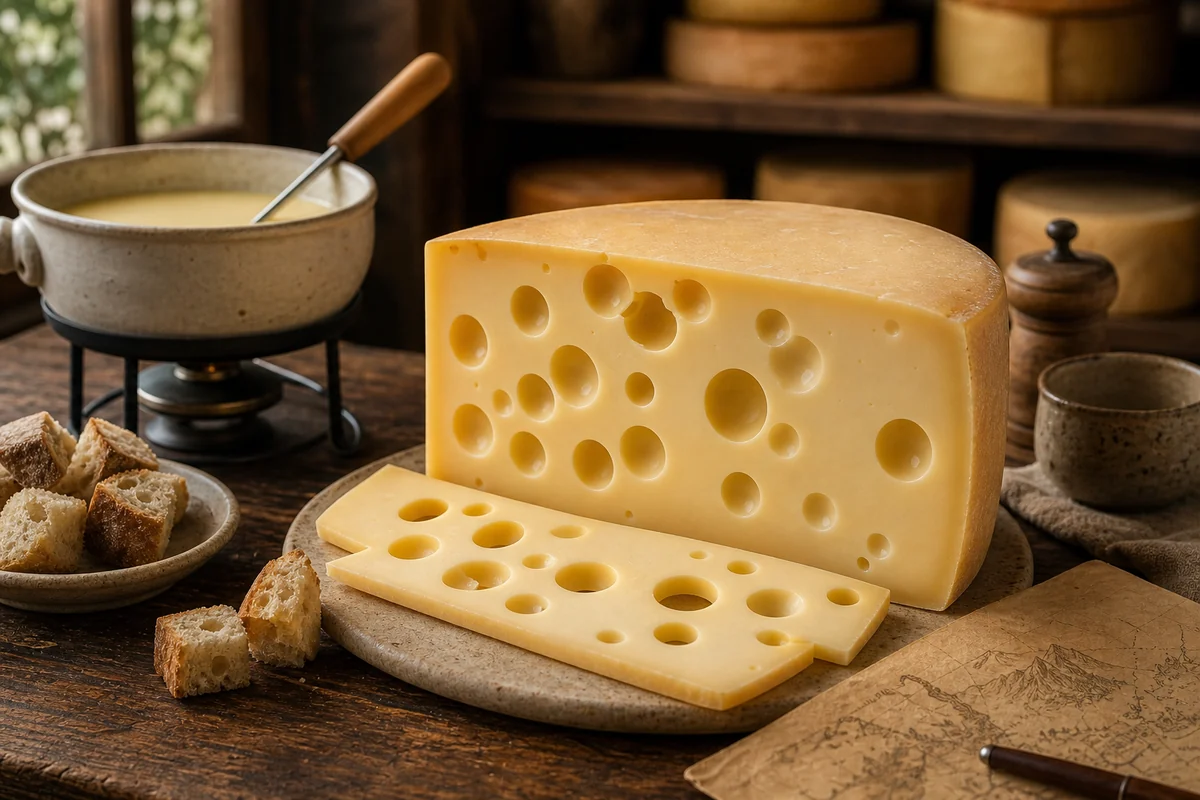
The sources also differ on holes. English Wikipedia says Beaufort lacks the holes of some other Alpine cheeses, while French gruyère must show holes from pea to cherry size.
French Wikipedia draws one shared trait with Comté: in both cheeses, wheels made from summer milk are usually more coloured than winter ones. It also counts about 4.7 billion bacterial cells per square centimetre in Beaufort's morge against 1.6 billion in Comté's.
Beaufort began as a gruyère-style cheese: INAO says Swiss cheesemakers brought the gruyère technology to the area in the 17th century and adapted it, and French Wikipedia names Fribourg as their home canton.
The name came to stand apart later. A 1929 agricultural survey quoted in INAO's specification records that Beaufort was by then sold under its own name rather than as plain Gruyère, a name that let it fetch a higher price.
Why Does Beaufort Have So Few Holes?
INAO's specification lists a paste with no openings, or almost none, among the traits that set Beaufort apart from other cooked pressed cheeses, and it credits ageing in a cold cellar.
The same text still allows a few fine horizontal cracks and a few small partridge-eye holes, and the AOP dairy council repeats both, so a cut face with a handful of either fits the description.
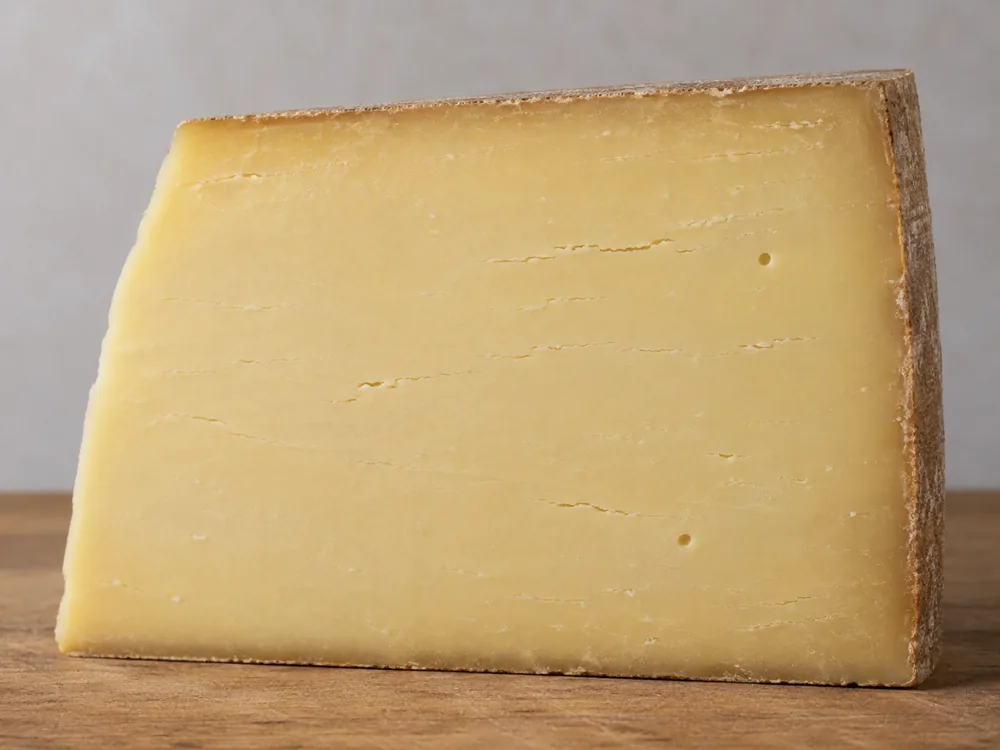
French Wikipedia puts the cause in cellar temperature, saying cheeses with holes ripen at 20 to 22 °C and cheeses without them at 16 to 18 °C, while INAO sets the Beaufort cellar at 6 to 12 °C.
Large holes in a wedge sold as Beaufort would therefore not match the AOP description, which leaves room only for fine cracks and small partridge-eye holes.
How Can You Tell Real Beaufort at the Counter?
INAO's specification sets rules for what a counter piece must show: a pre-packed piece has to keep a stretch of the characteristic rind, which may be cleaned of its morge, and grated cheese cannot be sold under the Beaufort name.
The AOP dairy council calls a piece that keeps part of the concave edge ideal, since that edge is the real sign of origin, and says a quarter too heavy for the amount wanted can be split in two through its thickness.
On the label, the name Beaufort must appear in letters at least two thirds the size of the largest on the pack, beside the European AOP symbol. INAO's rule bars any other qualifier next to the name apart from brand names, été and chalet d'alpage.
On a whole wheel the proof sits on the heel: a blue elliptical casein plate, about 10 cm long, marked in black with France, Beaufort, the workshop and the month and year of making.
Wheels made as chalet d'alpage carry a second, square red plate on the opposite side of the heel. The day and month of making sit on either side of the blue plate and must stay legible until the minimum ageing ends.
The AOP dairy council's description of the rind also says what should be absent: cloth folds, splits, cracks and white or grey spots.
A genuine counter piece keeps some rind or concave edge, and its label shows the name with the AOP symbol and no qualifier other than été or chalet d'alpage. On a whole wheel the heel carries a blue oval casein plate, with a red square one added for chalet d'alpage.
Where Can You Buy Beaufort and How Should You Store It?
The union's 2020 press kit gives an observed retail price of €20 to €23 per kilo in France.
For home cheese storage, the union says to keep Beaufort in its original packaging in the lower part of the fridge. It advises taking the cheese out 30 minutes before eating.
Why Does Beaufort Cost What It Does?
Beaufort's quality has to justify a high price because farming at altitude costs so much, the union's press kit says. It dates that logic to the 1960s, when production fell below 500 tonnes as farm labour grew scarce and expensive and ski resorts and hydroelectric dams paid higher wages.
The first dairy cooperative opened in 1961, and the union credits cooperatives with keeping making, ripening and sales going all year while letting small herd owners sell a modest milk output next to another job; the AOC followed in 1968.
On the farm, INAO's rules cap the herd's average milk at 5,000 kg per cow a year and require an average of at least 13 kg of hay per cow a day in winter. Supplements are limited to an average of 1.5 kg a day on the high pasture and 2.5 kg on valley pasture.
The scale stays small: the union counts 129,000 wheels and 5,160 tonnes in 2019, and the AOP dairy council counts 354 milk producers and 33 workshops in 2024.
Is Beaufort Safe During Pregnancy?
Every Beaufort is made from raw milk, and neither the NHS nor the CDC names Beaufort, so their lists on raw-milk cheese in pregnancy do not settle it.
The NHS also counts any cheese that has been cooked until steaming hot as safe.
How Much Protein and Fat Is in Beaufort?
INAO's specification sets two floors for the ripened cheese: at least 48 percent fat in the dry matter and at least 61 percent dry matter.
| Measure | Per 100 g | Source |
|---|---|---|
| Dry matter | At least 61 g | INAO specification |
| Fat | At least about 29 g, which is 48 percent of 61 g | Worked out from INAO's two floors |
| Protein | 30 g | Union press kit |
| Calcium | 1 g | Union press kit |
The union reckons a 60 g portion covers about two thirds of a day's calcium needs and 30 percent of the reference daily intake of protein, which it equates to two eggs or 100 g of meat.
By the union's figures, 100 g of Beaufort holds eight times the calcium of the same weight of yogurt or milk.
SOURCES & REFERENCES
What Else Do People Ask About Beaufort?
No. The AOP requires raw whole cow's milk, and the producers' union says the milk is neither pasteurized nor skimmed.
No. English Wikipedia places Beaufort in the gruyère family, but it is a separate French AOP cheese from Savoie with its own cows, area and concave wheel.
No. The union's press kit says the rennet is prepared from a calf's stomach.
Very few. INAO describes a paste with no openings, or almost none, and allows only fine horizontal cracks and small partridge-eye holes.
It is summer Beaufort made twice a day in a mountain chalet above 1,500 metres from the milk of one herd, about 400 tonnes a year according to the union.