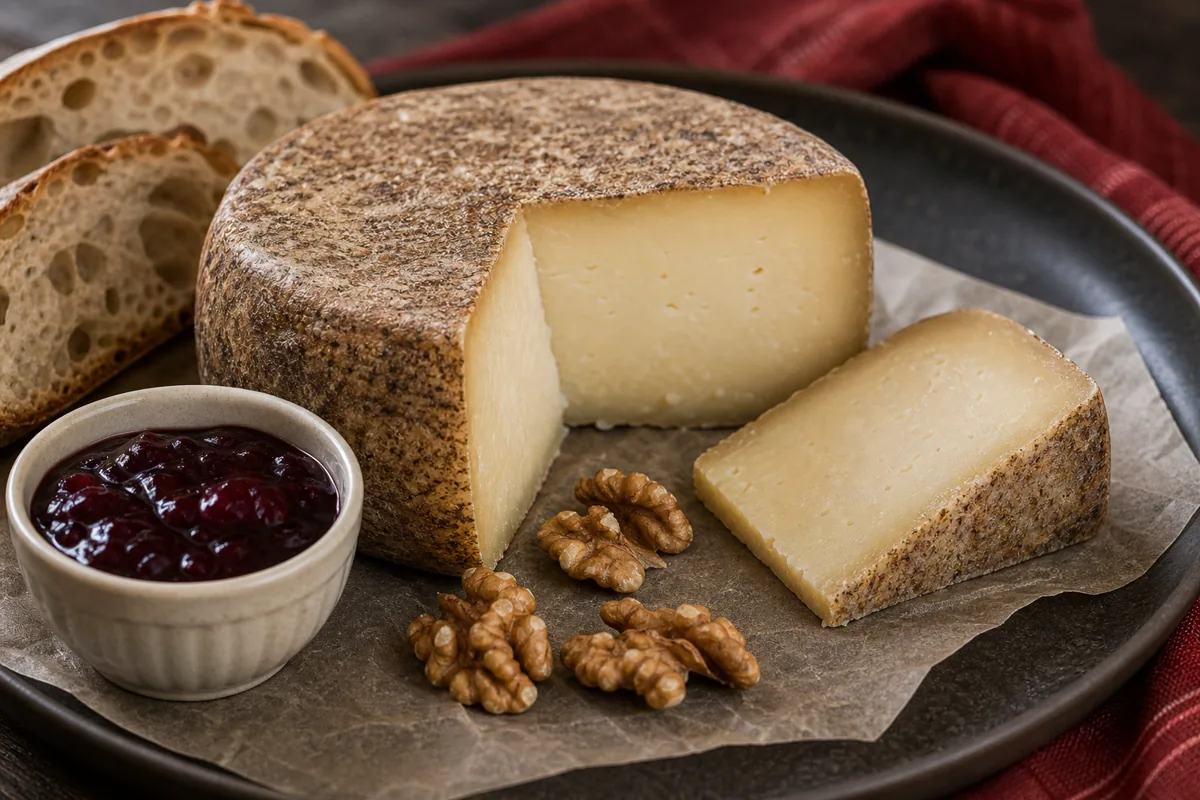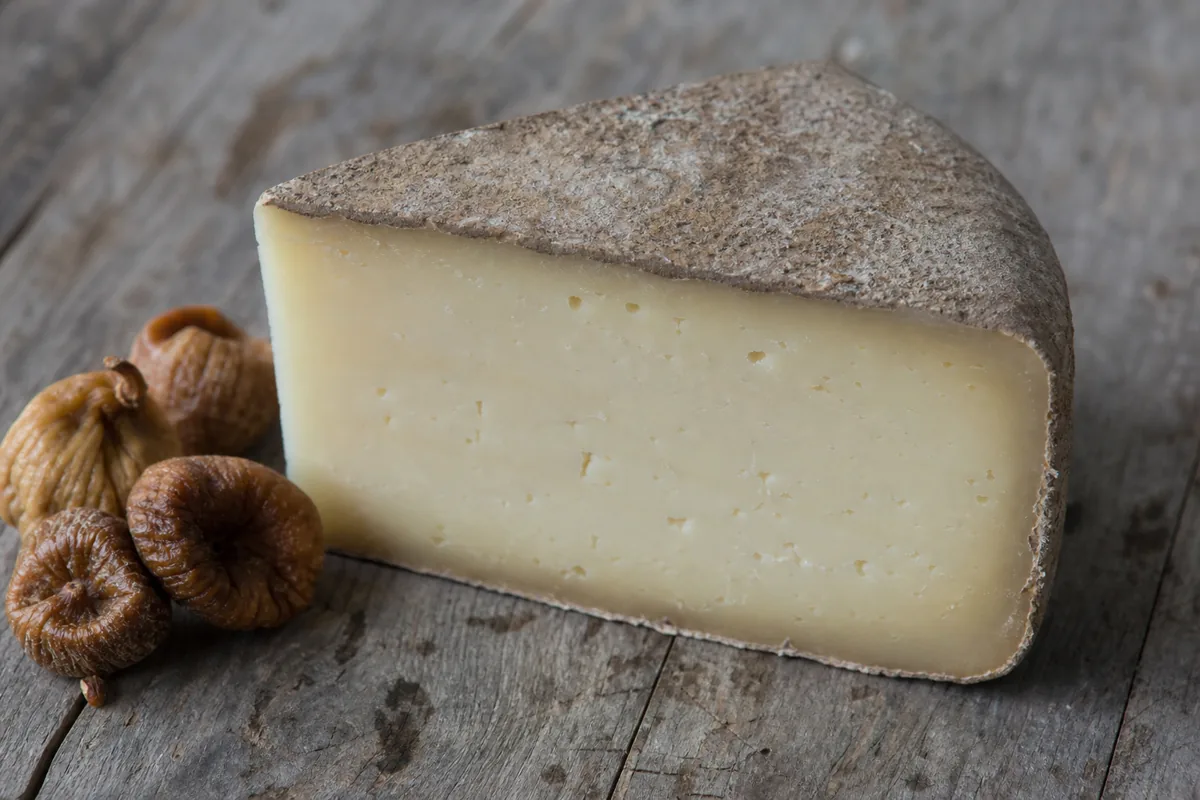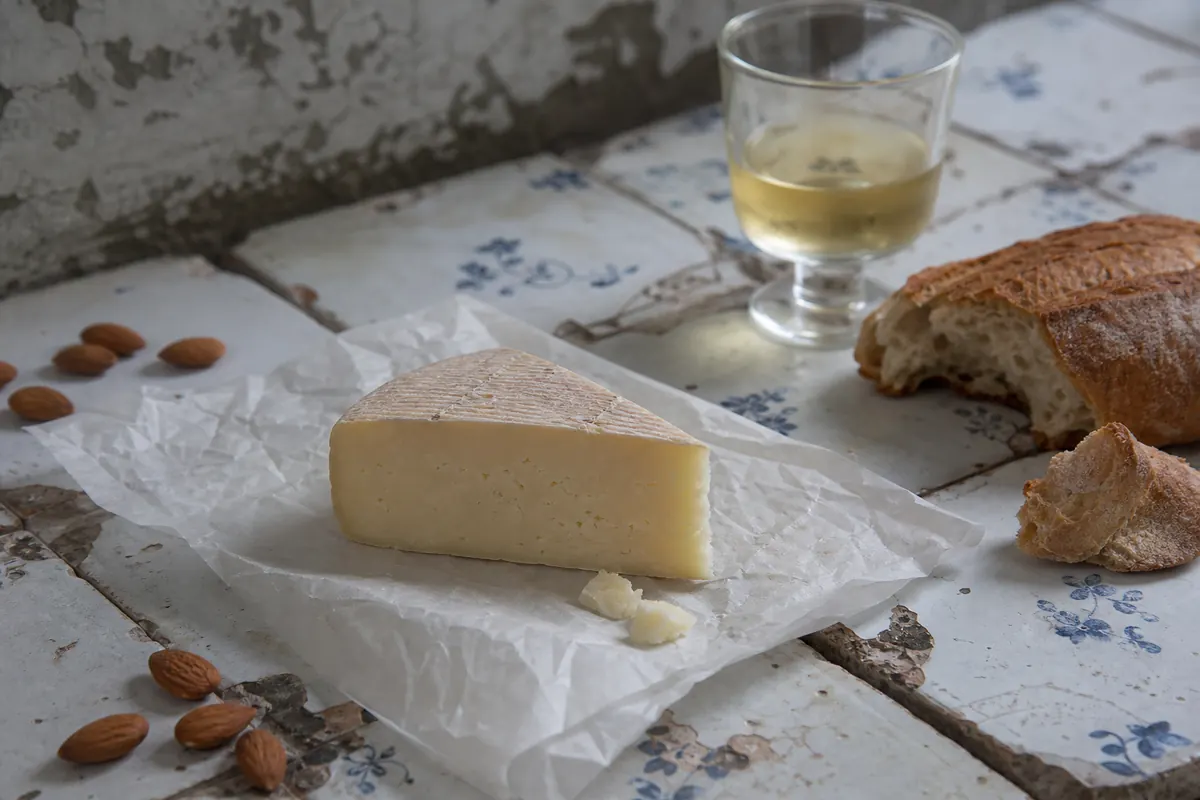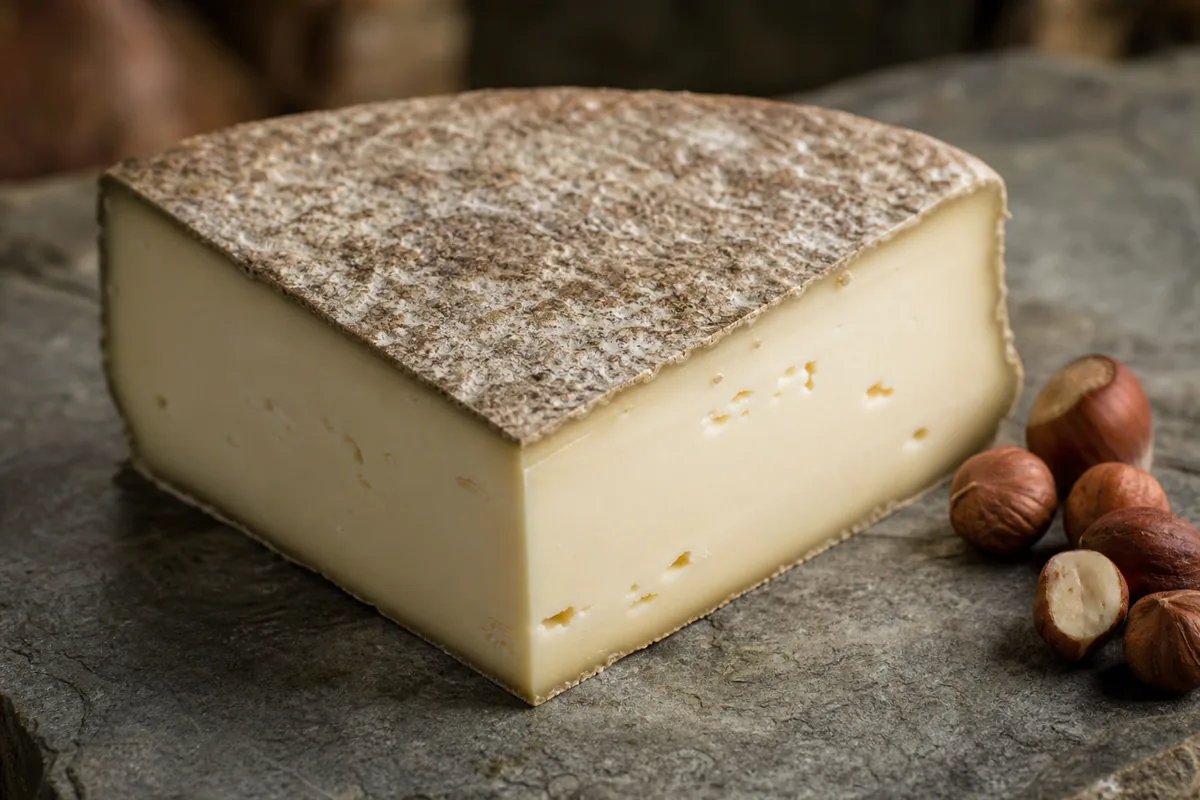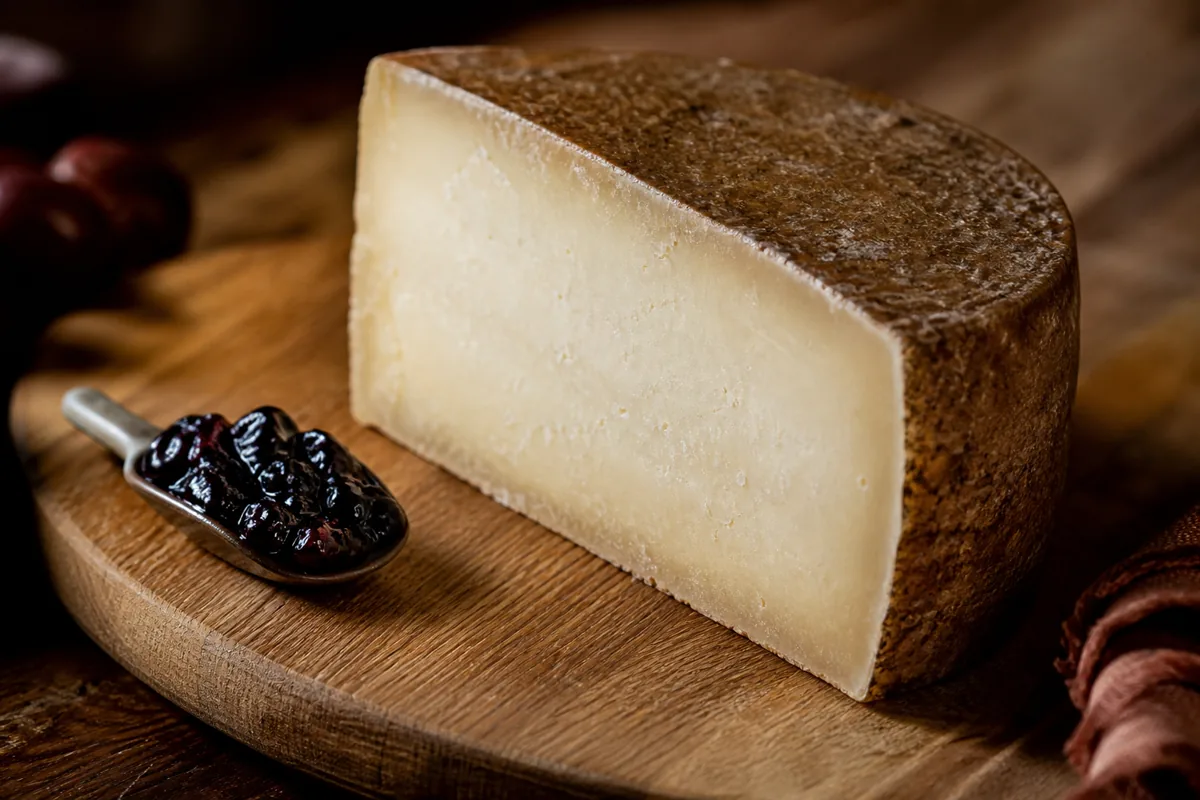
Ossau-Iraty is a sheep's milk cheese from the Basque Country and Béarn in south-west France, made under a protected designation of origin (PDO). Its protected description gives it a smooth, firm, velvety paste under a hard natural rind that runs from orangey yellow to grey.
Its classic partner is black cherry jam made from the cherries of Itxassou, a Basque village inside the Ossau-Iraty area.
In This Article
What Is Ossau-Iraty?
The name joins two places: the Ossau Valley in Béarn and the Iraty mountains in the Basque Country.
Ossau-Iraty is a lightly pressed, uncooked ewe's milk cheese of the Tomme type, made only from non-standardised ewe's milk set with rennet, then salted and matured.
A whole wheel weighs 1.8 to 3.3 kg at 17 to 21 cm across or 3.8 to 6 kg at 22.5 to 27 cm across under the EU single document, while CNIEL's tasting advice gives 2 to 3 kg and 4 to 7 kg.
The amendment the EU published in 2016 widened the ranges and withdrew the 7 kg farmhouse format because makers had stopped using it. It also moved the size rule from the mould to the matured cheese, because reaching the old 2 kg minimum meant filling the moulds to capacity, which caused problems in pressing.
Wheels below the size floor do not carry the PDO. In the 2012 draft's reasoning, a small cheese cannot support the long ripening the rules require.
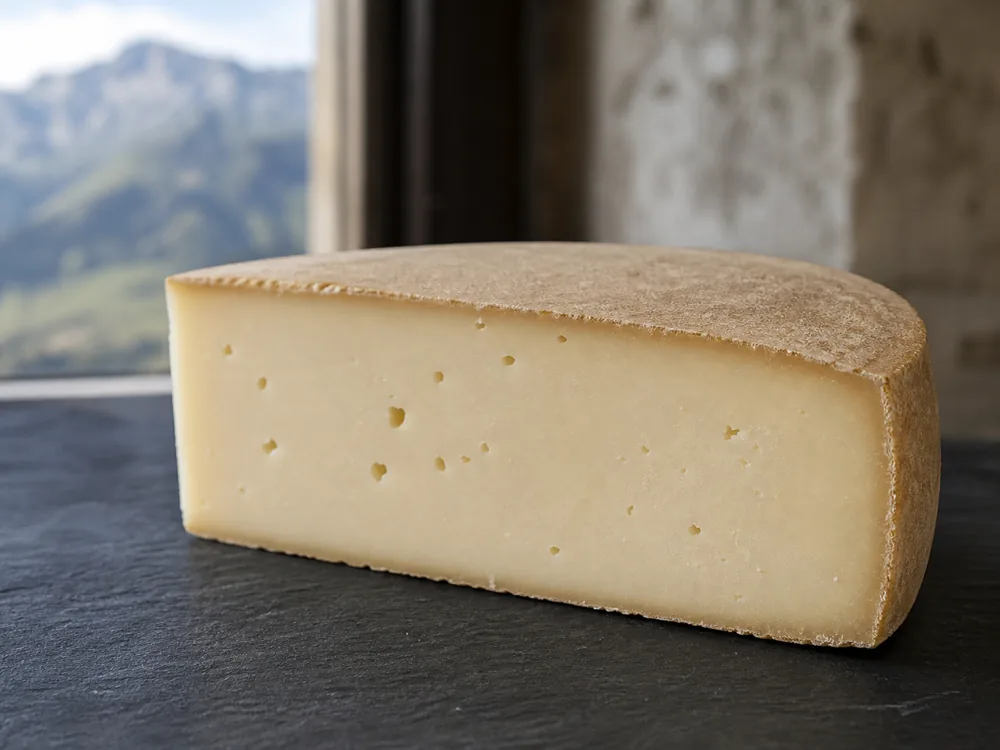
The rind is hard, a few millimetres thick and made of live microbial flora, and it sticks to the paste without peeling off. It is not eaten.
Sheep's milk cheese has been made in the western Pyrenees since at least the Middle Ages, as 14th-century sharecropping contracts and early 15th-century notarial deeds show. In the 14th century the cheese also served as a trading currency in rental and purchase contracts.
The hard rind and the pressed, uncooked format are tied to the terrain. Transport between the high pastures and the valleys was difficult, so shepherds made cheese on the spot, and a pressed, long-ripened wheel of several kilograms with a relatively hard rind travelled well.
Because the cheese keeps for long periods, it gave a shepherd's family protein-rich food all year, and the long ripening stayed even though transport became easier.
Ossau-Iraty became a French AOC in 1980 and a European PDO in 1996. The AOP dairy board counts 1,141 milk producers, 173 farmhouse producers and 4,986 tonnes sold in 2020.
Where Is Ossau-Iraty Made, and Why Is the Area Drawn There?
The PDO area covers the Basque and Béarn mountains and foothills of the Pyrénées-Atlantiques, plus three communes of the neighbouring Hautes-Pyrénées: Arbéost, Arrens-Marsous and Ferrières. The milk, the cheesemaking and the ripening must all happen inside it.
The area was redrawn in 1997 to 2001 around the mountains and foothills, leaving out the plains and plateaus. In the 2012 draft's figures, permanent grass covered on average 60 per cent of farmland inside the line and never less than 40 per cent in any canton, against 20 per cent on average in the excluded north, where field crops such as maize dominated.
The 2016 amendment brought some communes next to Pau back into the area, because they grow fodder and grain for farmers of the Ossau valley and lie along the old winter transhumance route.
How Do the PDO Rules Shape the Cheese?
The milk can come only from three local breeds: Basque-Béarnaise, Manech black-head and Manech red-head. These ewes suit an area that gets 1,200 to 1,800 mm of rain a year, because their woolly fleece keeps the water out.
The 2012 draft calls them the only breeds hardy enough for the damp pastures and the summer move to the mountains, and small enough that grass and hay largely feed them.
Milking and cheesemaking stop in September and October, and no herd may be milked for more than 265 days a year. The pause follows the breeds themselves, which give milk only in winter, spring and early summer.
Lambs are born before the flocks leave for summer pasture, so the milk year follows the growth of the grass and the ewes eat young, rich fodder. No milk may be used in the first 20 days after lambing under the 2012 draft.
Yield is capped at an average of 300 litres per ewe per year, and the milk must carry more than 110 g of useful dry matter, meaning fat plus protein, per litre.
The milk goes into the vat as it comes: the 2012 draft bans concentrating it before setting and allows only rennet, calcium chloride, water and harmless cultures to be added. In the draft's reasoning, working non-standardised milk raw or heat-treated soon after milking lets the character of the milk show as fully as possible.
Ripening lasts at least 80 days for 1.8 to 3.3 kg wheels and 120 days for 3.8 to 6 kg wheels under the single document, while CNIEL puts it at three months at least, a figure that falls between those two minimums.
Turning, brushing and a ban on all anti-fungal substances keep useful flora on the surface. Under the 2012 draft, the brush may carry water, salt, surface ripening cultures and red pepper purée.
The cellar is cool, and the rind is rubbed with salted water so that it stays well greased.
Rind colourings and natamycin (E235) are banned under the 2012 draft. The 2016 amendment also lets makers treat the rind with vegetable oil or white vinegar against the mites that eat it, particularly when ripening runs 3 to 4 months.
Oil cuts off the rind's oxygen, while vinegar slows the mites and some acid-sensitive bacteria, yeasts and moulds. The group asked to authorise both after a survey found makers still using them.
What Do Ossau-Iraty Ewes Eat?
Ewes must graze for at least 240 days a year, and on milking days when they stay in they need a ration with at least 600 g of dry matter from inside the area. Three quarters of herds move to mountain pasture in summer.
The basic ration is grass, fresh, dry or dehydrated fodder, straw and fermented fodder. Feed bought from outside the area, grass excepted, is capped at an average of 280 kg of dry matter per ewe a year, which the single document estimates leaves 67 per cent or more of the feed coming from the area.
Concentrates may not exceed an average of 800 g of dry matter per ewe per day or 150 kg over a milking year.
Silage is banned in the milking period from 1 February 2018, with baled grass allowed up to 1 kg per ewe a day if it is at least 70 per cent dry matter.
The 2012 draft ties the milk to this diet: hay, aftermath and pasture of mixed species give a milk rich in useful dry matter that sets well into cheese and carries a wide range of aromas.
Which Milk Is in Farmhouse, Dairy and Estive Ossau-Iraty?
Farmhouse Ossau-Iraty is always made from raw milk, and the farmhouse name is reserved for a farmer who processes only the milk of their own holding, on that holding. A dairy wedge may be made from raw, thermised or pasteurised milk.
| Kind of wheel | Milk | Holder |
|---|---|---|
| Farmhouse | Raw milk only, from the farmer's own holding | EU single document (2016) for raw milk; French specification (2012 draft) for raw milk and the own holding |
| Dairy | Heat treatment allowed outside farmhouse making; raw, thermised or pasteurised milk | French specification (2012 draft) for heat treatment; AOP dairy board (CNAOL) for the three milks |
Two making steps differ as well. Under the 2012 draft, only farmhouse makers may use the traditional sieving on nettles.
Only dairies may draw off whey up to a quarter of the milk's volume, and they may add drinking water to the curd, also up to a quarter of that volume, at 25 to 60°C.
Estive is farmhouse cheese made on summer mountain pasture, where the milking, making and marking must happen in the shepherd's hut, called a cayolar, etxola or cuyala.
The milk stays raw there and must be set within 24 hours of the latest milking. The hut must stand apart from where the herd winters, and making may start only after the date in the transhumance declaration.
On the pasture the ewes feed mostly by grazing, with only authorised cereal grains and minerals added. The group created the term in the 2016 amendment because making on mountain pasture was reviving and those cheeses needed a way to stand apart.
The milk line on the pack settles a given wedge: farmhouse wheels are always raw milk from one holding, while dairy wedges may be raw, thermised or pasteurised. Estive wheels are raw milk made in the shepherd's hut.
How Do Basque and Béarn Ossau-Iraty Differ?
Basque Ossau-Iraty has right-angled corners and a quite firm, dry, slightly crumbly texture, while Béarn Ossau-Iraty has rounded corners and a moister, more soluble paste, in the AOP dairy board's description of the two types.
In the board's description, the Béarn paste melts in the mouth, leaving a freshness across the whole palate as it does.
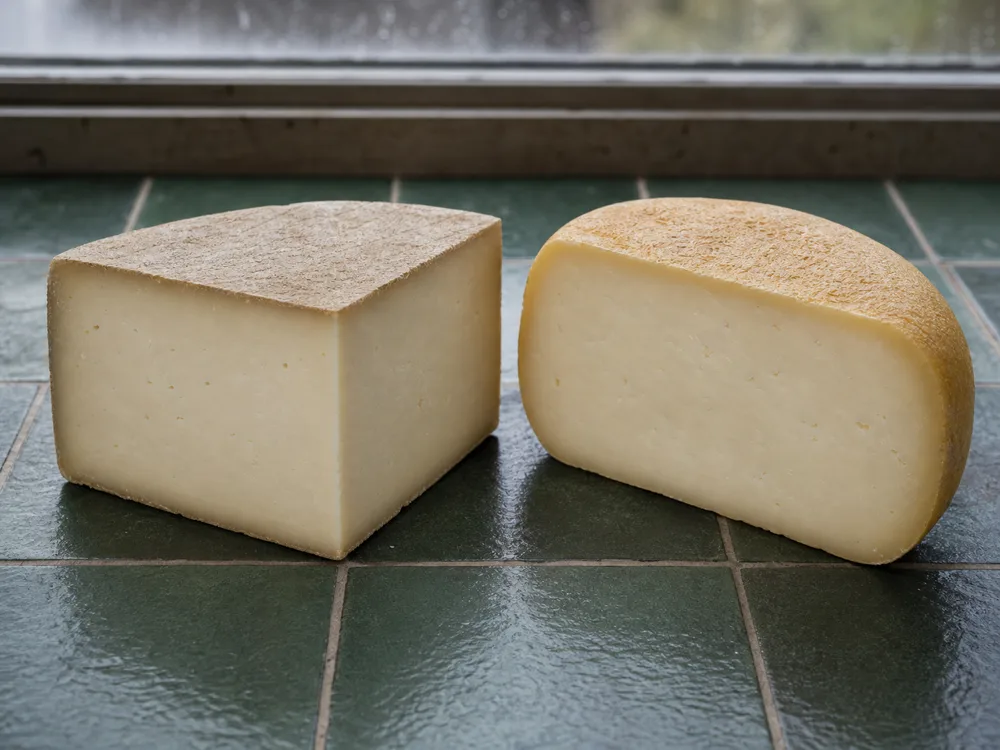
A label will not name the type: the PDO rules allow no qualifier next to the name except a brand, the farmhouse mention and, since 2016, estive. To tell which type you are buying, look at the corners of the wheel.
What Does Ossau-Iraty Taste Like?
Ossau-Iraty's protected description gives it a subtle smell, sometimes of flowers or fruit, and an intense taste balanced between acidity and fat. The same description calls the cheese salty but not excessively so, with a flavour that is often nutty or fruity.
The paste shades from ivory-white to amber-cream according to the ripening, and it may hold a few small eyes.
The AOP dairy board adds a milky, plant and sometimes animal smell, with a taste of dried fruit and ewe. CNIEL's tasting advice describes an ivory, slightly grainy paste, tender on the palate, with a light hazelnut and walnut flavour.
The varied flavours develop during the long ripening, when the fat and protein of the rich milk may break down in the cellar. The protected description's texture line is broad too: smooth, firm and melt-in-the-mouth, ranging from creamy to hard.
CNIEL adds that the paste is sometimes brittle and that its earthy aromas gain strength over time, so if you want those stronger aromas, ask how long a piece has ripened.
How Do You Cut and Serve Ossau-Iraty?
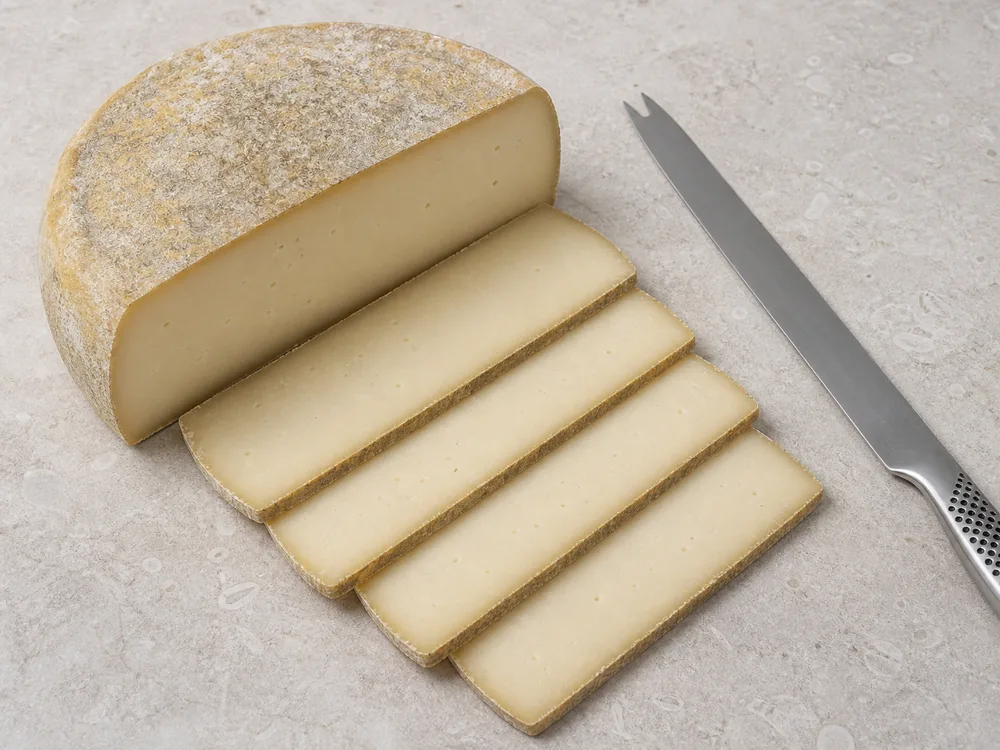
Ossau-Iraty is traditionally cut into slices 4 to 5 mm thick, perpendicular to the length of the cheese. If you want a more modern presentation, the AOP dairy board suggests cubes or triangles 2 to 3 mm thick.
Why Is Black Cherry Jam the Classic Match for Ossau-Iraty?
The producers' union calls the Itxassou cherry the traditional partner of Ossau-Iraty and says it brings out the cheese's subtlest flavours. If you are buying a jar for the cheese, Itxassou is the name to look for on it.
The AOP dairy board says Ossau-Iraty is traditionally eaten with black cherry jam, and CNIEL names the jam made from the cherries of Itxassou.
Itxassou is a Basque village inside the Ossau-Iraty area, listed among its communes in the 2012 draft. Cherries have reportedly grown there since 1750, from three local varieties: Xapata, Beltxa and Peloa.
The producers' union describes Beltxa as a small to medium fruit with very little sugar and a sour taste, used only for jam.
Peloa, very sweet when picked late, is eaten fresh or made into jam, and Xapata, both very sweet and slightly tart, is sold mainly fresh.
Cherry growing declined around 1970, when farms modernised and moved to sheep's milk and gave up the demanding harvest, and the Xapata association was founded in 1994 to protect the heritage.
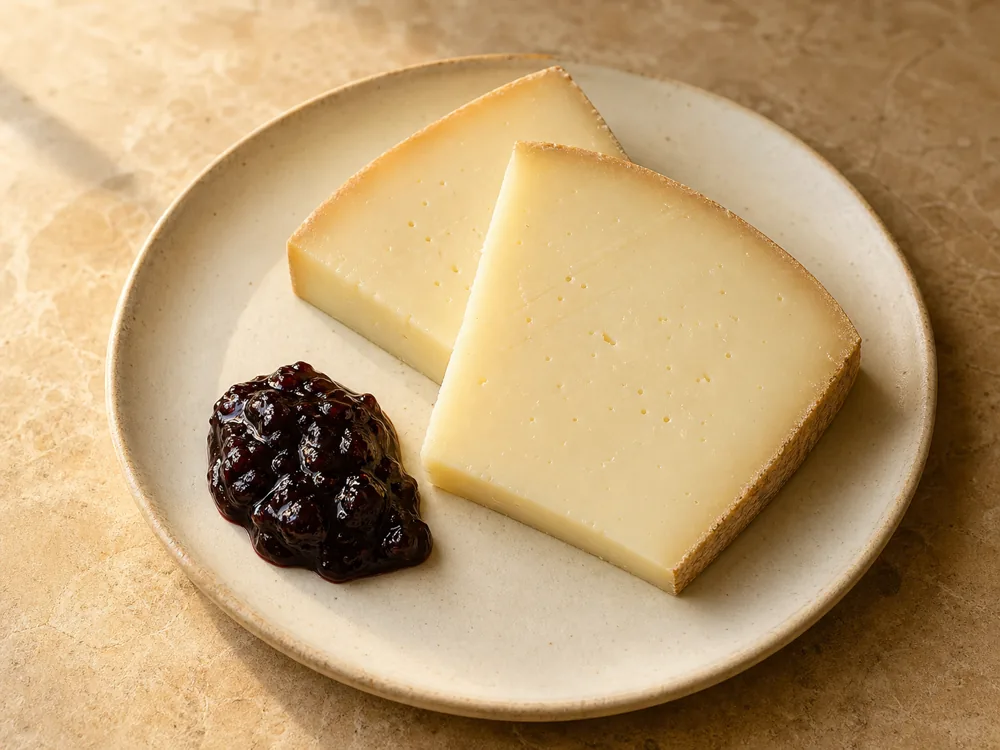
Quince paste is the second preserve, which the AOP dairy board says some gourmets recommend.
Which Bread, Wine or Tea Goes with Ossau-Iraty?
The AOP dairy board names cereal bread, and CNIEL gives a loaf for each of two approaches. If you want a match, it picks walnut bread: neither partner dominates, the soft chew leaves the sometimes brittle paste room to show, and the dried-fruit notes answer each other.
CNIEL adds that walnut bread gives body to young cheeses and underlines the ripening of older ones.
If you want a contrast, CNIEL picks wholemeal bread, whose discreet cereal taste cuts against the slight acidity of ewe's milk and balances it.
For wine, CNIEL picks red Arbois from the Jura, whose black-fruit, leather and spice aromas, fruity bouquet and tannic density bring out the cheese's warm-milk and hazelnut notes.
It also picks a demi-sec Champagne, lively, fresh, mineral and fruity, whose light sweetness and white-fruit aromas lift the cheese's finesse and coat its creamy, dense paste.
CNIEL's third pick is Dian Hong red tea, with ripe, honeyed fruit. If you serve it hot, it dominates the cheese but adds a melting touch to the paste, while cold the two stand level, and a little sugar highlights the cheese's creaminess where unsweetened tea contrasts with it.
The AOP dairy board's wider list runs from local dry whites to peated Islay whisky.
| Pairing | Type | Why It Works |
|---|---|---|
| Itxassou black cherry jam | Food | The traditional partner named by the AOP dairy board, CNIEL and the producers' union. |
| Quince paste | Food | The AOP dairy board's alternative, recommended by some gourmets. |
| Jurançon or Irouléguy | Wine | Dry whites from Béarn and the Basque Country on the AOP dairy board's list, which also names dry Jura whites. |
| Jura red | Wine | Listed by the AOP dairy board; CNIEL names red Arbois from the Jura. |
| Loire or Bordeaux red | Wine | Both on the AOP dairy board's list. |
| Champagne | Wine | The AOP dairy board lists brut, rosé and demi-sec; CNIEL picks demi-sec. |
| Dark beer or lager | Drink | Both on the AOP dairy board's list. |
| Peated Islay whisky | Drink | The AOP dairy board's spirit choice. |
| Dian Hong red tea | Drink | CNIEL's tea match; the AOP dairy board also lists red tea from China. |
Ossau-Iraty vs Manchego
Like Ossau-Iraty, Manchego from La Mancha carries a PDO and is made only from sheep's milk, in its case from the Manchega breed alone.
The rules for this Spanish cheese allow wheels of 0.4 to 4 kg and a ripening floor of 60 days, or 30 days for wheels up to 1.5 kg, against Ossau-Iraty's floors of 1.8 kg and 80 days.
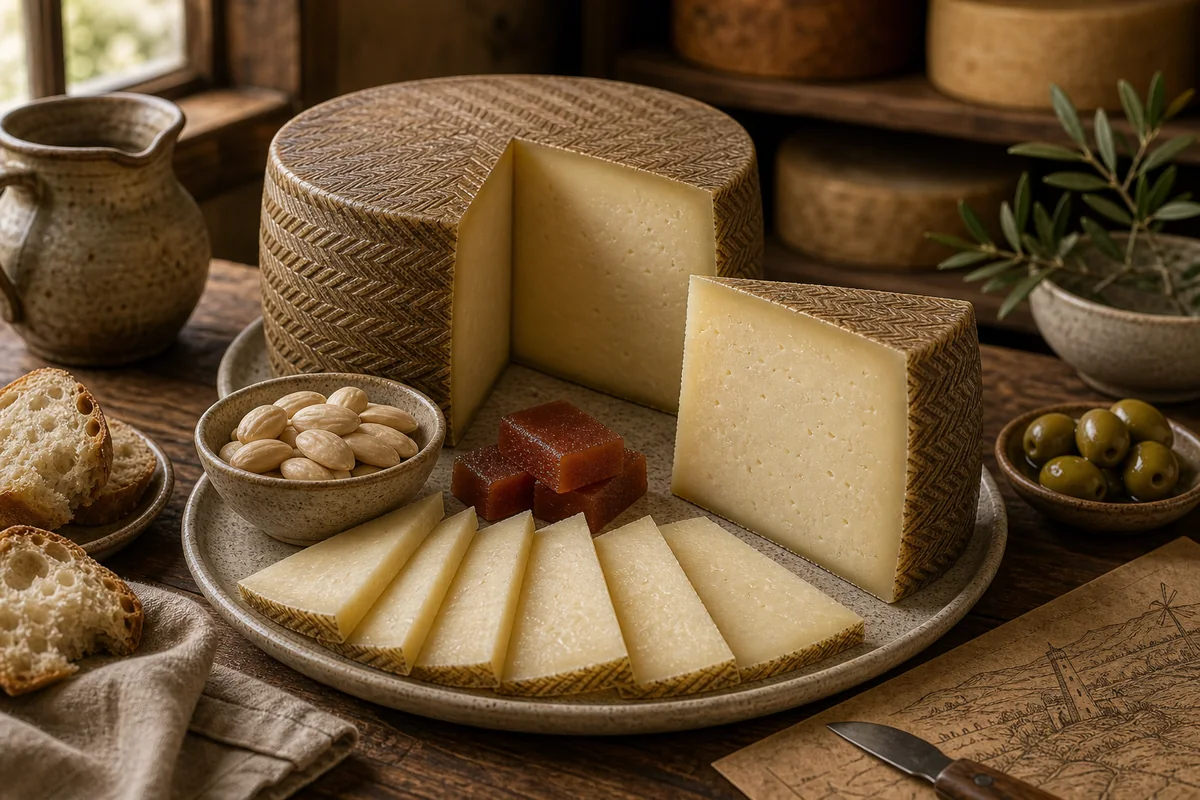
The rinds look different as well: Manchego curd was once pressed in plaited esparto grass baskets, and the moulds copy their zig-zag pattern, called pleita. With the two side by side at the counter, that zig-zag rind marks the Manchego.
| Attribute | Ossau-Iraty | Manchego |
|---|---|---|
| Area | Basque Country and Béarn, France | La Mancha, Spain |
| Sheep | Basque-Béarnaise, Manech black-head and Manech red-head | Manchega only |
| Milk | Raw on farms; dairies may heat-treat | Raw or pasteurised; raw-milk cheese may say artesano |
| Minimum ripening | 80 days (1.8 to 3.3 kg) or 120 days (3.8 to 6 kg) | 30 days up to 1.5 kg, otherwise 60 days; two years at most |
| Wheel weight | 1.8 to 3.3 kg or 3.8 to 6 kg | 0.4 to 4 kg |
| Rind | Natural, orangey yellow to grey, not eaten | Zig-zag pleita pattern, inedible |
What Is Amou Cheese, and How Does It Differ from Ossau-Iraty?
The cheesemonger Androuet describes Amou as a pressed, uncooked sheep's milk cheese from the Landes and traces it to the village of the same name.
In Androuet's description, a whole Amou wheel is broad, about 35 cm across, 7 to 8 cm high and 4 to 5 kg in weight. That is wider than either Ossau-Iraty size, 17 to 21 cm or 22.5 to 27 cm across, at a weight inside the larger Ossau-Iraty range of 3.8 to 6 kg.
Amou matures for two to six months by Androuet's account, with a texture running from firm and supple to hard and brittle and a flavour that moves between mild, nutty and piquant. The cheesemonger's suggested drink is a dry white wine.
How Do You Read an Ossau-Iraty Label?
On the label, the name Ossau-Iraty must appear in letters at least two-thirds the size of the largest lettering, and the 2012 draft French specification also makes the EU PDO logo compulsory.
A cut portion must keep a piece of the rind unless it weighs under 50 g or is sold diced, in sticks, in long thin strips, as shavings, sliced or grated.
When you handle a wedge, check the rind against the protected description: dry to slightly moist to the touch, without being sticky, and not crumbling apart.
Each wheel is marked with an embossed label or casein stamp whose artwork shows a ewe's head and differs between dairy and farmhouse cheese. The 2012 draft says wheels are sampled after the minimum ripening and given an analytical and tasting examination, and a cheese that fails loses its mark.
What Is in Ossau-Iraty, and Can You Eat It While Pregnant?
Ciqual, the French food composition table published by ANSES, lists Ossau-Iraty at 423 kcal per 100 g. Ciqual draws its fat and salt figures partly from the producers' union's own 2015 data.
| Nutrient | Per 100 g |
|---|---|
| Energy | 423 kcal |
| Fat | 36 g |
| Saturated fat | 24.3 g |
| Protein | 24.2 g |
| Salt | 1.76 g |
| Calcium | 764 mg |
The legal minimum sits lower: every 100 g must hold at least 58 g of dry matter, at least half of it fat, which works out to at least 29 g of fat per 100 g.
Ciqual puts lactose at under 0.2 g per 100 g, a value it credits to the producers' union.
Pregnancy advice turns on the milk line, since farmhouse Ossau-Iraty is always raw and a dairy wedge may be raw, thermised or pasteurised.
The NHS lists pasteurised or unpasteurised hard cheeses such as cheddar, pasteurised semi-hard cheeses such as edam and pasteurised soft cheeses as safe to eat, and says any foods made from unpasteurised milk must be thoroughly cooked.
The single document describes the paste as firm and ranging from creamy to hard. For a raw or thermised wedge, the NHS hard-cheese line covers only a hard piece, and a firm, creamy, slightly crumbly or brittle piece made from unpasteurised milk must be thoroughly cooked.
The CDC lists unpasteurized (raw) milk and dairy products made from raw milk as riskier, a line that takes in a raw or thermised wedge, and hard cheese, when made with pasteurized milk, as safer. It says pregnant women are 10 times more likely to get a Listeria infection.
Served cold, a pasteurized wedge described as firm, creamy, slightly crumbly or brittle rather than hard is a type the CDC list does not cover, so ask a midwife or doctor.
Check the milk line on the pack, because lait pasteurisé, lait thermisé or lait cru decides which of these agency lines applies.
SOURCES & REFERENCES
What Else Do People Ask About Ossau-Iraty?
Farmhouse Ossau-Iraty always is. Dairy wedges may use raw, thermised or pasteurised milk, so the ingredients list on the pack gives the answer.
At least 80 days for wheels of 1.8 to 3.3 kg and at least 120 days for wheels of 3.8 to 6 kg, under the EU single document. CNIEL gives at least three months.
No, the rind is not eaten. It is a hard natural rind of live microbial flora that sticks to the paste.
The AOP dairy board says the Basque type has right-angled corners and a firm, dry, slightly crumbly texture, while the Béarn type has rounded corners and a moister paste.
Black cherry jam, which CNIEL ties to Itxassou, a Basque village inside the PDO area. The AOP dairy board also mentions quince paste.