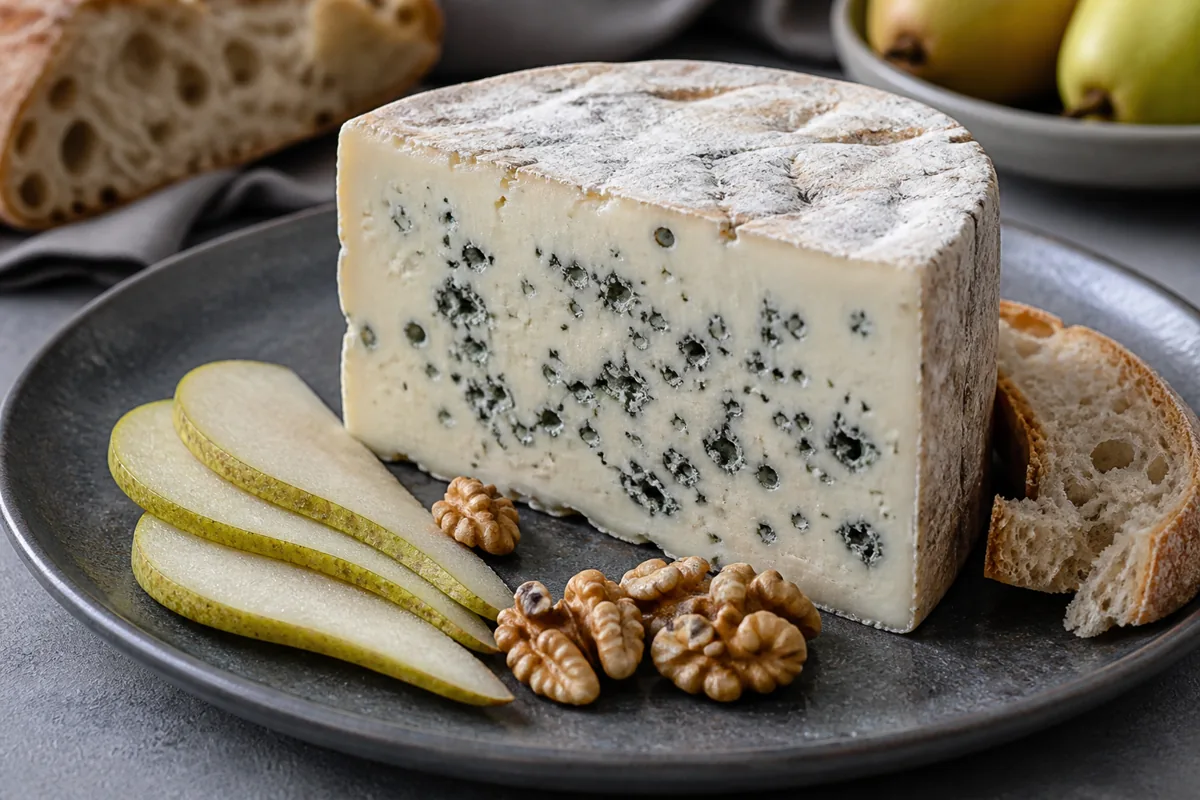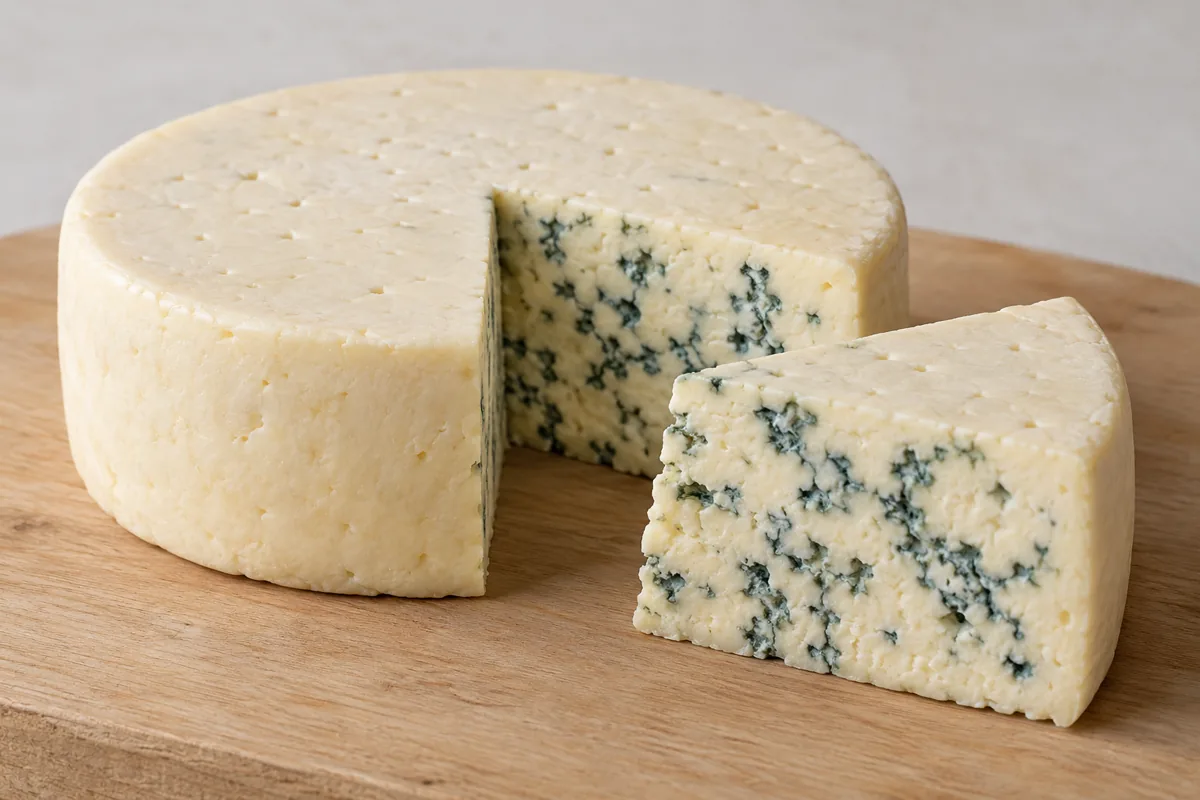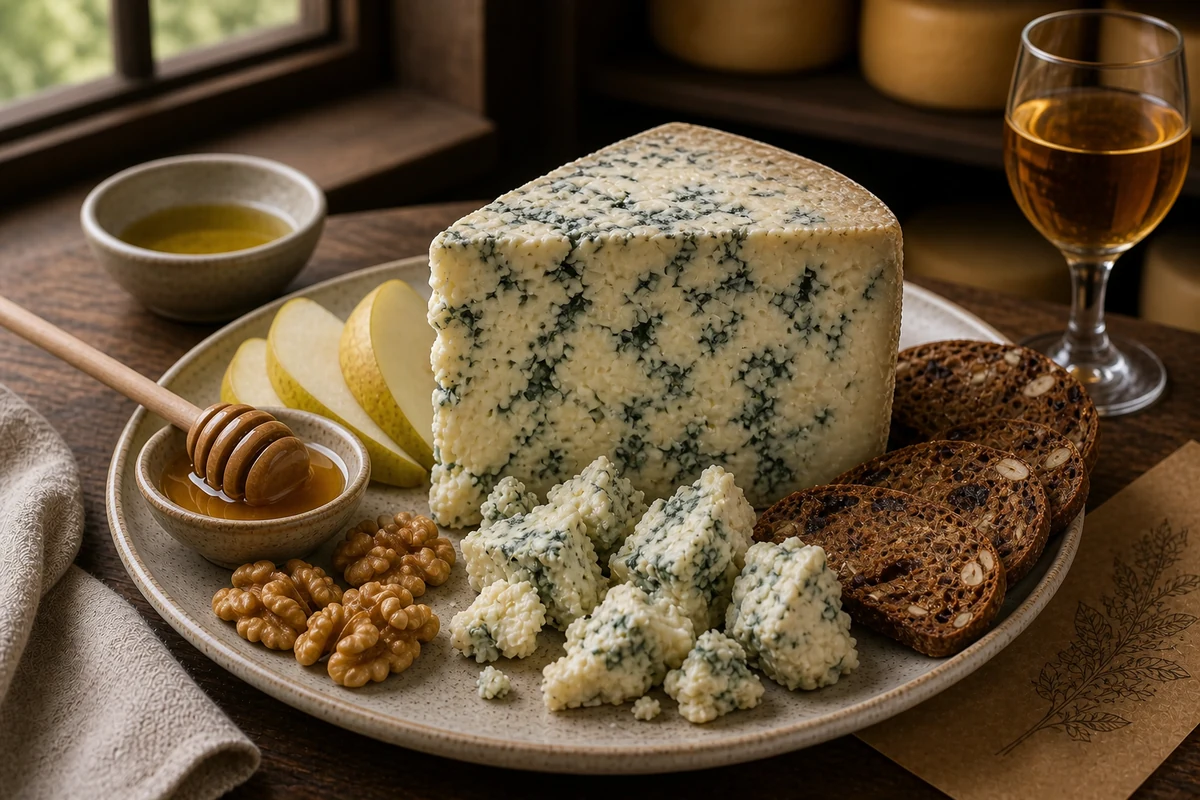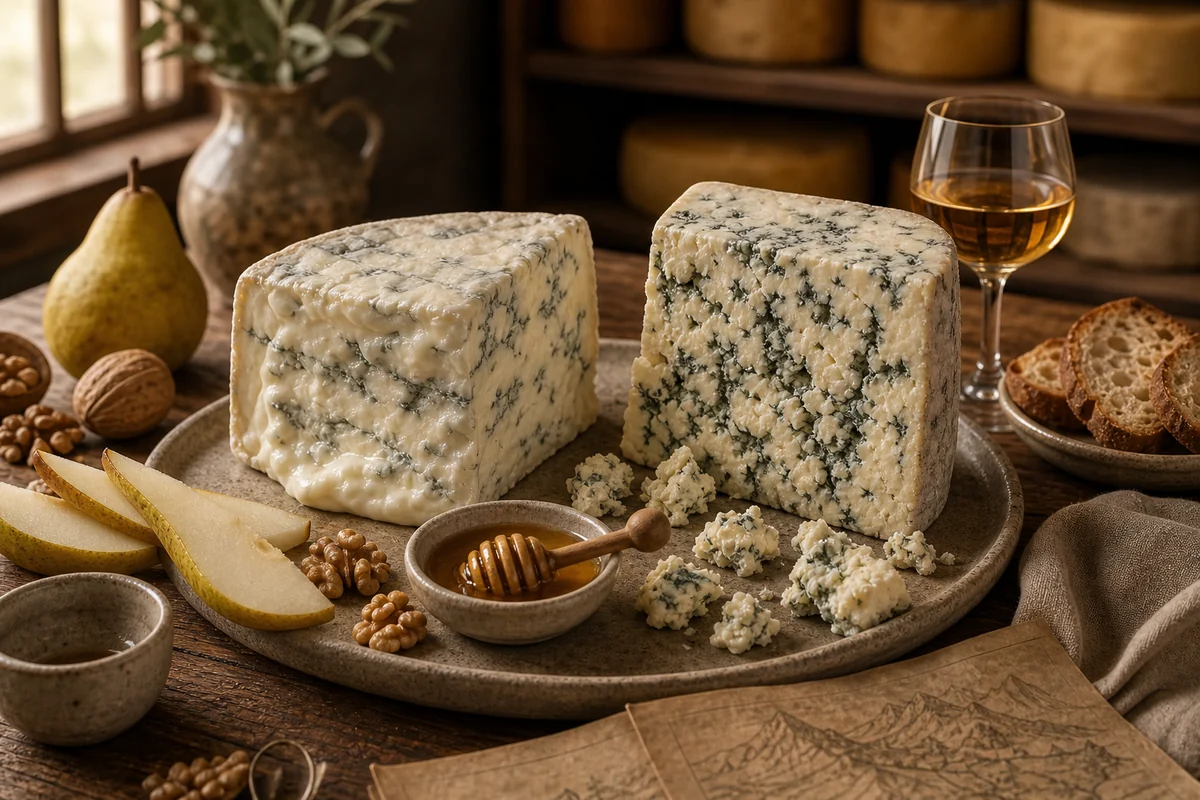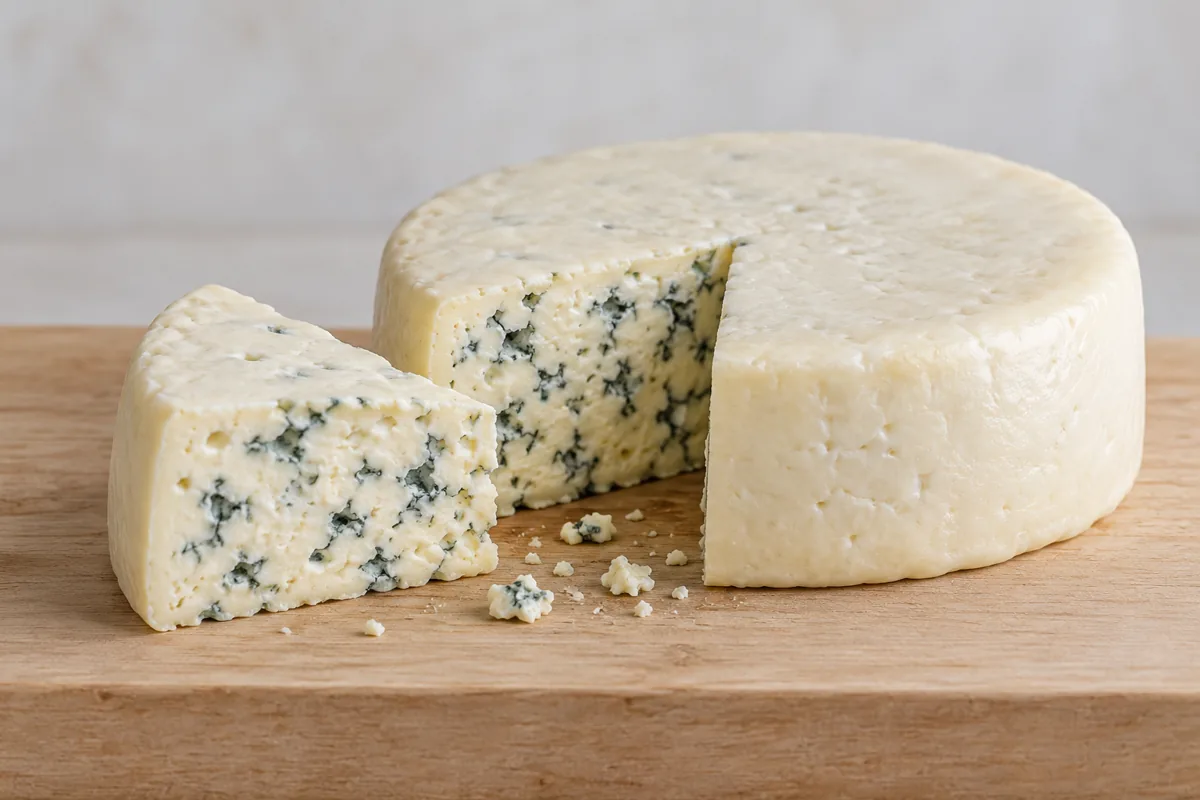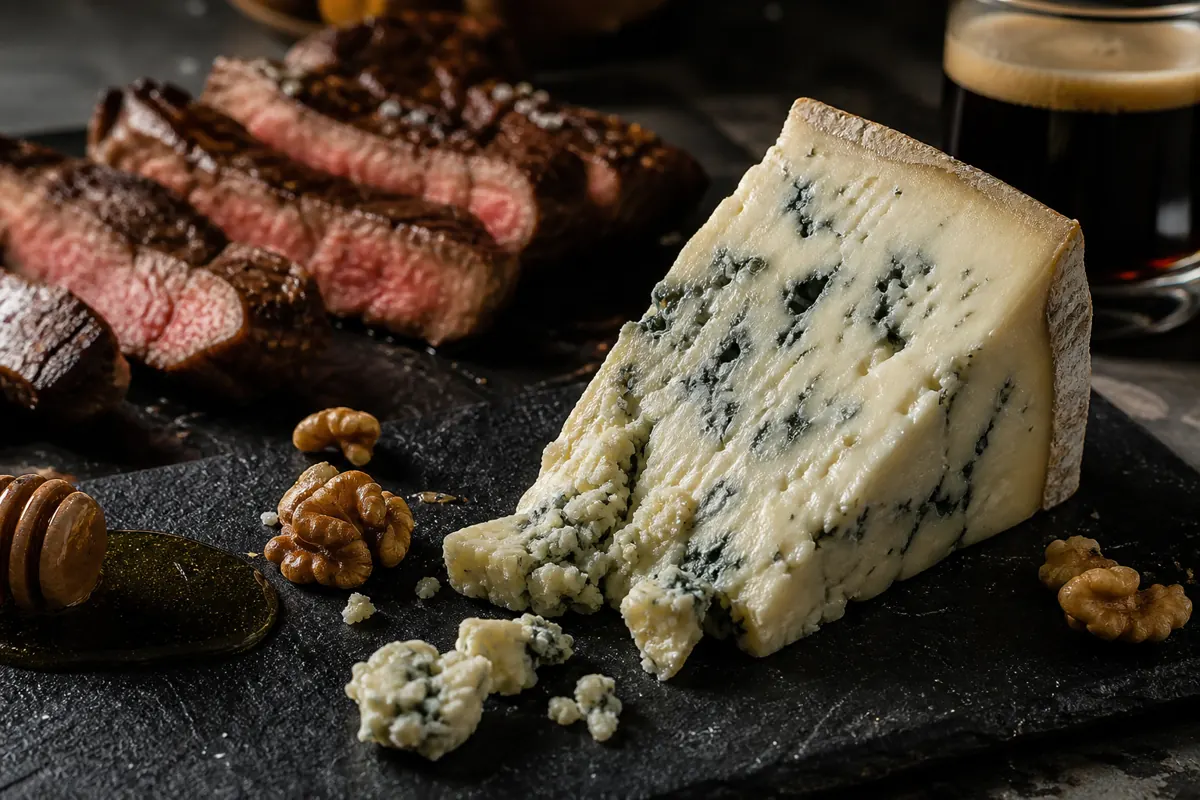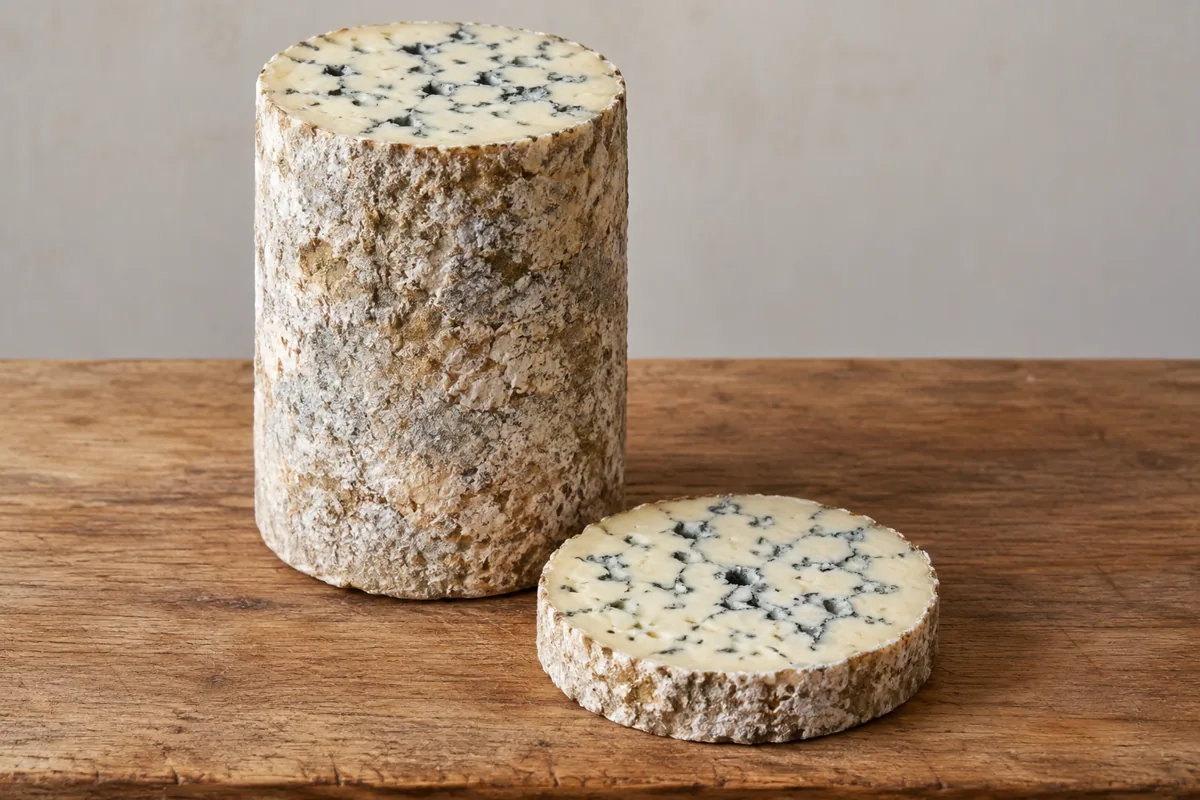
Fourme d'Ambert is a blue cheese made from cow's milk in the mountains of Auvergne, in central France, and sold under an AOP as a tall, narrow cylinder. Most sources describe it as one of the gentlest blue cheeses, though Cheese.com calls it sharp and tangy.
In This Article
What Is Fourme d'Ambert?
Fourme d'Ambert is a blue-veined cheese made from cow's milk and shaped as a cylinder that stands taller than it is wide. PDO Dairy Products gives it as 19 cm high and 13 cm across, weighing about 2 kg.
French Wikipedia gives the same height and width with a weight of 2 to 2.5 kg.
English Wikipedia also says Fourme d'Ambert is almost identical to Fourme de Montbrison, with slight differences in how the two are made.
Is Fourme d'Ambert Milder Than Other Blue Cheeses?
The official sources say it is. The Fourme d'Ambert AOP website says its gentle, rounded taste sets it apart from all other blue cheeses.
PDO Dairy Products' English page calls it "the soft blue cheese" and lists delicate aromas, with no mention of sharpness.
The same AOP website sets it beside Bleu d'Auvergne, a neighbouring Auvergne blue that it describes as more robust in flavour and creamier in texture.
| Source | Taste | Aroma |
|---|---|---|
| PDO Dairy Products | Scented notes and delicate aromas that build up in the mouth | Subtle scent of undergrowth |
| Fourme d'Ambert AOP website | Delicate flavour, a rounded taste | Undergrowth |
| Cheese.com | Savory, sharp and tangy, with hints of butter and cream | Strong, woody |
Cheese.com is the only source that leans the other way. Its note of butter and cream still matches the creamy paste the AOP bodies describe, so the gap sits in how sharp the blue reads rather than in the texture.
The two camps also name different things as the cheese's distinguishing mark. Cheese.com points to a paste more supple and dense than most blue cheeses, while the AOP websites point to flavour.
PDO Dairy Products says the altitude where the cows are milked gives the cheese a subtle, delicate flavour. The AOP website credits the richness and biodiversity of the terroir for the same subtle scent.
How Is Fourme d'Ambert Made?
The blue starts in the vat: the Fourme d'Ambert AOP website says Penicillium roqueforti is added to the milk before rennet sets it into curd.
The mould needs space and oxygen to grow, so the making steps are built around keeping the curd open. The AOP website says specific strains are chosen from hundreds of Penicillium strains to give a soft, creamy paste and the cheese's sky-blue colour.
- Cutting and stirring: about an hour in the vat (AOP website).
- Moulding and draining: 24 to 48 hours in the moulds, with turning (AOP website).
- Salting: by hand on the surface, with dry salt or in brine (AOP website).
- Piercing: from the 4th day after the rennet goes in (AOP website).
- Ripening: the cheese may carry the name only from the 28th day (AOP website), ripened at 8 to 12°C (French Wikipedia).
The step that keeps the curd open is coiffage. French Wikipedia describes it as slow stirring broken by rests that wraps each grain of curd in a thin film, so the grains do not fuse in the mould and leave natural gaps for the blue to grow into.
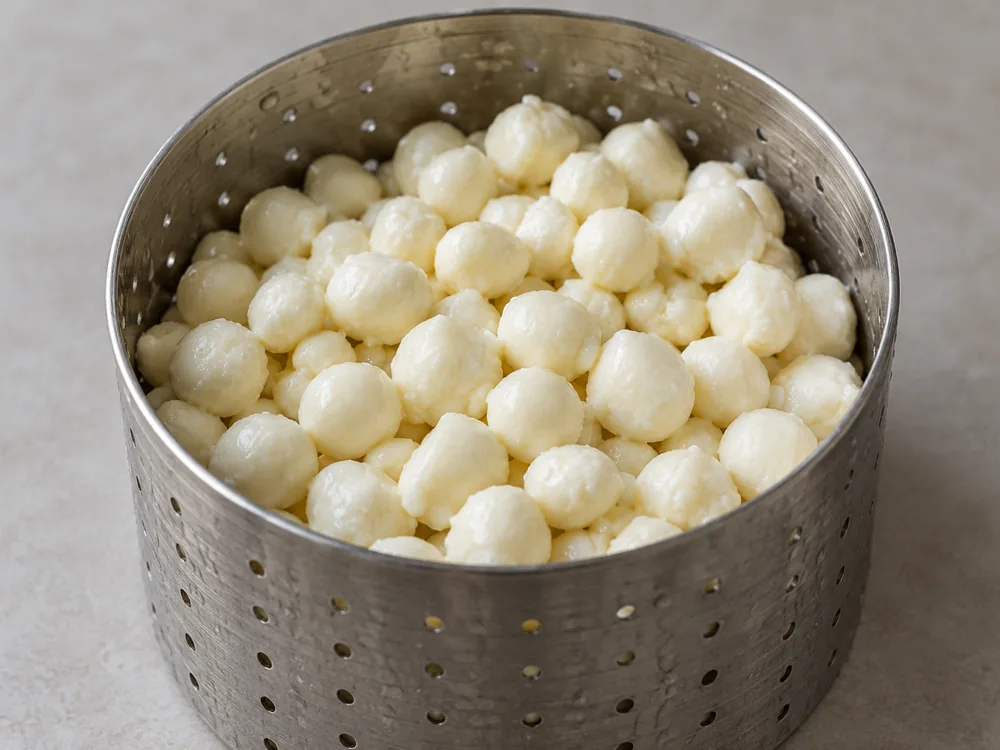
The AOP website says a mat carries the coiffed grains into the moulds, and that the cheeses are not pressed, so the openings survive the draining.
Piercing is what lets the blue spread: the AOP website describes chimneys made with large needles that carry air to the heart of the cheese, and PDO Dairy Products says the cheese then ages for about a month in cool, damp cellars.
French Wikipedia adds that the milk is heated to 32 to 35°C. It also puts the milk for one cheese at about 19 litres, a figure it marks as needing a citation.
The blue itself has a rye connection. The AOP website calls Penicillium roqueforti a fungus of rye, a cereal widely grown in Auvergne, and French Wikipedia says the mould was first grown on rye bread, then dried and ground into a blue powder.
The rules also reach back to the cows. The AOP website says they must graze at least 150 days a year, their winter fodder must come from the appellation zone, GMOs and palm oil are banned in their feed, and an independent body checks all of it.
Where Does Fourme d'Ambert Come From?
PDO Dairy Products places the production area around the Puy-de-Dôme mountain, in 5 cantons of the Cantal department and 8 communes of the Loire. French Wikipedia counts 43 cantons of the Puy-de-Dôme department, the mountain zones that leave out the Limagne plains, and gives the whole area as 800,000 hectares in 2005.
The cows are milked at 600 to 1,600 metres above sea level, according to PDO Dairy Products.
The cheese is old. English Wikipedia dates it to Roman times and points to a likeness of it carved above the entrance of a medieval chapel in La Chaulme, in the Puy-de-Dôme.
French Wikipedia separates legend from record. A legend puts the cheese before Caesar's conquest of Gaul, but its first traces date to around the 8th century, when serfs owed it to their lord as part of the tithe, as the tithe stone of the La Chaulme church shows.
In the 18th century it even served as payment to rent jasseries, the summer farms of the Forez mountains, according to French Wikipedia. It adds that women and children made the cheese there while the men stayed in the Ambert plain for the fieldwork.
Dairies took over from the jasseries later: French Wikipedia says production had been exclusively farm-made and carried out on the summer pastures until small dairies appeared from 1900.
PDO Dairy Products gives 1972 as the year of labelling for this French cheese, and French Wikipedia dates the AOC to 9 May 1972.
English Wikipedia says Fourme d'Ambert shared that AOC with Fourme de Montbrison until 2002, when each cheese got its own, and Cheese.com gives 2002, the year of the split, as its AOC year. The two Wikipedias disagree on the EU protected designation, with English Wikipedia giving 1996 and French Wikipedia 2006.
How Does Fourme d'Ambert Differ From Fourme de Montbrison?
French Wikipedia says the two differ mainly in how the curd is drained and salted today, and it lists the rind and veining that go with each.
| Fourme d'Ambert | Fourme de Montbrison |
|---|---|
| Reduced draining | Pre-draining, then drying lying in spruce troughs |
| Dry salt on the surface, or brine | Curd ground and salted within its mass |
| Slightly flowery rind | Red-orange rind |
| More veined | Milder and less veined |
French Wikipedia calls Fourme de Montbrison the milder and less veined of the two, a comparison that the Ambert producer pages cited here do not draw.
Both names start with fourme, which PDO Dairy Products traces to the Latin forma, the receptacle once used to make the cheese. French Wikipedia says the two shared a common denomination, fourme de Pierre-sur-Haute, on 14 May 1939.
Since the split of 2002, French Wikipedia adds, each cheese is sold under its own appellation, so the name on the label shows which of the two is in the box.
Is the Milk Raw or Pasteurised, and How Much Fourme d'Ambert Is Made?
PDO Dairy Products says Fourme d'Ambert may be made from raw milk or from thermised or pasteurised milk. Cheese.com lists only unpasteurized cow's milk, so the label on a given piece settles which milk it used.
English Wikipedia says industry and cooperatives most often use pasteurised milk. Farm production with raw milk has restarted, and four farmers now make up to 35 tonnes a year of Fourme d'Ambert fermière AOP from raw milk.
French Wikipedia counts 9 farm producers who make raw-milk cheese within the AOP, two of them in the canton of Ambert itself, and says industrial dairies made a large share of the cheese in 2021.
The output figures differ by source and year, partly because French Wikipedia's 2020 figure counts cheese made while PDO Dairy Products counts cheese marketed.
| Early 1900s | About 200 tonnes a year from small dairies (French Wikipedia) |
| 2017, marketed | 5,837 tonnes (French Wikipedia) |
| 2020, made | 5,800 tonnes from 1,200 milk producers and 16 cheese dairies, 7 industrial and 9 on farms (French Wikipedia) |
| 2020, marketed | 5,429 tonnes; 832 milk producers, 9 farmhouse producers and 6 production plants (PDO Dairy Products) |
French Wikipedia ranks it the 9th protected French cheese by volume, on its 2020 figures.
How Do You Choose a Good Fourme d'Ambert?
Fourme d'Ambert can be bought whole, standing upright in its light blue-grey coat, as a half, or in portions, according to the Fourme d'Ambert AOP website. A half can go on the board as the only cheese, with sliced pears beside it.
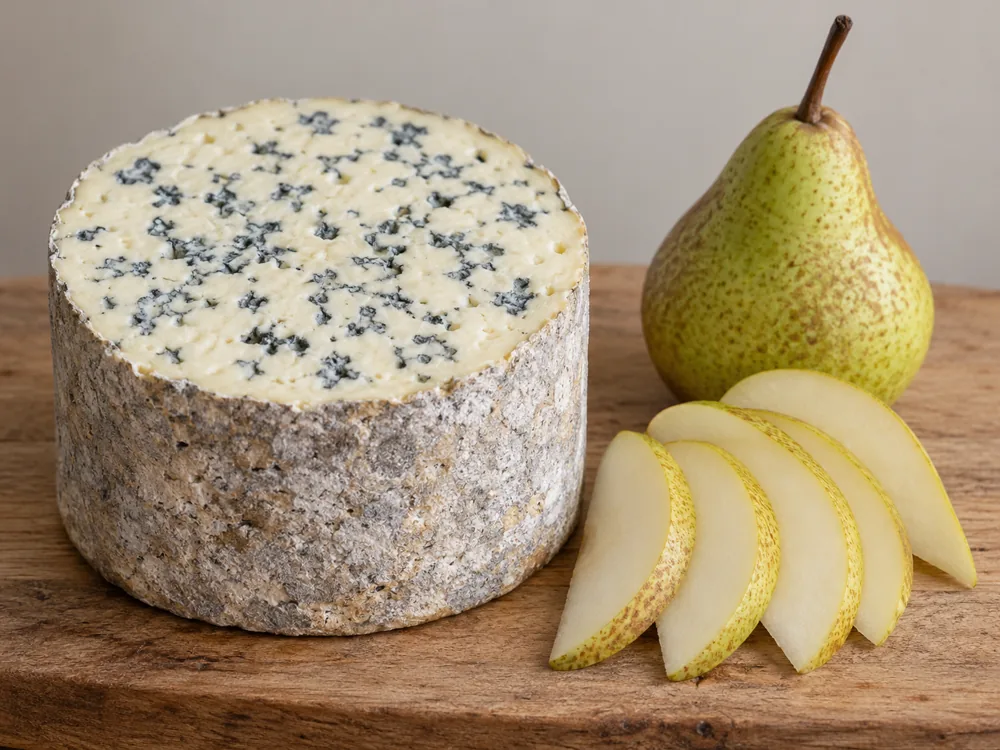
Inside, the same site says the heart should show ivory paste with well-developed, fairly regular blue veining. The cheese should also feel supple to the touch and give off a faint scent of undergrowth.
The AOP minimum is 28 days, but French Wikipedia says some makers age it longer, sometimes beyond 50 days, and English Wikipedia's infobox gives 1 to 4 months. French Wikipedia adds that a piece's best moment depends on how long it was aged and on whether it is industrial, artisanal or farm cheese.
For farm cheese, French Wikipedia prefers June to December, when autumn flavours of walnut, hazelnut and almond show. It says that window catches milk from flavour-rich spring grass, or milk drawn on the high summer pastures that it calls rich in flora.
Look for an ivory heart with even, well-developed blue veining, a supple feel and a faint undergrowth scent. For farm cheese, aim for June to December.
How Should You Serve and Pair Fourme d'Ambert?
Fourme d'Ambert is usually cut and sold in rounds, slices taken across the cylinder, and a round is then portioned the way a camembert is, according to the Fourme d'Ambert AOP website. A knife for it was designed with the Chambriard cutlery in Thiers.
The same site says to take it out of the fridge at least one hour before eating, so its aromas come through at room temperature.
For wine, PDO Dairy Products recommends a dry white made from 100% chardonnay under the Côtes d'Auvergne PDO, a full-bodied wine with a fruity and floral feel. It also names Coteaux du Layon and Muscat de Saint-Jean-de-Minervois, which the AOP website describes as sweet wines.
PDO Dairy Products gives two reasons for the chardonnay: the fullness of the wine and the creaminess of the cheese complement each other, and the wine's fruity and floral flavours chime with the earthiness of the cheese.
The AOP website adds a red, a 100% pinot noir under the Puy-de-Dôme IGP. Cheese.com lists Sauternes and other dessert wines, along with Pinot Noir and Syrah.
The AOP website says that pinot noir brings notes of lightly spiced cherries and freshens the cheese's undergrowth aromas, and says its volcanic terroir gives the wine an Auvergne character that adds originality to the pairing.
Fruit on the AOP website's list runs from fresh figs, raspberries and cherries to bananas.
| Pairing | Why It Works |
|---|---|
| Baguette or country bread | PDO Dairy Products names an artisanal baker's baguette or country bread. |
| Rye bread | Named by both PDO Dairy Products and the Fourme d'Ambert AOP website. |
| Lightly toasted gingerbread | PDO Dairy Products and the AOP website both suggest pain d'épices, lightly toasted. |
| Walnuts and hazelnuts | The AOP website lists both among the dried fruit and nuts to serve with it. |
| Mango chutney | The AOP website names mango chutney as another partner. |
| Apricot or plum jam | French Wikipedia names fruit jams such as apricot and plum. |
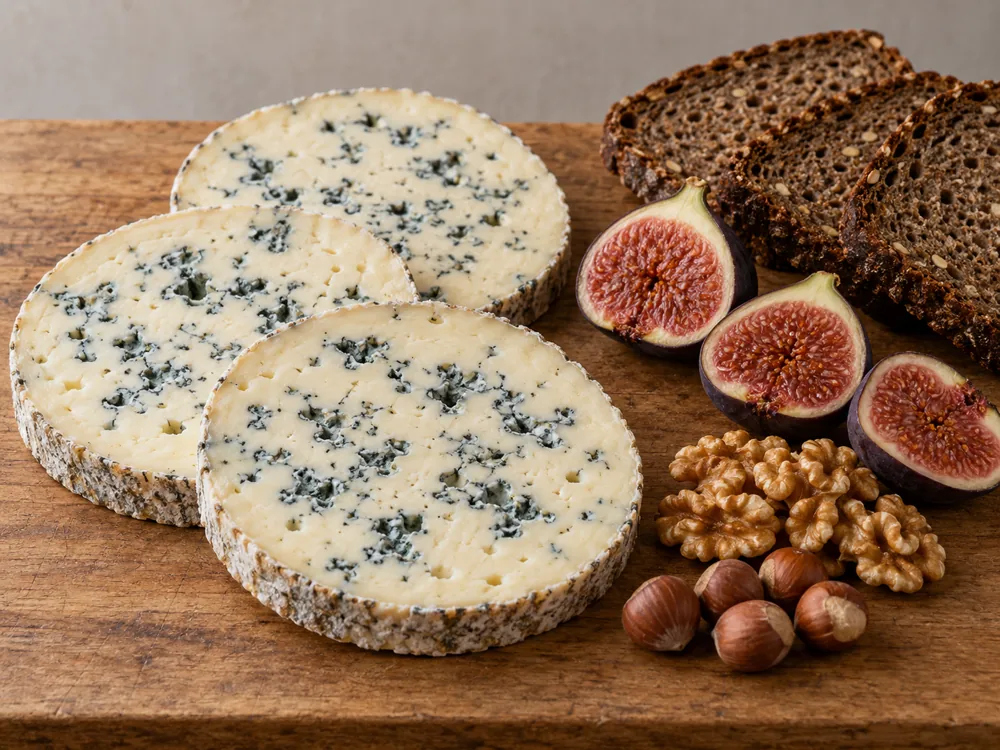
On a mixed cheese board, the AOP website says its mildness suits every key moment of a meal, and that it can sit among varied cheeses or go into sweet and savoury dishes.
For a regional board, the AOP website pairs it with other Auvergne AOP cheeses: Saint-Nectaire AOP, Cantal, Salers or Bleu d'Auvergne.
How Do You Cook With Fourme d'Ambert?
French Wikipedia says heated Fourme d'Ambert neither browns into a gratin nor turns stringy, which is why it can go into sauces. It adds that the cheese's gentle flavour can show off red meat, white meat and fish in a dish.
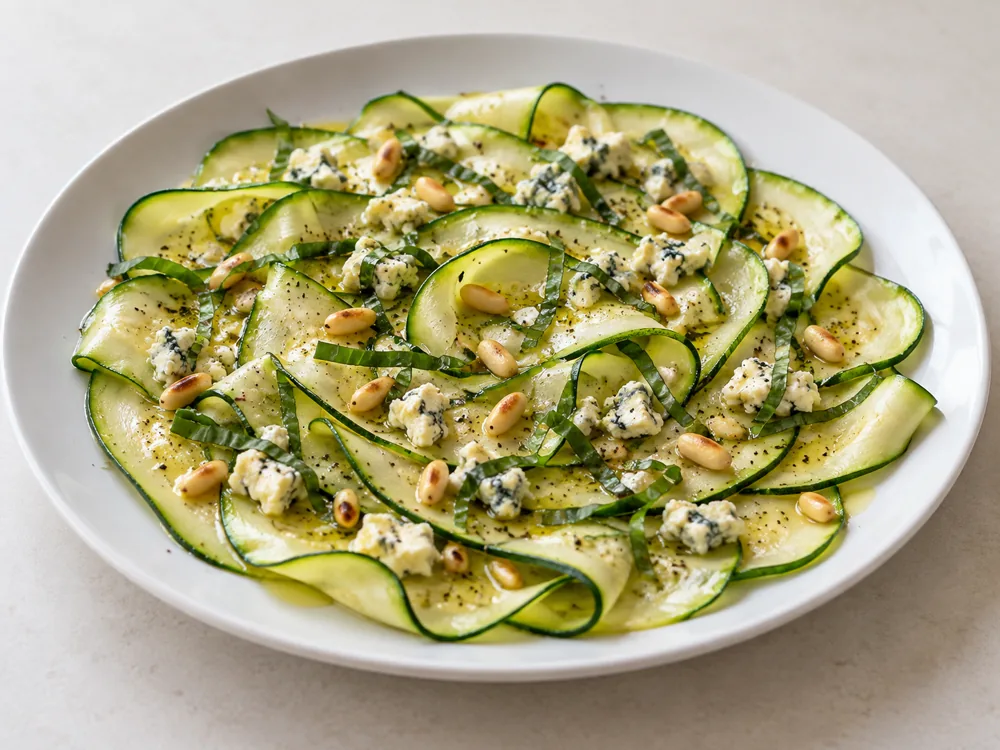
The Fourme d'Ambert AOP website publishes its own recipes. Its courgette carpaccio serves four with 80 g of Fourme d'Ambert, 2 small courgettes, 30 g of pine nuts, 2 tablespoons of olive oil, a few basil leaves and black pepper.
The courgettes are sliced thin with a mandoline or peeler and laid out in a rosette. The pine nuts are toasted in a dry pan, and the crumbled cheese, pine nuts and basil go over the top before the plate is served cold.
Its asparagus tart, also for four, spreads crème fraîche, egg and grainy mustard over puff pastry pre-baked for 6 to 7 minutes. Twelve green asparagus and 100 g of crumbled Fourme d'Ambert go on top, and the tart bakes for 18 to 20 minutes at 180°C.
The asparagus is halved lengthwise after the hard 2 to 3 cm of each base is cut off, and a thread of honey goes over the cheese before the final bake. The recipe judges doneness with a knife tip: the asparagus should be tender but not soft.
How Should You Store Fourme d'Ambert?
For cheese storage, the Fourme d'Ambert AOP website gives advice in two parts. The cheese keeps best for a few days somewhere cool, in its original paper.
A piece bought a little young can be left to ripen for several days, or even a few weeks, at the bottom of the fridge, the same site adds.
French Wikipedia gives May to October as the best season to eat it.
Is Fourme d'Ambert Safe During Pregnancy?
Neither the NHS nor the CDC names Fourme d'Ambert, so the rules on cheese in pregnancy do not settle it. Cheese.com and English Wikipedia call it semi-hard, but PDO Dairy Products' English page calls it the soft blue cheese, so the blue-veined rule is the safer reading.
The NHS also says pasteurised or unpasteurised soft blue-veined cheeses, such as Danish blue, gorgonzola and roquefort, must be thoroughly cooked. It counts any cheese cooked until steaming hot, including soft or blue cheese, as safe.
The CDC lists soft cheese made from unpasteurized (raw) milk, including blue-veined cheese, among its riskier choices, and pasteurized soft cheeses heated to an internal temperature of 165°F or until steaming hot among its safer ones. It notes that pregnant women are 10 times more likely to get a Listeria infection.
Served cold, Fourme d'Ambert is described as a pasteurized semi-hard or soft blue-veined cheese, a type the CDC list does not cover, so ask a midwife or doctor. The CDC also lists unpasteurized (raw) milk and dairy products made from raw milk as riskier, which covers a raw or thermised piece read as semi-hard.
Because neither agency names this cheese, the safer reading is to cook it until steaming hot. The NHS counts any cheese cooked that way as safe, but the CDC names only pasteurized soft cheeses heated to an internal temperature of 165°F or until steaming hot, so the CDC lists do not settle a raw-milk cheese once cooked.
The asparagus tart counts as cooked only if it is eaten steaming hot, while the AOP recipe lets it cool for 5 minutes and serves it lukewarm.
SOURCES & REFERENCES
What Other Questions Do People Ask About Fourme d'Ambert?
PDO Dairy Products describes delicate aromas that build up in the mouth and a subtle scent of undergrowth. Cheese.com calls it savory, sharp and tangy, with hints of butter and cream.
The Fourme d'Ambert AOP website says its gentle taste sets it apart from other blue cheeses, and it describes Bleu d'Auvergne as more robust in flavour and creamier in texture.
French Wikipedia says they differ mainly in draining and salting, and calls Fourme de Montbrison the milder, less veined cheese with a red-orange rind.
It can be. PDO Dairy Products says the milk may be raw, thermised or pasteurised, so the label tells you which.
Yes. French Wikipedia says it neither browns nor turns stringy when heated, so it suits sauces, and the AOP website bakes it into an asparagus tart.
PDO Dairy Products recommends a dry 100% chardonnay from the Côtes d'Auvergne, or Coteaux du Layon or Muscat de Saint-Jean-de-Minervois, which the AOP website calls sweet wines.