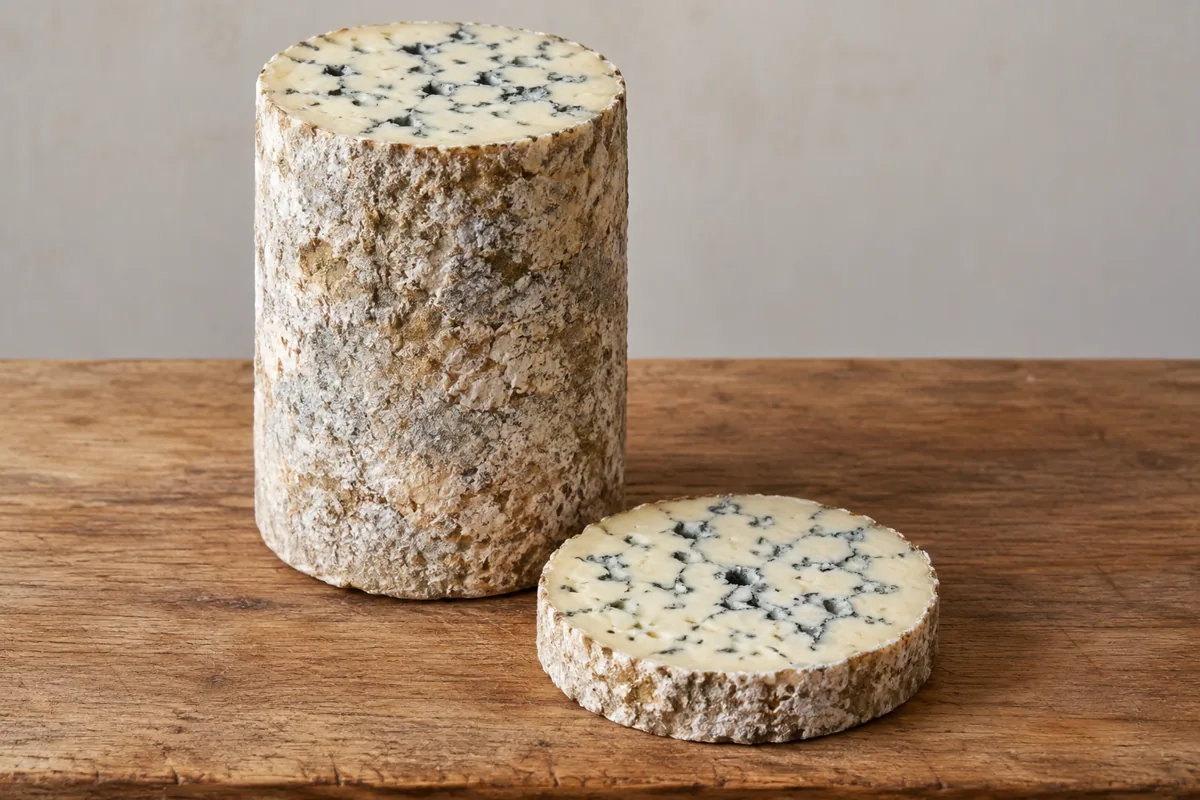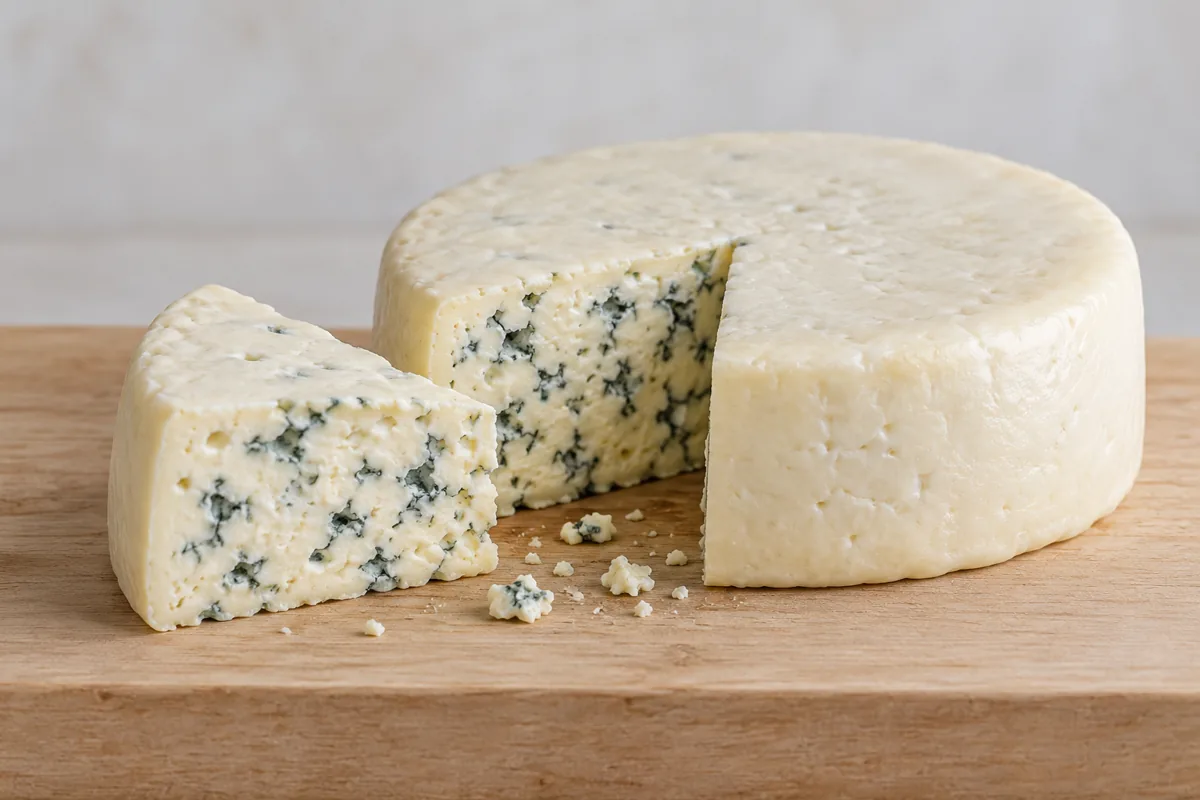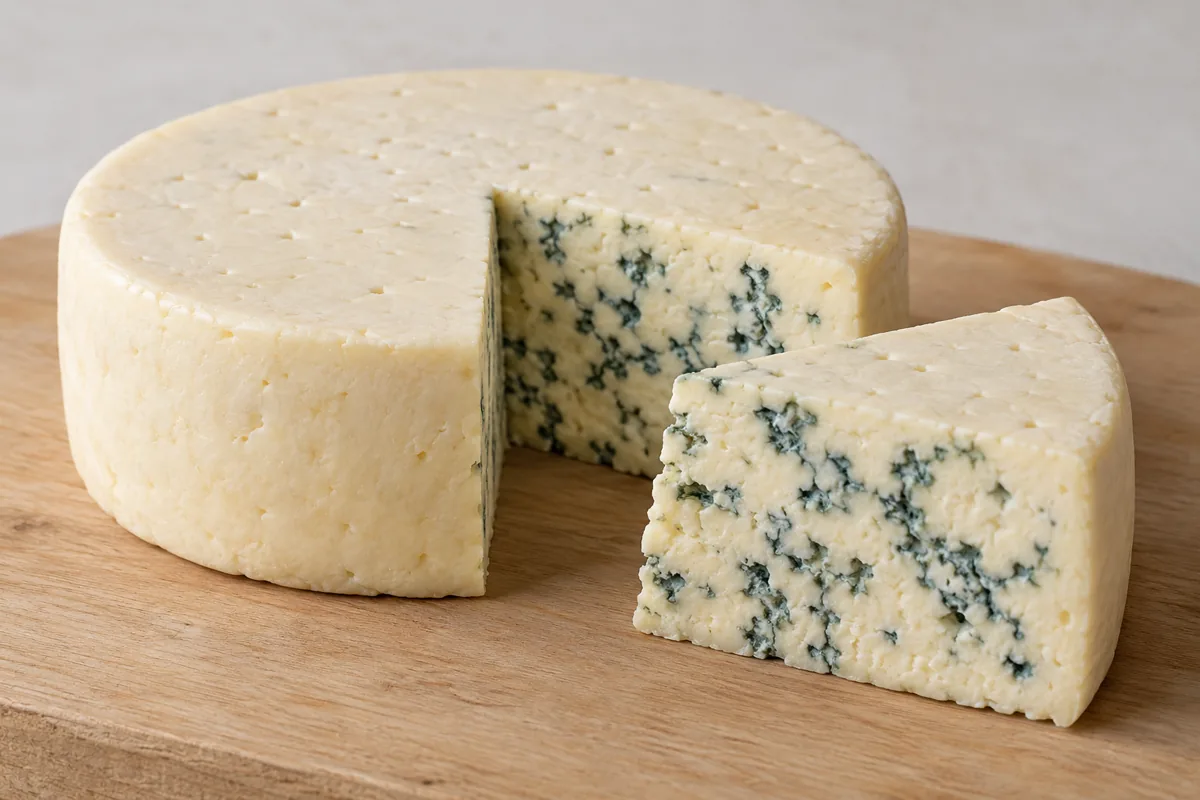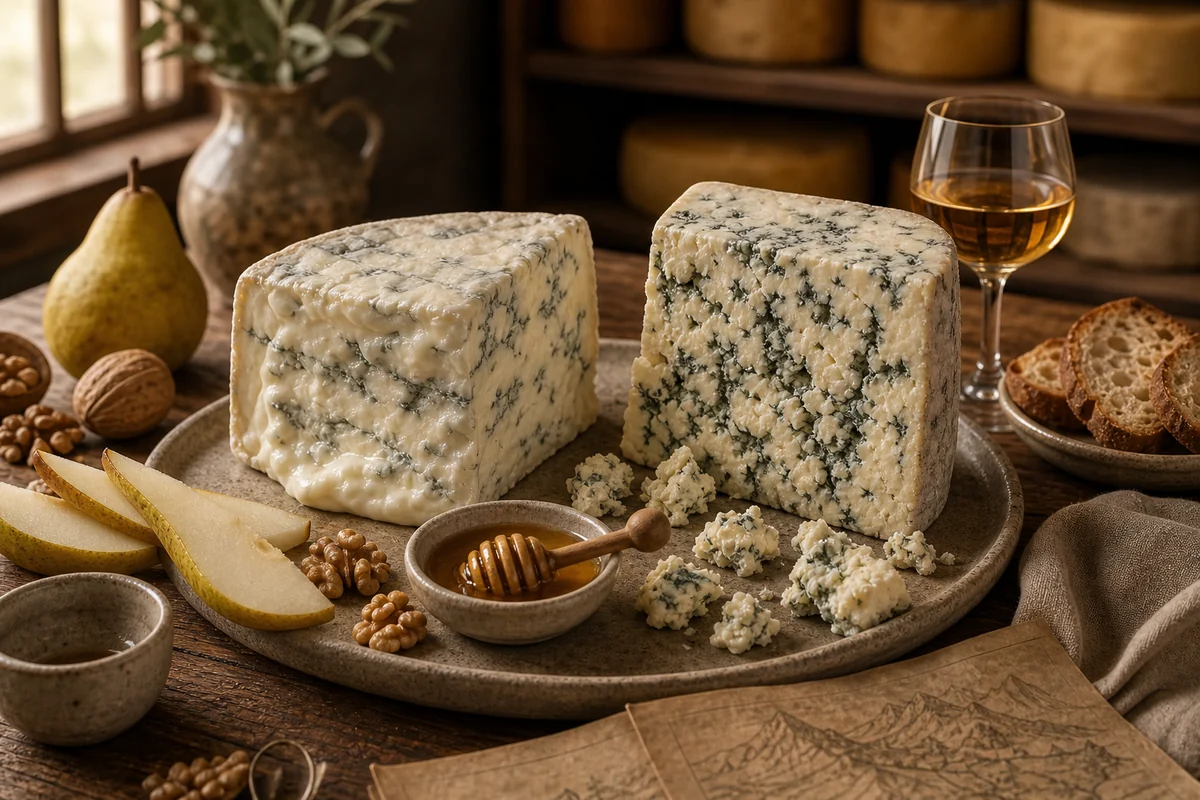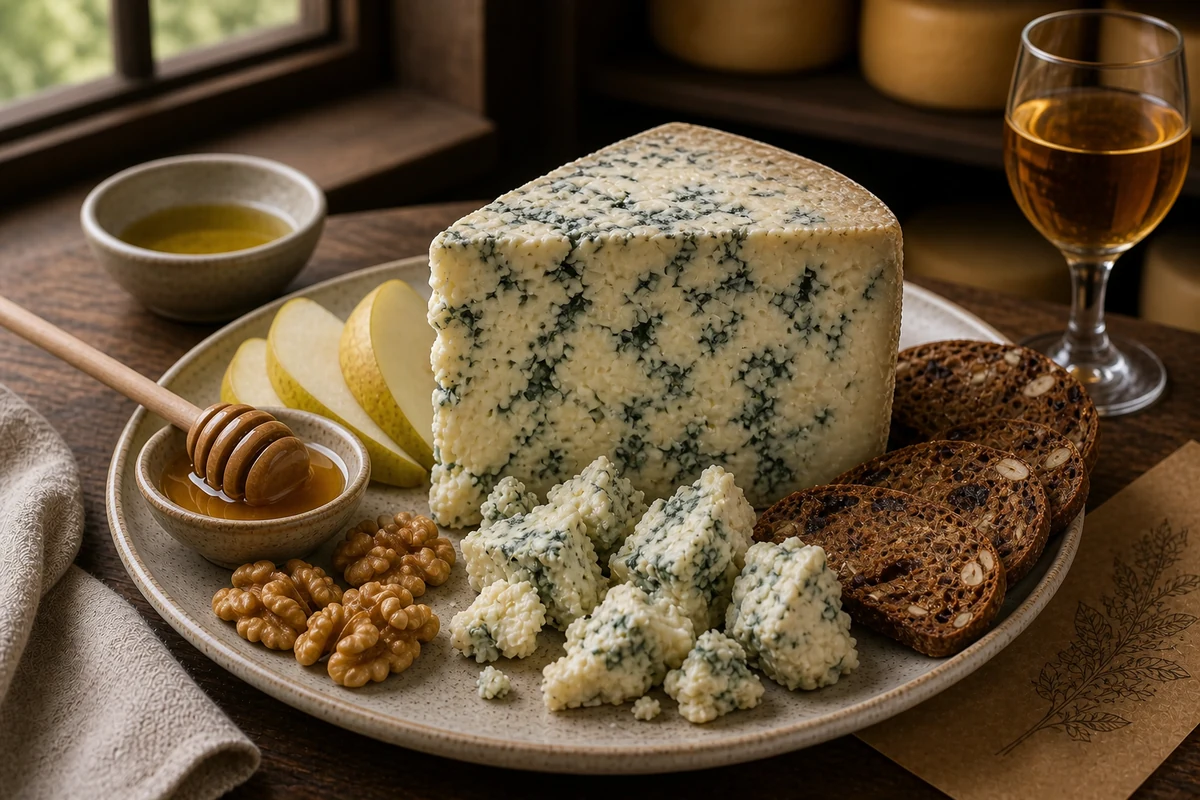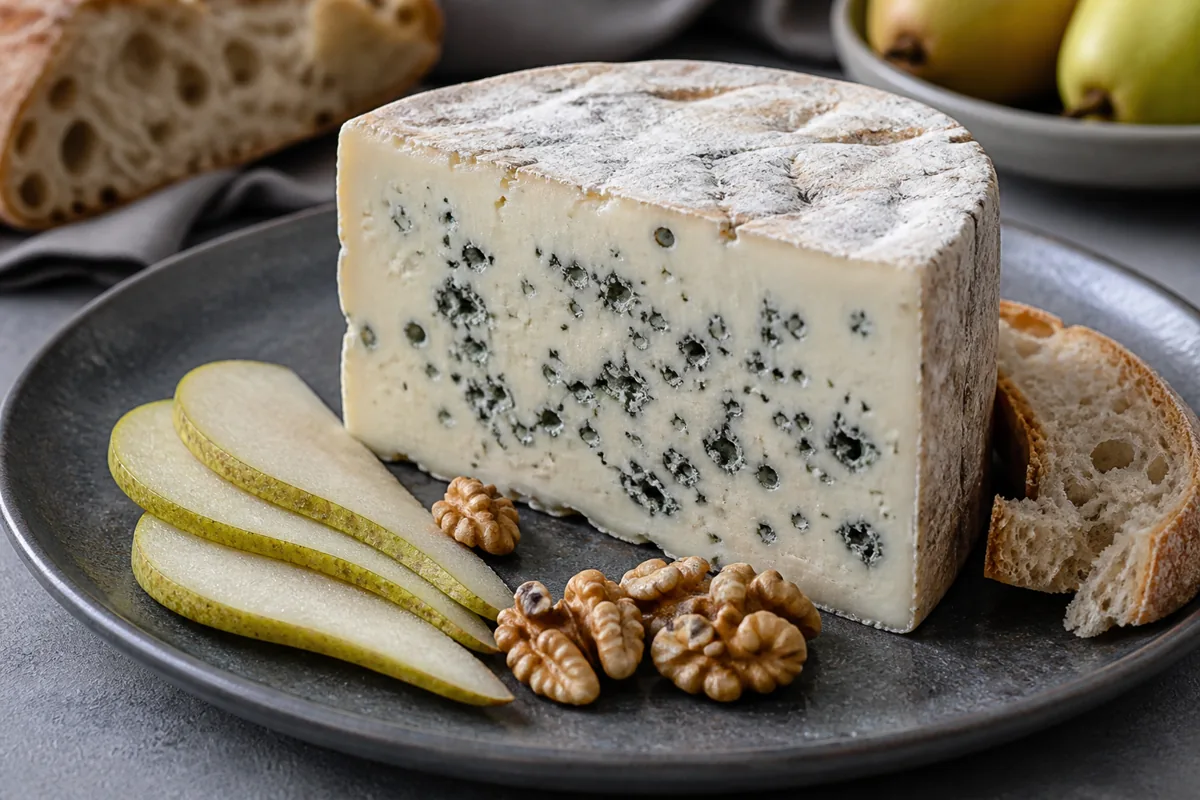
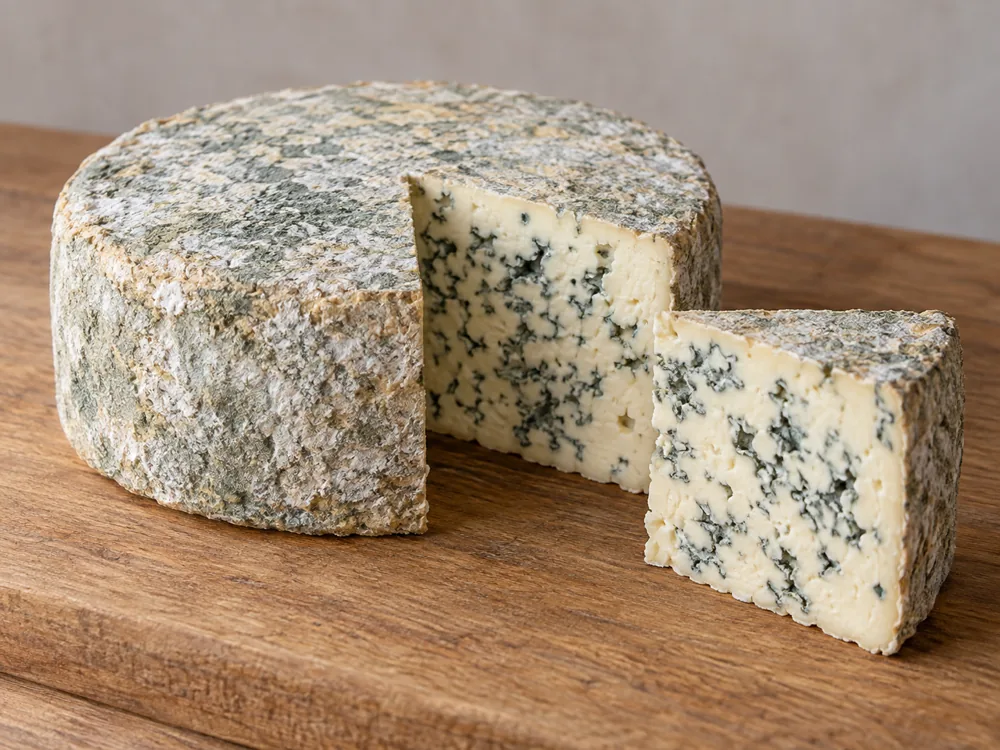
Bleu d'Auvergne is a blue cheese made from cow's milk in Auvergne, in south-central France, and protected by an AOP.
PDO Dairy Products, the site of the French dairy appellations, calls its taste intense yet balanced. The cheese's own AOP website cooks it into a creamy chicken and tagliatelle sauce and pairs it with pear, walnuts and honey.
In This Article
What Is Bleu d'Auvergne?
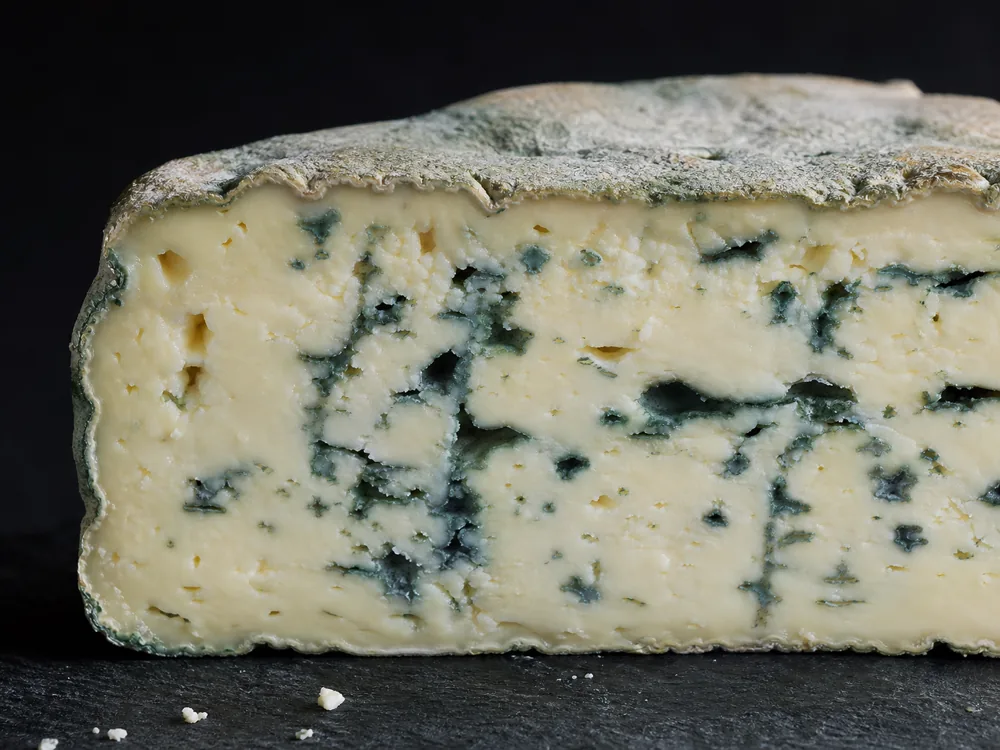
Bleu d'Auvergne is a blue-veined cheese made only from cow's milk. PDO Dairy Products says its blue-green mould gives it a distinctive marbled pattern.
How Is Bleu d'Auvergne Made?
The method goes back to the 1850s. PDO Dairy Products credits Antoine Roussel, an Auvergne native who trained in a pharmacy in Rouen, with a way of developing the blue mould that he perfected in 1854.
English Wikipedia says Roussel noticed that blue mould on his curd gave an agreeable taste, then found after several failed tests that mould from rye bread produced the veining and that pricking the curd with a needle let air in. The air matters because the blue mould grows in the pockets of air inside the curd.
The promotional association of Auvergne cheeses tells the story without a name, according to French Wikipedia: a farmer west of Clermont-Ferrand in the mid-19th century seeded curd with the mould that formed on rye bread and pierced it with a needle. French Wikipedia adds that the origin is not precisely known and is tied to that of Bleu de Laqueuille, with several versions in competition.
The EU product specification, which French Wikipedia quotes, dates the cheese earlier: it goes back to the early 19th century on the volcanic highlands of the Massif Central, and Paris knew it by 1879, when the chansonnier Francisque Bathol praised it.
Both accounts can be true if 1854 marks Roussel's method rather than the first Bleu d'Auvergne.
Makers today, French Wikipedia says, seed the milk with Penicillium roqueforti or Penicillium glaucum and set it with rennet, then cut and drain the curd and stir it gently so that draining starts at each curd grain before it goes into the moulds.
Salting, English Wikipedia says, comes in two stages: first on the flat faces and then on the sides, so the salt works gradually inward through the paste.
Each cheese is pierced as it enters the cellar, and French Wikipedia says mechanical piercing replaced the old knitting needles long ago, giving even veining and a satisfactory yield.
The cheeses then ripen for at least four weeks in cool, damp cellars, a figure both Wikipedias give and one English Wikipedia calls short for a blue cheese. English Wikipedia's infobox lists two months, which a cheese kept past the minimum would match.
| Point | Figure | Source |
|---|---|---|
| Milk for one cheese | 20 to 25 litres | French Wikipedia; English Wikipedia |
| Finished weight | 2 to 3 kg | French Wikipedia |
| Minimum ripening | 4 weeks | French Wikipedia; English Wikipedia |
| Dry matter | At least 52 g per 100 g of cheese | French Wikipedia |
| Fat | 50 g per 100 g of dry matter | French Wikipedia |
At the 52 g dry-matter floor a cheese holds up to 48 g of water per 100 g, and 50 g of fat per 100 g of dry matter works out to about 26 g of fat per 100 g of cheese.
Is Bleu d'Auvergne Made from Raw or Pasteurised Milk?
PDO Dairy Products says Bleu d'Auvergne may be made from raw milk or from thermised or pasteurised milk, and English Wikipedia's infobox says pasteurisation depends on the variety. The label on a given cheese therefore settles which milk it used.
In the industrial dairies that make most of the cheese, the two Wikipedias say, the refrigerated raw milk bought from farms is often pasteurised before processing. Pasteurised milk lacks the varied native microbes of raw milk, so makers re-seed it with a limited set of cultured organisms, and neither Wikipedia says what that does to the taste.
English Wikipedia lists it among the French cheeses granted an AOC, and PDO Dairy Products gives 1975 as the year. French Wikipedia adds the EU's AOP in 1996.
French Wikipedia says the AOP area covered almost all of the Cantal department in 2022, plus parts of Puy-de-Dôme, Haute-Loire, Aveyron, Corrèze, Lot and Lozère. It adds that the boundary was redrawn several times, notably in 1986 and 2017, and its infobox puts the production area at 2 million hectares in 2005.
| 2007 | 6,197 tonnes made (French Wikipedia) |
| 2017 | 5,047 tonnes marketed (French Wikipedia) |
| 2020 | 4,762 tonnes marketed (PDO Dairy Products) |
| Makers | 1,305 milk producers, 8 farmhouse producers and 6 production plants (PDO Dairy Products) |
The three yearly figures fall in turn, though only the 2007 figure counts cheese made, while the 2017 and 2020 figures count cheese marketed. Between those two marketed figures the drop is about 6 percent.
The sources disagree on farm cheese. English Wikipedia says that as of 2018 dairies made most of it and only one original farm-based production remained, while PDO Dairy Products counts 8 farmhouse producers.
The two counts may not measure the same thing, since one speaks of an original farm-based production and the other of farmhouse producers.
How Does It Taste Next to Fourme d'Ambert and Roquefort?
PDO Dairy Products calls the taste intense yet balanced, a punchy cheese with scents of wild mushrooms, cream and undergrowth.
English Wikipedia calls it strong and pungent but less so than other blue cheeses, and describes it as less salted, creamier and more buttery.
Fourme d'Ambert gets gentler words from PDO Dairy Products: a subtle, delicate flavour with a full-bodied taste that builds in the mouth, against the punchy taste it gives Bleu d'Auvergne.
Both pages name undergrowth among the scents, so the two share an earthy note, and Bleu d'Auvergne adds wild mushrooms and cream.
Ageing does not set them apart: PDO Dairy Products says Fourme d'Ambert is aged for a month in cool, damp cellars after holes are poked to air the paste, close to the four-week minimum for Bleu d'Auvergne. It credits the delicate flavour to cows milked at 600 to 1,600 metres above sea level.
Both are protected cow's milk cheeses, and Fourme d'Ambert's labelling came first, in 1972 against 1975. PDO Dairy Products also counts 5,429 tonnes of Fourme d'Ambert marketed in 2020 from 832 milk producers, against 4,762 tonnes of Bleu d'Auvergne from 1,305.
Fourme d'Ambert's area is the smaller one: PDO Dairy Products places it around the Puy-de-Dôme mountain, in five cantons of Cantal and eight communes of the Loire, where Bleu d'Auvergne covers almost all of Cantal and parts of six departments.
| Point | Bleu d'Auvergne | Fourme d'Ambert | Roquefort |
|---|---|---|---|
| Milk | Cow's milk, raw, thermised or pasteurised (PDO Dairy Products) | Cow's milk, raw, thermised or pasteurised (PDO Dairy Products) | Milk of Lacaune sheep only, raw and not heated above 34 °C under its AOC rules (English Wikipedia) |
| Format | Cylinder 18 to 20 cm across and 9 to 10 cm tall, or 19 to 23 cm across and 10 to 11 cm tall, 2 to 3 kg (French Wikipedia) | Cylinder 13 cm across and 19 cm tall, about 2 kg (PDO Dairy Products) | Wheel of 2.5 to 3 kg, about 10 cm thick (English Wikipedia) |
| Outside | Thin crust that may be tinged blue-green (PDO Dairy Products) | Blue-grey coat resembling stone (PDO Dairy Products) | No rind; slightly salty exterior (English Wikipedia) |
| Ripening | At least 4 weeks in cool, damp cellars (French Wikipedia) | A month in cool, damp cellars (PDO Dairy Products) | 5 months in the infobox, in the natural caves of Mont Combalou (English Wikipedia) |
| Taste | Intense yet balanced, punchy (PDO Dairy Products) | Subtle and delicate, full-bodied (PDO Dairy Products) | Tangy, with a sharp tang from the blue veins (English Wikipedia) |
English Wikipedia dates the AOC of sheep's milk Roquefort to 1925, and its rules fix the breed, the raw milk and the caves. A Bleu d'Auvergne label, by contrast, has to be read for the milk.
The milk volumes differ too: Bleu d'Auvergne takes 20 to 25 litres for a cheese of 2 to 3 kg, roughly 7 to 12 litres a kilogram, while English Wikipedia puts Roquefort at about 4.5 litres a kilogram.
The moulds overlap only in part: English Wikipedia says some Bleu d'Auvergne versions use the weaker Penicillium glaucum for the veining instead of the Penicillium roqueforti used in Roquefort and other blue cheeses.
Fourme d'Ambert is the subtle, delicate cow's-milk blue, Bleu d'Auvergne the punchier one, and Roquefort the sheep's-milk blue with raw-milk rules.
How Do You Cook With Bleu d'Auvergne?
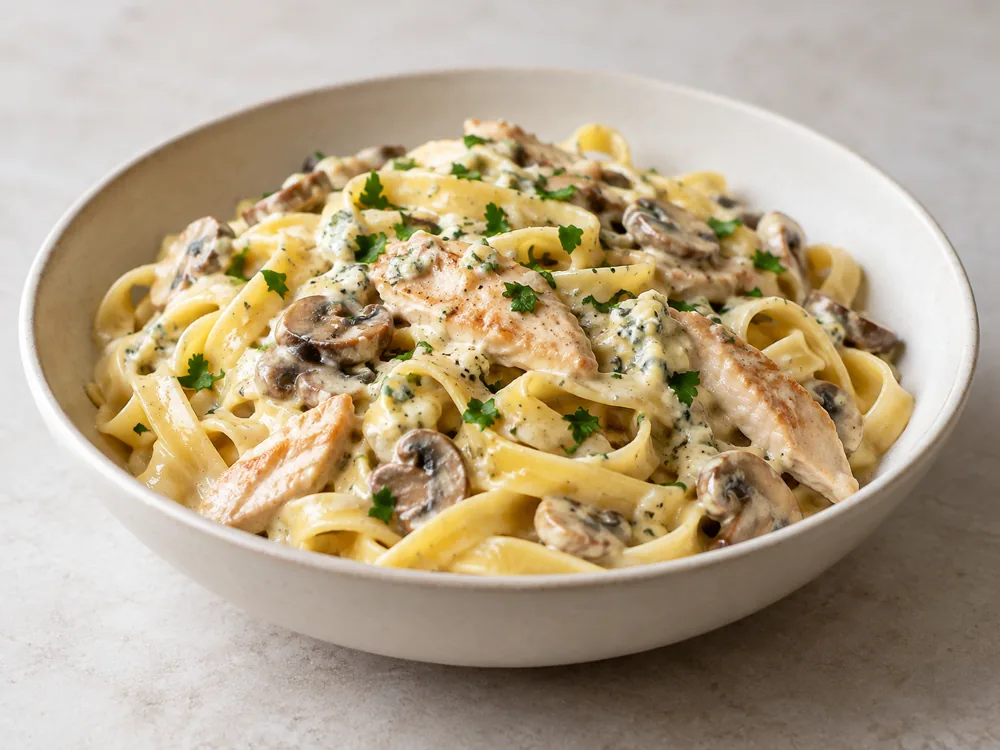
The Bleu d'Auvergne AOP website publishes its own recipes for the cheese, among them tagliatelle with chicken in a creamy sauce that serves two and takes 30 minutes.
That recipe uses 150 g of Bleu d'Auvergne with 400 g of tagliatelle, 250 g of chicken breast, 200 g of brown mushrooms, 100 ml of Saint-Pourçain white wine and 2 tablespoons of cream.
The chicken is browned with garlic, shallot and paprika, and the mushrooms cook for a minute. The cream, wine, cheese and parsley then go in before the drained pasta is tossed through and the pan comes off the heat.
The 150 g of cheese outweighs both the 100 ml of wine and the 2 tablespoons of cream, which makes the cheese the largest part of the sauce.
The same recipe page points to a cannelloni gratin and a grilled cheese sandwich among its other ideas, and English Wikipedia lists salad dressings, seasoning for pasta dishes and snacking.
What Can You Make With Bleu d'Auvergne Without Cooking?
The AOP website changes the cheese's temperature to suit each job. A spread on firm pear uses cheese softened at room temperature, while dates are stuffed with matchsticks cut from cheese straight out of the fridge.
Its cornflake bites use diced cheese that is softened, rolled in the flakes and served cold so that they do not crumble, and it builds sweet and savoury canapés on bases of pain d'épices, speculoos and walnut bread.
| Use | How It Works |
|---|---|
| Stuffed dates | Matchsticks of cheese cut straight from the fridge fill the dates. |
| Pain d'épices skewers | Cubes of cheese and pain d'épices alternate on cocktail sticks, about 4 cubes per stick. |
| Cornflake bites | Diced cheese softened at room temperature, rolled in sweetened or plain cornflakes and served cold. |
| Walnut-bread toast | Walnut bread topped with two slices of cheese, a small slice of raw ham, a quarter of a prune, walnut pieces and parsley. |
| Salad plate | Thin slices of cheese with salad leaves dressed with sherry vinegar, and cashew nuts. |
| Speculoos tartine | Speculoos spread with the cheese and topped with redcurrant jam. |
What to Serve With Bleu d'Auvergne
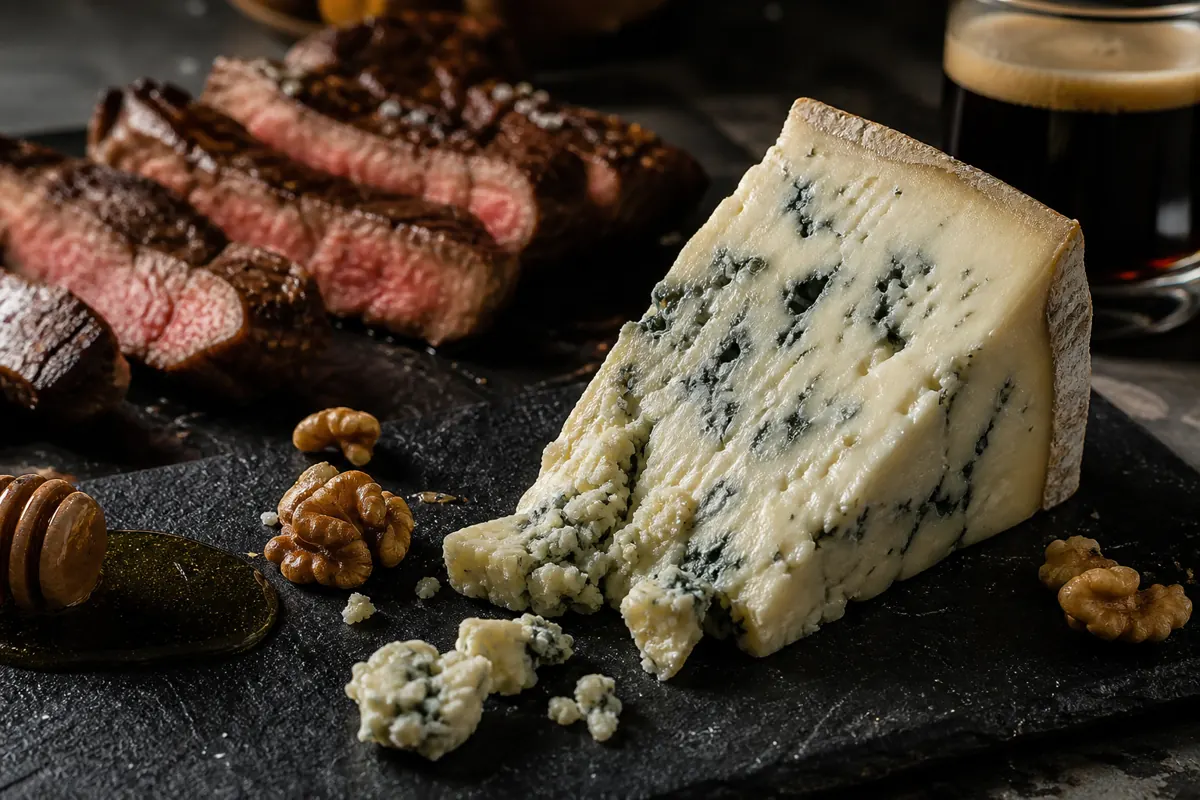
For wine, PDO Dairy Products suggests a sweet white wine such as Montbazillac or Pineau des Charentes, or a natural sweet wine such as Maury or Rasteau from the Côtes du Rhône.
English Wikipedia adds dessert Riesling and Sauvignon Blanc and, unlike PDO Dairy Products, strong, robust red wines.
Beer and stronger drinks work too. PDO Dairy Products names amber beer, fermented rhubarb juice and Pommeau de Normandie, and English Wikipedia lists barley wine, porter and peated Islay Scotch whisky.
English Wikipedia's reason for barley wine and porter is that they have both the sweetness and the bold flavour to balance the cheese, and it credits the whisky's bold, sweet and smoky flavour in the same way.
The first wine PDO Dairy Products names for Fourme d'Ambert is a dry white Chardonnay from the Côtes d'Auvergne, while for Bleu d'Auvergne it says a white should be sweet.
The food partners come mostly from the AOP website, which lists fruit, honey, jams and breads.
| Pairing | Why It Works |
|---|---|
| Pear | The AOP website says pear and Bleu d'Auvergne go well together. |
| Walnuts | The AOP website holds a cube of the cheese between two walnut halves. |
| Lavender honey | The AOP website names lavender honey as a match. |
| Fig, black cherry or redcurrant jam | All three jams appear on the AOP website's list. |
| Melon and watermelon | The AOP website suggests both in summer. |
| Sourdough, rye and dried-fruit bread | PDO Dairy Products names these three breads; the AOP website adds walnut bread and pain d'épices. |
Rye bread is on both blues' lists in PDO Dairy Products, which otherwise puts sourdough and dried-fruit bread with Bleu d'Auvergne and a baker's baguette, country bread or lightly toasted gingerbread with Fourme d'Ambert.
The AOP website says to offer fig or black cherry jam in a small saucer at the tasting or on the cheese board.
How to Store and Serve Bleu d'Auvergne
The AOP website gives exact storage advice: keep the cheese cool, wrapped in aluminium foil, in the bottom of the fridge, so that it keeps its full taste and creaminess. It also warns against moving the cheese through repeated changes of temperature.
The same site suggests buying one larger piece from the cheesemonger rather than small pieces, because a larger piece keeps better and goes on maturing, while small pieces spoil quickly.
The Bleu d'Auvergne AOP website says to bring the cheese to room temperature, as you would a wine, at least one hour before eating it.
PDO Dairy Products says the soft, creamy texture becomes all the more sumptuous, as with a fine wine, with the right maturing and temperature.
French Wikipedia gives June to December as the best time of year to eat Bleu d'Auvergne.
Is Bleu d'Auvergne Safe During Pregnancy?
PDO Dairy Products and English Wikipedia call Bleu d'Auvergne soft, and it is blue-veined, so the NHS line for soft blue-veined cheeses on cheese in pregnancy applies to it.
The NHS says pasteurised or unpasteurised soft blue-veined cheeses, such as Danish blue, gorgonzola and roquefort, must be thoroughly cooked. It counts any cheese cooked until steaming hot, including soft or blue cheese, as safe.
The CDC lists soft cheese made from unpasteurized milk, including blue-veined cheese, among its riskier choices. Its safer list includes pasteurized soft cheeses heated to an internal temperature of 165°F or until steaming hot.
Served cold, a pasteurized Bleu d'Auvergne is described as a soft, creamy blue-veined cheese, a type the CDC list does not cover, so ask a midwife or doctor. The CDC lists unpasteurized (raw) milk and dairy products made from raw milk as riskier, and its heated line covers pasteurized soft cheese only, so for a raw or thermised piece, cooked or not, ask a midwife or doctor too.
As the milk section above explains, only the label shows whether a given cheese used raw milk, so eat it in a dish cooked until steaming hot rather than cold. The CDC notes that pregnant women are 10 times more likely to get a Listeria infection.
SOURCES & REFERENCES
What Else Do People Ask About Bleu d'Auvergne?
PDO Dairy Products calls it intense yet balanced, with scents of wild mushrooms, cream and undergrowth. English Wikipedia says it is strong and pungent but less salted and creamier than other blue cheeses.
It can be. PDO Dairy Products says the milk may be raw, thermised or pasteurised, so the label tells you which.
At least four weeks, according to French Wikipedia and English Wikipedia.
No. Bleu d'Auvergne is made from cow's milk and Roquefort from the milk of Lacaune sheep, and English Wikipedia says only cheese ripened in the natural caves of Mont Combalou in Roquefort-sur-Soulzon may bear the Roquefort name.
PDO Dairy Products describes Bleu d'Auvergne as punchy and Fourme d'Ambert as subtle and delicate, and French Wikipedia gives Bleu d'Auvergne as a flat cylinder 9 to 11 cm tall where Fourme d'Ambert is 19 cm tall.
PDO Dairy Products suggests sweet whites such as Montbazillac or Pineau des Charentes and natural sweet wines such as Maury or Rasteau.