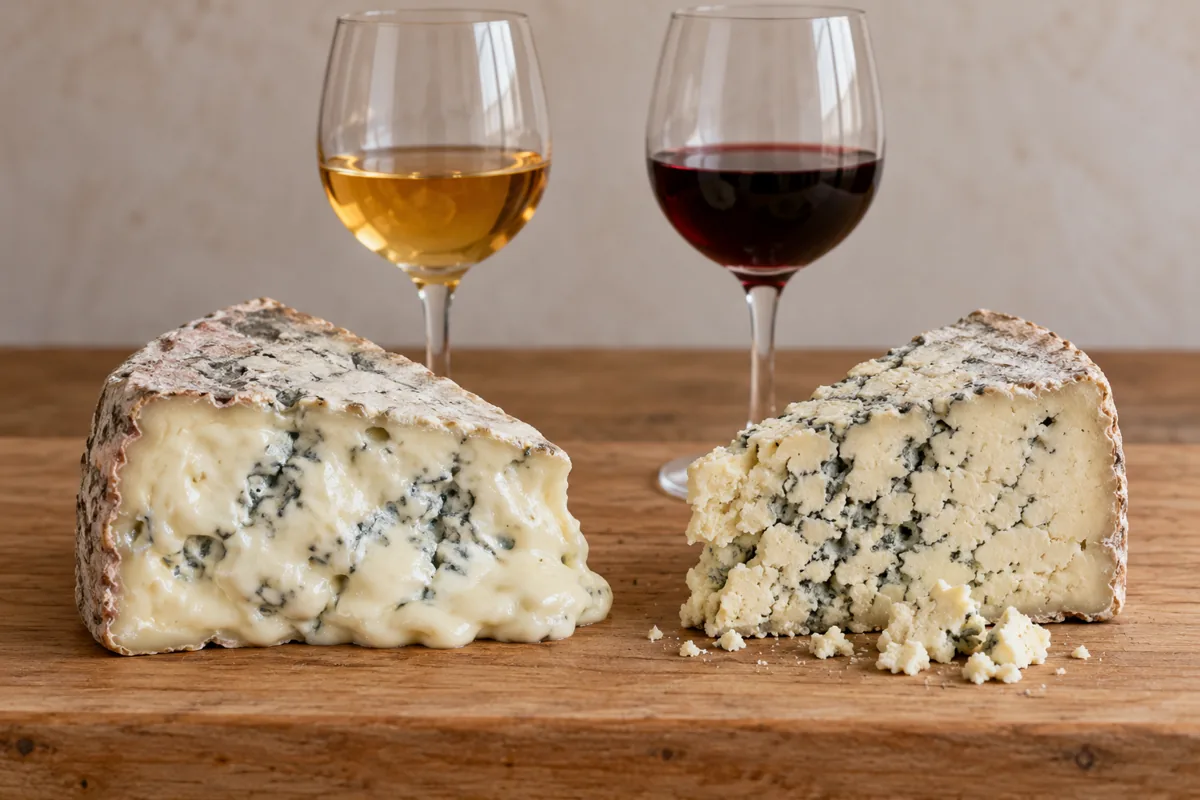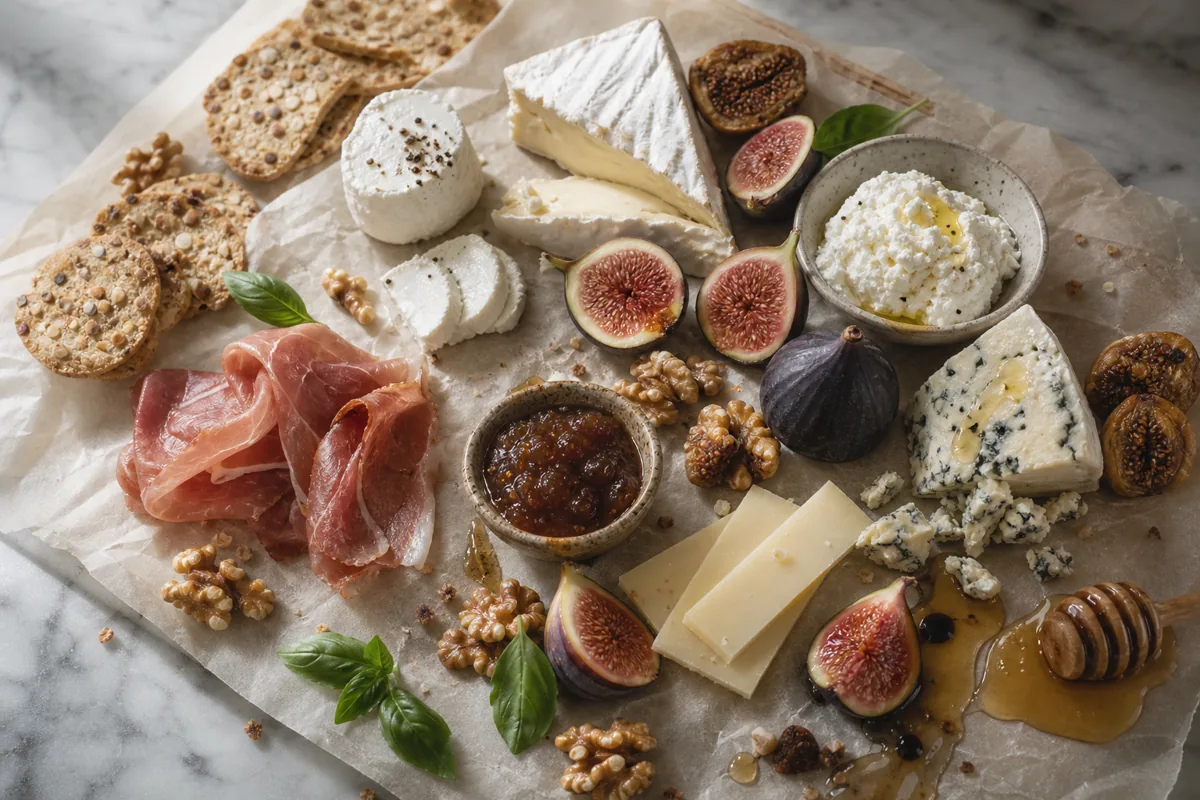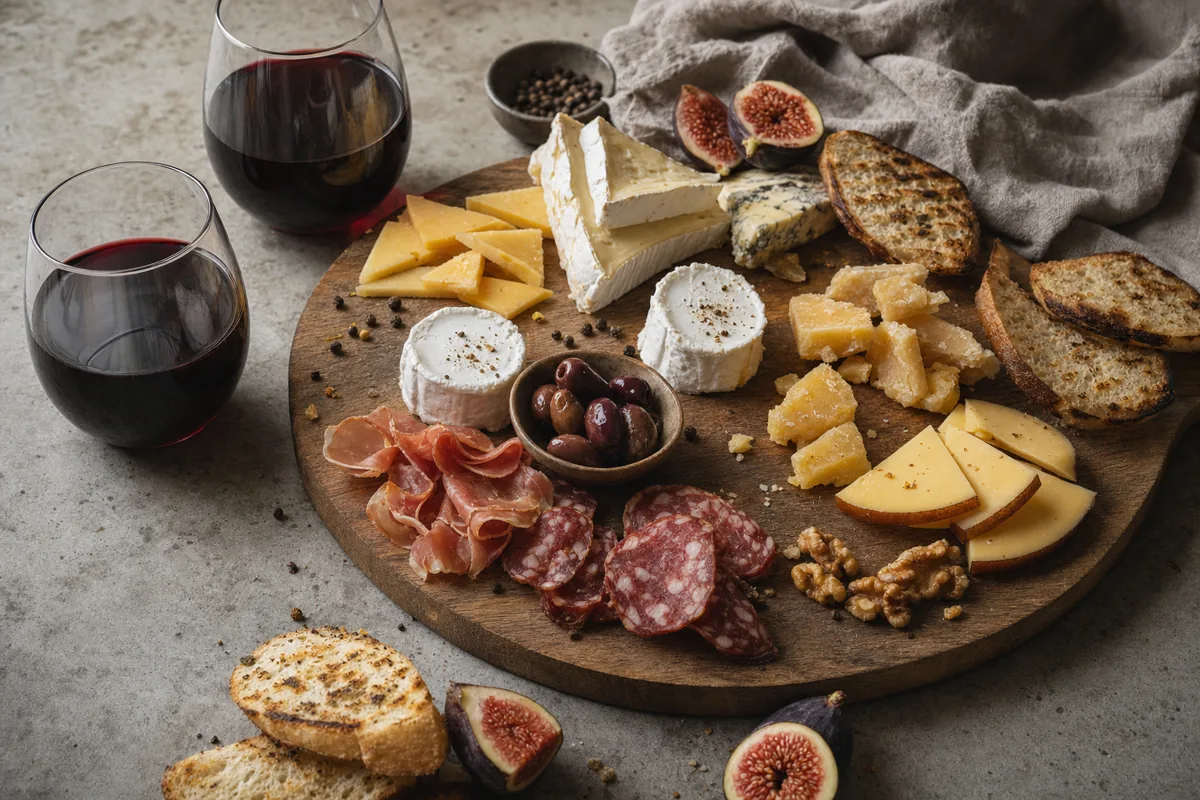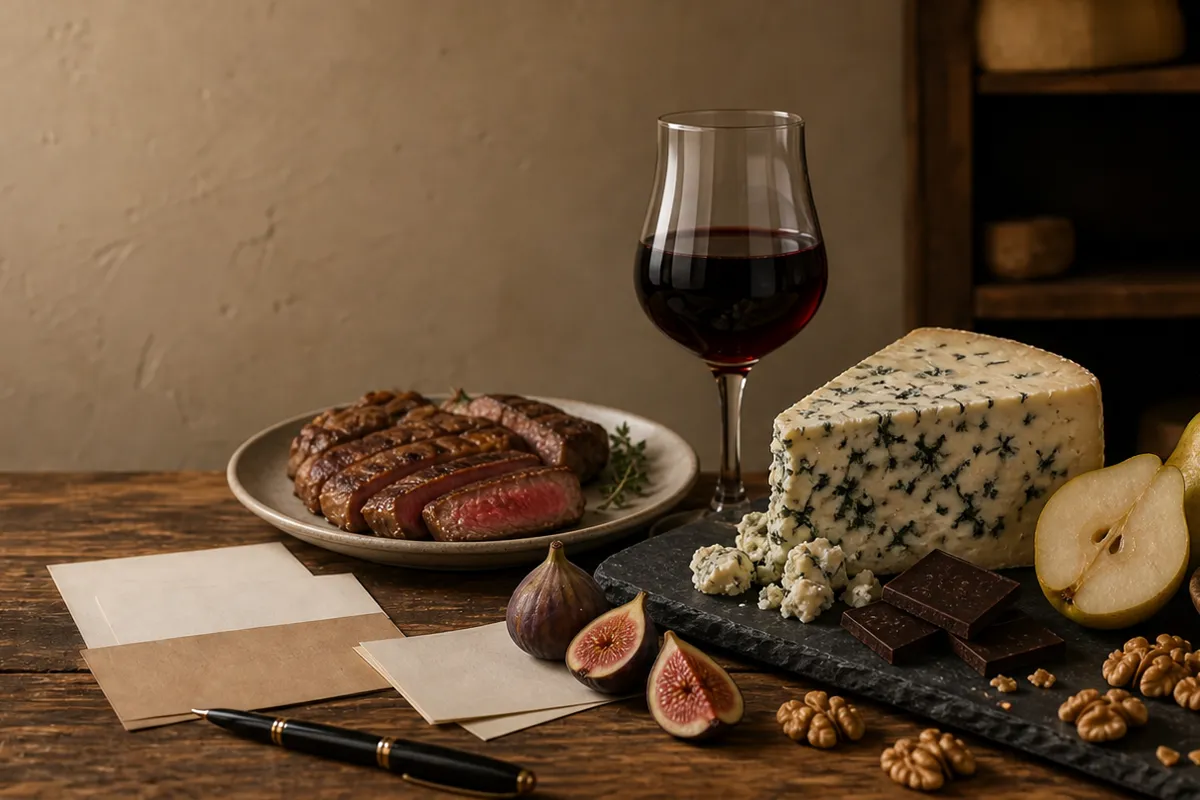
Longuère's case for sweet and fortified wine rests on the cheese itself: the saltiness and the mould in blue cheese make it their natural partner.
In This Article
How Strong Is the Blue Cheese You Are Pairing?
Start with its age and texture. A young blue usually holds more water and is creamier, while ageing dries it, makes it crumblier and concentrates the flavour, which raises the saltiness and the strength.
Wisconsin Cheese describes crumbly blues as more piquant than creamy ones and able to overwhelm a first-time taster, so it starts newcomers on a creamy, milder blue.
The veins come from the make. A strain of Penicillium mould goes into the curd before the cheese is shaped, and metal spikes then pierce the cheese so air reaches the mould and speeds its growth.
As the cheese matures, the mould breaks down fats and proteins. Castello credits the fat breakdown with a nutty, almond-like aroma and the protein breakdown with savoury, lightly bitter notes it compares to sourdough bread.
The strain varies: Penicillium glaucum, most often tied to Gorgonzola, looks greener than P. roqueforti, and some blues use both. Wisconsin Cheese adds that two blues made with identical mould samples are unlikely to taste alike, because makers can vary the season of the milk and how the cheese is aged.
The milk differs too. Stilton and Gorgonzola are cow's milk cheeses, while Roquefort is made from ewe's milk, and Longuère tells readers to weigh the milk and the texture before choosing a wine.
| Blue | Milk | Texture and make | Given by |
|---|---|---|---|
| Gorgonzola Dolce | Cow's | The younger, runnier style, creamy with a hint of nuttiness and sweetness | Longuère |
| Roquefort | Ewe's, raw | Rubbed with salt and wrapped in foil after four weeks so no rind forms; the mould grows from inside and the paste stays moist | Longuère; Roquefort Société (raw ewe's milk) |
| Danish Blue | Homogenised cow's | Curds handled loosely so they knit only lightly and the cheese crumbles, then turns smooth in the mouth; extra surface salt keeps it white; 3.3 g of salt per 100 g | Castello |
Vivino's wine guide splits blues by strength: restrained blues such as Cashel Blue and Cambozola take lighter wines and beers, and Roquefort and Gorgonzola Piccante sit at the strong end.
Maurice Beaver of Drink & Pair turns strength into a rule for the glass: the stronger the cheese, the more flavourful or intense the wine should be. His examples are a fruity, light Pinot Noir with a mild Cornish Blue and the heavy punch of a Barolo against a pungent, strong Gorgonzola.
Which Wine Goes with Each Blue Cheese?
Longuère's picks are Tawny Port or an aged LBV for Stilton, Sauternes for Roquefort, and a dry Marsala for Gorgonzola Dolce.
| Pairing | Why It Works |
|---|---|
| Port with Stilton | The Stilton Cheese Makers' Association calls Port the favoured choice of many and also lists Tawny Port, Sauternes, Gewurztraminer, Muscat and sweet dark Oloroso Sherry. Beyond Port, Beaver lists Barolo, Tokaji and Amarone. |
| Sauternes with Roquefort | Roquefort Société names sweet white wines such as Sauternes or Jurançon, and Longuère adds Tokaji and Trockenbeerenauslese. Vivino adds Banyuls, which it groups with Port for Roquefort and Stilton. |
| Dry Marsala with Gorgonzola Dolce | Longuère suggests a dry Marsala from Sicily for this soft, creamy style. |
| Late harvest wine with Danish Blue | Castello lists late harvest wine among the pairings for its Danish Blue, and Beaver pairs the cheese with Sauternes, Amarone, Port or Cabernet Sauvignon. |
| Gewürztraminer with Cambozola | Vivino's guide pairs Cambozola with Gewürztraminer. |
| Sweet white or dessert wine with blue cheese in general | Wisconsin Cheese names a sweet Bordeaux-style white, and for a more intense blue a dessert wine such as Port, which turns the sweetness up. |
Roquefort and Sauternes are each shaped by a fungus. Sauternes takes its flavour from noble rot, the fungus Botrytis cinerea, and Longuère says the wine's sweetness contrasts with the cheese's sharp, salty tang without being overwhelmed by it.
Noble rot needs morning mist in the vineyard and then dry weather: the fungus lays spores on the grape skins and drills holes through them, and the humidity has to clear by mid-morning or the grapes rot fully. As moisture escapes through the holes, the fungus feeds on acid and sugar, which Longuère says makes the wine honeyed, waxy and rich in umami.
He lists Tokaji and Trockenbeerenauslese beside Sauternes as wines that also take their flavour from a fungus.
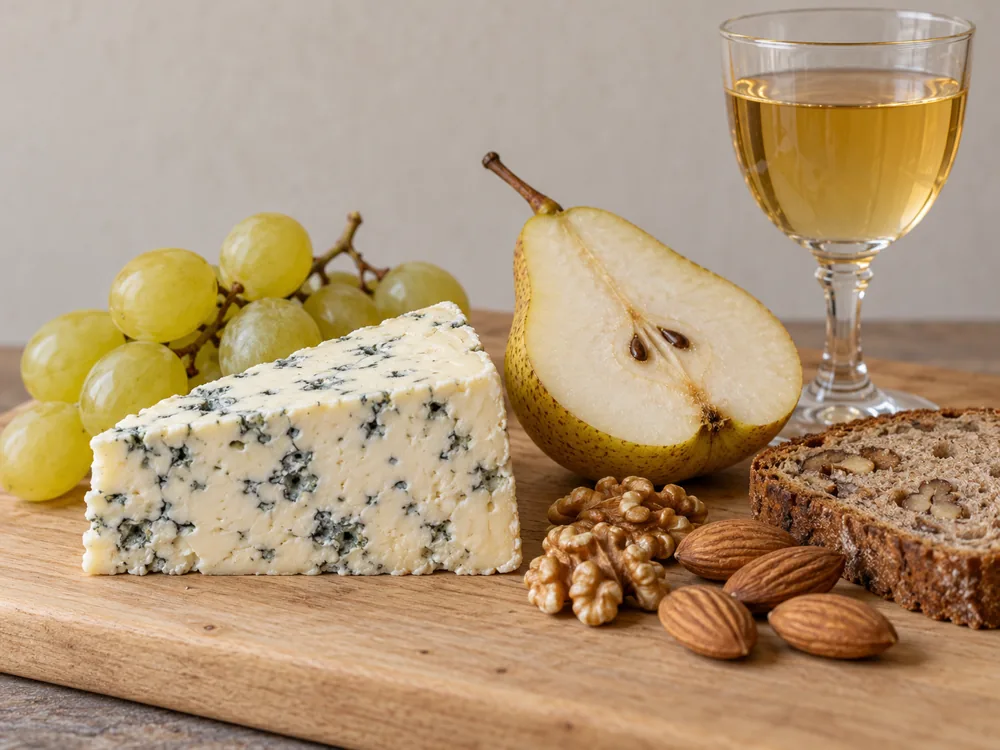
The Sauternes poured with Roquefort carries 120-220 g/L of residual sugar, against 113 g/L for Coke.
Vivino's guide names two ways to choose a wine for any blue: complement the cheese by echoing its flavours, or contrast it by offsetting its boldness.
Vivino gives a sweet wine two jobs with blue cheese: the sweetness balances the saltiness, while the acidity cuts through the richness. Vinocritic's checklist for any bottle gives acidity the same job and adds boldness or full body, rich flavours and possibly some sweetness.
For Gorgonzola Dolce, Longuère picks the dry Marsala for its nuttiness and concentration.
Port is not the only fortified choice. Vinocritic recommends Amontillado, Oloroso, Pedro Ximénez or Cream Sherry, and says the more aged the Sherry, the richer and nuttier it gets, which makes the cheese's funkier flavours stand out.
Vivino adds Madeira in the Bual or Malmsey styles, whose bright acidity cuts through creaminess. For a lighter sweet wine, Vivino and Beaver both name Moscato d'Asti, which Vivino describes as gently bubbly, with sweet peachy notes and a floral aroma.
Is There a Cheaper Alternative to Sauternes for Roquefort?
Yes. Wine Folly puts a decent 375 ml bottle of Sauternes at $30 or more and lists neighbours that use the same grapes for less.
| Wine | Where and what style, per Wine Folly | Named for blue cheese by |
|---|---|---|
| Barsac | Neighbouring sub-region of Graves; its dessert wines tend to be lighter and fresher than those of Sauternes | Beaver, for Roquefort |
| Monbazillac | Bergerac, next to Bordeaux; the same style at great prices | Beaver, for Roquefort |
| Sainte-Croix-du-Mont, Loupiac, Cadillac and other sweet Bordeaux appellations | The same grapes, not known to age quite as long; exceptional value | Beaver, Cadillac with a blue cheese dip |
Barsac producers can label their wine Sauternes or Barsac.
Which Port Style Suits Stilton and Other Blues?
Choosing a Port for Stilton starts with how the Port aged. Tawny spends years in oak until it is fully oxidised and mellow, while Ruby ages in the bottle, keeps some tannin and looks like a red wine.
Longuère's Stilton pick is a Ruby that is not too tannic and has a little age, and his example, a Late Bottled Vintage, is bottled after four years of wood ageing. He says such a wine has the complexity to handle the earthy mushroom flavours the mould gives, and enough fruit and grip to tone down the cheese's salt and add unctuosity.
An LBV is a single-vintage Ruby bottled four to six years after the harvest, and its label declares both the harvest year and the bottling year. Longuère's example sits at the short end of that range.
| Port style | Named for | Who names it, and why |
|---|---|---|
| Tawny | Stilton; blue cheese in general | Longuère, with an aged LBV as the other choice; Beaver, aged 10 years or more, because its nutty flavours complement the pungent, nutty quality of Stilton; Vinocritic, as generally the best Port for blue cheese for its creamy mouthfeel and the nut and oak notes it gains from ageing, with sweetness that balances strong, pungent flavours |
| LBV or another Ruby with a little age | Stilton | Longuère, for complexity against the mould's mushroom flavours and fruit and grip to tone down the salt |
| Vintage | Stilton; mature blue cheese, Roquefort and Gorgonzola | Beaver, as a special bottle; Marcello Borges of Gentleman's Gazette, because the wine and mature blue cheese are both unctuous and their aromas are similarly strong |
| Young Vintage with strong tannins | Stilton and matured Roquefort | Filipe Wang, because a strong, salty cheese balances those tannins |
Beaver's reason for Tawny or Vintage is that sweet wines contrast the salty flavours and complement the nutty ones. Tannin splits two of them: Longuère wants a Ruby that is not too tannic, while sommelier Filipe Wang, quoted by Ines Salpico in Decanter, favours young Vintage Port with strong tannins.
Price separates the styles too. Beaver keeps Vintage Port for a special bottle because it is not made every year and is often aged for decades, while Tawny and LBV are much more affordable.
On a Tawny label, the age number is the average time the wines in the blend spent in cask, so a 10 Years Tawny is a blend, not a single-age wine.
Wang suits ten- and 20-year-old Tawnys to cheeses with a nutty, slightly sweet finish and finds 30 years and older too concentrated to drink with cheese at all. His example there is 18-month Gruyère, not a blue, so the limit is advice for cheese in general.
For a board with several cheeses and one bottle, Salpico names White Port and a 20-year-old Tawny as the best all-rounders. White Port has no tannin and fine acidity, and the Tawny has a delicate nuttiness, so both cope with fat, salt, acidity and umami.
Wang adds dried cranberries, glazed orange peel, prunes or walnuts to the plate to take his young Vintage pairing further.
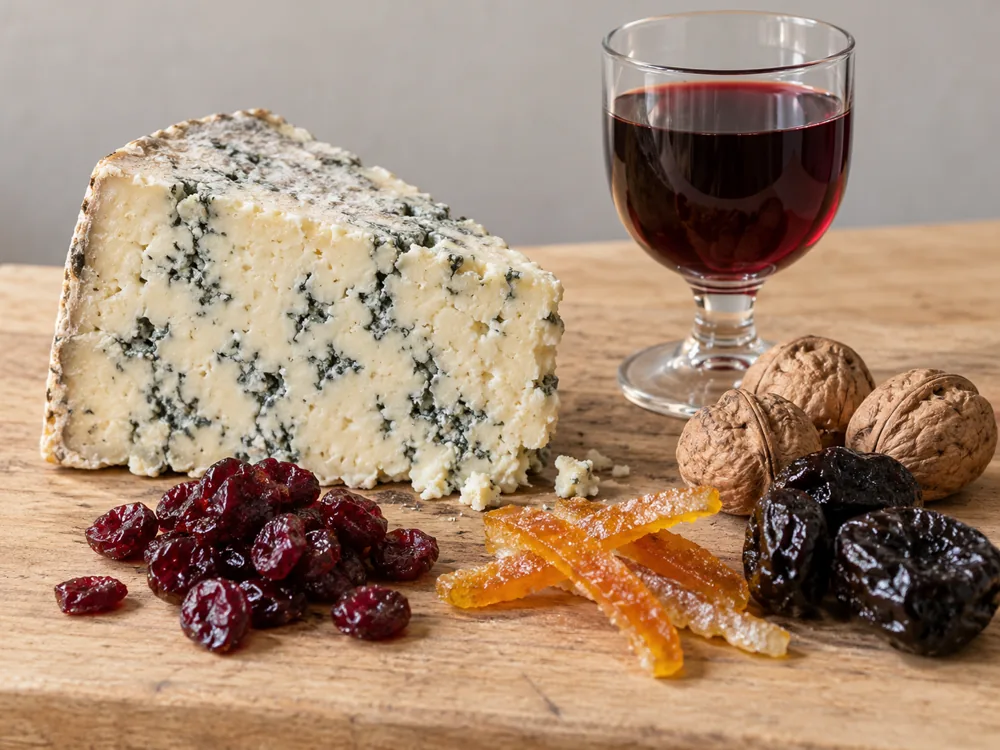
When the centre of a Stilton is crumbled into a jar, Longuère leaves Port behind. The cheese turns smooth and creamy with a mouldier flavour, and he pours a fortified wine aged oxidatively in a solera, such as Sherry or a Rutherglen Muscat that averages 12 years, whose raisiny, orange-peel character lets the cheese's more delicate flavours show.
Longuère also revives a dried-up Stilton by soaking it for a week or two in a sweet wine affected by botrytis.
Fortified wine has a limit. Vinocritic lists higher-alcohol fortified wines with particularly strong blue cheeses among the matches to avoid, along with a wine that is too tannic or a cheese that is too funky, which it says can turn harsh.
Does Red or Dry White Wine Work with Blue Cheese?
A red can work with a strong blue, and the holders split by style. Salpico writes that the fat in creamy, soft, mild cheeses binds unpleasantly with tannins, so Wang's tannic young Vintage Port is advice for intense, non-creamy blues.
| Style of blue | Red named or warned against, by whom and why |
|---|---|
| Creamy, soft or mild | Vivino advises against very tannic reds, which feel jarring with soft blue cheese; Salpico says the fat binds unpleasantly with tannins |
| Intense, non-creamy or robust | Wang: young Vintage Port with strong tannins for Stilton and matured Roquefort. Vivino: Cabernet Sauvignon with robust blues. Stilton Cheese Makers' Association: a full-bodied, robust red such as Shiraz for Stilton |
| Blue cheese in general | Vivino: Gamay and Pinot Noir. Vinocritic: Malbec, whose high acidity and smooth tannins reduce the risk of a clash. Wisconsin Cheese: bold, fruity reds such as Zinfandel or Malbec |
The Stilton makers decline to be prescriptive. Palates differ, they write, and a robust red, a sweet dessert wine or a fine Port can all work when the cheese and the wine balance one another, and they add that Blue Stilton goes well with any wine.
In a 2002 sensory study by Nygren, Gustafsson and Johansson, trained assessors profiled five commercial dry white wines before and after tasting each of two blue mould cheeses. For all five wines, most flavour intensities and the acidity dropped after the cheese.
Vinocritic recommends an oak-aged Burgundy Chardonnay such as Pouilly-Fuissé, whose oak it says helps bring out the cheese's nutty character, and calls it especially good with Stilton.
Vivino lists Gewürztraminer, Riesling (dry or off-dry) and oaked Chardonnay for their acidity and aromatics, and prefers off-dry styles of Sauvignon Blanc.
What Food Goes with Blue Cheese?
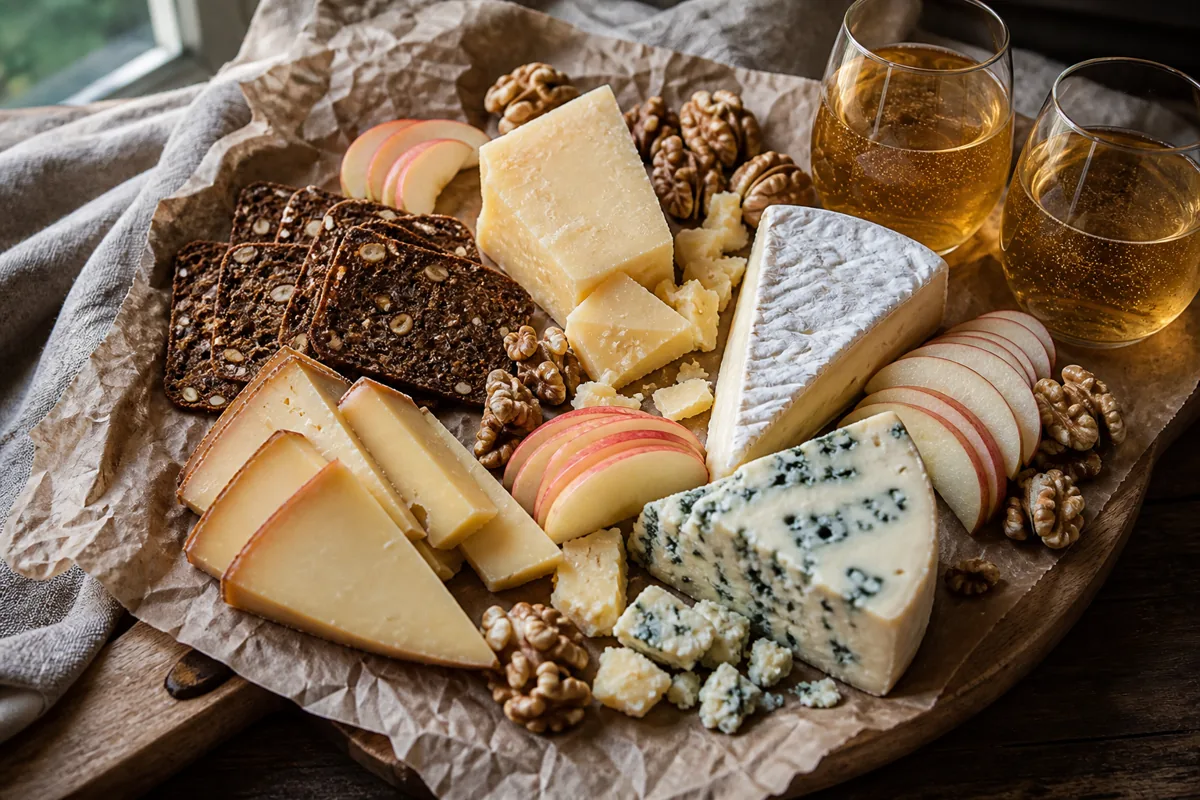
Castello lists honey, figs and nuts for its Danish Blue, and suggests it on rye bread, crackers or crusty bread, or on a board beside fruit, nuts or honey.
Underneath the cheese, Castello's board guide asks for neutral crackers, crisps or bread with a rustic crust, because accompaniments should complement and not compete with the cheese.
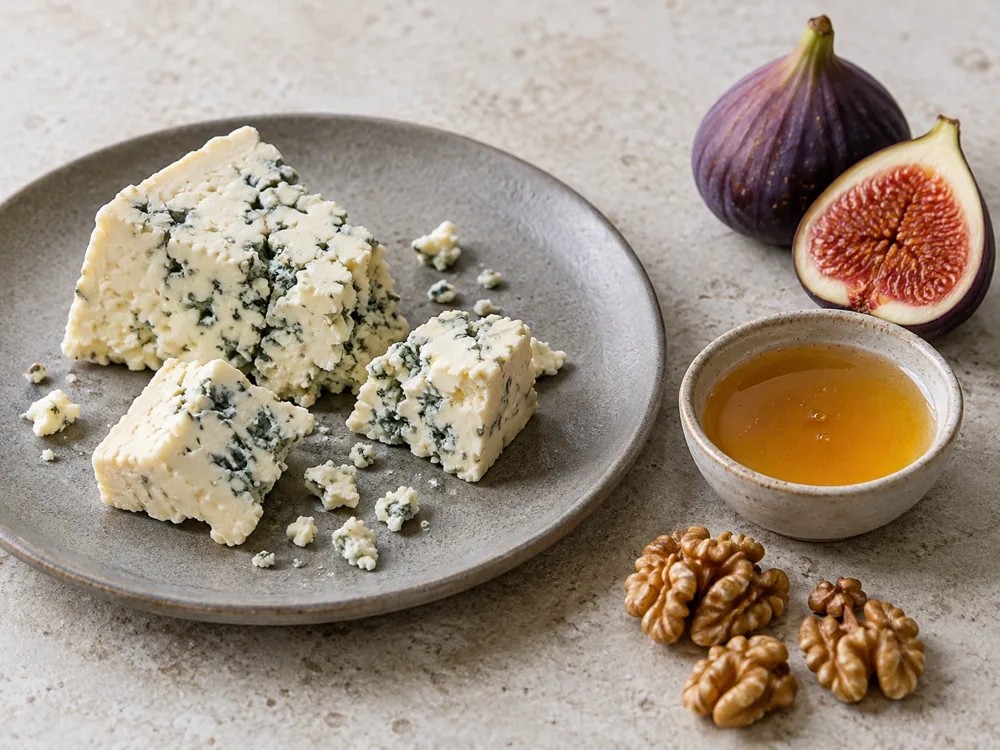
Fresh and dried fruit is the partner most producers share, and each adds its own breads or spreads.
| Food | Named for | Source |
|---|---|---|
| Honey, figs and nuts | Danish Blue | Castello |
| Apples, pears, black or white grapes, walnuts, almonds and dried fruit | Roquefort | Roquefort Société |
| Country, sourdough, walnut or raisin bread, and jams | Roquefort | Roquefort Société |
| Crackers, plum bread and mango chutney | Stilton | Stilton Cheese Makers' Association |
| Celery, dried fruit, cherries or grapes | Blue cheese on a board | Castello |
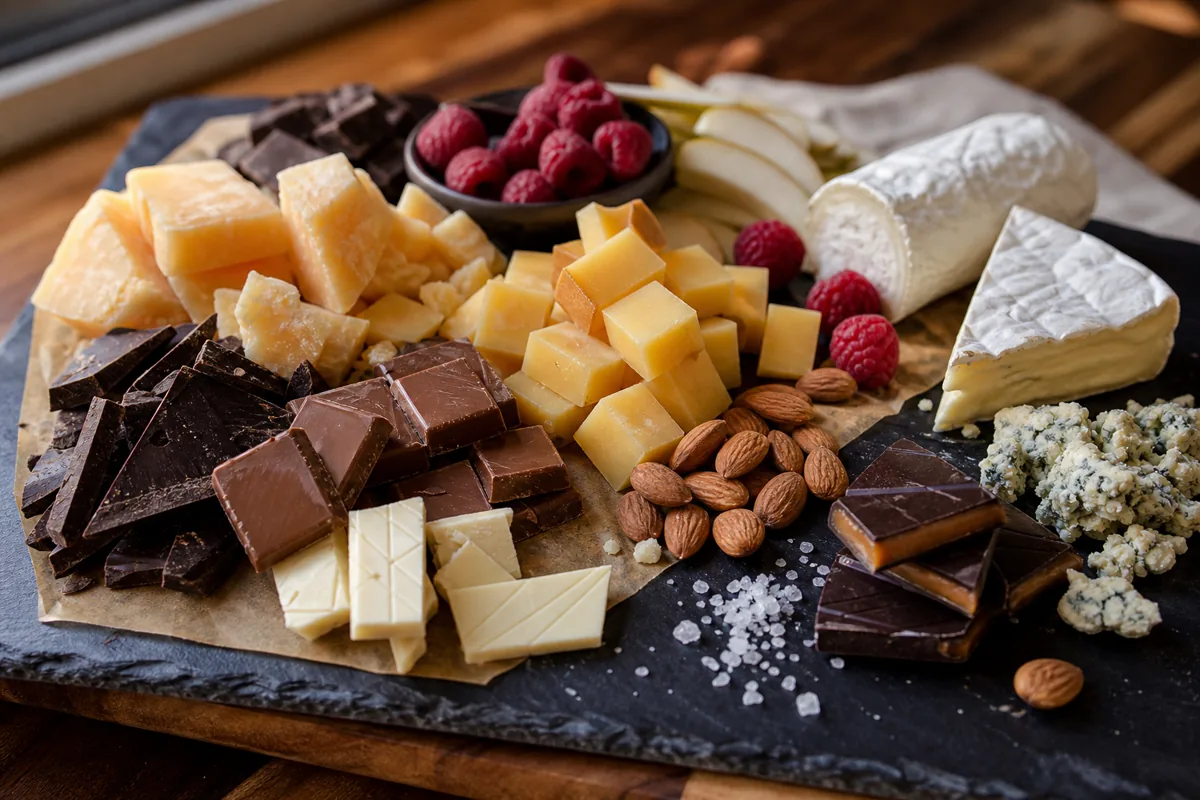
The least expected partner comes from Roquefort Société, which says Roquefort can also be eaten with dark chocolate.
What Cooked Dishes Work with Blue Cheese?
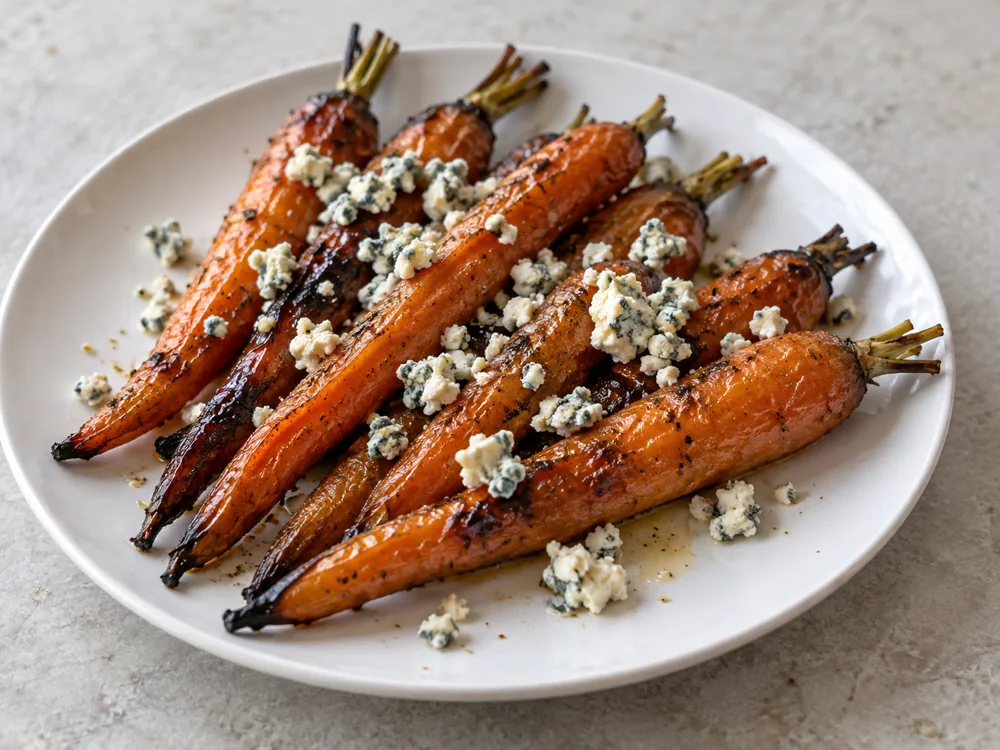
Castello names pasta sauces, soups, pizzas, salads and burgers as uses for its Danish Blue, and says a small crumble over roasted vegetables or baked potatoes adds a rich, savoury note.
In its grilled carrots, the crumbled blue goes on once the carrots have softened and picked up caramelised, charred edges, and Castello says it adds a salty bite that highlights their natural sweetness.
In Castello's radicchio and pear salad, a few crumbles bring savoury richness against the bitter leaves and the juicy sweetness of the pear.
Roquefort Société cooks Roquefort into stuffed potatoes, ravioli, tartlets and small soufflés, and even into desserts such as tiramisu and crème brûlée. It also mixes the cheese with mascarpone for a spread.
Stilton's makers and Castello both pair crumbled blue with cultured cream and lemon in a dip. The makers mix Stilton with plain yogurt, fromage frais or soured cream plus lemon juice and seasoning, while Castello stirs Danish Blue into crème fraîche with olive oil, honey, lemon zest and a pinch of cayenne.
Stilton also goes into pâté and rarebit. The makers beat it with half its weight of butter, a little milk, a pinch of mace and some sherry for the pâté, and blend it with a little cider and diced apple for the rarebit.
The Stilton makers say portions wrapped and frozen keep for up to 3 months and should defrost slowly, preferably in the fridge overnight.
Castello says frozen Danish Blue turns slightly crumblier, so it suits cooked dishes such as sauces, soups and casseroles, where the change will not show.
What Wine Goes with a Blue Cheese Sauce, Dip or Steak?
For a soufflé or a sauce, Longuère pours white. He says red wine tannins tend to clash with the cooked cheese's acidity and bring out a bitter, metallic flavour, so he suggests a mature white wine with little or no oak, such as a white Crozes-Hermitage.
Vivino, by contrast, allows red wines with dishes built on blue cheese sauce.
Beside meat, Vinocritic turns to red. For blue cheese served with steak, burgers or buffalo wings it names Cabernet Sauvignon, whose more prominent tannins absorb fat and protein and let a blue cheese dip's flavour come through, with Malbec as an equal choice.
For a salad or a ham and blue cheese tart, Vinocritic pairs an oak-aged Chardonnay.
Beaver's chart gives a wine for each dish:
- Steak with Roquefort sauce: Pinot Noir, Chardonnay or Sémillon.
- Roquefort mousse: off-dry Riesling or a South African Weisser Riesling.
- Blue cheese dip: Cadillac, Champagne or Aligoté.
- Dates stuffed with blue cheese: Vintage Port.
- Pears stuffed with blue cheese: Sauternes.
Beaver's pairings assume an after-dinner course. For a starter or a main course, he would skip sweet dessert wines and heavy reds in favour of beer or a crisp, slightly bubbly Prosecco.
What Beer or Spirit Goes with Blue Cheese?
Hoppy, bold beers are the brewers' answer. CraftBeer.com, published by the Brewers Association, says blue cheeses are best balanced by bolder beers such as IPAs or imperial IPAs.
Its style guide states the rule as matching strength with strength. Wisconsin Cheese scales it the same way: a more intense, aged blue needs a stronger beer.
Wisconsin Cheese suggests starting with a hazy, fruity New England IPA, whose bitter, hoppy notes cut through the fatty mouthfeel of the cheese while the fruity finish contrasts with its grassy, earthy flavour.
The style guide lists Stilton under natural rind cheeses rather than blue, and for English-style natural rind cheeses such as Lancashire and Stilton it names traditional British-style ales. Castello's own list for its Danish Blue names stout.
For spirits, Wisconsin Cheese names tequila reposado or añejo and says botanical liquors such as gin play well with blue.
How Should You Serve Blue Cheese on a Board?
Castello's cheese board advice runs the cheeses from mild to strong and gives each its own knife or cutter so the flavours don't mix. For a blue, it warms the knife in hot water before cutting the cheese into squares or wedges, while Roquefort Société cuts its wedge from the centre outward in a fan.
The same guide puts a blue among at least three to five cheeses, with a mild one in the mix for guests who are less adventurous.
Each producer sets its own time out of the fridge, from 30 minutes in Castello's guide to up to 2 hours for a Stilton board.
| Cheese | Time out of the fridge | Reason given | Given by |
|---|---|---|---|
| Stilton | Up to 2 hours for a cheeseboard | Lets the flavours develop | Stilton Cheese Makers' Association |
| Roquefort | At least 30 minutes, ideally an hour | Lets the paste soften and the aromas open | Roquefort Société |
| Blue cheese in general | 30 minutes | The blue colour intensifies | Castello |
Stilton's makers add that the cheese slices easily straight from the fridge, which suits sandwiches. For a board, their advice is the longer rest.
The Stilton makers' rest of up to 2 hours reaches the CDC's limit for perishable food, dairy included: never leave it out for more than 2 hours (or 1 hour if exposed to temperatures above 90°F).
Roquefort Société puts the wedge back in the fridge after the meal to keep its qualities.
The Sauternes and Port named for these blues have their own serving temperatures. Wine Folly says to serve Sauternes chilled, and Borges gives 50-58°F for Tawny Port and about 60°F for Ruby.
Borges adds that an opened Ruby-style Port lasts one to two weeks at most, while Tawnies may stay open longer.
Can You Serve Blue Cheese in Pregnancy?
Not uncooked, under NHS advice. The NHS lists "pasteurised or unpasteurised soft blue-veined cheeses, such as Danish blue, gorgonzola and roquefort" among foods that "must be thoroughly cooked" in pregnancy.
The same page lists any cheese cooked until steaming hot, including soft or blue cheese, as safe to eat.
The CDC lists soft cheese made from unpasteurized (raw) milk, with blue-veined cheese among its examples, as a riskier choice, and Roquefort is made from raw ewe's milk. For any other blue, check the label for the milk.
The CDC lists pasteurized soft cheeses heated to an internal temperature of 165°F or until steaming hot as a safer choice. Served cold, a pasteurized blue cheese, whether described as soft, creamy, runny or crumbly, is a type the CDC list does not cover, so ask a midwife or doctor.
Its reason is Listeria: the CDC says pregnant women are 10 times more likely to get a Listeria infection.
SOURCES & REFERENCES
What Do People Ask About Blue Cheese Pairings?
Yes. Stilton's makers call Port the favoured choice of many, and Castello's board guide names port wine for blue cheese in general.
Castello lists honey, figs, nuts, late harvest wine and stout for its Danish Blue, and suggests eating it on rye bread, crackers or crusty bread.
Yes. Roquefort Société lists jams among Roquefort's partners, next to special breads and fresh or dried fruit.
CraftBeer.com's style guide names IPAs and imperial IPAs, and Wisconsin Cheese suggests starting with a New England IPA.