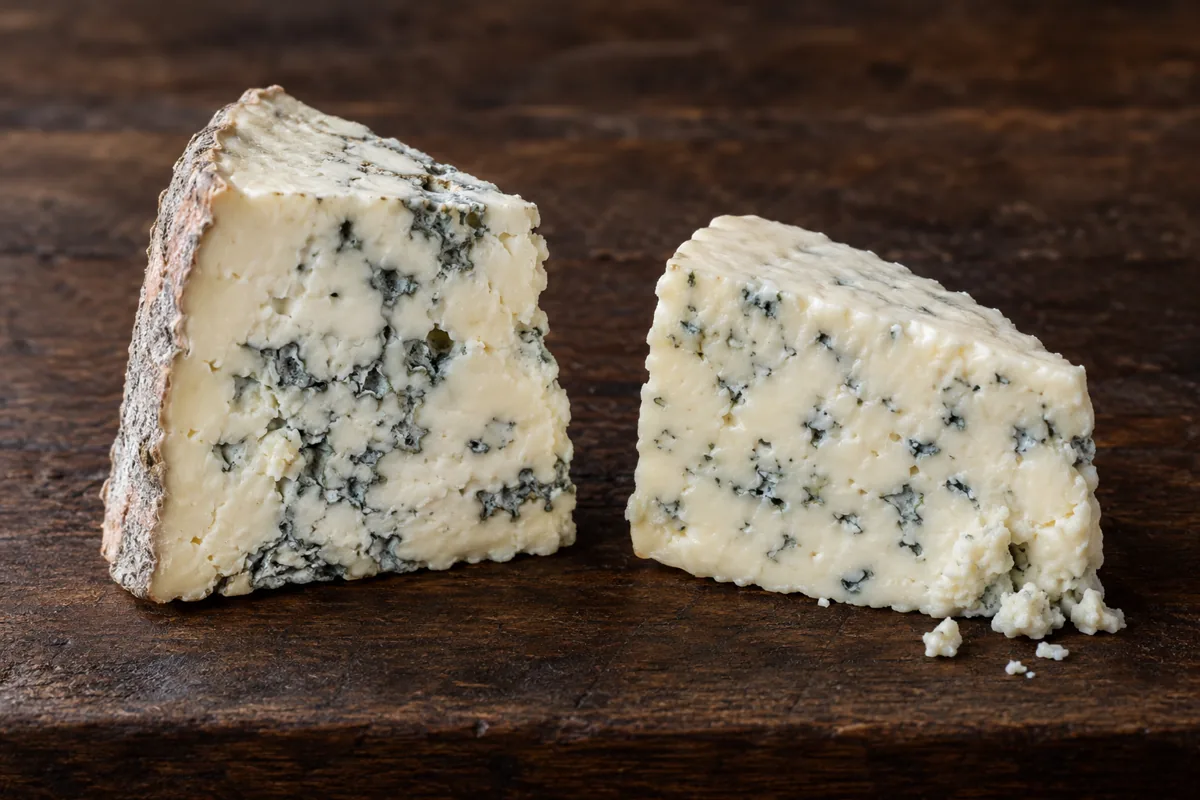
The milk separates these two before anyone tastes them. Gorgonzola is made with pasteurised whole cow's milk in northern Italy, while Roquefort is made with raw whole milk from Lacaune sheep and ripened in caves at Roquefort-sur-Soulzon.
Gorgonzola's label also tells you which of two strengths you are buying, while Roquefort is sold under one name with no style word allowed beside it.
In This Article
What Is the Difference Between Gorgonzola and Roquefort?
Both are blue cheeses with a dry-salted, needled paste, and almost everything else in their rulebooks differs.
The Gorgonzola DOP rules cover whole provinces of Lombardy and Piedmont in northern Italy, from Milan and Bergamo to Novara and Cuneo.
The Roquefort rules are tight on one step. Every wheel must ripen in the caves of the Combalou mountain at Roquefort-sur-Soulzon, in the Aveyron department of France.
The ewes' milk and the cheesemaking have a wider zone, which takes in most of Aveyron and parts of Aude, Lozère, Gard, Hérault and Tarn.
| Attribute | Gorgonzola | Roquefort |
|---|---|---|
| Where it is made | Set provinces of Lombardy and Piedmont, Italy | Ripened in the Combalou caves, Roquefort-sur-Soulzon, France |
| Milk | Whole cow's milk, pasteurised | Whole milk of Lacaune sheep, raw |
| Mould | Penicillium spores and selected yeasts added to the milk | Penicillium roqueforti spores |
| Minimum ripening | 50 days (Dolce), 80 days (Piccante) | 90 days from the day of making |
| Wheel | 20 to 32 cm across, at least 13 cm tall, 9 to 13.5 kg | 19 to 20 cm across, 8.5 to 11.5 cm tall, 2.5 to 3 kg |
| Outside | Grey and/or pinkish rind, not edible | Moist rind in the rules; Cheese.com calls the exterior edible |
| Paste | White and straw-coloured, blue-green or grey-blue veins | Smooth and well bound, evenly veined green-blue |
| Fat in dry matter | At least 48% | At least 52% |
The weights show the gap at the counter. A Gorgonzola wheel weighs 9 to 13.5 kg, three to more than five times a 2.5 to 3 kg Roquefort, so a Gorgonzola wedge comes from a far bigger wheel.
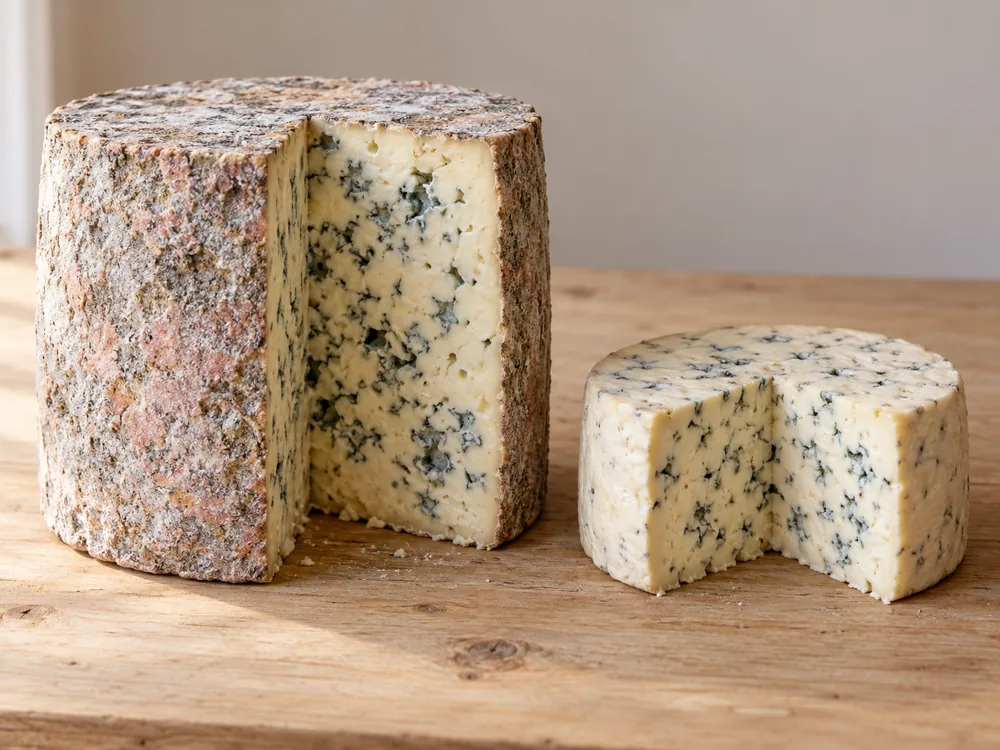
The outside differs too. Gorgonzola's rind is grey or pinkish and not edible, while the Roquefort rules call its rind moist and say nothing about eating it, and Cheese.com describes the exterior as edible and slightly salty.
The rules reach back to the herd as well. Gorgonzola's cows must be kept inside the production zone, and at least 50% of their feed, counted as dry matter over a year, must come from it.
Roquefort asks more of its ewes: they must be Lacaune, at least three quarters of their yearly feed must come from the production area, and grazing is compulsory on every day that weather and grass allow. Permanent indoor housing is banned, and the Gorgonzola specification sets no grazing rule.
How Are Gorgonzola and Roquefort Made Differently?
Both cheeses get their mould on purpose. Gorgonzola milk is seeded with Penicillium spores and selected yeasts before calf rennet goes in, and the Roquefort rules have the paste seeded with spores of Penicillium roqueforti.
Roquefort's mould is not any strain of that species, since the rules require the powders or cultures to come from traditional strains isolated in the caves of Roquefort-sur-Soulzon.
The rules set the rennet window at 28 to 36 °C for Gorgonzola and 28 to 34 °C for Roquefort, and Roquefort's must come within 48 hours of the oldest milking.
Both wheels are then salted dry and pierced with needles. The Gorgonzola rules list the piercing of the paste during ripening among the hand steps of the zone, and dry salting there continues for several days at 18 to 24 °C.
The Roquefort rules explain the needles this way: curd drained without pressing leaves regular openings in the paste, and the piercing lets air into them, so that Penicillium roqueforti can grow and vein the paste evenly green-blue.
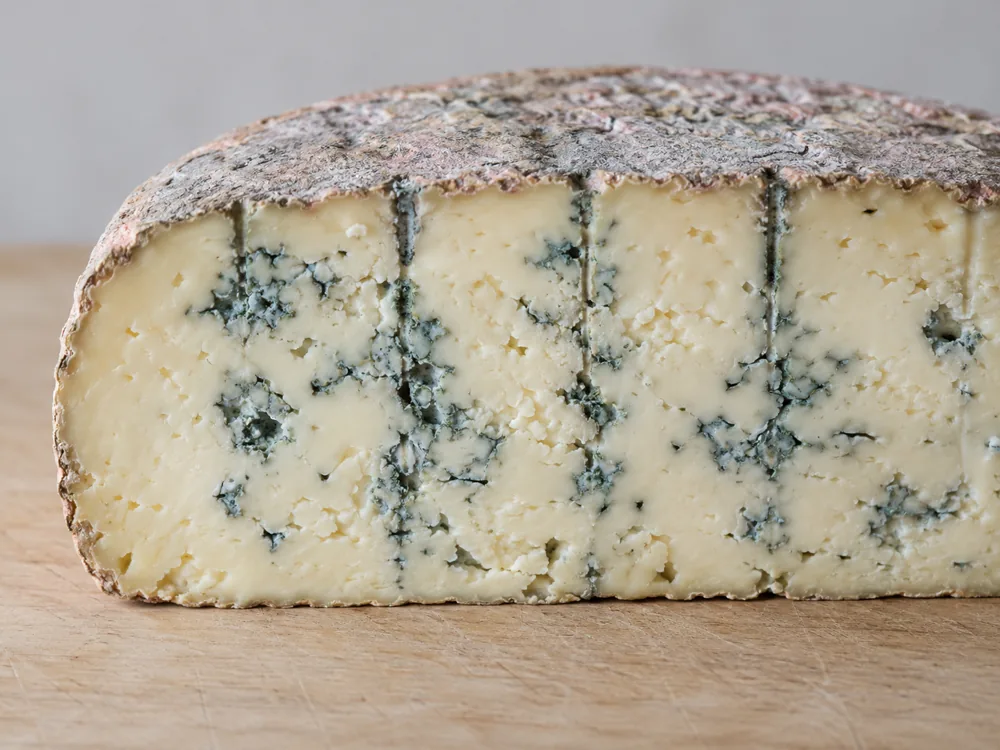
Where the ripening happens is the bigger split. Gorgonzola may ripen anywhere in its production zone, in rooms held at -1 to 7 °C and 85 to 100% humidity.
Roquefort must sit unwrapped in the Combalou caves for at least two weeks. Cool, damp air reaches those caves through limestone faults called fleurines, and the rules tie the growth of the mould to that air.
The rules describe how the fleurines work as chimneys through the rubble under the cliffs: air cooled by the north-east-facing rock walls goes down and takes up moisture from the groundwater. That draught keeps the caves cool and damp, and the rules name it as the climate in which the mould developed.
After the caves, Roquefort is wrapped and finishes a slow maturation, either in the same caves or in temperature-controlled rooms that may not fall below -5 °C.
The rules give the wrapping a job, which is to slow the growth of the mould, and say the slow maturation builds the creamy texture.
Only Gorgonzola's rules also set a ceiling. The Roquefort rules give just the 90-day minimum, Cheese.com puts its ageing at three to five months, and the producers' FAQ says it is sold at up to 12 months of ageing.
Which One Is Stronger, Gorgonzola or Roquefort?
By their own rulebooks, Gorgonzola Dolce is the mildest of the three styles, with a flavour described as sweet. Gorgonzola Piccante is described as decidedly sharp, and Roquefort as fine and pronounced.
No source we read ranks Piccante against Roquefort directly. The sodium figures in the health section give the one measured difference between them.
| Source | Gorgonzola Dolce | Gorgonzola Piccante | Roquefort |
|---|---|---|---|
| Protected-name rules | Sweet flavour | Decidedly sharp flavour | Fine, pronounced flavour with a light smell of mould |
| Gorgonzola consortium | Creamy and soft, slightly spicy | More herbaceous, firm and crumbly, stronger | Not covered |
| Cheese.com | Not covered | A sharp and salty kick, creamy and slightly moist | |
The texture words split the same way. The consortium calls Dolce creamy and soft and Piccante firm and crumbly, and Cheese.com calls Roquefort creamy and slightly moist with a crumbly texture.
Each rulebook also says where it thinks the flavour comes from. The Roquefort rules credit the Lacaune breed, the grazing system and the local feed with shaping the fatty acids in the milk, which carry the aromas, and say the raw milk adds to the bouquet that the mould brings out in ripening.
The Gorgonzola rules credit the quality of the forage and the hand steps passed down in the zone: seeding the milk with Penicillium spores, dry salting and piercing the paste.
Setting Roquefort beside Gorgonzola Dolce compares the mildest Gorgonzola style with a cheese its rules call pronounced. Piccante is the closer match in strength, though it is still made from cow's milk.
Why Do Wedges Under the Same Name Taste Different?
Roquefort has one rulebook and, according to its producers' FAQ, seven makers, so the differences between brands come from choices the rules leave open.
The FAQ lists them: the ewes' milk changes with the season of making, and each maker picks its own rennet, mould strains and concentration, needle size and number, and cave ageing.
The FAQ also notes that the ewes are not milked all year, since they rest for at least four months between the end of milking and the next lambing.
It says too that no farmhouse Roquefort exists, because only those seven makers may produce the cheese.
Gorgonzola's rulebook builds its variation in as styles. The consortium says Dolce and Piccante are both made from pasteurised milk with added enzymes and selected moulds, and the rules separate them by ripening window and flavour.
Which One Is Better for Sauces and Cooking?
For a cream sauce, Gorgonzola is the cheese its own producers recommend for the job. The Gorgonzola consortium suggests sauces and creams made with butter or cooking cream for pasta dishes, rice and gnocchi.
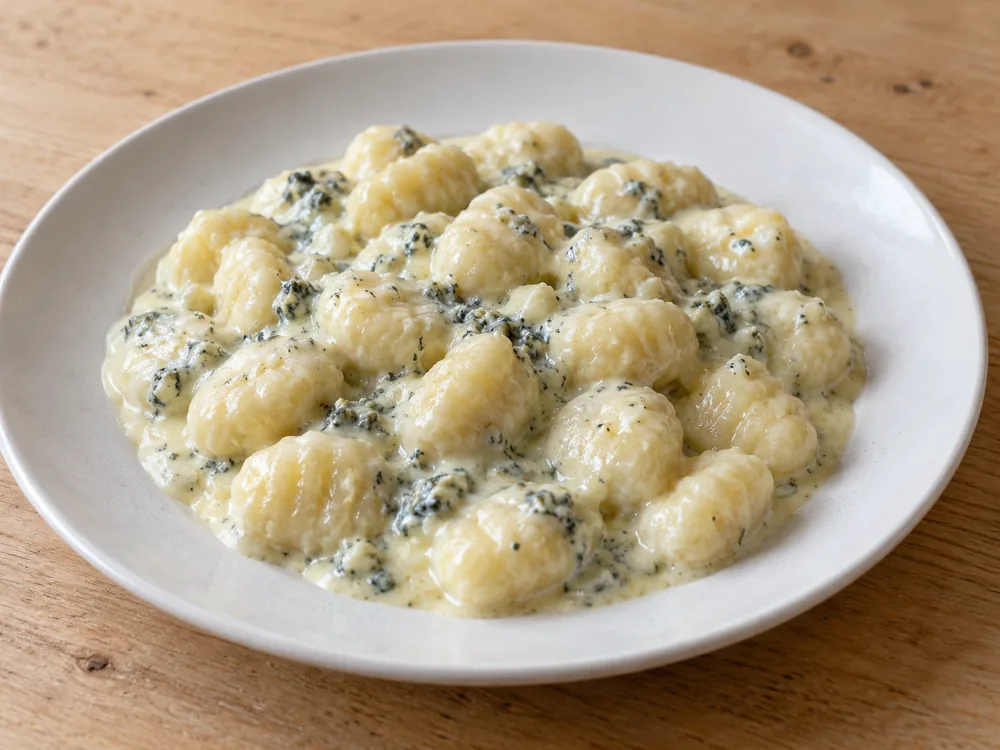
Roquefort goes into savoury sauces too, according to Cheese.com. Roquefort Société, one of the Roquefort makers, also suggests verrines and mini muffins at the aperitif, tartlets and small soufflés as starters, stuffed potatoes and ravioli as mains, and desserts such as tiramisu and crème brûlée.
Société adds that the cheese releases a flavour more or less pronounced depending on the preparation.
| Pairing | Why It Works |
|---|---|
| Bread | Crusty bread (Cheese.com), or country, sourdough, walnut or raisin bread (Roquefort Société). |
| Fruit and nuts | Apples, pears, black or white grapes, walnuts, almonds and jams (Roquefort Société). |
| Dark chocolate | Listed by Roquefort Société as a less usual match for Roquefort. |
| Grilled meats and salads | Roquefort crumbled over grilled meats, or in salads, pasta and risotto (Cheese.com). |
Roquefort Société names sweet white wines such as Sauternes or Jurançon for Roquefort. The Gorgonzola consortium pages we read name no wine.
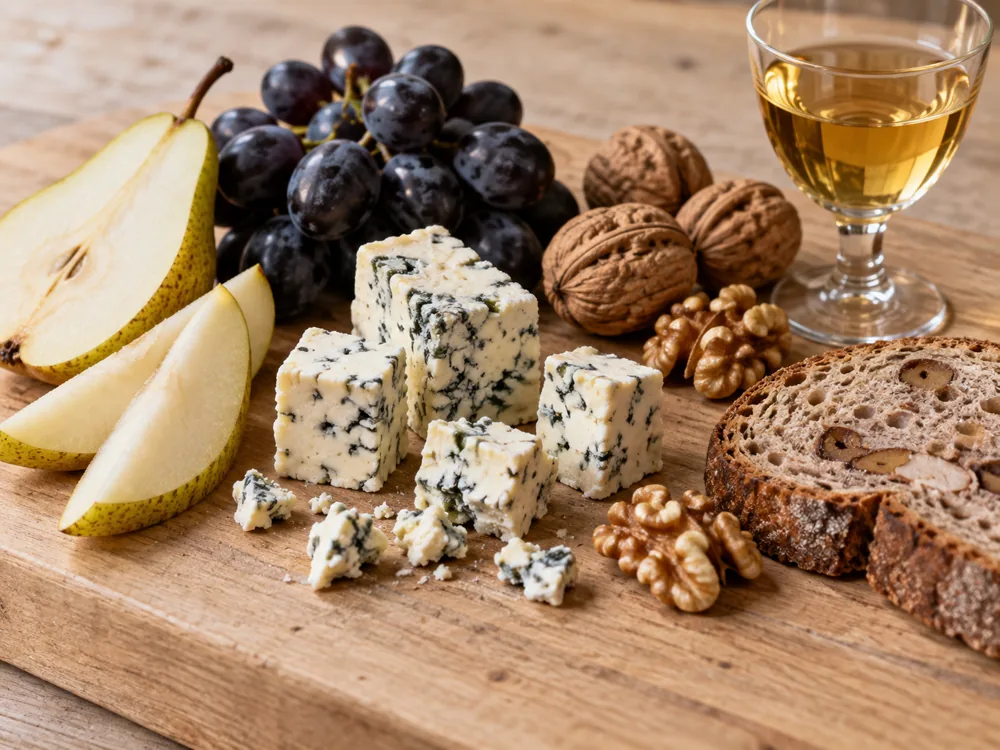
At the table, Société cuts a Roquefort from the centre outward in a fan, and serves it as cubes at the aperitif or blended with mascarpone into a spread.
Is Gorgonzola or Roquefort Healthier?
The two are close on calories and protein, and sodium is where they part. Calories-Info, which cites USDA FoodData Central, lists Roquefort at 1,809 mg of sodium per 100 g against 1,321 mg for Gorgonzola.
| Nutrient | Gorgonzola | Roquefort |
|---|---|---|
| Calories | 357 kcal | 369 kcal |
| Fat | 32.14 g | 30.64 g |
| Protein | 21.43 g | 21.54 g |
| Carbohydrate | 3.57 g | 2 g |
| Sodium | 1,321 mg | 1,809 mg |
| Calcium | 357 mg | 662 mg |
At a 30 g portion, those figures work out to about 543 mg of sodium for Roquefort and about 396 mg for Gorgonzola.
Roquefort's producers put its salt at about 3.5% on average in their FAQ. They say makers have lowered it over more than 10 years, from levels nearer 4.5%.
The FAQ gives the reason: salt's first job is to preserve the cheese, and Roquefort is a long-keeping cheese that holds more water than most.
If you are cutting salt, Gorgonzola is the lower-sodium choice on these figures. Roquefort comes out ahead on calcium, with 662 mg against 357 mg.
The Gorgonzola consortium's own table for Gorgonzola PDO gives different figures per 100 g: 314 kcal, 27 g of fat, 18 g of protein and 530 mg of calcium, against Calories-Info's 357 kcal, 32.14 g, 21.43 g and 357 mg.
Neither page says why they differ. Roquefort stays ahead on calcium against either Gorgonzola figure, and the nutrition panel on the pack in hand is the number that applies to that cheese.
On the Roquefort side the sources sit closer together, with the producers' FAQ giving 32 g of fat per 100 g against Calories-Info's 30.64 g.
Can You Eat Gorgonzola or Roquefort When Pregnant?
The NHS lists "pasteurised or unpasteurised soft blue-veined cheeses, such as Danish blue, gorgonzola and roquefort" among foods that "must be thoroughly cooked" in pregnancy.
That puts both cheeses in the same group as Danish blue, whether the milk was pasteurised or not.
The CDC draws its line by milk. It lists soft cheese made from unpasteurized (raw) milk, including blue-veined cheese, as a riskier choice, and pasteurized soft cheeses heated to an internal temperature of 165°F or until steaming hot as a safer one.
Roquefort is always made from raw milk, and its producers' FAQ says public health bodies advise pregnant women not to eat raw-milk cheese. Gorgonzola is always pasteurised, so a Gorgonzola sauce heated to an internal temperature of 165°F or until steaming hot falls on the CDC's safer side.
Served cold, Gorgonzola is described as a pasteurized soft or firm, crumbly blue-veined cheese, a type the CDC list does not cover, so ask a midwife or doctor.
The CDC gives the reason for the caution: pregnant women are 10 times more likely to get a Listeria infection.
What to Check on the Label Before Buying
On Gorgonzola, the word to find is piccante. The DOP rules require it next to the Gorgonzola name on the foil and on pre-packed pieces of the piccante types, and they set no required word for Dolce.
Whole wheels, halves and counter wedges come wrapped in embossed aluminium foil that carries the protected name. The foil leaves the origin stamp, with the identification number of the dairy that made the cheese, visible on the flat face of a whole or half wheel.
A wedge cut to order at the counter must still show the foil. Pre-packed pieces may come without it, but they must be cut from wheels whose origin was certified, and the pack must still show the name with the EU PDO symbol.
Roquefort's label works the other way. Its rules forbid adding any qualifier to the Roquefort name, so there is no Dolce or Piccante to choose between, only the makers' own brands.
Look instead for the Roquefort name, printed at least two thirds the size of the largest letters on the label, the EU PDO symbol in the same field of view, and the red ewe mark that the producers' body created in 1930.
The cheese itself is stamped in relief with a code for the place it was made, the day of making and a lot number. Cutting and packing must happen in Roquefort-sur-Soulzon, and only shops cutting to order or for immediate sale are exempt.
How Should You Store Gorgonzola and Roquefort?
Roquefort keeps much longer in the fridge than Gorgonzola, going by what each producers' body says.
| Point | Gorgonzola (consortium) | Roquefort (producers' FAQ) |
|---|---|---|
| Where | Always in the fridge | In the vegetable drawer of the fridge |
| Wrapping | Rind removed, then aluminium foil, or its own tray | Cling film or a closed box |
| How long | Eat within a few days of purchase; Piccante keeps longer than Dolce | Keeps a long time |
| Before serving | At room temperature for at least half an hour | Out of the fridge at least one hour |
| Freezing | Not covered | Not recommended; small portions if you must |
The consortium's reason for the rind and wrap advice is smell, since the rind is often the source of a strong odour in the fridge. It also asks for cling film on any face left exposed.
Its reason for the short window is that Gorgonzola is a living food that keeps maturing, which is why it advises buying reasonable quantities. Cheese.com gives Roquefort a number the producers do not, saying a wedge is best eaten within two to three weeks.
The sources disagree on wrapping Roquefort. The producers' FAQ names cling film or a closed box, Roquefort Société names the original wrapping or aluminium foil, and Cheese.com says foil or wax paper and warns that plastic wrap can change the flavour.
Roquefort's FAQ explains the hour out of the fridge by texture. Straight from the cold the cheese crumbles, and after an hour it can be cut and spread.
Its salt answer gives a second reason, which is that an hour out of the fridge limits the sensation of salt.
Can You Substitute Gorgonzola for Roquefort?
Yes, and Gorgonzola Piccante is the closer swap. Its rules describe a decidedly sharp flavour, which sits nearer Roquefort's pronounced flavour than the sweet flavour set for Dolce.
The textures point the same way. The consortium calls Piccante firm and crumbly, which is how Cheese.com describes Roquefort, while Dolce is creamy and soft and will not crumble over a salad in the same way.
Dolce in place of Roquefort brings in a cheese its rules call sweet, so the dish comes out milder.
Going the other way, Roquefort in place of Dolce puts a pronounced cheese into a dish planned around a sweet one.
The nutrition table also shows Roquefort carrying more sodium per gram, so taste before adding any other salt.
Gorgonzola or Roquefort: Which Should You Buy?
Buy Gorgonzola Dolce for a mild blue or a cream sauce, and cook it until steaming hot for a pregnant eater (NHS). Buy Roquefort for a sheep's-milk blue with a pronounced flavour, served to people who can eat raw-milk cheese.
Gorgonzola Piccante suits a buyer who wants a sharp blue made from pasteurised milk.
- Mild blue or cream sauce: Gorgonzola Dolce.
- Sharp blue from pasteurised milk: Gorgonzola Piccante.
- Sheep's-milk blue with a sweet wine: Roquefort with Sauternes or Jurançon.
- Less sodium per portion: Gorgonzola.
A cheese board can carry both, with Dolce as the sweet, soft blue and Roquefort as the sheep's-milk blue. Take Roquefort out of the fridge first.
SOURCES & REFERENCES
Gorgonzola vs Roquefort FAQ
Gorgonzola Dolce is the mild, sweet style. Gorgonzola Piccante and Roquefort are both described in strong terms, Piccante as decidedly sharp and Roquefort as pronounced, and no source we read ranks those two against each other.
Yes. Its rules require raw, whole milk from Lacaune sheep, while Gorgonzola must be made from pasteurised whole cow's milk.
Roquefort. Calories-Info lists 1,809 mg of sodium per 100 g for Roquefort and 1,321 mg for Gorgonzola.
Gorgonzola Dolce ripens for at least 50 days and Piccante for at least 80. Roquefort ripens and matures for at least 90 days from the day it is made, including at least two weeks in the Combalou caves.
The NHS says both must be thoroughly cooked in pregnancy. The CDC lists soft cheese made from unpasteurized (raw) milk, including blue-veined cheese, as riskier and pasteurized soft cheeses heated to an internal temperature of 165°F or until steaming hot as safer.
Served cold, Gorgonzola is described as a pasteurized soft or firm, crumbly blue-veined cheese, a type the CDC list does not cover, so ask a midwife or doctor.