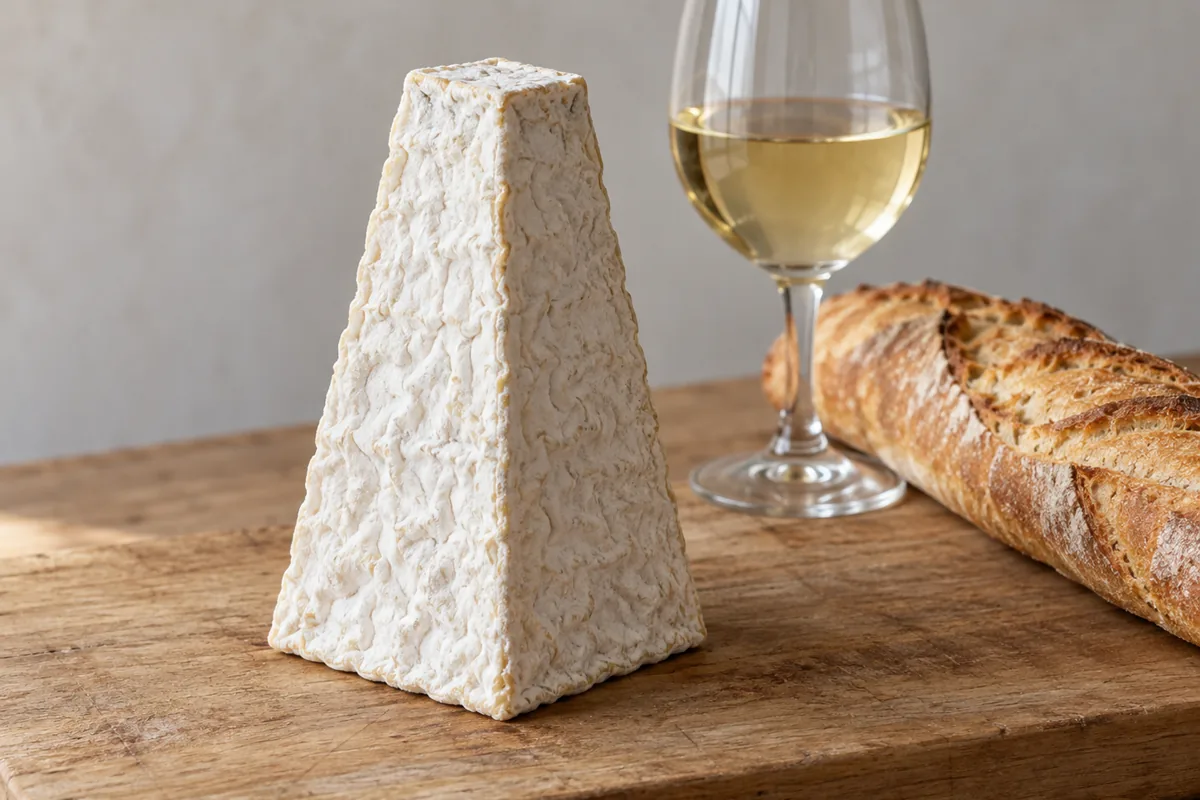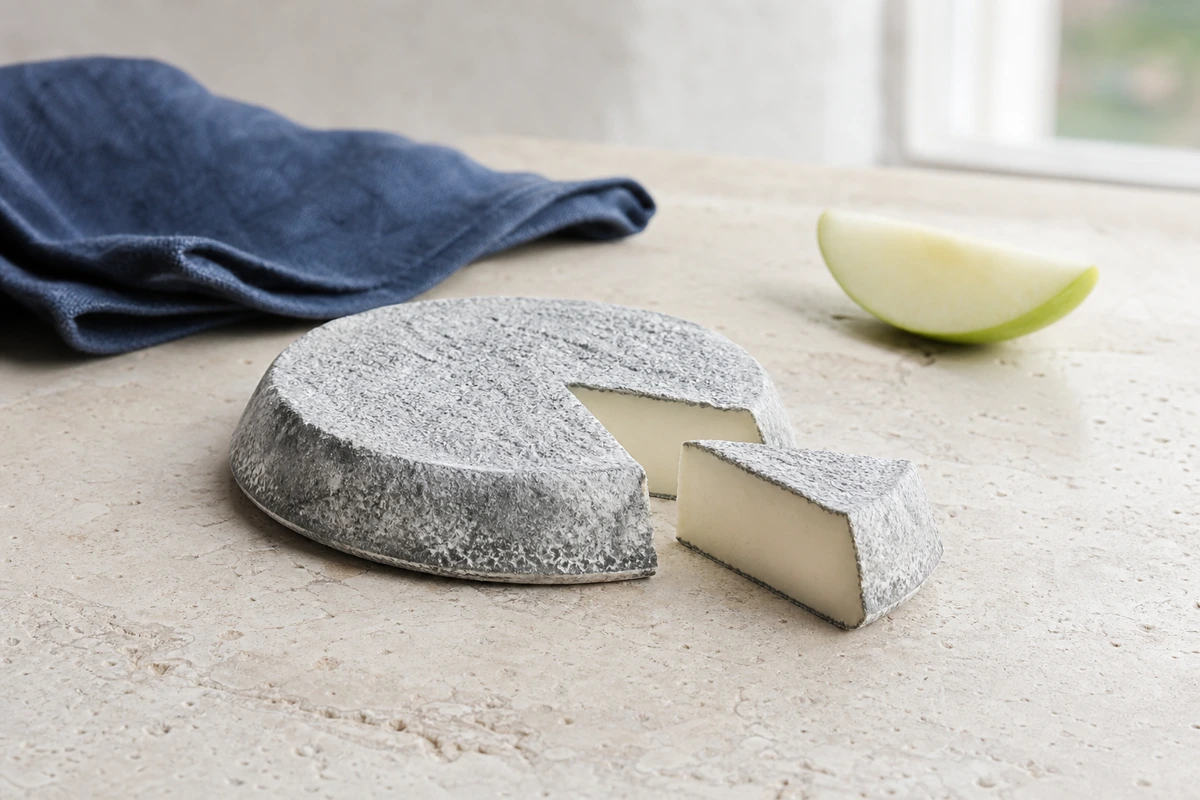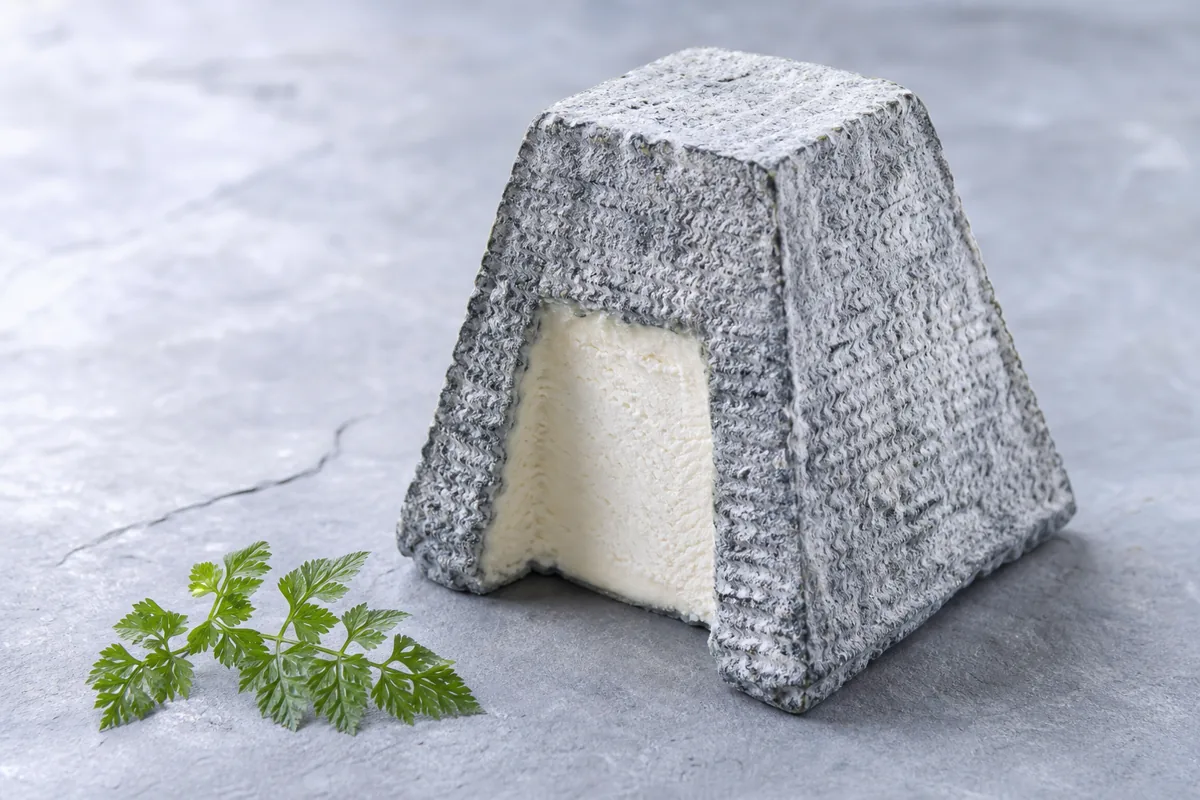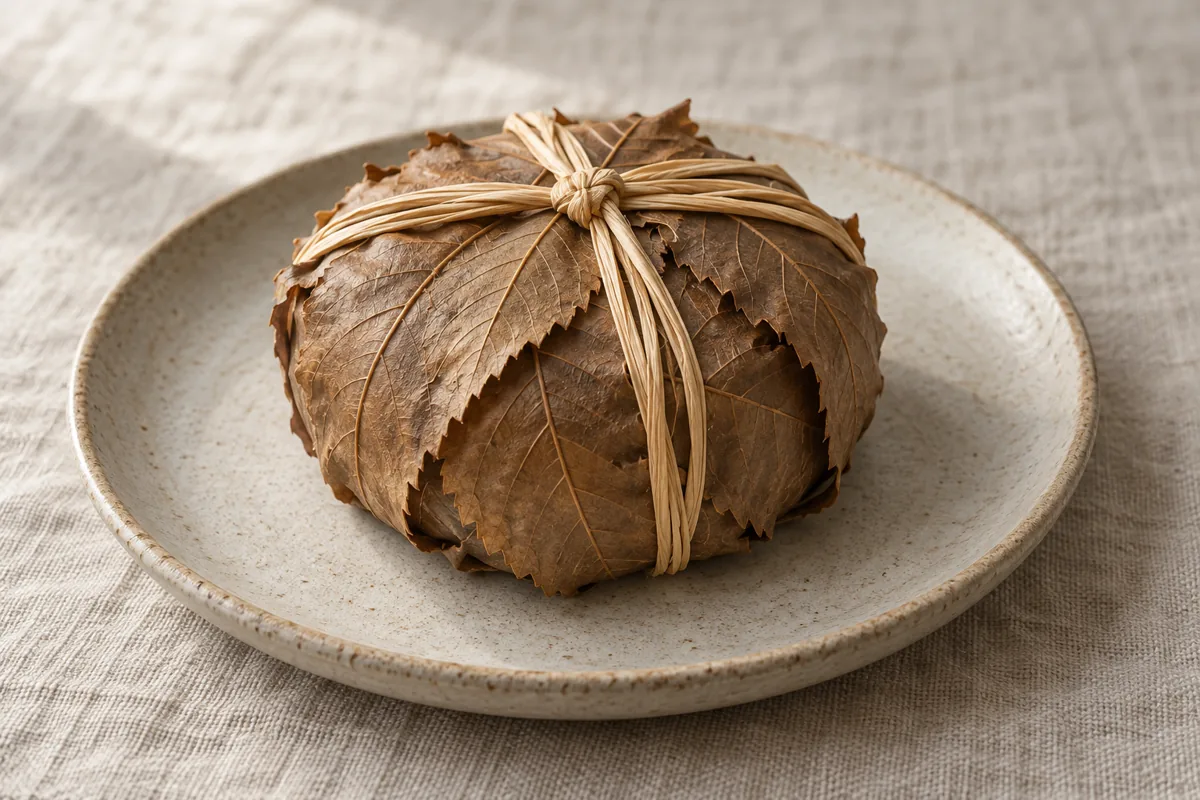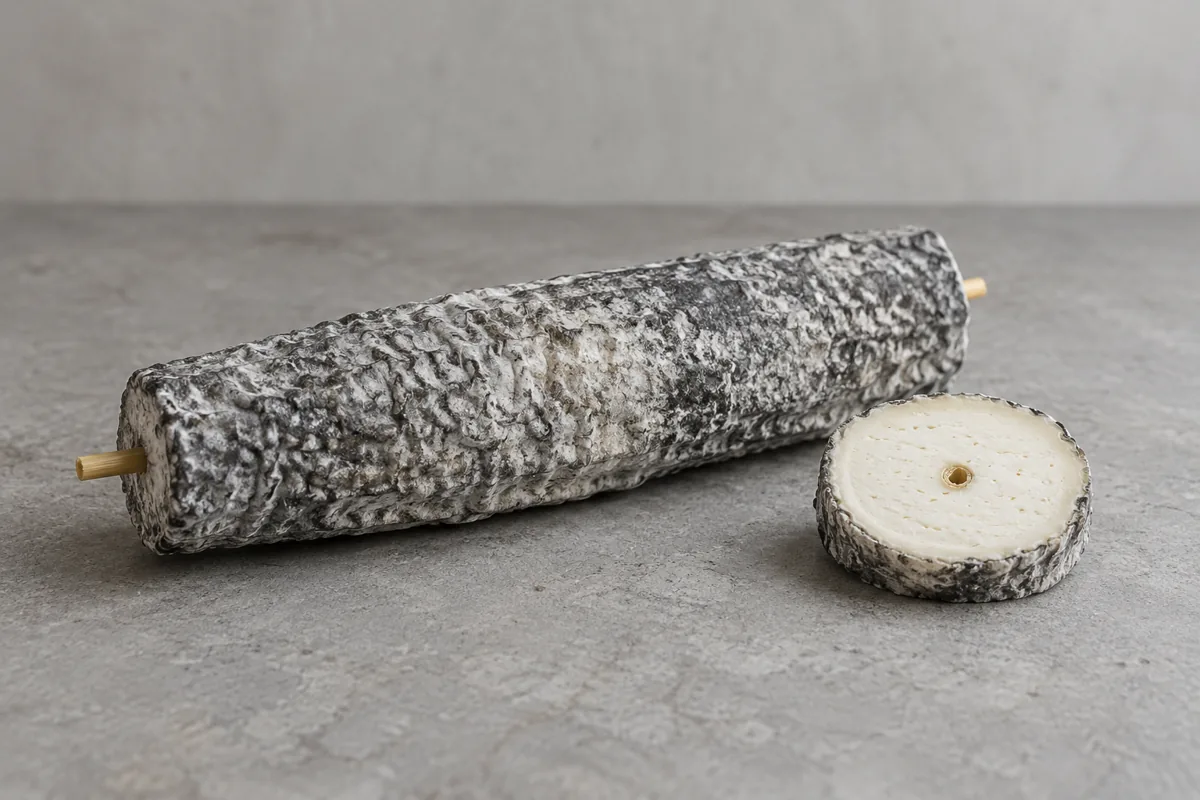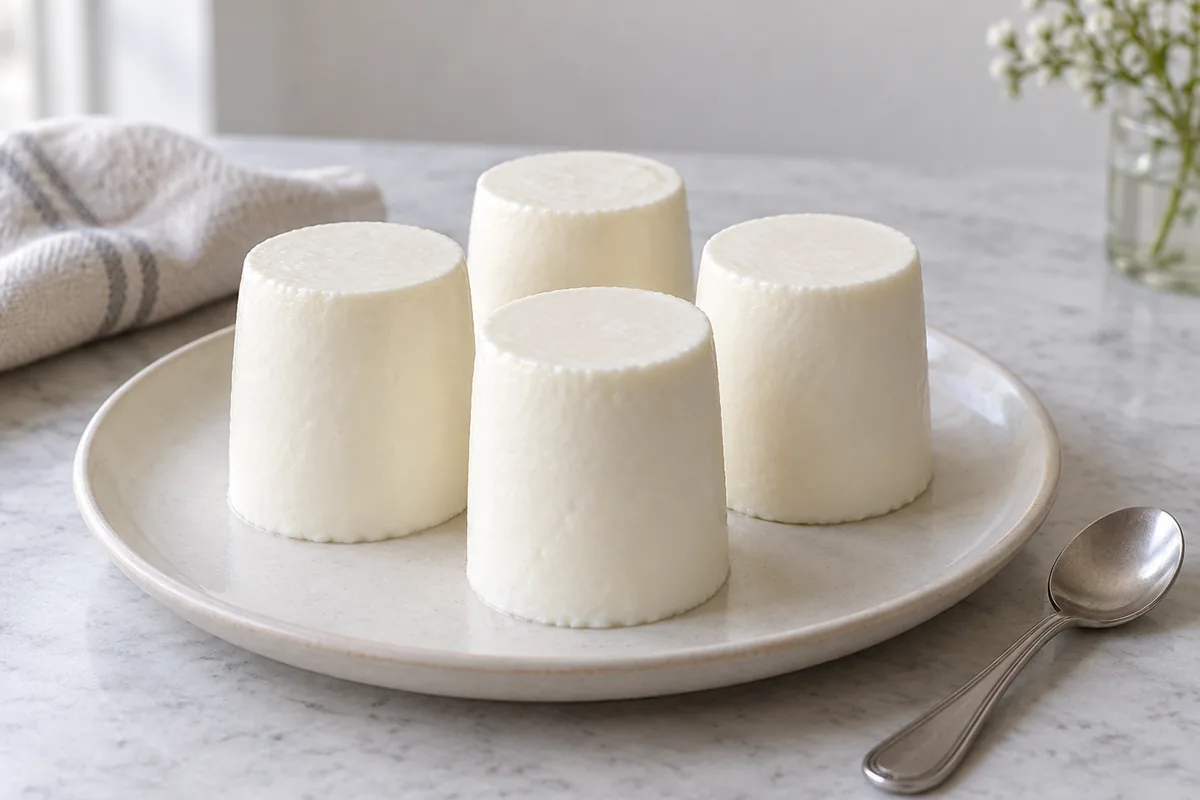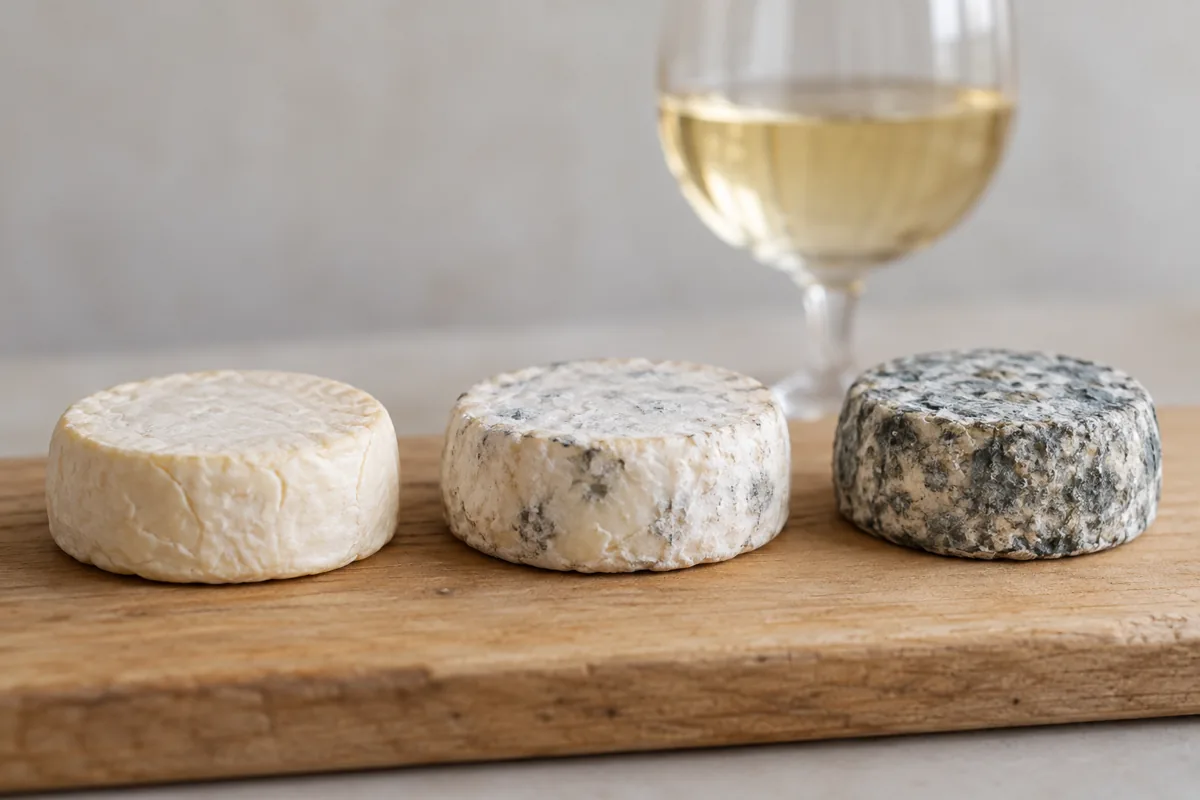
Crottin de Chavignol is a small raw-milk goat cheese from the Sancerrois in the Berry, protected as an AOC since 1976 and as an AOP since 1996.
Each cheese weighs only 60 to 90 g and is sold at several stages of ripening. The producers' syndicate says the stage sets the look of the rind, the texture of the paste and the strength of the aroma.
In This Article
What Is Crottin de Chavignol?
INAO, the French body that manages protected food names, defines it as a cheese of raw whole goat's milk, set mainly by lactic acid with a small amount of rennet.
The area centres on the Pays-Fort sancerrois farming district of central France and spreads into the Champagne berrichonne, the Loire hillsides and the Sologne. INAO describes these districts as clay and clay-limestone grassland that suits goat feeding.
English Wikipedia notes that the village of Chavignol itself has only about 200 inhabitants.
The feed rules keep the milk local. Forage must make up at least half of the goats' daily ration, silage is banned, and all forage is grown inside the area.
Concentrates and dehydrated feed may fill at most the other half of the dry matter. At least half of that feed must also come from the area, which is how INAO reaches its floor of 75% local dry matter in the daily ration.
Within the forage, INAO requires at least 70% to be grass, hay or wrapped bales, and it caps wrapped bales at half of the forage the goats eat each day.
The land rules cap the herd as well: INAO requires at least 1 ha of forage land inside the area for every 12 goats.
The farm's own grassland must cover at least 1 ha per 24 goats. Forage bought from the area can count towards that, at 4 tonnes of dry matter per hectare and up to half of the herd's yearly consumption.
The syndicate says the Alpine breed is the closest match, in body shape and coat colour, to the common goat of the Sancerrois, a local breed that no longer exists.
Which Stage of Crottin de Chavignol Should You Buy?
Pick the stage by the flavour you want: mi-sec for a mild, fresh goat taste, bleu for mushroom notes, sec for walnut and hazelnut, and repassé for a soft paste and an assertive character.
INAO fixes only the floor: every Chavignol ripens for at least 10 days at controlled temperature and humidity. Past that point the stage varies from cheese to cheese, and INAO lets sellers name the ripening stage on the label.
| Stage | Producers' syndicate | Grand Frais (French retailer) | CNAOL timing |
|---|---|---|---|
| Mi-sec (demi-sec) | Discreet goat flavour, prized for mildness and freshness | Young, mild and melting, with the tang of a fresh goat cheese | About 10 days |
| Bleuté | Lightly bloomed with white or blue Penicillium; gains maturity and finesse | Soft white or blue coat; stronger taste, still silky | Not given |
| Bleu | Mushroom and undergrowth aromas | Sold as affiné: grey to bluish rind and undergrowth aromas while still soft | About one month, when Penicillium appears |
| Sec | Walnut and hazelnut aromas | Affiné and dry: brittle paste with walnut and hazelnut notes | When very dry: hazelnuts and other nuts |
| Repassé | Kept in stoneware pots after normal ripening; soft paste and assertive character | Not listed | Not listed |
The sources split the stages differently. Grand Frais sells three (mi-sec, bleuté and affiné), and English Wikipedia uses jeune, bleuté and affiné, with a crumbly paste and bluish mould at the last stage.
Cheese.com adds that the rind wrinkles and takes on a bluish tint with age, while the taste grows more robust and goaty.
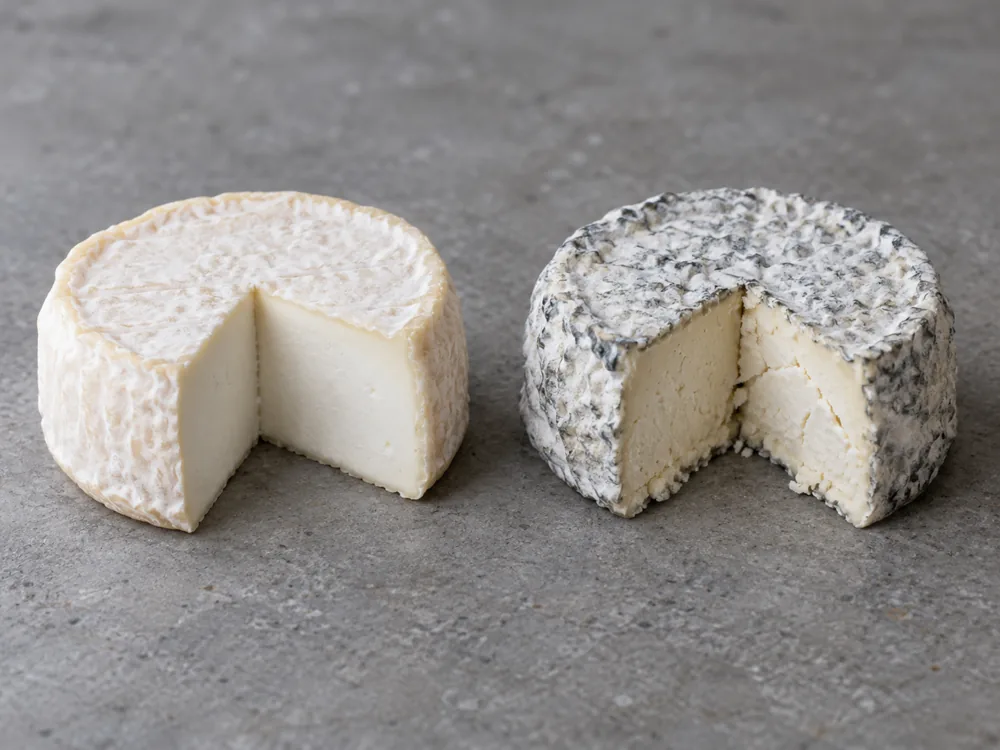
The sources also disagree on timing: INAO's floor and CNAOL's demi-sec are both about 10 days, while English Wikipedia's fact box says at least 4 weeks.
CNAOL says Penicillium appears after about a month. The four-week figure may therefore describe a cheese that has already bloomed rather than the legal minimum, which would put both numbers on one timeline.
INAO's own history explains the range of looks. When the cheese was a farm product, it came with or without white or blue moulds depending on the season and the milk supply, and in midwinter it was even repassé.
Repassé is the stage most shoppers never see. INAO describes a cheese covered in blue Penicillium and finished in a closed, confined space, which darkens the rind as far as brown and leaves the paste soft.
INAO counts the confinement on top of the 10-day minimum, so a repassé cheese is always older than the legal floor, and the syndicate aims it at people who want strong flavours.
Read the rind and paste before the label, using the cues the syndicate, Grand Frais and INAO give: a white or blue bloom marks bleuté or later, a soft paste under a grey to bluish rind is the soft version of affiné, a brittle paste is the dry stage, and a brown rind under blue mould is repassé.
How Is Crottin de Chavignol Made?
The syndicate describes a slow start: shortly after milking, the milk gets a small dose of rennet and sets for more than 24 hours at close to 20 °C.
| Curdling | Raw milk with a little rennet sets slowly for more than 24 hours near 20 °C (syndicate) |
| Pre-draining | The curd drains on a cloth first; INAO makes this step compulsory |
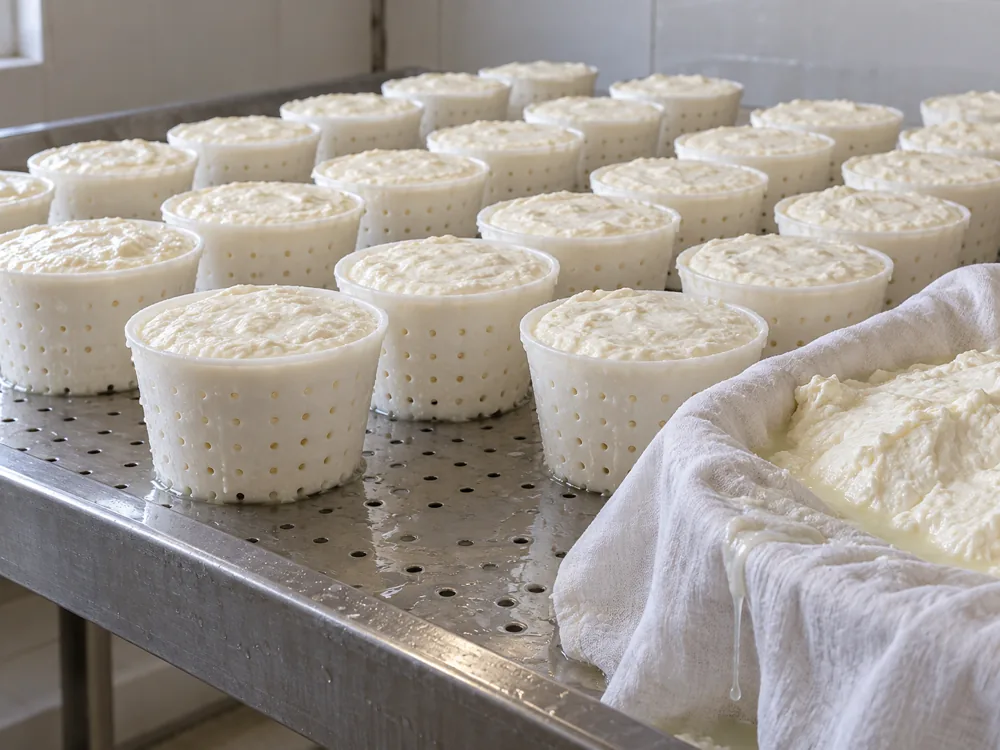
| Moulding | The curd goes into small truncated-cone moulds pierced with holes, called faisselles, for 12 to 24 hours and is turned often (syndicate); INAO requires at least one turn in the mould |
| Salting | The cheeses are unmoulded and salted (syndicate) |
| Drying and ripening | At least 10 days at controlled temperature and humidity (INAO) |
INAO links the shape to that mould. The truncated cone, plus a turn halfway through draining, gives the cheese its slightly domed side.
The pre-draining sets how much water the fresh cheese holds when it leaves the mould, and INAO says that moisture, together with the small weight for the surface area, steers which ripening flora develop on the cheese.
INAO adds that pre-draining was one way for the Berry farm woman to push the moulding to a later time and fit it around her other household and farm duties.
The syndicate says the slow curdling and the cloth pre-draining give the paste its character. The fresh cheese already has a fine, airy paste that suits the natural flora of the area's soil, climate and biodiversity.
Over at least ten days of ripening, the cheesemaker's skill decides how much of its potential the cheese reveals, according to the syndicate.
It also quotes Hugues Lapaire, who wrote in 1928 that the cheese asks for much patience and care. The cheeses were turned over and over, then put out in the attic and afterwards in a very cool cellar.
How to Serve and Cook Crottin de Chavignol
The syndicate serves Chavignol at the end of a meal, with an apéritif, and in cooking, from a Chavignol pie and a courgette cake to canapés on apple and a croque-madame.
For a cheese board, Grand Frais puts the cheeses out about an hour before eating.
Grand Frais says the cheese is used raw but also stands up to cooking, in quiches, savoury tarts and cakes, flans, crumbles, omelettes, mashed potato and stuffed vegetables. It also suggests stirring it into a cream sauce, pairing it with leeks or courgette, and, for an aperitif, marinating the cheeses in oil with herbs and spices.
| Use | How It Works |
|---|---|
| Diced, cold | In composed salads or on cocktail skewers (Grand Frais) |
| Shaved, cold | Over pasta or vegetables (Grand Frais) |
| Sliced, cold | On a bed of red beetroot (Grand Frais) |
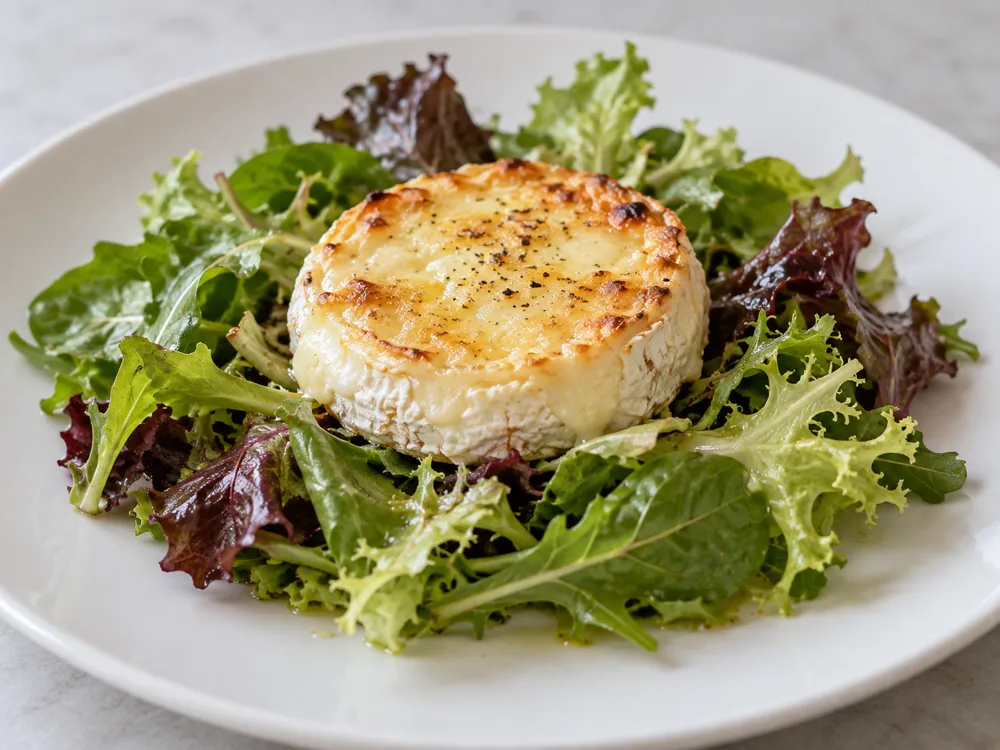
| Baked | Oiled, seasoned and baked 20 minutes at 180 °C, then served with a salad with lardons (Grand Frais) |
| On toast | Gratinéed on toast or bruschetta (Grand Frais) |
| Pan-fried | Breaded and fried until golden (Grand Frais) |
| Chopped or gratinéed | Chopped into dishes or used on a gratin (CNAOL) |
English Wikipedia calls baked Crottin de Chavignol on a green salad a classic dish.
The syndicate's recipe cards name a stage for four dishes. The golden Chavignol on toast asks for soft (moelleux) cheeses, while the omelette, the quenelles in tomato water and the mashed potato with croquettes ask for lightly aged ones (peu affinés or pas trop affinés).
The toast recipe, the one that asks for soft cheeses, runs like this:
- Lightly toast four slices of bread about 1 cm thick, rub them with a halved tomato, spread them with tapenade and top them with cured ham.
- Lightly scrape the rind of four soft Chavignols and cut each one into three or four rounds.
- Overlap the rounds on the ham, add ½ teaspoon of olive oil per slice and plenty of pepper.
- Grill for about 2 minutes, until the cheese turns golden and melts a little, and serve hot with a small mixed salad.
In those cards the lightly aged cheeses are mashed, sliced or diced. The quenelles loosen two mashed cheeses with 1 to 2 tablespoons of cream, the omelette gets slices three-quarters of the way through cooking, and the mash gets cubes of about 1 cm.
Other cards name no stage, and some are sweet. For four people, cubes from two cheeses alternate with pear pieces fried in olive oil and honey and sprinkled with sesame.
For six people, two 60 g cheeses go into an apple and raisin tart with melted Chavignol shavings.
What to Drink and Eat With Crottin de Chavignol
White Sancerre is the wine that the syndicate, CNAOL, Grand Frais and Cheese.com all name. The syndicate and CNAOL both point out that it comes from the same area as the cheese.
| Pairing | Why It Works |
|---|---|
| White Sancerre | Named by the syndicate, CNAOL, Grand Frais and Cheese.com. |
| Pouilly-Fumé | Named by the syndicate and Grand Frais. |
| Menetou-Salon, Quincy or Reuilly | Other Centre-Loire wines on the syndicate's list. |
| A light red | CNAOL's alternative to a white wine from Centre-Val de Loire. |
Grand Frais sets the cheese beside walnuts, hazelnuts, dried apricots and figs.
CNAOL's product sheet names four breads for it: traditional baguette, seeded baguette, Vienna bread and fruit bread.
What Does the AOP Guarantee When You Buy One?
INAO requires the whole chain to stay in the area: milk production, cheesemaking, ripening and the freezing, storage and thawing of curd all happen there.
Curd may therefore be frozen and thawed in the area before it becomes cheese, and INAO bars the word fermier, or any hint of a farm origin, from a cheese made from frozen curd. A label that says fermier is the buyer's check that the curd was never frozen.
How Do You Buy and Store Crottin de Chavignol?
A Chavignol keeps changing after you buy it, so the way you store it decides whether it stays at the stage you chose.
The CDC says to keep a refrigerator at 40°F (4°C) or below. Grand Frais says the cheese stays fresh in airtight packaging, while left in the open air it keeps drying, which is the way to let it firm up.
Few makers stand behind the name: the syndicate counted 79 producers in the Chavignol supply chain in 2025, and set beside CNAOL's 2020 figures its counts show the milk side shrinking while the processing side holds steady.
| Measure | CNAOL (2020) | Producers' syndicate (2024 to 2025) |
|---|---|---|
| Tonnes sold | 897 | 656 (2024) |
| Milk producers | 68 | 48 (2025) |
| Farmhouse cheesemakers | 33 | 21 selling direct and 5 selling to affineurs (2025) |
| Cheesemaking plants or dairies | 1 | 1 (2025) |
| Maturing plants or affineurs | 3 | 3 (2025) |
Between the two counts, tonnage fell by about 27% and milk producers by about 29%, while the number of dairies and of affineurs stayed at 1 and 3, as each source labels them.
How Much Fat, Protein and Salt Does Crottin de Chavignol Have?
One supermarket label for Crottin de Chavignol AOP, a 120 g Reflets de France pack sold at Carrefour, gives 316 kcal and 26 g of fat per 100 g.
| Nutrient | Per 100 g on the label | Per 60 g cheese, calculated |
|---|---|---|
| Energy | 316 kcal (1311 kJ) | about 190 kcal |
| Fat | 26 g | about 16 g |
| Saturates | 19 g | about 11 g |
| Carbohydrate | 1.5 g | about 0.9 g |
| Protein | 19 g | about 11 g |
| Salt | 1.6 g | about 1 g |
The 60 g column is our arithmetic from the label, not a printed figure. At the 90 g top of the weight range INAO allows when the cheese leaves the dairy, the same figures would give about 284 kcal.
That label lists raw goat's milk, lactic and ripening cultures, salt and rennet, and says the milk comes from the AOP area.
Is Crottin de Chavignol Safe During Pregnancy?
Cheese.com and English Wikipedia class Crottin de Chavignol as soft-ripened, so the NHS exemption for hard cheeses does not cover it. Neither the NHS nor the CDC names Crottin de Chavignol, so this reading rests on that classification.
The NHS lists foods made from unpasteurised milk, such as soft ripened goats' cheese with a white coating, among the foods that must be thoroughly cooked.
It also says pasteurised or unpasteurised mould-ripened soft cheeses with a white coating, naming brie, camembert and chèvre, must be thoroughly cooked.
The CDC lists soft cheese made from unpasteurized milk as a riskier choice. It says pregnant women are 10 times more likely to get a Listeria infection.
For pregnancy, that leaves hot dishes, because the NHS counts any cheese cooked until steaming hot as safe. The syndicate's 2-minute toast only melts the cheese a little, so it may not reach that point.
The CDC's safer list gives a heated route only for pasteurized soft cheeses heated to an internal temperature of 165°F or until steaming hot, and names none for soft cheese made from raw milk, so ask a midwife or doctor before eating Crottin de Chavignol, cold or cooked.
Cheese.com names a pasteurized cheese in the same style, Crottin de Champcol, which cannot carry the Chavignol name.
Where Does the Name Crottin Come From?
The syndicate and INAO trace "crottin" to the Berry word crot, meaning hole, which people used for the riverbank spots where women washed their laundry.
Farmers dug the clay from those banks and made oil lamps from it, then small moulds for draining cheese curd. The syndicate says the container gave its name to the cheese.
English Wikipedia gives a second theory: crotte, the French word for animal droppings, which an aged cheese can resemble.
Grand Frais and English Wikipedia describe crot itself as a small clay oil lamp, which English Wikipedia says resembles the cheese mould, where INAO and the syndicate define it as a hole on the riverbank.
Goats have been kept in the Sancerrois since the 16th century, and the syndicate points to Jean de Léry's history of Sancerre, written in 1573, as evidence.
The syndicate adds that goats, undemanding to feed and often kept by winegrowers' wives, gave the household its daily milk and a little extra income from milk and cheese.
INAO describes the area as historically poor farm country, where mixed farms made goat keeping a subsistence activity. Women ran both the goats and the cheesemaking, and the small cheeses often fed workers and day labourers in the fields and vines.
The name appears in print in 1829, when a tax inspector's "Statistiques du Cher" wrote that the goat cheeses of the Sancerrois were known as "Crotins de Chavignolles".
The same entry judged goat's milk unfit for butter but good for cheese. By 1862 the Cher counted 14,359 billy and nanny goats.
When phylloxera attacked the vineyards, the freed plots became goat pasture. In the early 1900s the first affineurs began collecting cheeses from farms and, helped by the Paris to Nevers railway, selling them in Paris markets.
SOURCES & REFERENCES
What Other Questions Come Up About Crottin de Chavignol?
Yes. INAO registers the AOP under both names, "Crottin de Chavignol" or "Chavignol", for the same cheese.
No. The AOP allows only raw whole goat's milk, so every cheese sold under the name is unpasteurized.
Grand Frais bakes oiled, seasoned cheeses for 20 minutes at 180 °C to serve with a salad. The syndicate's toast recipe needs only about 2 minutes under the grill for sliced rounds.