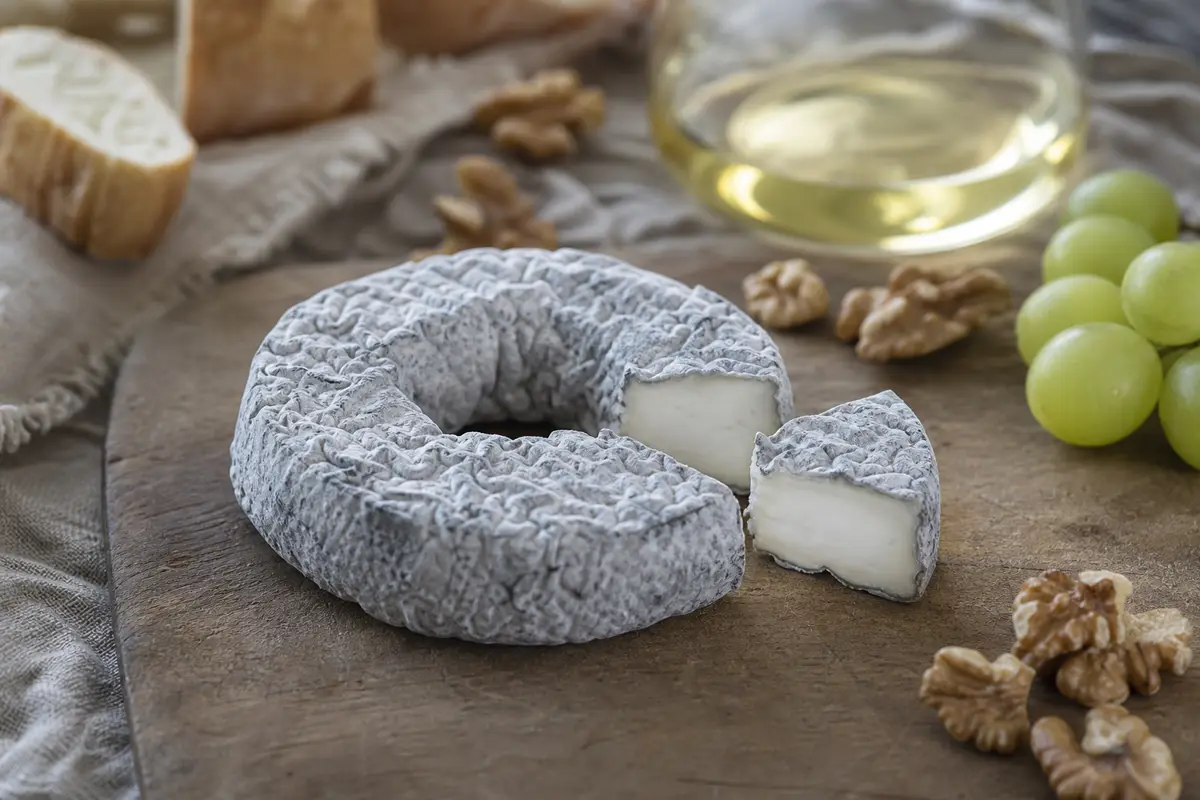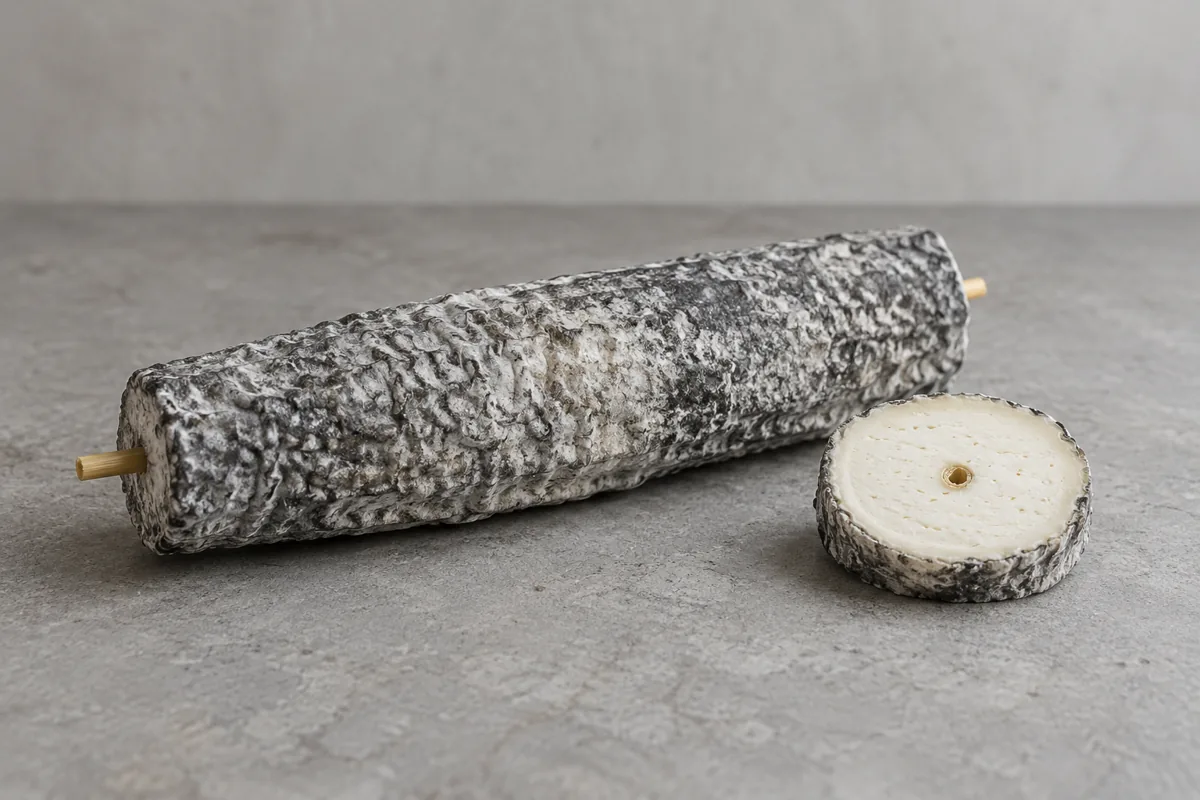
Sainte-Maure de Touraine is a protected French goat cheese shaped like a long, tapered log and made only from raw whole goat's milk. A cereal straw runs through the middle of every log, engraved with the cheese's name and a code that identifies the facility that made it.
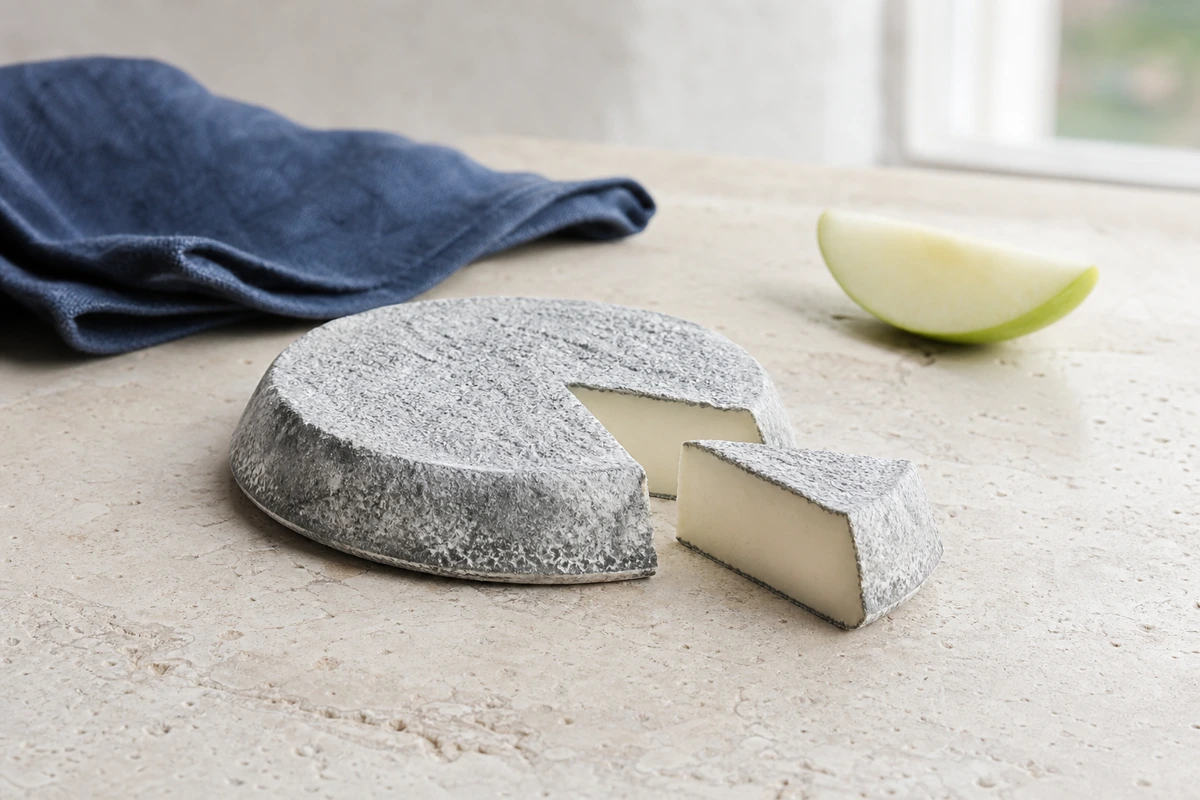
The surface is dusted with ash and carries visible surface mould after at least 10 days of ripening, counted from the day the rennet goes in. Inside, the paste is fine and white to ivory, creamy or even slightly damp when young, then drier and sometimes crumbly with age.
Ash and a straw alone do not make a Sainte-Maure de Touraine. The name also requires the raw milk, the production area, the tapered shape, and an individual PDO label.
In This Article
What Is Sainte-Maure de Touraine?
Sainte-Maure de Touraine is a soft goat cheese from Touraine, in the Centre-Val de Loire region of France. The EU single document puts the production area across all of Indre-et-Loire plus listed communes in Loir-et-Cher, Indre, and Vienne.
Milk production, cheesemaking, and ripening all have to happen inside that area. The protected rules therefore cover where the milk comes from and how the cheese is made, as well as what the log looks like.
The specification sets two numbers for the paste. Each cheese must hold at least 100 grams of dry matter, and its fat must reach at least 45 percent of that dry matter.
Because the 45 percent is measured on the dried cheese, it is not the fat share of the log you buy.
The EU single document describes a lactic flavour that is not too salty or acidic, with nutty hints and vegetal notes such as hay. The INAO specification words the same profile as dried-fruit aromas with vegetal notes such as hay.
The Reluctant Gourmet describes the aroma as mildly goaty and grassy with hints of cellar, and the taste as tangy, nutty, and slightly salty.
Why Touraine Matters
The cheese began on the poorest soils of Touraine. Clay and clay-limestone land suited fodder and cereal crops, so small goat herds put the poorest ground to use.
Their milk went into a cheese that families first made for themselves. Until the mid-20th century there were no real goat herds: poor rural households kept one to three goats, and the grandmother or the youngest daughter milked them and made the cheese.
The protected rules still tie the goats' feed to the area.
Each dairy goat's yearly ration must contain at least 825 kg of dry matter from the area, which the EU document puts at 75 percent of the total. At least 550 kg of the ration must be fodder, and that fodder may come from the area only.
Not every kilogram has to be local. The EU document leaves the remaining quarter of the ration open and names dried lucerne as a feed the area cannot supply.
Complementary feed may make up at most half of the ration, up to 550 kg of dry matter, and only feeds on a permitted list qualify. Fermented feed is limited to 1 kg of dry matter per goat per day and must be given with hay, green fodder, or grazing.
The pasture area must also reach 1,000 square metres per dairy goat, counting the farm's own land and the land behind bought-in fodder.
The herd must be Alpine, Saanen, or Poitevine goats, or crosses of those breeds.
The mould's volume matches a goat's daily milk, which the specification puts at about 2.5 litres per cheese. The Touraine tourism board gives a slightly lower figure, around 2.2 litres of fresh milk for a 250-gram log.
The cheese moved from family kitchens to the markets of Sainte-Maure and Tours, then on to Paris and Lyon. The appellation decree followed on 29 June 1990.
The INAO specification dates the first Sainte-Maure cheese contest to 1955 in the town's market hall, held to push farm makers toward better quality, and the appellation application to 1989.
The Touraine tourism board now counts more than 1,800 tonnes a year from 125 milk producers and 33 farm producers.
Where Does the Name Come From?
The cheese shares its name with the town of Sainte-Maure-de-Touraine, where the Touraine tourism board says a Friday-morning market sells it and an exhibition space called Les Passerelles is dedicated to it.
Several sources tell the same founding story. After the Saracen army was beaten near Poitiers in 732, civilians who had followed it with sheep and goats stayed in Touraine and passed on their cheesemaking.
The INAO specification tells it as history, while the tourism board and The Reluctant Gourmet call it a legend, and The Reluctant Gourmet says it may be apocryphal. The sources also disagree on the century, with the INAO specification and the tourism board saying the 8th and Cheese Professor the 9th.
The oldest documents the INAO specification links to this cheese are an 1830 statistic by the sub-prefect of Loches, which it says seems to describe it, and Balzac's mention in La Rabouilleuse, dated 1841 by the tourism board and 1842 by Cheese Professor.
Claims of a thousand-year-old recipe therefore rest on the legend, while the rules a buyer can check start with the 1990 decree.
The tourism board also says the engraved straw separates the protected cheese from its generic counterparts, so a similar log without that straw is not a Sainte-Maure de Touraine PDO.
What Is the Straw in Sainte-Maure de Touraine For?
The cereal straw runs lengthways through every log. The elongated shape made the cheese fragile and hard to handle, so the straw first served as a handling aid.
It later became a mark that shoppers could recognise. The rules now require the straw to be engraved with at least the name of the designation and a code identifying the production facility.
The INAO specification adds that the paste is sometimes brittle, and it ties the choice of rye, a cereal of poor land, to the extra stiffness a long cheese needs.
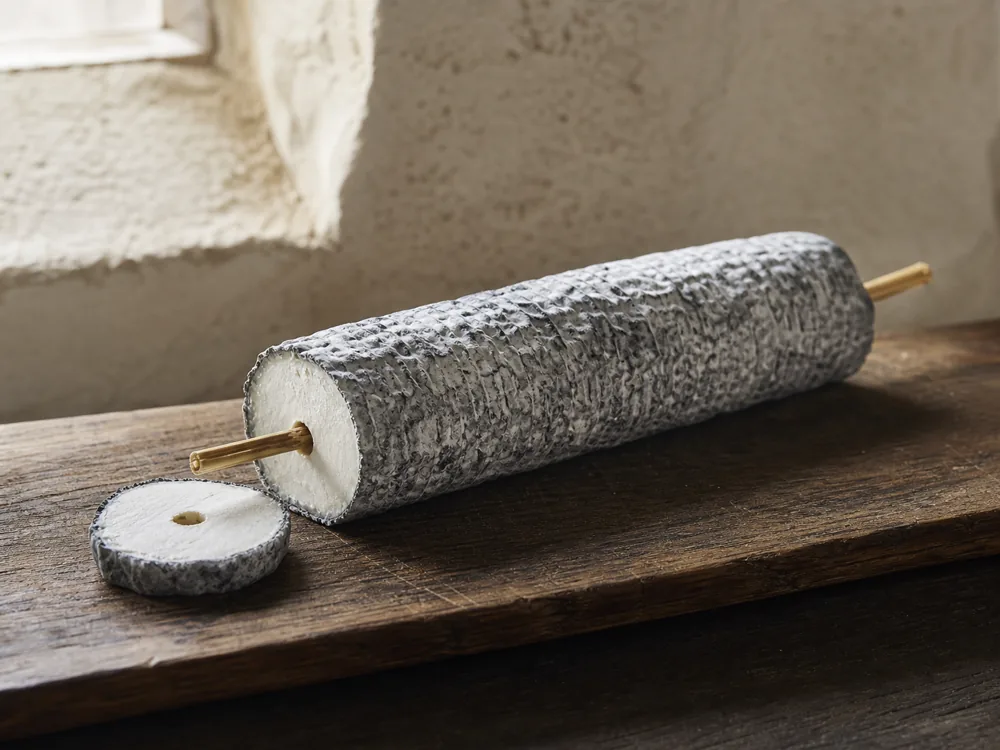
An unmarked stick does not meet that rule.
Makers receive the straws through the producer group, in proportion to the milk they use for this cheese, and they keep a running record of them. A maker who loses authorisation also loses the straws.
The Touraine tourism board describes laser-engraved rye straws about 16 cm long, made by craftspeople at the ESAT de Bridoré.
It says the straw shows the producer's name and an identification number, while the EU document asks for the designation name and a facility code.
The board adds that the rye is grown and harvested inside the appellation perimeter and that about six million straws are prepared each year.
Culture gives the straw a second job, saying it holds the fragile cheese together and ventilates its interior, a purpose the EU document and the INAO specification do not mention.
Why the Log Tapers
The protected cheese is a log in the shape of a truncated cone, so one end is wider than the other. The moulds are tapered and perforated, 260 mm tall, 65 mm across at the top, and 48 mm across at the bottom.
A log with the same diameter from end to end does not match that description.
The EU document says the elongated mould, the slow draining, and the ashing and salting give the cheese a ratio of surface area to volume that lets its own ripening flora develop.
The INAO specification says the shape very probably comes from the mould, which was first woven from willow wicker grown in the damp valleys of the Sainte-Maure plateau and later replaced by terracotta, tinplate, tinned iron, stainless steel, and plastic.
How Big Is a Log, and What Is in It?
The sources give different sizes. Culture lists a log about 1.5 inches across and 5 to 6 inches long weighing 8 ounces (about 227 g), The Reluctant Gourmet lists 16 to 18 cm and about 250 g, and the Touraine tourism board gives about 250 g.
Each of these logs is shorter than the mould, so the hand-filled curd must shrink as whey drains away.
The EU document and the INAO specification set no overall weight, so the 250 g figure is the tourism board's and The Reluctant Gourmet's description of a typical log, not a rule.
Combining the specification's two floors with a 250 g log gives at most 150 g of water and at least 45 g of fat, which is at least 18 percent fat in the whole log.
How Is Sainte-Maure de Touraine Made?
Makers use raw whole goat's milk, and the specification bans concentrating it by removing water before the curd forms. The curd sets mainly through lactic acidity, with only a small addition of rennet.
Before renneting, the specification allows the milk to mature for up to 24 hours at 10 C or above, with or without added cheese whey or lactic ferments, but it bans any acidifying or flavouring substance.
The INAO specification caps rennet at 5 ml per 100 litres of milk and sets coagulation at 18 to 48 hours at no more than 25 C. With so little rennet, the setting is left mostly to lactic acidity, so the curd takes a day or more to set.
Culture and the Touraine tourism board both describe about 24 hours of coagulation, which sits inside that range, with the milk renneted at about 20 C according to the board and 62 to 68°F according to Culture.
The curd is ladled by hand into the tapered perforated moulds. The whey then drains spontaneously, without pressure, for at least 18 hours from the start of moulding.
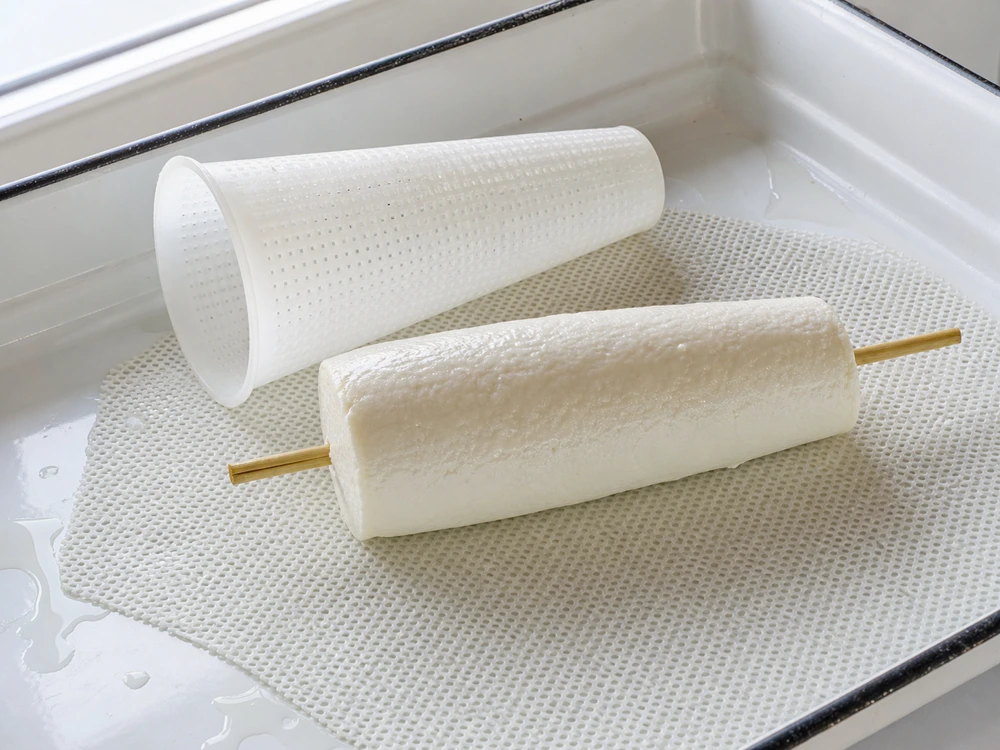
Salt and ash go on the outside only, after the log leaves the mould.
Culture and the tourism board both describe the coating as salt mixed with powdered charcoal, which the board credits for the grey colour, and Culture says the log then lies on a board to finish draining.
Why Does Ripening Need at Least Ten Days?
A log may leave the ripening room only after at least 10 days, counted from the day the rennet goes in. It must also show a well-developed rind covered with surface mould you can see with the naked eye.
The INAO specification sets the ripening room between 6 and 16 C, with air humidity above 75 percent.
Culture's cellar figures of 50 to 59°F with 90 percent humidity fall inside that band, and Culture adds that logs are turned every day.
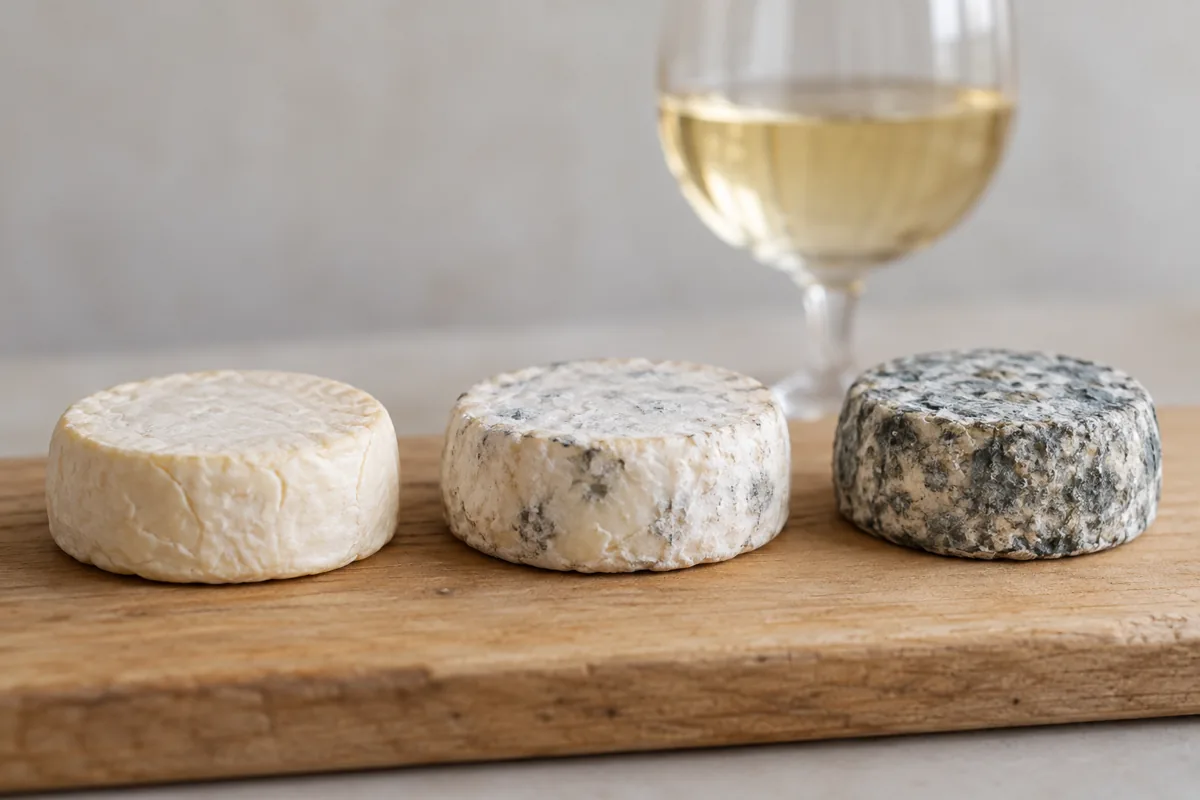
The INAO specification describes the rind moving from grey-white early in ripening to blue-grey as the cheese ages. Geotrichum and yeasts make up most of it, and small blue spots, mainly Penicillium, can appear.
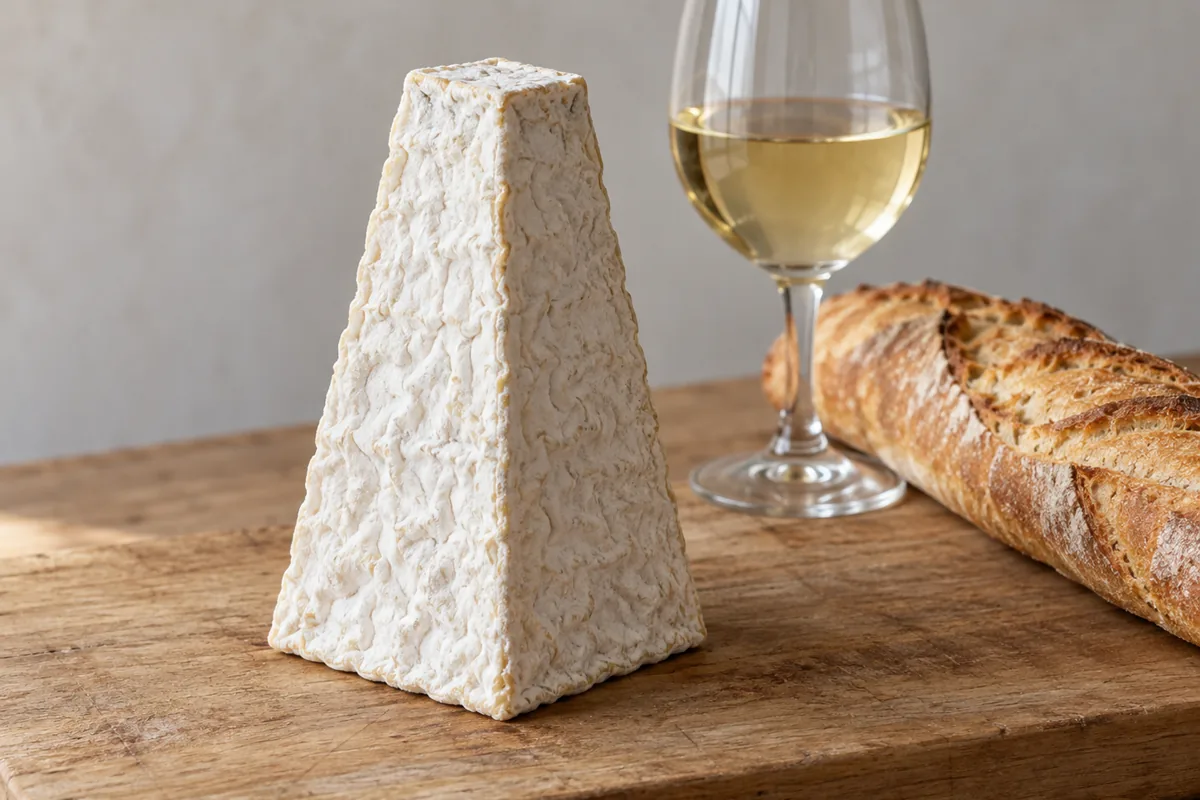
Pyramid-shaped Pouligny-Saint-Pierre is ripened in white, under Geotrichum candidum, for a sweet dried-fruit tang, or in blue, under Penicillium album, for a deeper, goatier flavour with mushroom and hazelnut hints, according to Cheese Professor.
Sainte-Maure's specification puts Geotrichum first among its rind flora, so its rind sits closer to the white style, with blue Penicillium spots as an occasional addition.
Because the rule asks for visible mould, grey ash alone is not the sign that ripening is done.
Culture magazine's cheese library describes a rind that is pale yellow with no mould at 10 days and shows blue mould by week three, which does not match the specification's release rule.
The 10 days start at renneting, so the make uses some of them: the specification's minimums of 18 hours for coagulation and 18 hours for draining leave a log no more than about 8.5 days in the ripening room before release.
Culture does not say where its 10 days start, so its pale yellow, mould-free rind at that age may describe a log counted from a later point, or one not yet ready for release.
The Reluctant Gourmet says the rind adds a subtle earthy note and protects the soft, white interior.
How Texture Changes With Age
The EU single document gives the basic arc. The paste is creamy, even slightly damp, and becomes drier and sometimes crumbly as the cheese ages.
| Source | Younger log | Older log |
|---|---|---|
| EU single document | Creamy, even slightly damp | Drier, sometimes crumbly |
| Culture magazine | Semisoft and moist, with young, acidic notes and a citrus edge | Dense and firm, with nuttier, saltier flavour |
| Touraine tourism board | Creamy | After about three weeks, more intense flavours |
| The Reluctant Gourmet | Creamy | Denser, eventually dry and brittle |
The sources agree on the direction, since the cheese loses moisture over time. They differ on the wording, with the EU document saying crumbly and Culture saying dense and firm.
None of them gives a day-by-day timetable, and the age ranges differ: Culture gives 10 days to three or four weeks, while The Reluctant Gourmet's table says the cheese can age several weeks and its text says typical ageing lasts four to six weeks.
A log aged four to six weeks would therefore sit beyond Culture's range, in the stage where the sources point to a drier, denser paste.
What Should You Check When Buying Sainte-Maure?
The label is the first check. Every cheese sold under the name carries an individual label showing the name and the EU PDO logo in the same visual field.
The EU document bans any other term beside the name on labels, adverts, and invoices, apart from the maker's own trademarks.
Ask whether the log is young or has ripened for around three weeks, because the sources describe those stages differently.
On a cut face, the EU document describes a clean cut and a fine, even paste that is white or ivory.
The Reluctant Gourmet lists spring to early autumn as the traditional best season, and the tourism board's own serving suggestions run from a spring salad to an autumn aperitif.
The tourism board says the stalls of Les Halles de Tours, open Wednesday to Sunday, hold ashen logs at various stages of maturation, and it encourages tasting the stages to find the right one for a cheese platter.
A PDO log shows the name and the EU PDO logo together on its individual label, a white or ivory cut face, and the age the seller names, young or about three weeks old.
How Should You Serve Sainte-Maure de Touraine?
The Touraine tourism board says to take the cheese out of the fridge an hour before tasting so it is at room temperature. The Reluctant Gourmet gives 30 minutes.
The sources suggest honey, nuts, bitter leaves, dried fruit, and Loire wines. The block below says who recommends each one.
| Pairing | Type | Why It Works |
|---|---|---|
| Acacia Honey | Food | The Touraine tourism board pairs it with a young log. |
| Chicory Leaves and Crushed Walnuts | Food | The Touraine tourism board names this as a spring serving. |
| Dried Fruit or Fresh Figs | Food | The Touraine tourism board suggests them for a log aged around three weeks. |
| Touraine Sauvignon | Wine | Named by the Touraine tourism board and The Reluctant Gourmet; Culture lists Sauvignon Blanc. |
| Sancerre | Wine | Named by Culture magazine and by The Reluctant Gourmet. |
| Red AOC Chinon | Wine | The Touraine tourism board's suggestion for red wine drinkers. |
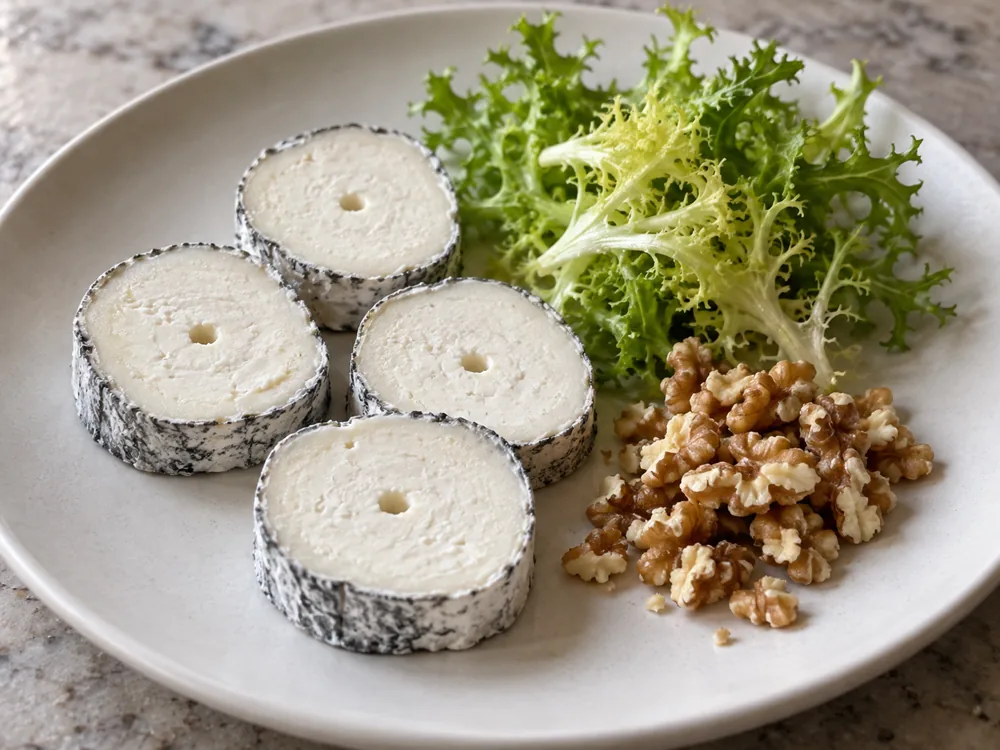
The board also suggests thin slices as an autumn aperitif. For a warm dish it says to dry the cheese lightly in the oven for a few minutes, which leaves the texture almost runny.
The board's recipe list also uses it baked: thin slices on toast finished with a little honey and chives, tartlets with cherry tomatoes, pithiviers with pears, and clafoutis, quiche, or courgette lasagne.
The board's split by age lines up with Culture's flavour notes: honey goes with the young log, which Culture calls acidic with citrus notes, and rustic accompaniments go with the older log, which Culture calls nuttier and saltier.
The Reluctant Gourmet's table pairs honey and walnuts with off-dry Vouvray, and puts figs, apricots, or raisins on a board with Pouilly-Fumé to bring out the cheese's tang.
For salads of beetroot, rocket, or citrus, it suggests crumbling the cheese over them with Quincy or Menetou-Salon, and for rounds topped with thyme or tarragon and olive oil it names Touraine Sauvignon.
Sauvignon Blanc leads the white-wine suggestions: Culture names Fumé Blanc, Sauvignon Blanc, and Sancerre, and The Reluctant Gourmet marks Sancerre and Pouilly-Fumé as Sauvignon Blanc, with off-dry Vouvray and sparkling Crémant de Loire as its alternatives.
Which Cheeses Can Replace Sainte-Maure de Touraine?
No substitute copies the whole combination of raw local milk, tapered log, engraved straw, ash rind, and protected origin.
Other Loire-area goat cheeses share some of it, so choose by the feature your board or dish needs. The block below uses what Cheese Professor says about each cheese.
| Cheese | What Cheese Professor says |
|---|---|
| Selles-sur-Cher | An ash-coated disc with a wrinkled grey rind, ash traditionally and vegetable charcoal today, that grows more peppery and earthy as moisture evaporates. |
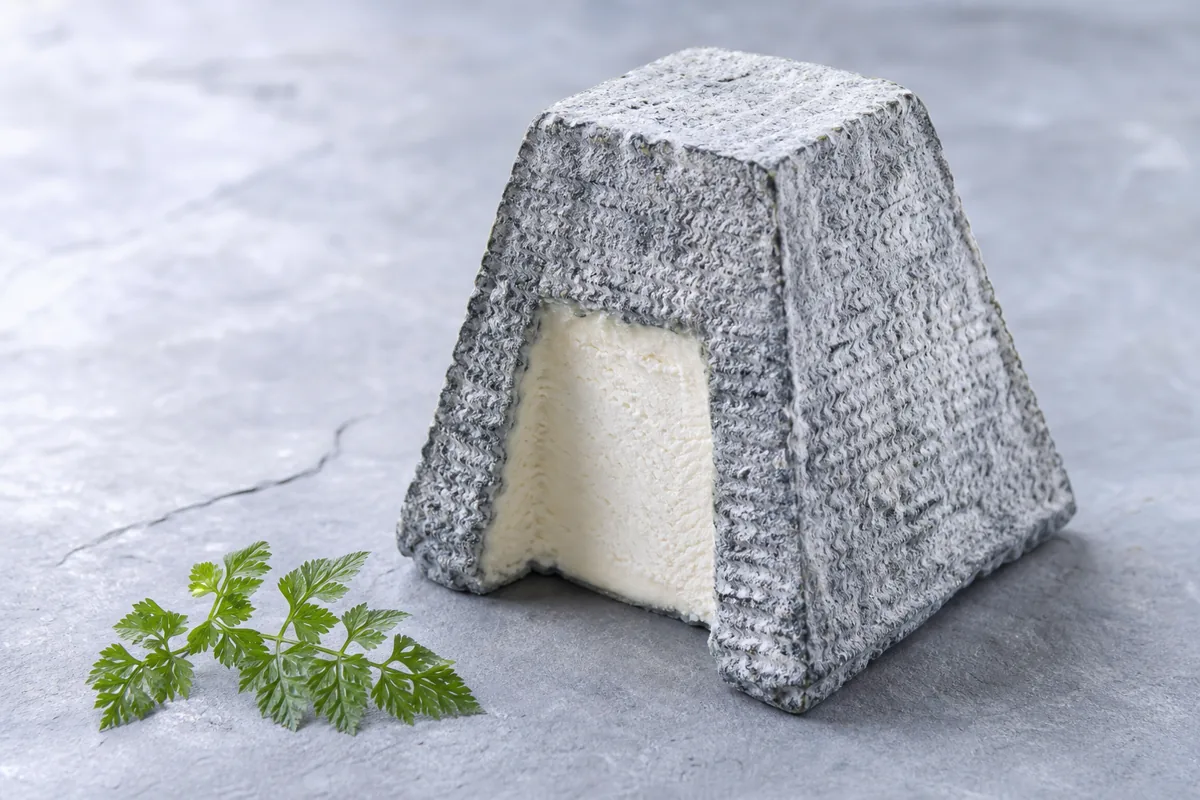
| Valençay | Unpasteurised goat milk, a pyramid missing its point, salted and coated with charcoal, eaten from the 11th day of ripening, with a texture that goes from firm to creamy. |
| Crottin de Chavignol | Compact cylinders sold in four AOP-recognised stages from 10 days to 2 months, with a rind that turns from white to blue as the cheese ages. |
| Sainte-Maure de Touraine | Raw goat's milk, a tapered log rolled in wood ash with a straw through it, per the EU single document and Cheese Professor. |
Ash-coated Selles-sur-Cher is a disc that, according to Cheese Professor, grows more peppery and earthy as moisture evaporates, where an older Sainte-Maure turns drier and crumbly.
Charcoal-coated Valençay uses unpasteurised goat milk too, but Cheese Professor says its texture moves from firm to creamy as it matures, the reverse of the drying path the EU document gives Sainte-Maure.
The EU document even lists the commune of Valençay inside the Sainte-Maure production area, so the two cheeses overlap on the map and the shape is what separates them.
Cheese Professor describes compact Crottin de Chavignol in four AOP-recognised stages from 10 days to 2 months, creamy and tangy when young and drier and more intense later, which makes it the substitute when the age stage matters most.
Where a recipe only needs goat's milk flavour, other goat cheeses can stand in, although they lack the straw and the protected origin.
Can You Store Sainte-Maure de Touraine at Home?
The EU document and the INAO specification give no storage timetable for this cheese. The FDA does not name cheese, but it says a refrigerator should stay at 40 F (4 C) or below and that perishables in general should go into it within 2 hours of purchase.
Stephen Jones of The Reluctant Gourmet estimates 2 to 3 weeks refrigerated and says the cheese is best within 10 to 15 days. That is one writer's estimate, not a rule from the specification.
The NHS accepts any cheese cooked until steaming hot, while the CDC's heated-cheese row covers pasteurized soft cheese only.
The NHS lists hard cheeses such as cheddar, gruyère and parmesan as safe whether pasteurised or unpasteurised, which does not cover a soft log like this one.
The EU document and the INAO specification say nothing about lactose, so we cannot call this cheese lactose-free.
Buy Sainte-Maure de Touraine when you want a protected raw goat's milk log whose engraved straw, tapered shape, and individual PDO label you can check at the counter. Ask whether the log is young or around three weeks old, and serve it at room temperature with the pairings the Touraine tourism board names.
SOURCES & REFERENCES
What Else Do People Ask About Sainte-Maure de Touraine?
The Touraine tourism board says to remove the straw carefully before tasting. The EU and INAO documents describe it as a handling aid and an identification mark, not as food.
Yes. The PDO requires raw whole goat's milk, and the milk must be produced in the defined area.