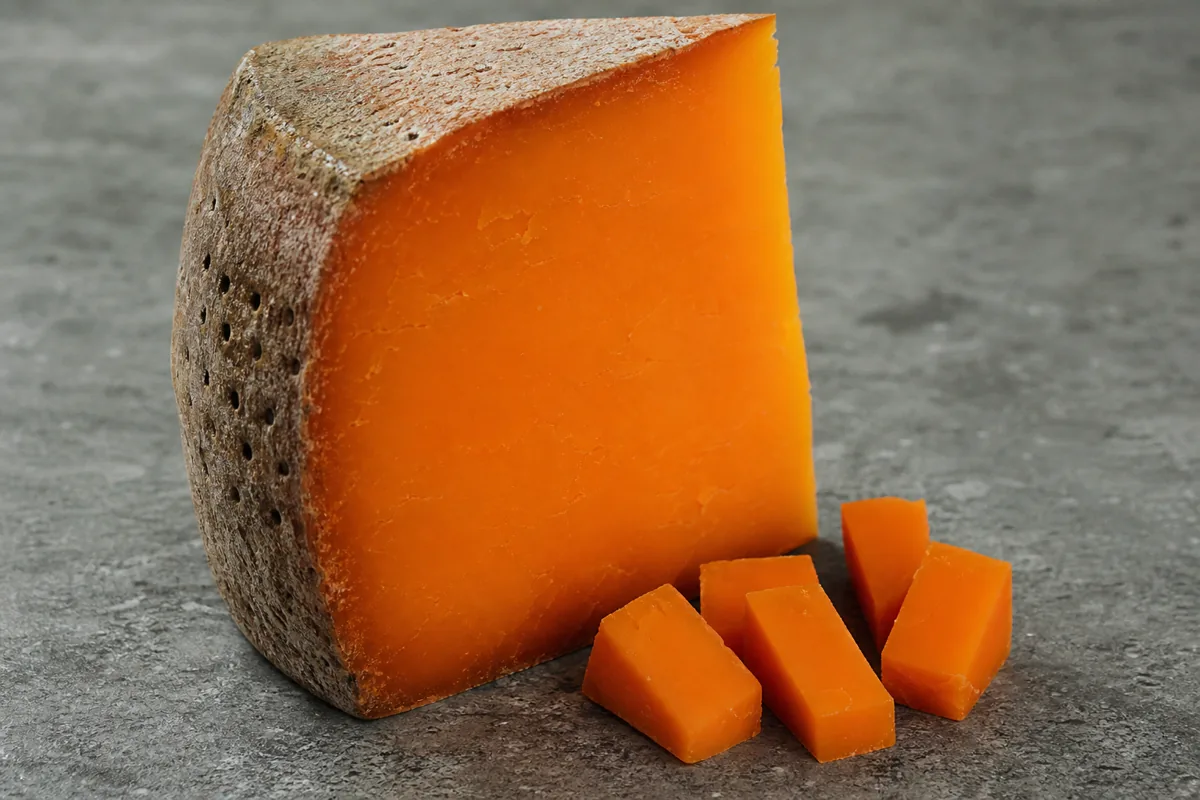
Mimolette is a ball-shaped cheese from northern France, made with cow's milk, with bright orange paste and a grey-brown rind pitted by cheese mites.
Age is the choice that matters at the counter. Taste France describes young Mimolette as supple, dense and nutty, and older wheels as brittle, fruity and slightly pungent.
In This Article
What Is Mimolette?
Mimolette was created in the 17th century as a French answer to Dutch Edam. Taste France credits Jean-Baptiste Colbert, who banned Dutch cheese imports while France and Holland were at war and told French cheesemakers to make their own version.
English Wikipedia places the request with Louis XIV under Colbert's trade policies, and French Wikipedia dates the ban to 1672, at the start of the Franco-Dutch War.
For a long time the cheese was sold as Boule de Lille (ball of Lille) or Vieux Hollande (old Holland). French Wikipedia says the name Mimolette only appeared after the First World War, from mi-molle, French for half-soft, which describes the young paste.
The ball is flattened slightly at the top and bottom, and English Wikipedia compares its look to a cantaloupe melon.
Weights differ by source: Isigny Sainte-Mère gives 2.8 to 3.5 kg for its balls, the Label Rouge specification allows 2 to 4 kg for an uncut ball, and English Wikipedia says about 2 kg. Isigny adds that a 3 kg ball takes 40 litres of milk.
Mimolette has no protected designation of origin (PDO), according to French Wikipedia.
It was first made in French Flanders, and Taste France says it is now produced in several other areas but usually ripened in its native region. French Wikipedia records that farmers there gradually gave it up until three industrial makers revived it: Lactalis at Bouvron, the Isigny Sainte-Mère cooperative in the Manche, and Savencia in the Somme.
Isigny says its Chef-du-Pont dairy was already making pressed Gouda and Edam in 1909, and that Mimolette arrived there in 1951. By then Dutch makers were selling similar cheeses at very competitive prices, and the cooperative's agents in northern France promoted Mimolette as a cheese able to compete with them.
Isigny counts about thirty producers of young Mimolette in France at that time, and says it moved to semi-mature and mature cheeses to stand out from the Dutch competition. It now ripens them in Normandy for 3 to 24 months.
Why Is Mimolette Orange?
The orange comes from annatto, also called roucou, a natural coloring taken from the seeds of the achiote tree (Bixa orellana). Isigny Sainte-Mère mixes it into the milk at the start of production, and Taste France notes that the orange paste darkens with age.
The Label Rouge specification caps annatto at 0.35 mL per litre.
French Wikipedia adds that industrial makers may use other colorings, such as carotene. English Wikipedia says the first French wheels were colored with carrot juice, and annatto came later to set the cheese apart from Edam.
Annatto, listed as E160b, is the same coloring used in orange Cheddar, as French Wikipedia points out. English Wikipedia says that in small amounts it adds no noticeable flavor or aroma, so the annatto itself adds no taste; a darker paste points to longer ripening, but the months on the label are the surer guide.
Why Does Mimolette Have Mites on the Rind?
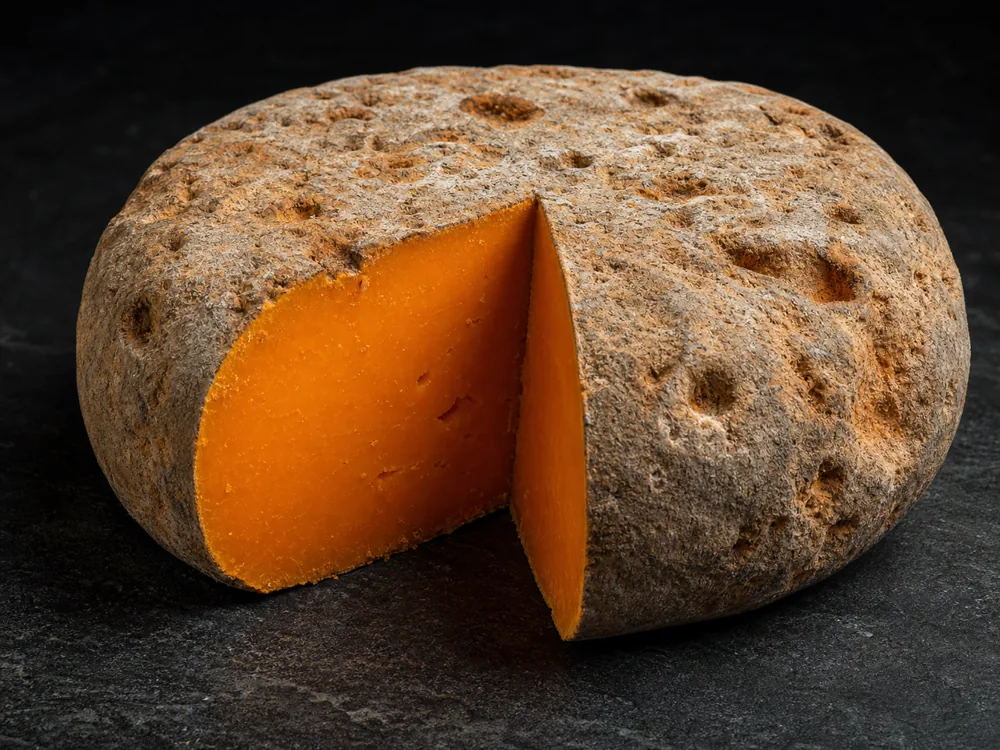
The craters in an aged Mimolette rind are made by cheese mites, microscopic creatures that live on the surface while the cheese ripens.
At Isigny Sainte-Mère, ripening of the mature cheeses starts with a 6-week stay in a drying cellar, where the cheeses grow a fine layer of mould on which the mites develop. The cooperative says the mites strip the rind and give it its natural look.
French Wikipedia says the mites are added on purpose, sprayed on in the first weeks, while the cheese ripens in a humid room at about 15°C. It adds that they perforate the natural rind so the cheese can breathe, while English Wikipedia says they enhance the flavor and Isigny credits them only with the rind.
The Label Rouge specification builds the mites into the care schedule. An affineur turns and brushes each wheel when its shape or mite coverage calls for it, at least 4 times for an old wheel and 6 times for an extra-old one.
The specification also separates the two jobs: turning gives the ball its round shape and evens and dries the rind, while brushing removes most of the mites before the cheeses ship.
On a Label Rouge wheel, the specification describes the finished rind as dry and hard, 0.5 to 1 cm thick, and grey-orange to brown.
Isigny also taps its wheels with a boxwood mallet during ripening. A muffled sound means a solid cheese, while a hollow sound means holes and a rejected wheel.
The mites caused trouble in the United States. English Wikipedia says the FDA detained about a ton of Mimolette in 2013 because the mites could cause an allergic reaction if eaten in large quantities, and lifted the restriction in 2014.
| Point | English Wikipedia | French Wikipedia |
|---|---|---|
| Period | 2013, lifted in 2014 | April 2013 to October 2014 |
| Cheese affected | Mimolette imports | Mimolette vieille imports |
| Quantity | About a ton detained | 1,500 kg destroyed |
| Mite limit cited | Six mites per cubic inch | More than 6 mites per square inch counted |
| Reason given | Mites could cause an allergic reaction in large quantities | Judged unfit for consumption by US customs; the FDA calls the mites allergenic |
French Wikipedia adds that Isigny Sainte-Mère, then the main exporter, had sold 60 tonnes of Mimolette in the United States in 2012.
Cheese.com gives a later end date, saying the ban was lifted in 2022 for several versions of Mimolette but not extra-vieille. It cites no FDA record, and both Wikipedias date the end to 2014, so which ages a US importer can bring in today is not settled by the cited sources.
How Is Mimolette Made?
Taste France and the Label Rouge specification both class Mimolette as an uncooked pressed cheese. The specification spells out the steps for its old and extra-old wheels.
The milk must be pasteurized within 36 hours of collection from the first farm, then ripened with lactic cultures for at least 2 hours before rennet goes in.
The specification lets the milk be treated before pasteurization to remove butyric spores, by bactofugation (centrifugal force) or microfiltration, because fewer spores mean fewer holes in the cheese. It describes the finished Label Rouge paste as having only rare holes.
- Cut: the curd is cut into grains and stirred gently so the grains do not stick together.
- Wash: part of the whey is replaced with water, at most 30% of the vat volume and in a single wash, and the grains are reheated in the vat.
- Press: the curd is pre-pressed, cut into blocks, placed in moulds and pressed into its ball shape.
- Brine: the cheeses sit in saturated brine at 10 to 15°C for 48 to 72 hours, then dry off.
- Ripen: the cheeses ripen at 8 to 16°C and 80 to 95% humidity, with regular turning and brushing.
Washing changes the acidity of the curd: with part of the lactose gone, less lactic acid forms, so the curd's pH is higher at moulding, according to the specification. Together with draining, it brings the curd to the dry matter the maker wants and heads off a sticky rind later.
Salt from the brine adds flavor and slows the microbes and enzymes that drive ripening. Because the brine is saturated, it salts the ball to a very high level, which the specification says makes the salt reach the core and last through the whole ripening.
Ripening is enzymatic digestion, mostly by microbial enzymes, that breaks the casein and fat of the young curd into the many compounds behind the taste and texture. The cellar's temperature and humidity steer how far that goes, and the specification sets a minimum ripening time for the old and extra-old wheels.
Which Age of Mimolette Should You Buy?
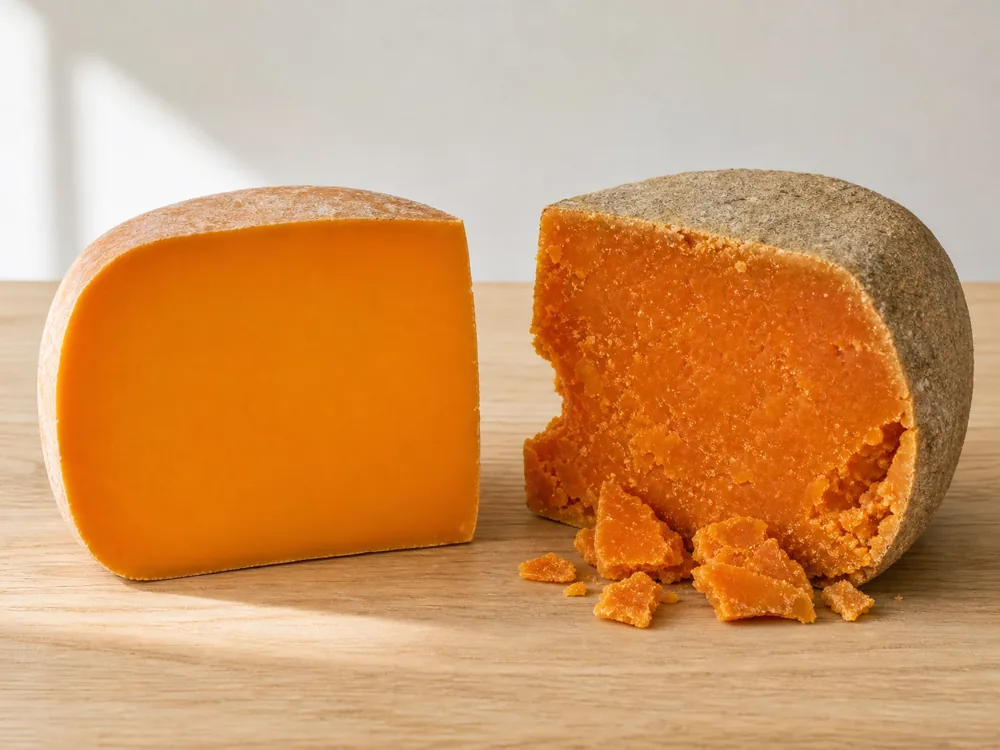
The three sources below draw the age lines a little differently, so the months on a label say more than the stage name.
| Stage | Taste France | Isigny Sainte-Mère | French Wikipedia |
|---|---|---|---|
| Young (jeune) | 3 months | 3 to 6 months | Under 6 months |
| Semi-mature (demi-vieille) | 6 months | 6 to 12 months | 6 to 12 months |
| Mature (vieille) | At least 12 months | At least 12 months; at least 13 for Label Rouge | 12 to 18 months |
| Extra-mature (extra-vieille) | At least 18 months | 16 to 24 months; over 18 for Label Rouge | Over 18 months |
Young Mimolette is soft, supple and fruity, with delicate milky notes after 2 months in the cellar, according to Isigny. French Wikipedia calls the young paste melting and mild.
By the semi-mature stage a hazelnut taste develops. French Wikipedia describes a more fragrant cheese with a light hazelnut flavor.
Extra-mature Mimolette turns brittle, with what Isigny calls a strong taste and salty notes, and English Wikipedia adds a hazelnut-like flavor.
English Wikipedia compares young Mimolette to Italian Parmesan, a comparison neither Taste France nor Isigny makes.
Total ripening runs from about 6 weeks (French Wikipedia) or 2 months (English Wikipedia, Cheese.com) to about 24 months. Cheese.com puts around 12 months as typical.
The rind gives you a visual cue at the counter. At 2 months Isigny describes a yellow-orange hue and soft texture, and after several months the rind turns grey-orange and craggy.
By the semi-mature stage French Wikipedia says the mites have pitted the rind well, and on extra-vieille the holes are clearly visible.
French Wikipedia lists vieux cassant and soleil de Lille as other names for the oldest cheese. Cheese.com says the texture goes from smooth and creamy when young to crumbly and granular with age, and that older wheels can develop tiny calcium lactate crystals that add crunch.
At the counter, trust the months on the label over the stage name. A grey-orange, pitted rind and a brittle paste then confirm an older cheese.
What Does Label Rouge Mean on Mimolette?
Label Rouge is a French quality mark, and for Mimolette it covers only two stages: vieille (old) and extra-vieille (extra-old).
Taste France dates the award to 1989, and Isigny Sainte-Mère says it helped write the original rules in 1988.
INAO lists the specification as LA/26/89, approved in its current form by an order of 18 November 2024. The Label Rouge figures in this article come from the 2014 text of that specification, which INAO also hosts, so values revised since then may differ.
The label carries the red-label logo, the approval number LA 26/89 and two certified claims: at least 13 months in the cellar for vieille or 18 months for extra-vieille, counted from the day of making, and aromatic intensity.
French Wikipedia says only two companies can currently make Label Rouge vieille and extra-vieille: the Isigny-Sainte-Mère cooperative in the Manche, and Lactalis's cheese company at Bouvron in Loire-Atlantique, which sells under the Boule d'Or brand. Neither is in Hauts-de-France, so a red-label wheel comes from western France, not the Lille region.
| Attribute | Standard Mimolette | Label Rouge Mimolette |
|---|---|---|
| Ripening | Compared at semi-mature, 6 months or more | At least 13 months (vieille) or 18 months (extra-vieille) |
| Rind | Plastic or paraffin coating | No plastic or paraffin coating, nothing added |
| Dry matter | At least 54% | At least 65% |
| Fat in dry matter | At least 40% | At least 40% |
| Milk to pasteurization | Up to 72 hours | Within 36 hours |
| Ripening room | Conditions not necessarily controlled | 8 to 16°C and 80 to 95% humidity |
The rind rule is the one you can see at the counter. The specification says most Mimolette on the market has a plastic or paraffin coating whose rind cannot be eaten, while nothing may be added to a Label Rouge rind.
The specification credits the higher dry matter, at least 65%, for the harder, more brittle and less elastic paste of Label Rouge wheels.
How Does Mimolette Differ from Edam?
Taste France separates the two by paste and rind: Edam has cream-colored paste and a paraffin wax rind, while Mimolette has bright orange paste and a natural, irregular rind.
French Wikipedia says the French cheese was not waxed, unlike its Dutch model, and that the orange was chosen to mark it as French. Dutch makers later copied the orange cheese, and Isigny says very few makers of Mimolette remain in France and Holland.
Coated Mimolette exists too, as the Label Rouge section explains, so the orange paste is the surer cue.
French Wikipedia also names the pavé de Roubaix as a very close cheese, with a cubic shape instead of a round one.
How to Cut, Serve and Pair Mimolette
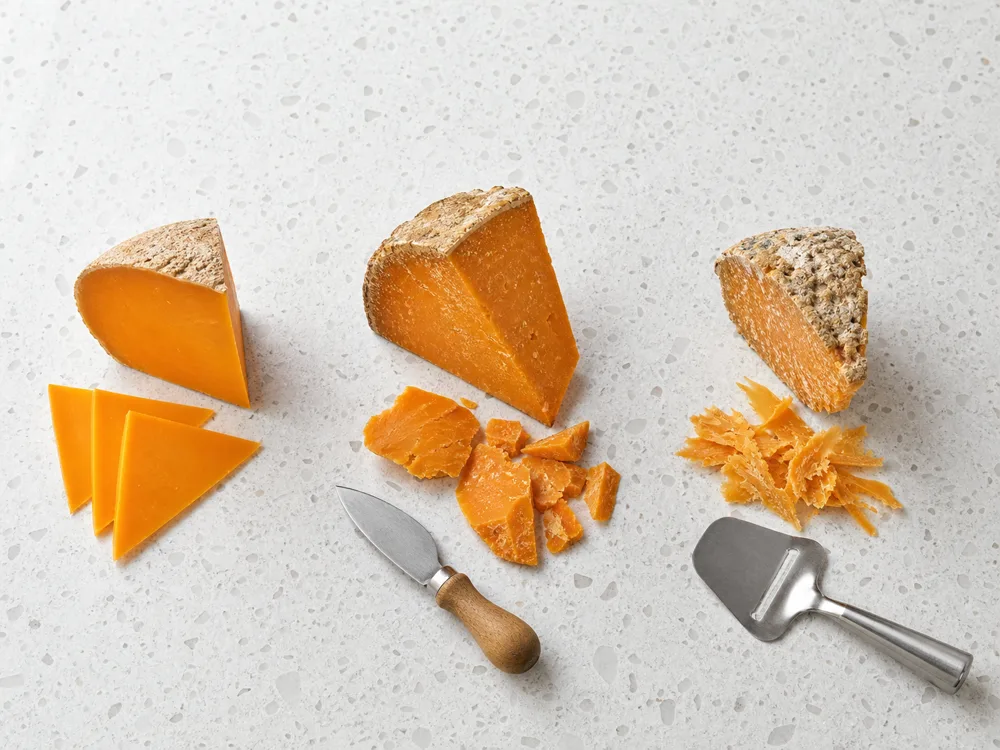
Taste France gives a cutting method for a portion: lay it on its side and cut wedges at an angle, from the middle of the point out to the edges.
Young Mimolette is usually sold in slices. Older cheese is too hard to cut, so it is broken into pieces or shaved with a cheese plane.
Isigny sells young Mimolette as slices for sandwiches and toasties, and says the thin slices can be eaten hot or cold.
Taste France lists recipes for a French cheese toastie and a beef burger with Mimolette, and for veggie sushis with cauliflower.
Cheese.com adds grating over pasta and salads and melting in gratins.
| Use | How It Works |
|---|---|
| Aperitif cubes | Isigny sells young Mimolette cubes and calls them ideal for an aperitif. |
| Sandwiches and toasties | Isigny's thin slices are meant for sandwiches or toasties, hot or cold. |
| Burgers | Taste France has a beef burger recipe with Mimolette. |
| Grating | Cheese.com lists grating Mimolette over pasta and salads. |
| Gratins | Cheese.com also lists melting it in gratins. |
| Shavings | Taste France shaves older, harder Mimolette with a cheese plane. |
Taste France is also the source for pairings. On the food side it names green apple, veal, chives and nutty flavors.
For drinks, it suggests dark beer with extra-mature Mimolette, and a red wine from Touraine Chenonceaux, Valençay or Côtes d'Auvergne with the younger cheese.
For a cheese board, Cheese.com pairs it with crusty bread, dried fruit and nuts, and notes that the bright orange paste adds color to the platter.
| Pairing | Type | Why It Works |
|---|---|---|
| Green apple | Food | Named by Taste France as a savory match for Mimolette. |
| Veal | Food | Taste France lists veal among its Mimolette pairings. |
| Chives | Food | Taste France pairs chives with Mimolette. |
| Dark beer | Drink | Taste France suggests it with extra-mature Mimolette. |
| Touraine Chenonceaux red | Wine | A PDO red Taste France suggests with younger Mimolette. |
| Valençay or Côtes d'Auvergne red | Wine | Two more AOC reds Taste France suggests with younger Mimolette. |
How to Buy and Keep Mimolette
Look for the age in months first, then the Label Rouge mark if you want an old wheel with an uncoated rind.
The Label Rouge specification allows four formats: an uncut ball, a whole or half ball pre-cut into portions and put back together, a hollowed ball holding its own cut pieces, and individual portions. Every portion must come from a Label Rouge wheel.
A Label Rouge portion has to carry rind, keep the ball's curve and not be broken into several pieces. Balls that miss the whole-ball standard may still be cut up and sold, but only as portions.
Dates depend on the format under the same rules: up to 120 days best-before for an uncut ball or vacuum-packed cuts, and a use-by date of no more than 30 days for cuts wrapped fresh near the cheese counter.
Once a pack is open, the CDC says to keep the refrigerator at 40°F (4°C) or below and to refrigerate perishable food, dairy included, within 2 hours, or within 1 hour above 90°F.
French Wikipedia gives April to September as the best season for Mimolette, though it adds that the cheese is good all year.
Is Mimolette Pasteurized, and What About Nutrition and Pregnancy?
Taste France calls Mimolette rich in protein and an excellent source of vitamins A, B2 and B12.
Under the dry-matter rule in the Label Rouge section above, solids make up roughly two-thirds or more of an old Label Rouge wheel.
French Wikipedia counts mimolette vieille among the cheeses richest in calcium, at 905 mg per 100 g, and says the calcium rises with longer ripening.
Curd washing removes part of the whey and with it part of the lactose, according to the specification. If you have lactose intolerance, check the label for a lactose figure.
The NHS lists pasteurised or unpasteurised hard cheeses, such as cheddar, gruyère and parmesan, as safe in pregnancy, along with pasteurised semi-hard cheeses such as edam.
The CDC lists hard cheese made with pasteurized milk as safer and says pregnant women are 10 times more likely to get a Listeria infection. Isigny Sainte-Mère describes its Label Rouge Mimolette, and English Wikipedia the cheese in general, as made with pasteurized milk, but French Wikipedia notes that farm production returned in the 2010s, so the label on a farm cheese is worth checking.
Is Mimolette Vegetarian?
It depends on the rennet, the coagulant that sets the milk. Label Rouge Mimolette is made with traditional animal rennet only, taken from the stomachs of young milk-fed cattle, and the specification bars every other coagulant, including vegetable, fungal and genetically produced ones.
The same document lists "rennets and coagulating enzymes" among the ingredients allowed in ordinary Mimolette without naming a kind, so the coagulant in a standard ball is left open. If you need vegetarian rennet, check the label or ask the maker.
SOURCES & REFERENCES
What Else Do People Ask About Mimolette?
These short answers point back to the sections above.
Annatto, a natural coloring from the achiote tree, is mixed into the milk at the start of production. It adds no noticeable flavor in small amounts.
Cheese mites develop on the rind surface during ripening and leave the grey, pitted crust. The FDA held imports over them from 2013 to 2014.
Remove any plastic or paraffin coating: the Label Rouge specification says it cannot be eaten. A Label Rouge rind has nothing added, but it is dry, hard and 0.5 to 1 cm thick.
No. Mimolette began as a French copy of Edam, but Taste France notes that Edam has cream-colored paste and a paraffin wax rind, while Mimolette is bright orange.
Taste France says young Mimolette is usually sold in slices, while older cheese is too hard to cut and is broken into pieces or shaved. Pick by the months on the label, since the sources draw the stage lines differently.
Not across the board. English Wikipedia says the FDA held Mimolette imports in 2013 over the number of mites on the rind and lifted the restriction in 2014, while Cheese.com dates the lifting to 2022 and says extra-vieille was left out.