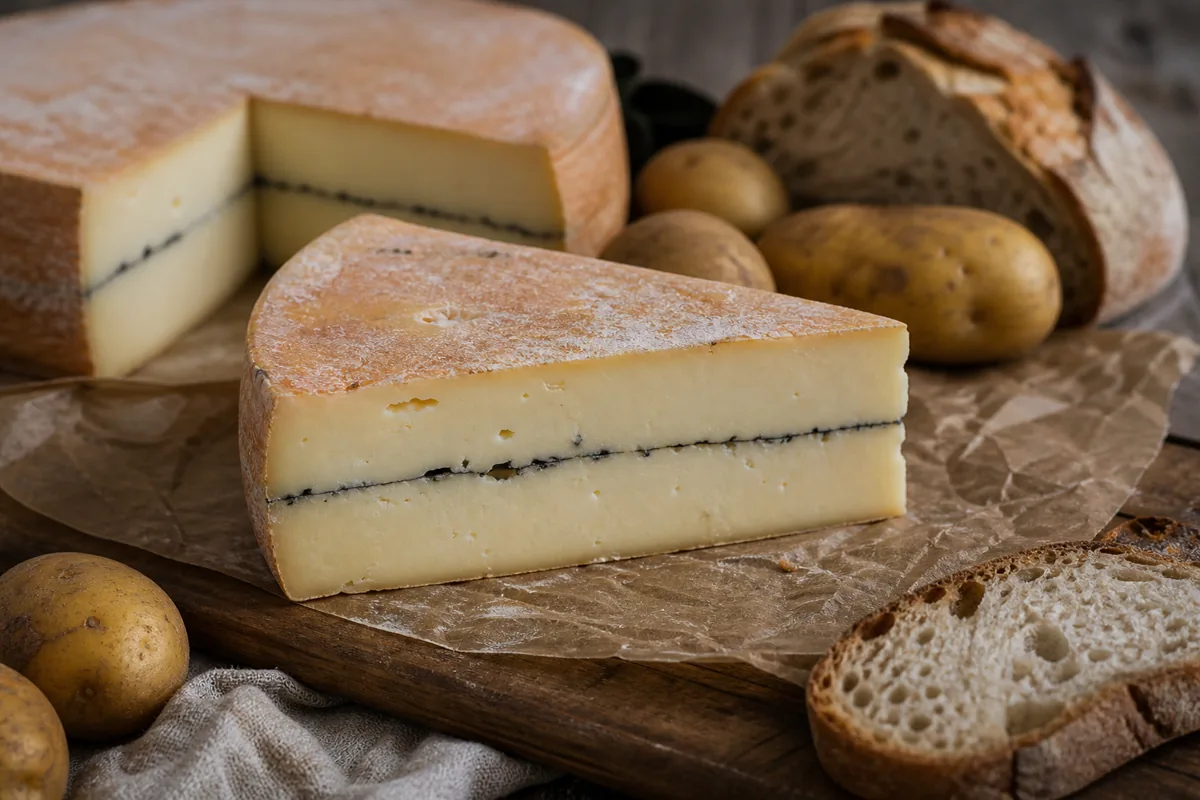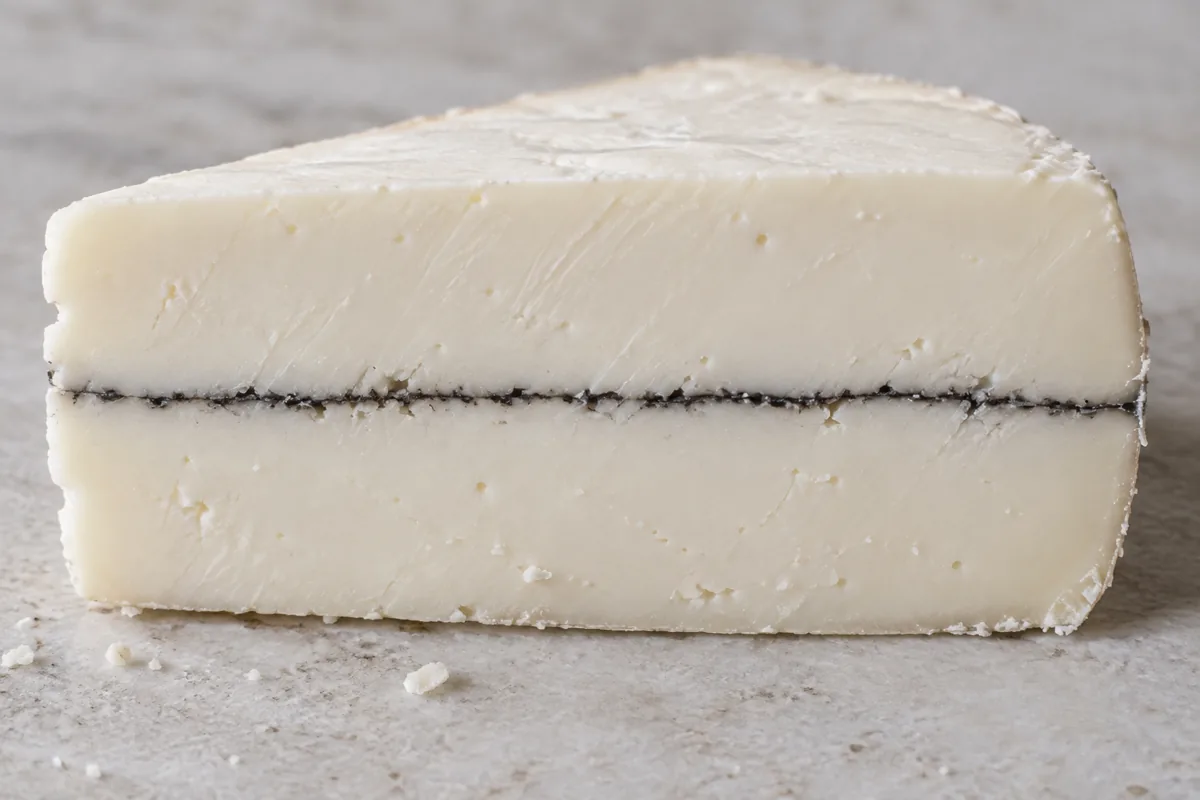
Mobay is a Wisconsin cheese made from two halves, one from sheep's milk and one from goat's milk, pressed together with a thin line of grape vine ash between them.
If you know Morbier, that dark line will look familiar. Culture magazine describes Mobay as cheesemaker Sid Cook's interpretation of the French Morbier, and Carr Valley Cheese in La Valle makes it.
In This Article
What Is Mobay Made Of?
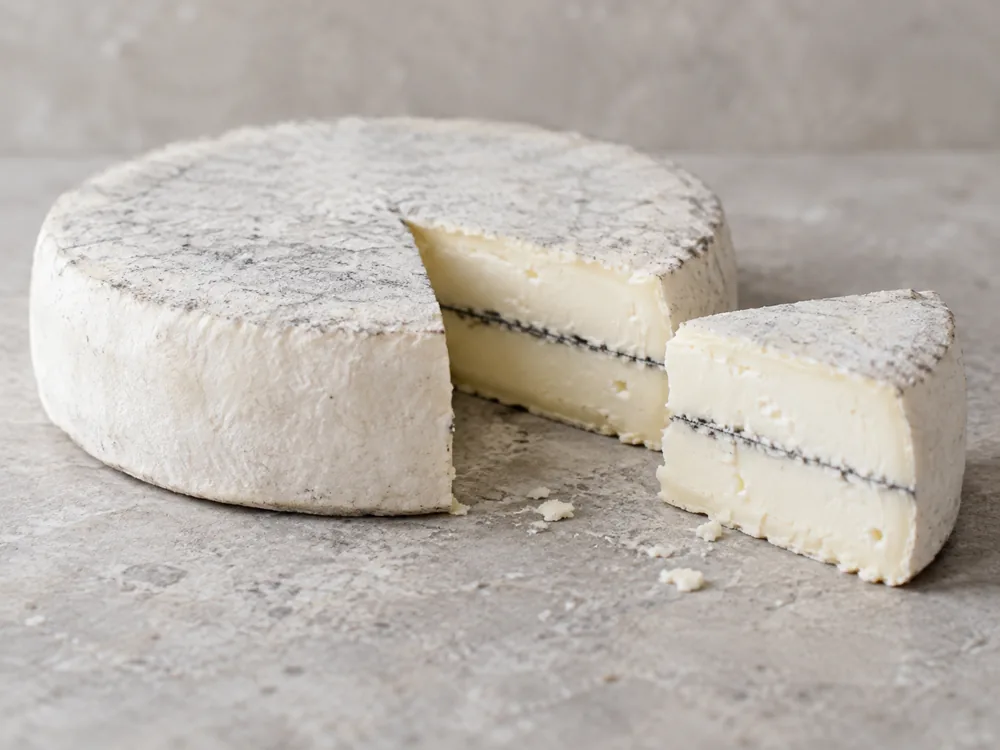
Mobay is built in two halves. Culture says the sheep's milk half and the goat's milk half are pressed together after each is made, separated by a decorative line of grape vine ash that runs horizontally through the middle.
On the cut face you see that line against white: Culture calls the interior paste bone-white apart from the line of ash and the texture semisoft and supple, and Cheese.com also describes a supple, bone-white cheese.
Both milks are pasteurized, and the ingredient list Wisconsin Cheese Mart gives reads pasteurized cultured goat and sheep milk, salt, enzymes, grape vine ash and calcium chloride. The same listing flags milk as the allergen.
If you avoid animal rennet, the rennet question is settled: Wisconsin Cheese Mart and Cheese Grotto call the rennet vegetarian, and Culture lists it as vegetable rennet.
Culture's entry also traces the milk to its farms: Carr Valley gets its sheep's milk largely from one dairy and its goat's milk from a group of eight farms in the Green Bay area.
Is Mobay the Same as Morbier?
They are different cheeses, although Cheese.com calls Mobay an homage to the French Morbier.
| Detail | Mobay | Morbier AOP |
|---|---|---|
| Milk | A sheep's milk half and a goat's milk half, both pasteurized | Raw cow's milk |
| How the layers are made | Two halves, one per milk, pressed together after each is made | Traditionally, later curd laid over a first layer covered with soot |
| The line | Grape vine ash, listed as an ingredient | Vegetable charcoal today |
| Wheel | 10 in (about 25 cm) across, 4 in (about 10 cm) high, 10 lb (about 4.5 kg) | 35 cm (about 14 in) across, 5 to 8 cm (2 to 3 in) high, 5 to 8 kg (11 to 18 lb) |
| Origin | Wisconsin, made by Carr Valley | Franche-Comté, France, protected as an AOC in 2000 and an AOP in 2002 |
France's agriculture ministry traces Morbier's line to Franche-Comté farmers who had too little milk for a whole cheese in one collection, so they covered the first curd with soot until more curd went on top.
In Mobay the line sits between two different milks, and Culture calls it decorative.
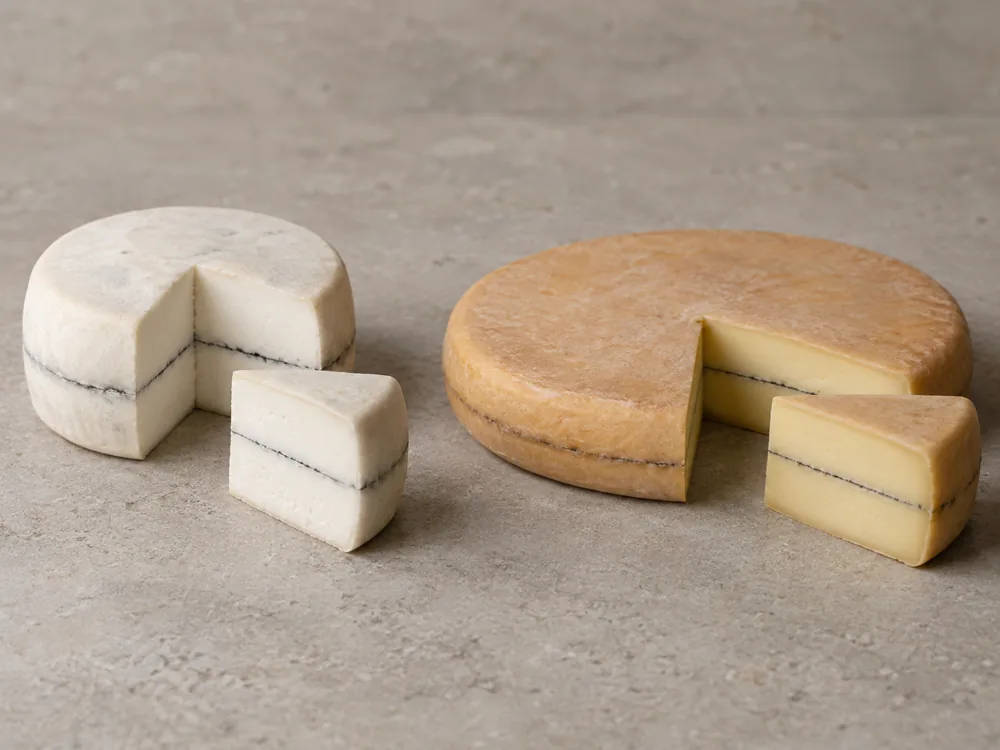
You can also tell them apart by colour: the ministry describes Morbier's rind as smooth and beige-orange over a supple, ivory-yellow paste, while Culture gives Mobay a bone-white paste and a light dusting of ash on the rind.
On a whole wheel, the shape gives them away too. By the ministry's figures a Morbier wheel is between four and seven times wider than it is high, while Culture's dimensions make a Mobay wheel about two and a half times wider than high, so Mobay is the thicker and narrower of the two.
Can You Eat the Ash in Mobay?
The line you see on the cut face is part of the cheese: Wisconsin Cheese Mart lists grape vine ash among Mobay's ingredients.
Cheese.com and Cheese Grotto describe a delicate layer or band of ash between the halves. The flavor descriptions below all concern the milks, not the ash.
The rind is another matter. Culture says the outside of the wheel carries a light dusting of ash; before you eat that rind, ask the seller whether it is meant to be eaten.
What Does Mobay Taste Like?
Each milk brings its own side of the flavor. Culture describes the sweetness of the sheep's milk as balanced by the bright tang of the goat's milk, and Cheese.com credits the sweet richness to the sheep's milk and the bright tang to the goat's milk.
For the cheese as a whole, Cheese.com's summary is sweet and tangy, and Cheese Grotto adds subtlety and earthiness to the flavor.
Culture, the U.S. Dairy Export Council and Wisconsin Cheese Mart's description all call the flavor delicate and rustic. Wisconsin Cheese Mart's own flavor profile field says decadent and rich, and going by Cheese.com's split, that wording may be describing the sheep half.
You can taste the split for yourself. The U.S. Dairy Export Council's specialty cheese gallery and Wisconsin Cheese Mart both suggest tasting each layer separately and then together, for three flavor profiles in one cheese.
How Should You Cut Mobay Around the Ash Line?
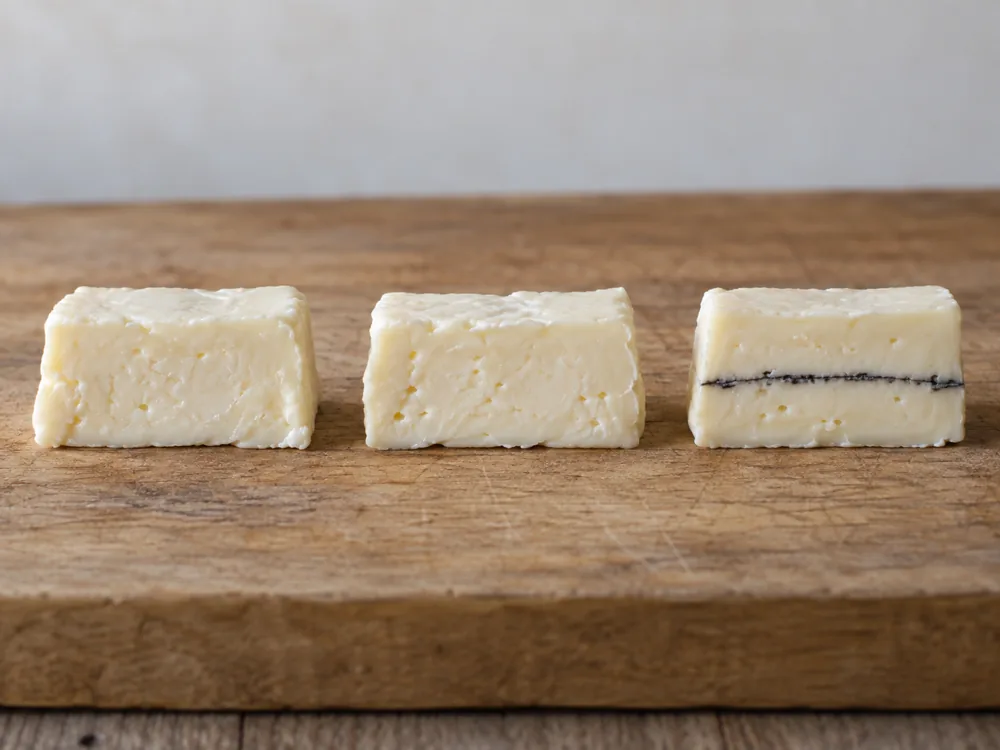
How you cut Mobay follows from how it is built. The ash runs horizontally through the middle of the wheel, so a piece that keeps the line in it carries both milks.
A slice you take parallel to the ash holds only the sheep's milk half or only the goat's milk half. To taste each layer alone, as the retailers suggest, cut one small piece from each side of the line and a third piece that straddles it.
Which Drinks and Foods Pair with Mobay?
The specific pairings below come from Cheese Grotto's product page for Mobay, and the U.S. Dairy Export Council's gallery also pairs it with Chenin Blanc or Riesling.
| Pairing | Type | Why It Works |
|---|---|---|
| Apples, pears and figs | Food | Fresh or dried fruit. |
| Dried cherries or preserves | Food | The sweeter option. |
| Chenin Blanc or Riesling | Wine | Fruit-forward white wines. |
| Belgian-style ale | Drink | The beer option. |
Fruit runs through most of the list, from the apples and figs on the plate to the fruit-forward white wines, and the Belgian-style ale is the one pour without it.
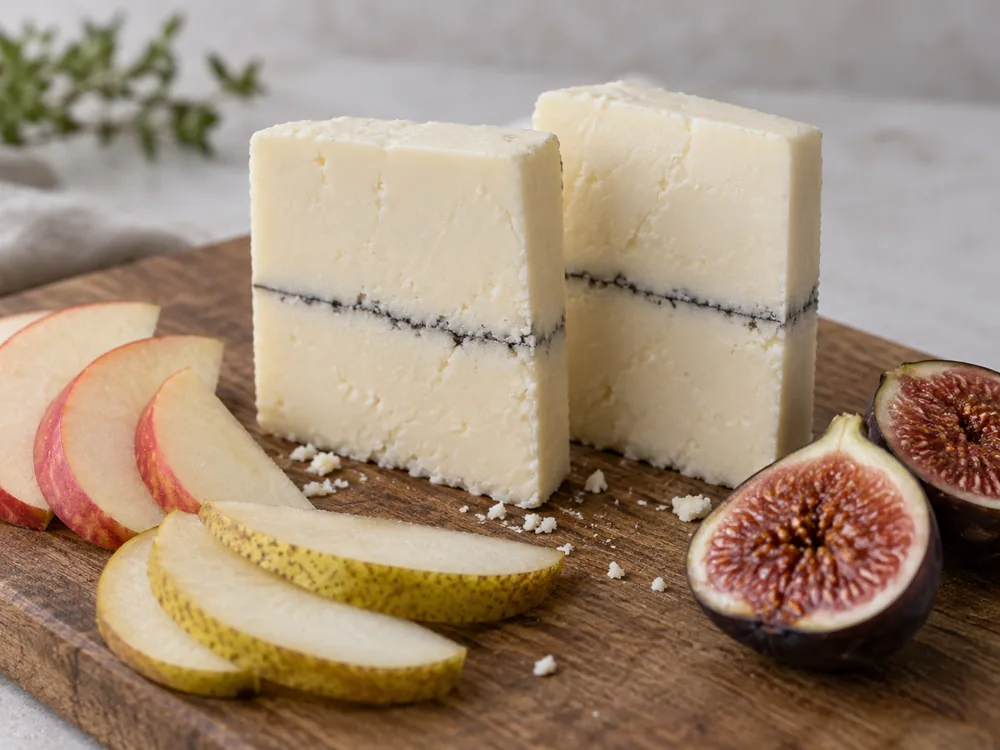
Cheese Grotto also calls Mobay a beautiful addition to any cheese plate, citing its light ash stripe through the middle and a taste that pleases almost any palate.
Is Mobay Safe During Pregnancy?
NHS lists pasteurised soft cheeses, such as feta, ricotta and halloumi, and goats' cheese that does not have a white coating (rind), as safe to eat. Mould-ripened soft cheeses with a white coating, such as brie, camembert and chèvre, and soft blue-veined cheeses must be thoroughly cooked, whether they are pasteurised or unpasteurised.
CDC lists soft cheese made from unpasteurized milk as riskier, and pasteurized soft cheese heated to an internal temperature of 165°F or until steaming hot as safer.
Mobay is made with pasteurized milk and has a semisoft paste. Culture lists its rind as plastic; check your piece for a white mould coating.
Where Can You Buy Mobay, and How Long Does It Last?
Wisconsin Cheese Mart and Cheese Grotto list Mobay online. Culture lists a whole Mobay at 10 inches across, 4 inches high and 10 pounds, and the retailers sell far smaller pieces, such as a 5-ounce portion listed at $9.00 on Wisconsin Cheese Mart's page and one-pound portions at Cheese Grotto.
If you compare by the pound, Cheese Grotto lists the one-pound portion at $38.00, while the 5-ounce portion at $9.00 works out to $28.80 a pound. Neither price includes shipping, which Cheese Grotto sets by zip code and sends out on Tuesdays for orders placed by Sunday.
A whole 10-pound wheel equals ten of Cheese Grotto's one-pound portions. When you pick a portion, look at the cut face: because the ash line runs through the middle of the wheel, the pack that holds both milks is the one where the line shows.
The U.S. Dairy Export Council's gallery prints the same 180-day shelf life and vacuum-packed retail cut for all six Carr Valley cheeses it lists, so the figure is not specific to Mobay. Once your piece is home, CDC says to keep a refrigerator at 40°F or below.
Mobay is sold as 5-ounce and one-pound portions or as a 10-pound wheel. The pack that holds both milks is the one where the ash line shows.
Who Makes Mobay, and What Has It Won?
Carr Valley Cheese in La Valle, Wisconsin makes Mobay, and every page that describes Mobay names Carr Valley as the maker.
The company's start date depends on whom you read. Carr Valley says it began in 1902 and is owned and operated by the Cook family, while Cheese Grotto says what began in 1883 continues as Carr Valley.
Culture reconciles the two dates by saying the Cook family has been making cheese since 1883, and it adds that Sid Cook bought Carr Valley in 1986.
Carr Valley's About page says Sid Cook is a fourth-generation cheesemaker who received his cheesemaking license at 16, and Cheese Grotto says Cook is Master Certified in Mobay and three other of his cheeses.
The size of the range differs by source as well. Carr Valley says the company now makes more than 50 original varieties, while Culture's count is larger, at over 65 different cheeses.
| Year | Contest | Result |
|---|---|---|
| 2025 | United States Championship Cheese Contest | Best of Class |
| 2025 | Los Angeles International Dairy Awards | Bronze |
| 2017 | U.S. Championship Cheese Contest | Second place |
| 2014 | World Championship Cheese Contest | Third place |
| 2011 | World Cheese Awards | Second place |
| 2009 | World Championship Cheese Contest | First place |
| 2007 | American Cheese Society | First place |
The earliest placing any page records for Mobay is from 2007. The U.S. Dairy Export Council's gallery lists the placings from 2007 to 2017, Cheese Grotto and Wisconsin Cheese Mart report the 2025 Best of Class, with Wisconsin Cheese Mart also listing the Los Angeles bronze.
The placings come from different contests, so a 2009 first place and a 2025 bronze cannot be ranked against each other.