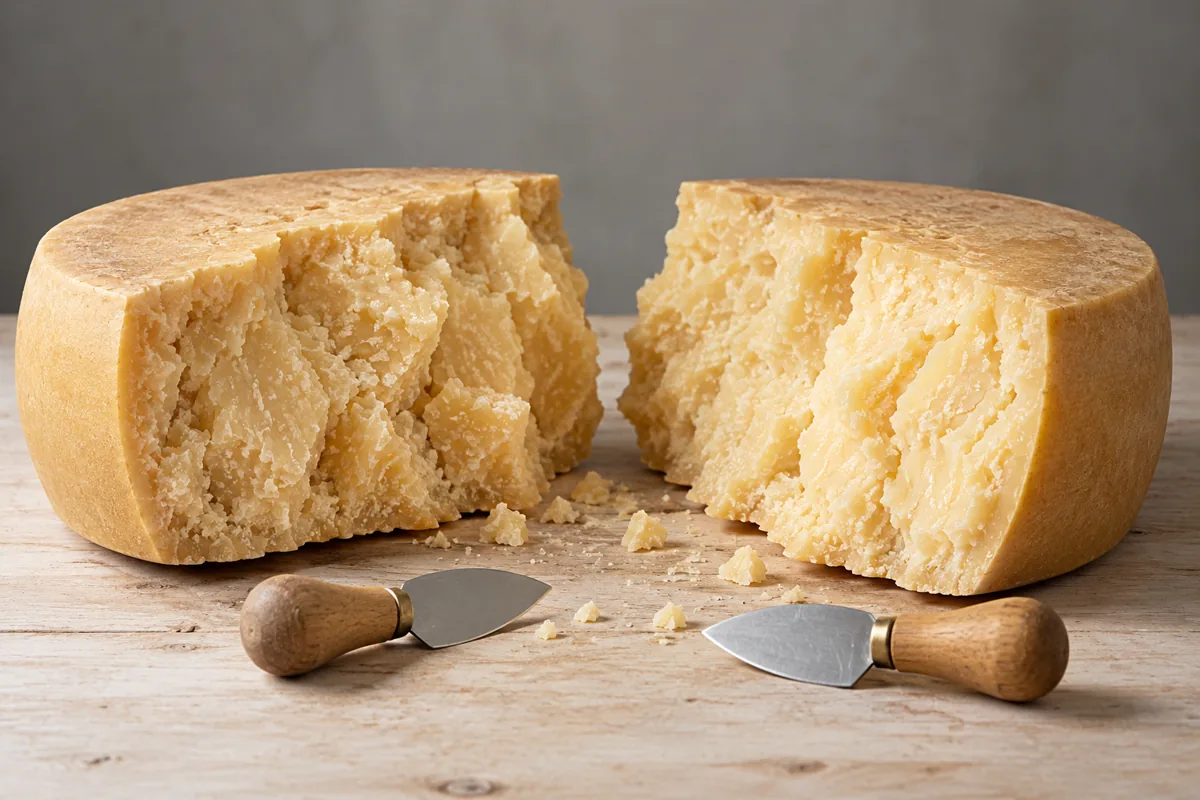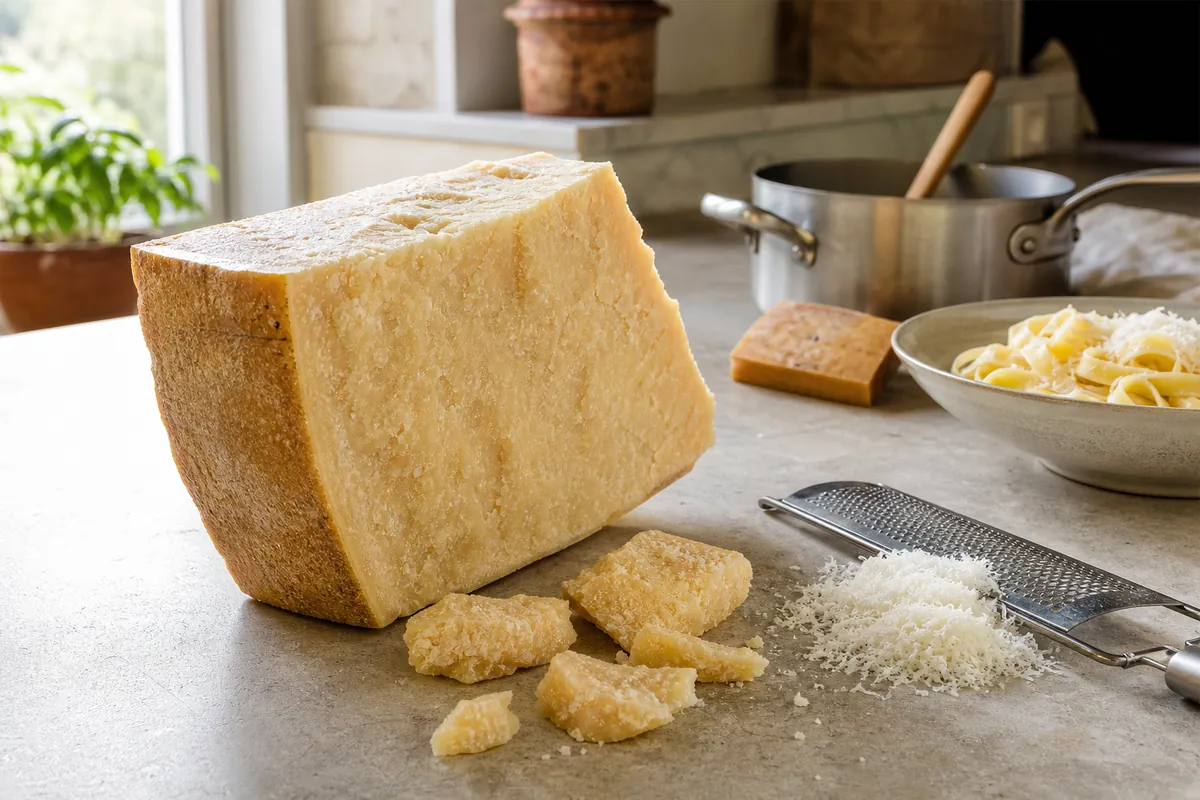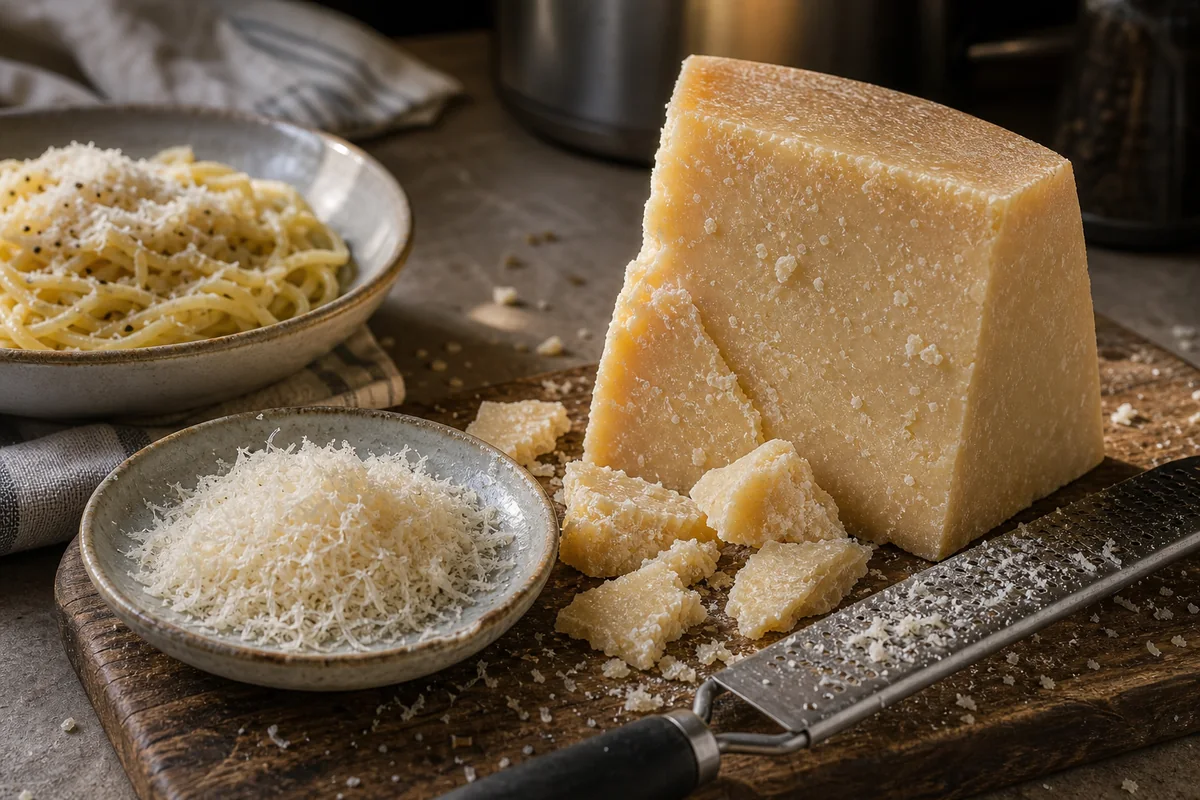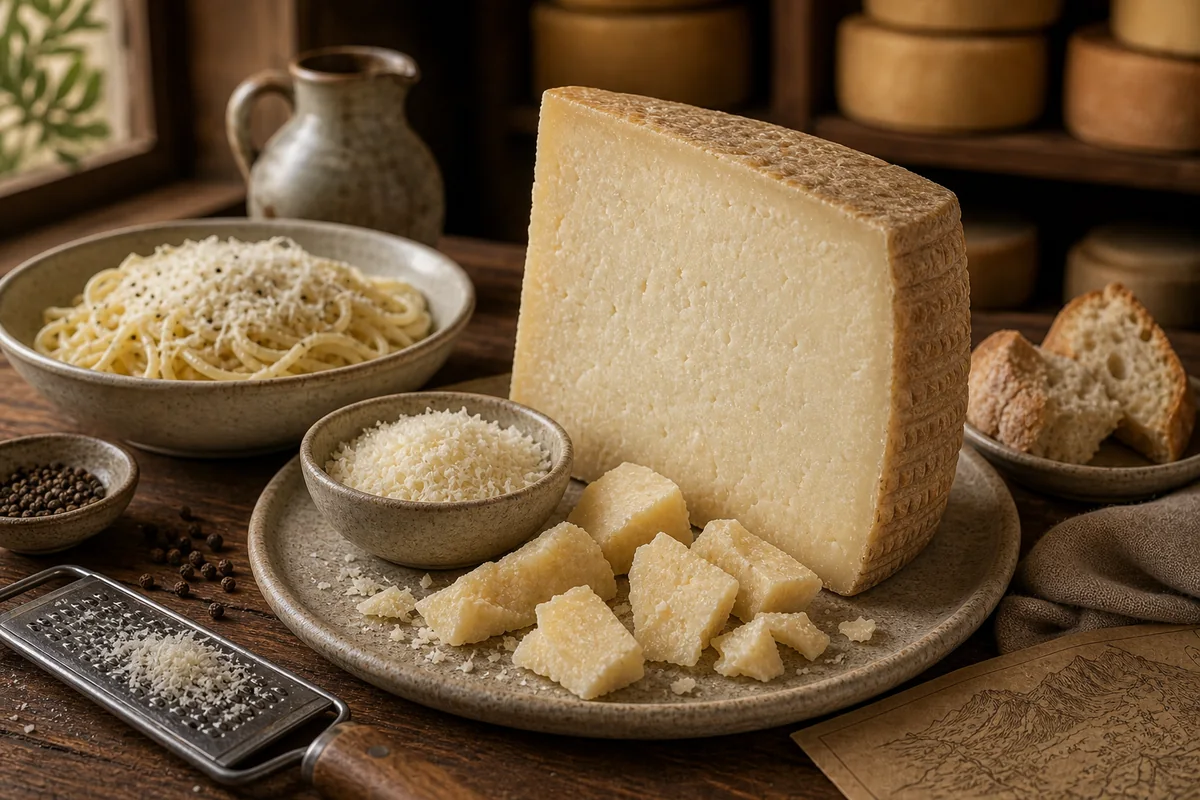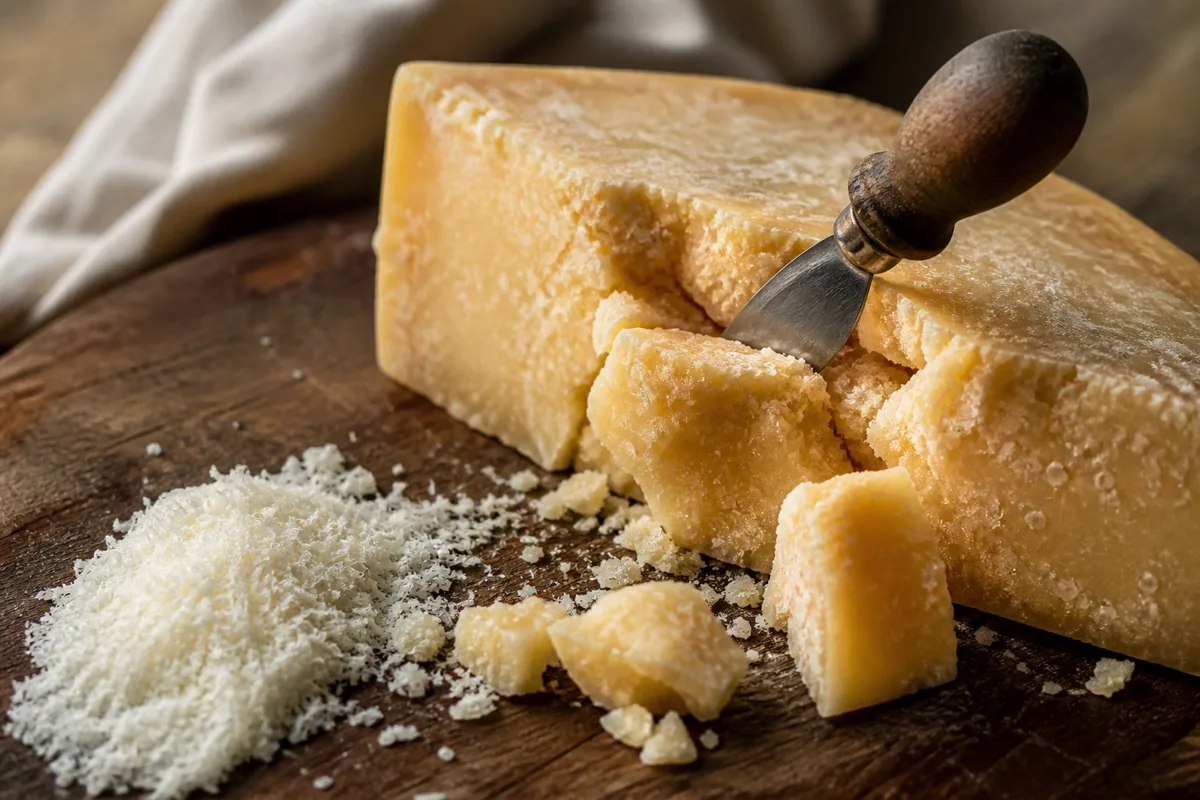
Reggianito is Argentina's smaller, faster-maturing answer to Parmigiano Reggiano. Italian immigrants adapted the grating-cheese tradition to local dairies, then named the result with a Spanish diminutive that points directly to its smaller wheel.
It became Argentina's most consumed and most exported hard cheese, but the name covers more than one production level. Every wheel must meet the national food code; only those carrying the voluntary Alimentos Argentinos seal must meet the tighter 2008 protocol.
In This Article
Where Does Reggianito Come From?
The Argentine method grew from Italian hard-cheese traditions including Parmigiano, Reggiano and Grana Padano. Immigration in the late 19th and early 20th centuries brought the knowledge; local wheel sizes, ingredients and commercial needs changed the result.
After World War I, Reggianito became serious export competition for Italian cheese. That pressure helped push Italian producers toward collective protection of the Parmigiano Reggiano name, while Argentina continued developing its own regulated style.
You can place it in the broad Parmesan family for cooking, yet the Argentine food code gives Reggianito its own weight class and minimum age.
What Does Argentina's Food Code Require?
Article 635 of Argentina's food code groups Reggianito with Parmesano, Parmesão, Reggiano and a local class called Sbrinz. The last name should not be confused with protected Swiss Sbrinz.
Within the Argentine code, wheel weight does most of the separating, and the minimum ripening time rises with size. Reggianito occupies the 5-to-10-kilogram band, which is why it can reach maturity sooner than a 38-kilogram Italian wheel.
| Name | Wheel weight | Minimum ripening |
|---|---|---|
| Parmesão | 4 to 8 kg | 6 months (wheels of 4 to 10 kg) |
| Reggianito and Sbrinz | 5 to 10 kg | 6 months (wheels of 4 to 10 kg) |
| Reggiano | 10 to 20 kg | 8 months (wheels of 10 to 20 kg) |
| Parmesano | Over 20 kg | 12 months (wheels over 20 kg) |
The legal bands overlap: a 7-kilogram wheel fits Parmesão, Reggianito and the Argentine Sbrinz class, while a 10-kilogram wheel touches both Reggianito and Reggiano. Weight alone therefore cannot confirm the class name printed on a label.
All five are low-moisture, hard-paste cheeses capped at 35.9% moisture, and each must carry at least 32 g of fat per 100 g of dry matter.
Makers may use raw or pasteurized milk after suitable mechanical cleaning. That flexibility distinguishes the base legal class from Parmigiano Reggiano and also makes the milk statement important for pregnancy decisions.
The required ingredients are whole or fat-standardized milk, specific lactic cultures, rennet or another suitable coagulant, and salt. No technological processing aid is allowed, although permitted surface coatings can still change how a wheel looks.
The finished cheese is hard, compact, brittle and granular, yellowish-white to slightly yellow, and shaped as a cylinder with flat faces and a slightly convex side.
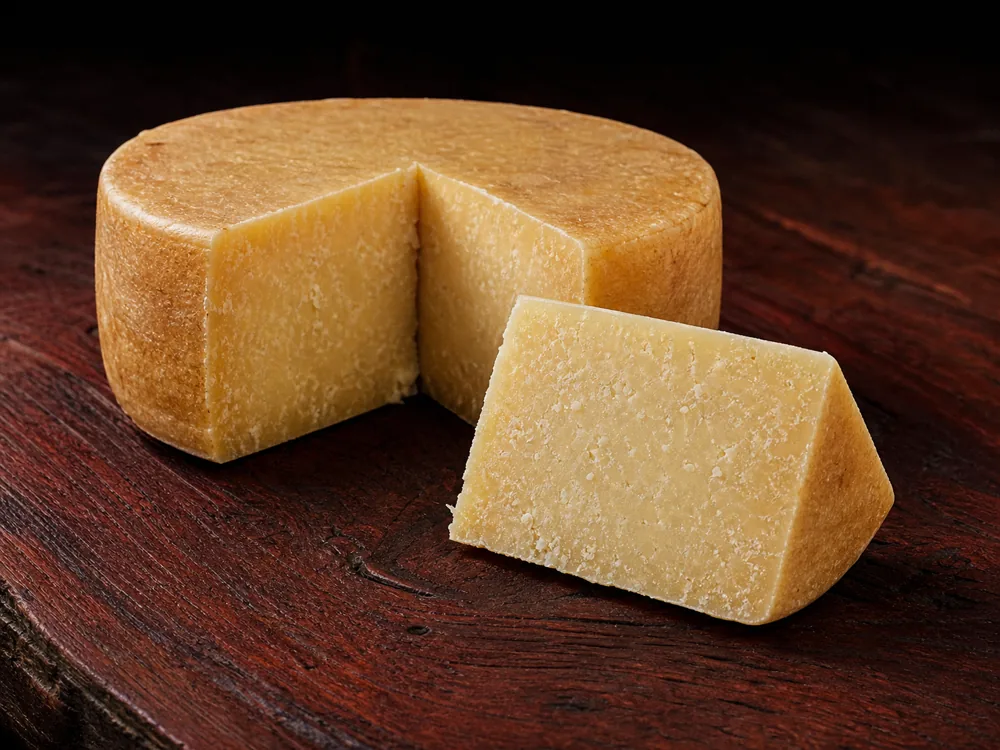
The cheese may be sold unwrapped or in food-grade packaging, with or without vacuum, and sometimes coated in paraffin.
For coatings on the surface of the cheese, the code permits its listed cheese colourants and linseed or other vegetable oils, alone or mixed with charcoal, calcium carbonate, iron oxide, aluminium, silver, gold or litholrubine BK.
At home, keep it in a refrigerator at 40°F (4°C) or below.
How Much Fat Does Reggianito Have?
The legal fat floor uses dry matter, which means the cheese after its water is removed. If you read that percentage as a share of the whole wedge, you will overstate how much fat the cheese contains.
Because Article 605 caps a low-moisture cheese at 35.9% water, at least 64.1 g of every 100 g is dry matter. The floor therefore works out to no less than about 20.5 g of fat per 100 g of cheese.
Within that dry-matter system, Reggianito may be either semi-fat or fat. The allowed range is broad enough for two compliant cheeses to carry different nutrition panels.
| Class | Fat in dry matter | Open to Reggianito? |
|---|---|---|
| Extra fat or double cream | 60% or more | No |
| Fat | 45.0 to 59.9% | Yes |
| Semi-fat | 25.0 to 44.9% | Yes, but only from the 32% floor up |
| Lean | 10.0 to 24.9% | No |
| Skimmed | Under 10.0% | No |
The voluntary seal narrows the method by setting the partially skimmed milk's fat-to-protein ratio between 0.65 and 0.75. Makers use the lower end for semi-fat cheese and the upper end for a fat one.
A bare “30% fat” claim leaves you guessing whether water was removed before the calculation, so rely on the package and its stated basis instead.
How Long Is Reggianito Aged?
For a wheel in Reggianito's legal size class, the minimum age is six months. A wheel carrying the voluntary quality seal must reach eight months, so the mark adds two months of required cellar time.
| Cheese or claim | Ripening time | How to read it |
|---|---|---|
| Standard legal Reggianito | At least 6 months | Applies to the 5–10 kg code class |
| Alimentos Argentinos seal | At least 8 months from the make date | Applies only when the wheel carries the voluntary seal |
| Five-month retail description | Below the code floor | Do not treat it as the Argentine legal minimum |
A five-month figure sometimes appears in general descriptions, but it sits one month below the code's floor. For a buying decision, use six months as the minimum and look for the eight-month seal when you want the tighter specification.
Eight months also equals the minimum assigned to the heavier 10-to-20-kilogram Argentine Reggiano class. The seal therefore asks the smaller wheel to remain in the cellar as long as that next class up.
What Does the Alimentos Argentinos Seal Add?
The Alimentos Argentinos protocol is voluntary, so its stricter rules apply only when the seal appears on the cheese. For you, that mark guarantees a narrower wheel size, eight months of ageing, tighter milk controls and a sensory score of at least 93 points.
| Food code, Article 635 | Seal protocol, 2008 |
|---|---|
| Raw or pasteurized milk | Cow's milk only, raw or pasteurized; pasteurization recommended to standardize the cheese |
| Wheel of 5 to 10 kg | Wheel of 7.2 kg, plus or minus 0.6 kg; 24 to 25 cm across and 14 to 15 cm high |
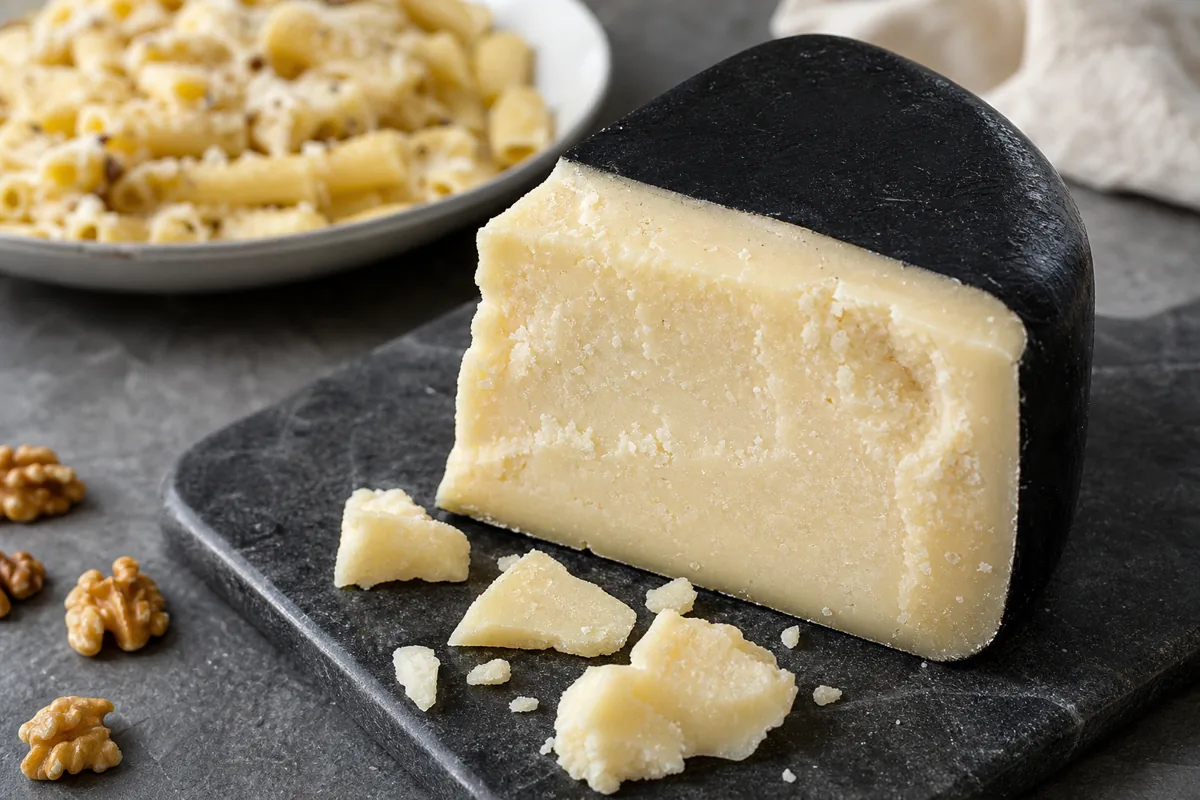
| Rind smooth, firm and well formed, with suitable coatings | Rind smooth and firm; pale yellow (natural) or painted black |
| No eyes, with the occasional small hole or mechanical opening | At most 2 eyes or openings per wheel, none wider than 3 mm |
| Cream and milk protein concentrate allowed as optional ingredients | No caseinate, milk powder, butter, cream or any other added fat |
| Additives allowed for low-moisture cheeses | No preservatives in the paste |
| No grading score set in Article 635 | At least 93 points in sensory grading (Extra quality) |
A sealed wheel centres on 7.2 kilograms, with a permitted range of 6.6 to 7.8, while standard code-compliant Reggianito may reach 10 kilograms. That size is one of the quickest ways to see how the voluntary protocol narrows the broader legal class.
Milk for the seal must come from pasture-based herds officially certified free of brucellosis and tuberculosis. The dairy then has to trace that milk from its farms through the finished cheese.
A three-month moving average of raw-milk samples may contain no more than 200,000 somatic cells per millilitre. The threshold is intended to control udder-health problems that change the milk and, in turn, the cheese made from it.
Raw milk also faces a ceiling of 100,000 aerobic mesophilic bacteria per millilitre, although a low count alone cannot guarantee good ripening. Antibiotic residues are barred, and minimum fat, protein and freezing-point tests add further checks before the milk reaches the vat.
Milk must go into the vat within 36 hours of milking and be held at no more than 5°C until then. For raw milk the limits tighten to 24 hours and 4°C.
Destination markets may request a finish other than pale yellow or painted black. Colour is therefore less reliable than the seal, dimensions and label when you are identifying a qualifying wheel.
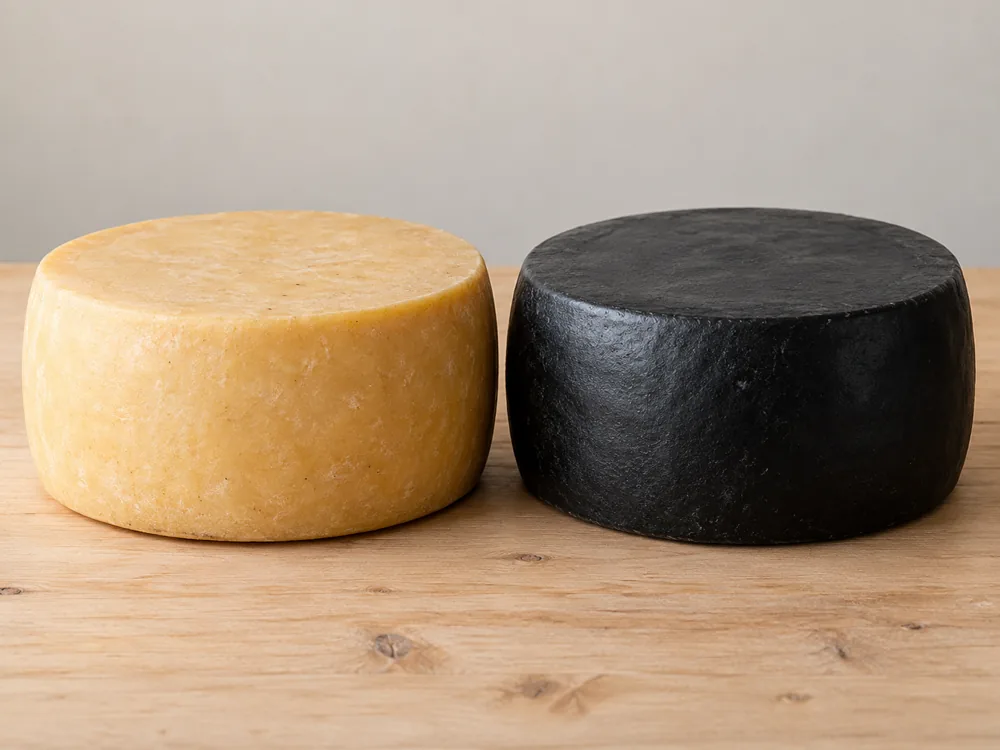
Inside, the protocol describes the paste as firm and compact, white-yellowish to ivory-yellowish and without pink halos.
The no-preservatives rule covers the paste, while antifungal treatment and rind cleaning remain allowed during ripening. A black-painted rind is permitted, but its colour tells you nothing about what the coating is made of.
After washing, packing, paraffining or painting, wheels are held at 4°C until they leave the factory. The protocol accepts heat-shrink polymer packs, favours clear or translucent ones because they let the buyer judge quality, and follows the preferences of its destination markets, mainly Europe and America.
The seal is voluntary. A wedge sold as Reggianito without it only has to meet Article 635, so the seal's wheel size, herd rules and 8-month ripening apply only to cheese that carries the seal.
How Is Reggianito Made?
The base food code requires cooked, drained, pressed, salted and ripened curd. The seal protocol turns that short definition into a controlled sequence of temperatures, grain sizes, pressure, brining and turning.
- Milk: pasteurized or heat-treated milk is brought to 31 to 34°C before cultures and calcium chloride go in.
- Setting: rennet or another suitable coagulant sets the milk in 12 to 25 minutes.
- Cutting: the curd is cut into even grains 1 to 3 mm across.
- Cooking: the stirred curd is heated to 45°C, then to 49°C with freeze-dried cultures or 51°C with natural cultures.
- Pressing: the curd is pressed in moulds for about 12 hours and turned from time to time.
- Brining: wheels sit in brine at 12 to 14°C for 8 to 9 days, at 24 to 30 hours per kilogram of cheese.
- Drying: one day at 10 to 15°C and 84% relative humidity starts the rind.
- Ripening: at 10 to 15°C, with wheels turned twice a week for the first 3 months and once a week after that.
The starter may come from milk, whey or a selected frozen or freeze-dried culture. Natural whey cultures carry local bacterial communities, so a recipe moved to another region may not acidify or flavour the cheese in exactly the same way.
Microbial rennet and chymosin-rich coagulants are allowed to limit bitter or off flavours. If vegetarian suitability matters, the code's flexibility means you still need the maker's ingredient statement.
Milk may be pasteurized at 72 to 73°C for 15 to 20 seconds or thermized at 65 to 68°C for at least 15 seconds. The phosphatase test distinguishes the two treatments, while thermization lowers bacterial counts without meeting the protocol's definition of pasteurization.
Acidity is tracked throughout the make: the milk is brought up by about 4 degrees Dornic before setting, and pH sits at 6.30 to 6.45 when the coagulant goes in, 4.95 to 5.10 at the end of pressing and in the brine, and 5.0 to 5.8 in the finished cheese.
Heating starts slowly, at 1°C every 2 minutes up to 45°C and then 1°C a minute, and the maker may speed it up or slow it down according to grain size and whey acidity. The grain's moisture and cohesion are then judged by examining its texture, and stirring continues until the grains bind as wanted.
The grains first settle under the whey for 15 to 20 minutes, then go into moulds under a pneumatic press. The protocol recommends raising the pressure from 2 kg/cm² in the first hour to 2.5, then 3 kg/cm², and 3.5 kg/cm² from the fourth hour on.
Brine strength is checked daily and microbiology every 15 days.
Because salting lasts 24 to 30 hours per kilogram, a 7.2-kilogram sealed wheel spends about 7.2 to 9 days in the tank.
How Does Reggianito Taste, and How Do You Use It?
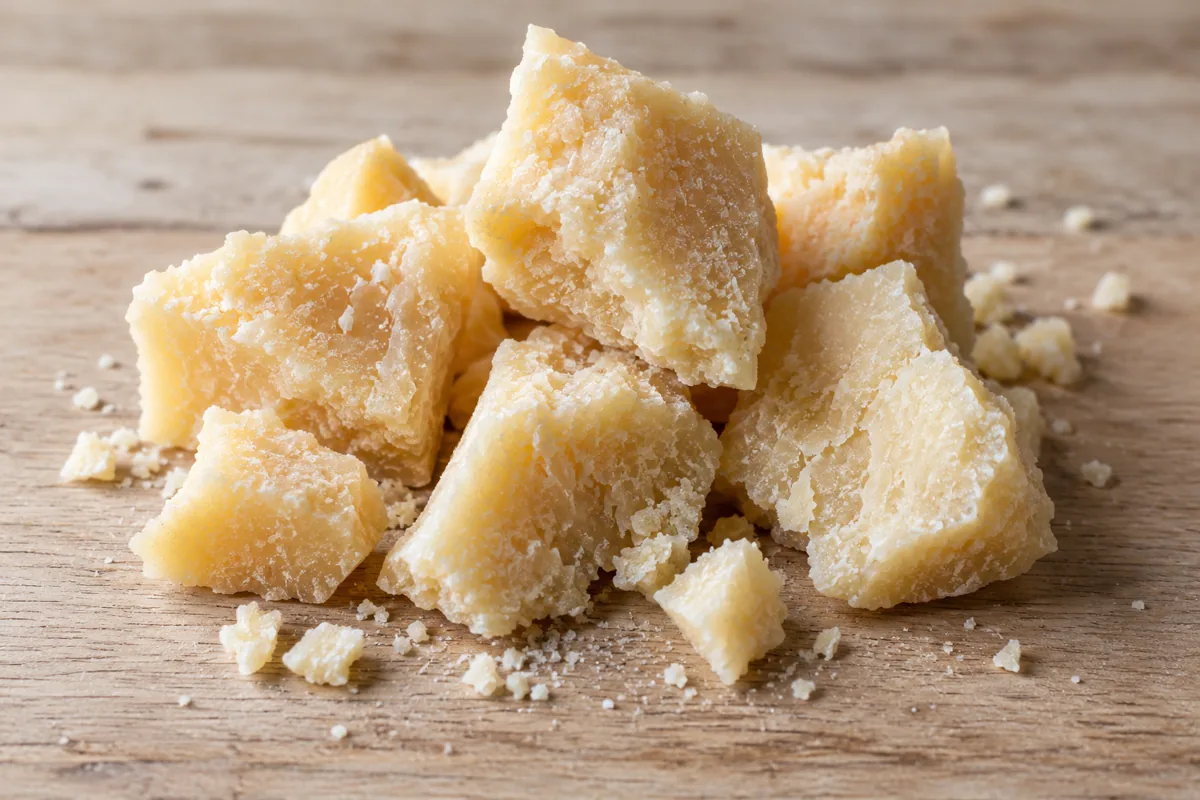
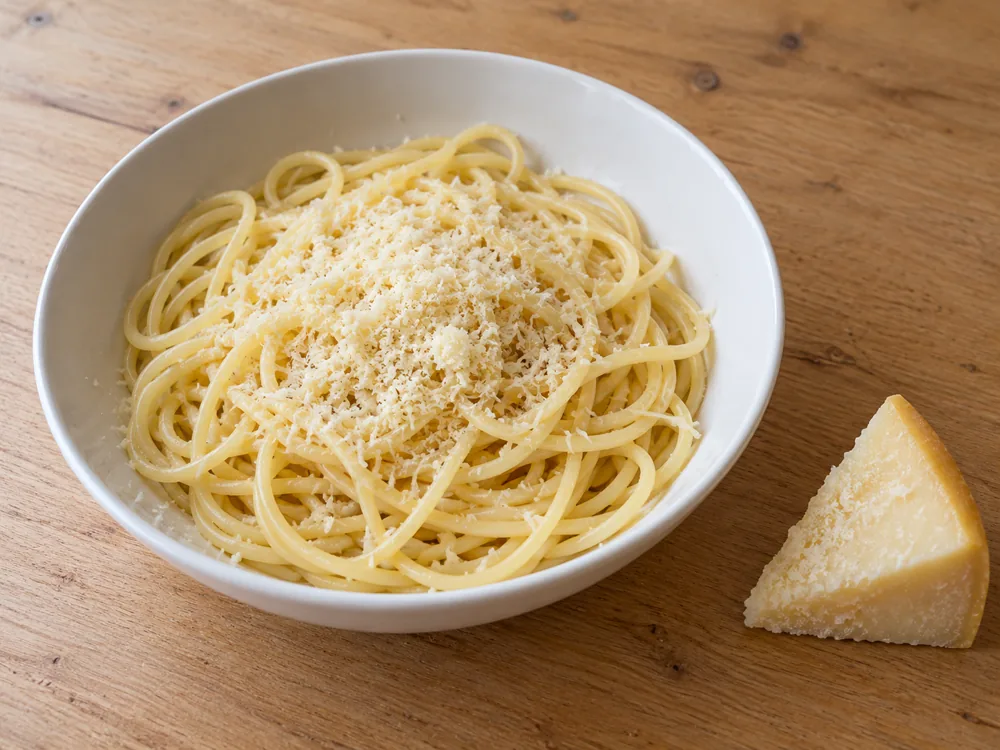
You can expect a salty, slightly piquant hard cheese with a compact, granular paste. Its aroma is generally mild and clean, while the flavour has enough strength to remain noticeable after grating.
Over pasta or a baked dish, that salt and granular texture make Reggianito an efficient finishing cheese. On an Argentine picada, cubes or small wedges let you taste the cheese directly rather than reducing it to a seasoning.
Reggianito vs Parmigiano Reggiano
Reggianito borrows the hard, granular format of Parmigiano Reggiano, then changes the scale and timetable. Its smaller wheel and shorter legal age reduce the time and capital needed to bring it to market, while the more flexible milk and rennet rules widen the production options.
| Point | Reggianito | Parmigiano Reggiano |
|---|---|---|
| Where it is made | Argentina | Emilia-Romagna and Lombardy, Italy (Wikipedia) |
| Milk | Cow's milk, raw or pasteurized (food code); pasteurized (Cheese.com) | Unpasteurised cow's milk (Wikipedia) |
| Wheel weight | About 6.8 kg (Wikipedia); 5 to 10 kg (food code) | Typically 38 kg (Wikipedia) |
| Minimum ageing | 6 months (food code) | 12 months (Wikipedia) |
| Top cooking temperature | Up to 51°C (seal protocol, Spanish-language Wikipedia) | 55°C (Wikipedia) |
| Time in brine | 8 to 9 days (seal protocol, Spanish-language Wikipedia) | 20 to 25 days (Wikipedia) |
| Starter and rennet | Natural or selected starters; microbial or chymosin-rich rennet (seal protocol) | Natural whey culture and calf rennet only (Wikipedia) |
| Name protection | A class defined in the Argentine food code | Protected designation of origin under Italian and EU law, EU protection since 1992 (Wikipedia) |
Reggianito spends more time in brine per kilogram: 24 to 30 hours, compared with roughly 13 to 16 hours per kilogram for a typical 38-kilogram Parmigiano wheel. That longer soak may help explain its saltier reputation.
Grana Padano sits between them on minimum age at nine months and also allows silage in the cows' diet. If you are choosing among the three, country, protected status, milk rules and age tell you more than the shared ability to grate.
Is Reggianito the Same as Parmesan?
The word Parmesan changes meaning across markets. In the European Union it is reserved for protected Parmigiano Reggiano, while elsewhere it may describe a broader family of hard grating cheeses.
That is why the full Italian name matters when you specifically want the PDO cheese. Reggianito is Argentine and legally distinct even when a shop places it beside generic Parmesan or suggests it for the same dish.
Outside Europe you may also see Parmesana, Parmezano or generic Parmesan on younger, pre-grated products, so read the origin and the full product name.
Argentina also uses Parmesano as a separate code class for wheels above 20 kilograms. A Reggianito label therefore identifies the smaller 5-to-10-kilogram cheese, not merely an informal Argentine spelling of Parmesan.
Is Reggianito Safe During Pregnancy?
NHS guidance includes hard cheese made from pasteurised or unpasteurised milk among the cheeses that are safe to eat in pregnancy.
The CDC is stricter about milk treatment: it places pasteurized hard cheese among safer choices and raw-milk dairy among riskier ones.
Because Argentina's food code permits either milk treatment, check your own wedge instead of relying on the cheese name. A label stating pasteurized milk fits both agencies' formulations; for raw-milk Reggianito, discuss the product with your clinician and apply the same distinction used for other cheese during pregnancy.
What Quick Questions Come Up About Reggianito?
It is salty and slightly piquant, with enough strength to remain noticeable after grating. The firm, granular paste keeps the flavour concentrated.
No. Reggianito is an Argentine cheese made in 5-to-10-kilogram wheels and ripened for at least six months; Parmigiano Reggiano typically weighs about 38 kilograms and begins at 12 months.
At least 6 months under Argentina's food code, and at least 8 months for wheels that carry the voluntary Alimentos Argentinos seal.
It can be. Argentina's food code allows raw or pasteurized milk, so check the label on the wheel you are buying.
Grate it over pasta or use it in baked dishes, where its salty, slightly piquant flavour remains noticeable. You can also serve it in small cubes or wedges on an Argentine picada.