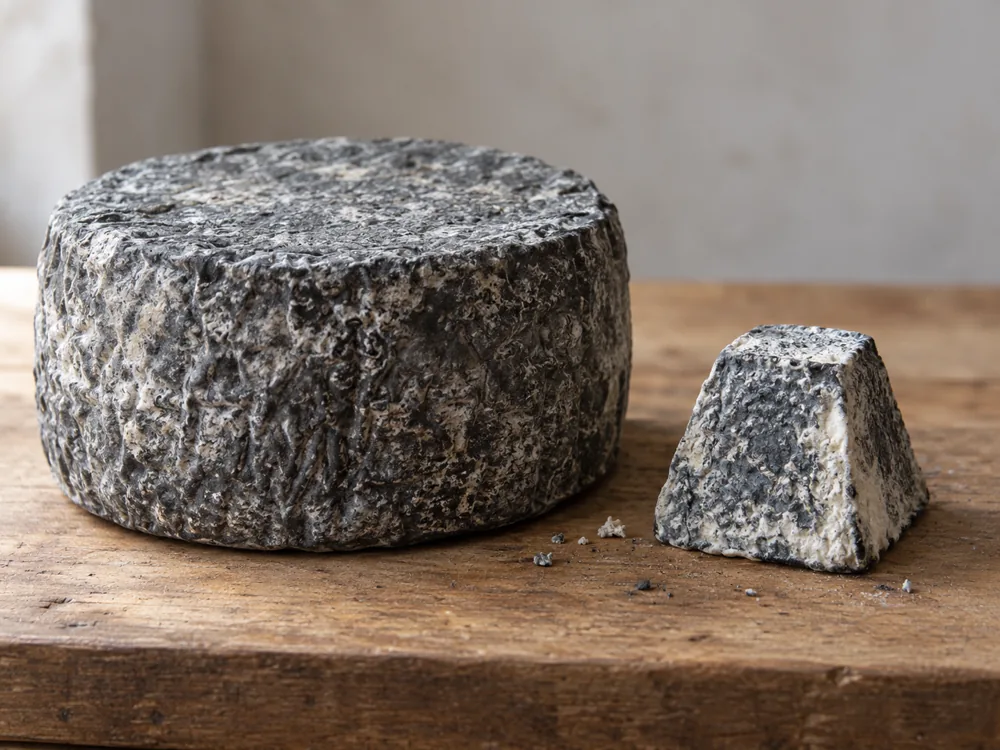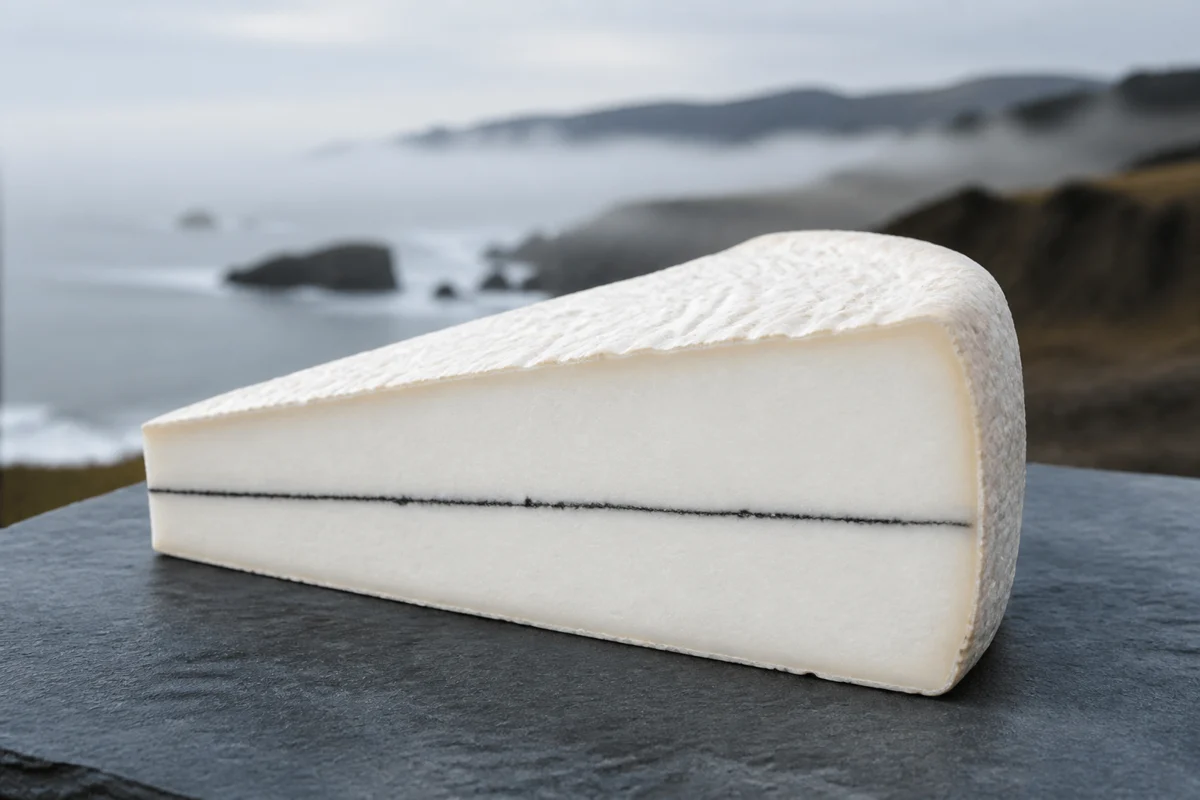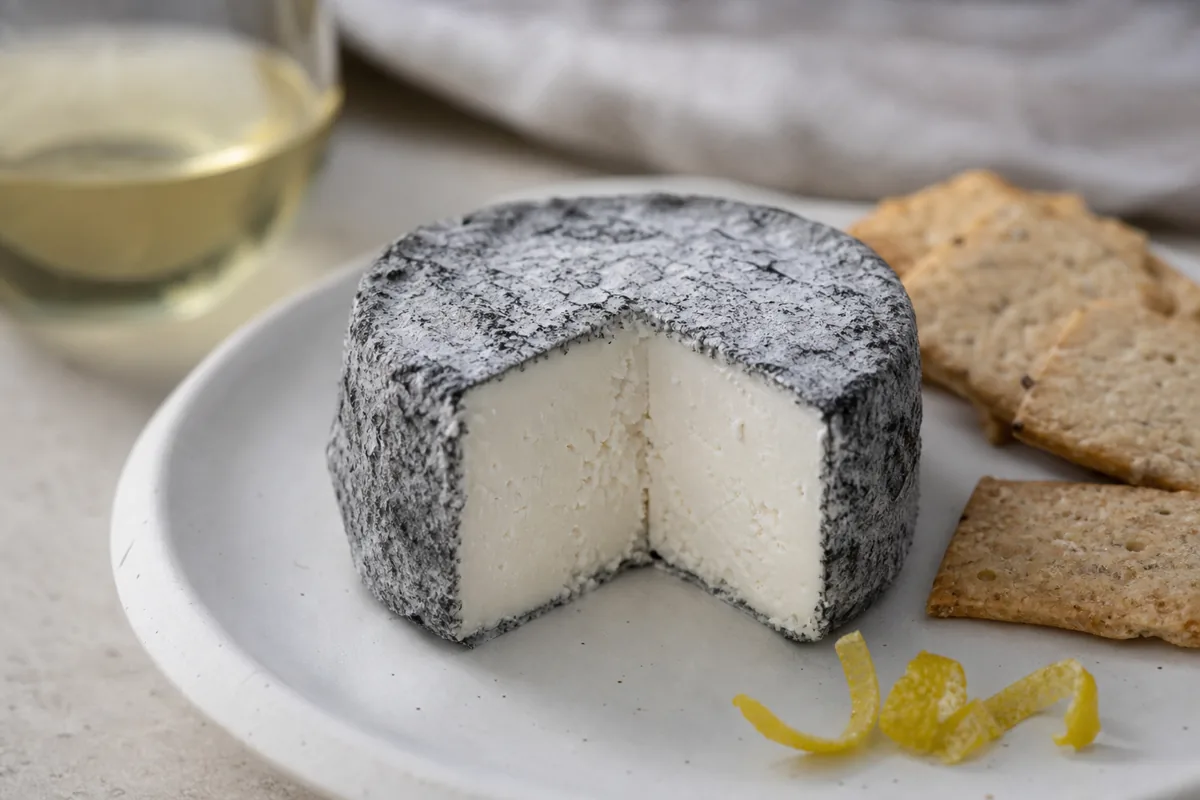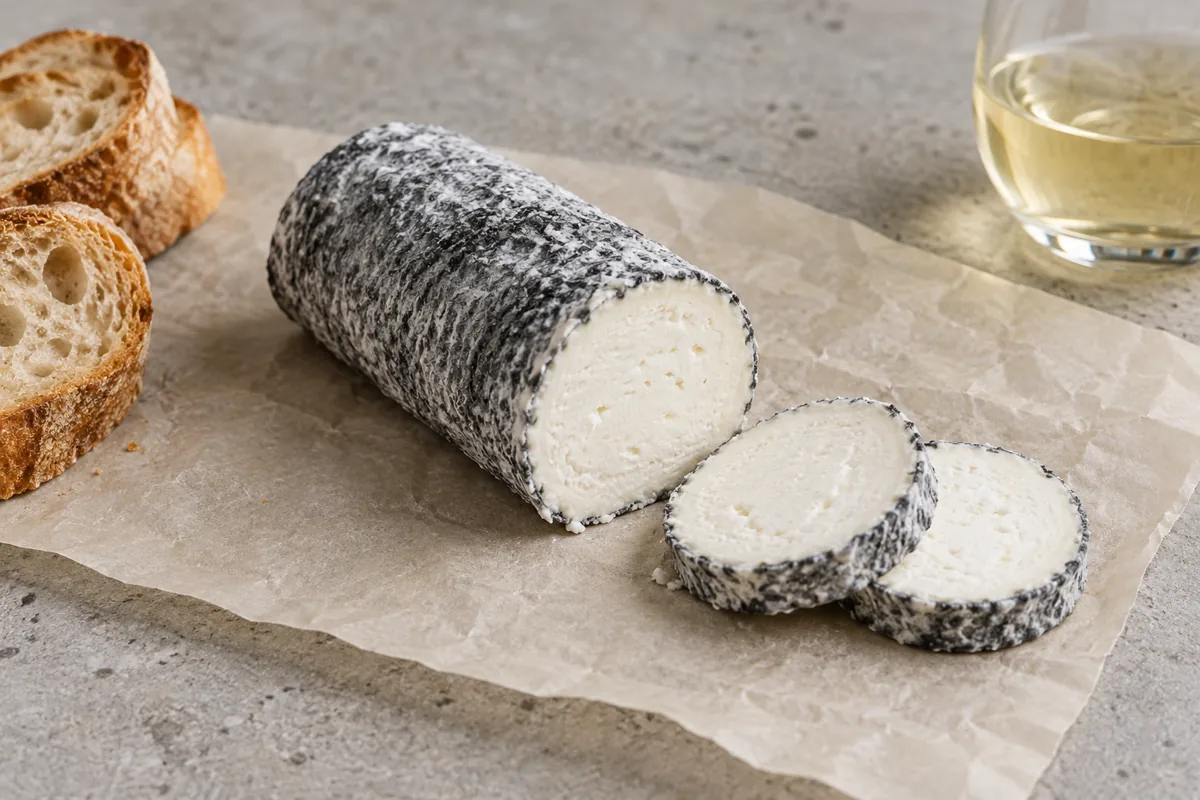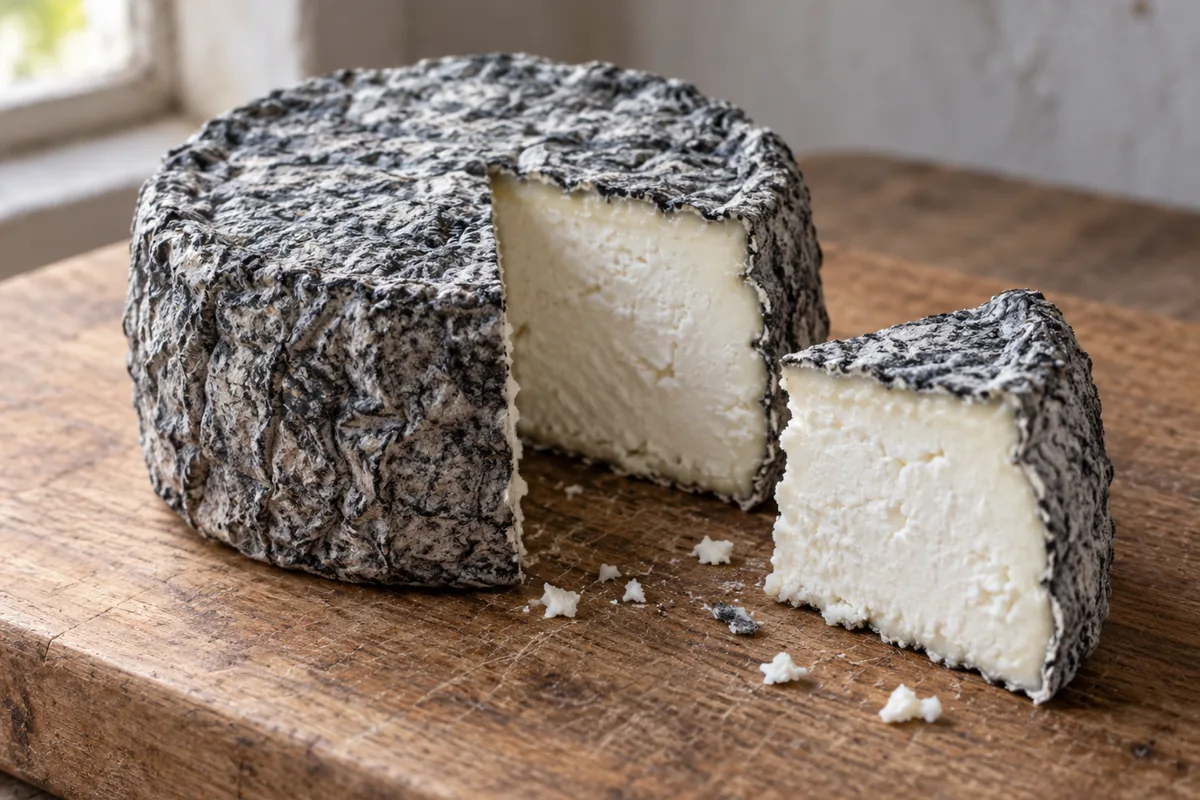
Grey Owl is a surface-ripened goat's-milk cheese from Fromagerie Le Détour in Notre-Dame-du-Lac, Québec, with a dark ash-coated rind over a snow-white paste. In 2024 it won Caseus Or at Sélection Caseus, which the Québec government's release presents as the title of best cheese in Québec.
Its royal-wedding reputation is thinner than one retailer's listing makes it sound: a London restaurant put it on the menu during the 2018 celebrations, and the cheese has no confirmed place on the wedding menu itself.
In This Article
What Kind of Cheese Is Grey Owl?
Grey Owl is a goat's-milk cheese with an ash-covered rind, and the sources that name a texture call it soft. How they label its style and rind differs, as the table shows.
| Source | Label it uses |
|---|---|
| The Globe and Mail (2009) | Soft, uncooked, lightly pressed, edible ash rind |
| Aux Terroirs | Soft paste; mixed rind |
| Formaggio Kitchen, description | Surface-ripened cheese covered in vegetal ash |
| Formaggio Kitchen, style field | Fresh Goat |
| American Cheese Society (2011) | Open goat's-milk category inside Soft Ripened Cheeses |
| Sélection Caseus, as Radio-Canada reports (2018) | Category for goat's-milk cheese with a bloomy rind |
The two competition classes are the only labels that point to a mold on the rind: the American Cheese Society defines Soft Ripened Cheeses as white surface mold ripened cheeses such as Brie, Camembert and Coulommiers, and the Caseus category is for bloomy rinds.
The Globe, Aux Terroirs and Formaggio Kitchen describe the surface without naming a mold, and Formaggio's own listing contradicts itself, calling Grey Owl surface-ripened in its text while the style field reads Fresh Goat.
The rind label matters most for the pregnancy question further down, where the NHS guidance turns on whether a soft cheese has a white coating.
How Is Grey Owl Cheese Made?
Grey Owl is made from pasteurized Saanen goat's milk. Sue Riedl, writing in The Globe and Mail in 2009, reported that the milk comes from a herd about 30 km from the dairy.
After pasteurizing, Riedl writes, the milk goes through slow coagulation, draining and light pressing before the cheese goes into moulds. Her fact box types it as soft, uncooked and lightly pressed, which means the curd is drained and pressed gently instead of being cooked and pressed hard.
Ripening takes 14 days, according to both Riedl and Aux Terroirs. Formaggio Kitchen's ingredient list is short, naming pasteurized goat's milk, vegetable ash, salt and microbial enzymes, with no ripening culture or mold in the list.
The sources disagree on size: Aux Terroirs gives the wheel as 1.2 kg, while Riedl's 2009 profile listed a 1 kg wheel. Aux Terroirs also lists 24% fat and 57% moisture.
Why Does Grey Owl Cheese Have an Ash Rind?
Riedl explains that rolling a cheese in ash once shielded it from flies and other insects, and that ash can also protect the interior by forming a thin rind. For Grey Owl she calls the edible ash primarily decorative.
She adds that ash is alkaline, which helps counter acidity in a cheese, and that because acidity can hinder ripening, ash aids the affinage process and can mellow the tang of a goat cheese.
Formaggio Kitchen gives the ash a larger job, saying the vegetable ash allows a beautiful rind to develop while the interior stays creamy. The two accounts agree that the ash colors the rind and differ on whether it does anything beyond appearance.
Riedl reports that the vegetal ash is sprayed on the exterior seven days into the 14-day ripening, so the wheel spends its first week without ash and carries it for the second.
Is Grey Owl Cheese Vegetarian?
Riedl's 2009 profile says all the cheese from Fromagerie Le Détour is made with non-animal rennet, and her fact box for Grey Owl lists a microbial enzyme as the coagulant and calls the cheese vegetarian friendly.
Formaggio Kitchen's listing points both ways: its ingredient list names microbial enzymes, which matches Riedl, but its rennet field says animal. Aux Terroirs says nothing about rennet.
The conflict has two possible explanations. Riedl's profile dates from 2009, so the recipe may have changed, and Formaggio's rennet field may be a default entry, since another field in the same listing also conflicts with its text.
Two signals say microbial enzymes (Riedl's 2009 fact box and Formaggio's ingredient list) and one says animal (Formaggio's rennet field).
What Does Grey Owl Cheese Taste Like?
Riedl describes a "tangy, crisp scent evoking fresh air" and writes that "the sweet and tangy flavour rounds off nicely into a long linger." Formaggio Kitchen calls the flavor pleasantly lemony.
Aux Terroirs describes subtle goat aromas, a delicately fresh flavor and light saltiness, so the three accounts center on tang and freshness rather than strong goat flavor.
Texture is where the descriptions split. Aux Terroirs calls the paste snow-white and chalky with a smooth mouthfeel, while Riedl writes that it is dense, silky smooth and melt-in-the-mouth, with paste that "oozes around the edges," like "a just-melting scoop of vanilla ice cream."
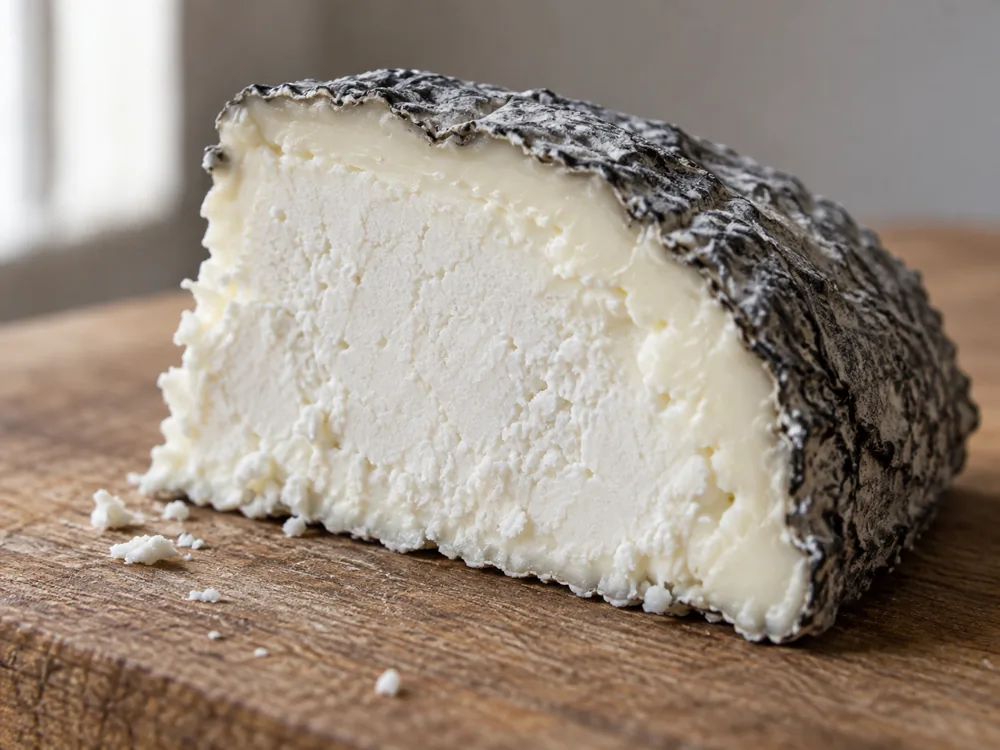
Formaggio Kitchen adds that the paste becomes creamy and runny at the edges as it ages, so how much soft band a piece shows depends on the age of the wheel it came from. Aux Terroirs' chalky paste and Riedl's oozing edges can then describe two parts of the same cheese, the dense middle and the aged outer band.
Where Is Grey Owl Cheese Made?
Grey Owl is made at Fromagerie Le Détour in Notre-Dame-du-Lac, which Radio-Canada places in Témiscouata-sur-le-Lac in Québec's Bas-Saint-Laurent region. Mario Quirion, whom the Globe names as the cheese maker, and his wife Ginette Bégin began production in 1999, according to Aux Terroirs.
Aux Terroirs says the couple chose Bégin's home region to develop its terroir, which had not seen a cheese dairy for 35 years. Because they wanted to make cheese rather than farm, they set up near milk suppliers, which fits Grey Owl's milk coming from goats about 30 km away.
According to Riedl, the couple first made Grey Owl at the request of an American client, and it went on sale in the United States in January 2007. It reached the Canadian market in early 2008, when it was officially christened Grey Owl.
Aux Terroirs says the ashy cheese was introduced in 2009, yet Riedl's profile appeared in June 2009 and already describes a cheese that had been on sale for more than a year. The two dates cannot both mark the first sale, and what the 2009 date counts is unclear.
Riedl names two other cheeses from the couple, the washed-rind Magie de Madawaska and Le Clandestin, and Aux Terroirs lists Le Verdict d'Alexina among the dairy's other cheeses.
Why Is It Called Grey Owl?
The name does two jobs, according to Riedl: it refers to the color of the cheese, and it honors Archie Belaney, one of Canada's first conservationists, who was also known as Grey Owl.
Aux Terroirs gives Grey Owl as the Anishinaabe name of the British Archibald Stansfield Belaney, who immigrated to Canada in 1906 and became a writer, lecturer and, in its words, one of the first champions of nature in the country.
The sources differ on how long he stayed near the dairy's home. Riedl says he lived for a number of years on the edge of Lake Témiscouata, while Aux Terroirs puts it at almost two years on the lake's shores.
Was Grey Owl Cheese Served at the Royal Wedding?
Not confirmed. Radio-Canada reported on 14 May 2018 that chef David Wilby of Windsor Grill, a London restaurant, put Grey Owl on his menu during the royal-wedding festivities.
Mario Quirion told the broadcaster, "C'est le fromage favori [de Meghan Markle]," meaning it is Meghan Markle's favorite cheese. He said the chef wanted the cheese to draw customers to the restaurant, since the occasion is festive in Britain for a month.
Radio-Canada adds that Markle, American-born, lived in Ontario for several years and reportedly tasted the cheese there. Formaggio Kitchen's listing says the cheese was allegedly favored by Markle and was served at the royal wedding.
That retailer line stretches the report, which describes a restaurant menu item rather than a wedding menu. The favorite-cheese claim rests on Quirion and the chef, with no direct quote from Markle.
The report's own wording stays at the edge of the event. Its headline says "en marge du mariage royal," on the sidelines of the royal wedding, and it calls Markle the prince's fiancée, so it was written before the ceremony and cannot describe what was served at it.
Which Awards Has Grey Owl Won?
Grey Owl's verified results come from two competitions, one North American and one Québécois.
| Year | Competition | Result | Source |
|---|---|---|---|
| 2011 | American Cheese Society, Montréal (August 5) | First place, Open Category Made from Goat's Milk | ACS 2011 awards brochure |
| 2023 | Sélection Caseus | Caseus Bronze | Gouvernement du Québec |
| 2024 | Sélection Caseus, 24th edition (September 25) | Caseus Or, the top honor; fifth Caseus prize overall | Gouvernement du Québec |
The American Cheese Society category set Grey Owl against goat's milk cheeses from Canadian and US makers, and the 2011 brochure names the runners-up as Damafro's La Bûchette from Québec in second and a Haystack Mountain Goat Dairy Camembert from Colorado in third.
The government release calls Sélection Caseus the only competition devoted to cheeses made in Québec, open to every maker whatever its size, cheese type or milk. In 2024 its jury of 25 experts judged 197 cheeses and singled out 22, with Grey Owl taking Caseus Or ahead of La Mélodie Bergère (Caseus Argent) and La Belle-Mère (Caseus Bronze).
Radio-Canada's 2018 report already credited the cheese with three Caseus wins in the category for goat cheese with a bloomy rind, which fits the count of five prizes by 2024.
How Should You Serve Grey Owl Cheese?
Riedl names one match: "It plays well with others, making an especially refined match with smoked salmon."
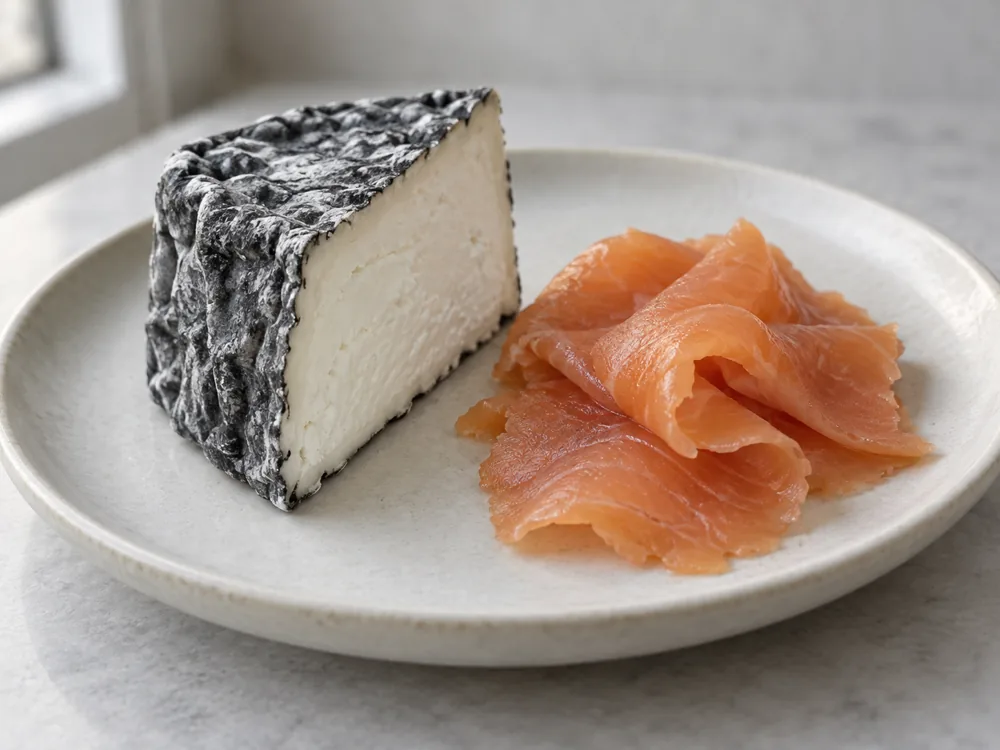
Smoked salmon carries its own pregnancy rule: NHS says cold-smoked and cured fish such as smoked salmon must be cooked until steaming hot, and CDC lists refrigerated smoked seafood, except in a cooked dish, among the riskier choices.
| Pairing | Type | Why It Works |
|---|---|---|
| Smoked salmon | Food | Riedl calls it an especially refined match. |
| Honey | Food | Formaggio Kitchen names honey. |
| Citrus | Food | Formaggio Kitchen names citrus. |
| Crisp white wine | Wine | Formaggio Kitchen's suggestion for the glass. |
Formaggio Kitchen's citrus suggestion sits beside its own description of a pleasantly lemony flavor, so that pairing echoes the cheese instead of contrasting with it.
For a cheese board, Formaggio Kitchen's general approach is three to four cheeses that differ in milk type, texture and flavor, and Grey Owl's goat's milk and soft, ash-covered paste would fill the goat slot in such a set.
Formaggio Kitchen also says to take cheese out of the refrigerator an hour or so before serving. CDC's limit for perishable food left out is 2 hours, or 1 hour above 90°F, so an hour of tempering stays inside the general limit and reaches the 1-hour limit on a table hotter than 90°F.
For portions, Formaggio Kitchen's general guidance for any cheese is ¼ lb per person as an appetizer and ½ lb per person for a larger serving. A whole 1.2 kg wheel, about 2.6 lb by Aux Terroirs' figure, therefore covers roughly 10 appetizer servings or 5 larger ones.
Riedl's fact box lists an edible ash rind, and Formaggio Kitchen's general guidance is that most rinds are edible and can be cut off if the taste or texture is not to the eater's liking.
Can You Eat Grey Owl Cheese While Pregnant?
Grey Owl is made from pasteurized milk. CDC lists soft cheese made from unpasteurized milk as riskier and pasteurized soft cheese heated to an internal 165°F or until steaming hot as safer, and says pregnant women are 10 times more likely to get a Listeria infection.
NHS says unpasteurised or soft ripened dairy foods may contain listeria, so pasteurized milk answers the raw-milk concern but not the soft-ripened one.
NHS draws its line by rind: pasteurised goats' cheese without a white coating is listed as safe, while pasteurised or unpasteurised mould-ripened soft cheeses with a white coating on the outside, such as brie, camembert and chèvre, must be thoroughly cooked.
Radio-Canada places its Caseus wins in a bloomy-rind goat cheese category, which points toward the cooked-only group. Neither agency names Grey Owl, so that placement is an inference.
NHS says to talk to a midwife or GP if you have already eaten something that should be avoided and are worried or have symptoms.
Where Can You Buy Grey Owl Cheese?
Radio-Canada reports that Grey Owl is sold in Canada and the United States. In the US, Formaggio Kitchen lists it at $36.95 without stating the weight and describes it as one of its best-selling goat cheeses.
Riedl's 2009 profile listed stockists from Victoria to New Brunswick and named Gourmet Denis as the US distributor, a list old enough to show the cheese's early range rather than where it sits today.
Supply is limited. Quirion told Radio-Canada in 2018 that the dairy would like to export elsewhere but struggled to meet demand, and Formaggio Kitchen's listing showed low stock and expedited shipping on October 1, 2026.
How Should You Store Grey Owl Cheese?
Formaggio Kitchen's general storage guidance for its cheeses, not advice written for Grey Owl, is a higher-humidity part of the refrigerator, in an enclosed spot with limited airflow rather than constant drafts. It names cheese paper as the wrap, with parchment as a stand-in for softer cheeses, and advises buying small quantities more often.
CDC's food-safety guidance for the refrigerator itself is 40°F or below, which applies to any soft cheese.
What Can Replace Grey Owl Cheese?
Aux Terroirs lists three alternatives on its Grey Owl page: Le Tuyau de poêle from Québec, and Selles-sur-Cher and Pavé Villageois cendré from France. The page gives names only, with no milk, size or age for them, so the comparison below uses a different ash-marked cheese whose source does state those points.
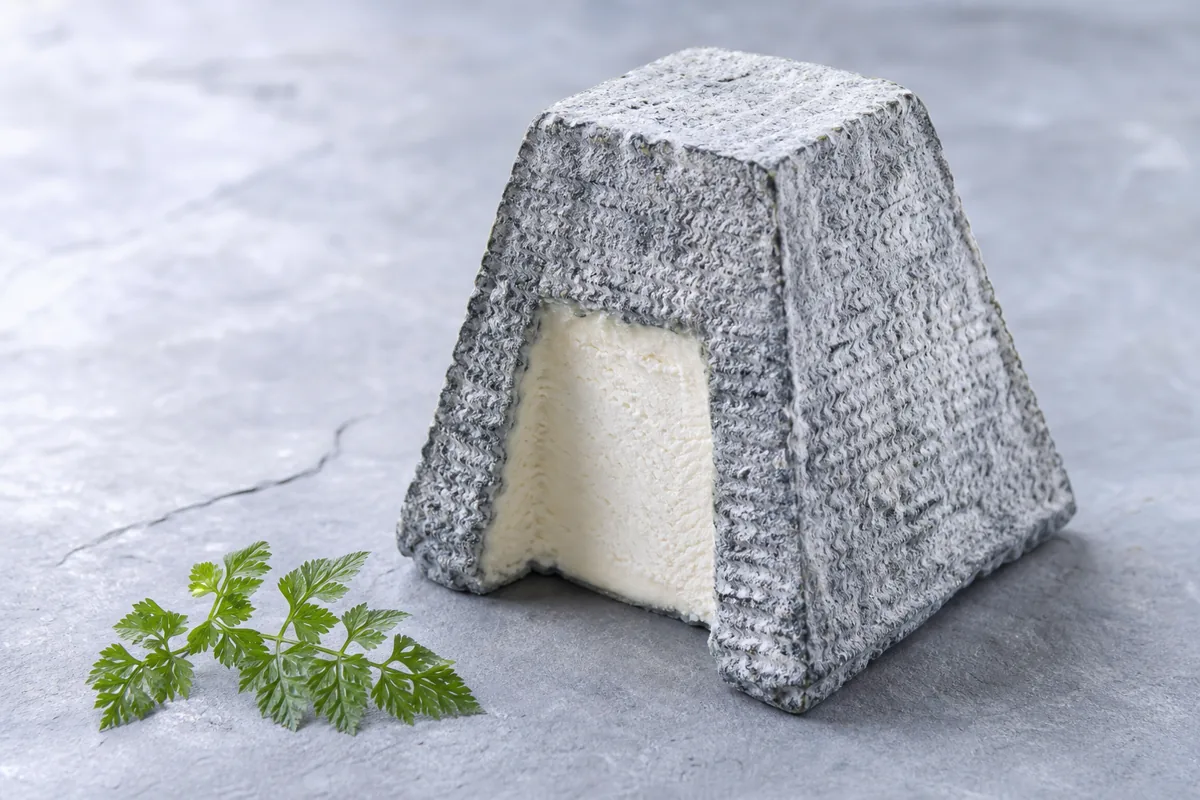
That cheese is Valençay, an ash-darkened goat cheese from Berry in central France, and it differs from Grey Owl in ways that show at the counter.
Valençay ripens in a similar direction: Wikipedia describes a center that starts crumbly and softens as the cheese matures, with a fresh, citric taste when young, under a natural blue-grey mold darkened with charcoal.
It is a truncated pyramid of 200 to 250 g ripened for about three weeks, far smaller than a 1.2 kg wheel. It is also an unpasteurized raw-milk AOC cheese, so it does not share Grey Owl's pasteurized milk, which matters for anyone following pregnancy guidance.