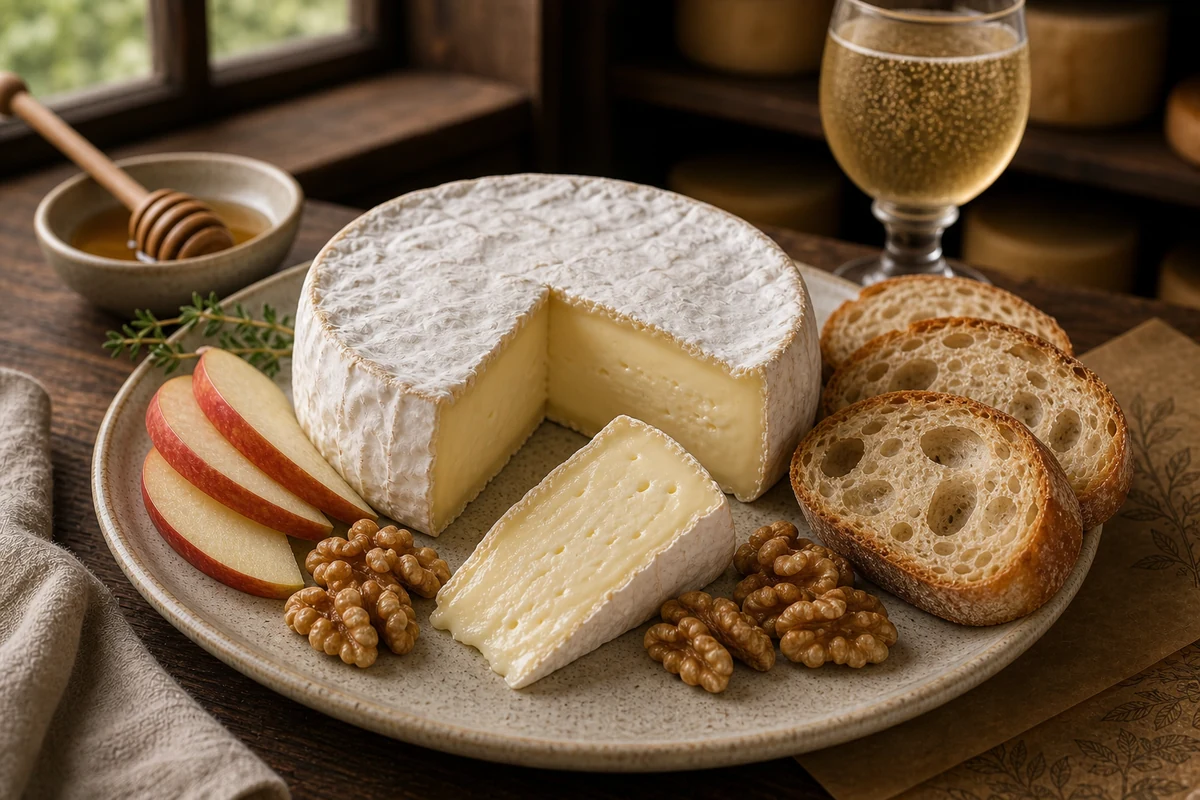
Camembert is the cheese that put Normandy on the world map. It sits within the classic French bloomy-rind cheeses and is often the first soft cheese people learn to love. The French regional cheese guide covers the Norman production zone and how Camembert AOP rules differ from ordinary Camembert de Normandie.
The small round box is iconic. Inside it, a 250-gram wheel ripens fast and delivers bold, earthy flavor that separates it from its milder cousin creamy French cheese. For serving Camembert whole and baked, the cheese board guide covers how to position it as a warm centerpiece.
This profile covers what makes Camembert distinct, how to bake it, and how to tell a genuine Normandy wheel from a factory copy.
In This Article
What Camembert Is
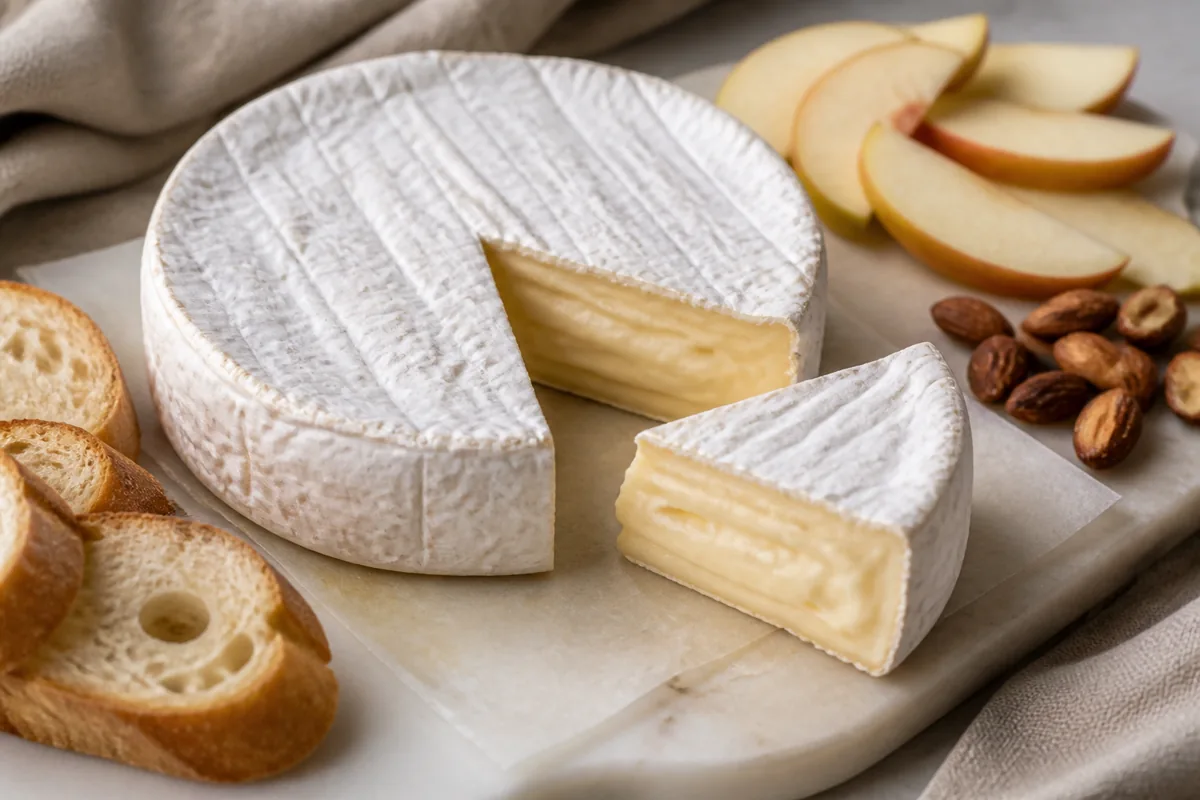
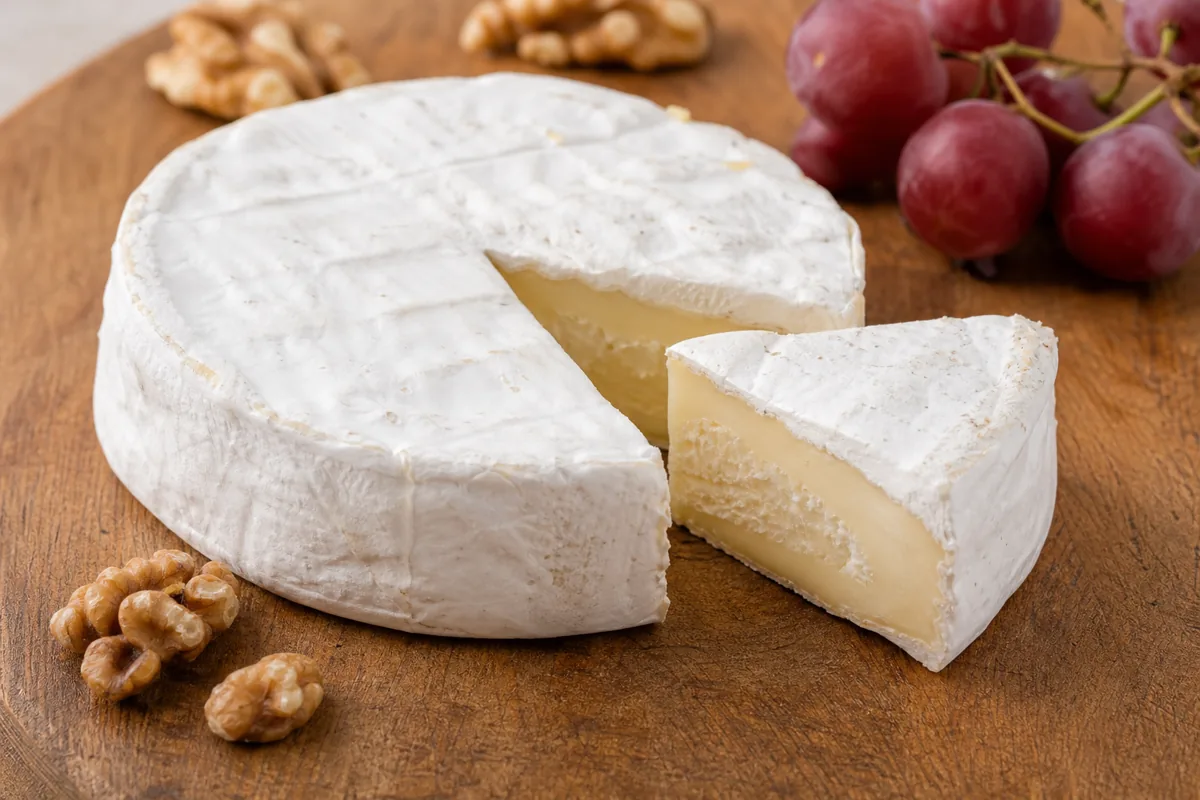
Camembert is a soft-ripened, bloomy-rind cow's milk cheese from Normandy in northern France. The standard wheel weighs roughly 250 grams and measures about 11 centimeters in diameter.
Marie Harel, a farmer in the village of Camembert, is traditionally credited with creating the cheese around 1791. The story says she sheltered a priest from the Brie region during the French Revolution, and he shared the technique for making soft-ripened cheese. Whether the legend is precise, the village of Camembert was producing this style by the early 1800s.
- Wheel weight — 250g, much smaller than a Brie wheel (2.5-3.0 kg)
- AOC rules — raw milk from Normande cows, hand-ladled in five passes
- Rind — white Penicillium camemberti bloom, fully edible
- Aging — 3-5 weeks, ripens from rind inward
- Box — traditional thin poplar wood round, part of the identity
The AOC designation Camembert de Normandie was granted in 1983. It requires raw milk from the Normande cattle breed, hand-ladling of the curd in five separate passes over at least 40 minutes, and aging for a minimum of 21 days. Only a handful of producers still meet these rules.
Most Camembert sold worldwide is labeled simply "Camembert" without the Normandie designation. These wheels use pasteurized milk, mechanical curd handling, and faster production. They are milder and less complex than the AOC version, but they account for over 90% of global Camembert sales.
Camembert Flavor and Texture
Ripe Camembert is bolder and earthier than Brie. The smaller wheel size means the rind-to-paste ratio is higher, which concentrates the flavors produced by the surface mold during ripening.
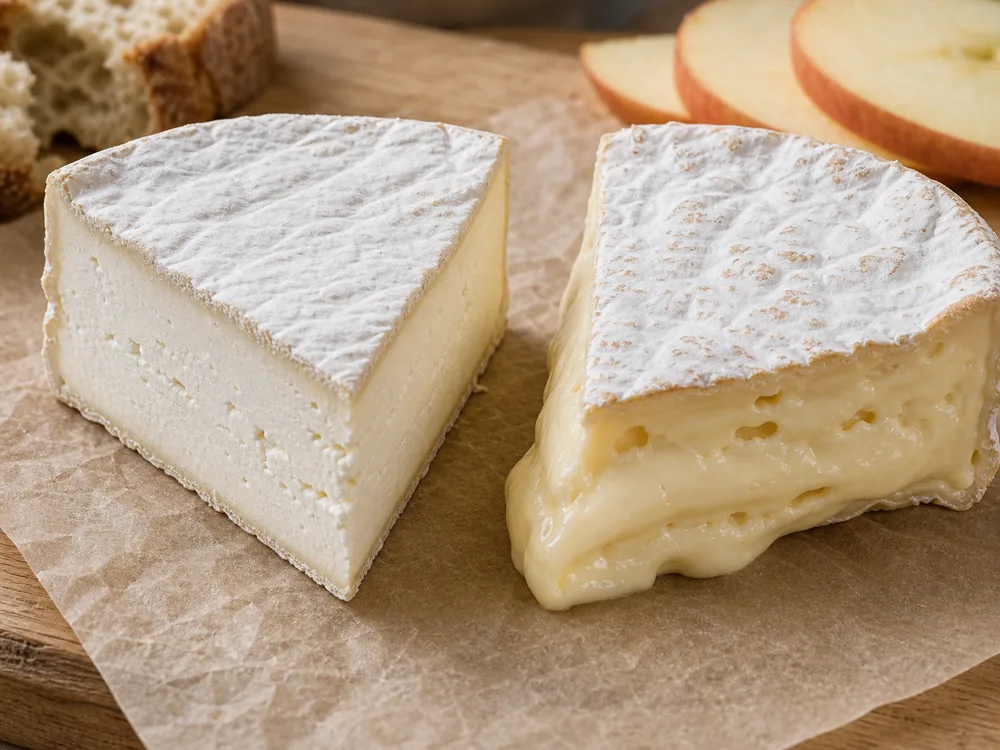
At peak ripeness, the paste is nearly liquid at room temperature. The center should ooze gently when you cut the wheel in half.
The radar above reflects a properly ripened pasteurized Camembert. AOC Camembert de Normandie made from raw Normande milk scores higher on umami (60+) and bitter (30+), with a distinct barnyard funk that pasteurized versions lack.
- Ripe paste — oozing, mushroomy, earthy, with a lactic tang
- Underripe paste — chalky white core, mild, firmer texture, needs more time
- Overripe paste — very runny, strong ammonia smell, dark brown patches on rind
- Rind flavor — earthy, mushroomy, slightly bitter, more intense than Brie rind
The key flavor difference between Camembert and Brie comes from the rind ratio. A 250g Camembert wheel has roughly twice the rind surface area per gram of paste compared to a 3kg Brie wheel. That means more mold enzymes working on less cheese, producing a stronger, more concentrated flavor.
Temperature matters as much as ripeness. Cold Camembert from the fridge is waxy and bland. Give it 30-45 minutes at room temperature before serving. The smaller wheel warms faster than Brie, so it needs less counter time.
The wooden box is not just packaging. Traditionally, the thin poplar container helps regulate moisture during transport and ripening. Some affineurs flip the wheel inside the box during aging. When you bake Camembert, the wooden box (with the lid removed) can go straight into the oven as the serving vessel.
How Camembert de Normandie Is Made
The AOC production method centers on one technique that industrial versions skip: five-pass hand-ladling. This is the most labor-intensive step and the one that defines authentic Camembert.
After the milk is warmed and renneted, the curd sets into a fragile gel. Instead of cutting and pressing (as with hard cheeses), the cheesemaker ladles the curd into molds using a shallow spoon called a louche.
- Warm raw Normande milk — must come from farms within the AOC zone
- Add rennet and let set — soft curd forms a delicate gel
- Hand-ladle in five passes — each pass spaced 40+ minutes apart
- Drain overnight — no pressing, gravity removes the whey
- Salt and spray with mold — Penicillium camemberti colonizes the surface
The five-pass method takes an entire working day. Each ladle pass adds a thin layer of curd to the mold. The long intervals between passes allow whey to drain naturally, creating the layered internal structure visible in a cross-section of the finished cheese.
Industrial Camembert uses mechanical curd cutting, single-pour filling, and pasteurized milk. The result is a more uniform, milder cheese that lacks the layered texture and raw-milk complexity of the AOC version.
After molding, the wheels are salted and sprayed with Penicillium camemberti spores. The white bloom appears within days and fully covers the rind by week two. The cheese ripens in controlled caves at 11-13 degrees C and 85-90% humidity.
Baking and Cooking with Camembert
Baked Camembert is one of the best warm cheese preparations in any kitchen. The small wheel size makes it a perfect single-serve appetizer for two to four people.
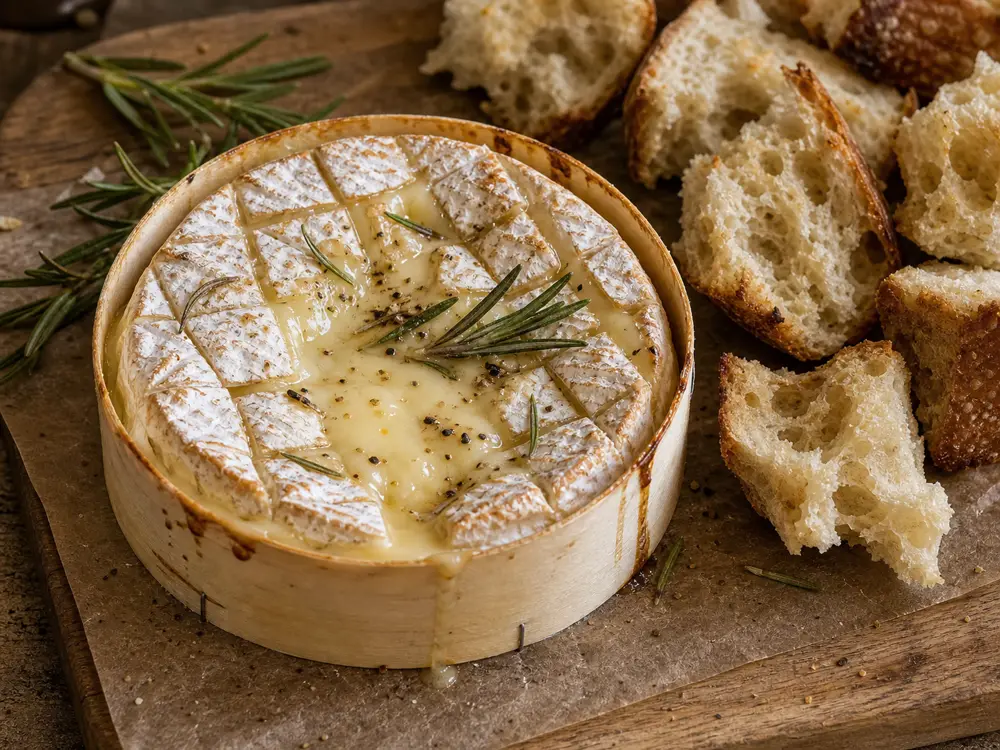
The wooden box doubles as an oven-safe vessel. Remove the lid, score the top of the rind in a crosshatch pattern, and bake until the center is liquid.
- Bake in the box — remove lid, score rind, 350F for 15-20 minutes
- Deep-fry wedges — flour, egg, panko coating, 375F for 2-3 minutes
- Stir into hot dishes — melts into sauces, risotto, and pasta off-heat
- Room temperature for boards — 30-45 minutes out of the fridge
For baking, use a cold wheel straight from the fridge. Cold Camembert holds its shape during the first minutes in the oven, then melts from the center outward as it heats through. A room-temperature wheel collapses too fast.
The melt score of 65 reflects Camembert's ability to become fully liquid under moderate heat. It pools rather than stretches. For cheeses that pull and stretch, mozzarella and provolone outperform Camembert. The Brie substitute guide ranks alternatives that replicate the soft, creamy melt of Camembert in baked dishes.
The flavor score of 72 accounts for standard pasteurized Camembert. AOC Camembert de Normandie from raw milk scores closer to 85, with pronounced earthiness and a barnyard funk that pasteurized versions cannot replicate.
Wine, Beer, and Food Pairings
Camembert's earthy, mushroomy character pairs best with drinks and foods that bring fruit sweetness or crisp acidity. The bolder rind flavor compared to Brie means Camembert can handle slightly more assertive pairing partners.
- Normandy cider — the classic regional match, dry and apple-forward
- Pinot Noir — low tannin red fruit complements the mushroom character
- Crusty bread — textural contrast against the oozing paste
- Walnuts and honey — crunch and sweetness offset the tang
Avoid heavy oaked Cabernet or Shiraz with Camembert. High tannins strip the creamy fat and leave a metallic finish. If you want red wine, stay with Pinot Noir or a light Beaujolais.
Normandy cider is the traditional local pairing for a reason. The apple orchards and dairy farms of Normandy have coexisted for centuries. The dry, slightly tannic farmhouse cider cuts through Camembert's richness better than most wines.
For a classic Normandy combination, bake Camembert in its box with a splash of Calvados (apple brandy) poured into a slit in the rind. The brandy infuses the melting paste with caramelized apple flavor. Serve with sliced apples and crusty bread.
How to Store Camembert
Camembert is a living cheese that ripens continuously after purchase. The small wheel size means it ripens faster and has a shorter window than larger Brie wheels.
Storage rules follow the same principles as all bloomy-rind cheeses: let the rind breathe, keep it cool, and eat it before it passes peak.
- Keep the wooden box — it regulates moisture during storage
- Vegetable drawer — warmest part of the fridge at 38-42 degrees F
- Never wrap in plastic film — trapped ammonia ruins the cheese within hours
- Eat within 3-5 days after cutting — the small wheel dries out quickly
The most common mistake is removing Camembert from its wooden box and wrapping it in cling film. The box is designed to regulate moisture and protect the rind. Keep the cheese in the box inside your refrigerator until you are ready to serve.
For a complete guide to wrapping and storing soft, semi-soft, and hard cheeses, our cheese storage guide covers every format with shelf-life charts. The Brie wine pairing guide also applies to Camembert — both respond well to the same Champagne and light red pairings.
Buying Genuine Camembert
The label distinction matters. Camembert de Normandie with the AOC/AOP seal is a protected product with strict production rules. Plain "Camembert" is an unprotected name that anyone can use.
In the US market, authentic raw-milk Camembert de Normandie faces the same 60-day FDA rule as raw-milk Brie. Since AOC Camembert reaches peak ripeness at 3-5 weeks, the genuine raw-milk version is not legally available in America.
Good pasteurized Camembert does exist. French producers like Isigny Sainte-Mere and Le Rustique make reliable pasteurized versions widely available in the US. They lack the raw-milk complexity of AOC Camembert but deliver solid flavor for boards and baking.
Camembert Substitutes
Brie is the most direct substitute for Camembert. Both are soft bloomy-rind cow's milk cheeses from France. Brie is milder and comes in a larger wheel, but it behaves identically in baking and on cheese boards.
- Brie — milder, larger wheel, same bloomy-rind structure
- Coulommiers — French bloomy-rind, size between Brie and Camembert
- Chaource — Champagne region bloomy-rind, tangier and denser
- Reblochon — washed rind, softer and nuttier, works in baked applications
For baking specifically, any soft bloomy-rind cheese in the 200-300g range works as a swap. The key is matching the wheel size to the baking vessel. A 250g Camembert fits perfectly in a small ramekin or its own wooden box.
Camembert Nutrition
Camembert has a nutritional profile nearly identical to Brie. The high moisture content keeps the per-ounce calorie count lower than hard aged cheeses.
- Low calories — 85 per ounce, one of the lowest among ripened cheeses
- Moderate sodium — 239mg per ounce, higher than Brie due to the surface salting method
- Low calcium — 39mg per ounce, only 3% of daily value
- Very low lactose — ripening converts most lactose to lactic acid
The sodium content is slightly higher than Brie because the smaller wheel absorbs proportionally more salt during the surface salting step. The difference is minor in practice.
Lactose content is very low in ripened Camembert. The fermentation and surface-mold ripening process converts most lactose to lactic acid. Many lactose-sensitive individuals tolerate ripe Camembert without issues.
Camembert FAQ
These are the questions we hear most often about Camembert, from baking to ripeness.
Yes. Remove the lid and any plastic wrapping. Score the top of the rind in a crosshatch pattern. Place the box on a baking sheet and bake at 350 degrees F for 15-20 minutes until the center is liquid. The wooden box is oven-safe at this temperature and makes a natural serving vessel. Dip crusty bread directly into the melted cheese.
Size and intensity. A Camembert wheel weighs about 250 grams. A Brie wheel weighs 2.5-3.0 kilograms. The higher rind-to-paste ratio in Camembert produces a bolder, earthier flavor. Brie is milder, butterier, and creamier. Both are soft bloomy-rind cow's milk cheeses from France, but they are not interchangeable in every situation. Our Brie vs Camembert comparison breaks down the differences that matter. For a deeper look at the bloomy-rind family, the Normandy bloomy-rind profile covers how the smaller wheel ages more intensely than Brie.
Yes. The white rind is Penicillium camemberti, a safe food-grade mold applied during production. It is fully edible and contributes an earthy, slightly bitter flavor that balances the creamy paste. Eating the rind is the intended way to enjoy Camembert. Trimming it removes half the flavor.
A cut Camembert wheel lasts 3-5 days in the refrigerator when wrapped in wax or cheese paper. The small size means it dries out faster than larger cheeses. Wrap the cut face loosely and return it to the original wooden box if possible. Never seal it in airtight plastic because ammonia builds up fast in the small wheel.
A mild ammonia note is normal in very ripe Camembert. The Penicillium mold produces ammonia as a byproduct of protein breakdown. A faint whiff dissipates after 10-15 minutes at room temperature. A strong, persistent ammonia smell means the cheese is past peak or was stored in airtight wrapping. If the smell is overpowering after 15 minutes unwrapped, the cheese is past its eating window.