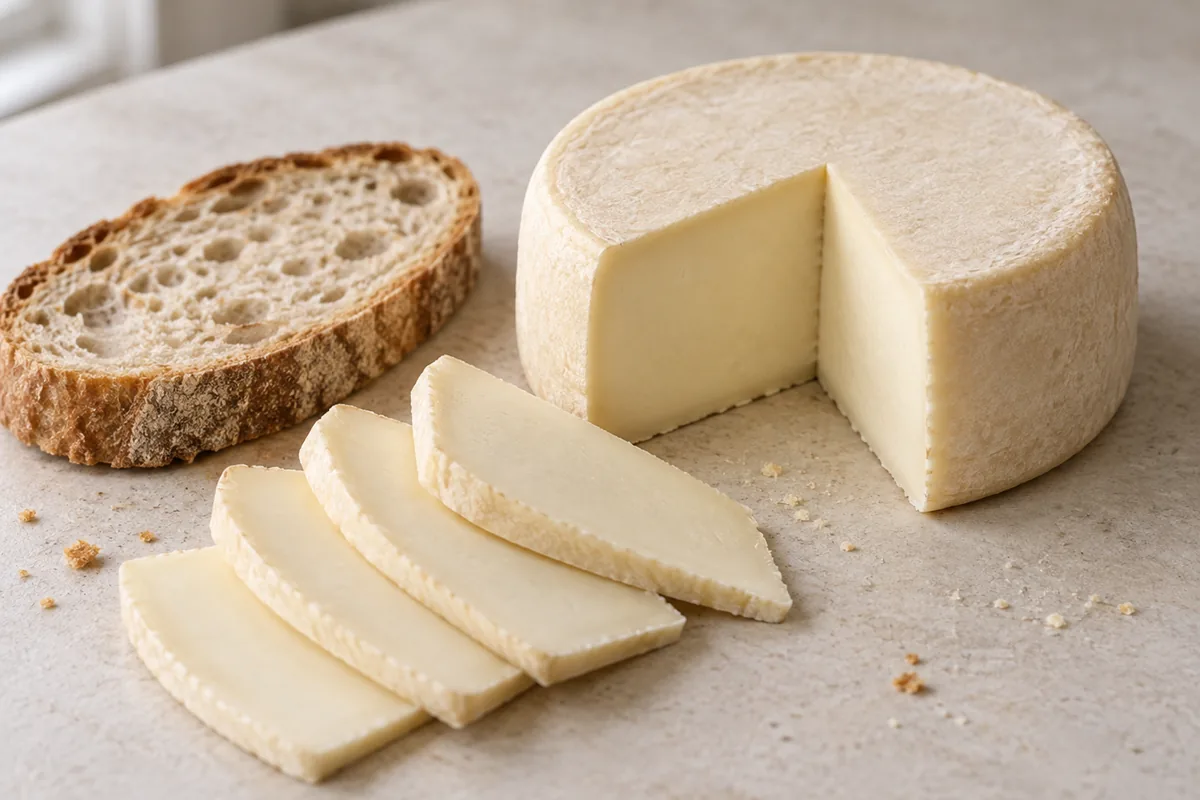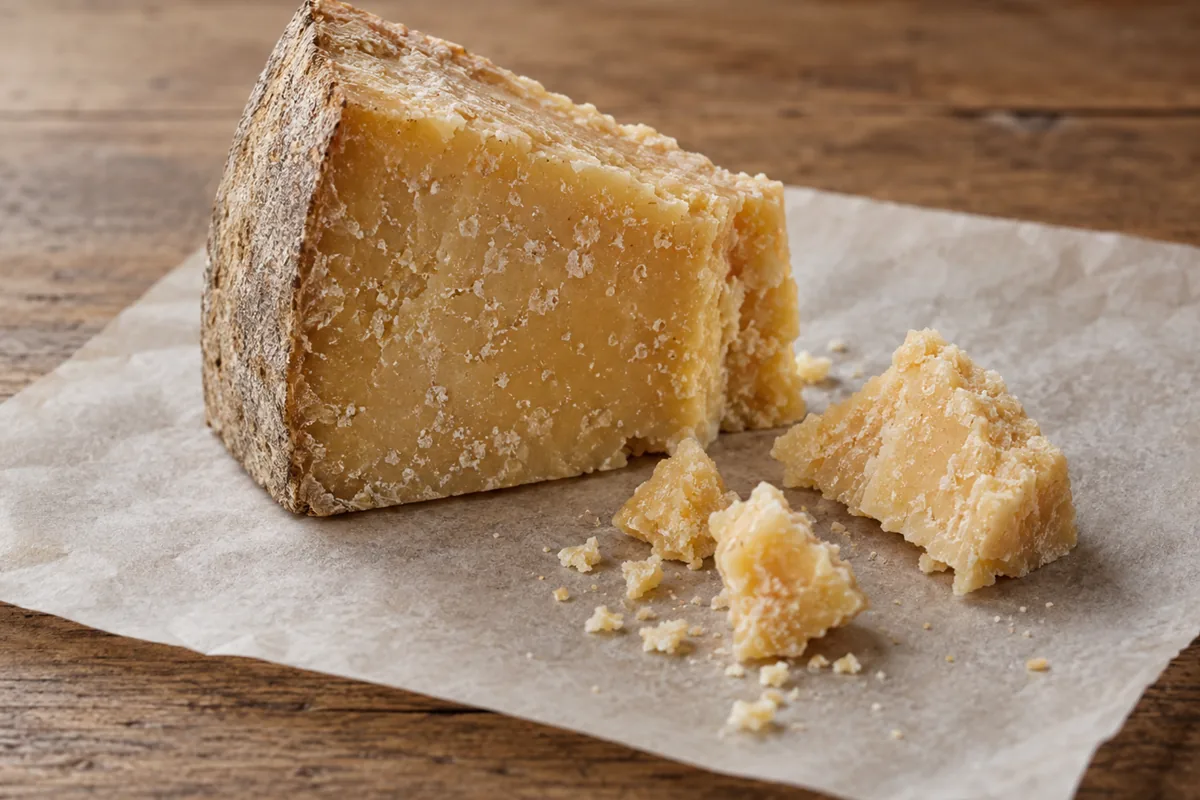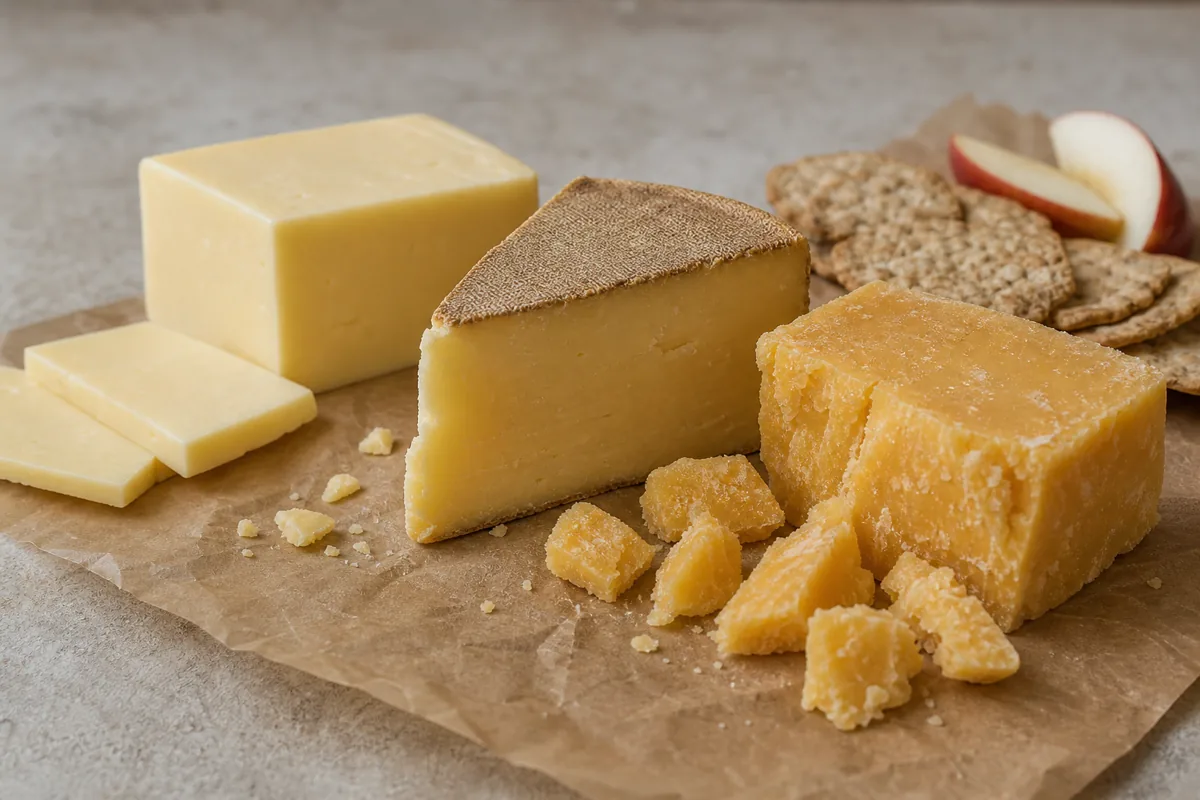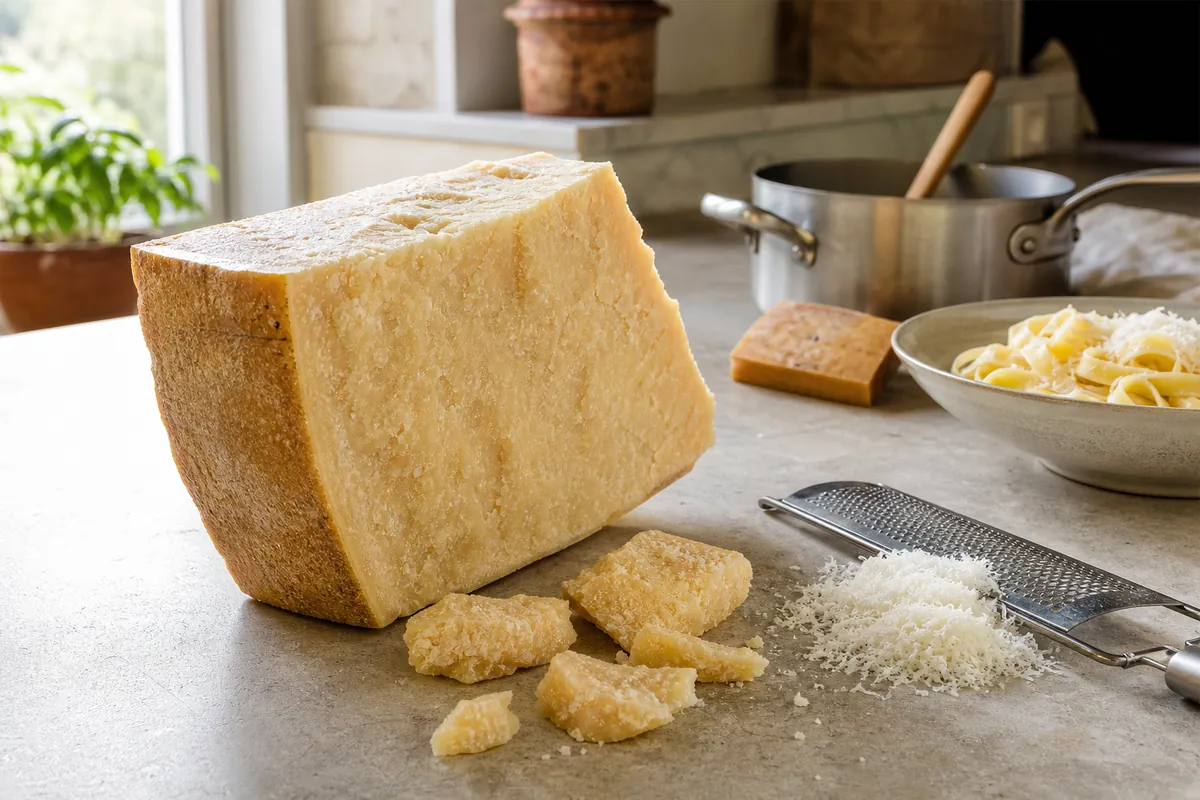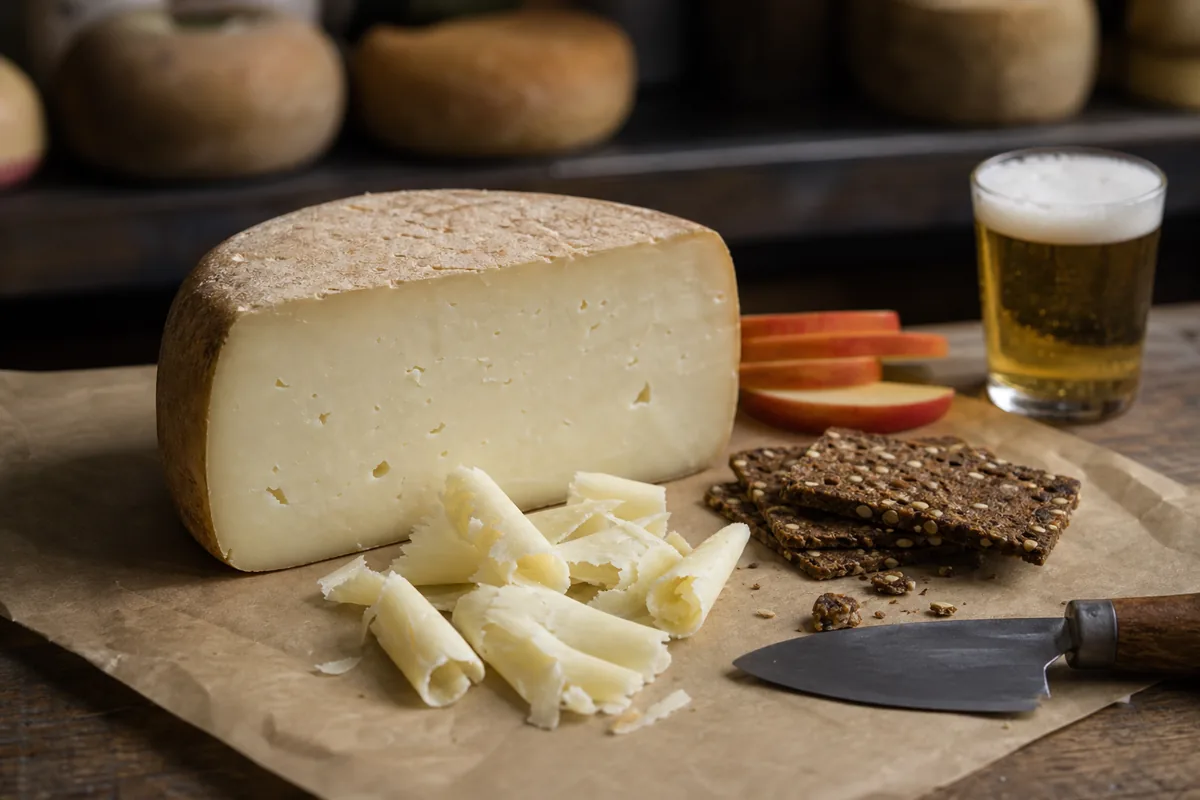
Aged Goat's Cheese is a semi-hard Dutch cheese made from pasteurized goat's milk and matured for at least 18 months, according to Cheese.com. It sits at the firm, crumbly end of goat cheese, unlike a soft fresh chèvre.
Sellers use the name loosely. Listed ages run from 7 months to 2-5 years, so the age on the label says more than the name does.
In This Article
What is Aged Goat's Cheese?
Cheese.com files it as a semi-hard cheese from the Netherlands with a natural rind, a cream colour, and a creamy, crumbly texture. Dutch Cheeseman UK is the only producer it lists.
Other sellers sell the same idea under Gouda names. Cheeseland describes its Dutch Girl as a Gouda-style goat cheese, and Murray's files its Dutch goat's-milk cheese under Gouda as Aged Goat Gouda.
Each seller's own description sets the age, the texture, and the flavour, so the same name can cover quite different cheeses.
The Gouda naming follows how Dutch goat cheese is usually made. Wikipedia says goat cheese in the Netherlands outside the Westerkwartier, the region west of Groningen, is usually made in the Gouda style.
The Westerkwartier is known instead for brie-like goat cheeses such as Machedoux and Quiorio, so a Dutch goat cheese with a firm paste points to the Gouda style. Murray's adds that Gouda is one of the oldest European cheeses and that versions made with other milks, goat's milk among them, were developed later.
Firmness words also vary between sources. Cheese.com lists Aged Goat's Cheese and Goat Gouda as semi-hard but files L'Amuse Brabander Goat Gouda among its hard Dutch cheeses.
The contest classes the sellers cite differ in the same way: Cheeseland's Dutch Girl placed in a semi-soft (semi-hard) goat's milk class, while Henri Willig's Extra Aged won a title for hard goat's cheese. A class name is a contest or catalogue category, so the age and the seller's own description say more about the bite than the class does.
How is it different from fresh goat cheese?
Wikipedia says the styles of goat cheese run from fresh and soft to aged and hard. It describes chèvre as a soft, creamy, melt-in-mouth cheese that can have a fruity taste, while Cheese.com describes Aged Goat's Cheese as semi-hard, creamy, and crumbly.
| Fresh chèvre (Wikipedia) | Aged Goat's Cheese (Cheese.com, Dutch Cheeseman UK) |
|---|---|
| Soft, creamy, melt-in-mouth | Semi-hard, creamy and crumbly |
| Can have a fruity taste | Rich, creamy flavour with a long-lasting taste |
| Tart goat flavour that Wikipedia credits to medium-chain fatty acids | Tanginess and earthy notes on the seller's page |
Time is the clearest gap. Wikipedia says chèvre is not aged for very long and usually wears a light-coloured rind or skin, while this cheese has a natural rind in Cheese.com's entry and its sellers state ages from 7 months upward.
Wikipedia describes goat cheese as made like other cheeses: the milk is filtered, a curdling starter (rennet or starter bacteria) is added, and the curds are moulded, separated from the whey, dried, flavoured, and cured.
The type of starter, the time or pressure of the draining, and the temperature and duration of the curing can change both texture and flavour, so the same goat's milk can end up as a soft fresh cheese or a hard aged one.
How old is Aged Goat's Cheese, and how do sellers' versions differ?
Stated ages span 7 months to 2-5 years, so compare each seller's own figure in the table below.
| Seller and product | Stated age | Texture and colour | Rennet |
|---|---|---|---|
| Dutch Cheeseman UK, Aged Goat's Cheese | At least 18 months | Semi-hard, creamy and crumbly; cream colour (Cheese.com) | Not stated |
| Henri Willig, Extra Aged Goat's Cheese | Not stated | Hard goat's cheese, according to the contest title the seller cites | Microbial rennet; marked vegetarian |
| Cheeseland, Dutch Girl | 7 months | Gouda-style goat cheese; entered in the semi-soft (semi-hard) goat's milk class at a 2016 contest | Vegetarian rennet |
| Murray's, Aged Goat Gouda | 2-5 years | Toffee-coloured, with white crystalline minerals | Vegetarian rennet |
The sellers do not state age in the same form. Cheeseland gives an exact 7 months, Cheese.com and Dutch Cheeseman UK give a floor of at least 18 months with no upper limit, Murray's gives a range of 2-5 years, and Henri Willig's Extra Aged carries only the name.
A floor or a range leaves room. Two pieces sold under Murray's label could differ in age by as much as three years, and a cheese sold as at least 18 months could be well past that.
Murray's says the white patches on cheeses like its Aged Goat Gouda are tyrosine crystals that form naturally as the cheese matures, and its description tells buyers to savor the crunch in each bite.
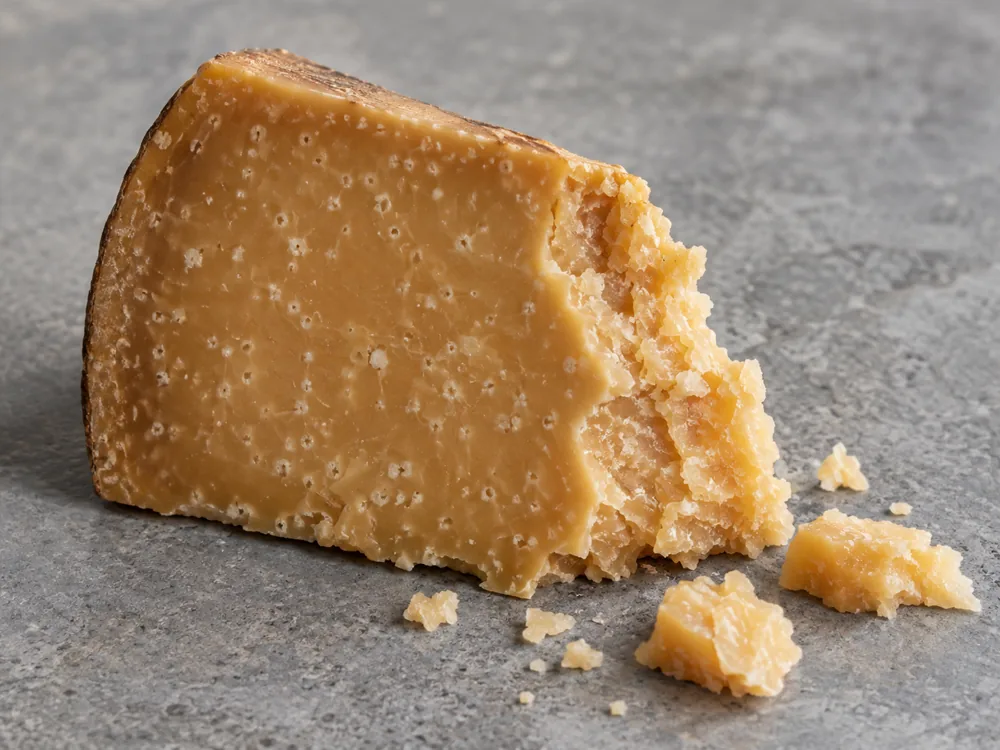
Of the four cheeses, only Murray's, the oldest listed, is described as crunchy.
What does Aged Goat's Cheese taste like?
Dutch Cheeseman UK's own page describes a full flavour that lingers, with tanginess and earthy notes.
The Gouda-style versions read sweeter. Murray's reports caramel and burnt sugar in its 2-5 year cheese, and Cheeseland reports a butterscotch-like flavour in the 7-month Dutch Girl.
Sweetness does not follow age in these descriptions. The sweetest words come from the cheese with the youngest stated age (7 months) and the one with the oldest (2-5 years), while the cheese with the 18-month minimum is the one described as tangy and earthy.
Cheeseland also compares Dutch Girl with its own Ewephoria sheep's-milk cheese and says fans of that cheese will like it, a pointer for buyers who already know the sheep's-milk cheese.
Wikipedia names caproic and caprylic acid, medium-chain fatty acids that goat milk has in higher proportions, as contributors to the tart goat flavour. It adds that goat milk is heavily influenced by what the goats eat and that goats tend to eat bitter plants other animals avoid.
Together with the cheesemaking choices above, that leaves each producer's cheese room to taste different at the same age.
A Murray's business-development staffer recommends the Aged Goat Gouda to friends who dislike the goaty flavour of goat's-milk cheese. Cheeseland calls Dutch Girl sweet and satisfying without the salty or tart flavours associated with goat cheese.
Which Aged Goat Cheese Should You Buy?
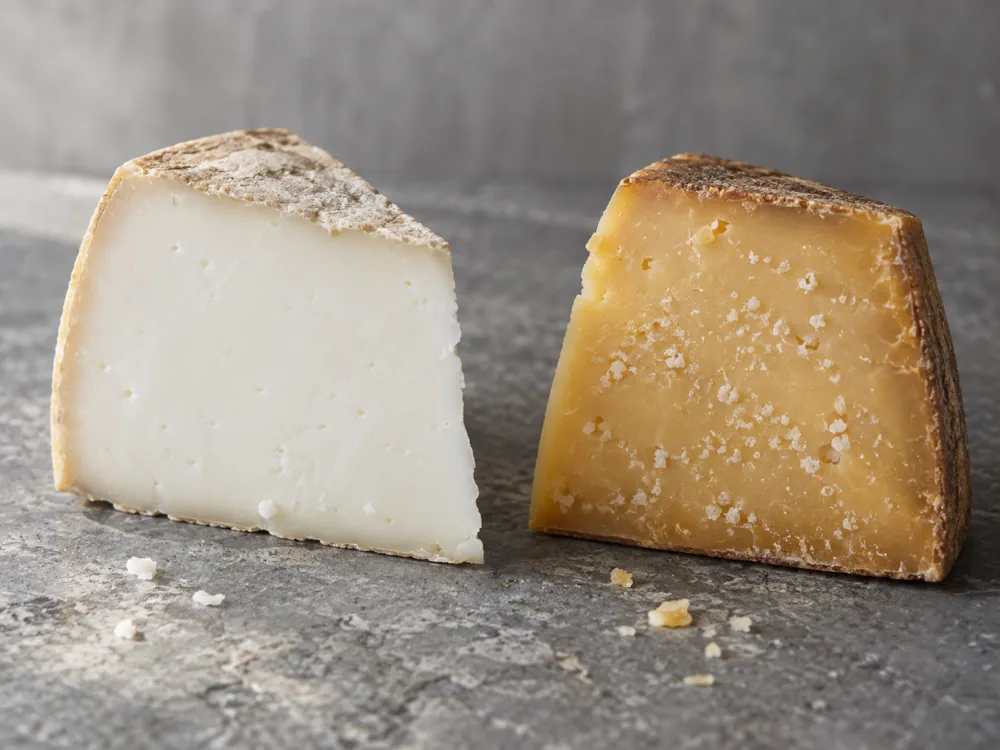
Paste colour gives a second reading on age. Murray's says the colour of a goat Gouda's paste is a good indicator of its age: younger versions aged for a few months have a snow-white paste, and older ones develop a more golden hue.
That fits the toffee-coloured paste Murray's lists for its 2-5 year cheese, and it makes a pale paste on a piece sold as multi-year a mismatch to ask the seller about. Cheese.com's colour words are looser: cream for Aged Goat's Cheese, and both pale yellow and ivory for Goat Gouda within one entry.
Formats differ as much as ages do. Dutch Cheeseman UK cuts by hand in three sizes, Henri Willig sells one fixed vacuum-packed piece, and Murray's sells by the pound.
| Seller | Size and format | Listed price | Note on the listing |
|---|---|---|---|
| Dutch Cheeseman UK | 250 g, 500 g, or 1 kg | £8.75 for 250 g | Cut by hand; ships to mainland UK only |
| Henri Willig | One vacuum-packed 1/11 portion, about 300 g | €17.95 including tax | Fixed piece, no age stated |
| Murray's Cheese | 0.5 lb to 5 lb, cut to order | $29.50 per lb | Age listed as 2-5 years |
Dutch Cheeseman UK says hand cutting can put an individual piece up to 10% off the ordered weight, with the order's total at or above what was ordered.
The prices are in three currencies and cannot be ranked against each other, and listed prices change.
Two sellers cite contest results. Cheeseland reports gold in its class at the 2017 International Cheese Awards in Nantwich and 5th place with 99.35 points in the semi-soft (semi-hard) goat's milk class at the 2016 World Cheese Competition in Madison, Wisconsin.
Henri Willig says its Extra Aged Goat's Cheese won the title of best hard goat's cheese in the world at the World Championship Cheese Contest in Madison, without giving a year. Cheeseland's Madison result and Henri Willig's title are in different classes, so neither one ranks the two cheeses against each other.
Read the age as an exact figure, a minimum, or a range, and check that the paste colour fits it: snow-white for a few months, golden for older. Medals from different classes do not rank two cheeses against each other.
How do you serve Aged Goat's Cheese?
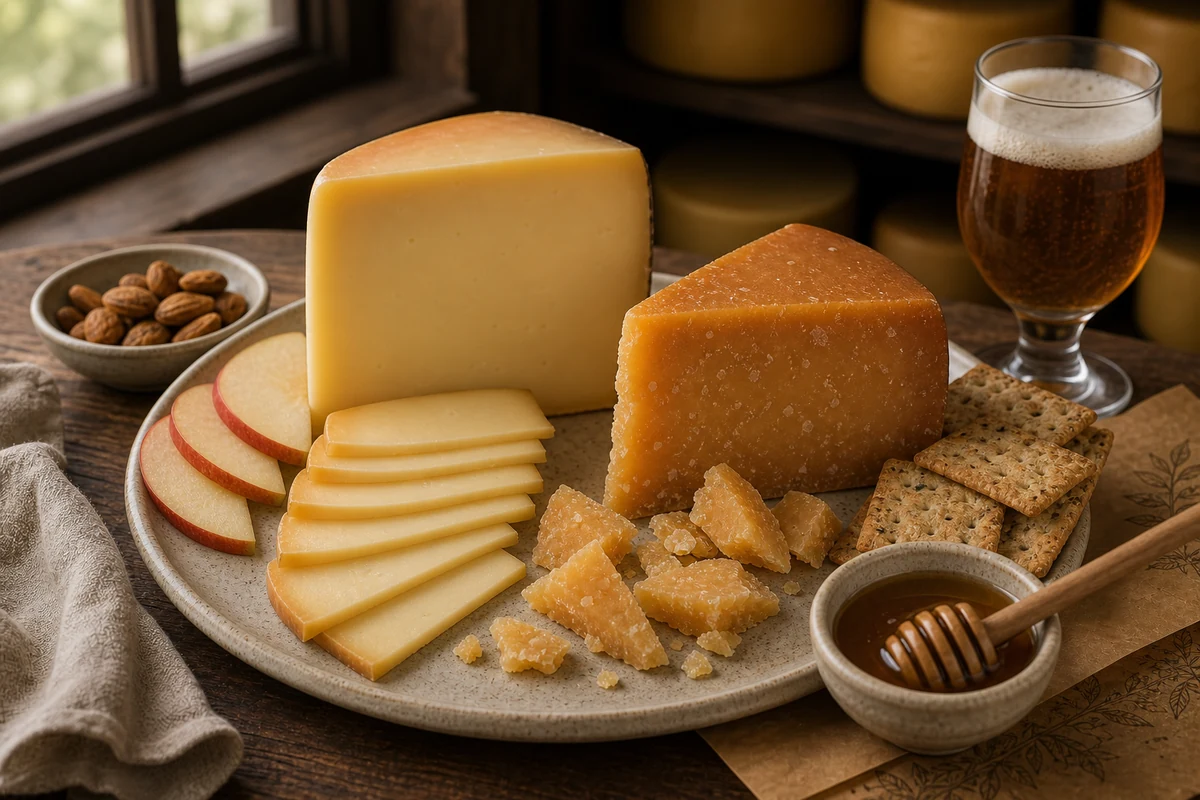
Henri Willig suggests thin slices of its Extra Aged Goat's Cheese on a cheese board with nuts and figs, or with a slightly sweet port.
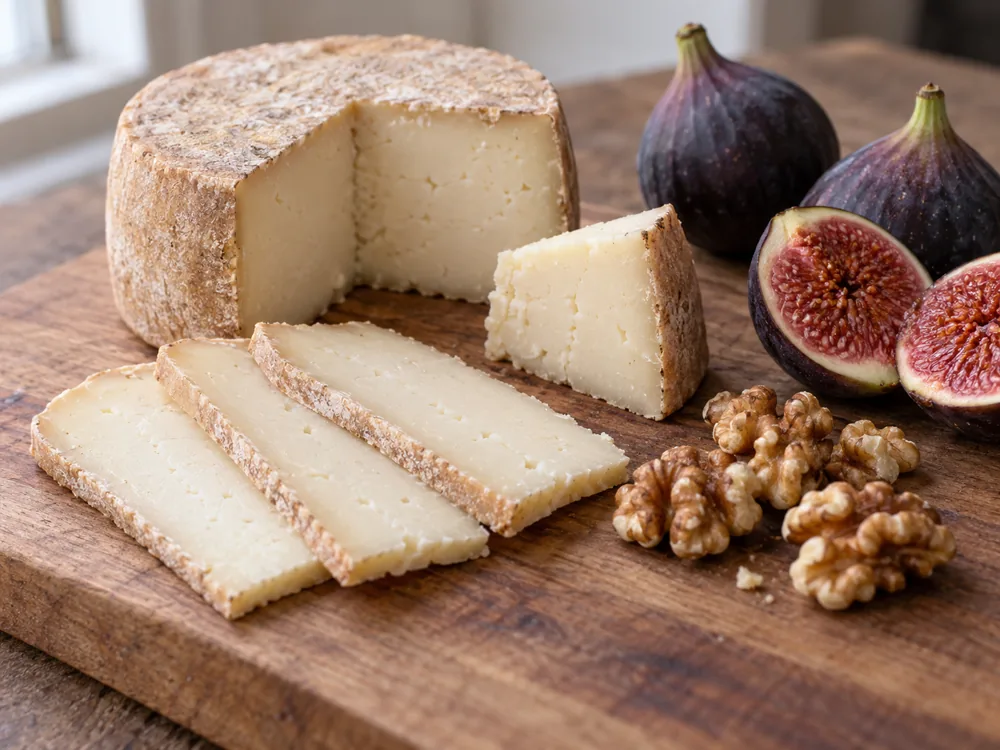
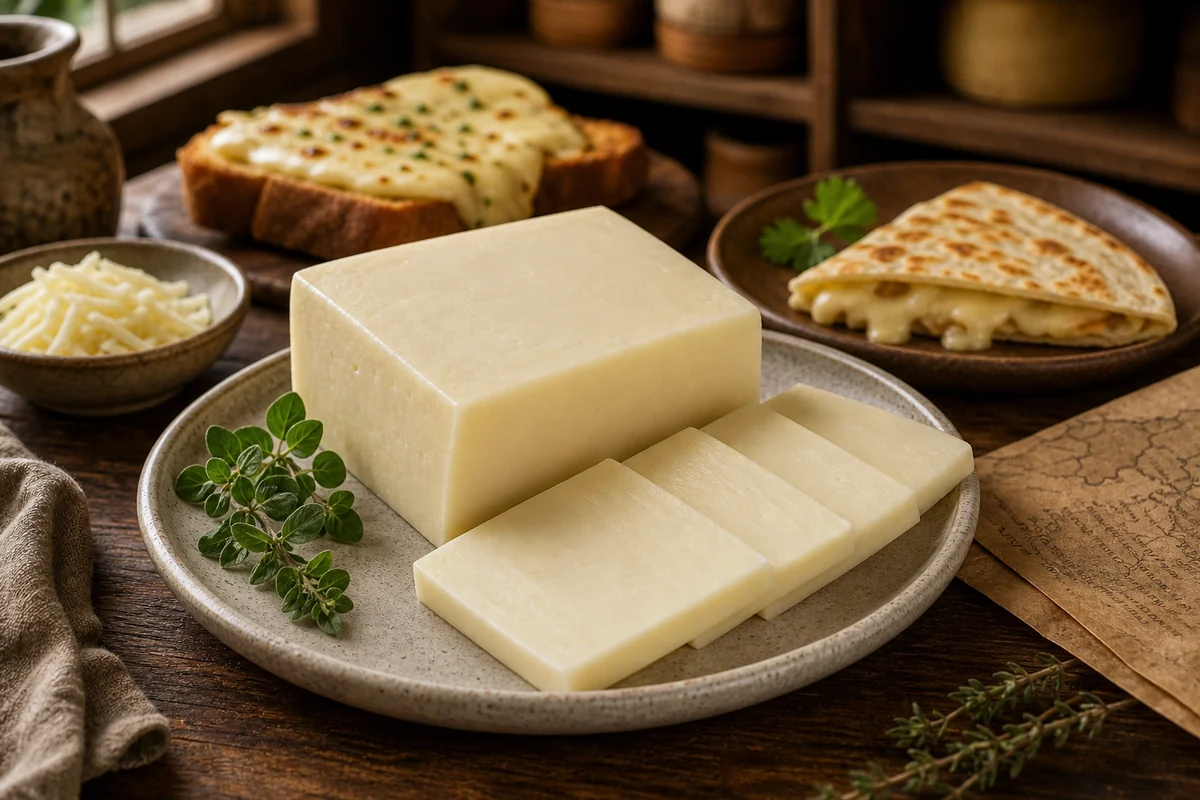
It also suggests grating the cheese over warm pasta or into a baked dish for an intense, rich flavour. A Murray's staffer adds a bite of Tickler Cheddar between pieces for contrast with the sweeter goat cheese.
Dutch Cheeseman UK lists cheese boards, pasta dishes, and sandwiches and salads as uses for its version, and Cheeseland offers Dutch Girl as an addition to a cheese plate or an appetizer.
Murray's product page lists honey mustard, bread and butter pickle chips, and a beef salami as its pairing recommendations.
Only Murray's gives a reason for a pairing: a bite of Tickler Cheddar contrasts with the sweeter goat cheese. Henri Willig's figs, nuts and slightly sweet port, and Dutch Cheeseman UK's light wines, come without a stated reason.
| Pairing | Type | Why It Works |
|---|---|---|
| Nuts and figs | Food | Henri Willig suggests them with thin slices on a cheese board. |
| Slightly sweet port | Wine | Henri Willig's other suggestion for its Extra Aged Goat's Cheese. |
| Sauvignon Blanc or rosé | Wine | Dutch Cheeseman UK suggests light wines such as these. |
| Scotch ale | Drink | Murray's description of its Aged Goat Gouda suggests a Scotch ale to toast the cheese. |
| Chardonnay or Pinot Noir | Wine | Cheese.com lists them, with Sauvignon Blanc, for the related Goat Gouda. |
How Do You Store Aged Goat's Cheese?
Murray's says to refrigerate the cheese when it arrives and to keep it in the cheese paper it ships in, which covers the cheese to stop it drying out while letting it breathe.
Henri Willig sends its piece vacuum-packed with the storage advice keep cool, and keep cool after opening.
The CDC's figure for the refrigerator that holds it is 40°F or below. The CDC also says to refrigerate perishable food, dairy among it, within 2 hours, or within 1 hour above 90°F, so a cheese board follows the same limit once it is out on the table.
What do the nutrition label and ingredients say?
Henri Willig's label gives, per 100 g of Extra Aged Goat's Cheese, 488 kcal, 42 g of fat (26 g saturated), 29 g of protein, 2.4 g of salt, and less than 0.5 g of carbohydrate. The ingredients are pasteurized Dutch goat's milk, salt, microbial rennet, and cheese cultures, and the allergen line says milk, including lactose, with no lactose figure.
Cheeseland prints its label per 1 oz (28 g) serving instead: 110 calories, 9 g of fat (6 g saturated), 7 g of protein, 200 mg of sodium, and no carbohydrate. It also lists 30 mg of cholesterol and 233 mg of calcium, which it gives as 20% of the daily value.
Scaled to 100 g, that serving works out to roughly 393 calories, 32 g of fat and 25 g of protein, our arithmetic from rounded label figures. The scaled figures sit below Henri Willig's 488 kcal, 42 g and 29 g, but the two labels belong to different cheeses and makers, so the gap cannot be put down to age.
Cheeseland lists sodium and Henri Willig lists salt, so those two lines do not compare directly.
Each of the three ingredient lists that exists (Henri Willig, Cheeseland and Murray's) ends up with the same four items: pasteurized goat's milk, salt, starter or cheese cultures, and rennet, with no flavourings or colour added.
Is Aged Goat's Cheese safe during pregnancy?
Cheese.com, Henri Willig, Cheeseland, and Murray's all describe the cheese as made from pasteurized goat's milk.
For a pasteurized goat cheese that Cheese.com and the sellers file as semi-hard or hard, the CDC's safer list has hard cheese made with pasteurized milk. The NHS lists pasteurised or unpasteurised hard cheeses such as cheddar, gruyère and parmesan, and pasteurised semi-hard cheeses such as edam, as safe to eat.
Neither agency names aged goat's cheese, so their lists do not settle which cheese category it falls in.
The NHS puts pasteurised or unpasteurised mould-ripened soft cheeses with a white coating, such as brie, camembert and chèvre, on its list of cheeses that must be thoroughly cooked. Cheese.com describes Aged Goat's Cheese as semi-hard with a natural rind.
The CDC says pregnant women are 10 times more likely to get a Listeria infection, so confirm pasteurized milk on the label of the piece you buy.
Which cheeses are closest to Aged Goat's Cheese?
Cheese.com's nearest entry is Goat Gouda in the Gouda family, made from pasteurized goat's milk in the Netherlands, tangy, with a firm, crumbly, slightly chalky ivory paste. As it ages, the entry says, goat Gouda becomes firmer and develops hints of caramel and nuts, and its flavours include tart apples and fresh grass.
Cheese.com gives the two entries the same country, milk and semi-hard type and separates them by texture, colour, aroma and flavour; only the Aged Goat's Cheese entry states an age.
| Aged Goat's Cheese | Goat Gouda |
|---|---|
| Creamy and crumbly | Chalky and firm |
| Cream | Pale yellow in the fact box, ivory in the description |
| Rich aroma, creamy flavour | Grassy aroma, tangy flavour |
| At least 18 months | No age given; firmer and more complex with age |
The same entry calls goat Gouda suitable for vegetarians, which matches the vegetarian rennet that Murray's and Cheeseland list.
SOURCES & REFERENCES
What Else Should You Know About Aged Goat's Cheese?
Cheese.com describes it as a semi-hard Dutch cheese made from pasteurized goat's milk, with a natural rind, a cream colour, and a creamy, crumbly texture, matured for at least 18 months. Other sellers sell aged goat cheeses under Gouda names with stated ages from 7 months to 2-5 years.
No. Wikipedia describes chèvre as a soft, creamy, melt-in-mouth cheese that can have a fruity taste, while Cheese.com describes Aged Goat's Cheese as semi-hard, creamy, and crumbly.
It depends on the seller. Cheese.com gives at least 18 months, Cheeseland ages Dutch Girl for 7 months, and Murray's lists 2-5 years for its Aged Goat Gouda.
Cheese.com, Henri Willig, Cheeseland, and Murray's all describe pasteurized goat's milk. Counted as a hard cheese made with pasteurized milk it is on the CDC's safer list, and counted as a hard cheese or a pasteurised semi-hard cheese such as edam it is on the NHS's safe list, but neither agency names it, so confirm pasteurization on the label and ask your midwife or doctor.
Henri Willig marks its Extra Aged Goat's Cheese vegetarian and lists microbial rennet, and Murray's and Cheeseland list vegetarian rennet. If you avoid animal rennet, ask Dutch Cheeseman UK which rennet goes into its version.
Murray's says to refrigerate it in cheese paper, Henri Willig says to keep it cool and keep it cool after opening, and the refrigerator should stay at 40°F or below, the CDC's limit.
The sellers describe it differently: Dutch Cheeseman UK reports tanginess and earthy notes, Cheeseland reports a butterscotch-like flavour, and Murray's reports caramel and burnt sugar and recommends it to people who dislike the goaty flavour.