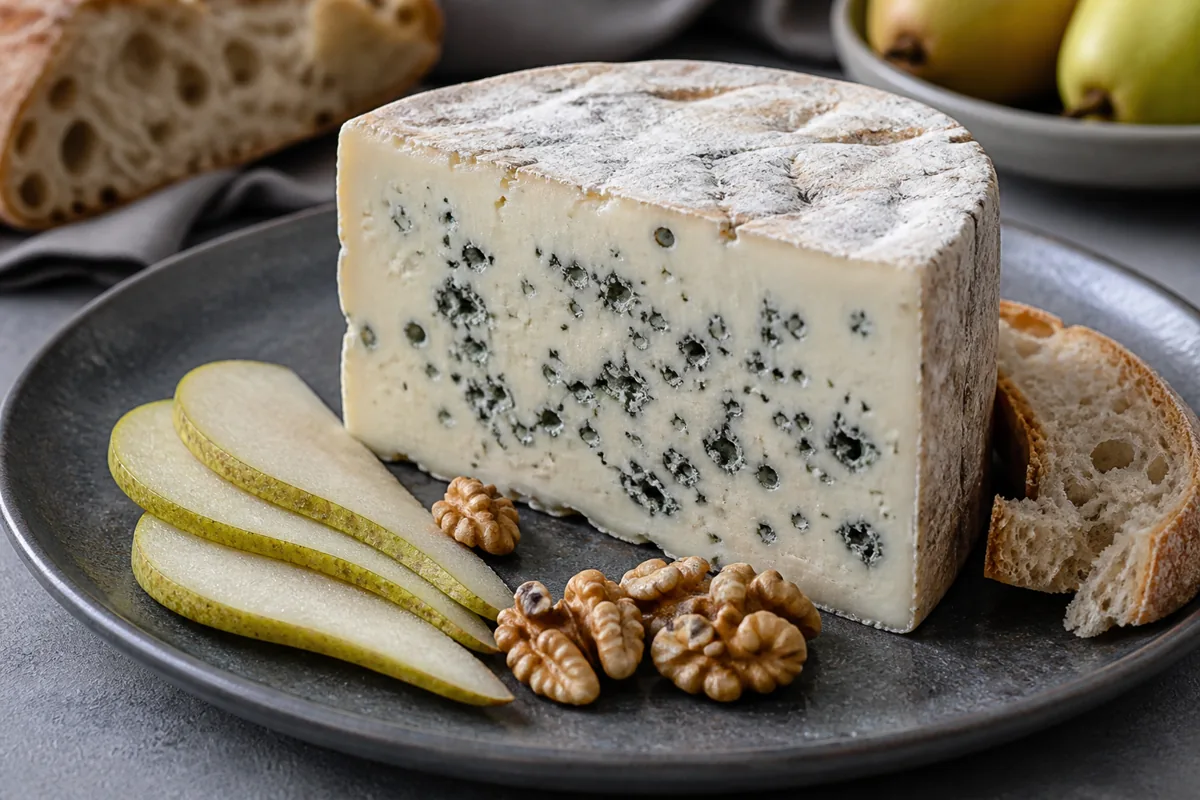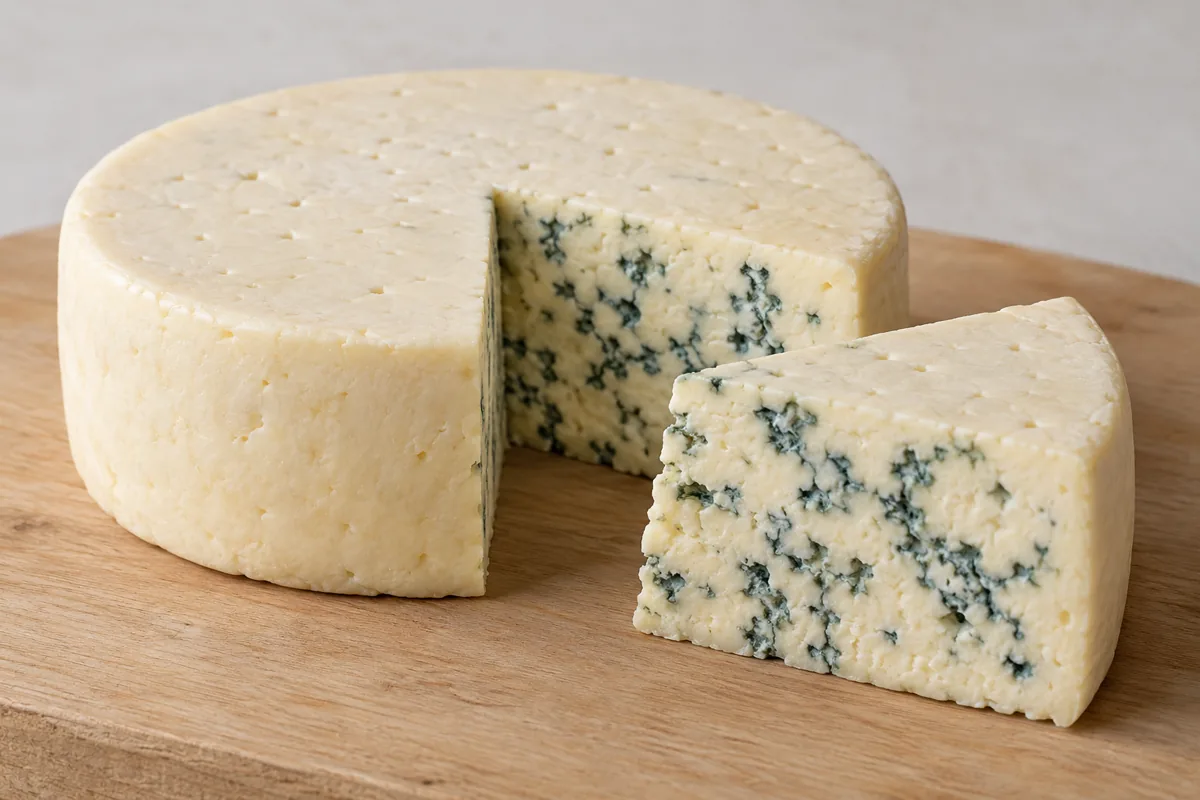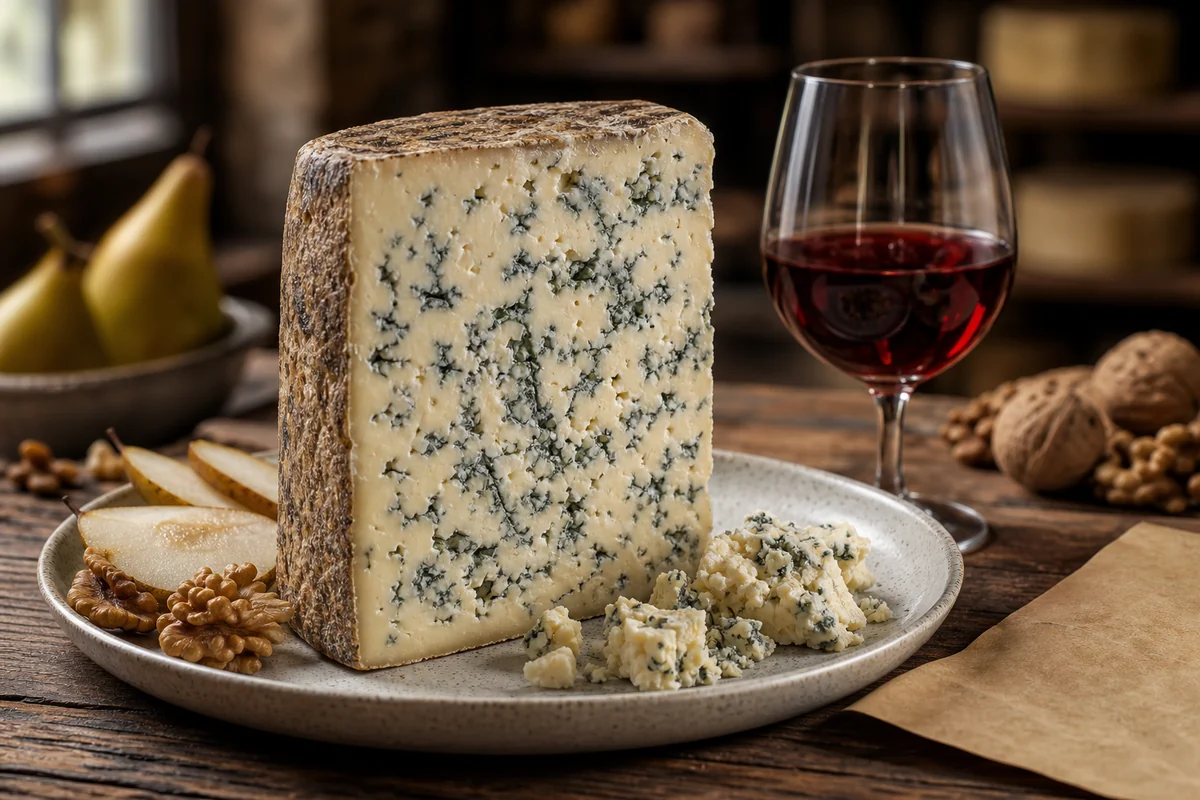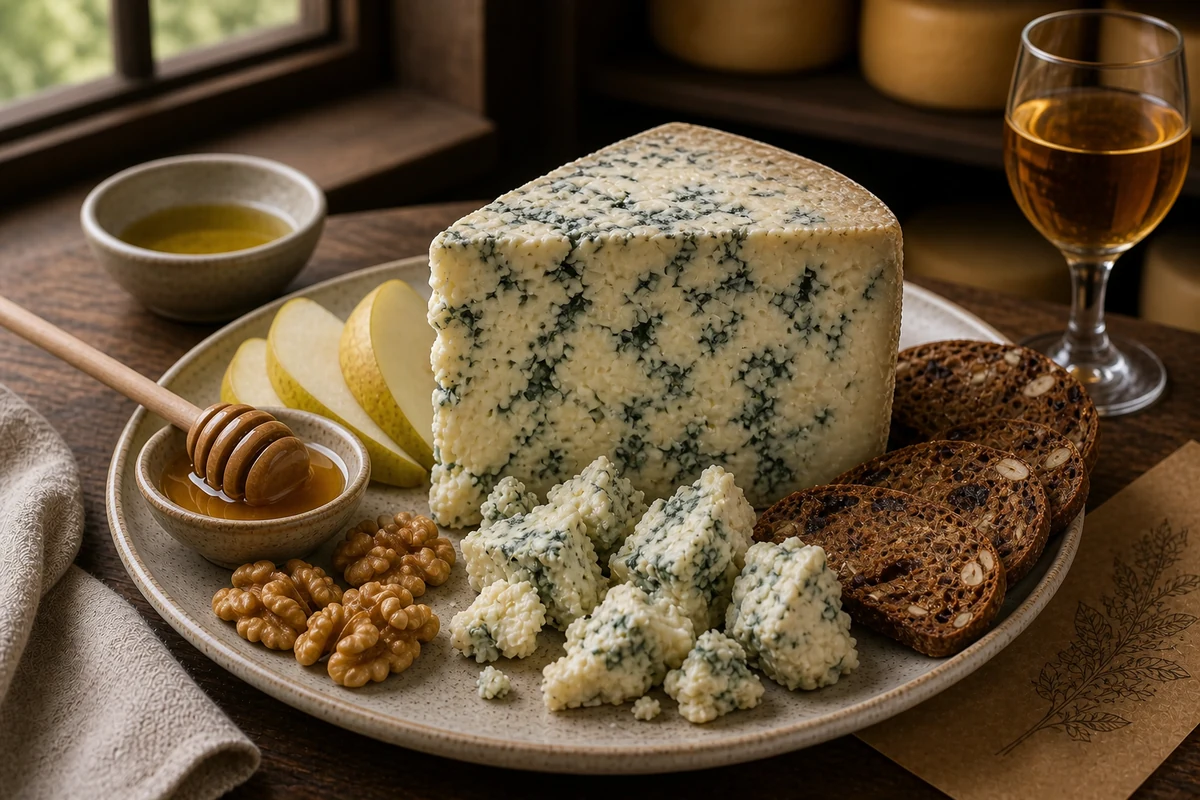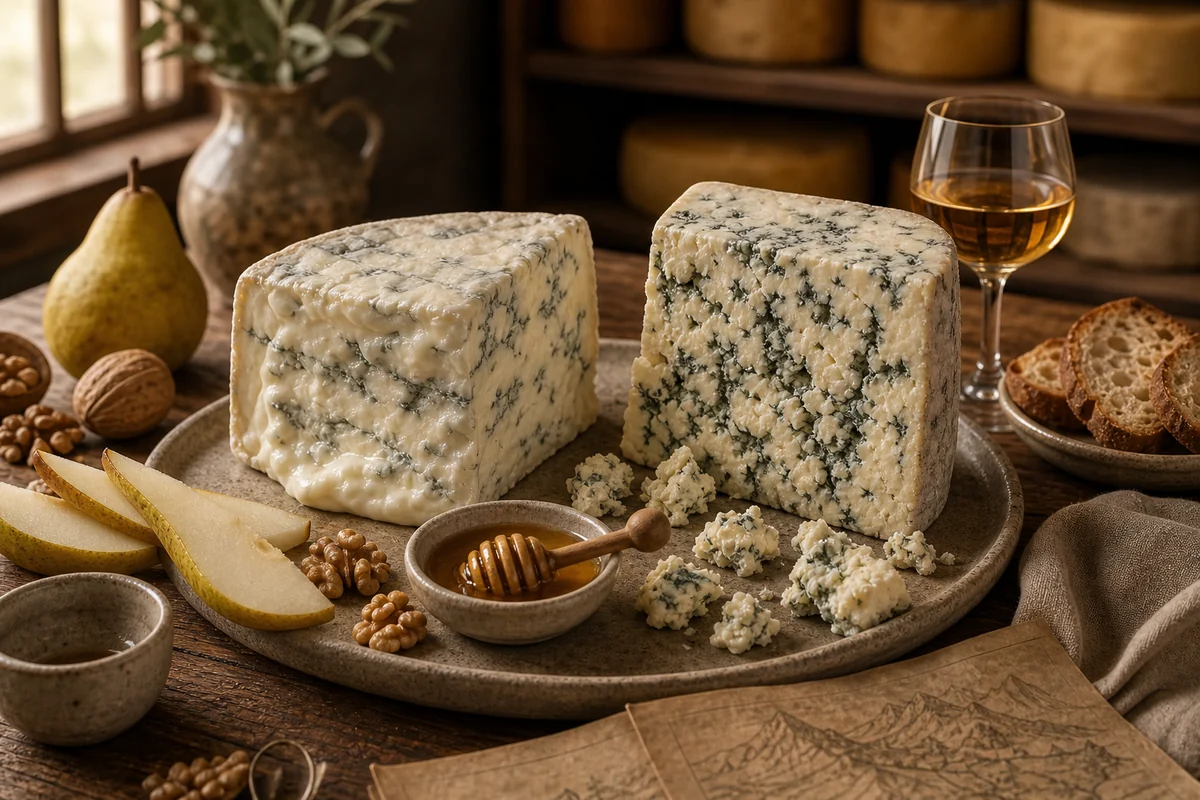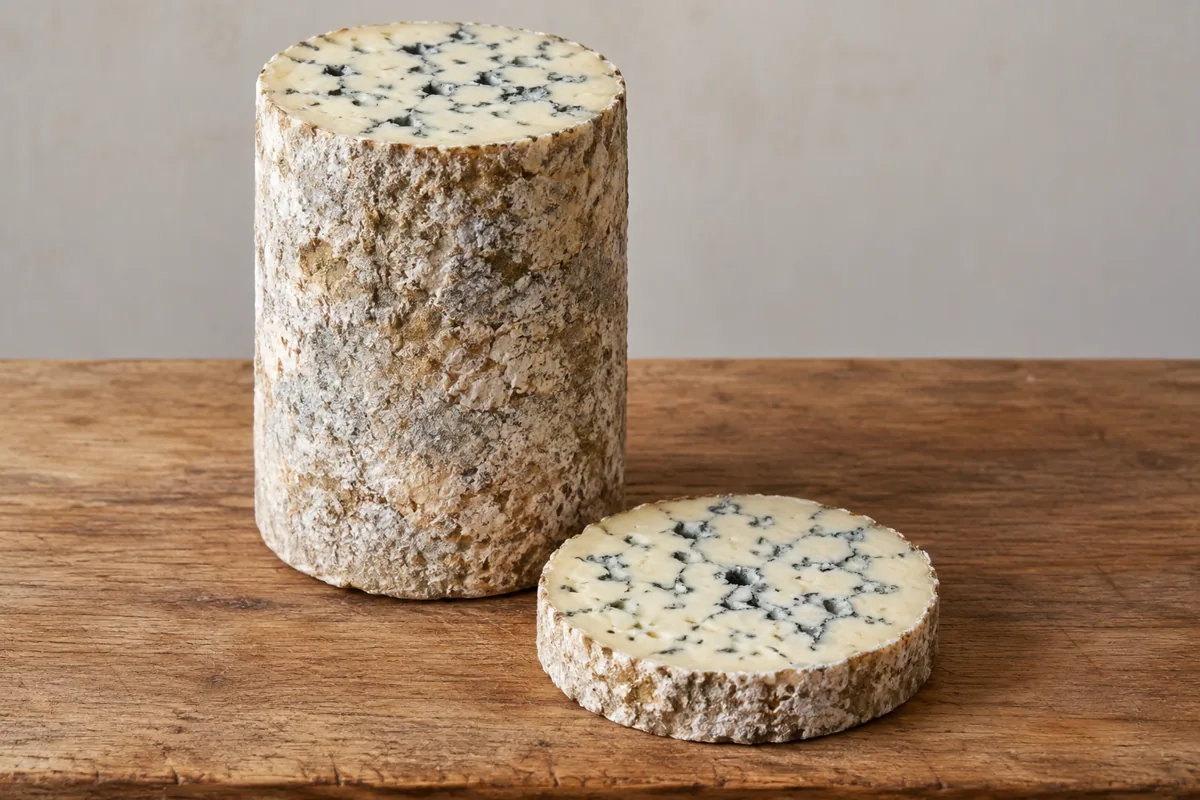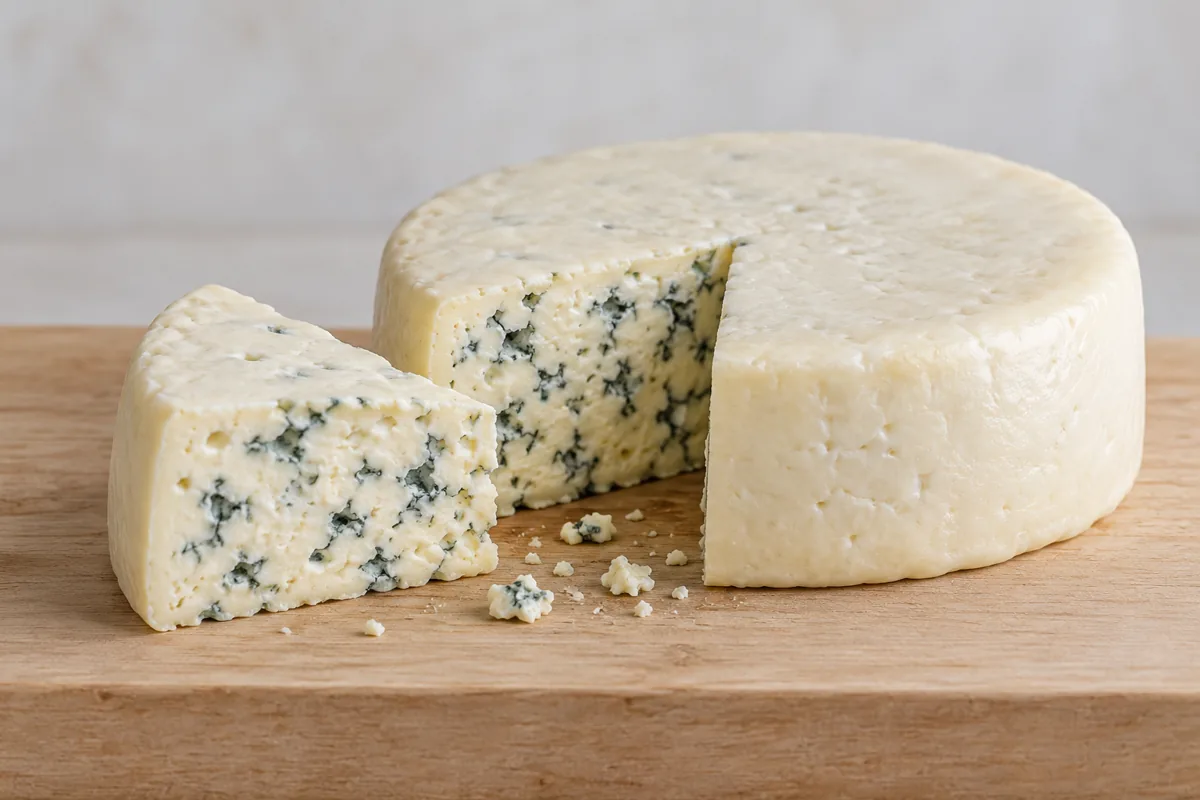
Roquefort is a sheep-milk blue cheese from southern France, made only with raw, whole milk from Lacaune ewes. Only wheels ripened in the caves under the Combalou mountain at Roquefort-sur-Soulzon may carry the name.
In This Article
What Does the Roquefort Name Require?
The INAO specification describes Roquefort as a blue-veined cheese made only from raw, whole sheep milk. Its paste is neither pressed nor cooked, and it is seeded with Penicillium roqueforti spores, then fermented and salted.
The same document fixes the size and make-up of every wheel.
| Point | Specification value |
|---|---|
| Shape | Cylinder |
| Diameter | 19 to 20 cm |
| Height | 8.5 to 11.5 cm |
| Weight | 2.5 to 3 kg |
| Fat | At least 52 g per 100 g of dry matter |
| Dry matter | At least 55 g per 100 g of ripened cheese |
Multiplying the two minimums, 52 percent of at least 55 g, sets a floor of about 28.6 g of fat per 100 g of ripened cheese, which the 30.6 g that USDA lists for Roquefort clears.
The milk rules start on the farm. Ewes must graze daily whenever grass is available, at least three quarters of their feed must come from the area, and milk cannot go to the dairy until 20 days after lambing.
Rennet goes in within 48 hours of the oldest milking, at 28 to 34 °C, and the only treatment allowed besides that warming is a filter for visible particles.
The specification also bans any other milk, or cheese made from it, from the dairies and cellars that handle Roquefort.
Sources describe the outside differently. The specification calls it a moist crust, while English Wikipedia says Roquefort has no rind and that the edible exterior is slightly salty.
French Wikipedia describes that outside as cream-white or ivory, with a surface that can weep slightly.
The unwrapping stage described under the caves heading may explain the gap, because the confederation says it includes removing the crust before cutting and packing.
Why Does Roquefort Use Raw Lacaune Sheep Milk?
The specification links the aroma to three choices: the Lacaune breed, a traditional feeding system built on the area's own resources, and the fatty acids in the milk, which it calls the carriers of aromas. Raw milk, it says, adds to the cheese's particular bouquet, which the mould reveals during ripening.
It describes the Lacaune ewe as suited to the area: its wool is concentrated on the back, which shields it from summer sun, and its hooves cope with stony ground. French Wikipedia adds that the breed was formed in 1942 from regional breeds and selected for milk yield while keeping its hardiness.
English Wikipedia says a small amount of cow's or goat's milk was sometimes added before the 1925 rules.
The specification caps bought-in feed at an average of 200 kg of dry matter per ewe a year and sets a barn ration averaging at least 1 kg of hay per ewe a day. It also reserves at least a quarter of the main forage area for the dairy flock to graze, and bans urea in feed, sweet-corn silage, and flocks kept indoors all year or raised without land.
Farm milk can wait at most 24 hours at 10 °C or below, though remote mountain rounds with small volumes may hold it 38 hours at 4 °C. The specification also bans holding milk, curd or fresh cheese at below-freezing temperatures.
French Wikipedia adds that the milk of many farms is blended and that microfiltration, which would remove micro-organisms, is banned, and the specification says working with raw, whole milk demands constant adaptation from the cheesemaker.
What Does Roquefort Taste Like?
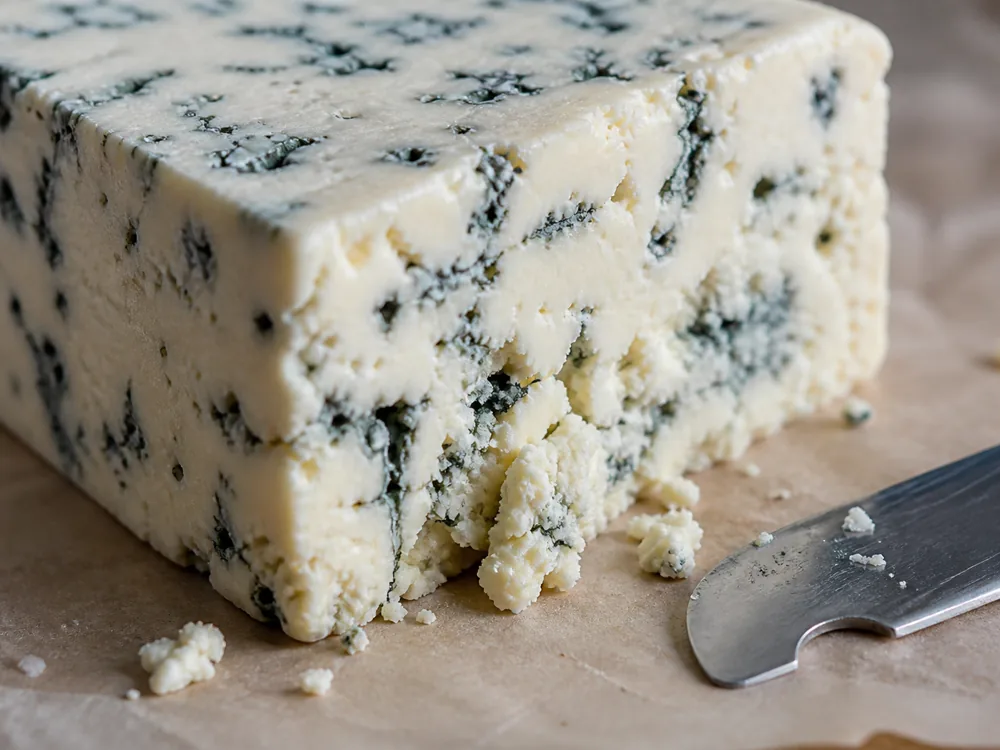
The specification describes a creamy, well-knit paste, evenly veined in green-blue, with a light smell of mould and a fine, pronounced flavour.
The Roquefort confederation, which groups the milk producers and makers, adds sweet, frank notes and a pronounced bitterness. It says the colour of the veins runs from dark green to pale green-blue depending on which house made the cheese.
| Source | Texture | Flavour and smell |
|---|---|---|
| INAO specification | Creamy and well knit | Fine and pronounced; light smell of mould |
| Roquefort confederation | Melts on the tongue; slightly moist | Sweet, frank notes; pronounced bitterness |
| English Wikipedia | Creamy, slightly moist; box lists semi-hard | Tangy, with a taste of butyric acid; sharp tang from the veins |
| French Wikipedia | Crumbly to creamy | Not described |
The sources split on texture: the confederation says the paste melts on the tongue, while English Wikipedia's summary box lists it as semi-hard. The confederation also says the paste is more or less creamy from one house to the next, so the feel of a piece depends partly on who made it.
Why Is Roquefort So Salty?
The specification requires dry salting, and French Wikipedia adds that the cheese is salted with dry salt rather than in a brine bath.
USDA FoodData Central gives the clearest measure: 1,809 mg of sodium per 100 g of Roquefort, the highest of the four cheeses below.
| Cheese | Sodium per 100 g | Fat per 100 g |
|---|---|---|
| Roquefort | 1,809 mg | 30.6 g |
| Blue cheese | 1,150 mg | 28.7 g |
| Feta | 1,140 mg | 21.5 g |
| Cheddar | 653 mg | 33.3 g |
By those figures, Roquefort carries about 57 percent more sodium than the generic blue cheese record, and nearly three times as much as the same weight of cheddar.
French Wikipedia, quoting the French food composition table (Ciqual, 2008), lists 1,600 mg of sodium per 100 g, about 200 mg below the USDA figure.
A 30 g piece works out at about 540 mg of sodium on the USDA figure, roughly what USDA lists for 47 g of feta, and at about 480 mg on the French one.
Why Is Roquefort Aged in Caves?
The law ties the name to one place. Ripening must happen in cellars in the scree of the Combalou mountain, inside the boundary a Millau court fixed on 12 July 1961.
French Wikipedia puts that zone at about 2 km long and 300 m wide.
According to the specification, the limestone cliffs of the Combalou fractured and collapsed over the centuries, and the cellars are cut into that fallen rock.
Cracks in the scree, called fleurines, act as natural chimneys. Air entering them is cooled by the cliff walls, which face north-east, and picks up moisture from underground water as it sinks toward the base of the scree.
The confederation says the cellars face north and reach up to eleven floors underground. When it is hot outside the fleurines blow cool, humid air in, and when the outside temperature sits between 0 and 10 °C they go still.
French Wikipedia gives the resulting cellar climate as a humidity of at least 80 percent and an average temperature of 10 °C.
Other cellars with fleurines exist, but the confederation says the north-facing Combalou caves have no equivalent. It counts at least 102 of these so-called bastard cellars in the 19th century and says only two still operate, in Fondamente and Peyrelade, making cow-milk blue cheese.
Inside, the confederation says, the cheeses stand on edge in the moving air on oak slats, over three shelf levels it calls top, table and floor, with a washable plastic sheet under them.
Oak takes up humidity and releases it when needed, and the ripener steers the airflow with doors and hatches and judges creaminess with a stainless steel probe.
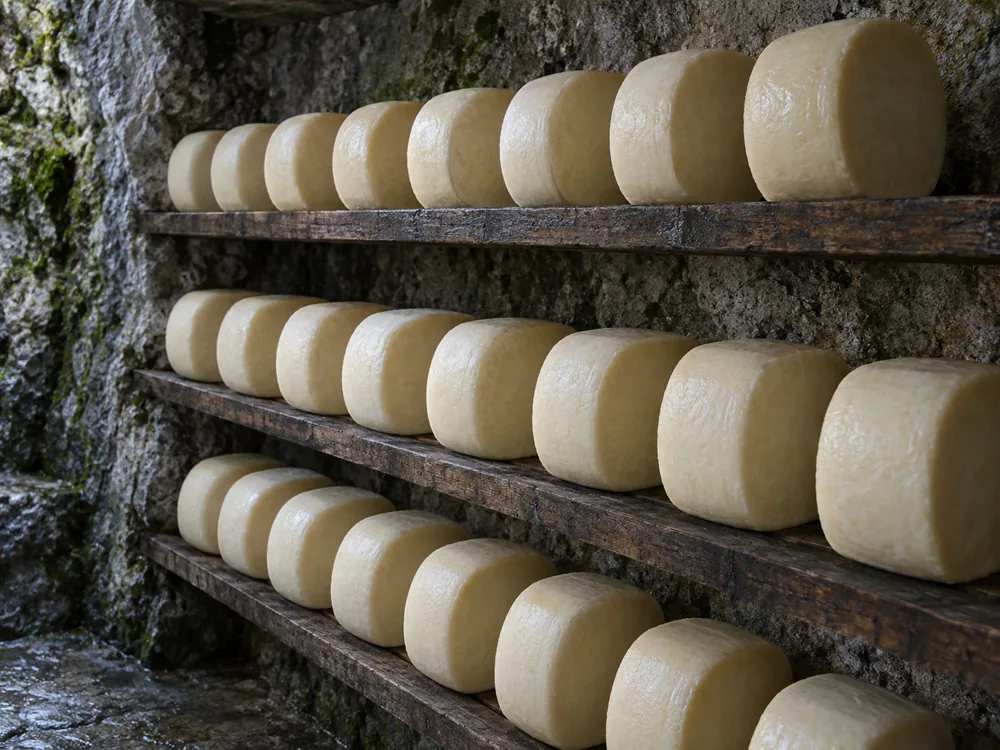
Ripening then runs in stages that the specification and the confederation describe:
- At least 2 weeks bare in the caves while the blue develops, under the specification.
- Wrapping in a protective sheet, traditionally tin, which the confederation says slows the mould; the specification allows this wrapping only in the caves.
- Slow maturation under the wrap, in the caves or in temperature-controlled rooms.
- Unwrapping and turning, which removes the crust, at least three months after ripening starts according to the confederation, followed by cutting and packaging.
- At least 90 days in all, counted from the day the cheese was made.
So the 90-day minimum covers cave time and cold storage together. Only the first stage has to happen with the cheese bare in the caves.
The confederation counts its three months from the start of ripening and the specification counts 90 days from the day of making, so the two clocks can start at different points.
English and French Wikipedia both give five months for the cheese, which sits above the 90-day floor.
The specification sets a floor of -5 °C for the maturation phase, and French Wikipedia says slowing maturation in temperature-controlled rooms lets makers spread sales across the year, because the ewes give milk for only part of it.
What Is the Blue Mould in Roquefort?
The blue is Penicillium roqueforti, and the specification allows only cultures of bacteria, yeasts and moulds whose safety has been demonstrated.
Its spores go into the milk or curd from powders or cultures made from traditional strains isolated in the caves at Roquefort-sur-Soulzon.
The confederation describes the rye bread method. The strain is placed in the moist crumb of baked rye bread, the mould takes over the whole loaf within weeks, and the crumb is then collected, crushed and sieved.
One maker, Papillon, still runs its own bakery for this bread, with a brick oven built in 1976.
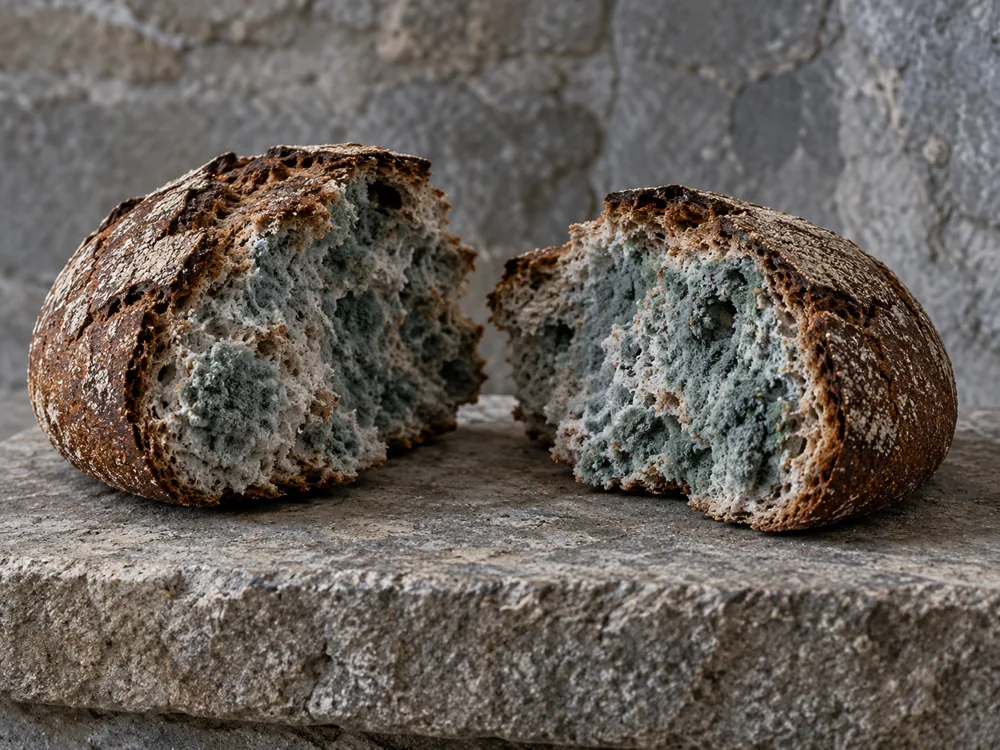
Because each of the seven makers keeps at least one exclusive strain, the confederation says the strain helps shape the texture of that house's cheese and gives it its own aroma and taste nuances.
The 2024 IMA Fungus study compares five known populations of the species. It describes the Roquefort cheese population as the product of a separate domestication in a more traditional production setting, and links it to longer conservation and growth on bread.
A 2024 study in IMA Fungus detected no PR toxin in the Roquefort population of the fungus. The authors describe the cheese-making populations as producing few toxins and suggest either selection or a loss of that ability over time.
The comparison covered 44 strains, eight of them from the Roquefort population, grown on a laboratory medium rather than in cheese, and the authors found no genetic fault behind the missing toxin, which suggests the gene cluster is switched down rather than broken.
These sources cover the blue veins the maker put there. None of them deals with other moulds that may grow on a cut piece at home.
How Does the Blue Spread Through the Paste?
The specification credits two make steps for readying the paste: draining without pressing, which leaves regular openings, and piercing, called piquage, which lets air reach the inside. It calls both indispensable for the mould to grow during ripening and vein the paste evenly.
Piercing happens in the dairy or in the cellar, and the cheese must reach the ripening cellar within two days of it, or four when public holidays interrupt deliveries. French Wikipedia says needles do the piercing.
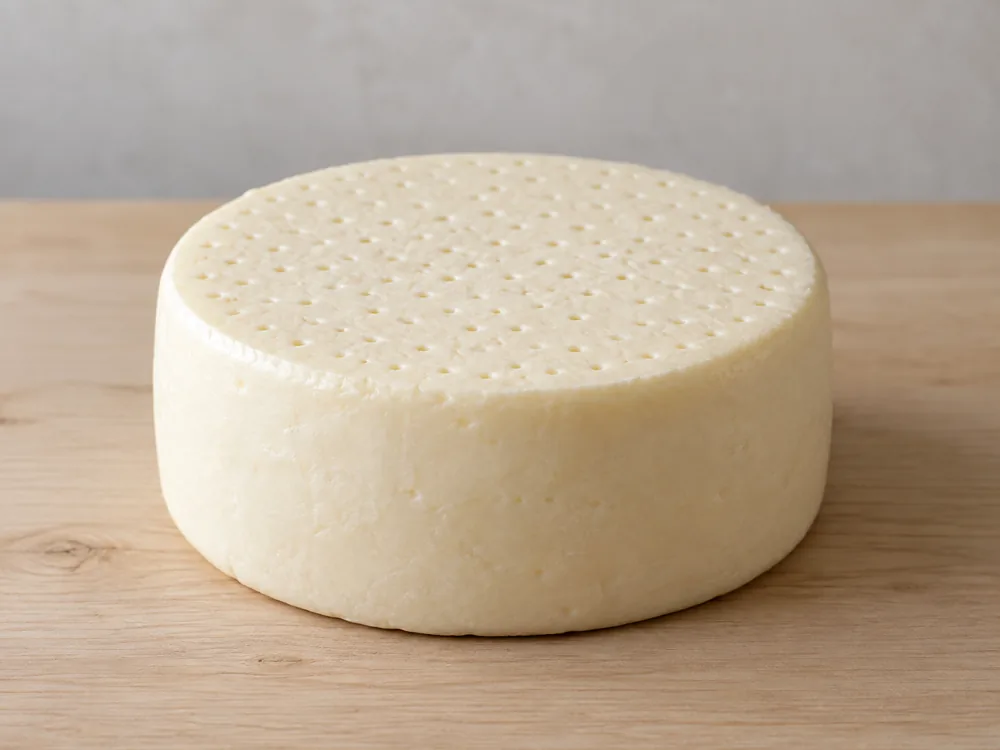
French Wikipedia lists the cultures added at renneting as lactic ferments (Lactococcus lactis), gas-producing ferments (Leuconostoc mesenteroides) and, above all, the mould spores.
The mould then needs air: the confederation calls Penicillium roqueforti an aerobic fungus that thrives in the ventilated cellars, and says the blue-green develops patiently from the heart of the cheese toward its edge.
Is Roquefort Safe During Pregnancy?
The NHS names the cheese directly. It lists "pasteurised or unpasteurised soft blue-veined cheeses, such as Danish blue, gorgonzola and roquefort" among foods that must be thoroughly cooked.
For a raw-milk blue like Roquefort, the CDC's riskier list has soft cheese made from unpasteurized milk, including blue-veined cheese, and it says pregnant women are 10 times more likely to get a Listeria infection.
Because the specification allows only raw milk, there is no pasteurised Roquefort to choose instead.
French Wikipedia reports that Lactalis has sold a pasteurised sheep-milk blue since 2019, but it cannot carry the Roquefort name. The NHS cooking advice covers soft blues whatever the milk, from pasteurised Danish blue to gorgonzola.
For other cheeses during pregnancy, the NHS says pasteurised or unpasteurised hard cheeses, such as cheddar, gruyère and parmesan, are safe to eat.
What Goes With Roquefort?
The Roquefort confederation opens its pairing advice with pear.
For a cheese platter or an aperitif, it suggests dried fruit and nuts. It also lists jams, fresh fruit, crisp vegetables and several breads, set out in the block below.
| Pairing | Why It Works |
|---|---|
| Dried fruit and nuts | Walnuts, almonds, hazelnuts, apricots, figs and prunes. |
| Jams and pastes | Jams, quince paste and fruit compotes. |
| Fresh fruit | Bananas, pineapple, melon, figs, grapes, green apples and pears, by season. |
| Crisp vegetables | Endive, sweet potato, lettuce, tomato, celery, radish and beetroot. |
| Breads | Different breads, brioche and gingerbread. |
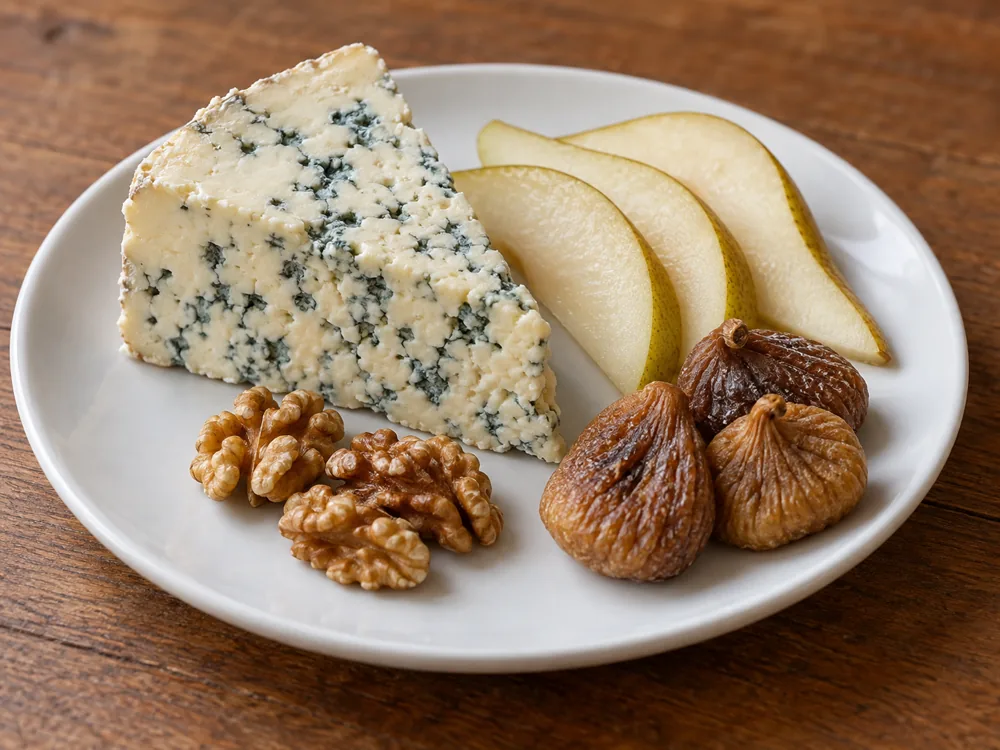
The confederation describes the fruit pairings as always a sweet and savoury combination that changes with the season, and says Roquefort likes the crunch and freshness of vegetables.
In the Aveyron, English Wikipedia says, regional cooking uses Roquefort in meat sauces, savoury tarts, quiches, pies and fillings.
The confederation offers a way to use every part of a slice. When the ends carry less blue, cut them off and keep them for a sauce or a Roquefort whipped cream.
What Can You Check Before Buying Roquefort?
The confederation says to judge it by eye first: the blue-green marbling should be spread evenly from the centre to the edges through a pearly white, slightly moist paste with wide-open cavities.
Smell comes next, and it names the mould and the acidity of the curdled milk, rising from the ivory paste.
On the packaging, the specification requires the name Roquefort in letters at least two thirds the size of the largest lettering on the label, with the EU PDO symbol in the same field of view.
The confederation's collective mark, a red sheep created in 1930, must appear as well, and apart from that mark, brand names and company names, no qualifier may be added to the name on labels, advertising or invoices.
A whole wheel is stamped with a code for the place of making, the day of making and a lot number, and the day of making is the date the 90-day minimum counts from.
Check three things: evenly spread veins in a pearly, slightly moist paste; the name, EU PDO symbol and red sheep mark on the packaging; and the stamped day of making on a whole wheel.
How Should You Cut and Store Roquefort?
The confederation's storage advice is short: keep Roquefort in the vegetable drawer of the fridge, wrapped in cling film so it does not dry out.
An older version of its advice, cited by French Wikipedia, named the original wrapping or aluminium foil and the bottom of the fridge instead.
Take it out at least an hour before serving so it reaches about 18 °C. The confederation also suggests taking out only the amount you will serve, to spare the rest from temperature swings.
For cutting, it recommends a cheese lyre, a cheese wire or a thin-bladed knife, starting with a cut through the foil wrapper:
- Cut down through the height of the cheese, from the edge to the centre.
- Cut that slice across its width.
- Slice the resulting quarter in a fan to make portions.
- Serve slices that run from the centre to the edge, so each person gets every part of the cheese.
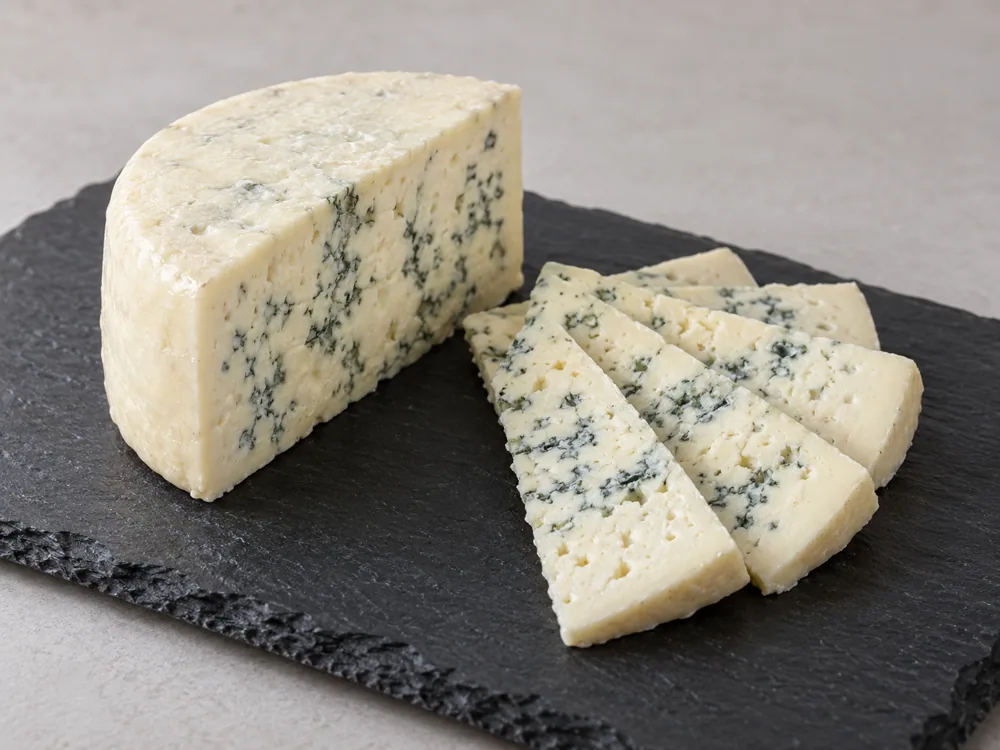
Once it is cut, go by the label date and general cheese storage practice.
Why Is Roquefort Expensive?
The rules put limits on every wheel: how much milk goes in, which ewes give it, how far it travels and where the cheese is finished.
English Wikipedia, citing Masui and Yamada's French Cheeses, says about 4.5 litres of milk go into each kilogram of Roquefort.
On the specification's 2.5 to 3 kg wheel, that is roughly 11 to 13.5 litres of milk in each wheel.
That milk comes only from Lacaune ewes, which French Wikipedia says are milked for about six months a year, ending in June. It adds that the milk is collected from farms within roughly 100 km of Roquefort-sur-Soulzon.
The finishing work stays local as well, since maturing, cutting and packing must happen in the commune of Roquefort-sur-Soulzon. The specification makes one exception: shops may cut cheese to order for their customers.
Who Makes Roquefort?
Seven companies make PDO Roquefort, according to the confederation, and each has its own cellar, its own mould strain and its own milk round.
| Maker | Group or status | Milk suppliers | Output per year |
|---|---|---|---|
| Société | Lactalis Group | About 1,000 | 10,000 t |
| Papillon | Savencia Group | 130 | 2,250 t |
| Fromageries Occitanes | Sodiaal Group; the only cooperative | 170 | 2,200 t |
| Gabriel Coulet | Family business, five generations | 100 | 2,000 t |
| Vernières | Family and independent since 1890 | 52 | 1,200 t |
| Carles | Family business, three generations | 15 | 230 t |
| Le Vieux Berger | Family business; the smallest maker | 8 | 180 t |
Those figures add up to about 18,000 tonnes a year. English Wikipedia gives 10,000 tonnes for all Roquefort, citing the same site, and French Wikipedia gives about 15,000 tonnes, so the three published totals disagree.
French Wikipedia's summary box lists 18,830 tonnes marketed in 2023, close to the confederation sum.
Société is the largest either way. The confederation calls it the first producer and exporter, founded in 1851, and French Wikipedia says the Lactalis group now makes more than 50 percent of all Roquefort.
The confederation table puts Société at 10,000 of about 18,000 tonnes, roughly 55 percent, while the introduction of French Wikipedia gives Société's share as 70 percent.
English Wikipedia adds that Roquefort is France's second most popular cheese after Comté, citing Masui and Yamada.
How Old Is Roquefort?
The oldest record in the specification is a mention in 1070 in the cartulary of the Abbey of Conques, in the Aveyron.
French Wikipedia dates an entry in the same cartulary to about 1060 and describes it as a donation of a cheese made in shepherds' huts, so the first record falls between 1060 and 1070 depending on the source.
On 4 June 1411, English Wikipedia says, Charles VI gave the people of Roquefort-sur-Soulzon a monopoly on ripening the cheese. In 1666 the Parliament of Toulouse confirmed those royal privileges, according to the specification.
Diderot and d'Alembert called it the king of cheeses in the 18th century, and on 26 July 1925 a French law made it the first cheese recognised as an appellation of origin.
English Wikipedia says output grew from 300 tonnes in 1820 to 9,250 tonnes by 1914. French Wikipedia says the 1925 law answered the rise of blue cheeses and cow-milk imitations sold as roquefort.
Older claims are weaker. Pliny the Elder praised cheeses from the Lozère and Gévaudan in AD 79, but some writers reject the link because he does not clearly describe a blue cheese, English Wikipedia notes.
French Wikipedia treats two stories as legend: the bishop of Albi serving Charlemagne a blue cheese, and a shepherd who left his bread and curds in a cave and came back to find them blue.
What Can Replace Roquefort?
No other blue-veined cheese can be sold as Roquefort, so any swap changes at least one of its three defining points: sheep milk, raw milk or the Combalou caves.
| Cheese | Milk | Raw or pasteurised | Minimum ripening | Mould population |
|---|---|---|---|---|
| Roquefort | Lacaune sheep milk | Raw | 90 days from making | Roquefort population of Penicillium roqueforti |
| Stilton | Local milk from three English counties | Pasteurised | 9 weeks | Non-Roquefort population of Penicillium roqueforti |
Blue Stilton uses the same mould species as Roquefort, but its rules require pasteurised milk.
The 2024 IMA Fungus study says one population of the species, which it calls non-Roquefort, is used worldwide for most blue cheeses, among them Stilton, Italian Gorgonzola, Cabrales and Danablue. A swap therefore changes the mould lineage as well as the milk.
The study credits that population with higher salt and lactic acid tolerance, faster growth on cheese and faster fat breakdown, traits it calls beneficial for large-scale cheesemaking.
SOURCES & REFERENCES
What Else Do People Ask About Roquefort?
Raw, whole milk from Lacaune ewes. The specification also accepts "black" ewes that meet the Lacaune breed standard.
At least 90 days from the day it is made, including at least two weeks bare in the Combalou caves.
No. The specification requires raw milk, and the NHS says pasteurised or unpasteurised soft blue-veined cheeses, including roquefort, must be thoroughly cooked during pregnancy.
Seven companies: Carles, Gabriel Coulet, Fromageries Occitanes, Papillon, Société, Vernières and Le Vieux Berger.
Roquefort is set with rennet. If you avoid animal rennet, check the label or ask the maker which kind it uses.