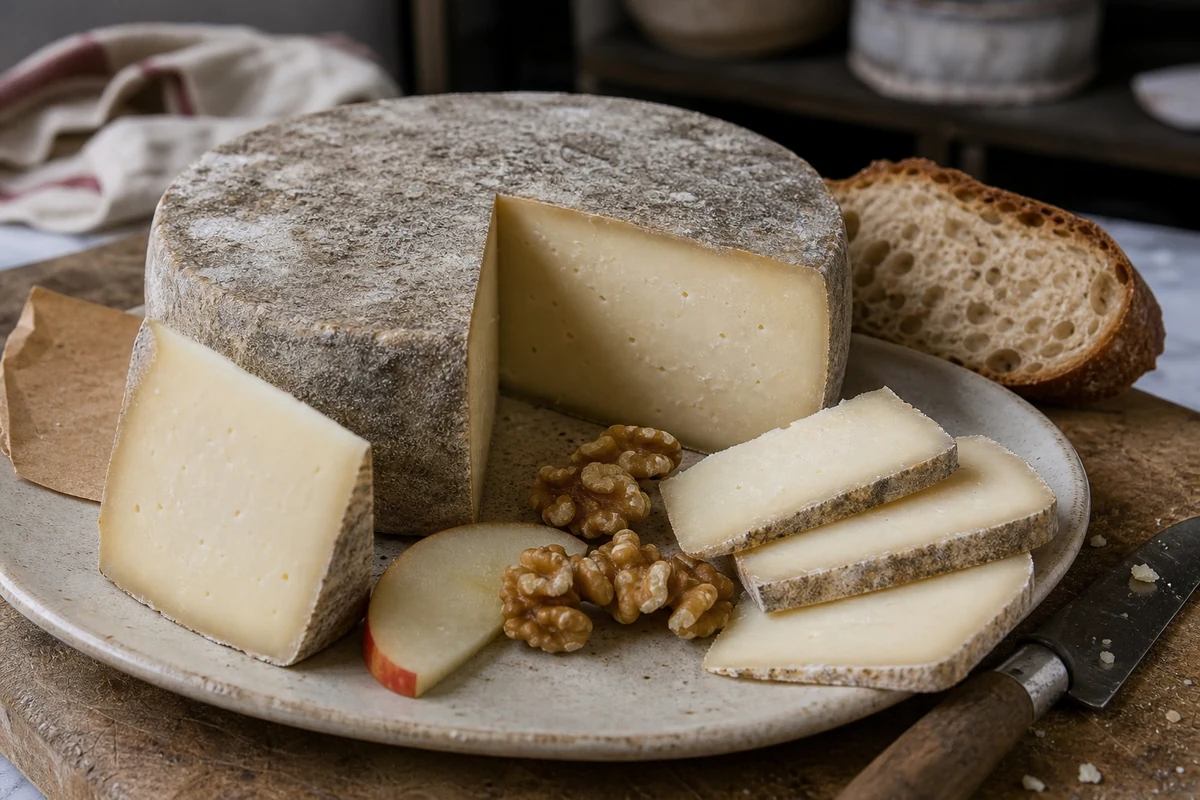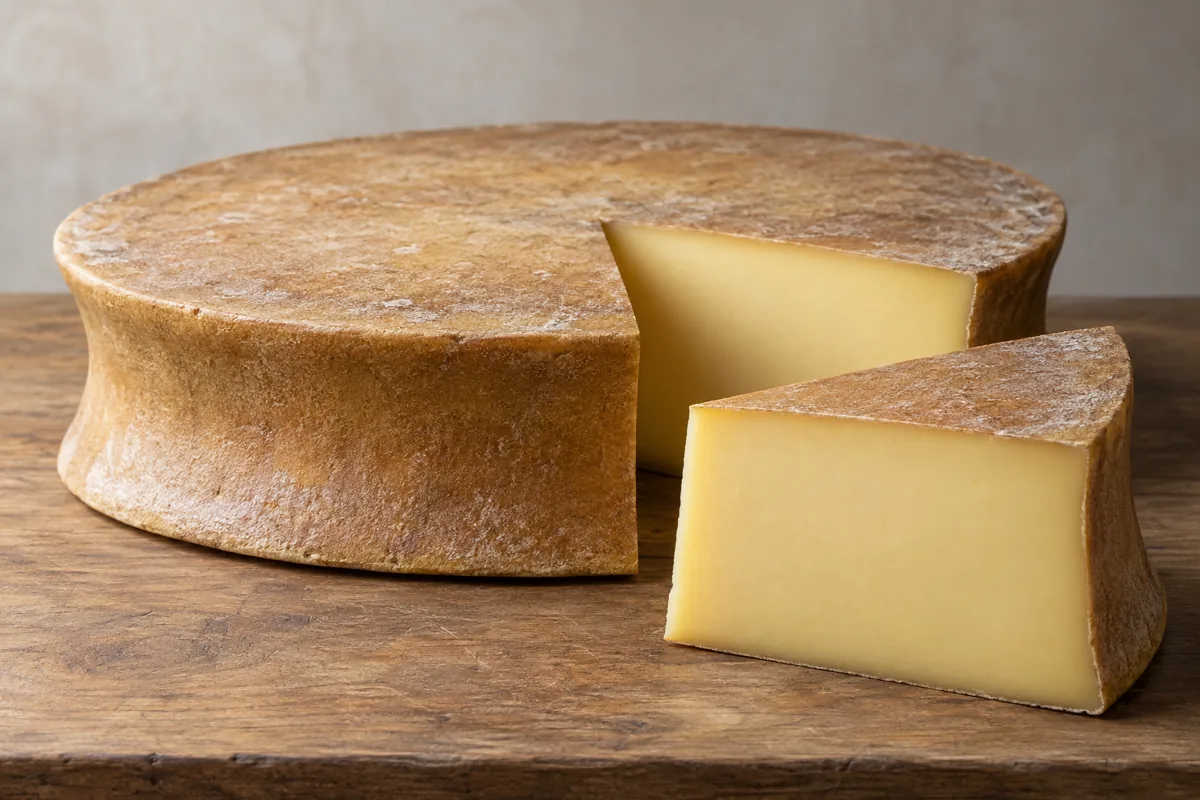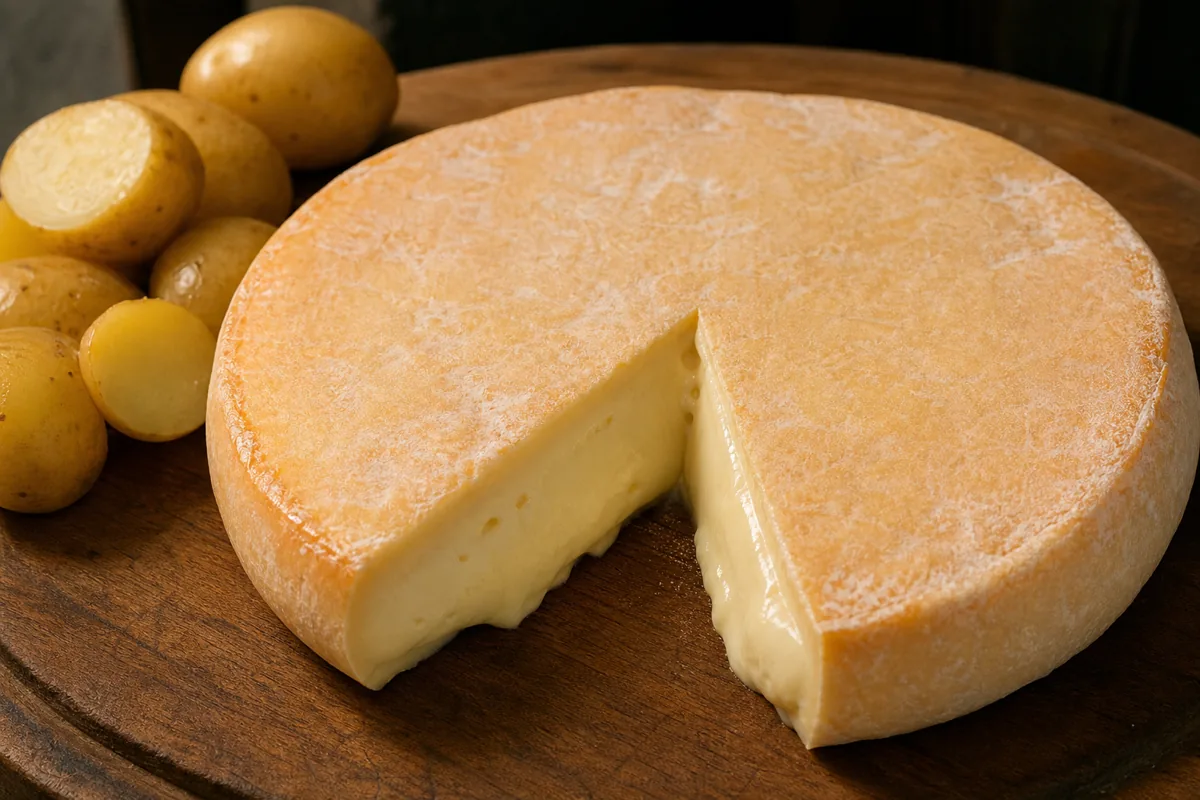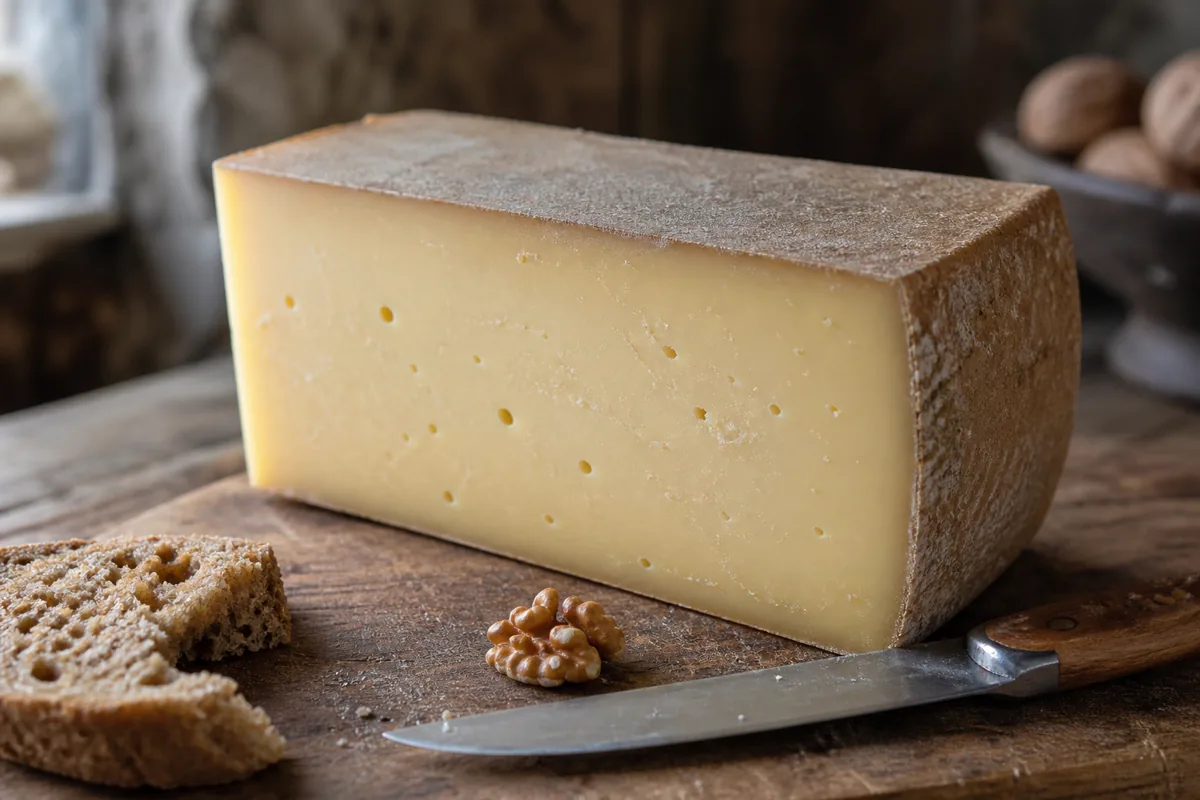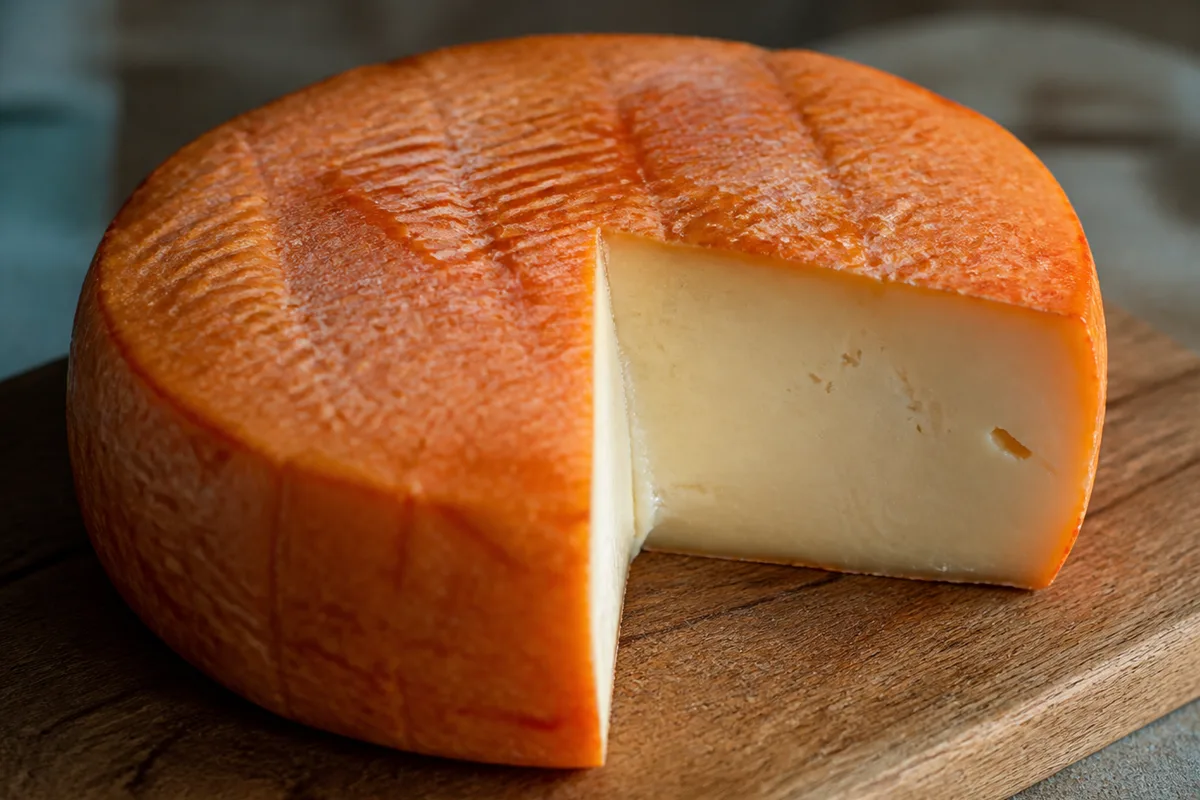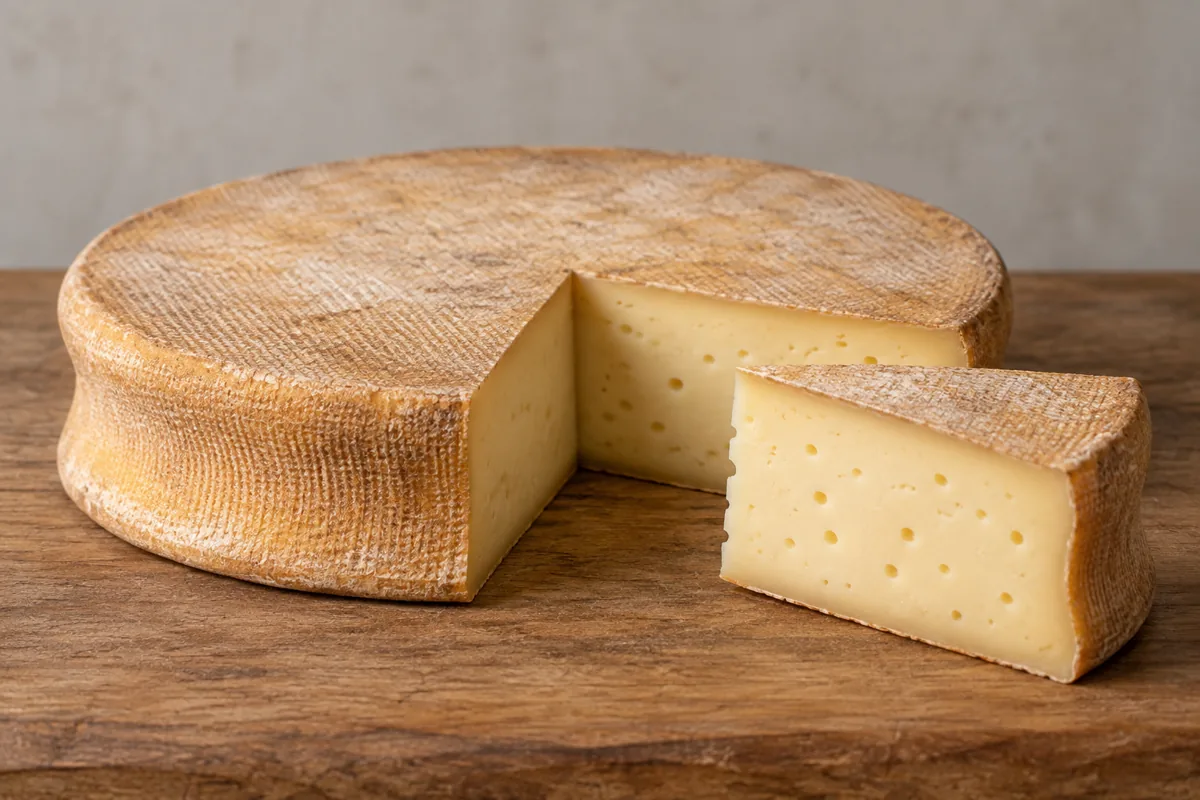
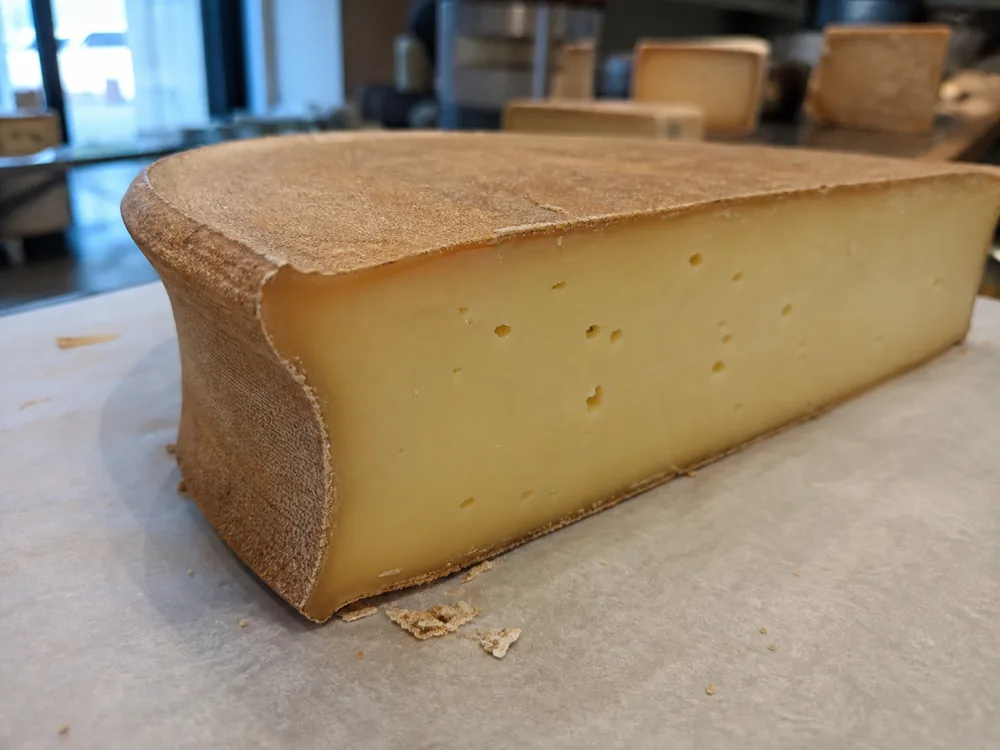
Abondance is a raw-milk cow's cheese from Haute-Savoie in the French Alps. Its low wheel curves inward around the side, giving you the concave heel that makes a whole AOP wheel easy to recognize.
The same rules follow the cheese from permitted cow breeds and pasture through a copper vat and at least 100 days in the cellar. At the table, that supple paste finds its clearest purpose in berthoud, where Abondance melts with Savoie white wine.
In This Article
What Is Abondance Cheese?
Legally, Abondance is a semi-cooked pressed cheese made only from raw, whole cow's milk. In everyday texture terms you can think of it as semi-hard, though its paste remains supple and melting rather than dry or brittle.
The cheese takes its name from the Abondance valley, where the abbey's canons encouraged its production from the 13th century. A record from 1381 even notes 15 quintals sent to the papal conclave in Avignon.
The wheel is the first thing to check: a flat cylinder 7 to 8 cm high with a concave heel, weighing 6 to 12 kg, under a smear-ripened, cloth-marked rind that runs from golden yellow to brown.
The modest format grew from farm making, where a family herd on mountain pasture supplied only enough milk for relatively small wheels. That history still separates Abondance visually from the much larger cooked cheeses of the Alps.
Some retail descriptions show a straight heel, but the registered AOP document requires the inward curve. When a product profile and the designation disagree, trust the concave heel and the 6-to-12-kilogram legal range.
What Do the Abondance AOP Rules Require?
Abondance has carried French AOC protection since 1990, and its modern AOP rules begin with the herd rather than the vat. That choice ties the finished cheese to animals that can handle the steep, seasonal landscape.
Only Abondance, Tarine and Montbéliarde cows may supply the milk. All three cope well with mountain farming, while the Abondance breed also offers a fat-to-protein balance suited to cheesemaking.
You may see both 45 and 55 percent quoted for the Abondance breed's share of a herd. The later requirement, effective from 2022, is 55 percent; 45 percent was an earlier step in the transition.
Feed is tied to the area as well. Cows graze for at least 150 days in summer and eat hay in winter, silage and other fermented feed are banned, and no more than 35% of the herd's yearly dry matter may come from outside the area.
The 2007 decree puts numbers on the diet: at least 50% of the summer base ration is grazed grass, winter hay is given as much as the cows want, and extra feed is capped at 1,800 kg per dairy cow a year.
It also limits stocking to 1.4 livestock units per hectare of main forage area and, from 2022, milk to 5,000 litres per hectare, which ties how much milk a farm can send to the vat to the land it farms.
The ban on fermented feed has one exception in the decree: a separate herd that gives no milk for the cheese may eat it, as long as nothing risks carrying butyric germs into the dairy milk.
Once the milk reaches the dairy, the controls shift from land and feed to heat, ingredients and equipment.
| Point | AOP requirement | What it changes |
|---|---|---|
| Milk | Raw and whole; cream may not be added or removed | No pasteurised or standardised AOP version |
| Heating | No milk treatment above 40°C; one warm-up to 30–35°C before rennet | Natural milk flora remains part of the make |
| Vat | Open copper; farm vats hold at most 1,500 litres | The traditional vessel is part of the designation |
| Ingredients | Milk, salt, calf rennet and lactic cultures; no colouring | The rind colour must develop without added dye |
| Composition | At least 48% fat in dry matter and 58% dry matter | At least about 28 g fat per 100 g of cheese |
| Place | Milk, making and ripening inside listed Haute-Savoie communes | Every main stage stays in the AOP area |
Taken together, the two fat and dry-matter minimums work out to at least about 28 g of fat in every 100 g of Abondance.
Using the milk raw and whole preserves more of the flora that the mountain forage brings into it.
Heat is not the only treatment the decree rules out: bactofugation, ultrafiltration and microfiltration are banned as well, and the making rooms may hold no equipment for them apart from the making vats.
How Is Abondance Made and Aged?
About 10 litres of milk become one kilogram of Abondance, so an average wheel represents roughly 100 litres. The evening and morning milkings meet in the same copper cauldron before rennet goes in.
Time is tight: a dairy must add rennet before noon on the day after the older milking, while a farm has 14 hours from the end of that milking. Those deadlines limit how long raw milk waits before the make begins.
Farm milk waits at 4 to 14°C, then returns to roughly its natural milking temperature in the cauldron. From there, the curd is cut small and heated enough to firm it without turning Abondance into a fully cooked pressed cheese.
- Cutting and heating: after rennet, the curd is cut and heated to 45 to 50°C (syndicate).
- Moulding: the curd is moulded in cloth, which the AOP dairy board calls hessian.
- Pressing: one day under the press.
- Salting: one day in a brine bath (syndicate).
- Ripening: at least 100 days on spruce boards in a cellar, turned every 2 days and rubbed with salty water.
The cut is fine: the syndicate wants pieces from a grain of rice to a kernel of corn, and the decree sets a grain under 1 cm³ and at least 40 minutes of work in the vat between the start of cutting and moulding.
When the curd grains squeak under the fingers, they are ready to leave the whey. The cheesemaker gathers them in cloth, a step that later leaves the rind's characteristic textile pattern.
Each cheese remains in its cloth-lined mould for at least five hours and under pressure for at least seven. Besides marking the surface, the cloth helps the local rind flora establish itself before the wheel enters the cellar.
Before the cellar, the decree allows at most ten days of pre-ripening, counted from the day of making, at 7 to 16°C.
In the cellar, the wheels ripen at 10 to 13°C and at least 90% humidity on unplaned spruce boards, whose rough wood helps the rind flora settle. The 100 days count from the day rennet goes into the milk.
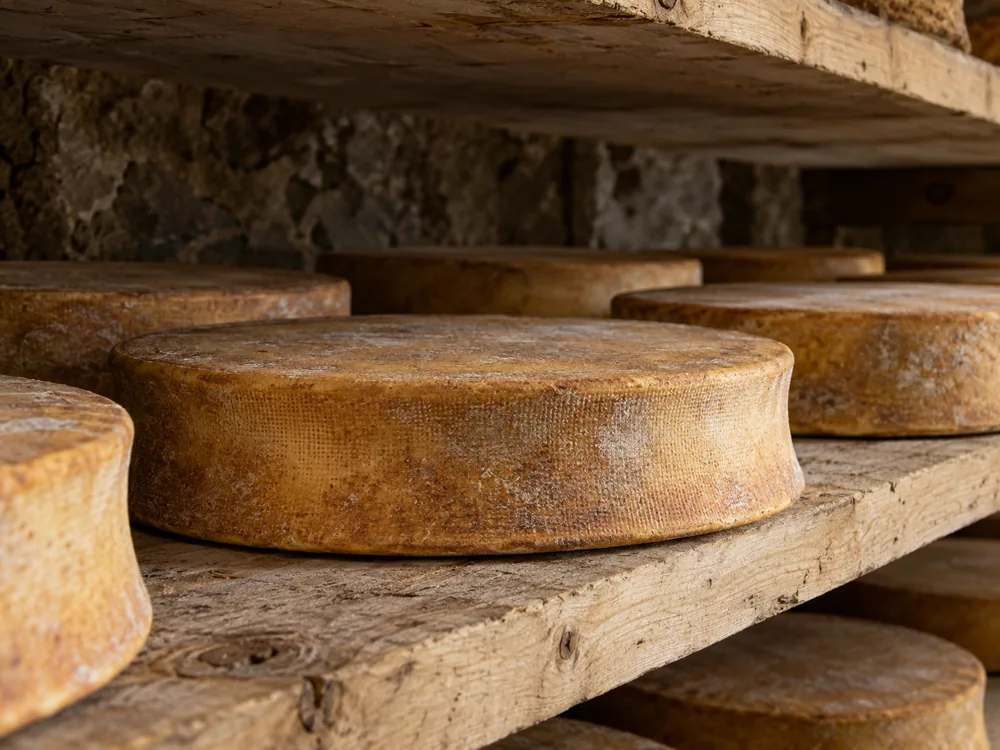
The legal minimum is 100 days, while many wheels continue for four to six months. If you prefer a gentler paste, ask for the younger end; more cellar time usually deepens the rind aroma and nutty bitterness.
What Does Abondance Taste Like?
You can expect fruit and hazelnut over a supple, melting paste, followed by a slight bitterness that keeps the cheese from tasting simply sweet or creamy.
- Fruit: pineapple, apricot and citrus can brighten the centre of the paste.
- Nuts: hazelnut is the clearest recurring note, often joined by gentle salt.
- Rind and finish: a cellar aroma and measured bitterness become more noticeable toward the outside.
That bitter edge belongs to the protected style alongside the small wheel, concave heel and supple body. If your wedge tastes aggressively bitter, however, that goes beyond the gentle finish the designation describes.
Because the melting texture rounds that bitterness, Abondance can move from a cheese board into a hot dish without losing its character.
How Do You Cook With Abondance?
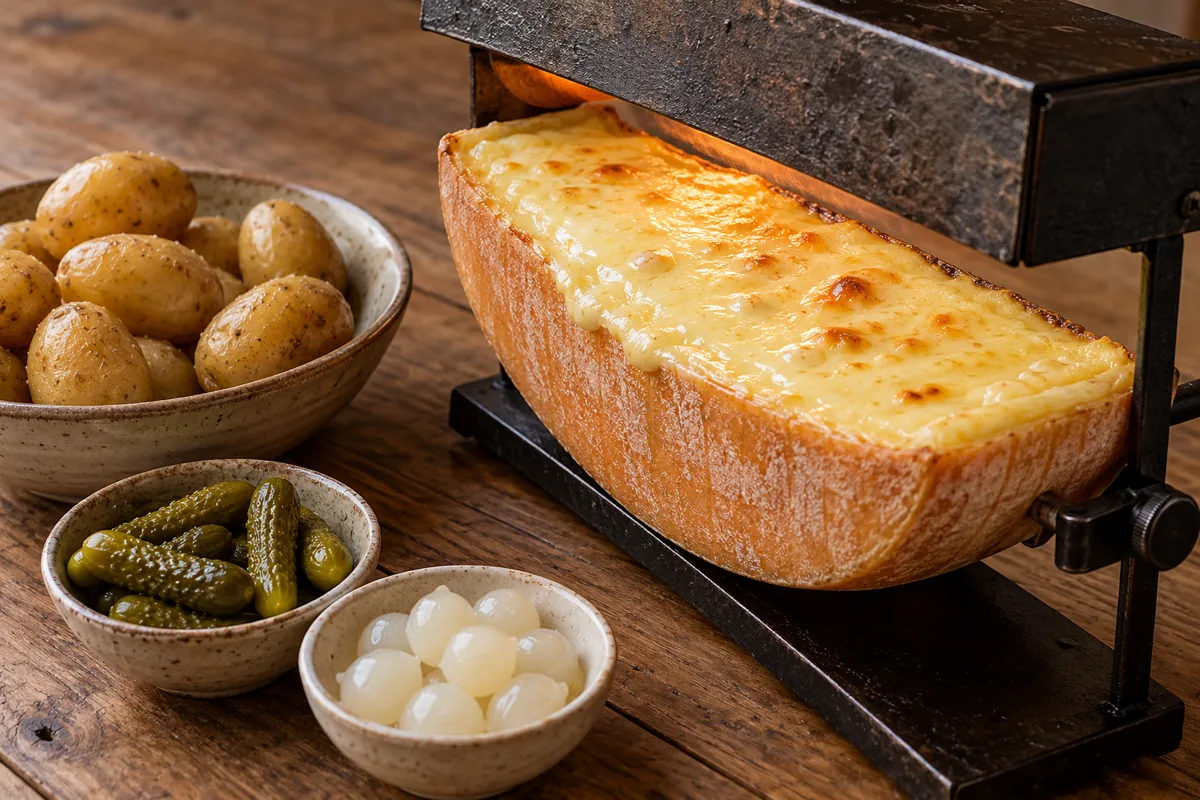
The dish that belongs most clearly to Abondance is berthoud, where sliced or grated cheese bakes with Savoie wine beneath a golden crust. It lets the paste melt while the wine cuts through its richness.
The dish began in the early 20th century at the Cercle Républicain in Thonon-les-Bains, where the Berthoud family served the cheese with garlic, white wine, pepper and nutmeg. Its name now belongs to a formally protected recipe rather than any generic dish of melted Abondance.
Since 6 September 2020, the Traditional Speciality Guaranteed rules have protected the name, ingredient quantities, porcelain cup and method. Unlike an AOP, this designation protects the recipe without confining it to one production zone.
A restaurant using the protected name must be approved, accept inspections and follow the recipe specification. Its central ingredients, Abondance, Savoie wine and Madeira or Port, are protected products in their own right.
For one person, the Châtel recipe uses 180 g of Abondance, 3 to 4 cl of Savoie white wine and 1 to 2 cl of Madeira or Port, plus garlic, pepper and optional nutmeg.
The dish is rubbed with garlic and baked at 180 to 200°C for 10 to 15 minutes. Châtel serves it hot with bread, potatoes cooked in their skins, green salad and cold meats.
Historically, berthoud was eaten on its own. Potatoes, cold meats and green salad came later, and today they turn the individual dish into a fuller meal.
Each portion bakes in its own porcelain cup, with the cheese grated or cut in thin strips so that it melts right through under the golden crust.
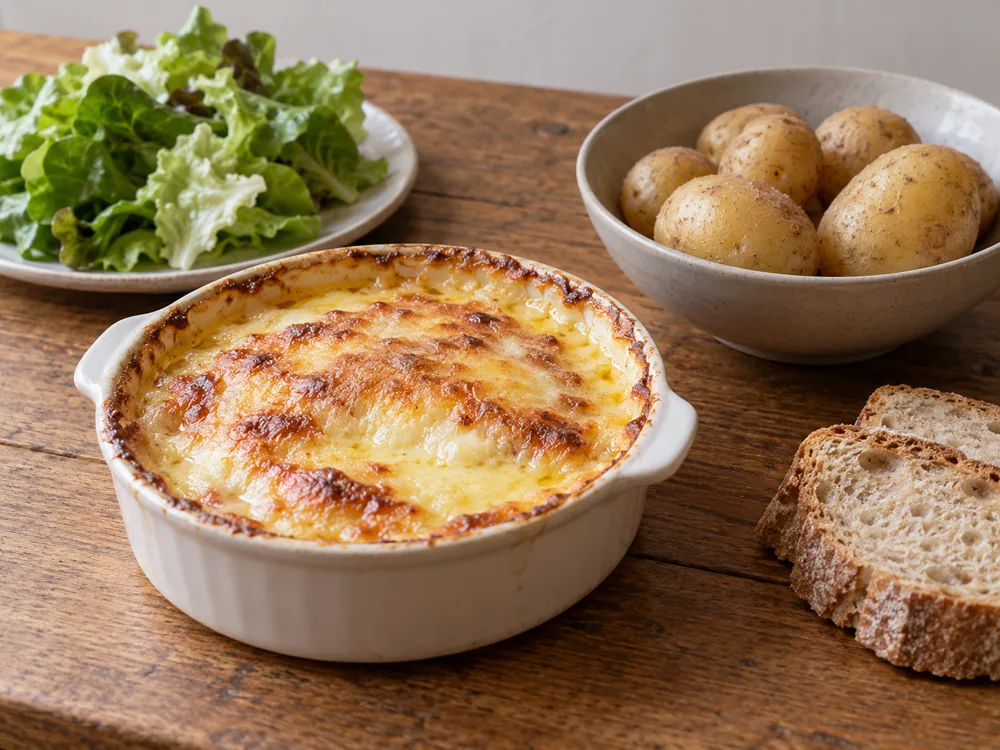
Beyond berthoud, Abondance belongs naturally on a cheese board, where you can notice its fruit and gentle bitterness before heat changes the texture. In cooking, its supple paste also works through crozets, risotto, pastry and pasta.
| Use | How It Works |
|---|---|
| Cromesquis | A crisp fried shell gives the soft, fruity cheese a useful aperitif contrast. |
| Risotto and crozets | Melt Abondance through risotto or Savoyard buckwheat pasta for a rich main course. |
| Asparagus starters | Use it as a savoury crust over asparagus, where the slight bitterness can meet the vegetable. |
| Salad and tourte | A Chablais-style salad keeps the cheese fresh, while a tourte turns its supple paste into a filling. |
| Farandelles or tagliatelles | Grated or melted through pasta, it adds fruit, salt and hazelnut rather than only fat. |
Can You Eat the Abondance Rind?
For berthoud, remove the rind before the cheese goes into the dish, so the washed surface does not take over a smooth melt.
On a table wedge, the rind is a different decision. It should be clean, cloth-marked and golden yellow to brown, with no colouring added, but its washed surface can taste stronger than the paste.
Each wheel is normally wrapped individually to protect the smear, or morge, during handling. Pre-packed pieces must even show rind on three faces, so seeing it at the counter is part of the product's traceable presentation.
Taste a small amount if the seller considers it edible, then decide whether the earthy bitterness improves your bite. A rind-free piece may be intended for further processing, while a visible rind does not obligate you to eat it.
What Goes With Abondance?
Crémant de Savoie gives the rich paste acidity and bubbles, while light regional whites such as Chasselas and Seyssel keep the fruit in view. With an older, more cellar-driven wedge, a dry red can carry more weight.
You can also move away from wine: a mild brown ale or hoppy blonde suits the nutty finish, while honey or quince jam plays against the cheese's slight bitterness. Keep the sweet element small so it supports rather than masks the milk and rind.
| Pairing | Type | Why It Works |
|---|---|---|
| Savoie whites | Wine | Dry Vin de Savoie, Roussette and sparkling rosé keep the rich paste lively. |
| Apremont | Wine | This crisp regional white suits both the fruity centre and slight bitter finish. |
| Red wine | Wine | Chignin, light Burgundy or another dry red can meet a more mature wedge. |
| Jura and Loire whites | Wine | Arbois, Côtes du Jura, Anjou and Saint-Pourçain take the pairing beyond Savoie without losing freshness. |
| Beer | Drink | A mild brown ale, hoppy blonde or porter can pick up the cheese's toasted and nutty side. |
| Honey, ginger and jam | Food | Lavender honey, ginger or chestnut and quince jam soften the slight bitterness; use them sparingly. |
| Nut bread and seeded baguette | Food | Both add texture and echo the hazelnut character without adding more sweetness. |
Abondance or Comté: How Do They Differ?
Both Abondance and Comté are raw-milk AOP cheeses from French mountain regions, yet they solve different jobs on your plate. Abondance is smaller, softer and ready sooner; Comté is firmer and offers a much broader ageing range.
Comté takes milk only from Montbéliarde or French Simmental cows fed exclusively on fodder from its appellation, where Abondance accepts three breeds and allows up to 35% of the herd's dry matter from outside its area.
| Point | Abondance | Comté |
|---|---|---|
| Class | Semi-cooked pressed | Cooked pressed |
| Where it is made | Haute-Savoie | Jura massif |
| Cows | Abondance, Tarine, Montbéliarde | Montbéliarde, French Simmental |
| Paste | Supple, melting, not elastic | Firm, unctuous, fine; tyrosine crystals in old wheels |
| Minimum ripening | 100 days | 4 months |
| Rind colour | Golden yellow to brown | Golden yellow to brown |
| AOC since | 1990 | 1958 |
| Milk producers | 240 | 2,389 |
| Tonnes sold in 2020 | 3,497 | 64,500 |
Hazelnut and citrus can appear in both, so flavour words alone may not settle your choice. Texture and age are more dependable: Abondance melts softly after at least 100 days, while Comté stays firmer and can mature for 18 to 24 months.
Longer-aged Comté can develop toast, brioche and dark chocolate notes that sit outside the usual four-to-six-month Abondance profile. Choose it when you want a firmer, more mature Alpine cheese; choose Abondance when suppleness and easy melting matter more.
Comté's paste colour follows the season: very pale yellow in winter, when the cows eat hay, and yellower in summer from the carotene in fresh grass. Abondance stays within one range, ivory to pale yellow.
Scale differs too. A Comté wheel takes 450 litres of milk on average, which pushed Jura farmers into village cooperatives called fruitières, while the syndicate's 10 litres per kilogram and about 10 kg per wheel work out to roughly 100 litres for an Abondance.
Choose Abondance for a supple, melting paste after at least 100 days. Choose Comté for a firmer paste and the option of 18 to 24 months of age.
For closer method relatives, look toward Valais raclette or Fontina. Reblochon belongs to the same broad Alpine table, but its smaller soft-ripened format leads you toward a different texture.
Farm or Dairy: What Do the Green and Red Plates Mean?
On a whole wheel, the casein plate tells you who made the cheese before you read the fine print: a green oval marks farmhouse Abondance, while a red square marks dairy production.
The plate also carries the workshop code, and farmhouse wheels add the word fermier. A cut wedge may lose that physical marker, so the retail label has to carry the distinction forward.
| Point | Farm cheese (green oval) | Dairy cheese (red square) |
|---|---|---|
| Milk | Only that farm's milk | Milk of several farms working as cooperatives |
| Workshop | One per producer; shared use banned | Abondance milk collected and stored apart from other milks |
| Milk per workshop a year | At most 500,000 kg | At most 5 million kg |
| Word fermier on the label | Allowed | Not allowed |
The farmhouse term covers method as well as milk ownership. Curd must be cut with a wire or fir cutter, lifted from the vat in cloth and turned by hand at prescribed intervals during the first 12 hours.
A specialist affineur may still finish a farmhouse wheel without erasing its farm status, as long as the farm supplied its own milk and carried out the required make.
Farm production remains visible, with 75 farmhouse producers counted in 2020 alongside 240 milk producers and 16 dairy plants. You therefore have a realistic choice between green-plate and red-plate cheese rather than a purely historical distinction.
Both kinds still follow the same core AOP rules for breeds, feed, raw whole milk, copper vats and minimum ripening.
How Do You Buy and Store Abondance?
At the counter, look first for the name Abondance and the EU AOP symbol. On a whole wheel, the casein plate and make date add clues about origin and age; on a wedge, the label must do more of that work.
The heel prints the day and month of manufacture, allowing you to count forward from the make date when a seller gives only a vague age. One hundred days is the floor, not a guarantee of a particular maturity.
A few small, regular openings are normal under the AOP description. Do not reject an otherwise sound wedge simply because a retailer's idealized profile showed a completely closed paste.
At home, keep Abondance in its original wrapping in the refrigerator's vegetable drawer, where the environment is less cold and dry than the back wall. Give it at least 30 minutes outside the fridge before serving so the fruit and hazelnut become easier to taste.
Is Abondance Safe During Pregnancy?
Every AOP Abondance is made from raw milk, so you cannot solve the pregnancy question by choosing a pasteurised version of the same protected cheese.
NHS guidance accepts hard cheese made with either raw or pasteurised milk, but its semi-hard list covers only pasteurised cheeses, and Abondance is usually classed as semi-hard.
The CDC lists raw-milk dairy among riskier choices and puts hard cheese on its safer list only when the milk is pasteurized, a condition AOP Abondance never meets.
Take the exact product and its raw-milk status to your midwife or doctor before buying it, as you would for any other question about cheese during pregnancy.
What Else Do People Ask About Abondance Cheese?
It is a hardy local breed named after the Abondance valley, kept mainly for milk. You can recognise it by its mahogany coat and the brown rings around its eyes, and it arrived with the Burgundians around the 5th century.
No. The AOP rules allow only calf rennet.
A restaurant cannot use the protected name for a version built on another cheese. The Traditional Speciality Guaranteed fixes the ingredients and quantities, with Abondance at the centre of the recipe.