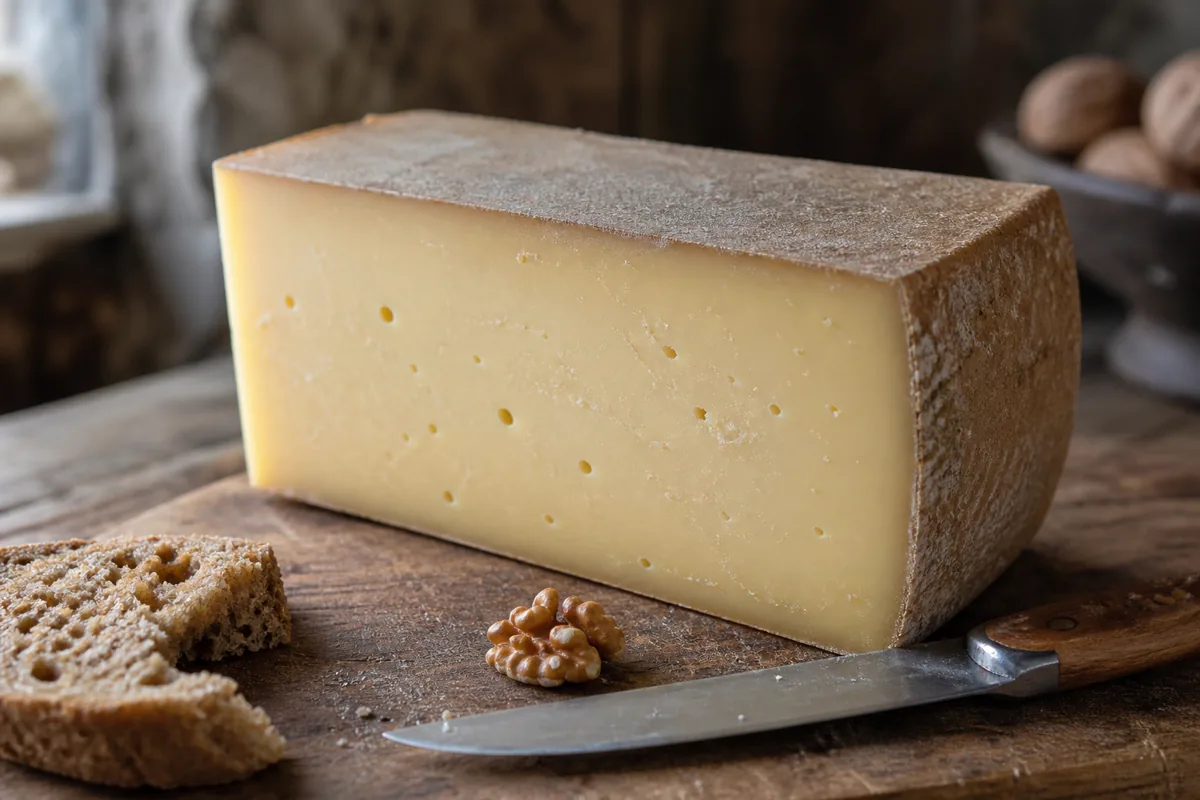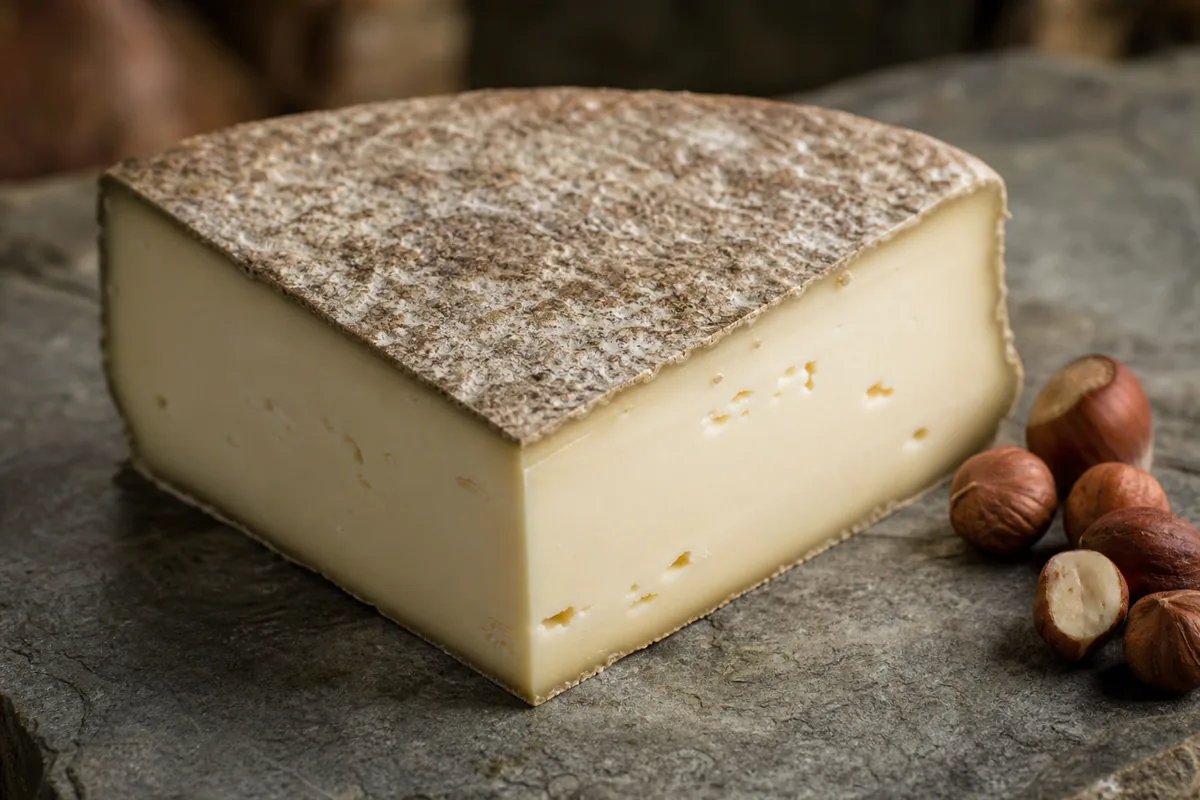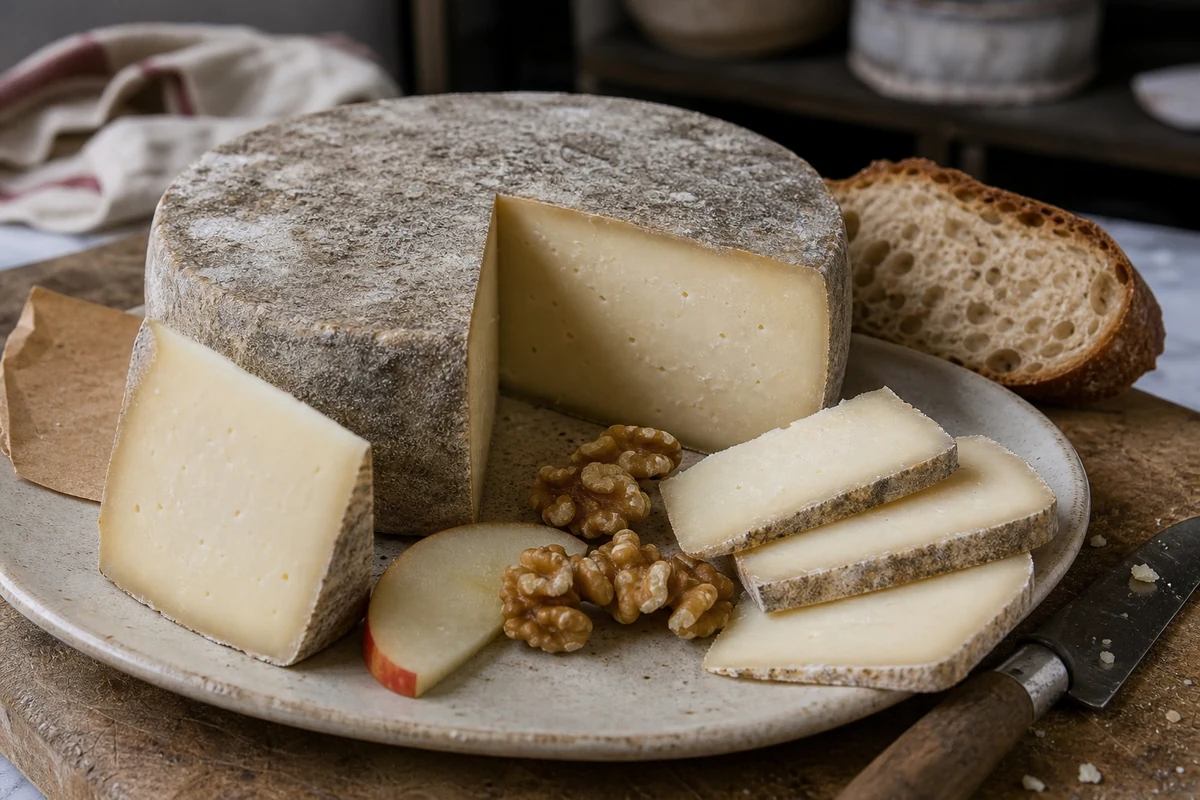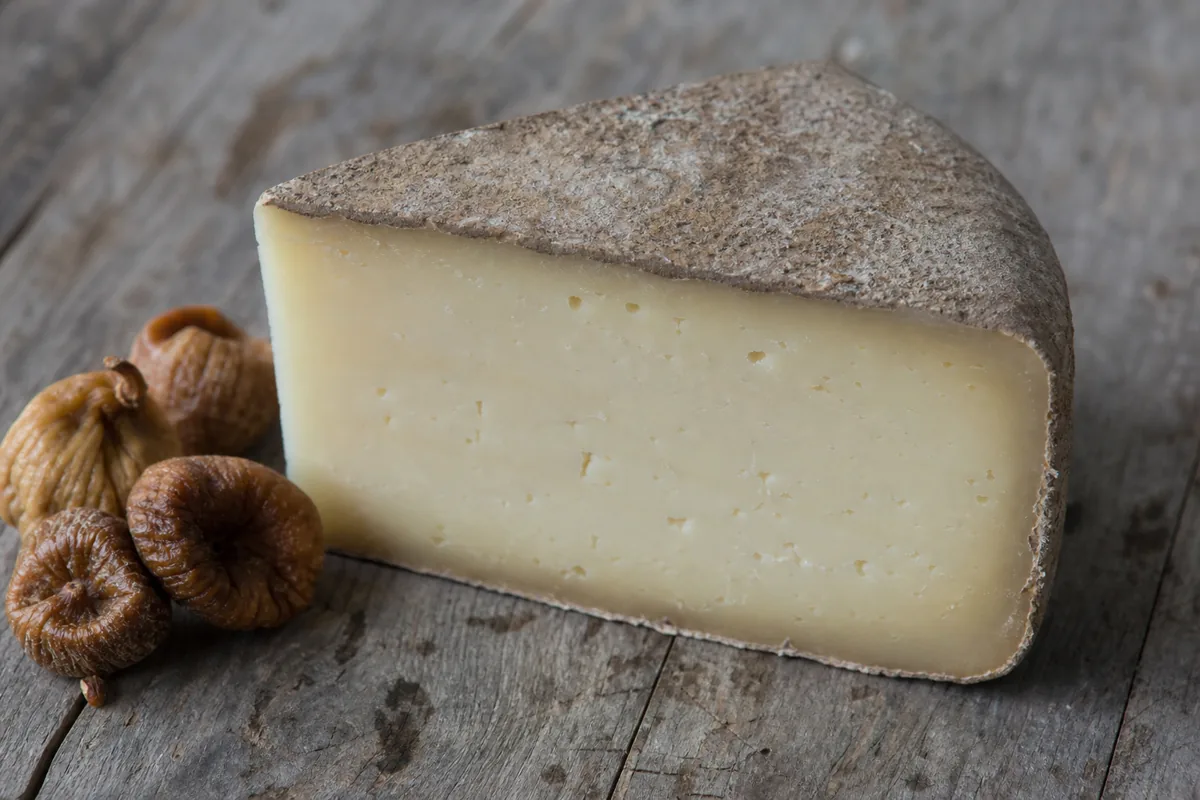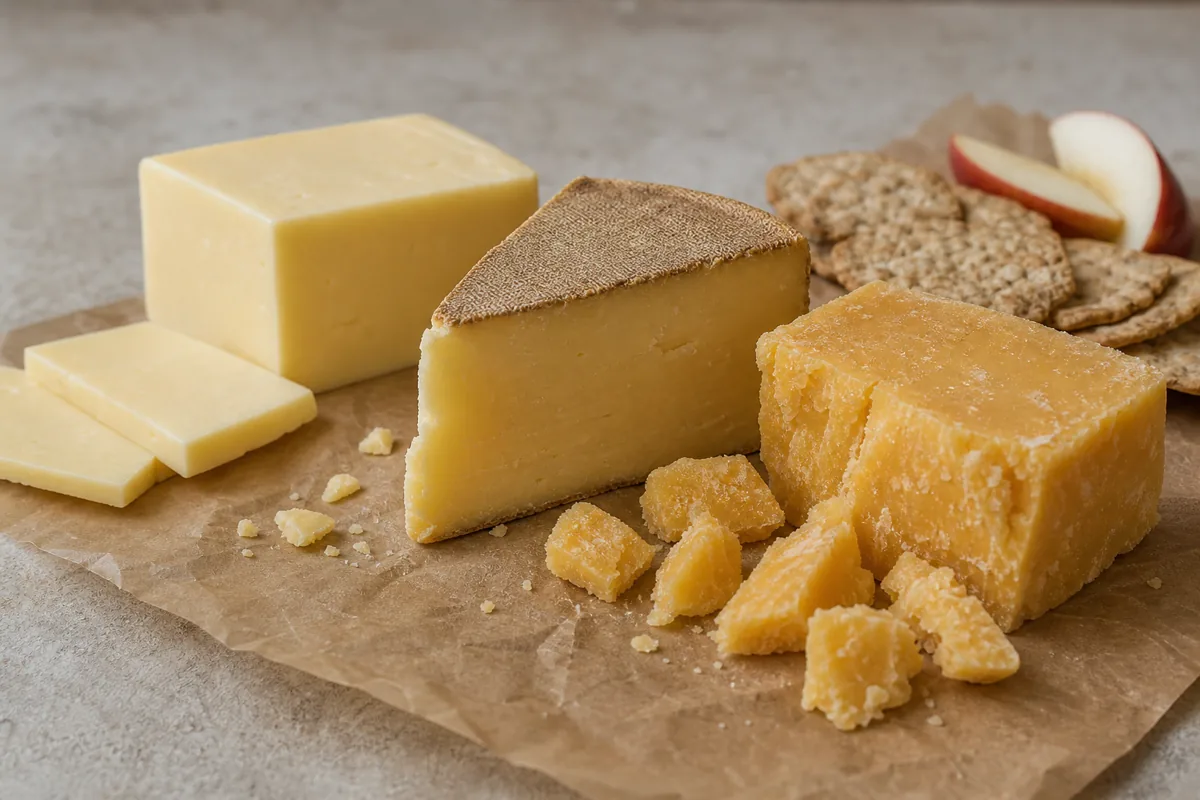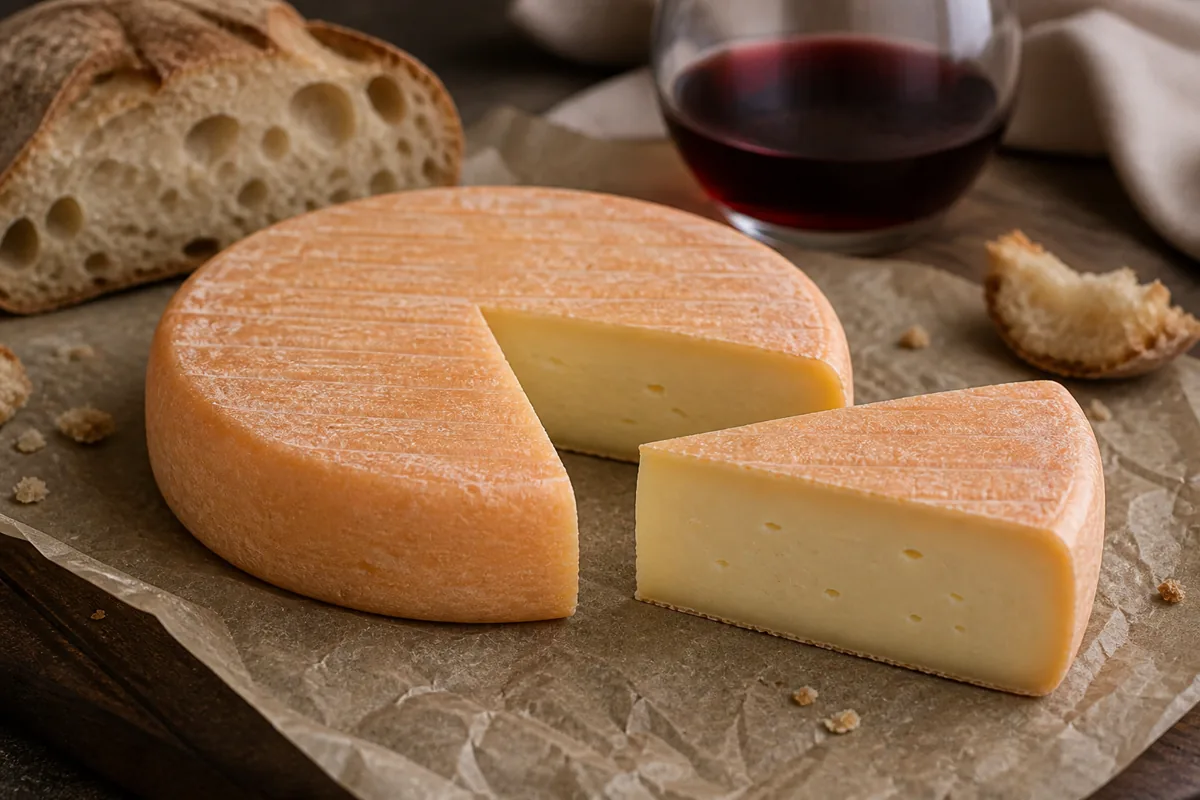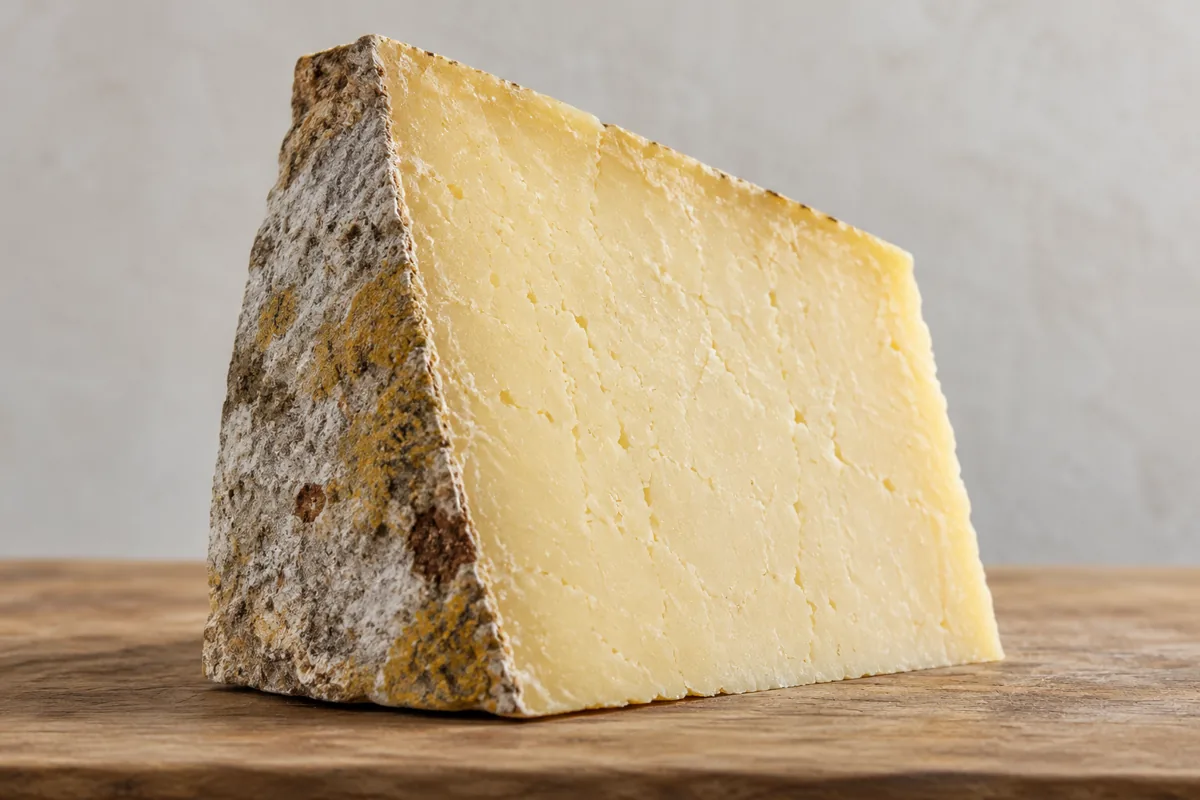
Cantal is a firm cow's milk cheese from the Auvergne mountains of France, made in a tall cylinder of about 40 kg and pressed twice. Its label must carry one of three age words: jeune, entre-deux or vieux.
Those words follow fixed ripening windows in the AOP rules, and the paste moves from supple and milky to drier, fruitier and more intense as it ages.
In This Article
What Is Cantal?
The protected name is Cantal or Fourme de Cantal. The AOP specification says a court in Saint-Flour recognised it as an appellation of origin on 17 May 1956, and a decree of 19 February 1980 made it an AOC.
CNIEL, the French dairy council, adds that EU protection as an AOP followed in 1996.
The area covers almost all of the Cantal department and a few communes in Aveyron, Corrèze, Haute-Loire and Puy-de-Dôme. Its core is the volcanic Monts du Cantal, which rise to 1,858 m at the Plomb du Cantal.
The rules allow two formats. The large cylinder weighs 35 to 45 kg from a mould 36 to 42 cm across, and the reduced format, labelled "petit", weighs 8 to 10 kg from a 20 to 22 cm mould.
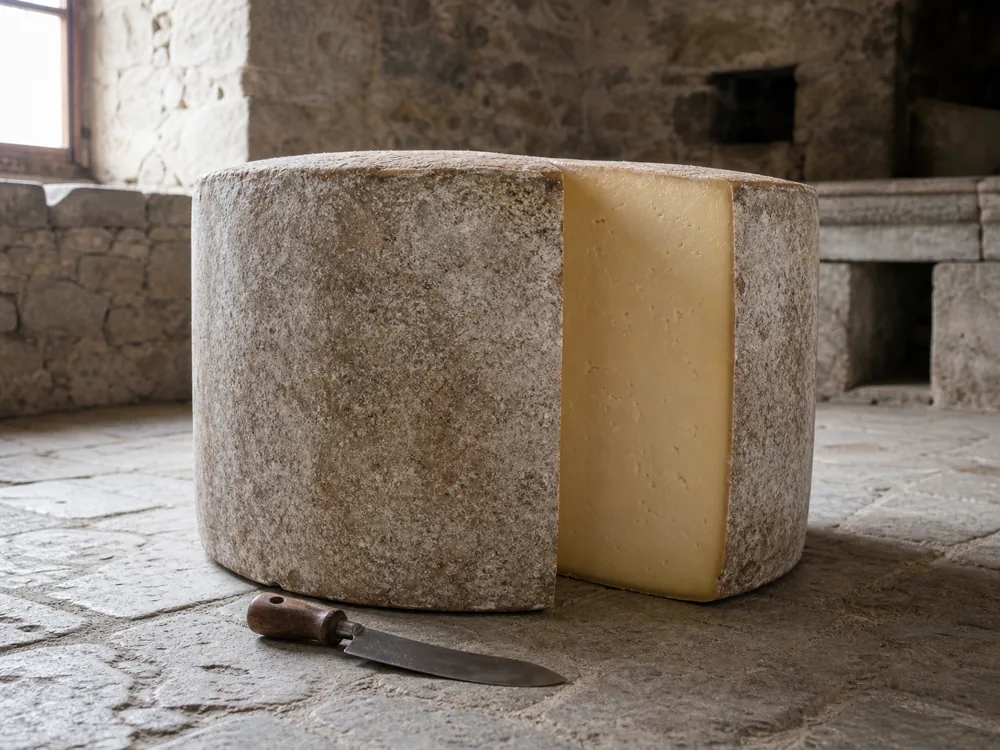
Other sources give different sizes. The AOP dairy board rounds the large wheel to 40 cm across, 40 cm high and 40 kg.
CNIEL lists a petit of 15 to 20 kg from a 26 to 28 cm mould and a Cantalet of 10 kg from a 20 to 22 cm mould. Only the Cantalet's mould matches a format the specification names, so the "petit" qualifier that the label rules reserve for the reduced format means the 8 to 10 kg cylinder, not CNIEL's heavier one.
The rules require at least 45% fat in dry matter, a figure that leaves out the water in the cheese. CNIEL gives the fat as 24 to 26% of the total weight.
What Do Cantal Cows Eat?
The specification describes the Cantal area as cool, wet mid-mountain country, at least 500 m up or with slopes steeper than 15%, and with at least 700 mm of rain a year. It says this mix of soil, altitude, relief and climate suits the area's communes to grass.
The herd's base ration must come entirely from coarse fodder grown in the area, and grazed or conserved grass must make up at least 70% of its dry matter. Cows in milk graze every day once the weather allows, and for at least 120 days a year grazing must cover at least 70% of their base ration.
In the period when grazing cannot cover that 70%, each cow in milk gets at least 5 kg of hay (dry matter) a day. Dry complementary feed, over 85% dry matter, is capped at 1,800 kg per cow per year and must come from a list of permitted ingredients.
Fodder that harms the smell or taste of the milk, such as leeks, cabbages, rape, turnips and beet leaves, is banned, and genetically modified crops cannot be grown anywhere on a supplying farm.
Each supplying farm needs at least one hectare of farmland per cow, and the dairy herd must be made of cows and heifers born and raised inside the area, with narrow exceptions for health reasons and a few mountain breeds.
How Is Cantal Made?
Cantal's texture comes from a make that presses the curd twice and mills it in between. The specification traces this to the burons, stone huts where herders made the cheese from May to October and had to keep it through long journeys to market.
The specification sets each step with a time or a temperature.
- Renneting: the milk is set with rennet only, at 30 to 34°C, and coagulates in 22 to 45 minutes.
- First pressing: the curd, cut to grains between the size of wheat and maize, is pressed in a presse-tome and turned at least twice, reaching more than 48% dry matter within four hours.
- Maturing the tome: the pressed block, called the tome, rests at least 10 hours at 15 to 20°C and acidifies to pH 5 to 5.4.
- Milling and salting: at least 13 hours after renneting, the tome is milled and mixed with dry salt, then waits at least an hour.
- Second pressing: the curd goes into the mould in layers and is pressed for at least 18 hours for a large wheel or 12 hours for a petit.
The minimum times add up to at least 32 hours from renneting to the end of the second pressing for a large wheel: 13 hours before milling, an hour with the salt and 18 hours of pressing. Taste France describes the pressed curd resting 10 to 24 hours before milling, where the specification sets only the 10-hour floor.
The specification gives each step a job. The presse-tome drains the curd and raises its dry matter, the long rest lets the tome acidify, milling gives the paste its texture, salting through the mass spreads the salt evenly before ripening, and the second pressing gives the cheese its shape.
It adds that the double pressing, the long acidification and the salt in the mass, together with a high dry matter, are what let Cantal be sold at several ripening stages and kept for long periods. CNIEL describes the resulting texture as grainy and crumbly.
Dairies using raw milk work it as soon as it arrives, while heat-treated milk may wait up to 48 hours between the start of collection and renneting, including at most 24 hours of maturation. On a farm, renneting must take place within 24 hours of the oldest milking, and the vat used may be the wooden gerle.
Beyond milk, the only ingredients allowed are rennet, bacterial, yeast or mould cultures shown to be safe, salt and calcium chloride. Fat may be adjusted to reach the 45% minimum, but standardising protein, concentrating the milk, and freezing the milk, the curd or the fresh cheese are banned.
Ripening happens in rooms at 6 to 12°C with at least 95% humidity, where the wheels are rubbed or brushed and turned to build an even rind. The rules ban ripening under plastic film.
Ripening became a trade of its own when dairies began collecting milk from several farms at the end of the 19th century, because most of those dairies lacked the skill, the rooms and the capital to ripen cheese. Specialist ripeners took it over, and their cool, damp cellars and regular care let Cantal reach its different stages.
The specification says the rind, the texture of the paste and the taste all develop during ripening, through those cellar conditions and the ripener's care.
Jeune, Entre-Deux and Vieux: How Long Is Each Aged?
The AOP rules tie each stage word to a ripening window counted from the day of renneting, and to a minimum dry matter. Other sources round those windows in different ways.
| Stage | AOP specification | AOP dairy board | CNIEL | Taste France | Cheese.com |
|---|---|---|---|---|---|
| Jeune | 30 to 60 days; at least 57% dry matter | 30 to 60 days | At least 30 days | At least 30 days | 1 to 2 months |
| Entre-deux | 90 to 210 days; at least 58% dry matter | 90 to 120 days | 3 to 4 months | 2 to 6 months | 3 to 9 months |
| Vieux | 240 days or more; at least 60% dry matter | More than 240 days | More than 8 months | Over six months | Over 8 months |
The widest spread is in entre-deux. Under the rules, a cheese sold with that word can be anything from 90 to 210 days old, roughly three to seven months, while the dairy board gives 90 to 120 days and CNIEL 3 to 4 months.
Those dry-matter minimums leave a vieux with at most 40% water against 43% for a jeune, and the specification describes the paste as supple when young and slightly crumbly in the most aged cheese.
Cheese aged 61 to 89 days, or 211 to 239 days, must stay in approved ripening sites and can only be sold on to another approved company, as plain Cantal with no stage word.
The stage word is fixed on the day the cheese leaves an approved ripener's cellar for a consumer or for a distributor that is not an approved ripener. Age counts from renneting, and moving a cheese between approved ripening sites does not break the count.
From 120 days, the fourth month after renneting, the label may also state the age in months.
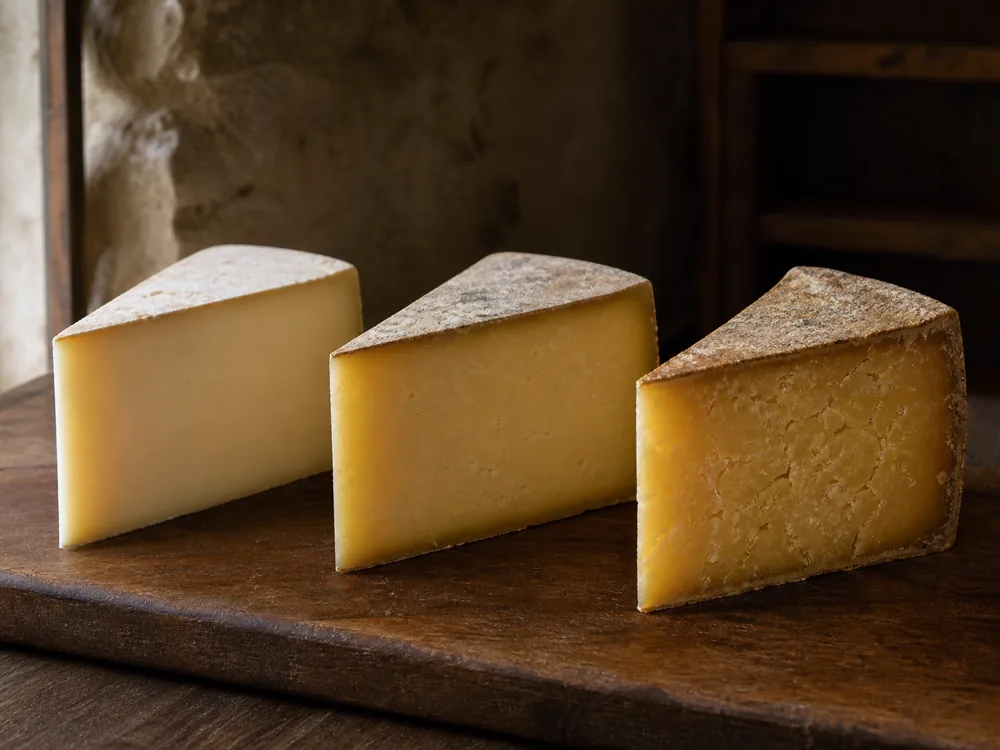
A stage word guarantees only its window: jeune 30 to 60 days, entre-deux 90 to 210 days, vieux 240 days or more. A months figure, allowed from 120 days, states the age more closely.
Is the Cantal Specification About to Change?
France 3 reported in November 2025 that the cheese interprofession, the CIF, has proposed replacing the three stage words with two. Jeune would stay at 30 to 60 days, and an aged cheese would start at 120 days, sold under months such as 4 to 6 or 6 to 8.
Cheese aged 60 to 120 days could then no longer be sold. CIF president Laurent Lours says that at 90 days the cheese has barely started to ripen, and that consumer studies found it more expressive, fruitier and easier to identify at 120 days.
He adds that for three or four years every company has already released its aged cheese at 120 days, which sits at the top of the dairy board's 90 to 120 days and CNIEL's 3 to 4 months for entre-deux.
France 3 itself lists today's windows as 90 to 180 days for entre-deux and from 210 days for vieux, which differs from the specification's 90 to 210 and 240 days, a gap the report does not explain.
The second proposal concerns feed. Lours says the sector has had to ask for a derogation in one year out of two over the last decade, because drought leaves grass and fodder stocks short.
The draft would allow hay, and only hay, bought outside the area, up to about 600 kg per cow a year, while lengthening the minimum grazing from 120 to 150 days and banning maize silage for 75 of those days.
Lours says the maize-free period is meant to strengthen the taste and give a slightly yellower paste, but that it is too early to judge, because none of it applies yet.
The file still has to be agreed with an inquiry commission and validated by INAO, and Lours put an official decree two or three years away. Producers are not united either: the 740 to 750 producers work across a zone from 200 to 1,500 m of altitude, and some find the changes go too far while others want more.
France 3 states there is no change for now, so the stage words and windows above still apply.
What Does Each Cantal Stage Taste Like?
The AOP specification gives one line for the whole range: the taste starts lactic, sometimes slightly tangy, and grows fruity, intense and long-lasting with age.
The specification adds that the dry rind thickens with ripening time, and Taste France splits the range into three stages by rind, paste and texture.
- Jeune: Taste France describes a firm yet supple texture with buttery flavours, a thin white to greyish rind and ivory to straw-yellow paste.
- Entre-deux: Taste France gives a soft, creamy paste with notes of hazelnut and fermented cream under a golden-brown rind.
- Vieux: Taste France describes a dry, almost crumbly texture and a strong character, with a brown rind and a brownish paste.
Cheese.com says entre-deux has a creamy interior with a texture that recalls Cheddar. It sums up the flavour as a tangy butter taste that deepens with age.
The AOP dairy board adds that the flavours change with age while the paste stays firm yet melting in the mouth.
How Do You Cook With Cantal?
The Auvergne dish that uses Cantal is truffade, potatoes fried with thin slices of cheese until the mass turns slightly stringy. The Auvergne AOP cheese association's recipe uses tome fraîche, the fresh pressed curd, together with Cantal jeune.
The association's recipe for six uses 1 kg of potatoes, 300 g of tome fraîche de Cantal, 150 g of Cantal jeune and eight slices of smoked streaky bacon, with chopped garlic and parsley.
Its potatoes are Bintje, diced coarsely, rinsed and dried in a cloth, and it recommends a deep non-stick sauté pan.
The potatoes are fried in the bacon fat and partly crushed before the cheese is folded in with two wooden spatulas. The flattened cake then cooks covered on low heat for about 5 minutes, gets the garlic and parsley for 2 more minutes, and finishes on higher heat until the edges turn golden.
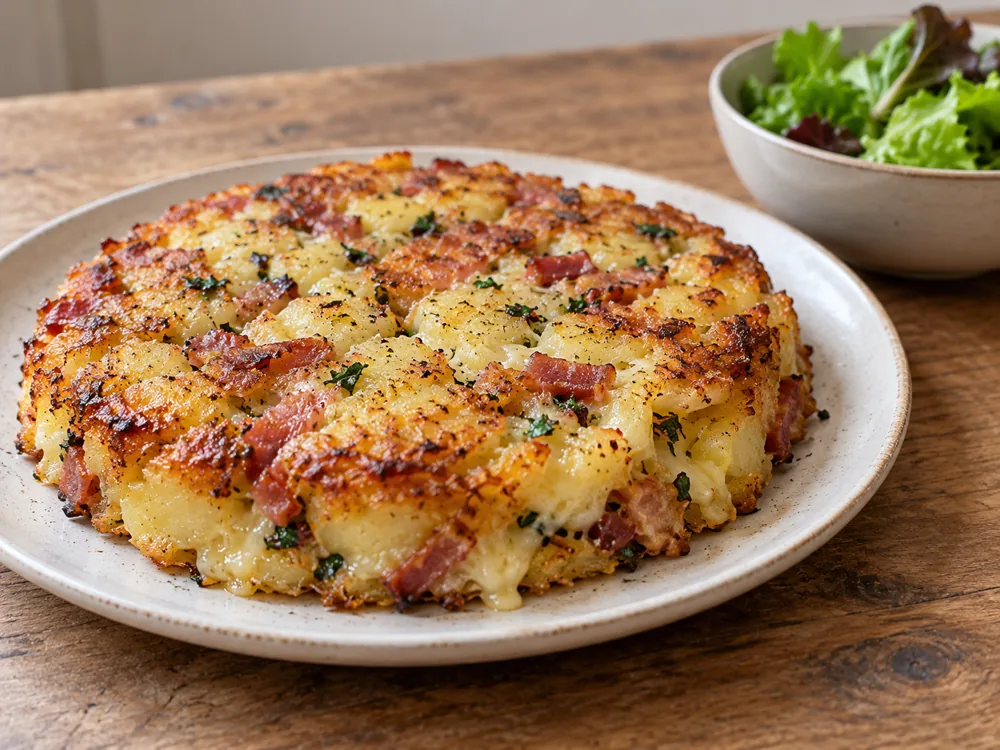
The association serves it turned out of the pan like a tarte tatin, with a green salad.
Its Auvergne fondue uses about 1 kg of AOP cheese for six to eight people, melted into white wine with garlic, grainy mustard and nutmeg. The "crêtes cantaliennes" version is one third each of Cantal jeune, entre-deux and vieux.
The association's other favourite is half Cantal entre-deux and half dairy-made Saint-Nectaire.
The method removes the rinds and cuts the cheeses into dice or strips, rubs the pot with garlic and adds the cheese gradually to the hot wine, stirring in figures of eight with a wooden spoon.
The bread is a large country loaf cut up in advance so that it hardens, and a few crumbs of Bleu d'Auvergne can sharpen the fondue.
| Use | How It Works |
|---|---|
| Auvergne raclette | The Auvergne AOP cheese association melts 150 g each of Cantal, Saint-Nectaire, Salers, Bleu d'Auvergne and Fourme d'Ambert over potatoes and charcuterie. |
| Egg bricks | CNIEL lists bricks d'œuf à la cantalienne among its Cantal recipes. |
| Potato cake | CNIEL also names a gâteau de pommes de terre au Cantal. |
| Aligot | Taste France calls Cantal the cheese of choice for aligot, mashed potato with cheese and garlic. |
| Eaten as it is | Taste France says Cantal is mostly eaten in its natural state, though it is also good melted. |
What Goes With Cantal?
The AOP dairy board's breads and drinks for Cantal are the same list it gives for Salers, which adds only white vermouth, so the list is shared rather than written for Cantal alone.
Taste France is more specific. It serves Cantal on farmhouse bread or with cured ham, in a Cordon Bleu-style chicken suprême or a vegetable soup, and it insists on a Marcillac red for wine.
Beer is on the dairy board's list too, as dark beer and lager.
| Pairing | Type | Why It Works |
|---|---|---|
| Breads | Food | The AOP dairy board names nut, cereal, cocoa, Vienna and wholemeal bread. |
| Cured ham and farmhouse bread | Food | Taste France serves Cantal on farmhouse bread and with cured ham, and also names a Cordon Bleu-style chicken suprême and a vegetable soup. |
| Champagne | Wine | The AOP dairy board lists brut, rosé and demi-sec Champagne. |
| White wine | Wine | The AOP dairy board names dry white wine from the Jura. |
| Red wine | Wine | The AOP dairy board names reds from the Jura, the Loire and Bordeaux; Taste France suggests Marcillac red. |
| Islay whisky | Drink | The AOP dairy board suggests a peated Islay whisky. |
For a winter cheese board, the Auvergne AOP cheese association sets a piece of Cantal jeune beside Saint-Nectaire, Salers, Bleu d'Auvergne and Fourme d'Ambert. It picks the jeune for its mildness and melting texture.
How Does Cantal Compare With Salers?
Salers is also a pressed uncooked cow's milk AOP, first made in the village of Salers in the Cantal mountains. The AOP dairy board's figures show Cantal selling roughly ten times Salers' tonnage.
| Point | Cantal | Salers |
|---|---|---|
| Milk | Raw or heat-treated cow's milk | Raw milk |
| When it is made | All year | 15 April to 15 November only |
| Who makes it | 933 milk producers, 77 of them farmhouse, and 12 production plants | 78 producers, all farmhouse |
| Wooden gerle | May be used to rennet milk on a farm | Used for the milk and for making the cheese |
| Maturing plants | 4 | 7 |
| Protected since | 1956 | 1961 |
| Tonnes sold in 2020 | 10,538 | 1,064 |
The specification says the move from burons to village dairies at the end of the 19th century let Cantal be made all year. The dairy board ties Salers to the 15 April to 15 November period when its cows are out at pasture.
The dairy board calls Salers the only fully farmhouse AOP cheese. A Cantal label may say it was made with milk from Salers-breed cows, but only when all of the milk came from that breed, so the phrase names the cows and the cheese is still a Cantal.
How Do You Read a Cantal Label and Keep a Wedge?
The label must show the name, the stage word and, on the small format, "petit", all in letters at least two-thirds the size of the largest on the label. It must also carry the EU AOP symbol and say who made the cheese and who ripened it.
The label names both firms because making and ripening are separate jobs, and the dairy board counts 12 production plants but only 4 maturing plants.
CNIEL adds a quick check on the rind: a rectangular plate that is green for raw milk and brown for pasteurised milk.
Taste France recommends keeping Cantal in the refrigerator wrapped in parchment paper, then taking it out 30 minutes before eating so it reaches room temperature.
Is Cantal Safe During Pregnancy?
It depends on the milk. The AOP rules allow Cantal from raw or heat-treated milk, and farmhouse Cantal must always use raw milk.
CNIEL advises pregnant women, children under five and people with weakened immunity against raw-milk cheeses other than cooked pressed ones. Cantal is an uncooked pressed cheese, so raw-milk Cantal falls inside that advice.
The NHS lists pasteurised or unpasteurised hard cheeses such as cheddar as safe, but only pasteurised semi-hard cheeses such as edam. Cantal sits between those lines: the AOP rules call its paste firm, while Cheese.com classes it as semi-hard.
The CDC lists dairy products made from raw milk as riskier and hard cheese made with pasteurized milk as safer. It says pregnant women are 10 times more likely to get a Listeria infection.
Neither agency names Cantal, so the milk line on the label, lait cru or lait pasteurisé, is the fact to take to a midwife or doctor.
SOURCES & REFERENCES
What Else Do People Ask About Cantal Cheese?
No. Salers is a separate AOP cheese made only from raw milk between 15 April and 15 November, while Cantal is made all year from raw or heat-treated milk.
Cheese.com compares the texture of Cantal entre-deux to Cheddar, but Cantal is made differently: the curd is pressed, milled, salted and pressed again.
The AOP dairy board describes a firm yet melting texture, and Cantal jeune goes into truffade and Auvergne fondue.
Look for lait cru on the label. CNIEL says raw-milk Cantal carries a green plate on the rind and pasteurised Cantal a brown one.