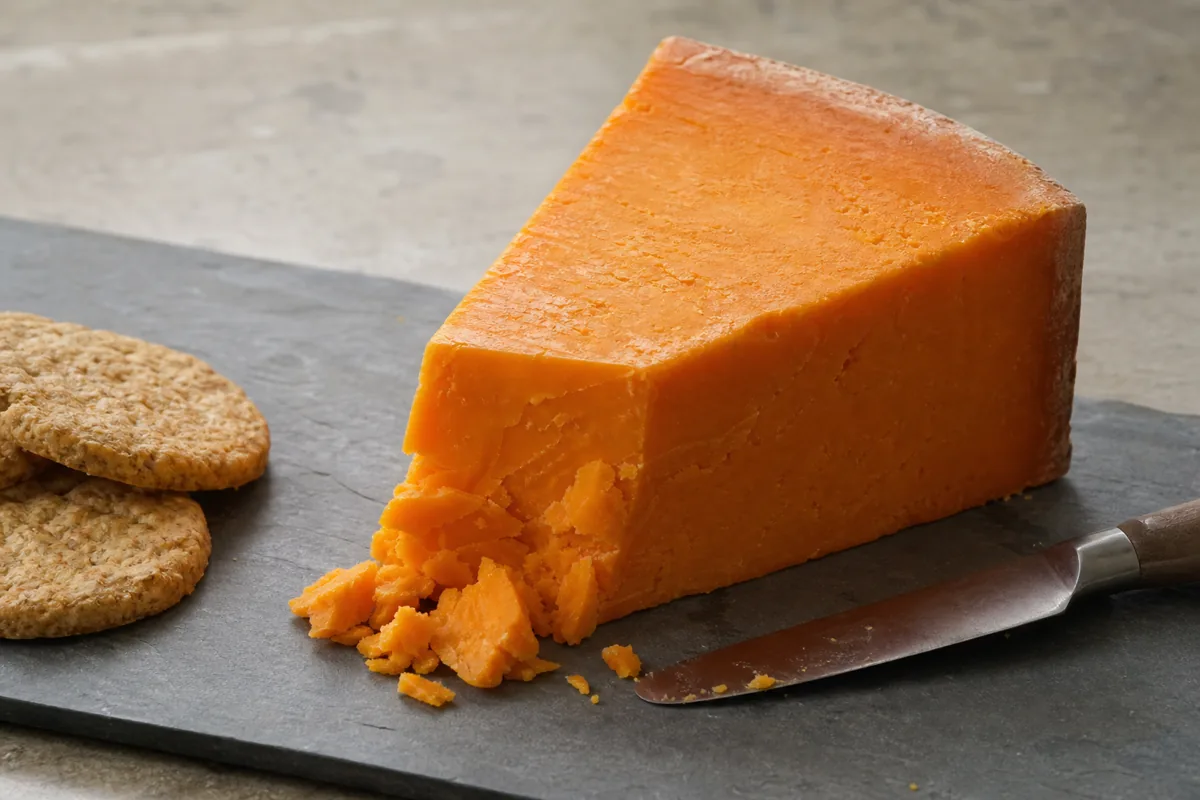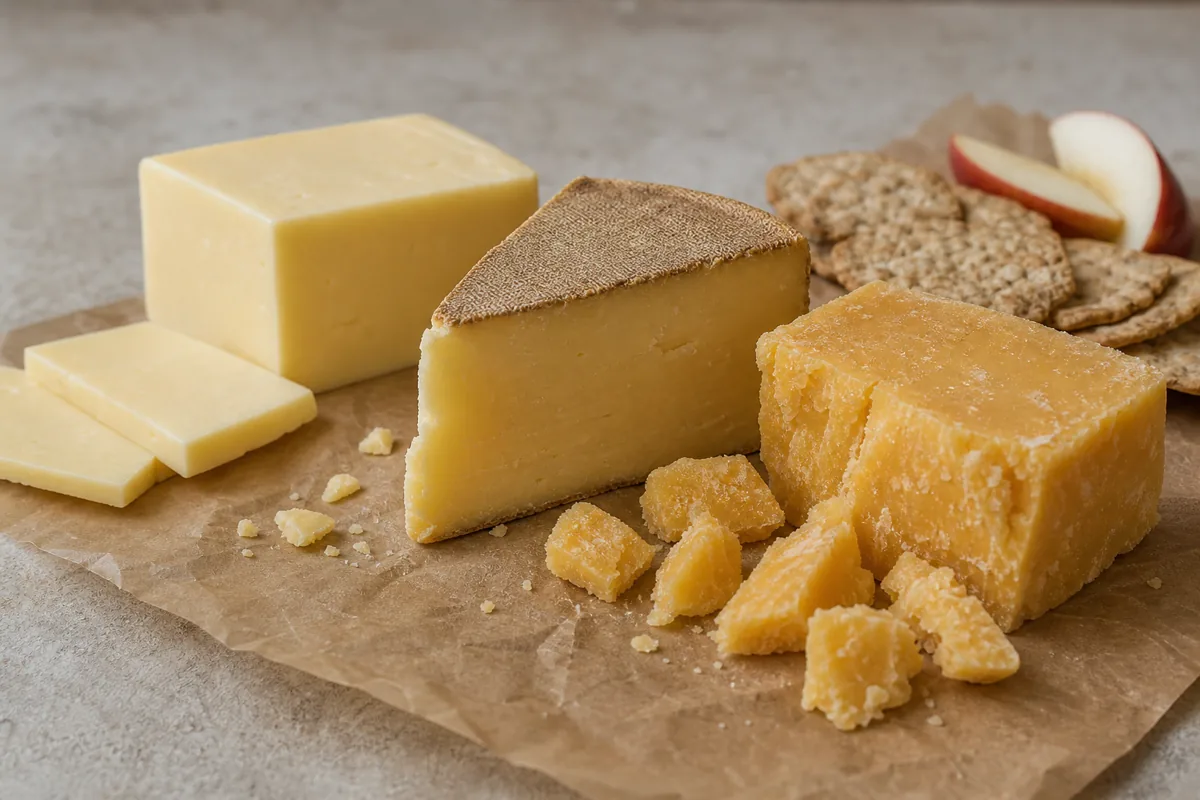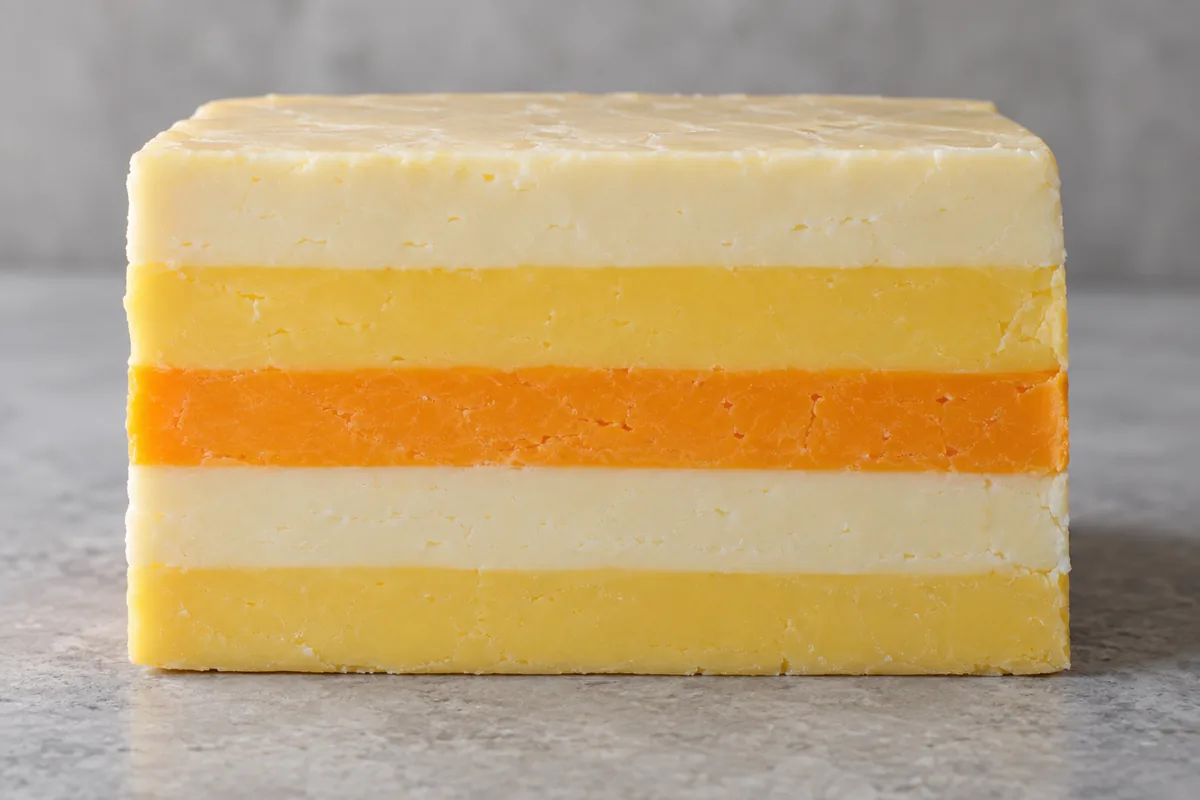
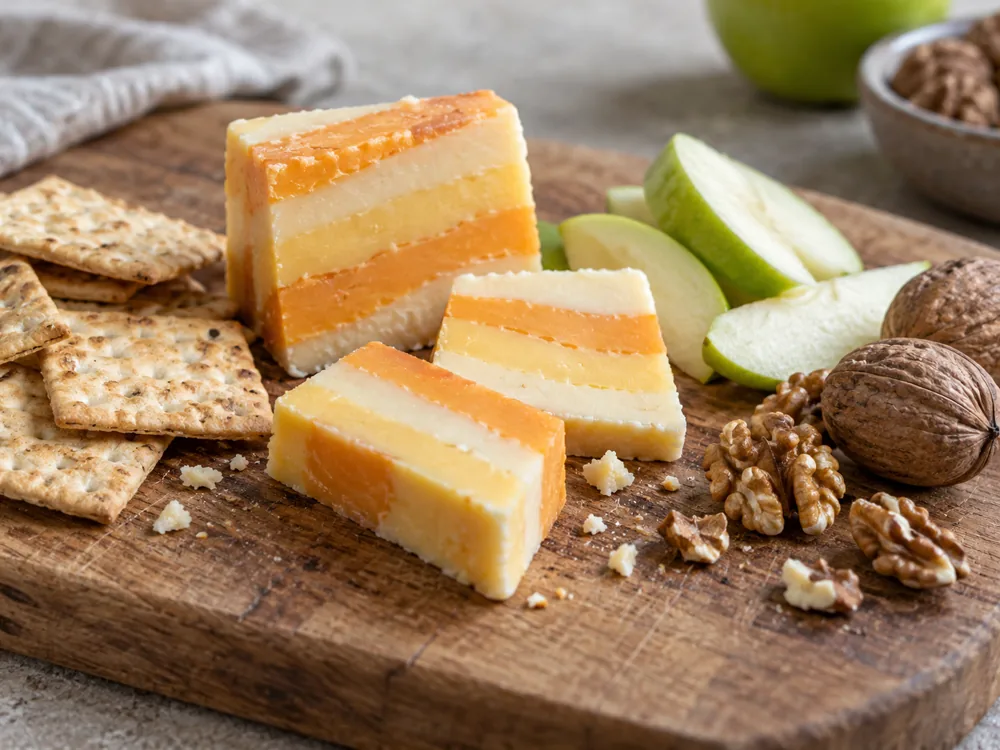
Five Counties is a block of cheese built from five English cheeses stacked in layers and pressed together, so a cut face shows stripes of white, yellow and orange. Cheese.com lists the five as Somerset Cheddar, Cheshire, Derby, Double Gloucester and Red Leicester, though some sellers name Caerphilly in place of Derby.
Ilchester, a Somerset company that blends British cheeses, is the maker most often tied to it, and other brands sell the same idea as Saxonshire.
In This Article
How Is Five Counties Cheese Put Together?
Five Counties is assembled from finished cheeses rather than made as one recipe. Wikipedia describes it as "a sandwich of five layers of different English cheeses" and says Ilchester "do not actually manufacture any cheese from scratch", specialising instead in blending British cheeses.
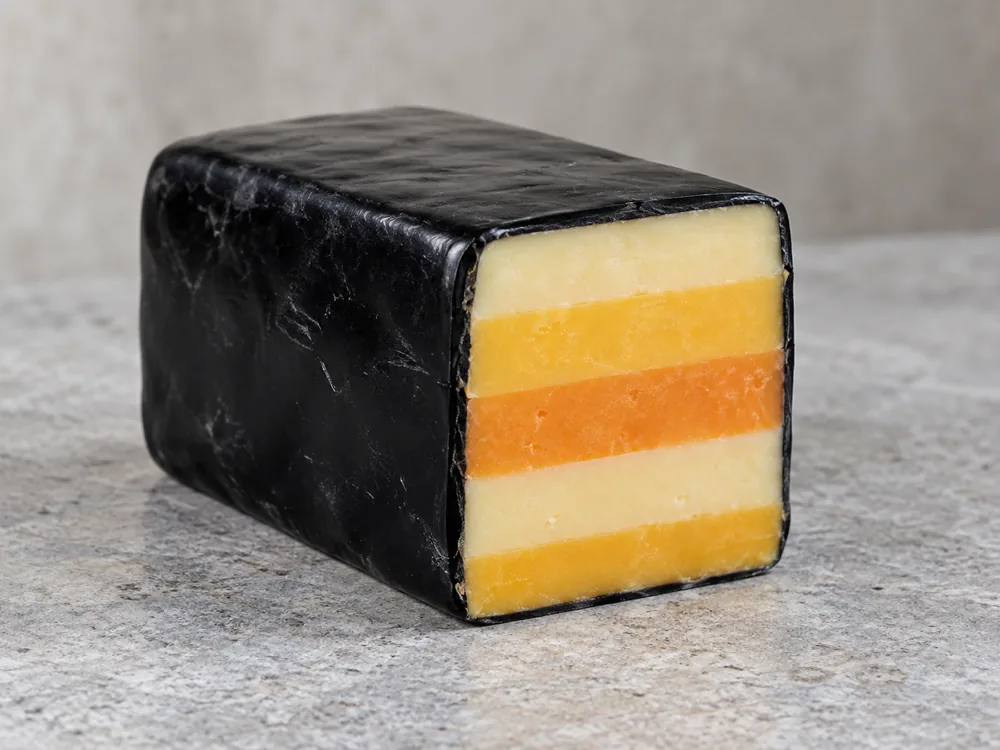
Springbank Cheese, a Canadian retailer, describes the layers of its Saxonshire-labelled block as "stacked one on top of the other, pressed together", with a coat of black wax over the outside.
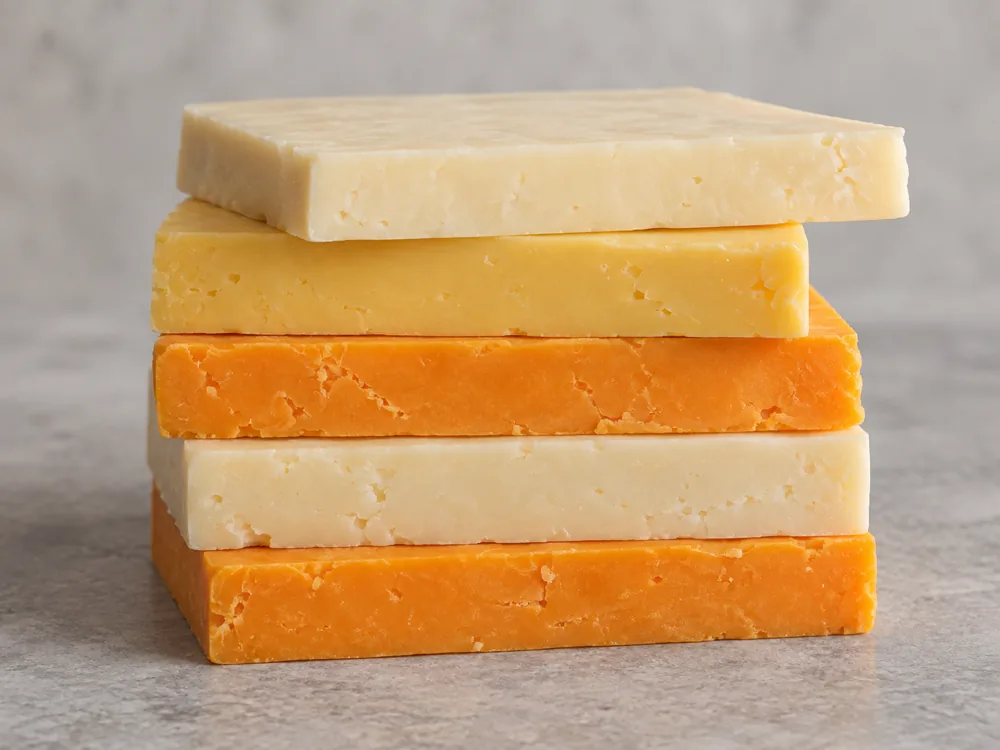
Stacking also names a step in making Cheddar, but at a different stage: Fromage Homage describes cheddaring as stacking and turning blocks of curd to drain the whey and raise the acidity of one cheese. Five Counties stacks cheeses that are already finished.
Because the stripes are separate cheeses, they can part along the joins. A 2014 review of an Ilchester block on Fromage Homage reports that the different stripes "fell away from each other fairly easily."
The same review says the cheese was developed a decade earlier, which puts its start at about 2004. Ilchester's brands now belong to Norseland, a subsidiary of the Norwegian dairy company TINE, according to Wikipedia.
Which Five Cheeses Are in Five Counties?
Cheese.com, Coombe Castle, The Nibble and Springbank Cheese agree on four of the layers: Cheddar, Cheshire, Double Gloucester and Red Leicester. The fifth is where they split, with Cheese.com and Coombe Castle's label for its Saxonshire naming Derby, and The Nibble's entry for Saxonshire and Springbank Cheese's product listing naming Caerphilly in its place.
Cheese.com describes the stripes as alternating layers of yellow, orange and white, and every source counts five layers even where the names differ.
The swap changes the cheese itself. Fromage Homage says Derby is similar in many ways to Cheddar, which is the kinship behind Cheese.com's "cheddar or close to cheddar", and a Caerphilly layer takes its place.
Read the cheese list on the pack: it is the only guide to which version you are holding.
Is Saxonshire the Same Cheese as Five Counties?
Saxonshire is the same five-layer idea from a different company. Coombe Castle sells it under its Belton Farm name, and The Nibble says it is "also called 'five counties cheese'."
Cheese.com lists Five Territories, Five Shires and Saxonshire as synonyms for Five Counties, yet its description also calls Saxonshire and Five Shires "similar layered cheeses," so even the reference sites do not settle whether these are one cheese or several.
Do not confuse it with Huntsman, the other layered cheese The Nibble describes beside Saxonshire: it layers only two cheeses, Double Gloucester and a creamy blue Stilton, instead of five.
What Does Five Counties Taste Like?
Cheese.com calls the block buttery, mild and salty with a smooth texture, and gives a reason: all five cheeses are "either cheddar or close to cheddar."
Whether you will taste five different cheeses is where the accounts part. Springbank Cheese's copy says each layer has its own distinct character, some more buttery and rich and others more dry and tart, none of them aggressively sharp.
The 2014 Fromage Homage review, the one account that tastes the block layer by layer, found the two pale stripes alike and the others different. The reviewer guessed those two were Cheddar and Derby and could not tell them apart: "They both looked, smelled and tasted the same to me," with a cold as the caveat.
The middle stripe, guessed to be Cheshire, was "a bit too sweet," and the bright orange stripe, guessed to be Red Leicester, tasted "like it had been sweating on a cheese counter for too long."
The other orange stripe, guessed to be Double Gloucester, "didn't taste too bad and had a bit of a tang to it."
Springbank Cheese's distinct layers and the reviewer's look-alike pale stripes fit together: the two stripes the reviewer could not separate were the guessed Cheddar and Derby, which Fromage Homage calls similar, and the three other stripes each drew a different verdict.
Eaten together, the leftovers "all tasted of cheese," and the reviewer would probably not buy it again, though the block might taste better "fresh from the factory."
Why Do All Five Layers Taste Like Cheddar?
The family tie behind Cheese.com's description shows in how Fromage Homage places the cheeses. It says Leicester was influenced by the cheddar-makers of the south-west and is probably a distant cousin of Cheshire.
Cheddar is the family's anchor, but it belongs to no single county. Cheese.com names Somerset Cheddar for that layer, the Coombe Castle, Springbank Cheese and The Nibble entries say only Cheddar, and Fromage Homage notes that Cheddar is now made all over the world rather than in any one county.
Cheshire spreads across borders too. Fromage Homage says it is made in Cheshire and four neighbouring counties, two of them in Wales (Denbighshire and Flintshire) and two in England (Shropshire and Staffordshire).
Cheshire also comes in three varieties, traditional white, red coloured with annatto, and blue-veined.
Colour is where the five differ most. Fromage Homage says Leicester was dyed to tell it apart from other regional cheeses, and because buyers linked a richer colour with better quality and with creamy milk full of beta carotene from summer pasture.
Should You Buy Five Counties Cheese?
If you are weighing it against a plain Cheddar, the case for Five Counties rests on two things: the stripes and familiarity.
The Cheesy Place's listing averages 4.6 out of 5 across five customer reviews, and one reviewer writes that they used to eat the cheese in England and call it a favourite.
The one critical account is the 2014 Fromage Homage review, whose objection was the format itself: the writer says they do not get "the idea of lots of different things all at once." Five reviews and one blog post are thin evidence either way.
Is Five Counties Cheese Vegetarian?
It depends on the brand and the pack. Coombe Castle's Saxonshire panel lists vegetarian rennet, and The Nibble says Saxonshire is made with vegetarian rennet.
Open Food Facts transcribes the panel of the Ilchester pack sold in the US as listing enzymes without naming their source, so that pack does not say whether its rennet is vegetarian. Both panels name annatto as the colouring.
Is Five Counties Cheese Safe During Pregnancy?
Every pack that states its milk names pasteurised milk: Ilchester's US pack lists pasteurized milk, Coombe Castle lists pasteurised cow's milk for Saxonshire, Springbank Cheese lists pasteurized cow's milk, and Fromage Homage calls Five Counties a pasteurised cheese.
Fromage Homage calls the block hard and Cheese.com calls it semi-firm. Neither the NHS nor the CDC names Five Counties or a layered block, so if you are pregnant, their lists for pasteurised hard and semi-hard cheese do not settle it.
How Should You Serve and Cook with Five Counties?
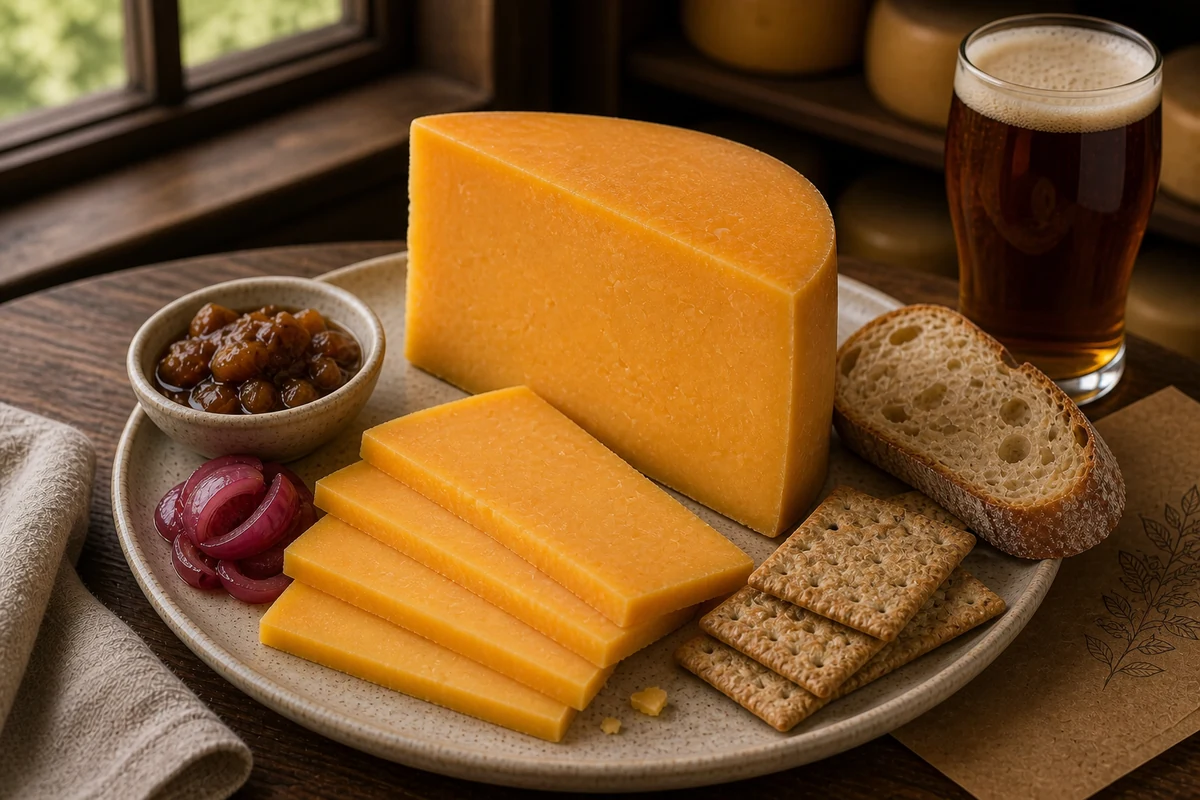
Put it where people will see the stripes. Springbank Cheese says the cheese's "dramatic appearance" makes an impression on cheese trays and charcuterie boards, and The Nibble calls Saxonshire popular at holiday gatherings.
Off the board, Cheese.com says Five Counties can be used as a topping on burgers and salads.
A customer review on The Cheesy Place's listing says they eat the cheese with apples, or on its own sliced thinly.
What Drinks and Foods Go with Five Counties Cheese?
Five sources name drinks or foods for Five Counties and Saxonshire.
| Source | Suggestion |
|---|---|
| Cheese.com | Dark beers and fruity wines |
| Springbank Cheese | Merlot or Moscato; brown ale, stout or porter |
| Coombe Castle | Chardonnay |
| The Cheesy Place | Beaujolais and Sauvignon Blanc |
| The Nibble | A light red or a crisp white wine; simple crackers, tart apples and walnuts |
Their wine advice splits between red and white, so no single wine is a consensus, and only Cheese.com and Springbank Cheese suggest beer.
Where Can You Buy Five Counties, and What Does It Cost?
Look in specialty cheese shops. Springbank Cheese lists black-waxed Five Counties Saxonshire with the 140 g piece at $8.61, and The Cheesy Place in Ontario lists a 250 g piece at $20.99, both in Canadian dollars.
Per 100 g, you pay about $6.15 at Springbank Cheese and $8.40 at The Cheesy Place by our arithmetic. The two listings also name different layers, Caerphilly at Springbank Cheese and Derby at The Cheesy Place, and The Cheesy Place cuts each piece to order, so your piece can run slightly over or under the weight listed.
Format differs as well: Springbank Cheese's black-waxed piece weighs about 0.14 kg and measures 11.2 x 8.5 x 3 cm, with sizes noted as approximate, while Coombe Castle lists Saxonshire as 8 x 179 g and 2 x 1.2 kg.
Both sellers ship. Springbank Cheese lists a delivery time of 1 to 2 weeks, and The Cheesy Place wraps each piece in cheese paper with ice packs and ships orders placed after 2 pm on Wednesday outside the Greater Toronto Area the following Monday.
A 2014 reviewer found a block in a local supermarket; before you look for it there, confirm current stock with a local retailer.
Before buying, check the layer list (Derby or Caerphilly), the rennet wording on the panel and the price per 100 g, because the sellers' packs differ on all three.
How Much Fat, Salt and Calories Are in Five Counties?
Open Food Facts records the Ilchester pack sold in the US at the per-100 g values below, with 20 g of the fat saturated and 0.5 g of calcium.
A 30 g serving, the pack's own serving size, gives you about 110 kcal, 10 g of fat and 7 g of protein.
Coombe Castle's own label for its Saxonshire block lists 399 kcal, 33.8 g of fat with 22 g saturated, 23.5 g of protein and 1.61 g of salt per 100 g.
Fat, saturated fat and protein agree with the Ilchester figures within 2 g, but the Coombe Castle label gives 32 kcal more and 0.51 g less salt, and Open Food Facts puts the Ilchester pack 20% above the 1.77 g average it records for English cheeses.
If you are watching salt, a 30 g serving comes to about 0.6 g on the Ilchester figure and about 0.5 g on the Coombe Castle figure.