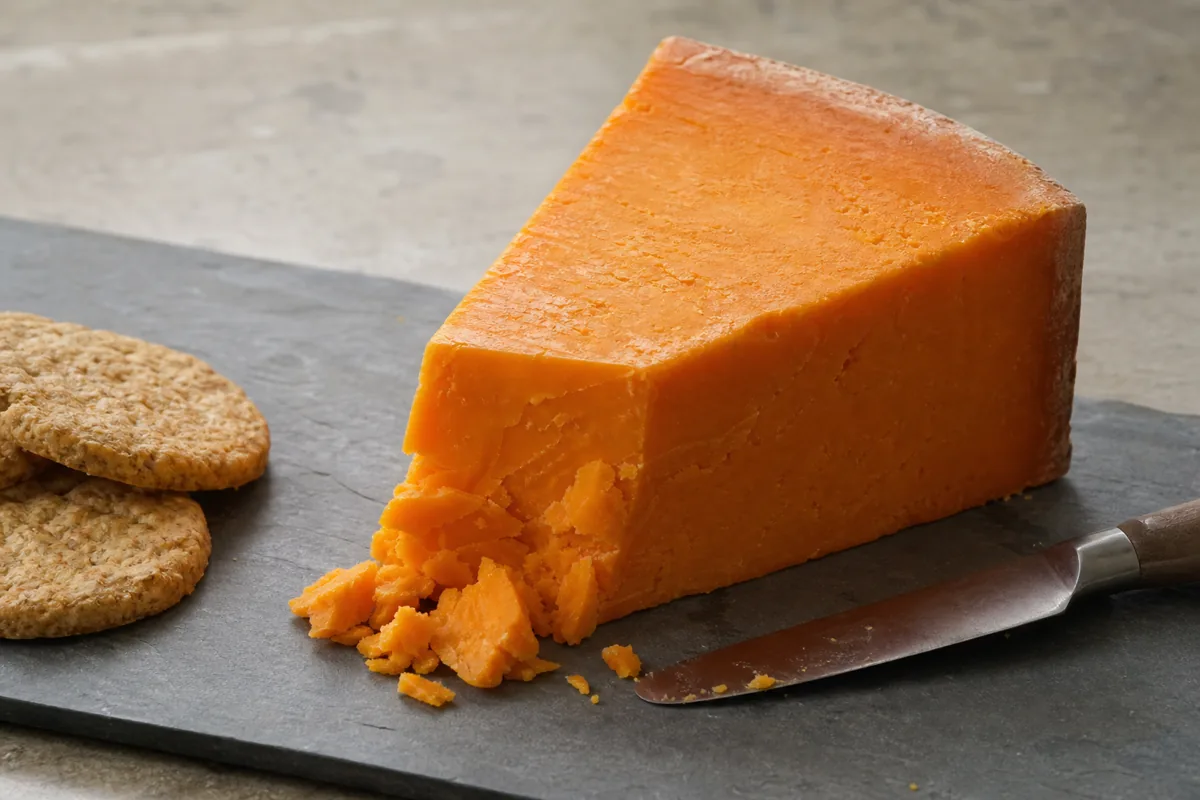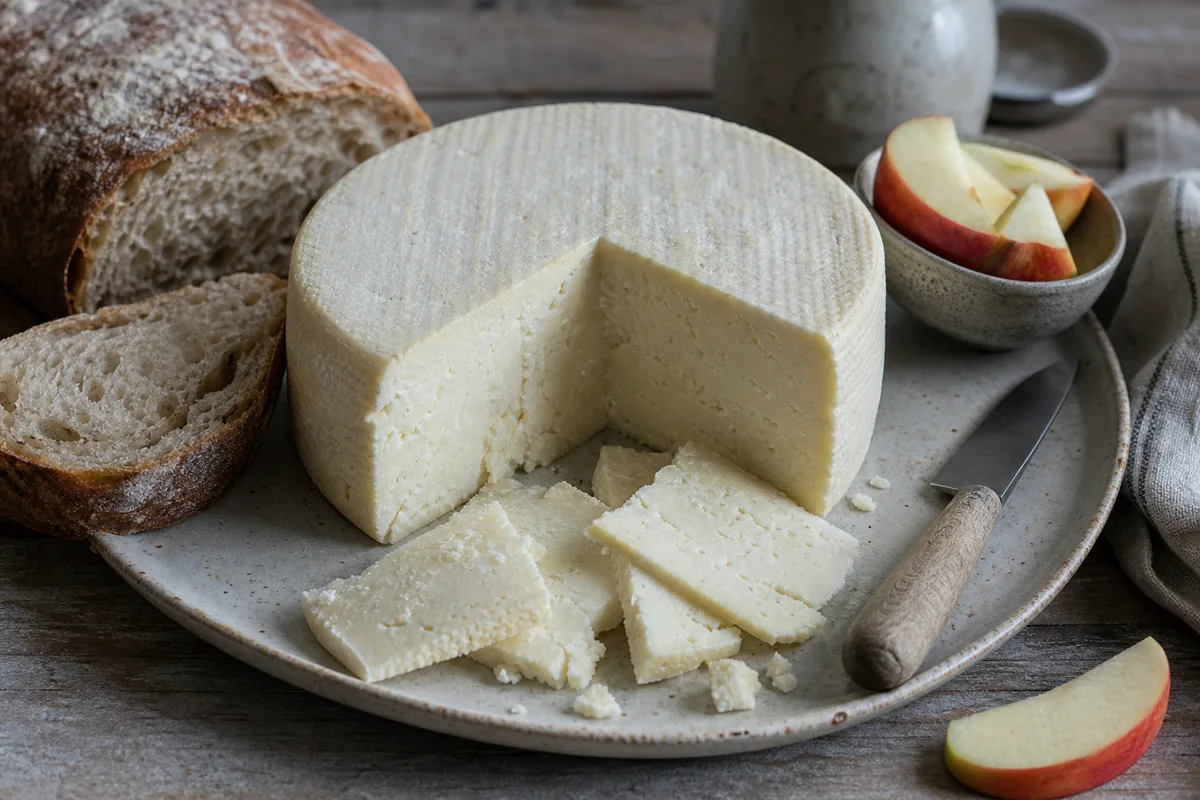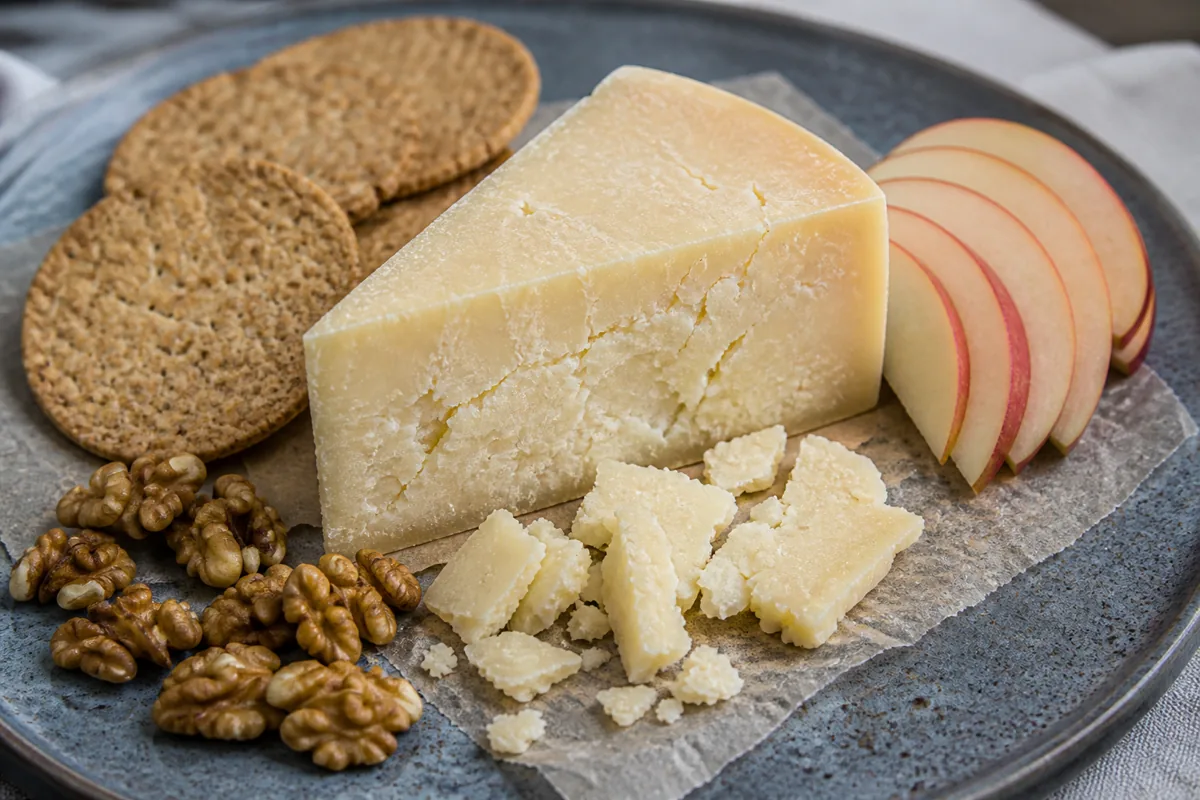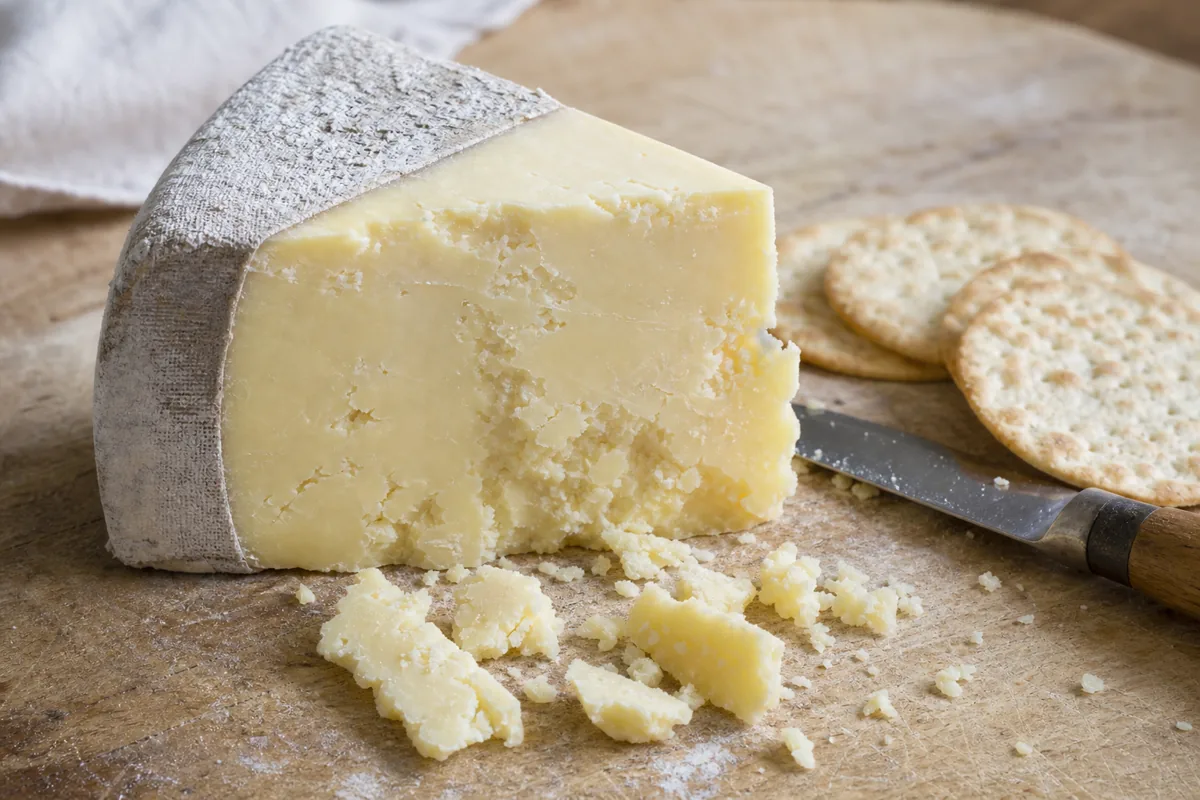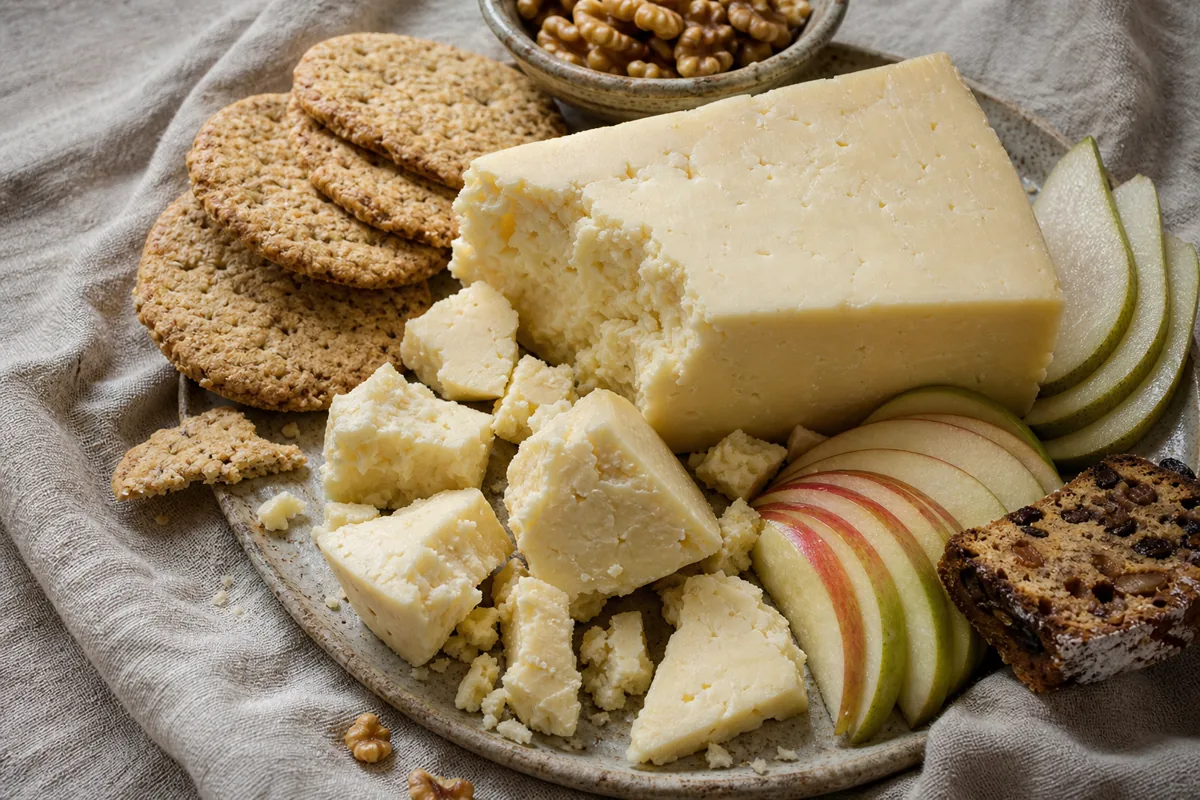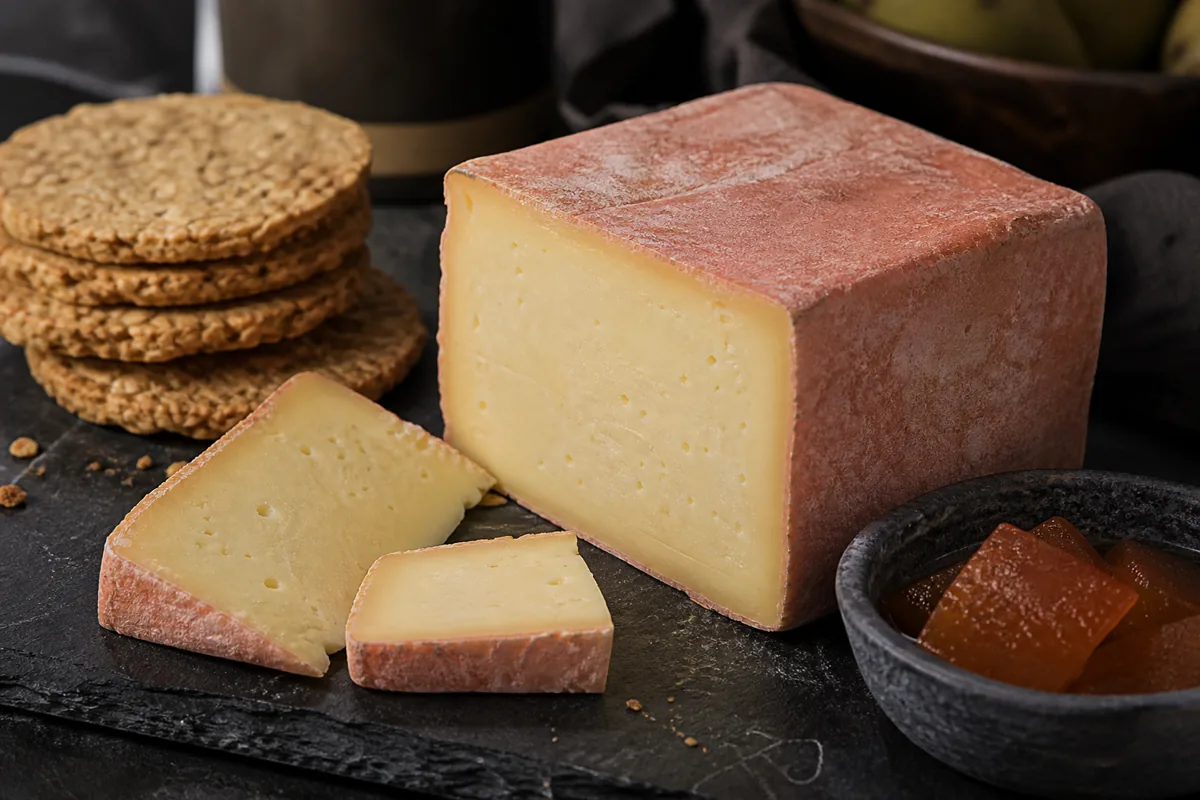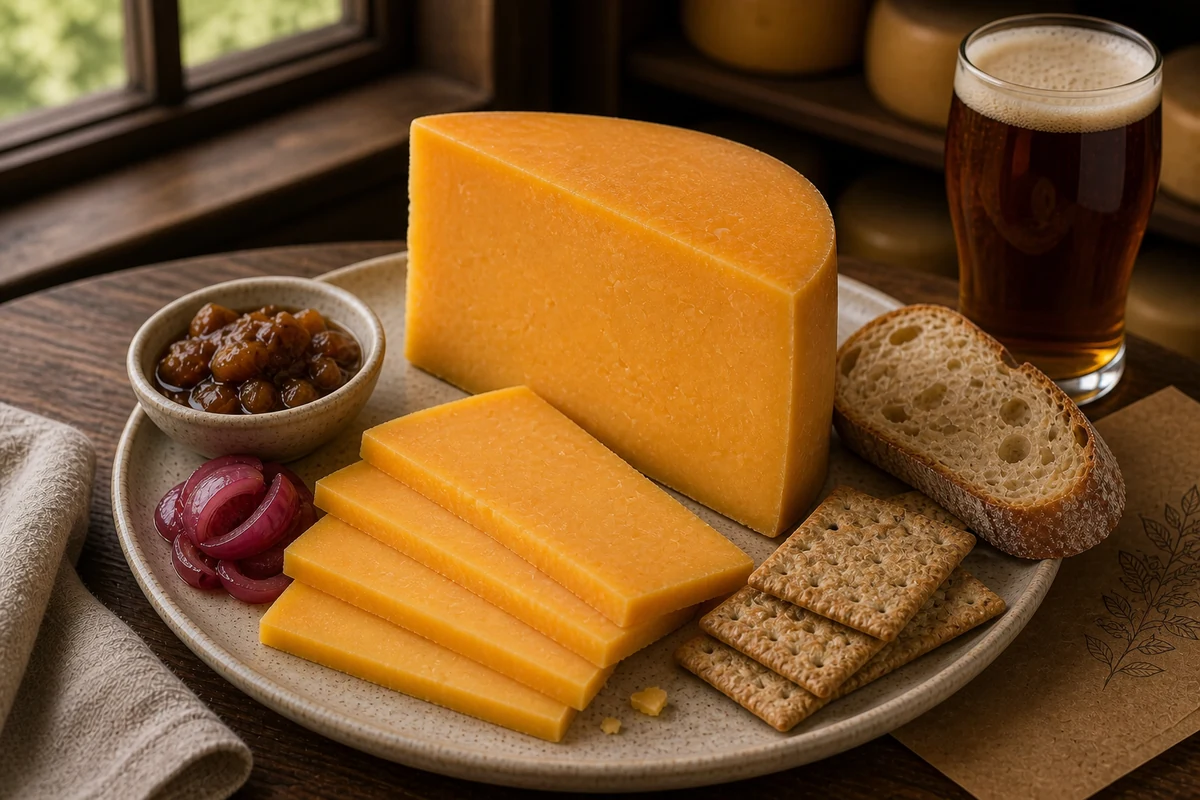
Double Gloucester is an orange cow's-milk cheese from Gloucestershire, England, with a history reaching back to the 16th century. Its colour now comes from annatto, while its texture can range from smooth creamery blocks to dense, crumbly farmhouse rounds.
If you buy the common pasteurised version, expect a smooth, buttery cheese with enough body for slicing and excellent melt. A matured raw-milk wheel can taste earthier, smokier and more savoury, so the maker matters as much as the name.
The word double has no settled explanation. It may refer to full-cream milk from two milkings, a richer make or a taller wheel, and the surviving evidence does not let us choose one theory with confidence.
Most UK supermarket Double Gloucester is pasteurised creamery cheese sold in slabs. Traditional raw-milk rounds still exist, however, so read the milk line and maker before assuming every orange wedge will taste alike.
In This Article
Why Is It Called Double Gloucester?
Nobody knows for certain where the name came from, and makers today still give more than one explanation. Whichever story is right, “double” does not mean double strength or twice the ageing.
| Theory | Why it fits |
|---|---|
| Two full-cream milkings | Traditional Double Gloucester uses whole morning and evening milk, while Single uses skimmed evening milk with whole morning milk. |
| A richer make | Keeping the cream from both milkings produces a fuller cheese than the lighter Single Gloucester. |
| A taller or larger wheel | Double rounds were generally larger and may have stood about twice as high as Single Gloucester. |
The milk theory fits the documented make: Double uses full-cream milk from both morning and evening, while Single combines skimmed evening milk with whole morning milk.
Wheel size supports the other theory because Double rounds are larger than Single ones. What you can safely take from the name is a fuller, larger style rather than a promise of double ageing.
Double Gloucester vs Single Gloucester
Single Gloucester is the lighter and more tightly defined cheese. Its PDO confines production to Gloucestershire farms with Gloucester cows, while Double Gloucester has no equivalent protected designation and can be made elsewhere.
| Point | Single Gloucester | Double Gloucester |
|---|---|---|
| Milk | Skimmed evening milk with full-cream morning milk | Full-cream milk from both milkings |
| Flavour | Lighter and less savoury | Fuller and more savoury |
| Texture | Lighter, lower in fat and more crumbly | Slightly firmer |
| Age | Generally younger | Generally aged longer |
| Protected name | PDO | None |
Their markets diverged as well: Double travelled beyond the county and competed with respected Cheddar and Cheshire, while Single was mainly eaten close to home. Wider trade helped Double become the easier cheese to find today.
That protection gap changes how you shop. A Single Gloucester label promises the county, farm and Gloucester-cattle connection, while Double Gloucester asks you to inspect the maker's own details because the name alone does not restrict production to Gloucestershire.
Both cheeses were traditionally tied to Gloucester cattle, but that connection nearly disappeared when the breed and its cheesemaking declined in the 1950s. Charles Martell revived farmhouse Double Gloucester in 1973 with three Old Gloucester cows, then brought Single Gloucester back in 1978.
How Double Gloucester Is Made on a Farm and in a Creamery
A traditional farm make begins with raw milk from heritage Gloucester cattle and vegetable rennet. At Old Ley Farm, that milk becomes cheese twice a week through a compact process of warming, cooking, stacking, milling and pressing.
The finished round measures about 10 inches across and 5 inches high and weighs 8 lb.
After about six months, the farm round has a tough natural rind around dense, crumbly orange paste. That finish feels very different from the sealed surface of a modern creamery block.
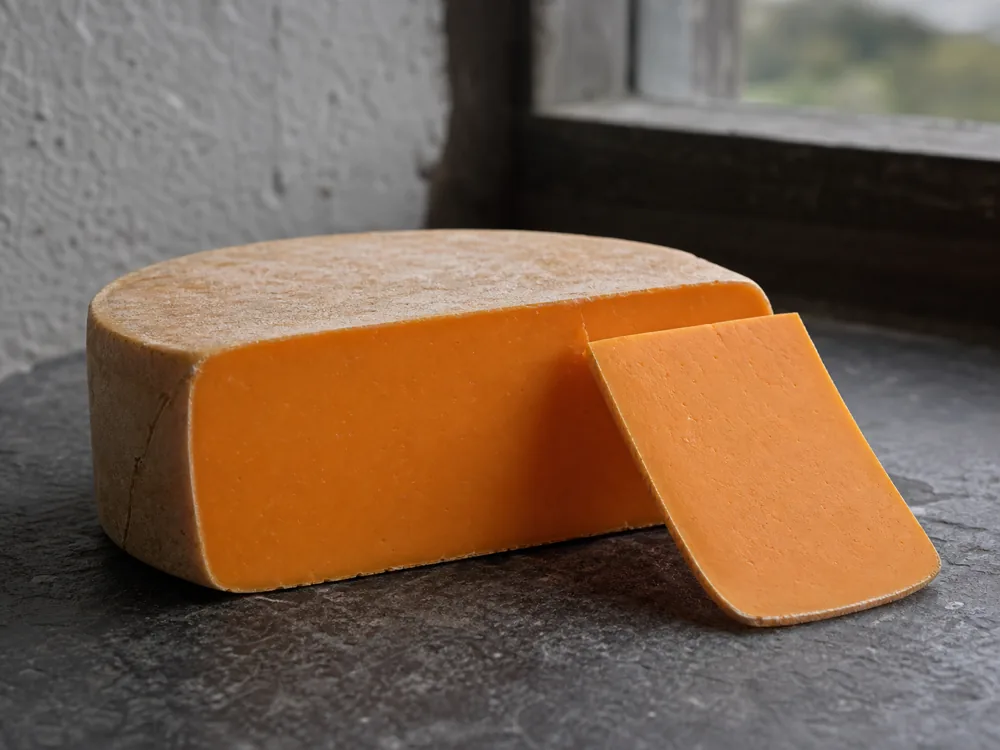
Belton Farm in Shropshire shows the creamery route: pasteurised milk from nearby farms, vegetarian rennet and about six months of maturation in vacuum packs. It can appear as a 20-kilogram block, 12-kilogram round or smaller four-kilogram wheel.
The milk comes from cattle grazing the Cheshire plain, whose underlying rock-salt deposits are associated with a gentle salty quality in the finished cheese. For you, the more reliable shopping clues remain milk treatment, maker and rind style.
Rind is where the two production models become visible. A tough natural surface points toward a traditional farm round; plastic, wax or vacuum wrapping points toward creamery maturation.
Read that clue together with the raw-or-pasteurised milk statement before you treat two orange wedges as interchangeable.
Colour once came from lady's bedstraw; today it usually comes from annatto made from achiote seeds. Makers originally used colour to make the cheese stand out and suggest rich milk, but modern orange tells you about the colouring rather than the butterfat.
What Double Gloucester Tastes Like, Young and Matured
Butter and cream form the baseline, but the flavour can finish very differently. A pasteurised creamery block tends to stay smooth and gentle, while a matured raw-milk round may bring toasted nuts, earth, smoke or even a bacon-like savoury note.
| Style | Flavour | Texture |
|---|---|---|
| Pasteurised creamery | Smooth, creamy, buttery and gently tangy | Firm enough to slice, with a clean bite |
| Young raw-milk farm cheese | Milky sweetness, butter and a little grassiness | Firm and creamy with a slight bounce |
| Matured raw-milk farm cheese | Toasted nuts, tang, earth, smoke and deeper savoury notes | Denser, more crumbly and sometimes slightly waxy |
Within one farm cheese, youth brings a slight bounce and milky sweetness; maturity makes the paste denser and more crumbly as nuts and savoury notes come forward. That change is useful when you can compare the same maker at two ages.
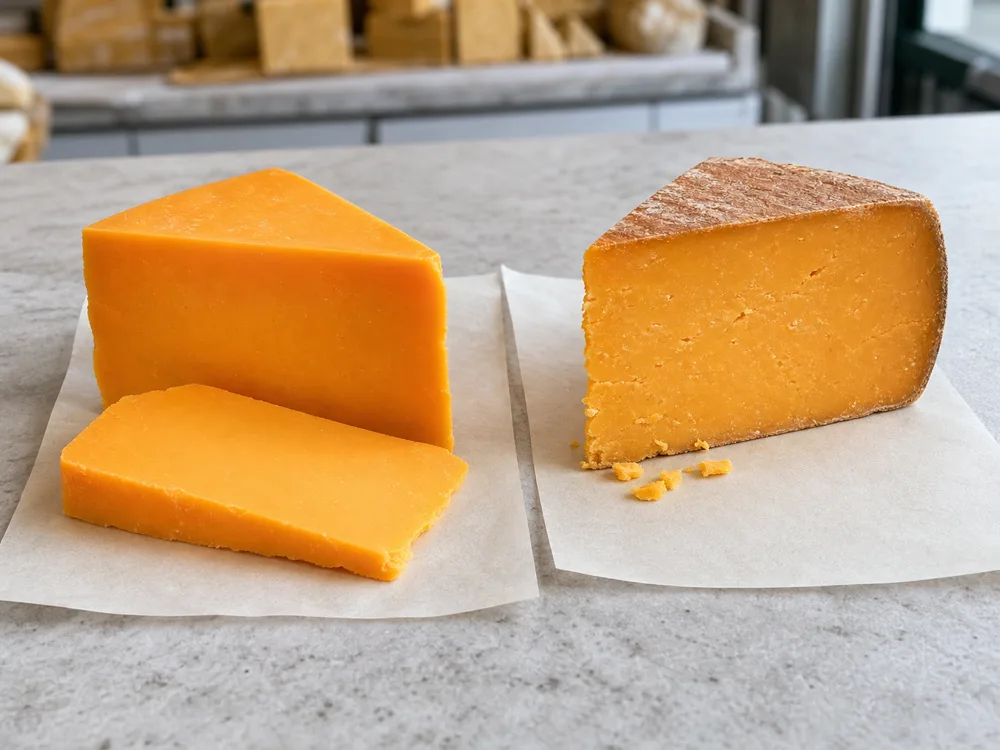
Most Double Gloucester is sold at four to six months, though some reaches about 36 weeks, so ask for the age of the piece you are actually buying.
At serving temperature, a creamery block should give you a clean slice and an even buttery bite. A natural-rind farm wedge asks for more attention: taste from the centre toward the rind so you can notice where the sweet milk gives way to earth, smoke and a drier crumble.
A pasteurised creamery cheese can be creamy and gentle at six months, while a raw-milk farm round of the same age may taste earthy, smoky and deeply savoury. Age alone does not identify the style.
Double Gloucester vs Cheddar and Red Leicester
Colour will not separate Double Gloucester from orange Cheddar or Red Leicester, because annatto can colour all three. Texture, ageing and flavour give you better clues.
| Point | Double Gloucester | Cheddar | Red Leicester |
|---|---|---|---|
| Ageing | About 4 to 6 months | A few months to several years | About 6 to 12 months |
| Texture | Buttery and smooth; firm yet crumbly | Smooth and slightly elastic, more crumbly with age | Crumbly and dense |
| Flavour | Smooth, tangy | Mild to sharp, sharper as it ages | Caramel and sweet, with earthy undertones |
| Colour | Orange, from annatto | White, pale yellow, or orange from annatto | Orange, from annatto |
Ageing creates the clearest separation. Cheddar can mature for years and grow progressively sharper, while Double Gloucester commonly reaches you around four to six months.
If you want a pronounced sharp edge, aged Cheddar is the natural direction. Double Gloucester keeps more butter and cream in the foreground, even when a farm version develops earth and tang.
Red Leicester leans sweeter and more caramel-like, with a dense, crumbly body. Choose it when that sweetness matters more than Double Gloucester's buttery tang.
Because some creameries make all three, a same-maker tasting can reveal the style differences without changing milk supply and production scale at the same time.
How Does Double Gloucester Melt, and What Goes with It?
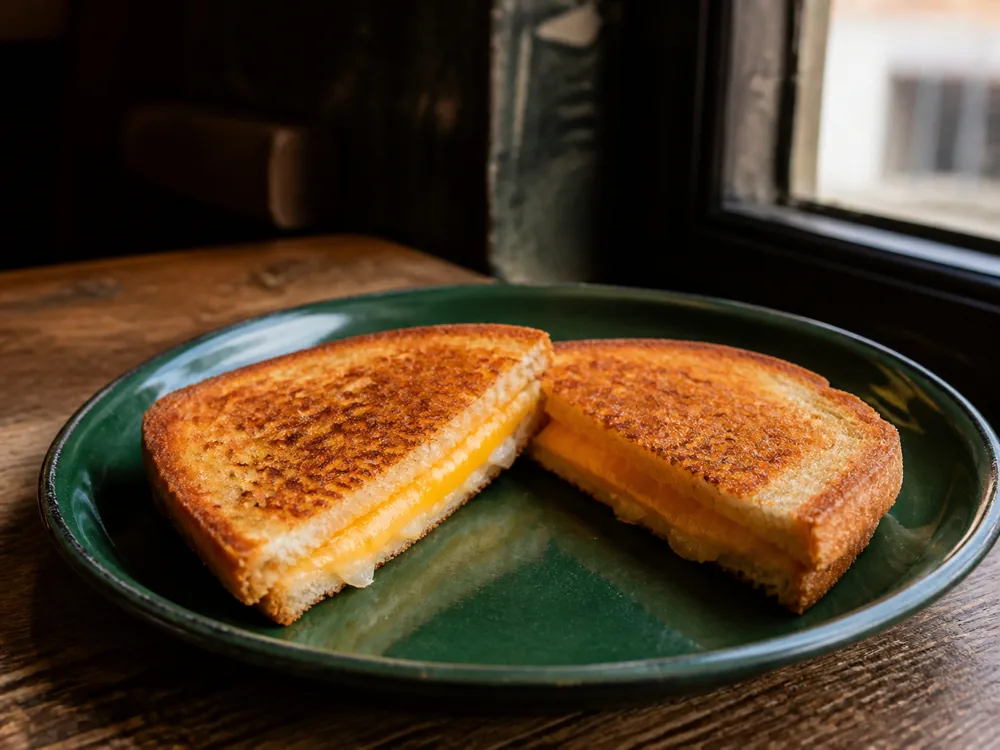
Double Gloucester is a strong melting cheese, especially in a toastie. It gives you a smooth melt with a buttery, gently tangy flavour rather than Cheddar's sharper finish.
Both cheeses melt well, so your choice comes down to flavour. Use Double Gloucester for creaminess, or add a little Blue Stilton and mustard when you want the filling to push harder.
Thin slices give you an even layer in a sandwich, while coarse grating helps the cheese spread through potatoes or pastry. Because the flavour is gentler than aged Cheddar, you can use a generous layer without turning the whole dish sharply acidic.
| Use | How It Works |
|---|---|
| Stilton and mustard toastie | Grate Double Gloucester with Blue Stilton, then add English mustard for a toastie with more salt and bite. |
| Thick slice on a biscuit | A firm slice holds together on a biscuit and makes a natural pub-style snack with ale. |
| Eaten on its own | Its firm bite and buttery flavour also work without cooking or another cheese. |
A dry cider cuts through the butter and suits a younger farm cheese, while pale ale echoes its pub-cheese character. With a mature earthy round, a light red can carry the savoury notes without smothering them.
British pale ale is the most natural all-purpose match: bitterness refreshes the palate and malt meets the cheese's nutty side. A crisp Sancerre takes the pairing in a lighter direction.
For red wine, start with Pinot Noir or Zinfandel for creamery cheese and move toward Cabernet only when the wedge has enough mature flavour to meet it.
| Pairing | Type | Why It Works |
|---|---|---|
| British pale ale | Drink | Malt meets the cheese's nutty side while bitterness refreshes the palate. |
| Sancerre | Wine | A crisp white keeps a smooth creamery cheese feeling light. |
| Zinfandel or Pinot Noir | Wine | These lighter reds suit buttery cheese without crowding it. |
| Cabernet Sauvignon | Wine | Save the stronger red for a mature raw-milk wedge with enough earth and tang. |
| Dry cider | Drink | Acidity cuts through butter and works especially well with younger farm cheese. |
| Apples and pears | Food | Crisp fruit adds moisture and gentle sweetness beside the firm paste. |
| Crusty bread and pickles | Food | Bread supports the cheese, while pickles sharpen a rich pub-style plate. |
What Are Huntsman, Cotswold, and the Cheese-Rolling Wheel?
Double Gloucester also acts as the base for two familiar blended cheeses. Huntsman alternates it with Blue Stilton, giving the buttery orange cheese a salty blue contrast.
Cotswold blends it with chives and spring onions. The marketed name sounds traditional, but the value lies in the combination itself: mild, creamy cheese carrying fresh onion flavour.
Richard Widcombe's 1978 The Cheese Book placed Cotswold among newer English cheeses flavoured with additions, describing a smooth, mellow base lifted by fragrant onion.
Every spring, racers chase a 7-to-9-pound wheel down the steep 200-yard slope at Cooper's Hill. The cheese gets a one-second head start and can reach at least 70 mph, turning the firmness of Double Gloucester into part of a very different local tradition.
The first racer to the bottom wins the wheel.
How Do You Buy and Store Double Gloucester?
The label answers the two questions that matter most: how the milk was treated and which rennet was used. Supermarket slabs are usually pasteurised, while traditional farm cheeses from makers such as Smart's and Jonathan Crump use raw milk.
Belton, Smart's and Jonathan Crump all use vegetarian rennet, while any other brand has to be confirmed on its label.
Next, look at form and age together. A rindless block is the practical choice for toasties and everyday cooking; a natural-rind wheel or wedge earns its higher price when you want the deeper aroma and changing texture of a farmhouse cheese.
Double Gloucester is much easier to find than Single, both in the UK and abroad. That availability gives you choice, but it also makes the words “Double Gloucester” less predictive until you check the maker, milk and maturity.
Once opened, wrap the cheese in waxed paper or cling film and aim to use it within 10 to 14 days. Give it up to an hour outside the refrigerator before serving, especially when you want to taste the difference between a gentle creamery piece and a mature farm wedge.
Is Double Gloucester Safe in Pregnancy?
NHS guidance accepts hard cheese made from raw or pasteurised milk, but its semi-hard list names only pasteurised examples such as Edam.
Double Gloucester is described as both hard and semi-hard, which makes a generic category less useful than the product in front of you. A pasteurised block meets the milk condition either way; a raw-milk farmhouse wheel needs a more specific decision.
For raw-milk cheese, the CDC prefers pasteurized hard cheese and lists raw-milk dairy among riskier choices.
Cooking until steaming hot changes the NHS answer, which matters if you are using the cheese in a toastie. For a cold raw-milk portion, take the exact label to a midwife or doctor and apply the same milk-treatment distinction used for other cheese during pregnancy.
What Else Do People Ask About Double Gloucester?
No one knows for sure. The main theories are richer milk from both daily milkings, milk skimmed twice, or a cheese about twice the height of Single Gloucester.
A creamery version is usually smooth, creamy and buttery. Mature raw-milk farm cheese can be more pronounced, with earth, smoke, nuts and deep savoury notes.
Yes. Its smooth melt and buttery flavour make it especially useful in toasties, gratins and savoury pastry.
Makers now add annatto, a natural colouring from achiote seeds. Earlier wheels drew their yellow colour from the wild flower lady's bedstraw.
Several major creamery and farmhouse versions use vegetarian rennet, but the unprotected name does not guarantee it. Check the label on the exact brand.