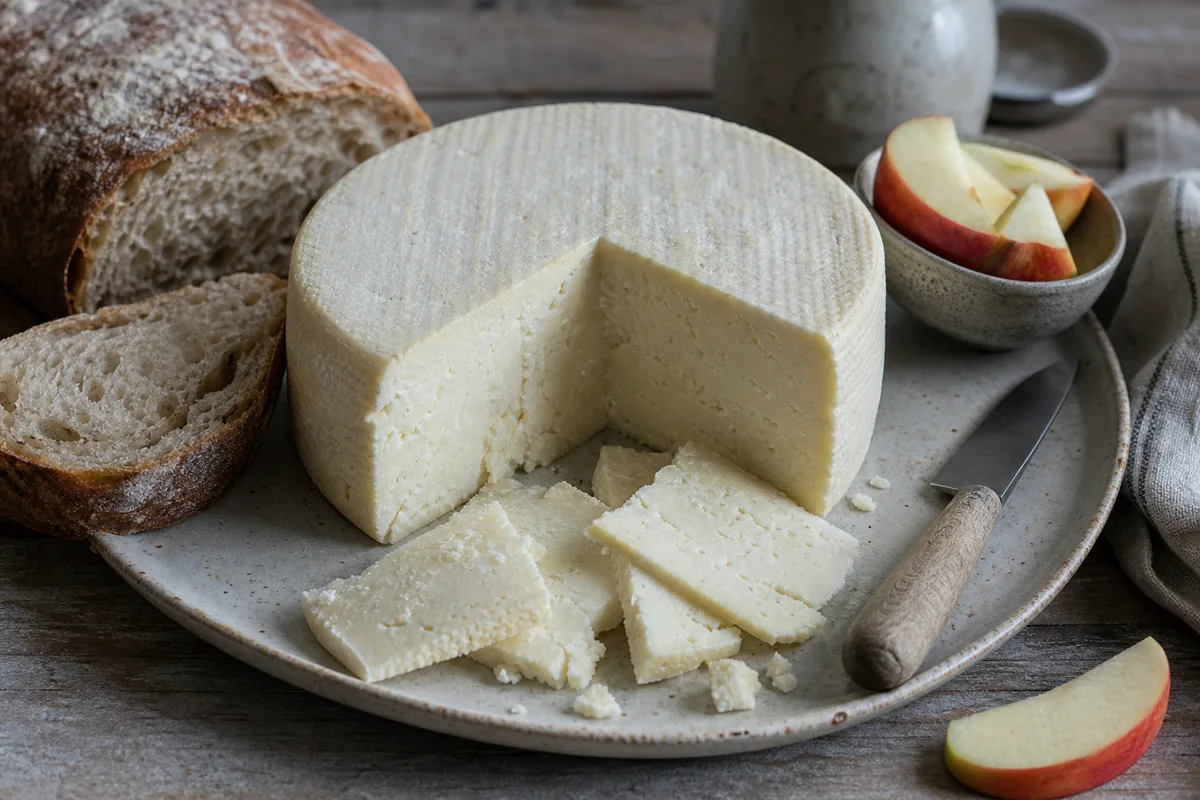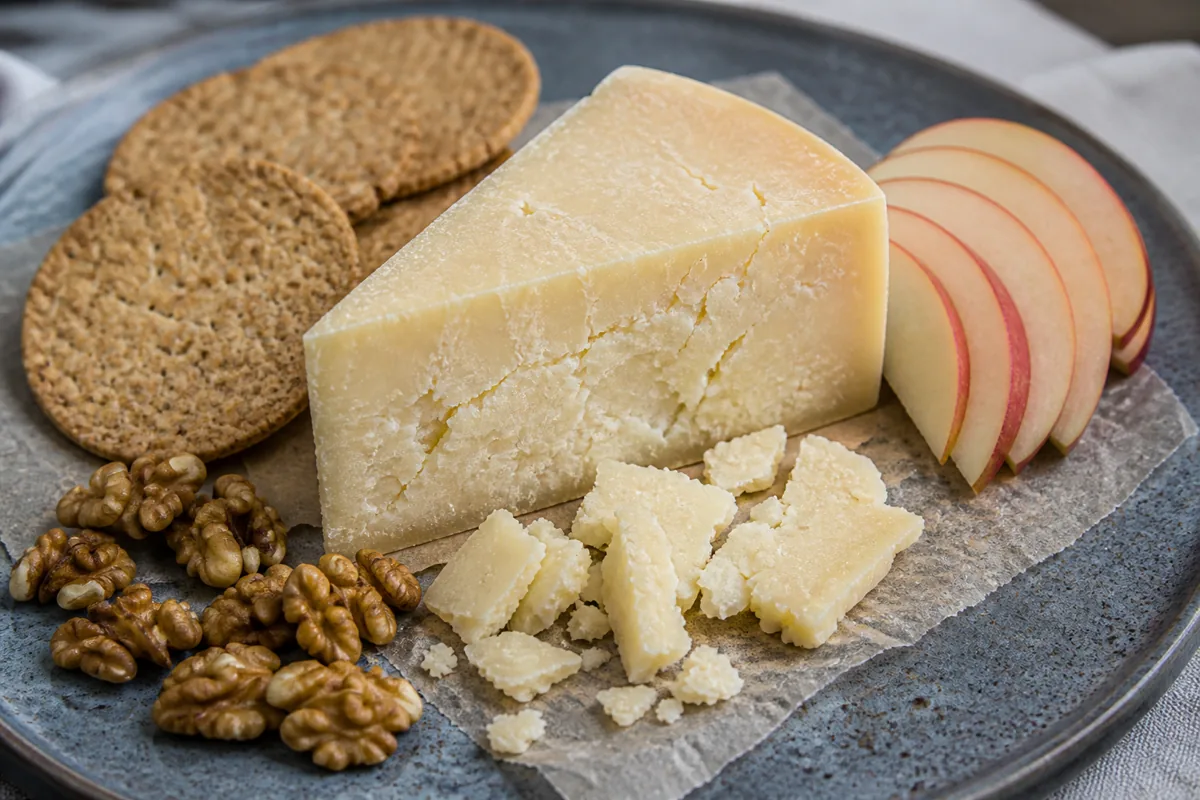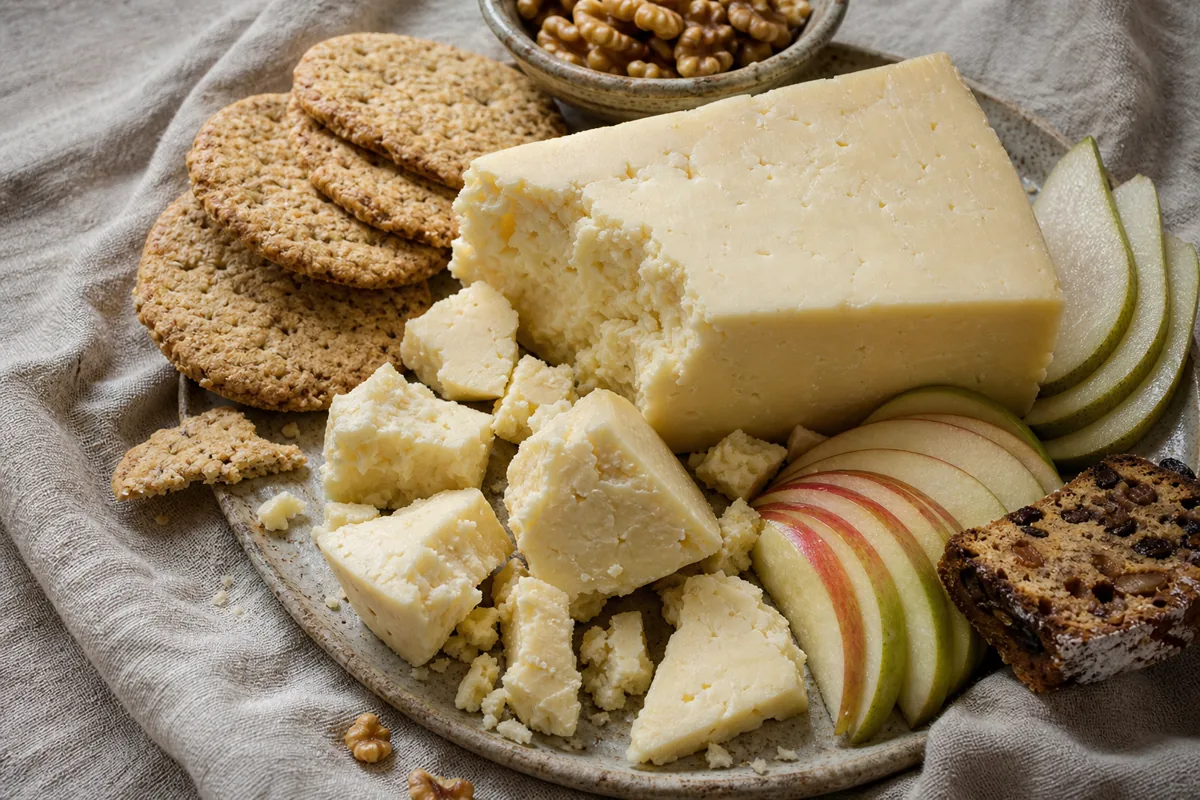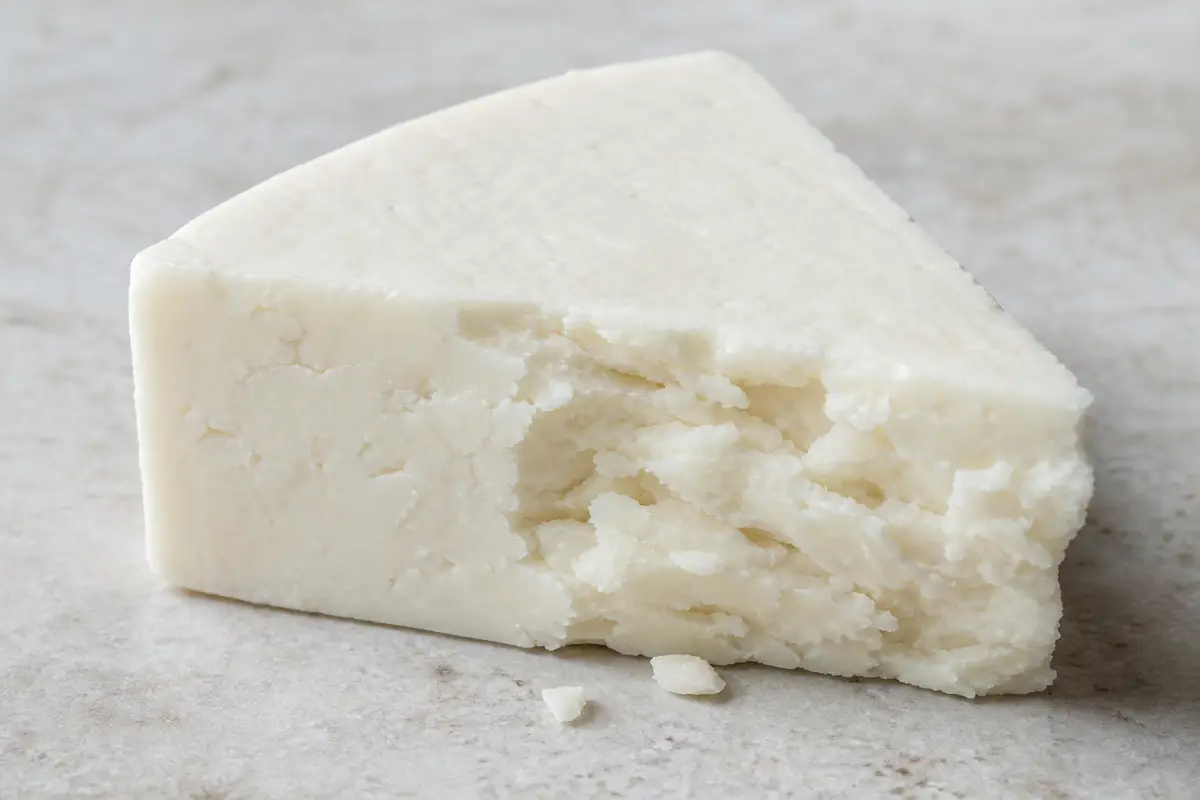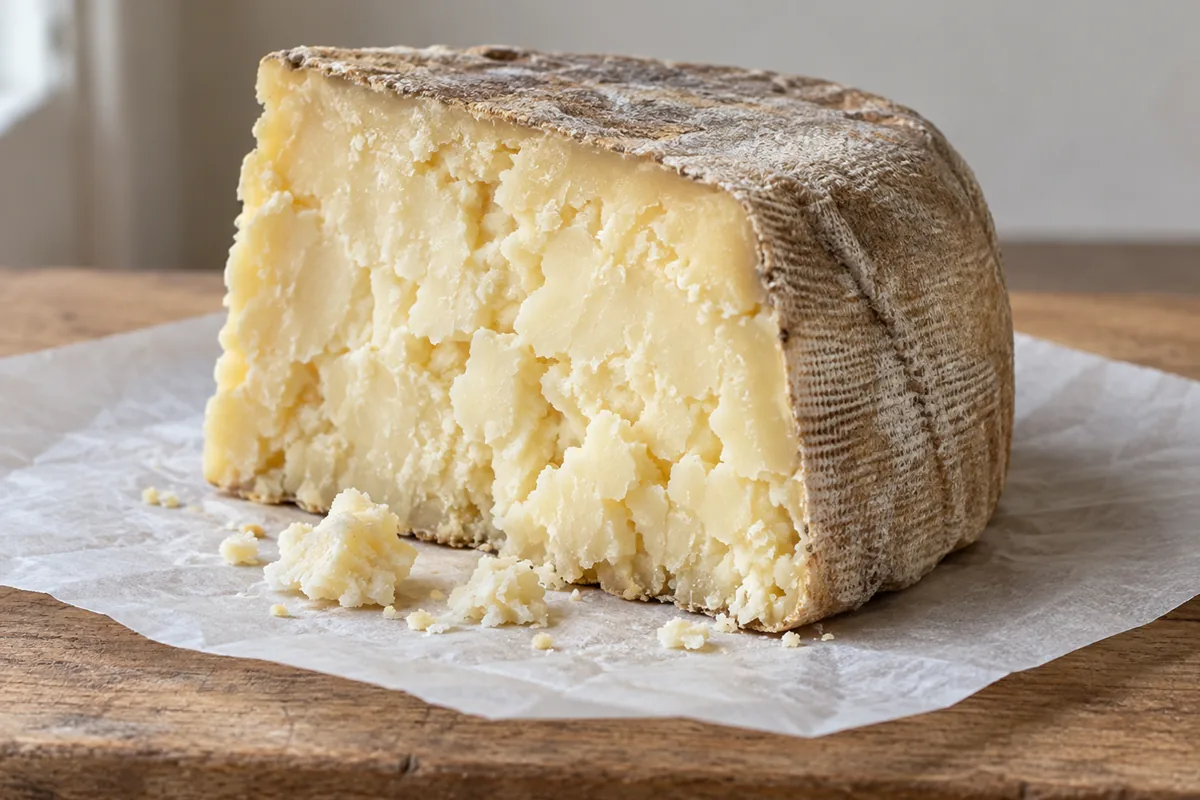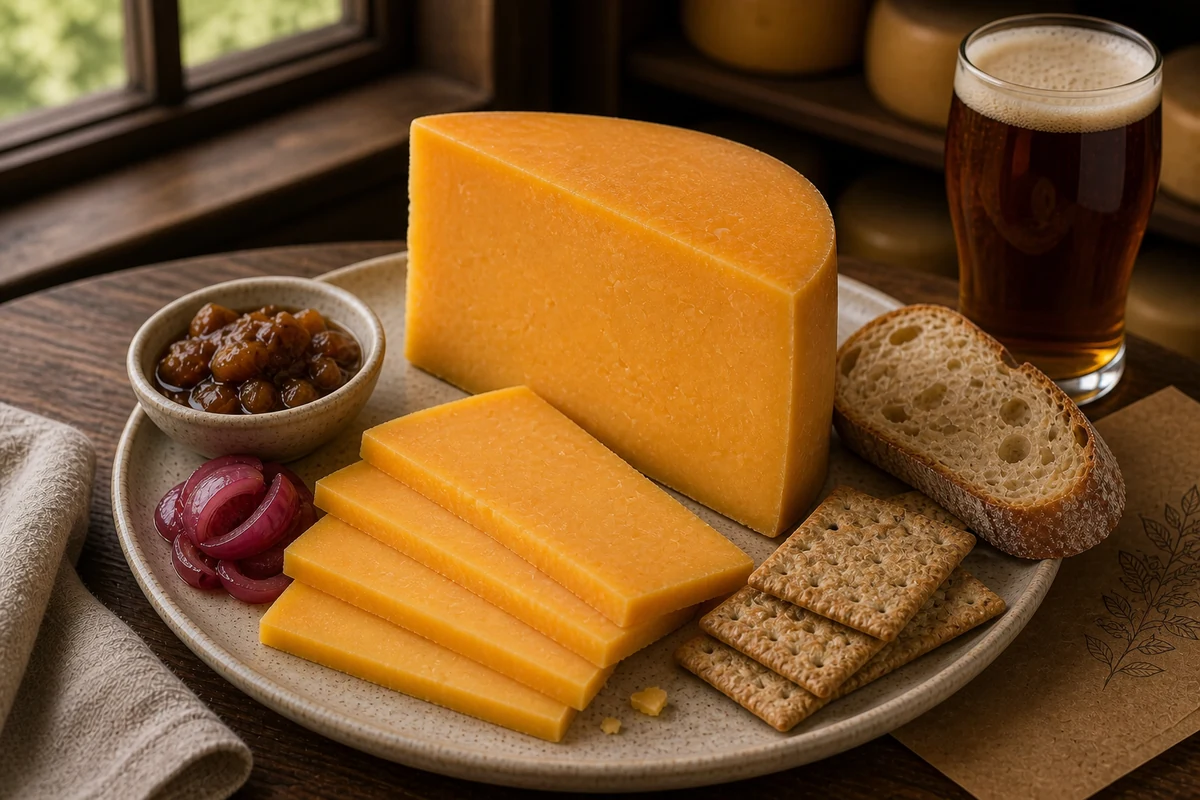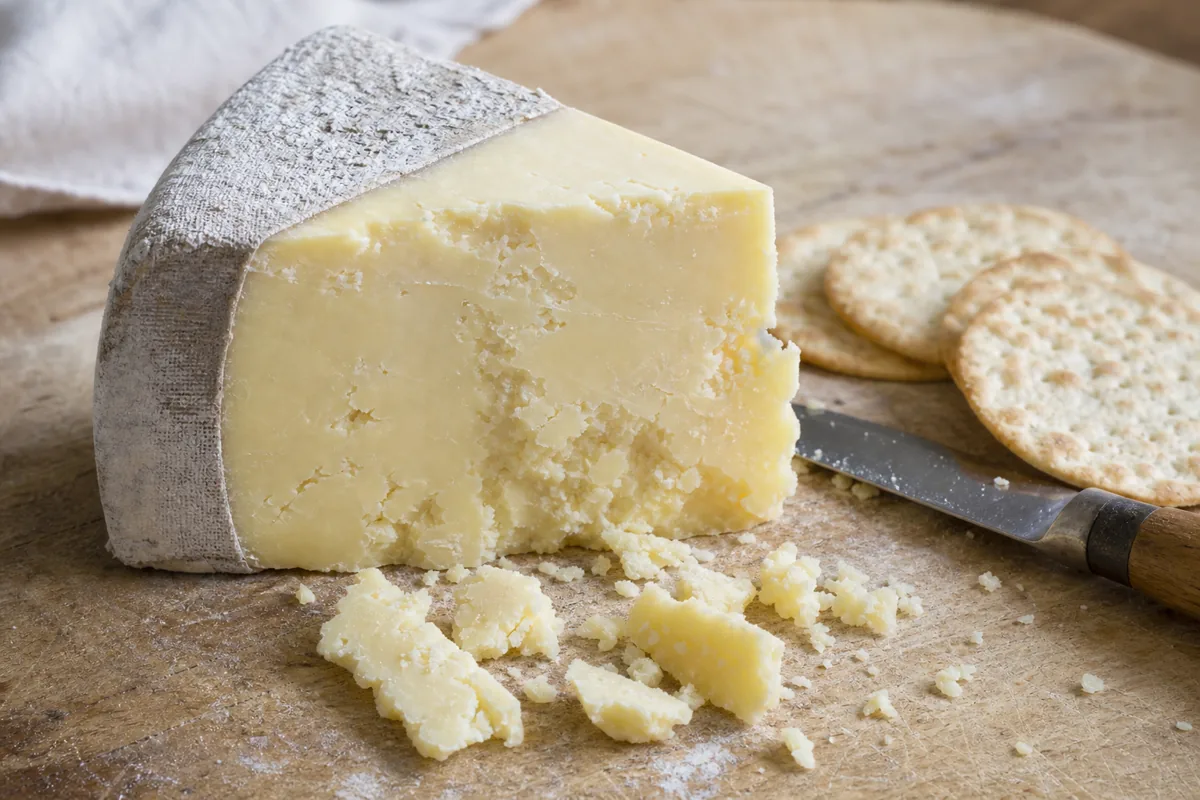
Lancashire is an English cheese made from cow's milk in the county of Lancashire, and it comes in three styles: Creamy, Tasty and Crumbly. Wikipedia and the British Cheese Board say Creamy and Tasty follow a traditional method that blends curd made on different days, while Crumbly is a later cheese made from a single day's milk.
The protected form is Beacon Fell Traditional Lancashire Cheese, a PDO name whose specification fixes the milk area, the make and the composition.
In This Article
What Is Lancashire Cheese?
The Beacon Fell specification describes a cheese made from full-fat cow's milk in a traditional cylindrical form. It must hold at least 48% butterfat in the dry matter and no more than 48% moisture.
That fat figure is measured against dry matter, not the whole cheese. With moisture capped at 48%, dry matter is at least 52%, so the floor works out to about 25 g of fat in every 100 g of cheese.
The same document gives the sensory profile the protected cheese must meet.
Farmhouse descriptions use plainer words. Neal's Yard Dairy says the Kirkham family call it a buttery crumble, and Culture magazine describes Mrs Kirkham's as buttery, lemony and yogurty, with a pronounced tang and a long, rounded finish.
Culture magazine adds that the texture is moist, rich, crumbly and creamy, and that Graham Kirkham calls it "fluffy monster".
The cheese can reach a shop as a whole cylinder, a cut portion or a block, in sizes that suit the customer. Under the specification it is either bandaged, waxed, buttered or vacuum packed.
How Does the Multi-Day Curd Method Work?
Traditional Lancashire mixes curd from different days, and Wikipedia calls this unique among British cheeses. The British Cheese Board gives the reason: small Lancashire farms in the 1890s often lacked enough spare milk to make a whole cheese in one day.
Without refrigeration, farmers turned the spare milk into curd, kept it overnight at room temperature and mixed it with the next day's curd, sometimes blending it again with the curd of the day after.
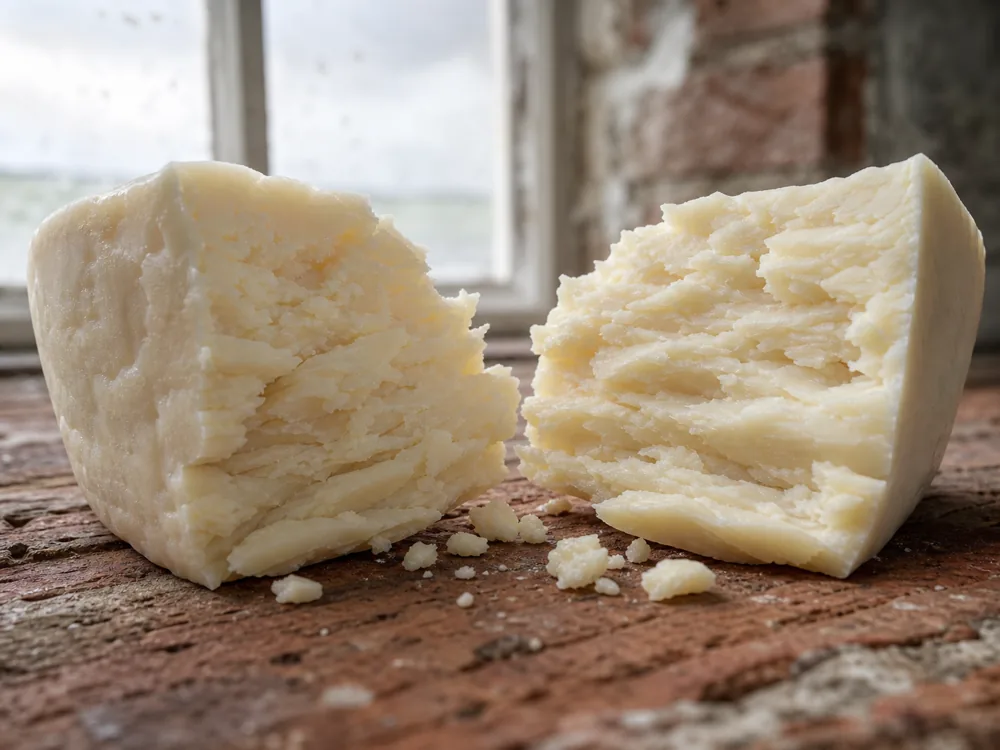
Around 1890, Lancashire County Council sent Joseph Gornall of Garstang to farms across the county to teach one standard method, because the specification says production had varied until the late 1800s and the cheese was not consistent. The specification adds that the Agriculture Ministry's 1956 handbook on cheesemaking closely followed his methods.
| Step | What the specification says |
|---|---|
| Setting | Starter culture goes into the vat, the milk is stirred slowly, then rennet is added |
| Cutting | The curd is cut at a clean break to about the size of a broad bean |
| Draining | On cheesemaking tables the curd is broken at intervals and the whey drained until the recipe's acidity is reached |
| Holding | Some curd is held for 24 to 48 hours at ambient temperature |
| Blending | The next day, new curd is mixed with roughly equal parts of 24-hour and 48-hour curd, or with 24-hour curd alone, and finely milled |
| Salting | Salt is added at about 2.5% of the curd weight |
| Pressing | The cheese is lightly pressed, then bandaged, waxed, buttered or packed |
| Maturing | At least 3 to 4 weeks in a temperature-controlled store |
The specification calls correct blending of the curd crucial to the flavour and texture. It also says the delicate curd must be handled so that the fat is not broken out or lost in the whey.
Culture magazine's account of the Kirkham make shows where the fat is protected. Cooled milk from the previous evening goes into warm morning milk, the curd is cut by hand and left to settle, and Culture says this keeps as much fat as possible in the curd.
Farmhouse practice varies around the same idea. Culture says Mrs Kirkham's joins the previous day's curd with the current batch in equal quantities, and The Courtyard Dairy says traditional Lancashire is made over two days, or sometimes three or four.
Two retailers that sell Kirkham's say what the extra day of curd adds. The Courtyard Dairy says the two-day method gives a rich yet light and fluffy texture and helps develop yoghurty, fresh acidic flavours, while Neal's Yard Dairy says curd from several milkings lends complexity to the flavour.
The specification gives a reason tied to time: the slow production lets the micro-organisms present in each dairy be absorbed and add their flavour characteristics, and the master cheesemaker's experience decides the timing of every stage.
Creamy, Tasty or Crumbly: How Old Is Each Style?
Creamy and Tasty are the same traditional cheese sold at different ages. The British Cheese Board says the separate Crumbly Lancashire style is made from only one day's milking, which is why it lacks the blended curd.
| Source | Cheese described | Age given |
|---|---|---|
| Beacon Fell PDO specification | Beacon Fell Traditional Lancashire | Sold from 1 month; fully mature at about 6 months |
| British Cheese Board | Creamy Lancashire | 4 to 12 weeks |
| British Cheese Board | Tasty Lancashire | Over 12 weeks, up to 24 months |
| Wikipedia | Crumbly Lancashire | 6 to 8 weeks |
| Neal's Yard Dairy | Kirkham's Lancashire | Average 3 to 4 months; some wheels 9 to 12 months |
| Culture magazine | Mrs Kirkham's Lancashire | At least 6 weeks; midi wheels usually 3 months; larger wheels up to 12 months |
| The Courtyard Dairy | Kirkham's Lancashire | 3 to 6 months; Creamy up to 12 weeks, Tasty over 12 weeks |
The sources agree on a line at about 12 weeks between Creamy and Tasty. They part at the top end, where the specification calls the cheese fully mature at about six months and the Cheese Board lets Tasty run to 24 months.
At the young end the figures sit closer: the specification allows sale from one month, and the Cheese Board starts Creamy at four weeks.
Neal's Yard Dairy says it tastes Kirkham's batches at one to two months old, sells most at three or four months with fresh, gentle flavours, and keeps a few for about nine to twelve months in its own maturing arches as Mature Kirkham's. Those older wheels, it says, develop a texture closer to the crumbly side of buttery crumble and flavours that are more upfront and punchy.
Sources split on how ageing changes the body: the specification calls the mature cheese reasonably spreadable, while Neal's Yard Dairy says matured Kirkham's moves toward the crumbly side. One covers the whole protected name and the other one farm's oldest wheels, so an older wedge may differ by maker.
The Cheese Board's own descriptions set the three styles apart by texture and finish.
| Style | Texture | Flavour and finish |
|---|---|---|
| Creamy Lancashire | Fluffy and open | Rich creamy flavour, smooth buttery finish |
| Tasty Lancashire | Not described | Rich, with a mature nutty bite on the finish |
| Crumbly Lancashire | Not described | Milder, slightly tangy, with a young, fresh milky finish |
Sources give different start dates for Crumbly. Wikipedia places it in the 1950s, the British Cheese Board says the 1960s, and the PDO specification describes a crumbly-textured imitation Lancashire developed in the 1960s and 1970s for production-line making, without calling it Crumbly.
The Cheese Board says cheese factors in Lancashire wanted a younger, less expensive cheese to compete with rival cheeses such as Caerphilly, Cheshire and Wensleydale. The specification's producers are blunter and call the imitation "a characterless white, acid and crumbly textured cheese."
Wikipedia calls Crumbly suitable for mass production, and The Courtyard Dairy says the modern dairy version was invented to speed up the make and gives a drier, more crumbly, tart cheese.
A crumbly texture does not make a cheese Crumbly Lancashire. The Courtyard Dairy calls the Creamy and Tasty that the Kirkhams make a more traditional Lancashire than the Crumbly now made by many modern dairies, and Culture magazine still describes the Kirkham cheese as slightly crumbly at six weeks.
The Cheese Board adds that Crumbly follows a make similar to Cheshire cheese making.
Where Is Lancashire Made, and What Does the PDO Protect?
The Beacon Fell PDO requires milk from the ceremonial county of Lancashire, including Blackpool and Blackburn with Darwen, and the cheese must be made in the same county. GOV.UK records the name as registered in the EU on 21 June 1996 and carried into the United Kingdom scheme on 31 December 2020.
Wikipedia describes a narrower area north of the River Ribble, including the Fylde, Preston and Blackpool. The specification on GOV.UK, last updated on 24 November 2023, names the whole ceremonial county.
The specification's history section also names the Fylde. It says records show Traditional Lancashire was first made on farms there, north of the Ribble, and that it has been made in the Fylde, North Preston and Garstang areas for generations.
Only the full name Beacon Fell Traditional Lancashire Cheese carries the PDO. Wikipedia says Crumbly Lancashire is the only Lancashire made outside the county, so the word Lancashire alone does not tell you where a cheese was made.
Why Does the PDO Tie Lancashire to Local Milk?
The specification was written by the makers' own applicant group, so its reasons for the milk area are the makers' case for the name. It credits the sandstone bedrock of the area, with its soft water and lush grazing, for the cheese's buttery texture and mellowness.
The climate is the next argument. The specification says the coast and the Gulf Stream spare the area temperature extremes, so the fat in the milk stays relatively consistent.
Prevailing westerly winds bring relatively high rainfall, which the specification says keeps the grass lush and clean, with little dust and so few coliform bacteria.
It puts yearly rainfall at about 1,450 mm and says that keeps grazing fresh enough for the cows to stay on the same feed levels all year, which gives a steady supply of milk with a soft fat.
Only one of these arguments becomes a rule: the county boundary for milk and cheese. No feed or grazing condition is attached, so the PDO guarantees where the milk came from, not what the cows ate.
Who Still Makes Lancashire Cheese?
The number of makers fell hard. The specification counts over 200 farms and a few creameries making about 4,800 tonnes a year before the Second World War, against five farms and six creameries making 1,650 tonnes today.
During the war, the specification says, Lancashire was banned in favour of hard cheese, which was easier to cut into ration portions. By 1948 only 22 farms still made it.
Current counts differ by source. The specification says five farms and six creameries make it, while the British Cheese Board says nine small cheesemakers in the Preston area do, naming Dewlay and Singletons' Dairy as two of the largest.
The PDO application came from The Lancashire Cheesemakers Ltd, care of Dewlay's Garstang address. The specification says the Lancashire Cheese Association, formed in the early 1900s with 30 or 40 members, is down to six members plus five manufacturers in the Farmhouse scheme.
One farm still makes it with raw milk. Neal's Yard Dairy counts 202 farmhouse producers in 1939 and says only the Kirkham family remain, and Culture magazine calls their cheese the world's last authentic raw-milk Lancashire.
Culture magazine reports that Ruth Kirkham began making it at Lower Beesley Farm near Goosnargh in 1978 and later handed the cheesemaking to her son Graham. Neal's Yard Dairy calls Graham the third generation of his family to make it.
The Courtyard Dairy says Graham Kirkham has grown the herd from 40 to 100 cows, built a new dairy and returned to more traditional ways of making Lancashire.
Dewlay Cheesemakers in Garstang, founded by George Kenyon in 1957, says it makes its Lancashire from pasteurised milk bought from local farmers, using the two-day curd method.
What Should You Check Before Buying Lancashire?
Milk treatment is the first thing to check, because the two named makers differ.
| Product and source | Milk | Rennet | Format |
|---|---|---|---|
| Kirkham's Lancashire, Neal's Yard Dairy | Raw cow's milk | Animal | - |
| Mrs Kirkham's Lancashire, Culture magazine | Raw milk from the farm's own Holstein Friesian herd | Animal | Cloth applied between pressings, then coated with butter |
| Kirkham's Lancashire, The Courtyard Dairy | Unpasteurised cow's milk | - | Clothbound and buttered |
| Dewlay Lancashire, Dewlay | Pasteurised milk from local farmers | Dewlay says its cheeses suit vegetarians | - |
The label also tells you which style you are buying. The table above gives each source's ages for these labels, and the sources differ at the top end.
The Courtyard Dairy gives Kirkham's a shelf life of two weeks from the delivery date.
Do Wheel Size and Coating Change Lancashire?
The Courtyard Dairy says its 25 kg wheel ages more slowly, which it says gives a better, longer-lasting flavour, and that it is one of only two shops that still have Kirkham's made in that traditional size. The smaller 10 kg midi is easier for wholesalers and shops to handle, it adds, which is why that size is now the common one.
| Source | Size named | Weight |
|---|---|---|
| Culture magazine | Small, for the Christmas market | 6.5 lb (about 3 kg) |
| Culture magazine | Midi | 25 lb (about 11 kg) |
| Culture magazine | Large | 40 lb (about 18 kg) |
| The Courtyard Dairy | Traditional wheel | 25 kg (56 lb) |
| The Courtyard Dairy | Midi | 10 kg |
| The Courtyard Dairy | Mini truckle, plus 250 g, 500 g and 1 kg pieces | 1.1 kg |
| Neal's Yard Dairy | Whole cheese | About 9 to 10.5 kg |
| Neal's Yard Dairy | Smallest cut piece | About 280 to 328 g |
| Dewlay | Traditional waxed cheese | 20 kg |
The midi figures agree within about a kilogram, but the large wheel does not: Culture puts it at about 18 kg and The Courtyard Dairy puts the traditional wheel at 25 kg.
Culture magazine ties the larger wheels to the longest ageing, up to 12 months, when it says the flavours are fullest and most rounded.
The Courtyard Dairy explains the buttered cloth as a way for the cheese to breathe. Dewlay's wheel is waxed and, it says, still cut at deli counters.
How Do You Serve Lancashire?
Toasting is the most common use. Wikipedia says Creamy Lancashire is good for toasting because it does not become stringy when melted, and the British Cheese Board says it keeps a smooth, even consistency.
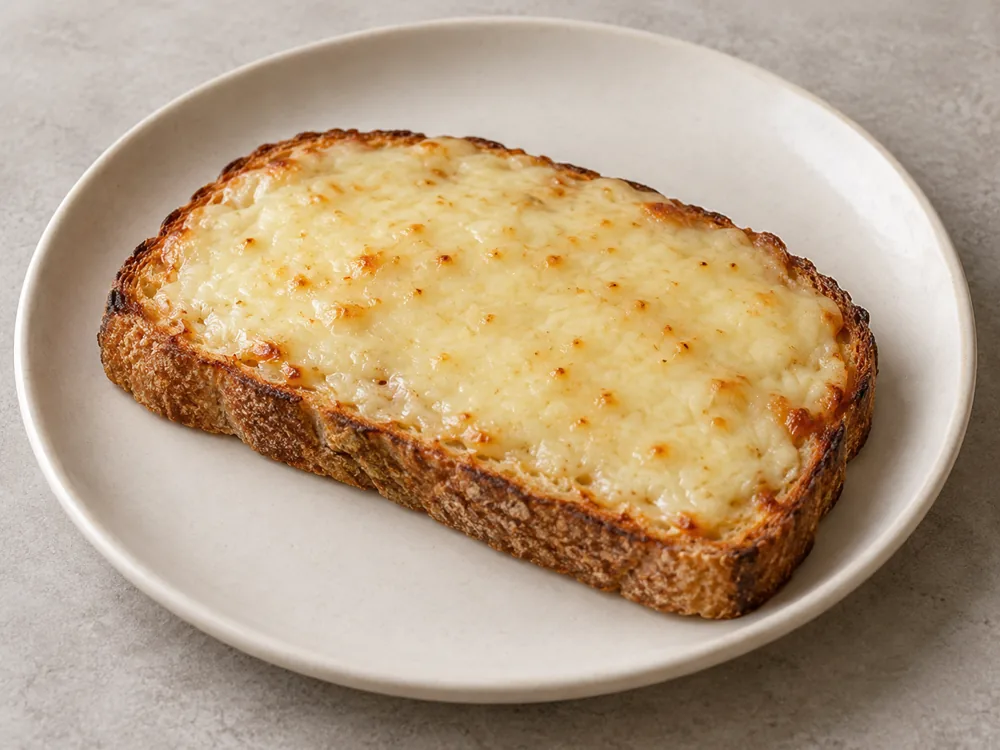
The Cheese Board goes further and says Lancashire probably makes the best cheese on toast in the world. It credits the blended-curd method for both the rich buttery flavour and the smooth, even melt.
The Cheese Board matches each style to different dishes.
| Use | How It Works |
|---|---|
| Cheese on toast | The British Cheese Board's first suggestion for Creamy Lancashire. |
| Welsh rarebit | Also listed by the Cheese Board for Creamy Lancashire. |
| Sandwiches and pasta | The Cheese Board names both for everyday eating with Creamy Lancashire. |
| Cheese and onion pie | The Cheese Board's cooked dish for Tasty Lancashire. |
| Salads | The Cheese Board suggests crumbling Crumbly Lancashire over them. |
Tasty Lancashire goes on a cheeseboard or into a ploughman's lunch, which the Cheese Board lists as a lump of cheese, pickle, crusty bread and real ale.
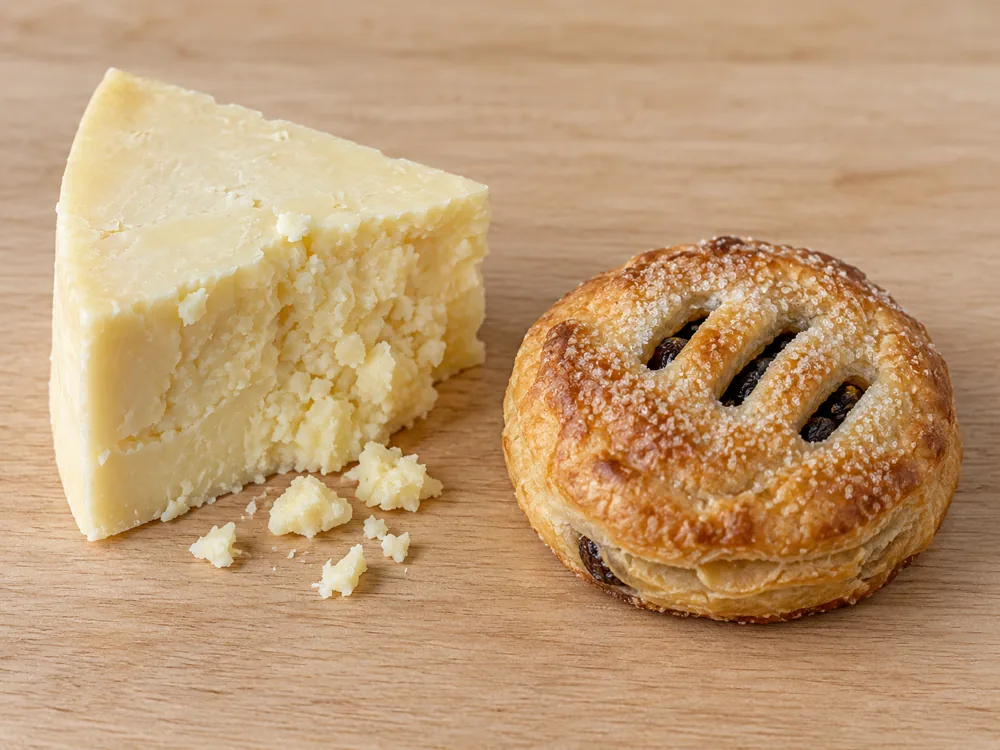
The traditional pairing is sweet. Wikipedia and Culture magazine say Lancashire is traditionally served with Eccles cakes and Chorley cakes, which Culture describes as a flaky, currant-studded pastry and the less sweet of the two.
| Pairing | Type | Why It Works |
|---|---|---|
| Eccles cake | Food | Named as the traditional partner by Wikipedia and Culture magazine. |
| Chorley cake | Food | Also named by Wikipedia and Culture magazine. |
| Fruit cake | Food | The British Cheese Board's suggestion for Crumbly Lancashire. |
| Granny Smith apple | Food | The Cheese Board pairs a crisp one with Crumbly Lancashire. |
| Pickle and crusty bread | Food | Part of the Cheese Board's ploughman's lunch with Tasty Lancashire. |
| Real ale | Drink | The drink in the Cheese Board's ploughman's lunch. |
The Courtyard Dairy says Graham Kirkham's favourite way to cook his cheese is "Cheesey Eggs", the dish his mother, Mrs Kirkham, taught him.
Is Lancashire Safe During Pregnancy?
The NHS lists pasteurised or unpasteurised hard cheeses, such as cheddar, gruyère and parmesan, as safe to eat, and it lists pasteurised semi-hard cheeses such as edam as safe too. Lancashire is not among the cheeses the NHS names.
How you classify Lancashire depends on the description you follow. Wikipedia calls its texture hard, while the PDO specification describes a moderately firm body and a mature cheese that is reasonably spreadable.
A pasteurised Lancashire such as Dewlay's fits the NHS safe list under either label. A raw-milk Lancashire such as Kirkham's is covered only if it counts as a hard cheese, and the NHS also lists any cheese cooked until steaming hot as safe.
The CDC lists hard cheese made with pasteurized milk as safer, and dairy products made from raw milk as riskier. It also says pregnant women are 10 times more likely to get a Listeria infection.
Under the CDC wording, raw-milk Kirkham's counts as riskier even though it is a firm cheese, so the milk line is the fact to check for cheese in pregnancy.
SOURCES & REFERENCES
The Beacon Fell specification describes young Lancashire as clean and mellow and mature Lancashire as quite sharp and tangy. Culture magazine describes Mrs Kirkham's as buttery, lemony and yogurty.
Both are made by the same traditional blended-curd method. The British Cheese Board says Creamy is matured for 4 to 12 weeks and Tasty for longer, up to 24 months.
No. The British Cheese Board says Crumbly Lancashire is made from one day's milking, while Creamy and Tasty blend curd from different days.
No. Only Beacon Fell Traditional Lancashire Cheese is a PDO name, and it requires milk from and a make in the ceremonial county of Lancashire.
Some is. Kirkham's Lancashire is made with raw milk, while Dewlay says its Lancashire uses pasteurised milk.
It depends on the maker. Neal's Yard Dairy and Culture magazine list animal rennet for Kirkham's, while Dewlay says all its cheeses are suitable for vegetarians.