Organic cheddar is cheddar made from milk that comes from a certified organic farm, and the label describes that farm, its feed and the ingredients allowed in the cheese.
The FDA's definition of cheddar in 21 CFR 133.113 has no organic version, so an organic cheddar follows the same cheese standard as any other and gets its organic status from USDA's separate regulations in 7 CFR part 205.
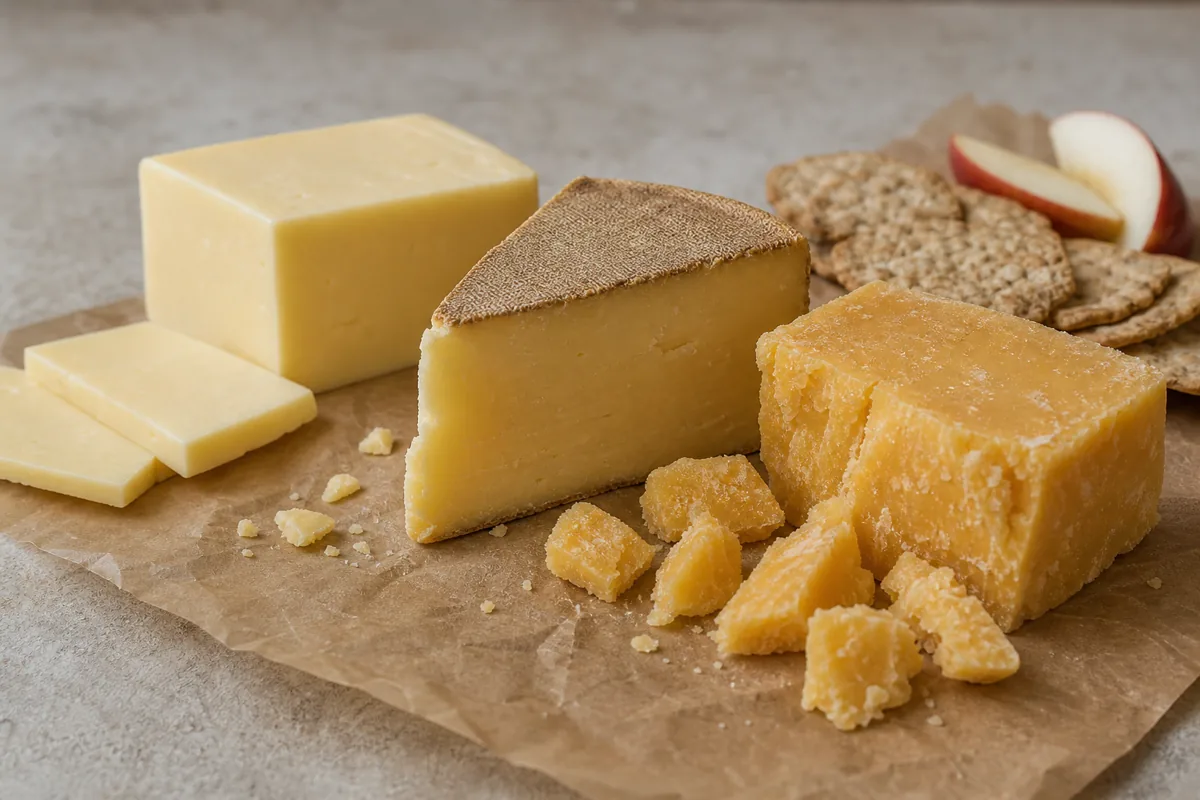
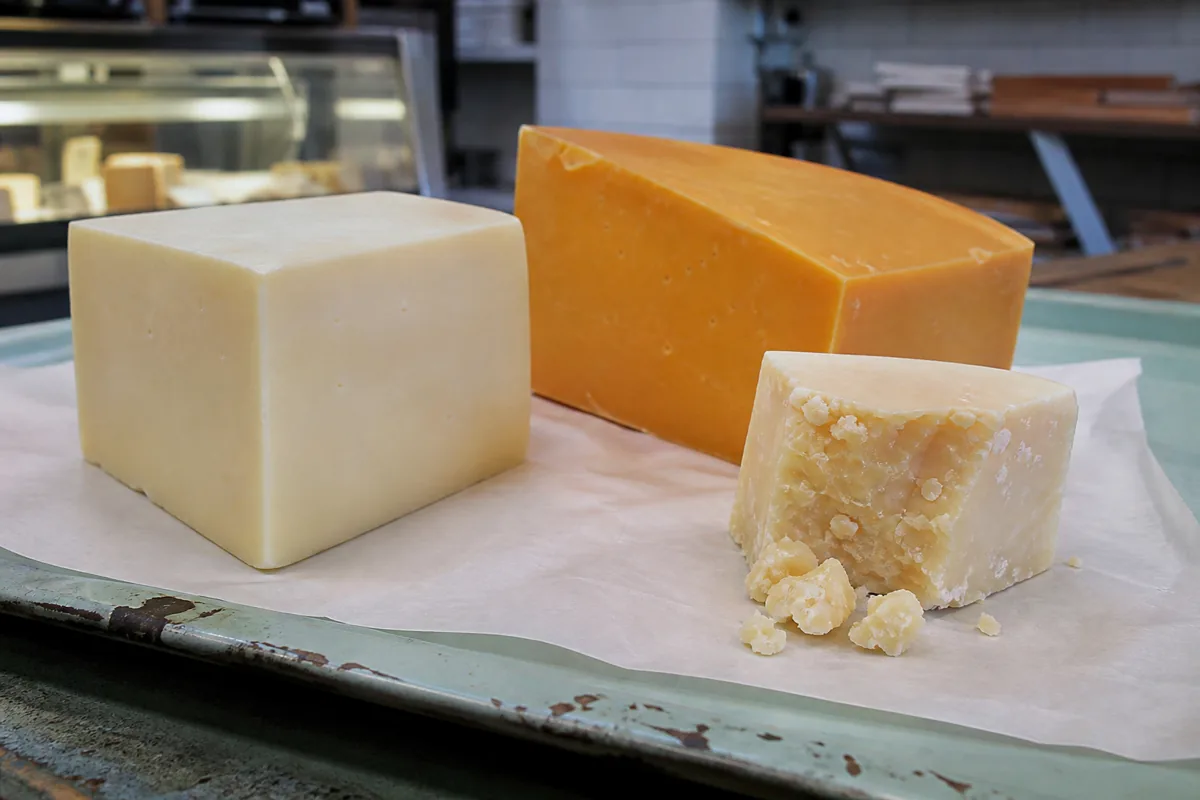
Colour is the most visible difference on the shelf: some organic cheddar is white, some is orange, and the label does not decide which.
In This Article
What Makes Cheddar Organic?
What makes a cheddar organic starts with the farm behind its milk, and USDA's rules for that farm begin with a grazing floor for dairy cows. The herd must graze for the whole grazing season of its region, which must be at least 120 days a year, and pasture must supply an average of at least 30 percent of dry matter intake during that season (7 CFR 205.237).
The rest of the ration has to be organic as well, and the producer may not use animal drugs, including hormones, to promote growth (7 CFR 205.237).
The season itself is set by region and need not be continuous: weather, season or climate can split it into pieces. The 30 percent is an average over the whole season, and lactation does not exempt a cow from the pasture rules (7 CFR 205.237; 7 CFR 205.239).
Milking is the dairy-specific case. Cows may be kept off pasture for short periods each day for milking, but milking must be scheduled to leave enough grazing time for the 30 percent average, and milking frequency or duration cannot be used to deny pasture (7 CFR 205.239).
The rules also name the other times a cow may be kept off pasture: one week at the end of a lactation, three weeks before calving, at calving and up to one week afterwards. Outside the grazing season, yards, feeding pads and feedlots can supply the required outdoor access, and continuous total confinement of any animal indoors is prohibited (7 CFR 205.239).

Supplements are allowed only in amounts needed for adequate nutrition and health, and any agricultural ingredient in them must be organic. Feed or forage with added antibiotics, including ionophores, is barred, as are formulas containing urea or manure and mammalian or poultry slaughter by-products fed to mammals or poultry (7 CFR 205.237).
Producers of ruminants must also write down the total ration for each type and class of animal, including the percentage of each feed type and of pasture, and record what was actually fed and how rations changed with the grazing season (7 CFR 205.237). If the grazing share behind your cheddar matters to you, ask the maker, since these figures go into the producer's records.
Is Organic Cheddar Grass-Fed?
Not automatically. The US rule caps fed dry matter at an average of 70 percent of a cow's demand during the grazing season, so pasture can be as little as 30 percent of what she eats (7 CFR 205.237).
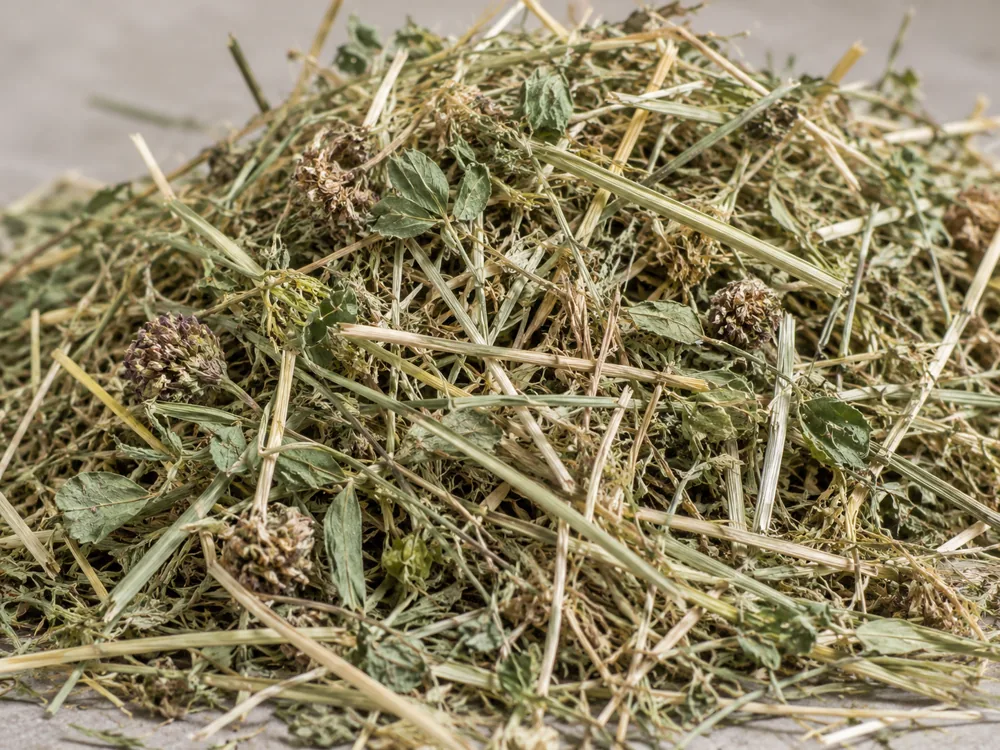
A maker that wants to say grass-fed makes that claim on its own. Organic Valley sells a Grassmilk Raw Cheddar and describes the cows' diet as organic pasture grasses and legumes in summer and dried grasses and legumes in winter, with minerals, vitamins and molasses year-round.
Organic Valley's stated reason for that feed is that a cow's nutritional and energy needs rise greatly when she is producing milk, so it gives its Grassmilk cows the highest-quality grasses and legumes, such as alfalfa and clover.
If you want grass-fed cheddar, look for that claim on its own, since it adds information that the organic claim does not. Organic Valley's Grassmilk cheddar carries both: its FAQ says its grass-fed cheese is also organic cheese.
Organic Valley lists a second grass-fed cheese, Grassmilk Raw Sharp Cheddar. The page for its Organic Raw Sharp Cheddar instead speaks of milk from pasture-raised cows, and its ingredient line reads organic cultured milk where the Grassmilk Raw Cheddar line reads organic grass-fed cultured milk.
So "pasture-raised" and "grass-fed" are Organic Valley's own wording: section 205.237 sets feeding numbers and defines neither phrase.
What Can Organic Cheddar Contain Besides Milk?
Under USDA's product-composition rule, any cheese sold as "organic", organic feta as much as organic cheddar, must be at least 95 percent organically produced ingredients by weight, with water and salt left out of the count (7 CFR 205.301).
Any remaining ingredient must be organic unless no organic form is commercially available or it is a substance the National List permits (7 CFR 205.301). Salt falls outside the count because the rule excludes water and salt added as ingredients (7 CFR 205.302), and Organic Valley's two ingredient lines print salt and sea salt without the word organic.
The wording on the label changes the promise: "100 percent organic" requires every ingredient to be organic, while "made with organic" followed by named ingredients needs only 70 percent organic ingredients (7 CFR 205.301).
The cheddar standard and the National List allow some of the same helpers. FDA lists calcium chloride, at no more than 0.02 percent of the dairy ingredients' weight, as an optional coagulation aid, and USDA's list of nonorganic substances allowed in organic products includes calcium chloride (21 CFR 133.113; 7 CFR 205.605).
Cultures follow the same pattern: the cheddar procedure subjects the dairy ingredients to the action of "a lactic acid-producing bacterial culture", and the National List permits any food grade bacteria, fungi and other microorganisms (21 CFR 133.113; 7 CFR 205.605). Organic Valley's two block pages and the Kettle & Fire soup all describe the cheddar's milk as cultured.
How Is Organic Cheddar Made?
Organic cheddar follows the same cheddar standard as any other. FDA describes cheddar by a procedure "or by any other procedure which produces a finished cheese having the same physical and chemical properties" (21 CFR 133.113), so an organic cheddar is judged against that same description.
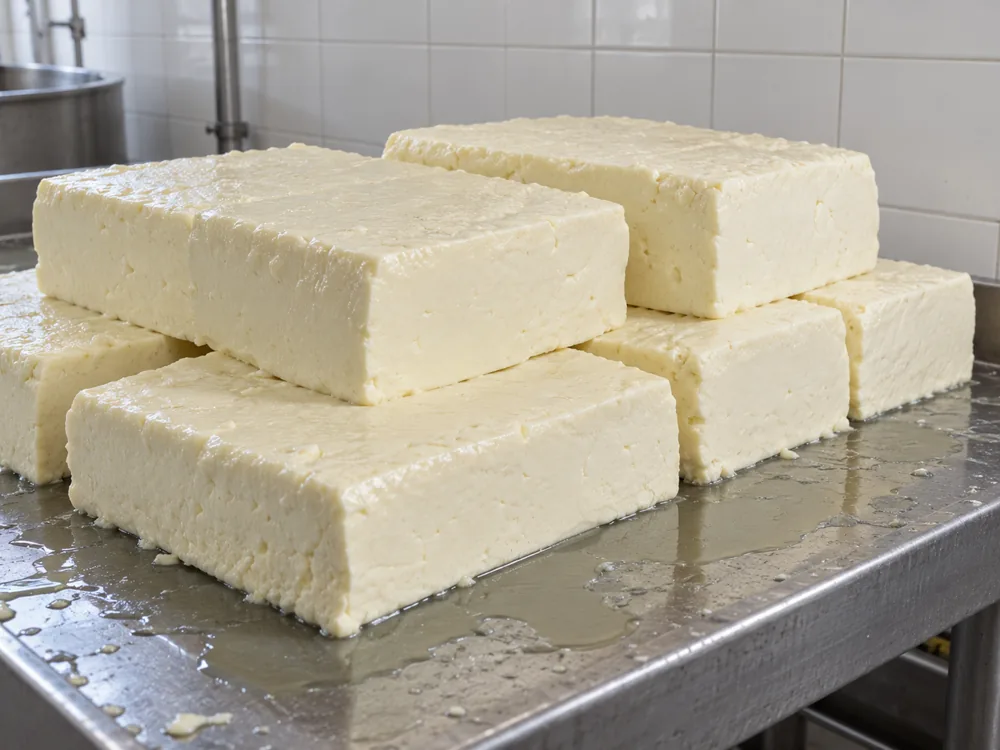
In that procedure, clotting enzymes set the cultured dairy ingredients to a semisolid mass, which is cut, stirred and heated with continued stirring so that whey separates from curd. The whey is drained and the curd is matted into a cohesive mass.
That mass is cut into slabs "so piled and handled as to promote the drainage of whey and the development of acidity". The slabs are then cut into pieces, which may be rinsed briefly, and the curd is salted, stirred, drained further and pressed into forms (21 CFR 133.113).
The standard then fixes two measurements for the finished cheese: at least 50 percent milkfat by weight of the solids and at most 39 percent moisture. By simple arithmetic those limits put a floor of about 30.5 percent milkfat on the whole weight, since solids make up at least 61 percent and at least half of the solids must be fat.
What Color Is Organic Cheddar Cheese?
Both white and orange exist, depending on the brand. FDA's cheddar standard lists coloring only as an optional ingredient, so it requires neither shade (21 CFR 133.113).

A USDA final rule published on 28 May 2013 changed who may supply annatto colour by removing non-organic annatto extract color from the National List for organic handling. The removal took effect on 3 November 2013, with a compliance year to 3 November 2014, after the National Organic Standards Board determined that annatto extract was available in organic form in sufficient quantities.
The logic is availability: a nonorganic agricultural ingredient may appear in an organic product only when it is not commercially available in organic form (7 CFR 205.606). The compliance year existed so handlers could source organic annatto extract, substitute ingredients and change labels, and it was shorter than the two years that two commenters had asked for (78 FR 31815).
An organic cheddar can therefore still be orange, but only with organic annatto. The ingredient list on your pack shows which choice the maker made, as these three examples do.
| Product | Colour ingredient listed | What the maker or listing says about colour |
|---|---|---|
| Organic Valley Grassmilk Raw Cheddar | None (organic grass-fed cultured milk, sea salt, vegetarian enzyme) | The page says the cheese is "usually white, but its color can change with the seasons" as cows graze different plants |
| Organic Valley Raw Sharp Cheddar | None (organic cultured milk, salt, vegetarian enzyme) | Not stated |
| Organic cheddar in Kettle & Fire Broccoli Cheddar soup | Organic annatto | Ingredient line: organic pasteurized cultured cow's milk, salt, organic annatto, enzymes |
A pale block says nothing about sharpness. Organic Valley ties sharpness to ageing: its Raw Sharp Cheddar is aged "to balance the cheese’s characteristic sharpness with a buttery finish".
Is Organic Cheddar Cheese Vegetarian or Halal?
Not necessarily vegetarian, because the label often says only "enzymes". FDA's cheddar standard lets makers declare enzymes of animal, plant or microbial origin simply as "enzymes" (21 CFR 133.113), so look for wording such as "vegetarian enzyme" or "microbial enzymes", which carries the information.
The standard gives enzymes two jobs, clotting the milk and acting in curing or flavor development, and the one word "enzymes" can stand for either (21 CFR 133.113).
The organic seal does not settle it. USDA's list of nonorganic substances allowed in organic products names animal enzymes, among them rennet from animals, animal lipase, pepsin and bovine-liver catalase, and separately requires any other enzyme to come from edible plants, nonpathogenic fungi or nonpathogenic bacteria (7 CFR 205.605).
Both Organic Valley cheddar pages list a vegetarian enzyme. The company's FAQ on the Raw Sharp page, worded about its pasteurized cheeses, adds that it uses vegetarian, microbial enzymes in most of its cheeses and an animal-derived lipase in only one variety, its blue cheese.
Halal status turns on the same coagulant question. IslamOnline's fiqh section says plant-based and microbial rennets are unanimously permissible, while rennet from animals not slaughtered by Islamic rules is disputed.
The disputed case is rennet from a lawful animal not slaughtered by Islamic rules: IslamOnline reports that most scholars treat it as impure because the animal's stomach becomes impure at its unlawful death, while some prominent scholars permit it because rennet contains no blood. Rennet from a pig is unanimously prohibited.
When you shop, the same page reads "microbial rennet", "microbial enzymes" and "vegetable rennet" as permissible sources and takes plain "rennet" or "animal enzymes" to mean, usually, calf or cow rennet from conventional slaughterhouses. It adds that a "suitable for vegetarians" label avoids the dispute because those cheeses use non-animal enzymes.
Read the pack for 'vegetarian enzyme' or 'microbial enzymes'. A plain 'enzymes' does not say whether the source is animal, plant or microbial, and halal turns on the same question.
Is Organic Cheddar Cheese Healthier Than Regular Cheddar?
The nearest evidence compares milk, not cheddar. A 2016 meta-analysis of 170 studies in the British Journal of Nutrition, whose lead authors work at Newcastle University, found these differences between organic and conventional milk.
| Concentration measured | Result in organic milk |
|---|---|
| Total saturated fat and monounsaturated fat | No significant difference |
| Omega-3 (n-3) fatty acids | 56 percent higher |
| Alpha-linolenic acid | 69 percent higher |
| Very long-chain n-3 fatty acids (EPA, DPA, DHA) | 57 percent higher |
| Conjugated linoleic acid | 41 percent higher |
| Alpha-tocopherol and iron | Higher |
| Iodine and selenium | Lower |
Each percentage is an estimate with a range around it: the abstract gives 38 to 74 percent for omega-3 fatty acids, 27 to 87 percent for the very long-chain group and 14 to 68 percent for conjugated linoleic acid, all as 95 percent confidence intervals. Total omega-6 fatty acids did not differ significantly, so the omega-6 to omega-3 ratio was lower in organic milk, by an estimated 71 percent.
The authors' analysis of a large European milk survey pointed to higher grazing and forage intake on organic farms as the main reason for the differences, which ties the result to the pasture rule rather than to anything done at the vat.
The abstract reports concentrations in milk, not health outcomes, and its authors conclude only that organic milk has a more desirable fatty acid composition than conventional milk.
Per one-ounce serving, the label on Organic Valley's Raw Sharp Cheddar lists 110 calories, 9 g of fat (5 g saturated, 25 percent of the Daily Value), 180 mg of sodium and 6 g of protein. The Grassmilk Raw Cheddar page prints the same figures.
The 9 g of fat in a 28 g ounce is about 32 percent by weight, in line with the floor that FDA's standard sets.
Is Raw Organic Cheddar Safe to Eat?
For a raw-milk cheddar the answer depends on the agency: NHS puts no pasteurisation condition on hard cheese, while CDC's hard-cheese line applies only to cheese made with pasteurized milk.
US rules treat raw-milk cheddar differently from pasteurised cheddar: if the dairy ingredients are not pasteurised, the cheese must be cured at not less than 35°F for at least 60 days (21 CFR 133.113).
Organic Valley's Grassmilk Raw Cheddar is aged a minimum of 60 days and its Raw Sharp Cheddar at least six months. The Grassmilk page says the cheese begins with unpasteurized milk.
A footnote on its raw cheddar pages says the milk was heated at 155°F for 16 seconds. That is the maker's own statement, and Organic Valley still names and sells both cheeses as raw.
On both pages the asterisk is attached to the word "Raw" in the description, so the heating statement qualifies the word itself.
If you follow NHS advice, you can eat organic cheddar, raw or pasteurised: the NHS lists pasteurised or unpasteurised hard cheeses, such as cheddar, as safe to eat.
If you follow US advice, ask a midwife or doctor before you eat an organic cheddar without a label that says pasteurized milk, even cooked: Organic Valley names and sells its Grassmilk Raw and Raw Sharp cheddars as raw, and the CDC lists unpasteurized (raw) milk and dairy products made from raw milk as riskier and hard cheese, when made with pasteurized milk, as safer.
Is Organic Cheddar Soup the Same as Block Cheddar?
No: soup holds the cheddar as one ingredient among others. Kettle & Fire's Broccoli Cheddar Keto Bone Broth Soup lists organic cheddar cheese beside organic chicken bone broth and broccoli, so its label describes a recipe rather than a cheese to cut and eat.
The cheddar is the third item on that ingredient line, after water and organic cream, and a second cheese, organic Parmesan, follows further down with its own entry of organic pasteurized cultured milk, salt and enzymes.
Both cheeses list plain "enzymes", so if you need to know what set the milk for vegetarian or halal reasons, ask Kettle & Fire. The label does call the cheddar's milk pasteurized.
Where Can You Buy Organic Cheddar Cheese?
Organic Valley sells its Raw Sharp Cheddar as an 8 oz block or 6 oz slices and its Grassmilk Raw Cheddar as an 8 oz block. Its pages say that no antibiotics, artificial growth hormones, toxic pesticides or GMOs are used on its farms.
Both block pages print eight 1 oz servings per container and tell you to keep the cheese refrigerated.
On a pack, five lines settle most of the questions above. They are whether the label says organic or made with organic, the enzyme wording, a colour ingredient such as organic annatto, the words grass-fed in the ingredient line and, for raw-style cheddars, whether the milk is called pasteurised.