Cheese Profile

Harbison: How a Failing Batch Became a Spruce-Wrapped Cheese

Harbison cheese is a spruce-bark-wrapped, spoonable soft cheese from Jasper Hill Farm in Vermont. Learn its story, taste, and how to serve it.

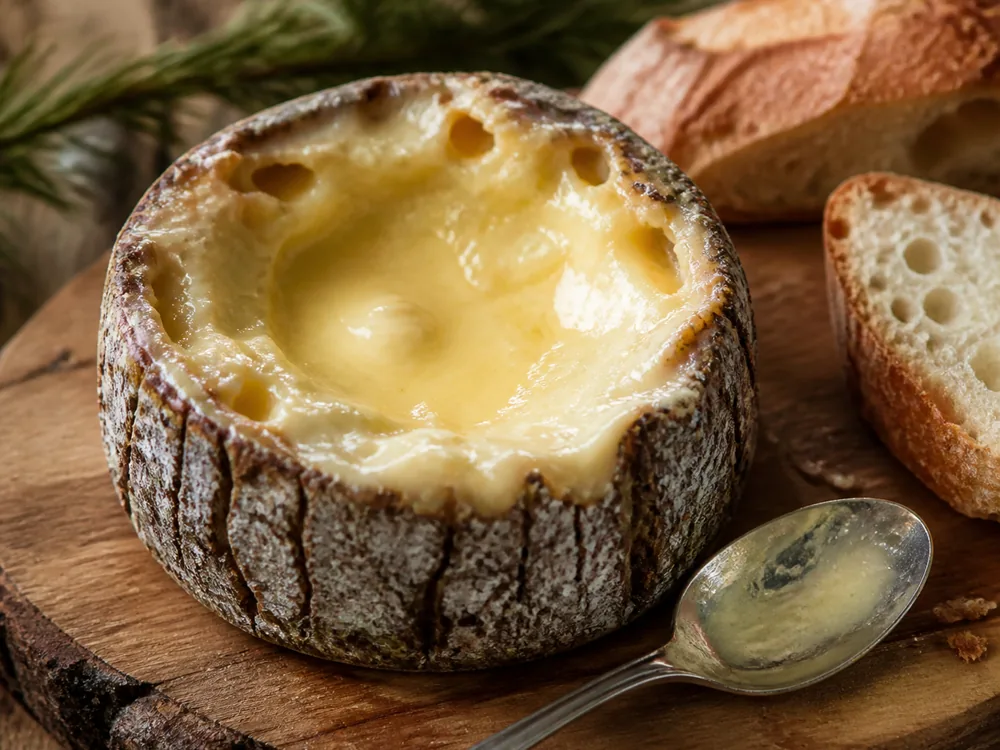
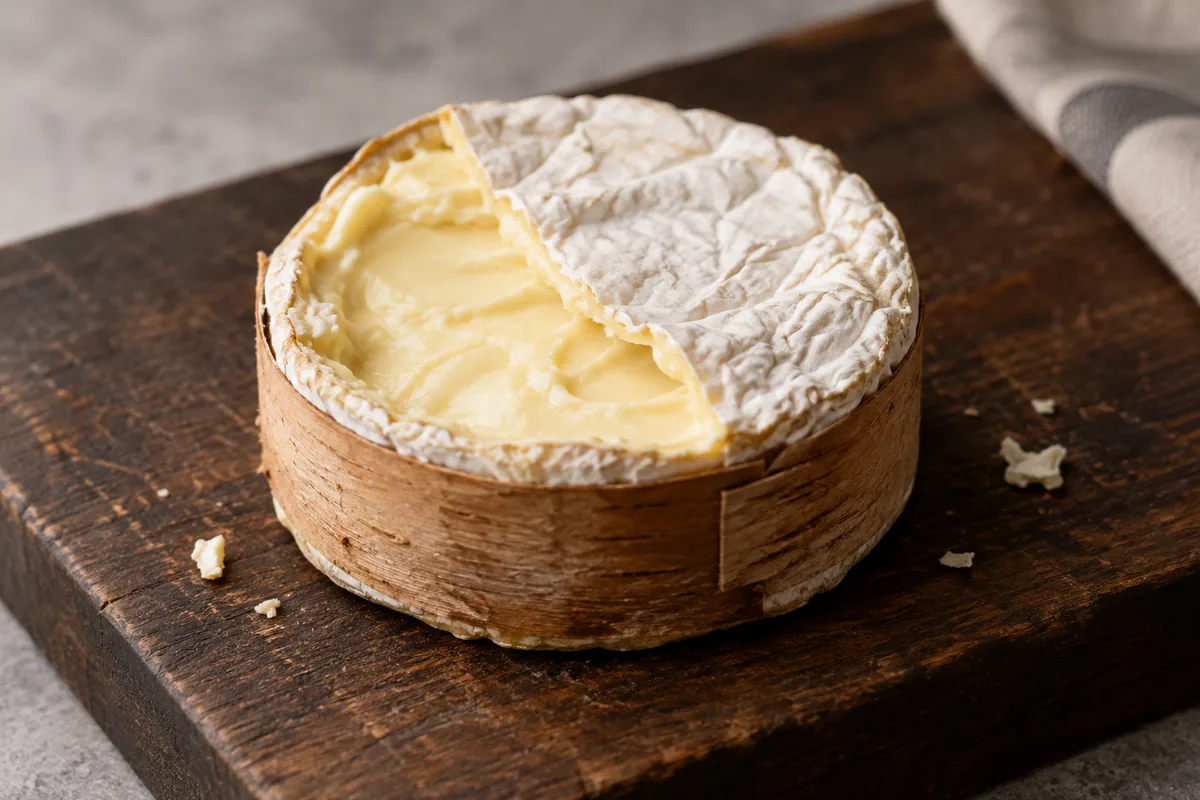
Wheel of Harbison cheese wrapped in spruce bark with soft interior
HARBISON QUICK FACTS
OriginJasper Hill Farm, Greensboro, Vermont, United States
MilkPasteurized Ayrshire cow's milk
TextureSoft and spoonable at full ripeness, almost fondue-like
RindWhite bloomy rind, belted in a strip of spruce cambium bark
AgingAbout 6 to 13 weeks
PDO / DOPNo protected status
FlavorSweet cream and mushroom, with a resinous, piney note from the bark
AvailabilityWhole Foods, specialty cheese shops, and mail order across the US
PriceSpecialty pricing; roughly $28-30 for a 9 oz wheel

Harbison is a soft, spoonable cow's-milk cheese from Jasper Hill Farm in Greensboro, Vermont, belted in a strip of spruce bark that holds its shape and adds a resinous, piney flavor. It's one of the most consistently awarded American cheeses of the past decade.

It exists because a batch of a different cheese refused to behave.

Brothers Who Bought a 200-Acre Ruin

Andy and Mateo Kehler, along with their wives Victoria and Angie, bought a rundown, roughly 200-acre hillside farm in Greensboro, Vermont, in 1998. The dairy barn hadn't held cattle in nearly 40 years, but the brothers had deep roots in the area: their family had been summering on nearby Caspian Lake for nearly a hundred years.

The timing wasn't accidental.

Greensboro lost roughly 30 percent of its dairy farms in 1998 alone, a crisis the Kehlers cite as part of what drove them to act.

They spent five years rebuilding the barn, started an Ayrshire dairy herd, and brought their first cheeses to market in 2003. The farm today milks about 45 Ayrshire cows, a Scottish breed chosen for cold-climate hardiness and cheesemaking-quality milk.

How a "Pancaking" Batch Became a New Cheese

Harbison wasn't planned. Jasper Hill's cheesemakers were working a batch of Moses Sleeper, their Brie-style cheese, that was at risk of "pancaking," spreading and flattening past any useful shape as it ripened.

Pancaking is a ripening fault rather than a flavor fault. The paste breaks down faster than the thin bloomy rind can contain it, so a wheel that would taste fine ends up too flat and too wide to sell.

Borrowing a technique from Jura classics like Vacherin Mont d'Or, they wrapped the failing wheels in a thin band of spruce cambium bark to hold their shape structurally.

The band carries the load the rind cannot, keeping a straight side on the wheel while the inside goes soft.

The result held together and developed a new character from the bark, becoming its own cheese.

Harbison placed at the American Cheese Society competition by 2012, which is the earliest solid date anchor for its existence, though no source gives an exact founding year or batch date.

Who Was Anne Harbison?

Sources consistently describe her as "the grandmother of Greensboro," a longtime local figure who ran a bed and breakfast, volunteered at the public library, and had known the Kehler brothers since they were children. Beyond that, her biography is thin: no source gives birth or death dates, a fuller life story, or a specific civic accomplishment beyond being a beloved and personally significant community elder.

The Cellars at Jasper Hill

Harbison ages in the Cellars at Jasper Hill, a 22,000-square-foot underground facility built into the hillside, divided into seven separately climate-controlled vaults arranged around a central corridor the farm calls "the Ellipse." It became operational in 2008, following the success of Jasper Hill's 2003 collaboration with Cabot Creamery on Cabot Clothbound Cheddar, which won Best of Show at the American Cheese Society in 2006.

The Cellars brought a European cooperative-affinage model to Vermont: rather than each small producer building its own aging infrastructure, the facility ages, distributes, and markets cheese for Jasper Hill's own creamery plus several other regional producers, including Cabot Creamery and von Trapp Farmstead. A team of affineurs handles what Jasper Hill's own site describes as "barking, washing, flipping, brushing, spiking, and salting," tailored to each cheese style.

How Harbison Is Made

Harbison is made from pasteurized Ayrshire cow's milk with traditional animal rennet. Curds are cut into 1-inch cubes, ladled into molds, flipped multiple times, rested overnight, then brined.

Cutting at a full inch leaves the curd deliberately coarse, because large pieces hold whey instead of shedding it and that retained moisture becomes the loose, spoonable body of the finished wheel. The same milk cut into small grains would drain toward something closer to a firm cheese.

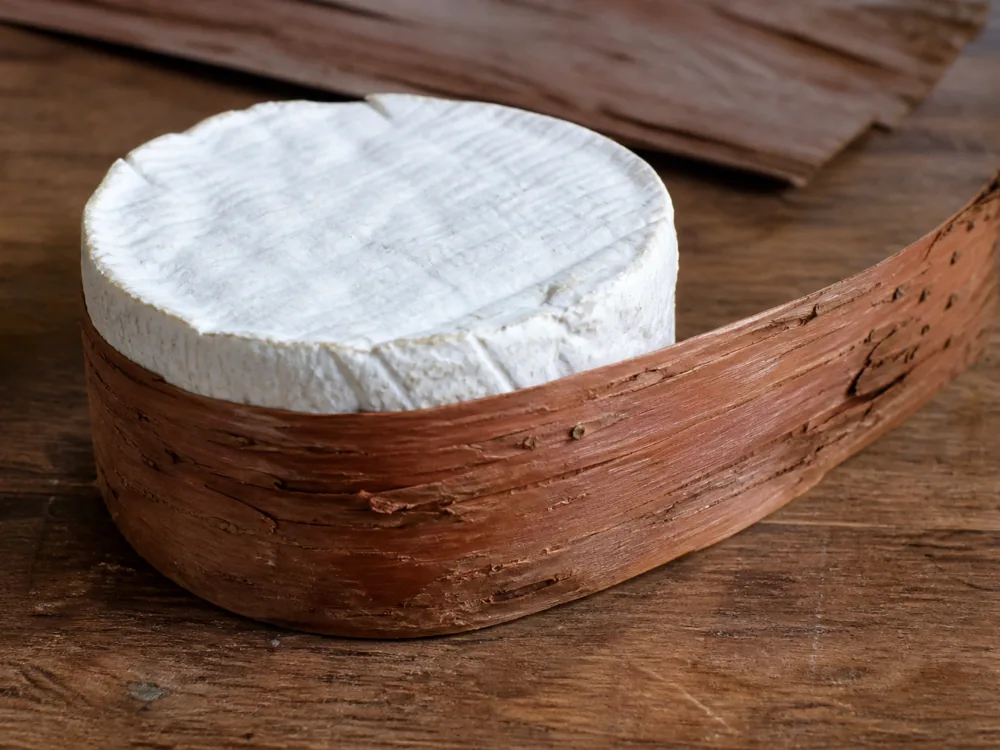
Spruce bark being wrapped around a wheel of Harbison cheese - Harbison cheese | KnowTheCheese
Harbison's spruce cambium bark is harvested from Jasper Hill's own woodlot, boiled to soften it, then wrapped snugly around each wheel.

The bark itself is spruce cambium, the soft inner layer between bark and wood, harvested from Jasper Hill's own woodlot rather than bought from an outside supplier. Strips are boiled to soften and sanitize them, then wrapped around each cheese, doing double duty: structurally belting the rind to stop the soft paste from spreading, and contributing a resinous, piney flavor as the cheese ages.

Boiling does more than sanitize. Wet cambium bends around a soft wheel and closes on itself without splitting, while a dry strip cracks before the ends meet.

Jasper Hill's own site notes the bark may develop harmless blue-green mottling from Penicillium mold, which is kept rather than treated as a defect.

The rind is bloomy, not washed, and current official aging runs 6 to 13 weeks, though earlier accounts of the cheese describe a shorter 4-to-6-week window, which likely reflects an earlier version of the recipe rather than an error.

What Harbison Tastes Like

Jasper Hill's own flavor wheel for Harbison lists sweet cream, button mushroom, woodsy, raspberry, and mustard notes. Cheese writer Erika Kubick has described it as "a hot tub of instant fondue that tastes of custard and forest," with notes of mushrooms, bacon, mustard, and evergreens, soft "as buttercream frosting when ripe."

Cheese writer Janet Fletcher, tasting a mature wheel, described it as "as goopy as fondue, with heady aromas of smoke, damp cave, roasted cauliflower and butter-browned cabbage." Younger wheels read simpler and sweeter, buttery with mild earthy notes, before the mustardy, mushroomy, woodsy character builds with age.

Age shows on the cut face before it shows on the palate. A young wheel holds a pale, cakey center that keeps the mark of a knife, while a fully ripe one slumps toward the edge of the plate within a minute of being opened.

The resin sits strongest right where the paste meets the bark, so a spoonful taken from the outside tastes piney and one taken from the middle tastes mostly of sweet cream. Working from the center outward gives you both in the same sitting.

Awards

Harbison has won Best American Cheese, or Super Gold, at the World Cheese Awards in 2015, 2016, 2018, and 2023, plus Best of Show at the 2018 American Cheese Society competition among nearly 2,000 entries.

One correction worth making explicitly: Harbison did not win Best American Cheese at the 2024 World Cheese Awards. That honor went to Jasper Hill's own Bayley Hazen Blue, which placed fifth worldwide overall.

Harbison received a Gold Medal that year, a real result but a different one, and the two are easy to conflate in casual coverage.

How to Serve Harbison

Harbison is a spoon cheese. Jasper Hill recommends peeling the bark away when the wheel is young enough to slice, or leaving it intact and spooning the paste once it has softened with age.

Take the top off with a thin, smooth blade run just inside the bark belt, so the disc of rind lifts away whole and the paste stays where it is. A serrated knife tears the bloomy rind and drops crumbs of it into the cheese.

Open the wheel at the table rather than in the kitchen, since the paste keeps loosening once the lid is off and the first ten minutes are when it looks best.

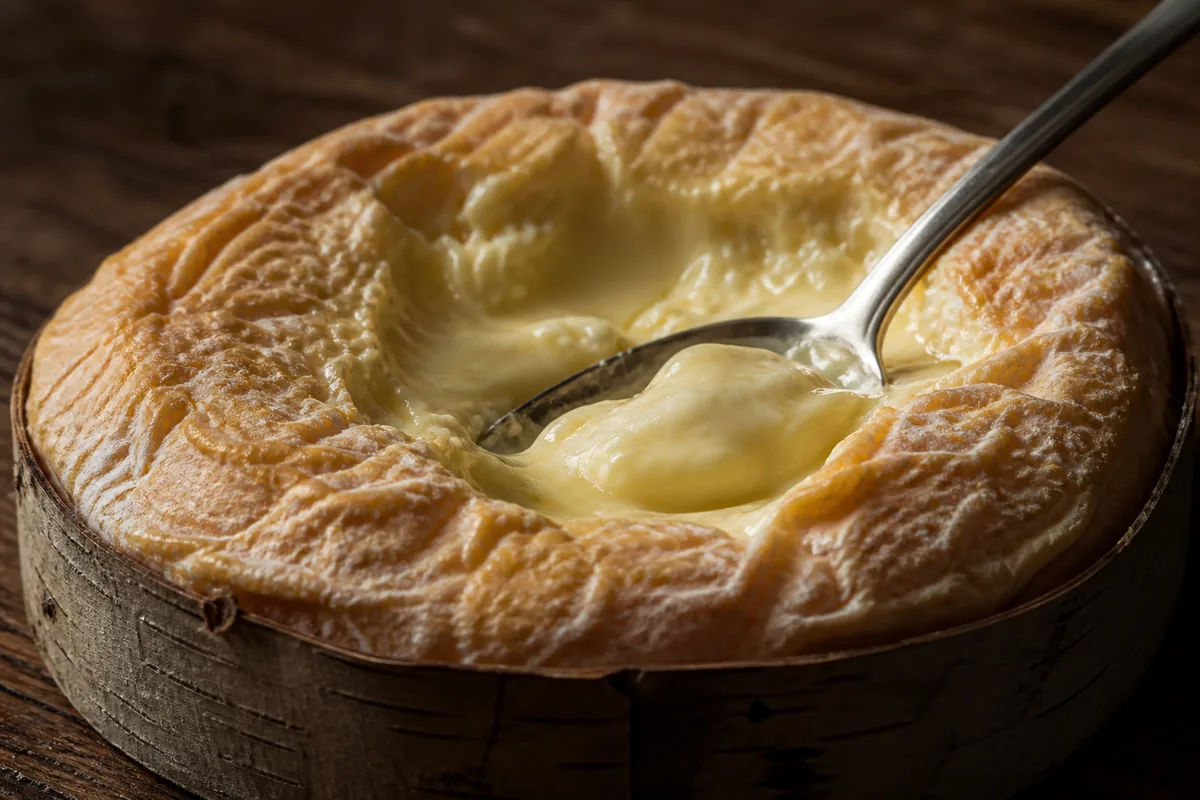
Wheel of Harbison cheese with the top cut open, soft interior visible with a spoon nearby - Harbison cheese | KnowTheCheese
At full ripeness, Harbison's paste turns soft enough to eat with a spoon, straight from the wheel.

Retailer Zingerman's puts it simply: "Let it come to room temperature, cut off the top, scoop it out onto something warm and crusty."

Jasper Hill pairs it with oaky white wines, barrel-aged sour beer, fruit mostarda, and crusty bread. Erika Kubick recommends savory pairings like fries, salami, and pickles, or sweet ones like fig jam and buckwheat honey.

What you scoop onto matters more than it sounds, because soft bread folds under a load of paste this loose. Toasted baguette coins, a stiff-crusted sourdough, or a sturdy cracker will each carry a full spoonful without collapsing.

The bark is a belt around the side and not a box with a base, so a wheel warmed in a low oven needs a shallow dish under it to catch whatever escapes at the bottom edge.

What to Use Instead When Harbison Isn't Available

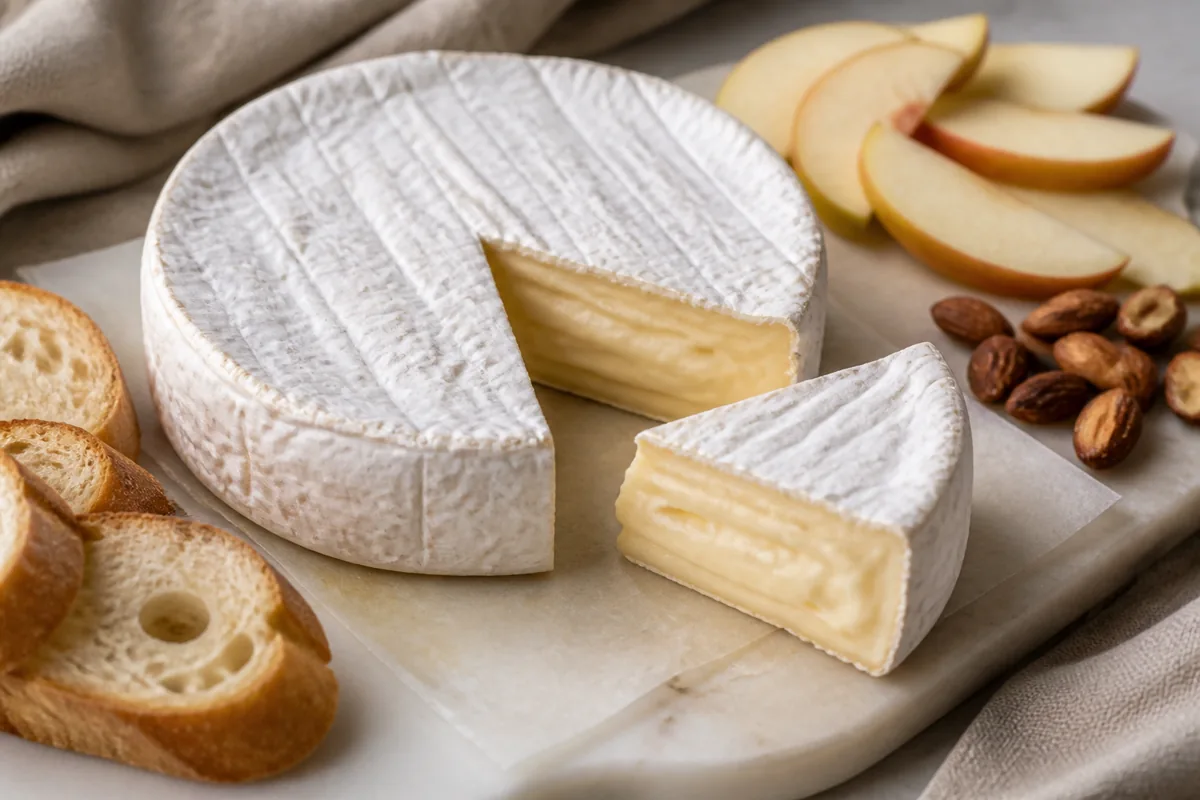
A ripe French Vacherin Mont d'Or is the closest match, since it's the same bark-belted, spoonable tradition Harbison borrows from. A very ripe Brie or Camembert approximates the soft, oozing texture without the piney bark note.

Ripeness decides whether either swap works at all. A firm, chalky wheel of Brie or Camembert slices cleanly and sits there, which is the opposite of what a recipe built around Harbison is asking for.

With the piney note missing, put it back on the board instead of into the cheese. A sprig of rosemary tucked under the warm wheel or a spoonful of pine honey alongside covers the ground the bark would have covered.

Buying Harbison

Harbison is sold nationally at Whole Foods and Murray's Cheese, along with specialty shops like Formaggio Kitchen and Zingerman's, typically as a 9-ounce wheel.

Press the top gently through the wrapper before you commit. A wheel that gives under a finger and comes back slowly is ripe enough to spoon, and one that stays firm still has fridge time ahead of it.

The belt tells the rest. It should sit flush against the side of the wheel all the way around, since a band that has gone slack means the paste behind it has already shrunk away.

A 9-ounce wheel feeds four to six people as part of a board. The clock starts once it is cut, so buy it for the day you plan to serve it rather than as something to keep on hand.

BUYING TIPS
Best Value
A 9 oz wheel from Whole Foods or a local specialty cheese shop
Premium Pick
A Champagne-washed Special Wash edition, when available
What to Avoid
A wheel with a cracked or dried-out bark belt, a sign it's aged past its prime
Where to Buy
Whole Foods Market, Murray's Cheese, Formaggio Kitchen, and Zingerman's
What to Look For
A snug, intact bark belt and a top that gives slightly when pressed

Nutrition and Safety

Retailer listings commonly cite roughly 80 calories, 6g fat, 4g saturated fat, and 5g protein per 1 oz serving, though these figures come from aggregated retail listings rather than a single verified panel, so treat them as approximate.

Those numbers are per ounce, and an ounce of a cheese this soft is a couple of spoonfuls rather than a slice, so a helping on a board runs well past a single serving.

Harbison is made with pasteurized milk, which makes it a safer choice than raw-milk soft cheeses for pregnant women and others avoiding unpasteurized dairy.

Pasteurization answers the milk question, not the handling one. A soft, high-moisture wheel that has sat out through a long afternoon belongs back in the fridge and on tomorrow's cooking list rather than back on the board.

Storing Harbison

Everything that makes Harbison good is moisture, which is also what makes it a poorer keeper than a hard cheese. The bark belt holds the shape but does nothing to slow the paste down, so cold air and a breathable wrap do all the work.

STORAGE GUIDE
Best Location
Main body of the refrigerator, not the door
Wrapping
Cheese paper, not plastic wrap, to let the rind breathe
Freezing
Avoid freezing; the soft paste and bark belt both suffer after thawing.
Room Temp / Serving
Let it sit for 45 minutes to an hour before serving so the paste softens fully.

Once opened, use Harbison within about a week, since the paste continues to soften and the flavor deepens even under refrigeration.

Keep it sitting on its base with the cut top covered loosely rather than pressed flat, because paste this soft flows into a tight fold of paper and stays there. The bark belt keeps the sides upright on its own.

SOURCES & REFERENCES


1.
Jasper Hill Farm, 2026 Reference
Kehler brothers' backstory, 1998 farm purchase, herd detail.

2.
Jasper Hill Farm, 2026 Reference
Production process, flavor wheel, aging time, official awards list.

3.
Formaggio Kitchen, 2012 Reference
Origin story, spruce bark process detail, 2012 ACS placement.

4.
Erika Kubick, Cheese Sex Death, 2026 Reference
Tasting notes, Anne Harbison background, serving suggestions.

5.
Janet Fletcher, 2018 Reference
2018 World Cheese Awards tasting notes.

6.
Hardwick Gazette, 2024 Reference
Correction on 2024 World Cheese Awards result: Bayley Hazen Blue, not Harbison, won Best American Cheese.

7.
Jasper Hill Farm, 2026 Reference
Underground aging facility detail, cooperative affinage model.

Harbison FAQ

No, the spruce bark belt is meant to be removed before eating; it's there to hold the soft paste's shape and add flavor to the rind as it ages, not to be eaten itself.

No, that's a common mix-up. Jasper Hill's Bayley Hazen Blue won Best American Cheese at the 2024 World Cheese Awards; Harbison received a Gold Medal that year, and its own Best American Cheese wins were in 2015, 2016, 2018, and 2023.

Sweet cream and mushroom when young, developing mustardy, woodsy, and resinous notes from its spruce bark wrap as it ages toward a soft, spoonable texture.

Yes, Harbison is made with pasteurized Ayrshire cow's milk, which makes it a safer choice than raw-milk soft cheeses for pregnant women and others avoiding unpasteurized dairy.