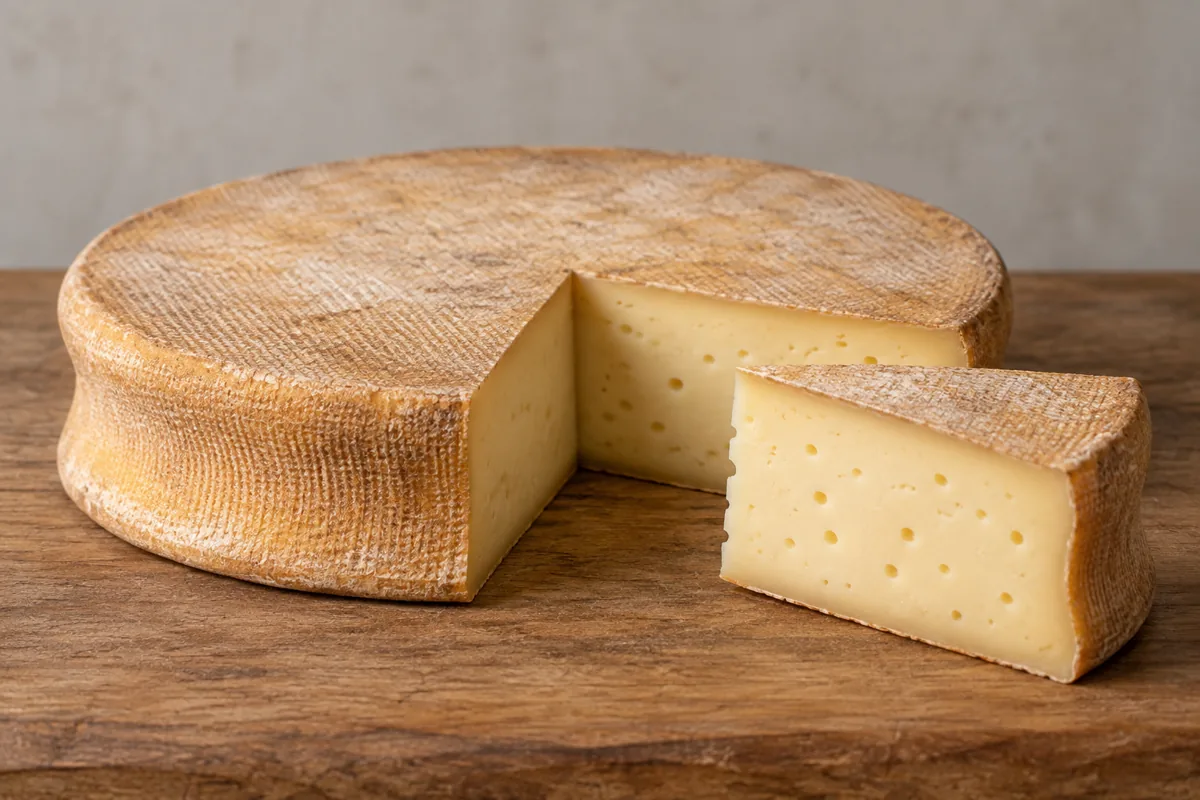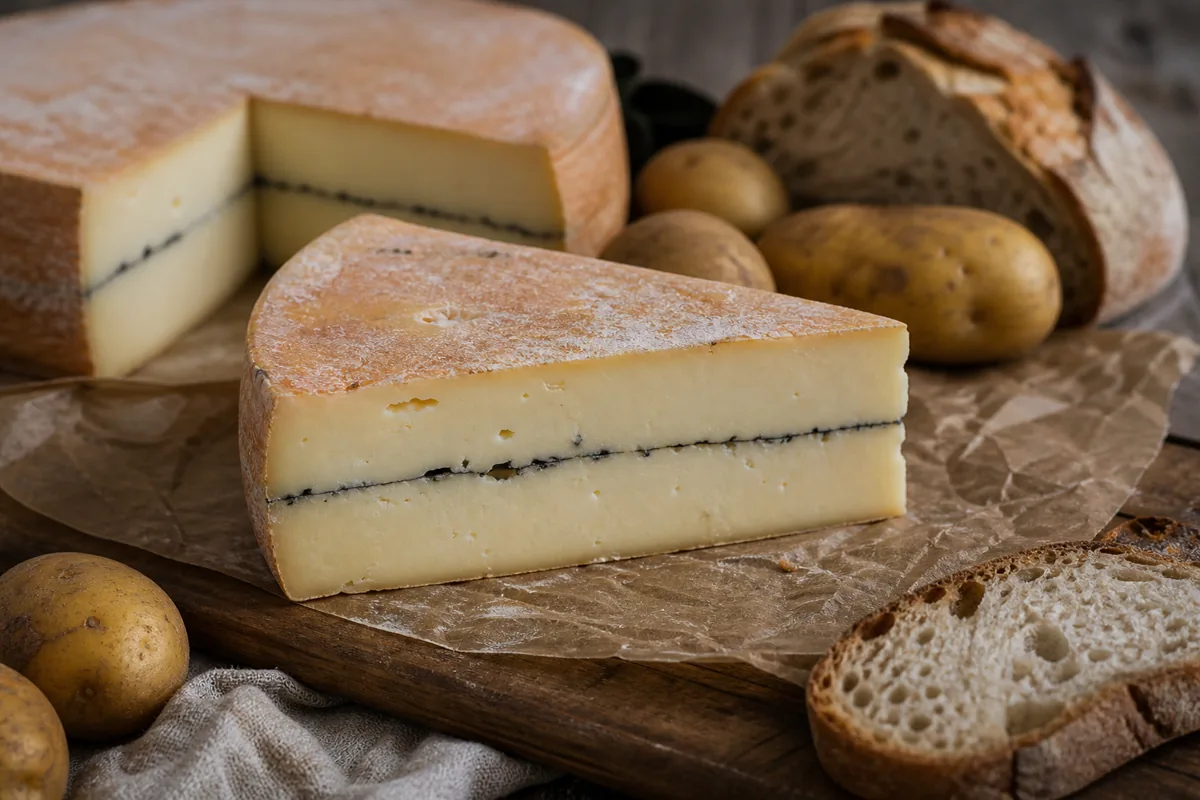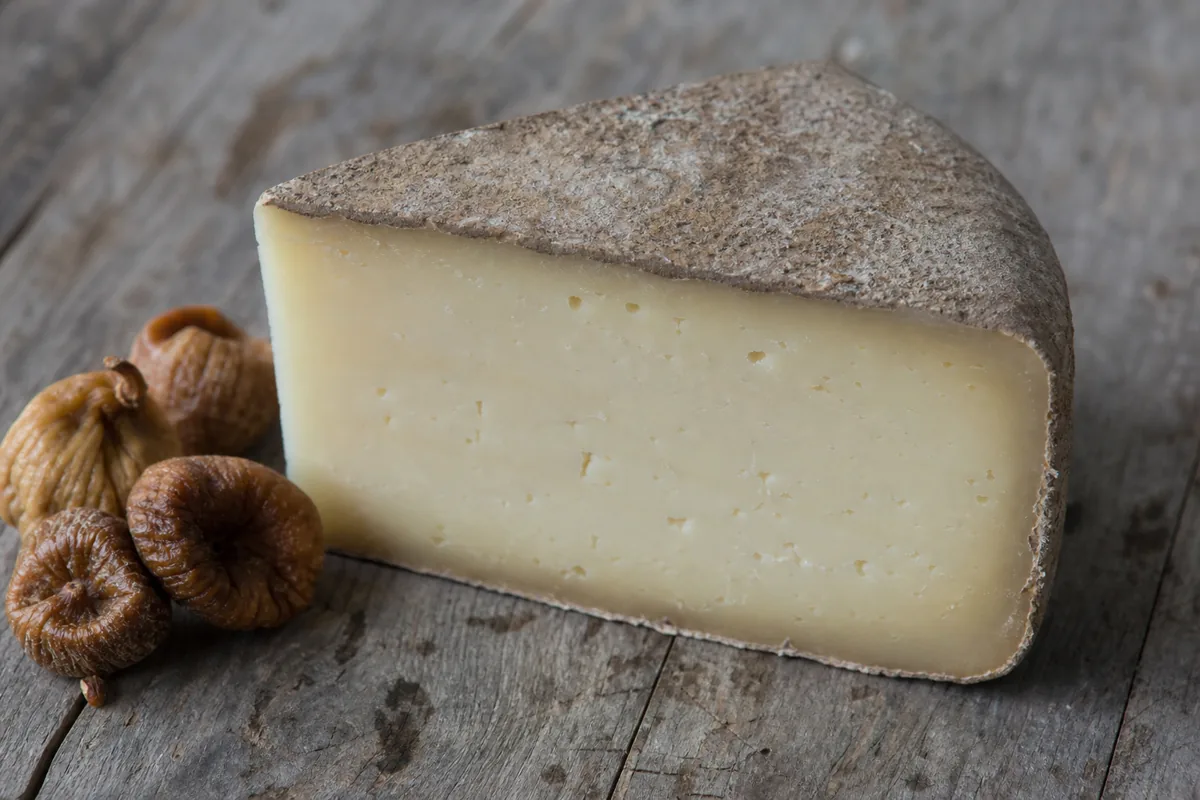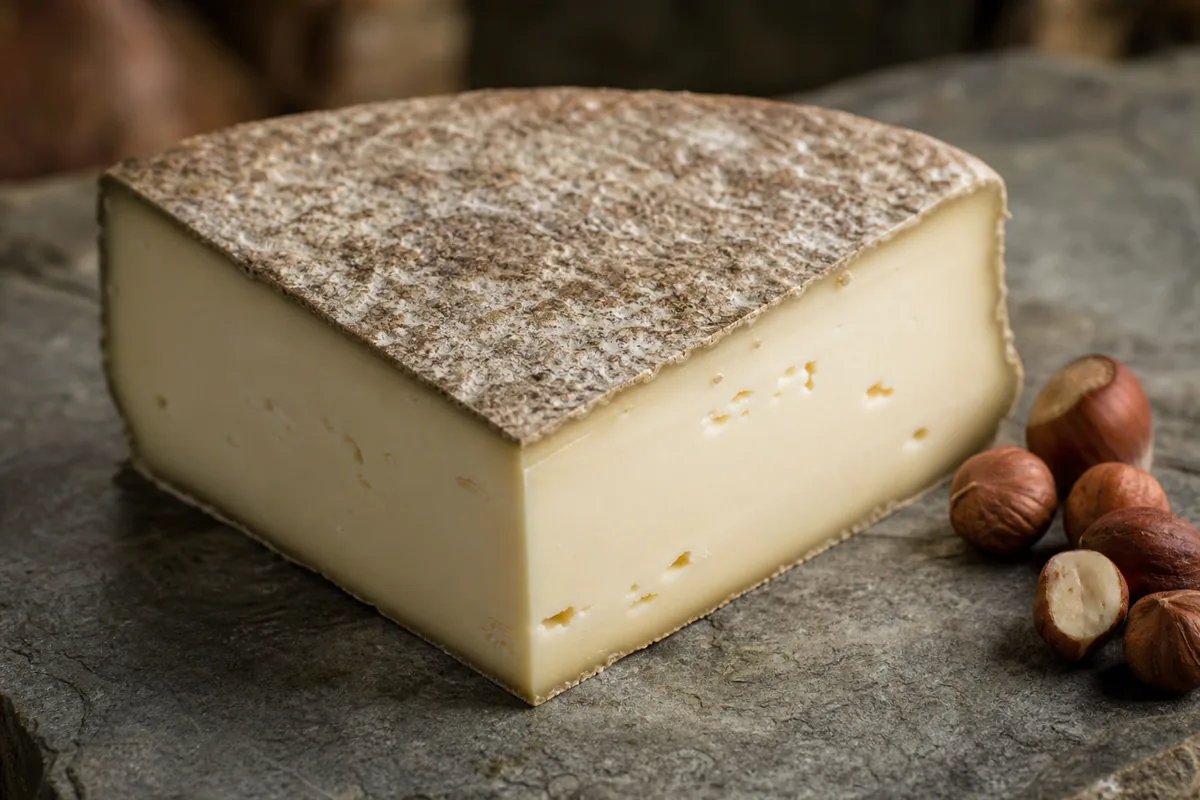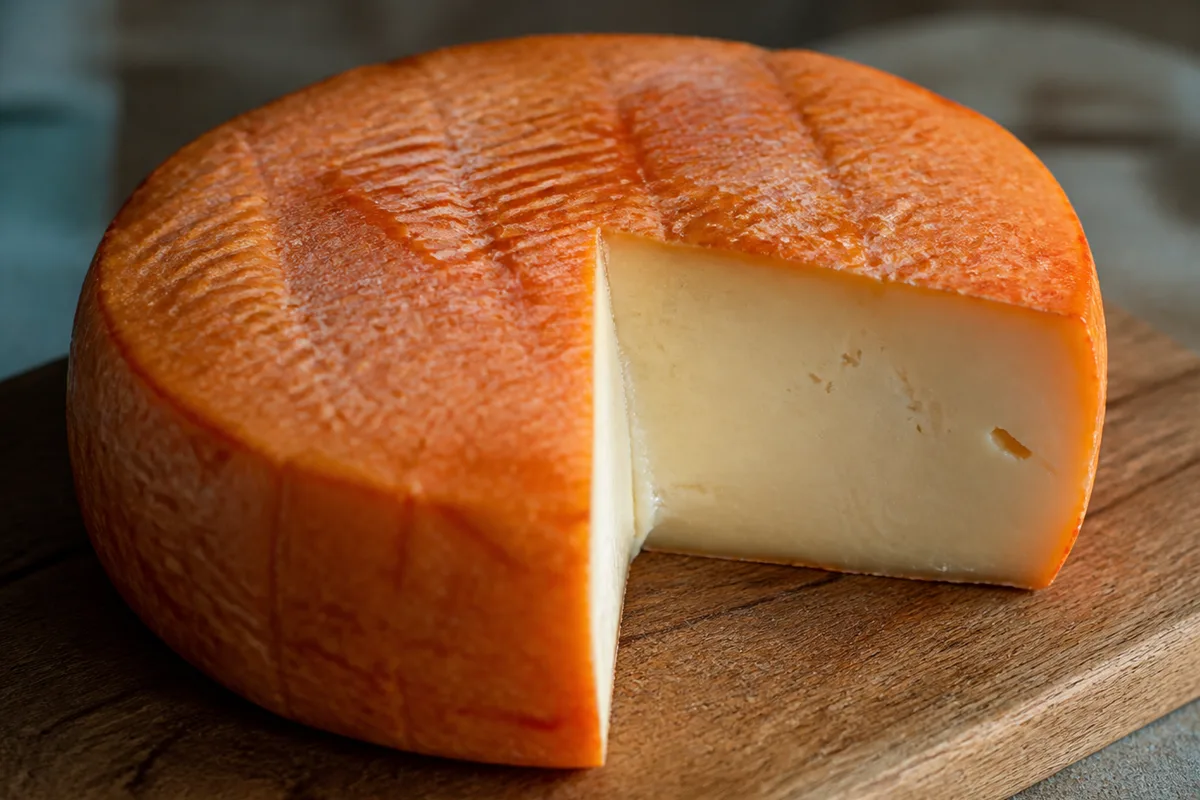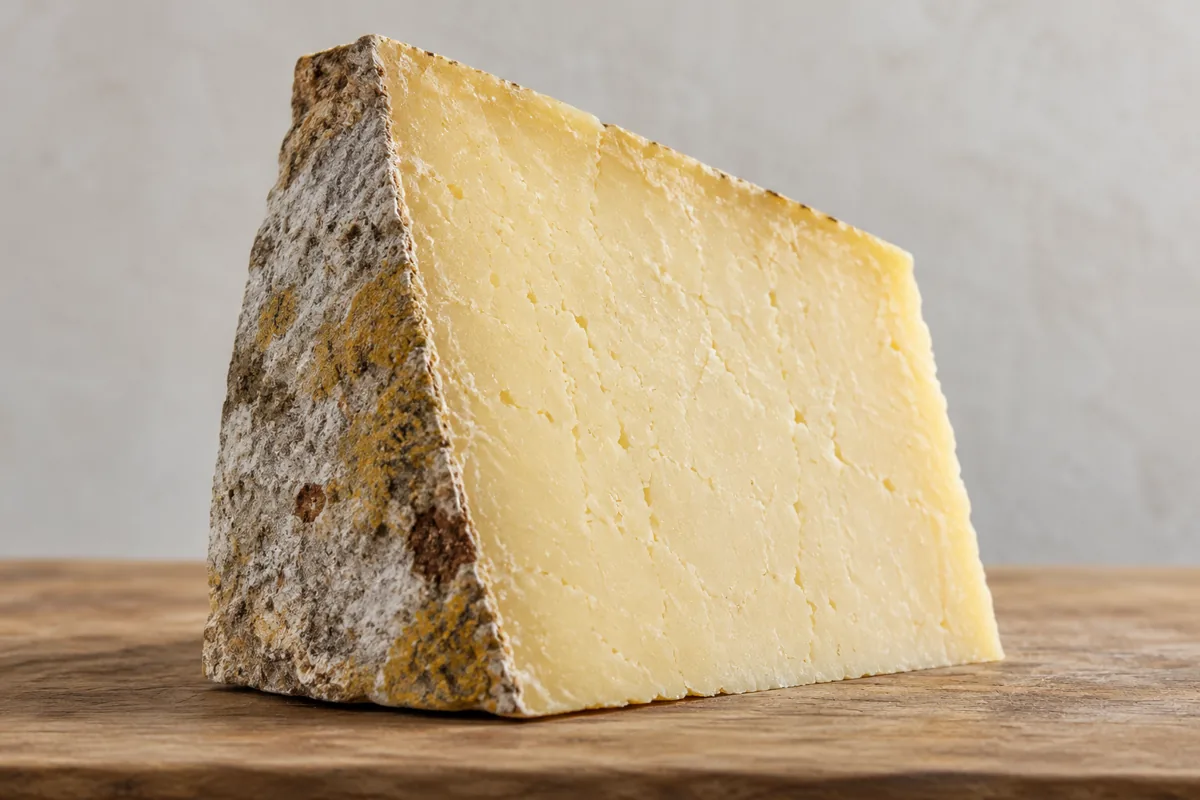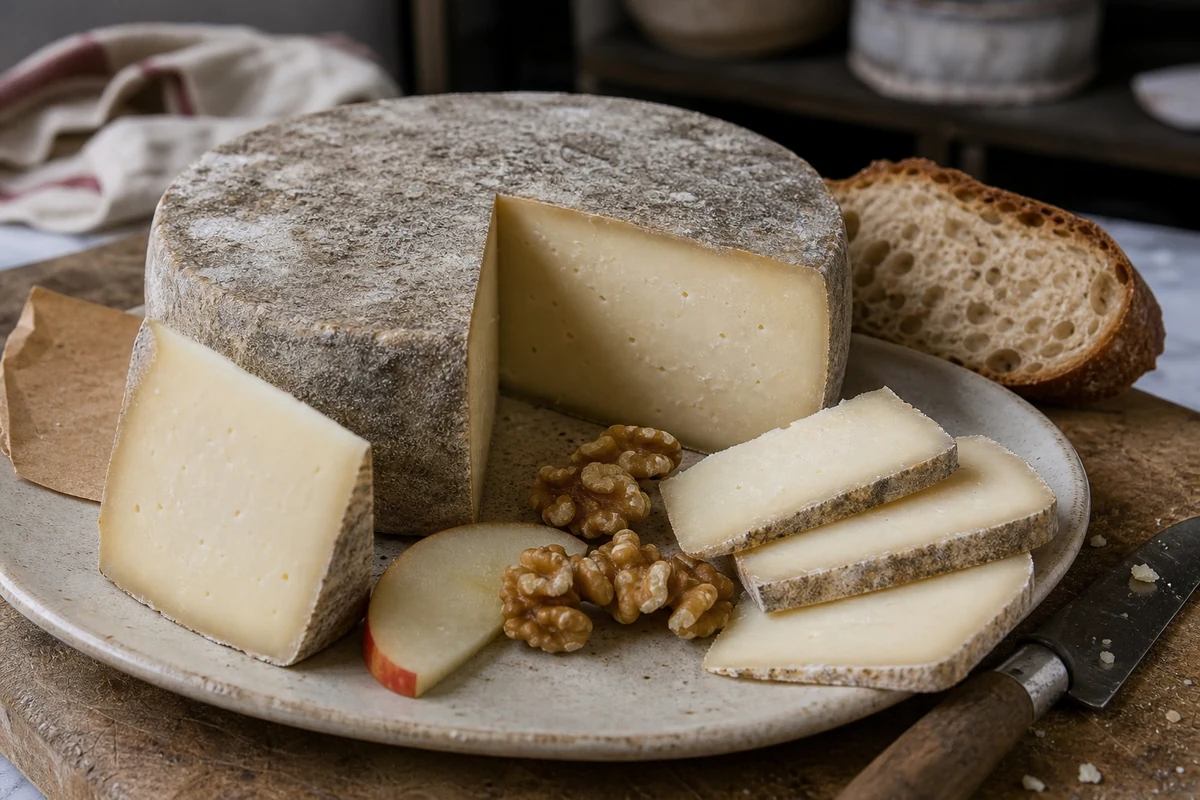
Tomme de Savoie is a pressed, uncooked cheese from the French Alps, made from raw or thermized cow's milk. When you meet it at the counter, expect a low wheel with a gray natural rind and a semi-firm, pale paste dotted with small openings.
Its fat level can differ from wheel to wheel, so the label tells you more than the name does.
Its IGP rules leave room for lean and rich versions, which is why two genuine wheels can taste and feel noticeably different. The fat statement on your wedge matters more than a generic description of the cheese.
In This Article
What Is Tomme de Savoie?
The protected area reaches beyond Savoie and Haute-Savoie into 27 named communes in Ain and 5 in Isère. Milk production, cheesemaking and ageing must all happen within that boundary.
Regional summaries often shorten that geography to Savoie and Haute-Savoie, so check a border village against the registered specification rather than the shorter marketing description.
The name comes from the Savoyard toma, a cheese made in mountain pastures. Farm families traditionally used milk left after skimming off cream, a history that still explains the unusually wide fat range you see today.
Tomme is also the name of a broad family of mountain cheeses, and Tomme de Savoie is only one of them. It has its own legal area, formats and composition limits, which the next section sets out.
What Does the IGP Require for Tomme de Savoie?
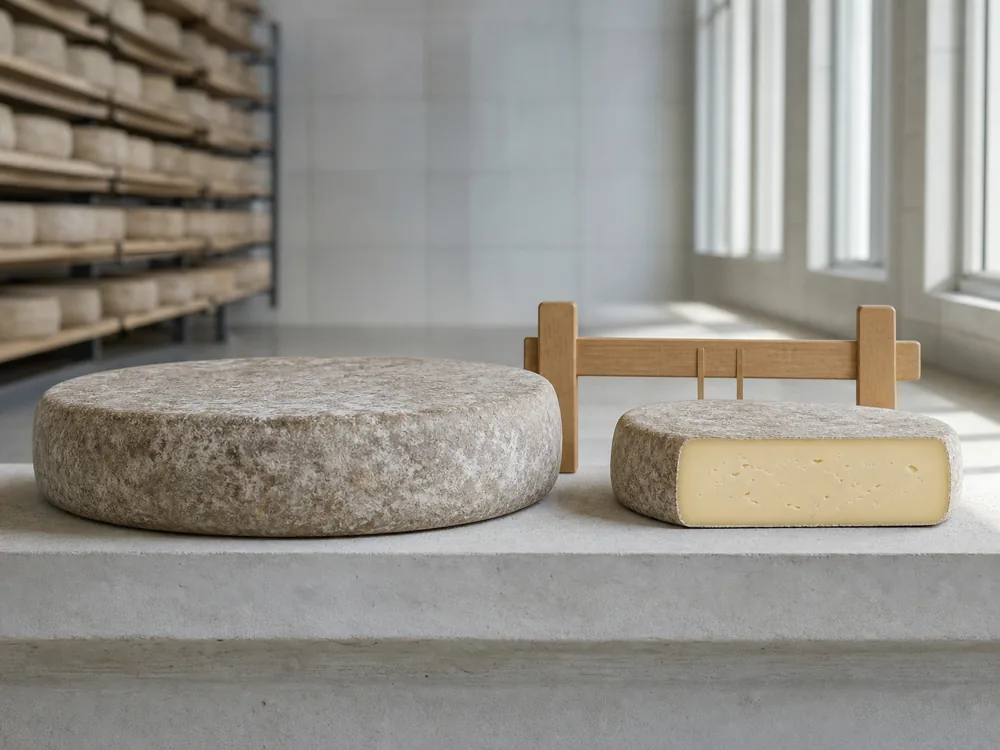
The specification allows two formats. The standard wheel is a flat cylinder 18 to 21 centimeters across and 5 to 8 centimeters high, weighing 1.2 to 2 kilograms, and the reduced format is at most 8 centimeters high and weighs 400 to 900 grams with the same sensory characteristics.
INAO puts the average standard wheel at 1.7 kilograms, in the upper half of that weight range.
| Point | Requirement | What It Means for the Label |
|---|---|---|
| Milk | Cow's milk, raw or thermized | Check which of the two the wheel uses. |
| Herd | At least 75% Abondance, Montbéliarde or Tarentaise cows | Local Alpine breeds supply the milk. |
| Dry matter | At least 45% | Water makes up at most 55% of the cheese by weight. |
| Fat by total weight | At least 9% | Lean wheels are allowed; the fat section covers the range. |
| Salt | 1.2% to 2% | A wedge holds at most 2% salt by weight. |
The breed rule works differently for farm and dairy wheels. A farm's own herd must be at least 75 percent Abondance cows, Montbéliarde or Tarentaise cows, while a dairy applies the same share to the whole herd that supplies its collected milk.
A much larger wheel may still be a tomme, but it falls outside both protected Tomme de Savoie formats.
Farmhouse Tomme de Savoie is the exception rather than the norm. The regional consortium lists 600 tonnes of farmhouse cheese beside 5,800 tonnes from dairies, so a farm wheel accounts for roughly 9 percent of the total.
Why Do Fat Levels Vary?
When farm families skimmed cream for butter, the remaining milk could be leaner or richer depending on how much cream they removed. Modern makers can still skim the milk to set the fat level, so variation is part of the cheese's design rather than an inconsistency.
That flexibility is unusual among protected cheeses: Tomme de Savoie is sold at several declared fat levels. You therefore need to compare like with like before deciding that one wheel is lighter than another.
The historical accounts differ over whether the milk remained from butter-making or from making Beaufort and other aged cheeses. Both place partially skimmed milk at the beginning of the story, so leaner Tomme de Savoie has deep roots rather than being a recent diet product.
The legal floor is 9 percent fat by total weight, while commercial labels may show 20, 25, 30, 35, 40 or 45 percent fat in dry matter. Those percentages use different denominators, so placing them side by side without the basis creates a false comparison.
Producer descriptions sometimes quote an 8-to-30-percent range without stating the basis. Treat that as background only; the package in your hand gives the figure that applies to your wheel.
| Figure | Basis | How to use it |
|---|---|---|
| At least 9% | Total cheese weight | The legal minimum in the IGP specification |
| 20, 25, 30, 35, 40 or 45% | Dry matter only | Common declared grades; compare only with another dry-matter figure |
| 8% to 30% | Total weight in one consortium summary; unspecified on one producer page | Check the individual label because the published bases are not consistent |
A published 8 percent figure sits below the specification's 9 percent floor. Use the fat statement on the wheel you are buying.
Fat in dry matter is a different measure from fat by total weight. Water stays in the cheese, so a label reading 45 percent fat in dry matter describes the solids only, and the wedge itself contains less fat than that.
At the specification's 45-percent dry-matter minimum, 20 percent fat in dry matter becomes 9 percent of the whole cheese, while 45 percent becomes about 20 percent of total weight.
What Goes Into the Milk?
The specification requires green forage in the cows' base ration for at least 150 days a year, consecutive or not, equivalent to at least 50 percent of the base ration. All coarse forage for lactating cows must come from the production area.
Feeds from outside the area, meaning dried forage, corn ear, humid corn grain and fodder beet, are capped at 4 kilograms of dry matter per lactating cow per day on a yearly average. Corn ear and humid corn grain may be fed only between 15 October and 15 May.
Catch crops from the brassica family are excluded because they can affect the taste and smell of the milk.
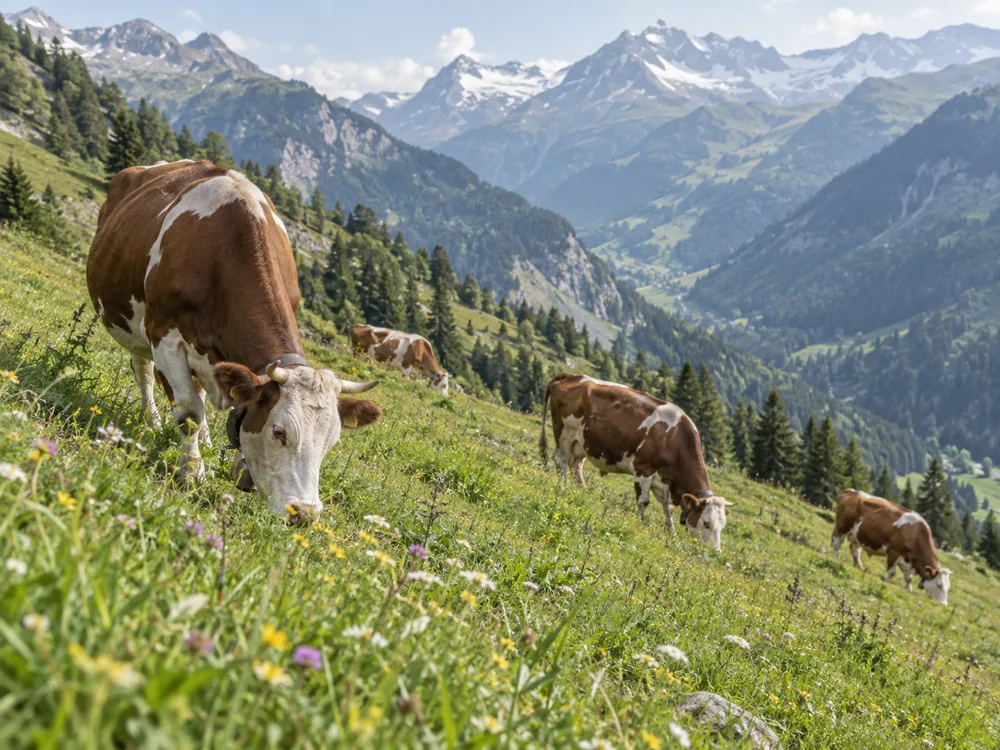
The breed rule has a reason in the specification: milk from Abondance, Montbéliarde and Tarentaise cows sets a firmer gel after rennet and gives more cheese per litre than the milk of other breeds raised in the same conditions.
The specification adds that these breeds suit grazing on sloping meadows, and both it and the consortium put local breeds at 90 percent or more of the herd, well above the 75 percent minimum.
A study cited in the IGP specification linked the cows' base ration to the fatty-acid profile of both milk and cheese. For you, the practical point is that the forage rules shape more than regional identity; they also influence what ends up in the paste.
Raw or thermized milk retains natural flora that contributes to the cheese's typical character. Bactofugation, microfiltration, high pressure, ionisation, ultrafiltration and sterilisation are also barred, preventing other treatments from stripping or radically changing the milk.
How Is Tomme de Savoie Made?
The make is tightly bounded from vat to cellar, with a time, temperature or limit attached to almost every stage. Those controls still leave each maker room to choose the fat level.
- Milk preparation: the milk may be thermized and may be skimmed to the fat level the maker wants, and starter bacteria are added.
- Renneting: the milk is at 30 to 35°C, and coagulation takes 25 to 40 minutes in total.
- Cutting: the set curd is cut into grains between the size of a corn kernel and a hazelnut.
- Stirring: 20 to 60 minutes, with optional heating that may not pass 40°C, and washing the grains is forbidden.
- Moulding and pressing: the curd goes into moulds or draining baskets and is pressed mechanically or by stacking.
- Acidification: at least 5 hours from the start of moulding to salting, at 20°C or warmer, with at least one turn.
- Salting: dry or in brine, never in the vat.
- Ageing: in the cellar, covered in its own section below.
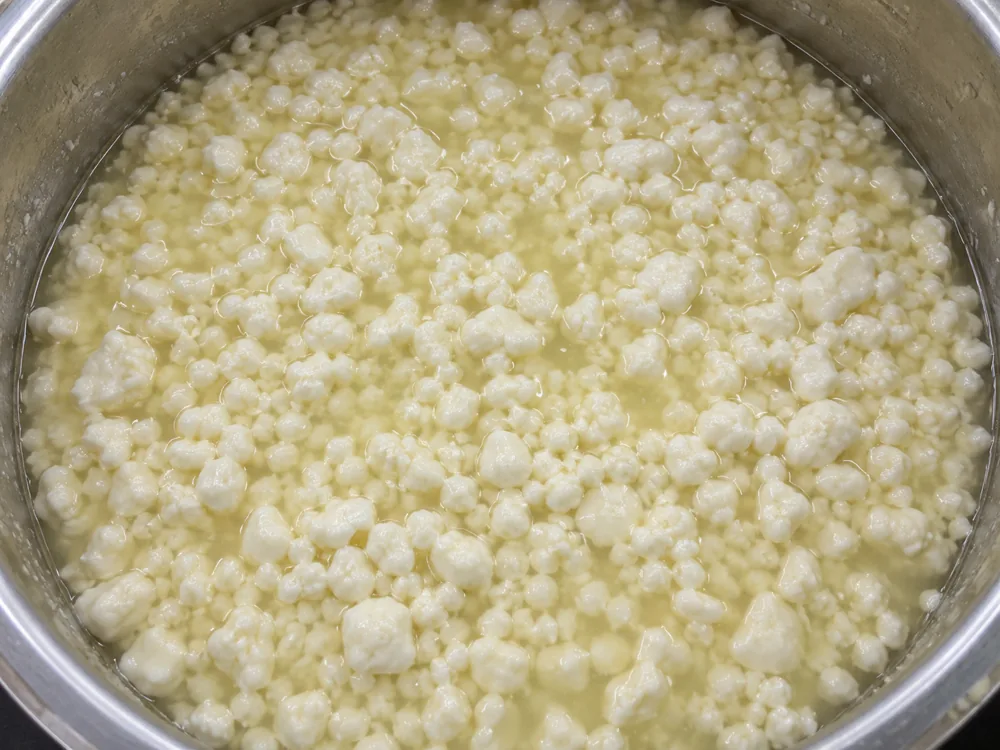
The identification mark goes on during the acidification phase, so each wheel carries its workshop number and sequential number before it is salted.
Once salting is complete, cellar care takes over, and regular turning helps the natural surface flora settle into the gray rind that distinguishes the finished wheel.
What Should the Rind and Paste Look Like?
A genuine rind can look more varied than a neat gray product photograph suggests. Its surface ranges from gray to gray-white, while yellow, red or white secondary molds may appear on the suede-like skin.
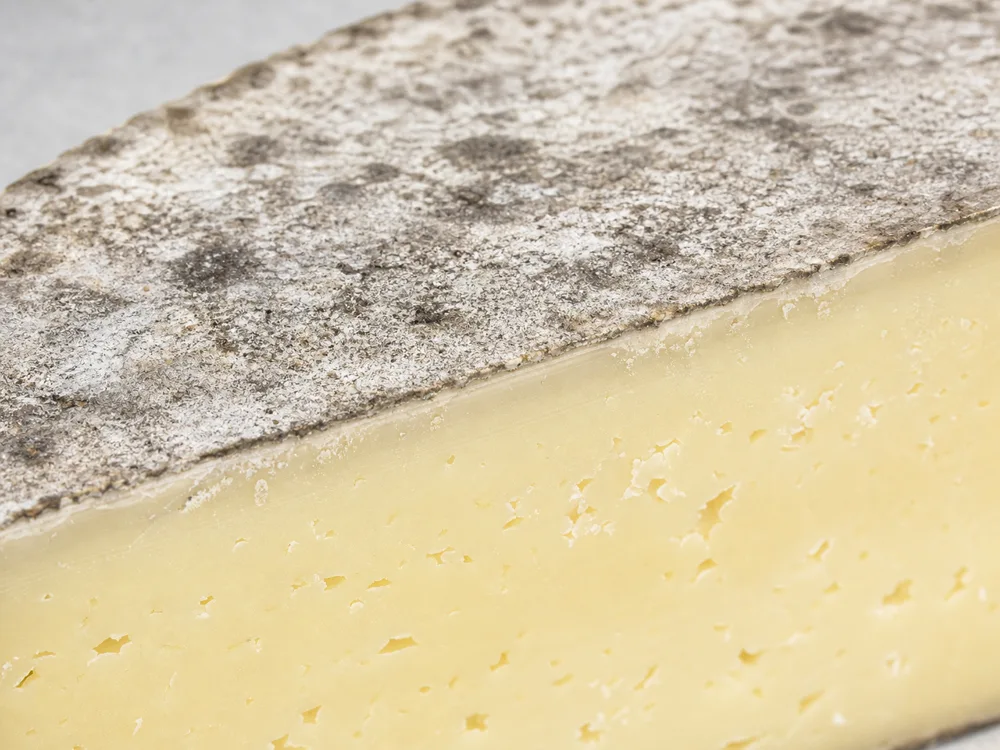
Inside, look for a semi-firm white-to-yellow paste with small openings. It should bend more readily than an aged Alpine grating cheese, though the exact suppleness changes with fat and age.
That gray look comes mainly from mucor, a mold whose growth the wooden ageing boards encourage. Makers call the fine mold that rises during ageing poil de chat, or cat's hair.
Turning lays the fine mucor hairs flat and helps them become part of the rind. The gray surface flora can carry a cellar aroma, and experienced buyers often look for the varied molds that flower across it.
How Long Is Tomme de Savoie Aged?
The legal clock runs for at least 30 days from renneting until the wheel leaves the ageing cellar. Trade guidance rounds that to four weeks and places the most useful quality window between 30 days and three months.
Because the count starts at renneting, the hours of pressing, acidifying and salting come out of the 30 days, so the wheel spends a little less than that in the cellar itself.
| Figure | What it means |
|---|---|
| 30 days | Legal minimum, counted from renneting until the wheel leaves the ageing cellar |
| Four weeks | Rounded trade description of the same minimum |
| 30 days to three months | Common quality window rather than a second legal rule |
Thirty days is the only legal minimum; the wider range describes when producers expect the cheese to show well. A wheel can therefore be compliant before it reaches the maturity you personally prefer.
The short window is part of why the cheese exists: the big aged Savoie cheeses take months to mature, and a tomme ready in weeks helped farms with cash flow.
Pressed uncooked cheeses are heated little before pressing, so they keep enough moisture for 3 to 6 months of ageing, and Tomme de Savoie's usual 30 days to 3 months sits at the short end of that class.
The cellar stays at 8 to 14°C and at least 90 percent humidity. Wheels rest on wooden boards and are turned one to three times a week, creating the damp, oxygen-rich surface conditions in which the rind develops.
As the wheel ages, its mild dairy character becomes more rustic and forceful. Because no fixed week-by-week flavour scale exists, ask the cheesemonger for the age and taste the current batch when you can.
What Does Tomme de Savoie Taste Like?
You can expect a clean, slightly salty and milky centre, sometimes edged with acidity or gentle piquancy. Older wheels move toward a stronger animal and cellar character, while younger ones keep the milk more prominent.
| Part or stage | What you may notice |
|---|---|
| Young paste | Clean milk, lactic freshness and a light citrus edge |
| Riper paste | More animal, rustic and piquant, sometimes with hazelnut |
| Near the rind | Mushroom and cellar aromas become easier to notice |
| Overall structure | Frank and slightly salty, with a tender to semi-firm body |
Hazelnut is possible, but it is not the one flavour every wheel promises. If that note matters to you, sample the cheese rather than choosing by age or fat grade alone.
Can You Cook With Tomme de Savoie?
Tomme de Savoie works in both hot and cold dishes when you want its earthy rind and milky paste to stay noticeable. For a dish built around a pool of melted cheese, Raclette is the cheese made for that job.
A producer's recipe collection layers slices into a potato gratin with crème fraîche and garlic, then uses cubes in fougasse and a summer salad. That range gives you a better guide than a blanket claim about melt: slices soften in baked dishes, while cubes keep enough body for bread and salad.
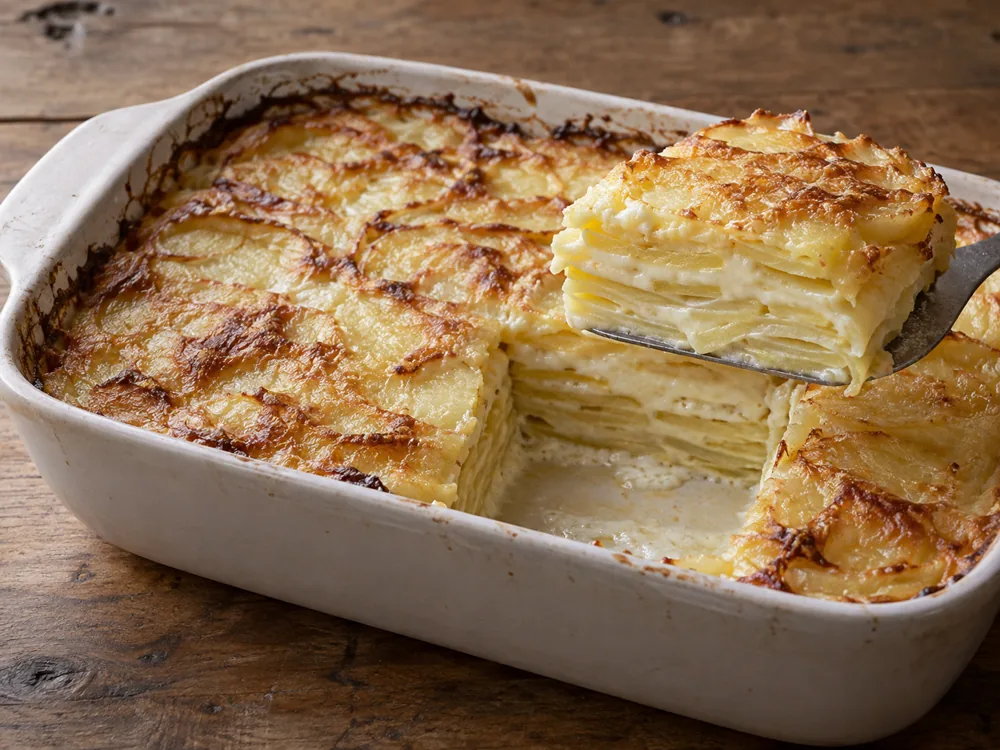
Its leek quiche and its tourte of mushrooms, spinach and onions also use the cheese, so Paccard's recipes treat it as both a baked and a cold ingredient.
How Can You Recognize a Genuine Wheel?
On a whole wheel, look for two marks: an identification mark with the workshop number and a sequential number, and the word Savoie printed on the edge or the top.
Only authorized makers receive those identification marks, and the producers' group behind the IGP takes them back when an authorization is withdrawn. Since 2006 the Savoie marking has been printed in a burnt-wood-colored food ink, so a brown stamp is what you should expect to see.
Packaged cheese must show the name, the maker, ageing house or packer with an address, and the certifying body. A wheel that a farm producer or cheesemonger sells you directly may lack the Savoie marking without breaking the rules.
Cut portions, slices and pre-packed pieces are all allowed, so on a cut wedge the label is your main cue. A small-mould cheese may carry the word petite on labels and invoices, but never joined to the name or directly above it.
A farmhouse wheel is made from the producing farm's own herd, while a dairy collects milk from many farms.
How Should You Serve and Store It?
Give a wrapped wedge up to one hour outside the refrigerator before serving it, then unwrap it shortly before eating. As the paste loses its refrigerator chill, the milk, mushroom and cellar aromas become easier to notice.
Its makers serve it simply, on a cheese board with bread and dried fruit.
Crisp Savoie whites keep the pairing light, while a dry Pinot-style red suits a riper wheel with more earthy rind character.
| Pairing | Type | Why It Works |
|---|---|---|
| Bread | Food | Paccard serves the cheese on a board with bread. |
| Dried fruit | Food | Paccard pairs the board with fruits secs, the French term for dried fruit and nuts. |
| Savoie white wine | Wine | Culture magazine names whites from Chignin, Apremont or Roussette. |
| Dry pinot red | Wine | Le Farto suggests a dry red such as an old-vines pinot. |
| Situation | Wrapping and place | Practical limit |
|---|---|---|
| Unopened or intact piece | Original packaging, low in the refrigerator or in the vegetable drawer | Follow the package date |
| Opened wedge | Rewrap closely without trapping excess moisture | Check it regularly and follow seller guidance |
A producer suggests about one month in original packaging, but that is not a universal life for every opened wedge. Keep your refrigerator at 40°F (4°C) or below, then let the date, condition and seller's advice guide you.
What Can Replace It?
The word tomme covers a broad family of mountain cheeses, so an unlabeled tomme tells you little about milk, fat or ageing. Start with the style you need rather than assuming every cheese carrying the family name will behave alike.
The specification's own description gives the points a stand-in would have to match: cow's milk, a pressed uncooked make, a semi-firm white to yellow paste with small openings, a gray natural rind and a frank, slightly salty taste.
For a milder, softer alternative, Reblochon moves you away from the semi-firm tomme texture; for a more deliberate hot-cheese dish, Raclette is the clearer melting choice. Neither is a direct substitute, but each can match a different job on your menu.
What Are Tomme de Savoie's Nutrition and Pregnancy Facts?
One producer gives about 360 calories per 100 grams, but a cheese sold at several fat grades cannot have one universal nutrition panel. Use the figure on your own package when calories, fat, protein or salt affects your choice.
The specification allows raw or thermized milk and bans pasteurisation, using pasteurisers only to thermize. A wheel sold under the IGP name is therefore never made from pasteurised milk.
In France, health authorities advise pregnant women to avoid raw-milk cheese, while the NHS and CDC lists name milk only as pasteurised or unpasteurised, which leaves thermized milk between the two. Take the milk statement from the wheel to your midwife or doctor before deciding whether it fits the advice you follow for cheese during pregnancy.
What Else Do People Ask About Tomme de Savoie?
No. Tomme is a broad family name, while Tomme de Savoie is a protected cow's milk IGP cheese with its own area, formats and composition limits.
Expect a clean, slightly salty and milky centre, sometimes edged with acidity or gentle piquancy. A riper wheel may add hazelnut and cellar notes.
It is made from raw or thermized cow's milk, and the specification bans pasteurisation. Check the individual label to see which one the wheel uses.
The legal minimum is 30 days from renneting. Many wheels continue ageing for up to three months as the flavour becomes more rustic and powerful.
An unopened piece keeps about one month in its original packaging, low in the refrigerator or in the vegetable drawer. Keep the refrigerator at 40°F (4°C) or below and check an opened wedge regularly.