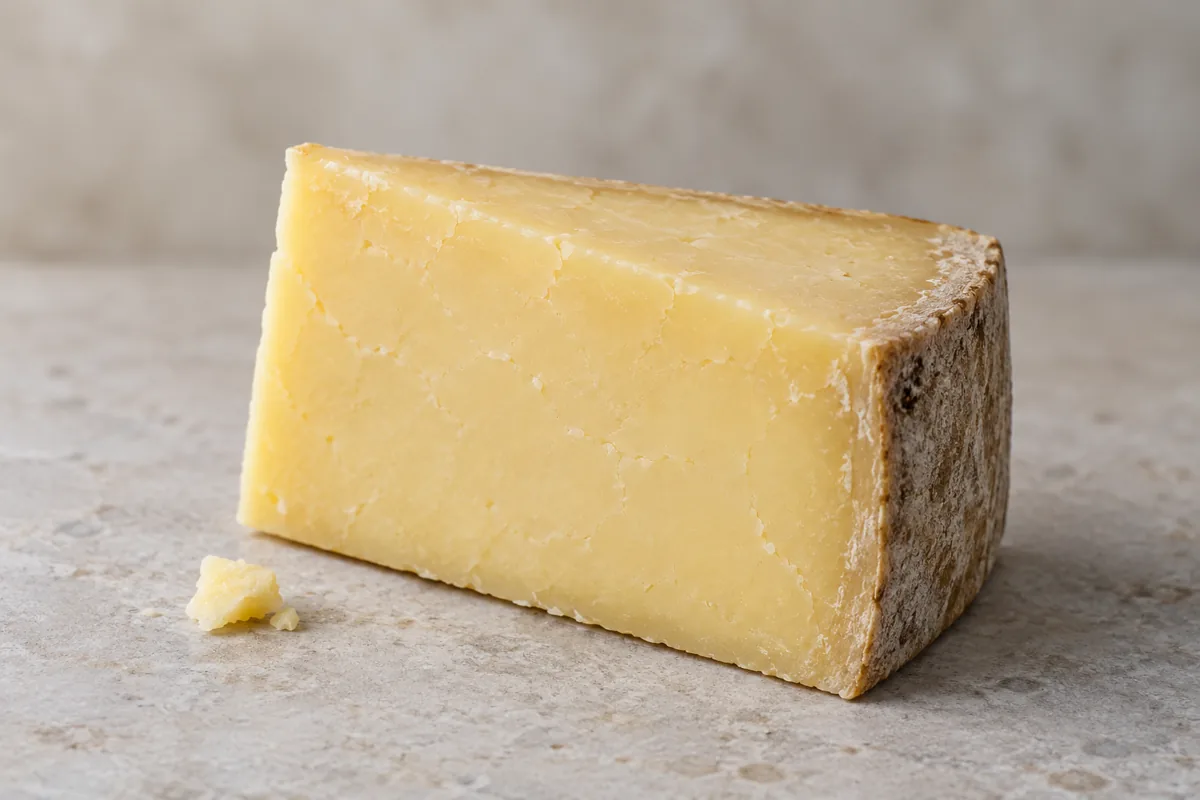
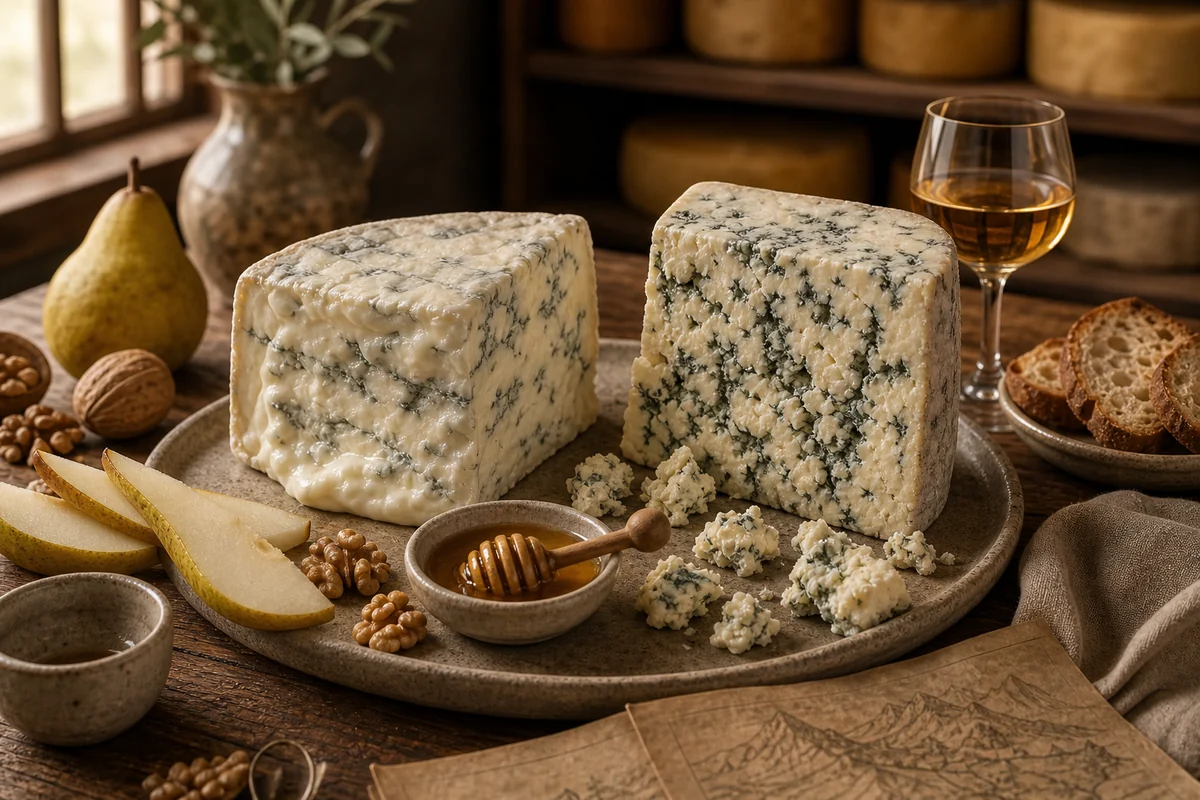
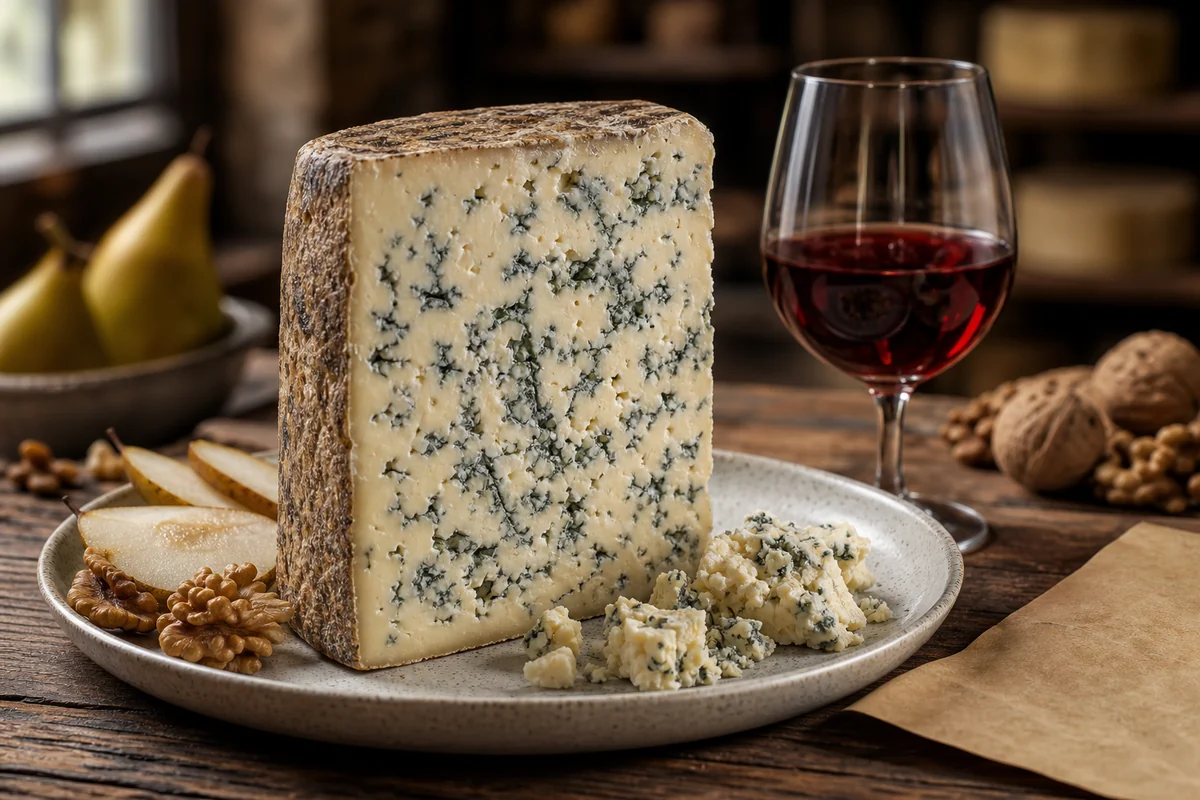
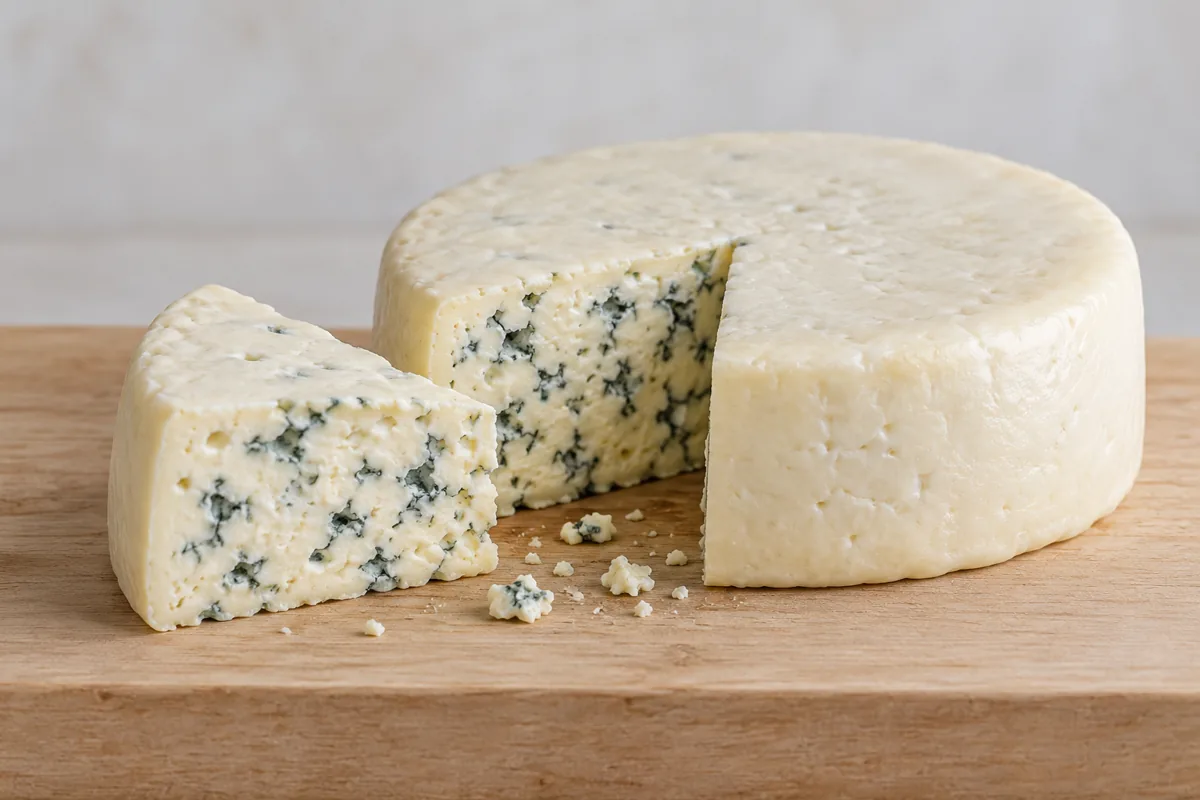
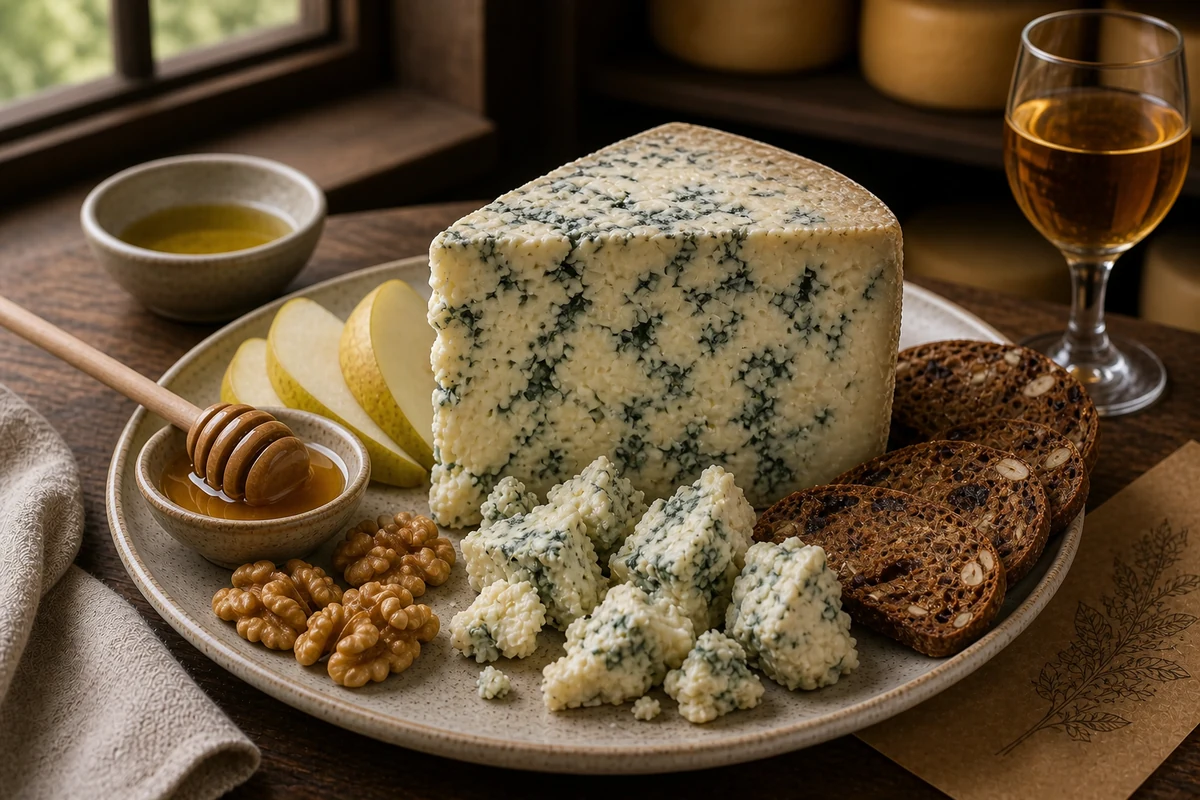
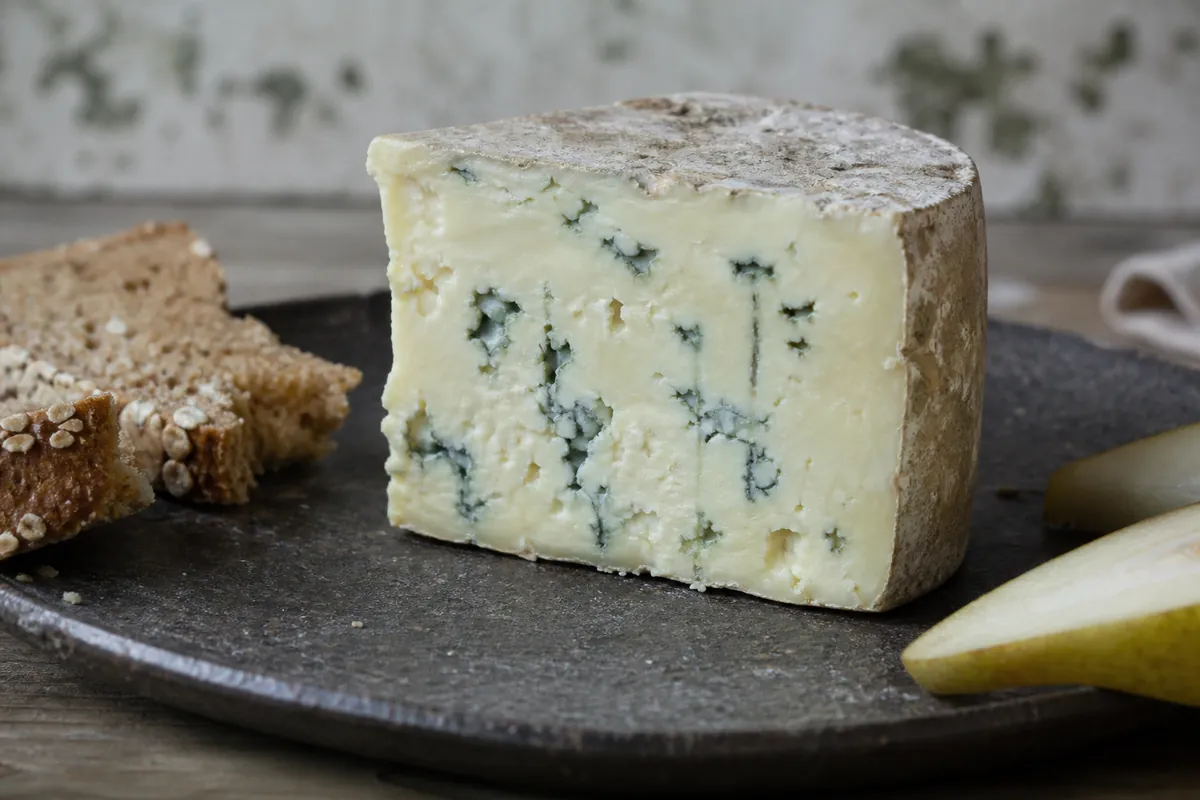
Oregon Blue is Rogue Creamery's classic blue cheese, made in Central Point, Oregon from certified organic pasteurised cow's milk and cave-aged for 90 days. Rogue describes the flavour as moderate blue with Comice pear, green apple and honey.
If you searched for the name and found a world-championship cheese wrapped in grape leaves, that cheese is a different Rogue blue.
In This Article
Is Oregon Blue the Cheese That Won World's Best?
No. The 2019 World Cheese Awards champion was Rogue River Blue, a separate cheese from the same creamery.
The Shelby Report recorded Rogue River Blue on 100 points from 3,804 entries from 42 countries, level with a 24-month Parmigiano-Reggiano until chairman Nigel Barden used his casting vote. It was the first American cheese to take the title.
The title was not its first honour. Rogue's story page says Rogue River Blue became the first non-European blue cheese to win World's Best Blue Cheese at the World Cheese Awards in London in 2003, and that it took Best in Show at the American Cheese Society competition in 2009 and 2011.
Oregon Blue has collected its own medals, which Rogue lists on its product page. It won silver in 2022 and bronze in 2023 at the World Cheese Awards, then silver in 2025, in the Best USA Blue Cheese, cow's milk category, and gold in 2026 at the International Cheese and Dairy Awards.
A World Cheese Awards medal works differently from the champion title: judging teams of three or four award bronze, silver or gold on appearance, texture, aroma and flavour, with most points going to flavour and mouthfeel.
Each team also nominates one Super Gold cheese, and a super jury of 16 picks the champion from those, so a silver or bronze marks a cheese judged worthy of that level, not a placing against the champion.
If you are choosing between three of Rogue's blues, here is how its product pages separate them.
| Cheese | What is done to it | Ageing | Flavour as Rogue describes it |
|---|---|---|---|
| Oregon Blue | The base cheese | 90 days in caves | Comice pear, green apple and honey, moderate blue, savory-sweet finish |
| Smokey Blue | Oregon Blue wheels cold-smoked for many hours over Oregon hazelnut shells | 90 days in caves | Spicy-sweet honey, apple and nectarine with a mild blue finish |
| Rogue River Blue | Each wheel hand-wrapped in organic, biodynamic Syrah grape leaves soaked in pear spirits | 9 to 11 months | Pear brandy, vanilla, toffee, truffle and fig with pronounced blue character |
Smokey Blue is Oregon Blue with an extra step: Rogue's pages give both cheeses the same ingredients, 90 days of cave ageing, 180-day shelf life and storage temperature, and Smokey Blue's page says its wheels are Oregon Blue cold-smoked over hazelnut shells.
Rogue's story page dates Smokey Blue's debut to 2006 and calls it the world's first smoked blue cheese, and its product page credits the smoke with aromas of barrel-aged vanilla, bread pudding and candied bacon.
Rogue River Blue differs in more than its leaves. Rogue calls its texture fudgy and rich, with calcium lactate crystals that develop with age, where Oregon Blue is rich, creamy and crumbly.
If you are expecting the champion's truffle and fig notes, an Oregon Blue wedge is the gentler cheese. Rogue says it makes Rogue River Blue only in autumn, when it considers local cows' milk at its best, and releases each vintage on the Autumnal Equinox after 9 to 11 months of ageing.
Rogue River Blue's age differs by a month at the upper end on its own product page: 9 to 11 months in the description, and a minimum of 9 to 12 months in the key-details list.
Oregon Blue is Rogue's base blue, aged 90 days with a moderate blue flavour. Smokey Blue is the same cheese cold-smoked, and Rogue River Blue is the leaf-wrapped autumn release with pronounced blue character.
When Was Oregon Blue First Made?
Oregon Blue dates from the early 1950s, though Rogue's own pages differ on the year: its history page says the first wheels of Oregon Blue were produced in 1953, while its product page says the cheese was first created in 1954.
Rogue Creamery's own history starts in 1933, when a Portland entrepreneur worked with the city of Central Point to set up Southern Oregon's first artisan creamery cooperative, the Rogue River Valley Co-op.
Tom Vella and Celso Viviani bought it in 1935 and renamed it the Sonoma Valley Cheese Factory, Plant No. III. When their partnership dissolved in the early 1950s, Vella renamed the plant Rogue River Valley Creamery and set out to make blue cheese.
Vella travelled to Roquefort, France, to learn blue cheese making from the masters, and he came back with a recipe and plans to build Roquefort-styled caves for optimal ageing.
Whether Oregon Blue was the first such cheese also depends on the page: the history page calls it one of the first cave-aged, French-style blue cheeses made west of the Missouri River, and the product page calls it the first cave-aged, Roquefort-style blue made on the West Coast.
Vella's son Ignazio inherited the creamery in 1998, and David Gremmels bought it in 2002 and renamed it Rogue Creamery.
How Does Oregon Blue Compare with Roquefort?
Oregon Blue shares Roquefort's mould but not its milk or its place. Rogue calls Oregon Blue Roquefort-style, and its ingredient list ends with Penicillium roqueforti, the mould that causes the blue veins in Roquefort.
Wikipedia attributes Roquefort's flavour to unpasteurised sheep's milk, that mould and the natural caves of Roquefort-sur-Soulzon in France, while Oregon Blue is made from pasteurised cow's milk and aged 90 days in Rogue's caves.
Roquefort is one of several blue cheeses, along with Cabrales, Danablu, Gorgonzola and Blue Stilton, that hold a protected designation of origin, which reserves the name for cheese made in a particular region. An Oregon cheese can therefore claim only the style, which is how Rogue words it.
On its product page Rogue ties the phrase Roquefort-style to cave ageing.
What Does Oregon Blue Taste Like?
Rogue calls Oregon Blue approachable and fruity, with a moderate blue flavour and a hint of sweet forest honey. Its tasting notes are Comice pear, green apple and honey, ending in a savory-sweet finish.

The paste is ivory with distinctive green-blue veins, and the texture is rich, creamy and crumbly, according to the creamery.
How Is Oregon Blue Made?
Rogue lists the ingredients as certified organic pasteurised whole cow's milk, salt, enzymes, cheese cultures and Penicillium roqueforti. The steps below are the general method Wikipedia describes for blue cheeses, so they show how this kind of cheese is made rather than how Rogue makes its wheels.
In Wikipedia's account, the mould is sprinkled over the curds once they are ladled into containers, and the curd granules knit in the moulds into loaves with a relatively open texture. Whey then drains for 10 to 48 hours without pressure while the moulds are turned often.
Salting follows, by brine or dry salting for 24 to 48 hours, and Wikipedia says the salt gives flavour and acts as a preservative.
The veins are mould. In blue cheeses generally, the young cheese is punctured so air can reach the aerobic Penicillium roqueforti, and the mould grows along those openings, as Wikipedia's blue cheese article describes.
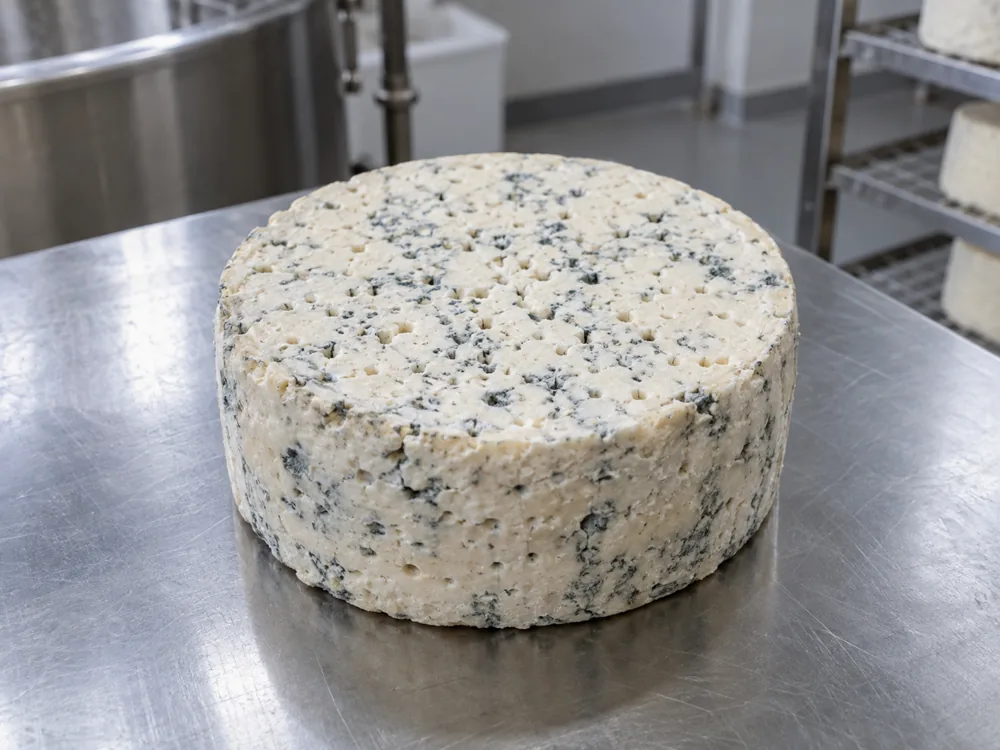
Wikipedia adds that the curds are pressed loosely to leave air gaps, so after piercing the mould can also grow between the curds.
The mould also breaks fatty acids down into ketones, which Wikipedia says give blue cheese its richer flavour and aroma. Freshly made blue cheese has little to no blue flavour, and Wikipedia puts the usual ripening time before it reaches a typical, marketable flavour at 60 to 90 days, so Oregon Blue's 90 days sits at the long end of that range.
A typical ripening room, per Wikipedia, runs at about 8 to 10°C (46 to 50°F) and 85 to 95 percent relative humidity, though this varies by cheese.
Is Oregon Blue Organic, Pasteurised and Vegetarian?
Yes to all three, according to Rogue Creamery.
The milk is certified organic, pasteurised cow's milk that Rogue says is rBST free.
Rogue's 68-acre dairy farm in Grants Pass was certified USDA organic through Oregon Tilth in January 2016, and its blue cheeses became certified organic on September 1, 2016, eight months later.
David Gremmels, the creamery's owner, described its herd to the Shelby Report as an organic herd of Brown Swiss and Holstein cows.
The rennet is a vegetarian, GMO-free microbial enzyme, and Rogue also labels the cheese gluten free. Wikipedia's account of blue cheese making describes rennet as a mixture from a calf's stomach lining, which is the ingredient a microbial enzyme replaces here.
Can You Eat Oregon Blue While Pregnant?
The NHS says pasteurised or unpasteurised soft blue-veined cheeses, such as Danish blue, gorgonzola and roquefort, must be thoroughly cooked before eating in pregnancy. Pasteurisation therefore does not move a soft blue-veined cheese onto the NHS list of safe cheeses.
The CDC lists soft cheese made from unpasteurised milk, blue-veined cheese included, as the riskier choice, and lists pasteurised soft cheese heated to an internal 165°F or until steaming hot as the safer one. It also says pregnant women are 10 times more likely to get a Listeria infection.
Rogue describes the paste as creamy and crumbly, words the NHS does not use, so the soft blue-veined line above is the NHS line that applies to Oregon Blue. The NHS also lists any cheese that's been cooked until steaming hot, including soft or blue cheese among the foods that are safe to eat.
Served cold, Oregon Blue is described as a pasteurized creamy, crumbly blue-veined cheese, a type the CDC list does not cover, so ask a midwife or doctor.
What Goes with Oregon Blue?
Rogue names salads, appetizers and mains as the dishes for Oregon Blue, and says it goes particularly well with lamb, burgers and steak. Its page adds that the cheese brings a great touch of tanginess to meats.

For drinks, the creamery suggests these.
- Wine: Viognier, Riesling and Pinot Noir
- Beer: IPA, Weissbier and pale ale
Burgers are the one dish Rogue names for both Oregon Blue and Smokey Blue, and its advice for the two other blues otherwise points in different directions.
| Smokey Blue | Burgers and deviled eggs; nut brittle or preserved fruits on a cheese board; Cabernet Franc, Zinfandel and white wines with a hint of sweetness; American whiskey |
| Rogue River Blue | Needs no accompaniment or a simple fruit compote; Viognier, Gewurztraminer, Syrah, Cabernet Franc and Sauternes; hazelnut porter, chocolate stout, pear brandy, whiskey and bourbon |
How Do You Buy and Store Oregon Blue?
You can buy Oregon Blue from Rogue as a wedge of about 6.5 ounces or as a whole wheel of about 5 pounds, and Rogue says the exact weights vary because the cheeses are handmade.
In 2026 Rogue lists the Oregon Blue wedge at $20, about $3.08 an ounce at the stated weight, against $80 for the 2026 vintage Rogue River Blue quarter wheel of about 18 ounces, about $4.44 an ounce. Rogue also says online order discounts do not apply to Rogue River Blue because of its limited nature.
Rogue says to keep it refrigerated at 38° to 40°F and gives a shelf life of 180 days, so once you open a wedge, ask Rogue whether that 180 days still applies.
The CDC advises keeping a home refrigerator at 40°F or below and checking it with an appliance thermometer.
It also says perishable food, dairy included, should not sit out for more than 2 hours, or 1 hour above 90°F, which sets the limit for a wedge on a cheese board.
What Can You Use Instead of Oregon Blue?
If you cannot get Oregon Blue, Gorgonzola dolce is the sweeter-finished Gorgonzola style. Wikipedia says dolce can have a less salty taste and a slightly sweet finish, with a delicate flavour and a buttery consistency.
Rogue describes Oregon Blue as creamy and crumbly, and Wikipedia divides those traits between the two Gorgonzolas: dolce is buttery and delicate, while piccante is the more aged version, with a firm, crumbly texture and a more pungent flavour. Neither version therefore copies Oregon Blue's texture exactly, so the choice depends on whether your dish needs the sweet finish or the crumble.
Wikipedia also says either version can be quite salty, with a bite from the blue veining, so the less salty taste of dolce is a possibility rather than a guarantee.
Gorgonzola is typically aged for three to four months, close to Oregon Blue's 90 days, and Wikipedia says the length of ageing sets its consistency, with the cheese firming as it ripens. Gorgonzola is inoculated with Penicillium glaucum, according to Wikipedia, where Rogue's ingredient list names Penicillium roqueforti, so the veining mould differs between the two cheeses.
Gorgonzola is often used as a steak topping, sometimes as a sauce with port or other sweet wine, so if you planned Oregon Blue for steak, one of the three meats Rogue names, Gorgonzola fits that use too.