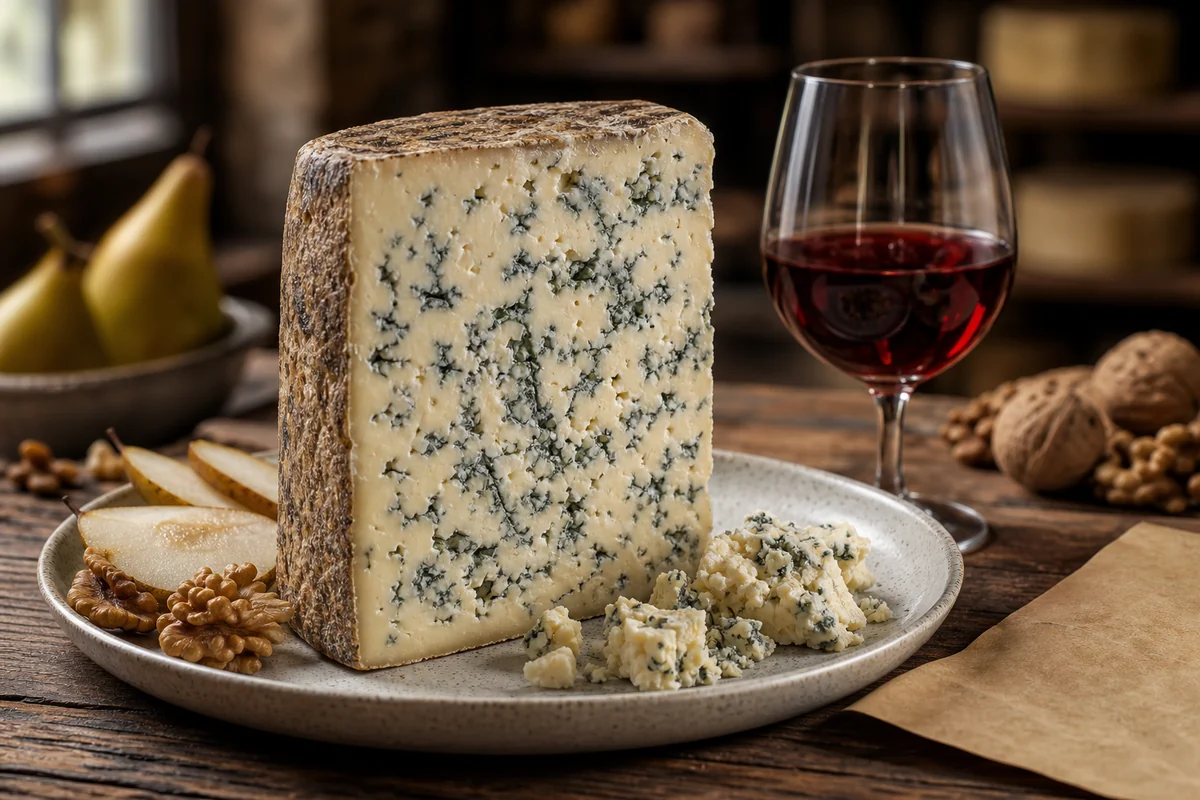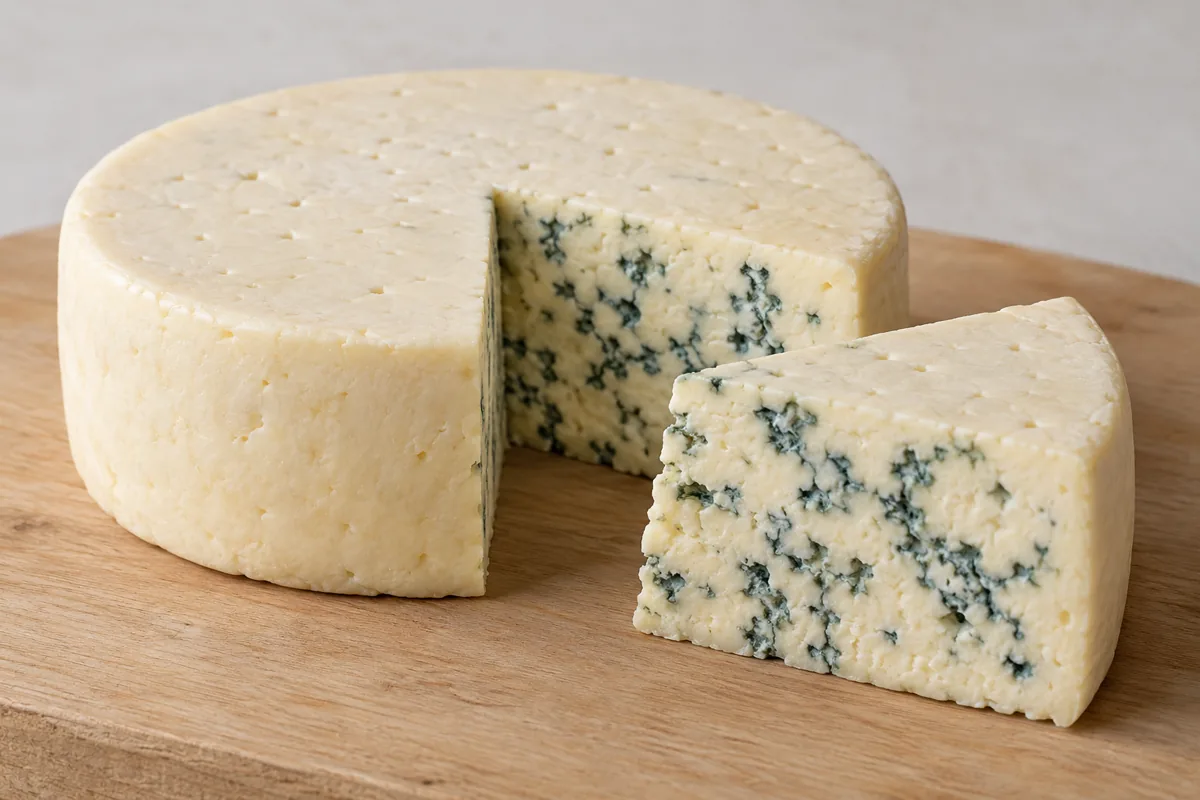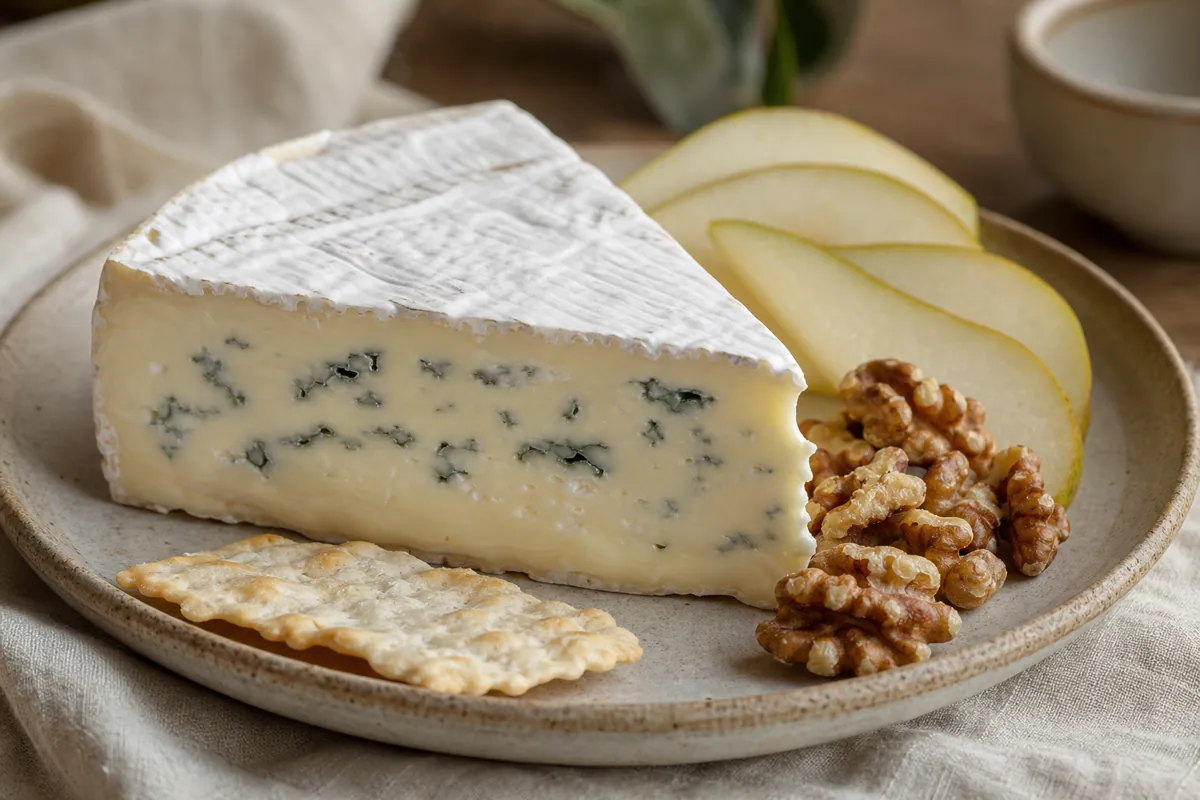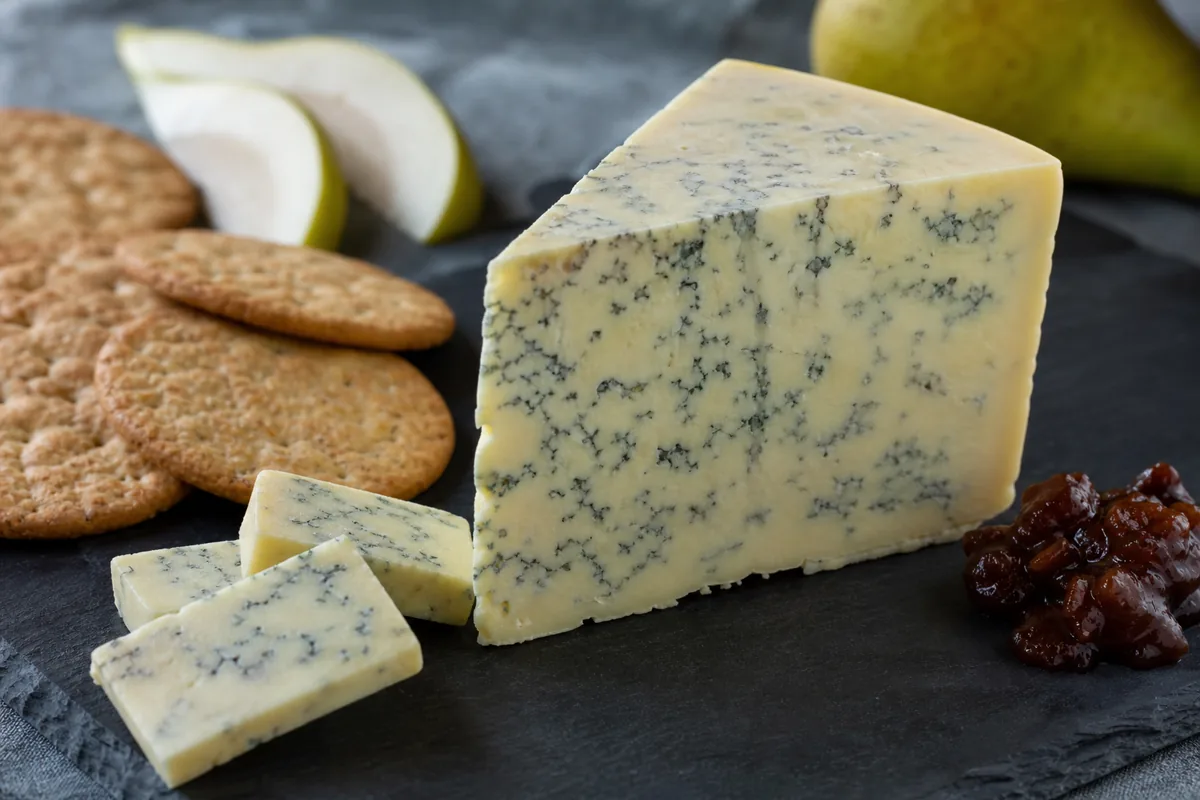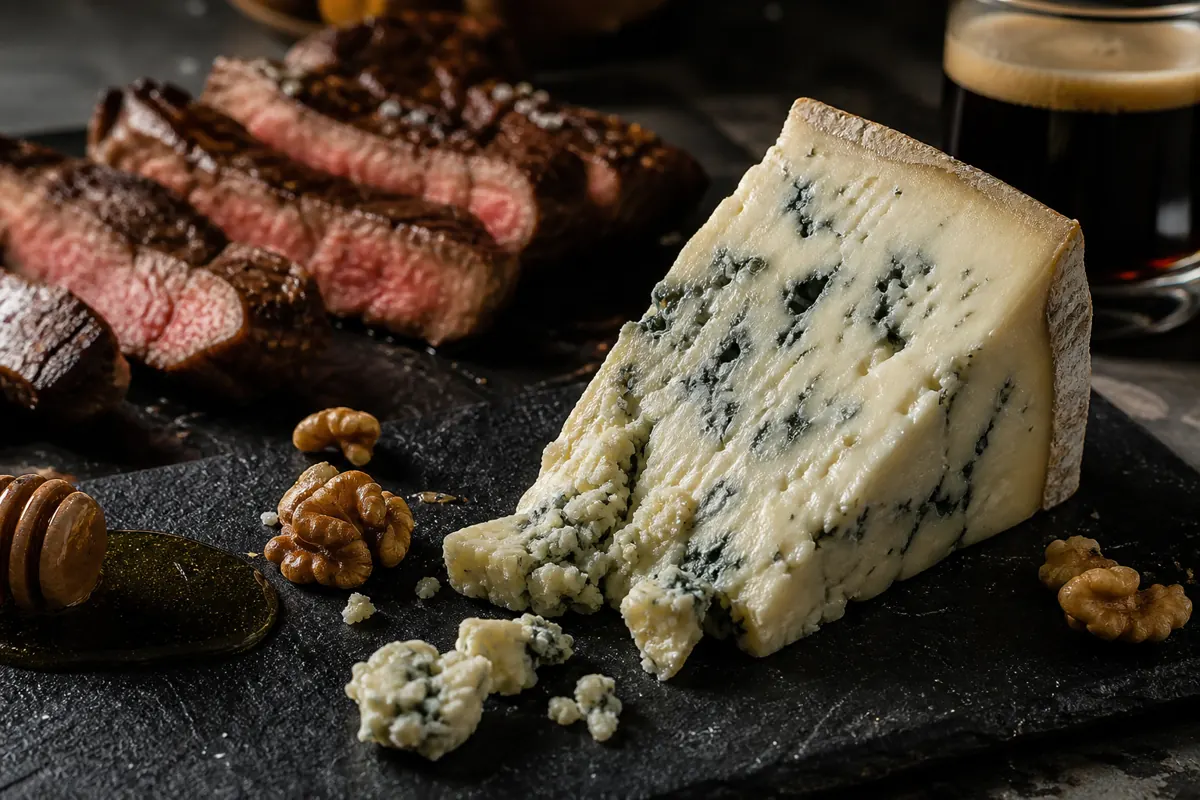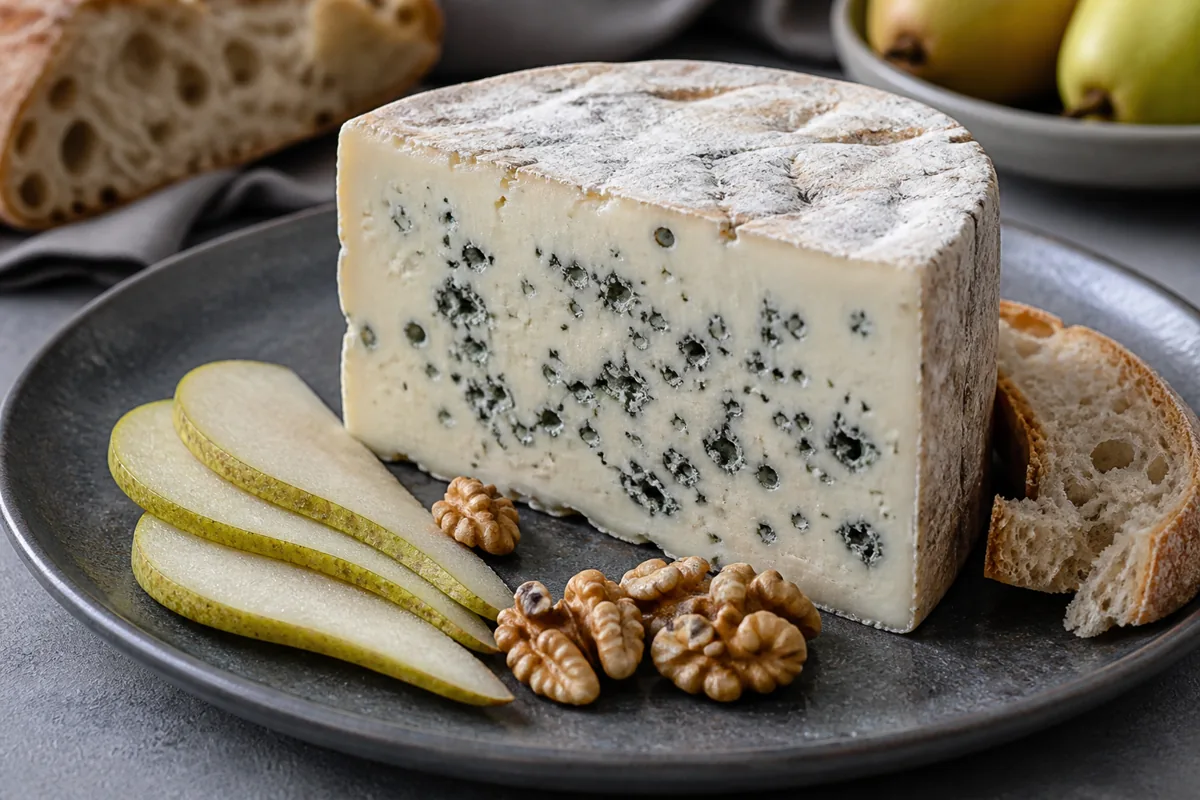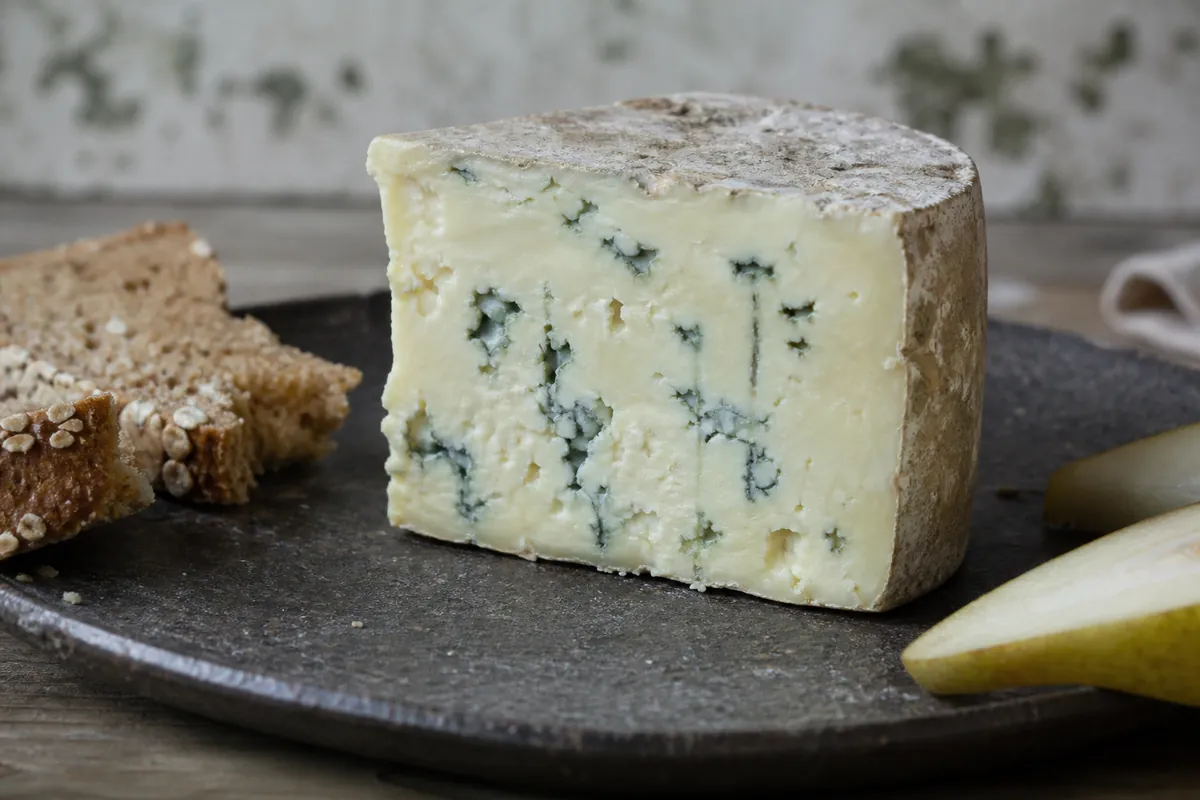
Cashel Blue is a pasteurized cow's milk blue cheese made by the Grubb family at Beechmount Farm, near Fethard in County Tipperary. Jane and Louis Grubb created it in 1984, and the producer calls it the first Irish farmhouse blue.
The producer describes young Cashel Blue as velvet-textured with a primrose hue, while Sheridans Cheesemongers says a well-matured one is buttery and almost spreadable.
Where your wedge falls between those two depends on how long its batch aged, a decision the producer makes by tasting each batch.
In This Article
What Is Cashel Blue and How Is It Made?
Louis Grubb moved back to the family farm at Beechmount in 1979 with his wife Jane, and they bought a dairy herd of 90 cattle. Jane took a cheesemaking course the next year, and Cashel Blue took four years of experiments before it was ready for market in 1984.
The Grubbs' daughter Sarah and her husband Sergio Furno, who had worked extensively in the wine trade, took over management in 2004 and introduced cheese maturation to the company, and they remain its head cheese maturers.
The ingredients are pasteurized whole cow's milk, salt, vegetarian rennet, starter cultures and Penicillium roqueforti, the blue mould.
The producer's account of the make runs through these steps:
- Setting: the milk is pasteurized, then stirred with a starter culture, the blue mould and vegetarian rennet, and a cheese harp is drawn through the curd to separate it from the whey.
- Moulding: the curds are turned regularly until firm enough to go into moulds, and the moulds are turned to drain the remaining whey.
- Day three: the cheeses come out of the moulds and are salted.
- Day four: each wheel is pierced by hand so that air reaches the centre and the blue mould spores can develop.
- Cave ageing: the cheeses are held at around 10°C and turned every day so the moisture does not run to one side.
- Foil and grading: once the blueing starts the cheeses are wrapped in foil, and a taste team grades each batch to decide the ageing, usually 2 to 3 months.
The producer gives reasons for two choices behind those steps. It pasteurises the milk carefully so as not to compromise its delicate sweet flavour elements, and it says salt is essential because it acts as a natural preservative and brings the light salt edge to the flavour.
The producer calls the make handcraft rather than precise science: cheesemakers wait, watch and feel the curds, and 23 people work on the cheese. Piercing is done one cheese at a time, and the cheese is cut and wrapped by hand on the farm.
Where Does the Milk for Cashel Blue Come From?
All of the milk for Cashel Blue comes from grass-fed herds within 25 kilometres of the farm, and more than 40% comes from Beechmount Farm itself.
The rest comes from the local area and goes directly from farm to cheese dairy, which stands on the family's 200-acre farm in County Tipperary.
Classic Cashel Blue is made from the milk of Friesian and Jersey cross cows according to the producer's Q&A, while Sheridans says the milk comes from the Grubbs' own select herd of Holstein-Friesians together with carefully chosen local herds. The producer is the first-hand source for its own herds, so ask it if the breed matters to you.
The producer says a whole wheel takes about 15 litres of milk. The producer's own comparison is roughly a litre of milk for every 100 g of cheese, so by that rule of thumb a 175 g pack stands for about 1.75 litres.
How Does Cashel Blue Change with Age?
In the producer's Q&A, Cashel Blue's crumbly curd turns smooth as it ages, with creaminess developing over time, and Sheridans describes a well-matured cheese as buttery and almost spreadable.
| Source | Younger cheese | More matured cheese |
|---|---|---|
| Cashel Farmhouse Cheesemakers, product page | Velvet texture and a primrose hue | Flavour deepens, giving a melt-in-the-mouth experience |
| Cashel Farmhouse Cheesemakers, Q&A on the foil | Proteins and fats in the curd are crumbly | Smooth consistency, with creaminess developing over time |
| Sheridans Cheesemongers | Not stated | Buttery and almost spreadable, and bulging under the rind |
Cheese.com puts the ageing at about three months, which sits inside the producer's range of 2 to 3 months.
The producer's Q&A frames the timescale: from milk going into the vat to the shop shelf, it says cottage cheese could take a few days and Camembert a few weeks, while its blues take a few months.
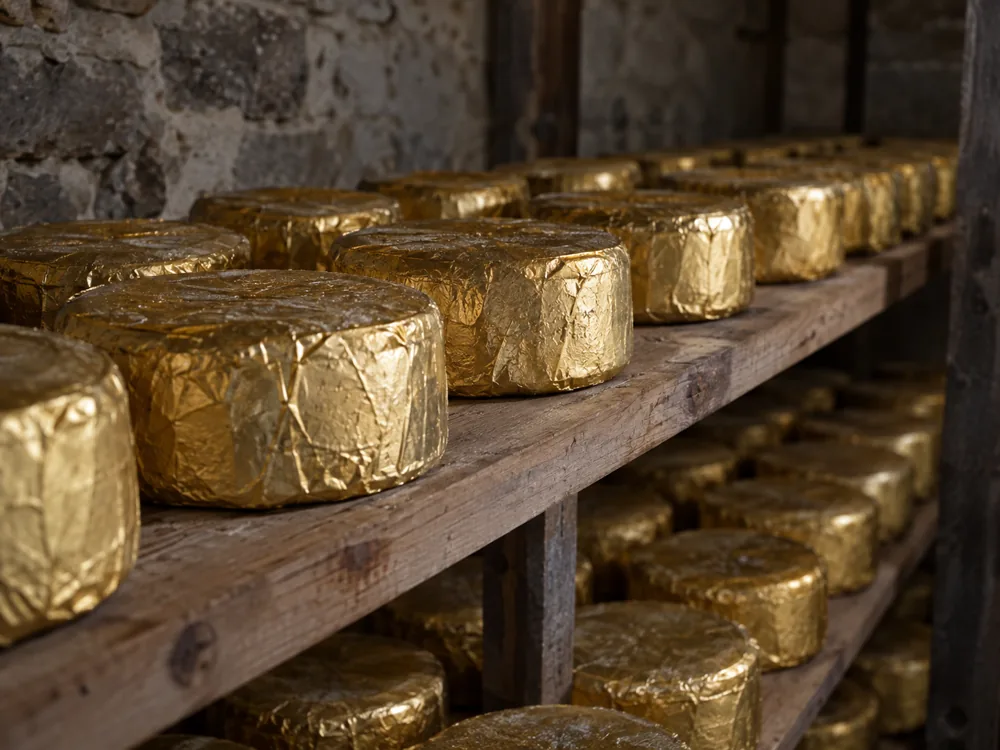
The taste team tastes the cheese again before any order leaves the farm, so the grade set before ageing is checked a second time.
Sheridans sells this cheese as Cashel Blue Mature, while the producer gives one usual ageing window of 2 to 3 months.
The practical way to find out how old a wedge is: ask the seller or taste a sample.
What Does Cashel Blue Taste Like?
The producer describes the cheese as "sumptuously rounded with creamy, savoury blue notes, a light salt edge and subtle hints of spice".
Cheese.com calls it creamy with a mild flavour. It adds a good balance of saltiness and creaminess, with the blue veins contributing a tangy and slightly spicy element.
Sheridans describes the flavour as creamy and sweet with a mild tang, and says it appeals even to customers who would normally be a little scared of blue cheese.
The producer's own wording is not uniform: its pear pairing page speaks of bites of intense, salty blue, while its main page promises only a light salt edge.
The Q&A says the foil helps the blueness develop so that it plays a supporting but not aggressive flavour role, and that on French cheese counters the cheese is particularly respected for its gentle character.
Yes. The producer says the natural rind is edible but tastes saltier than the paste, and for a larger piece it recommends cutting a triangle that includes both rind and interior.
How Do You Serve Cashel Blue?
The producer's pear page says the juicy, grainy texture and clean sweetness of a ripe pear refresh the palate between bites of the salty blue, and its honey page says a drizzle creates a sweet-and-salty harmony that softens any sharp spice.
On its preserves page the producer calls a sweet, vinegary preserve the perfect foil for the rich, buttery fats, one that anchors the saltiness, and names onion marmalade or fig, apricot or beetroot chutney as favourites. Its walnut page says the slightly bitter skin of a walnut is an earthy counterpoint to the creamy fats.
The producer's chocolate page pairs the cheese with dark chocolate of 85% cocoa or more, which it says shares earthy, fermented undertones with blue cheese. Its tip is to stuff a date with Cashel Blue and dip it in 85% cacao, and it says the chocolate pairing was discovered at Salone di Gusto in Italy.
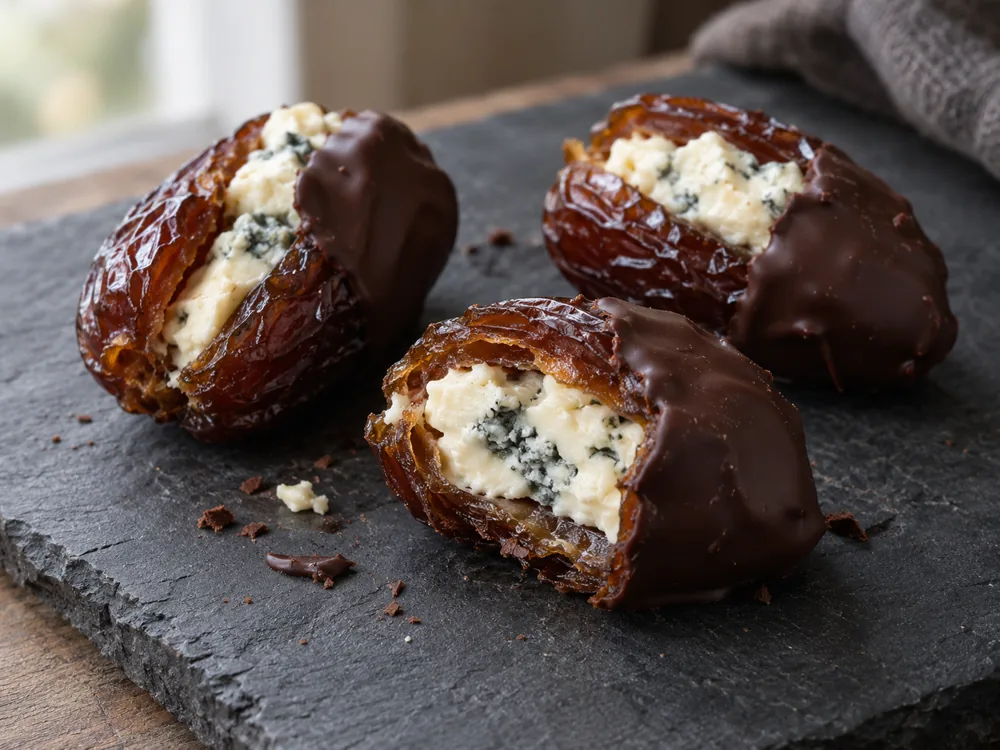
A fig works by mirroring rather than contrasting, the producer's fig page says: a fresh or dried fig's honeyed seeds and jammy interior give a lush, textured sweetness that mirrors the lush character of the cheese.
If you want something to eat it on, the producer's biscuit page names water biscuits as a neutral, crisp canvas, with oatcakes, charcoal wafers and soda bread toasts as alternatives. Its bread page says a crusty sourdough or nutty rye grounds the creaminess, and Sheridans recommends crusty bread with onion marmalade.
For drinks, the producer's craft ale page says a malty amber ale has enough body to match the earthiness of the cheese without overpowering it, and that porter's espresso and chocolate aroma offsets the creamy salinity. Its wine page calls a sweet dessert wine such as Sauternes the gold standard for blue cheese.
| Pairing | Type | Why It Works |
|---|---|---|
| Ripe pear | Food | The producer's pear page says its juicy sweetness refreshes the palate between bites. |
| Dark chocolate, 85% cocoa or more | Food | The producer's tip is a date stuffed with the cheese and dipped in 85% cacao. |
| Honey or walnuts | Food | The producer says honey gives a sweet-and-salty harmony and a walnut's bitter skin is an earthy counterpoint. |
| Crusty bread with onion marmalade | Food | Suggested by Sheridans Cheesemongers; the producer also names onion marmalade as a favourite preserve. |
| Amber ale or porter | Drink | The producer says an amber ale matches the earthiness and porter offsets the creamy salinity. |
| Sauternes | Wine | The producer calls a sweet dessert wine such as Sauternes the gold standard for blue cheese. |
Can You Cook with Cashel Blue?
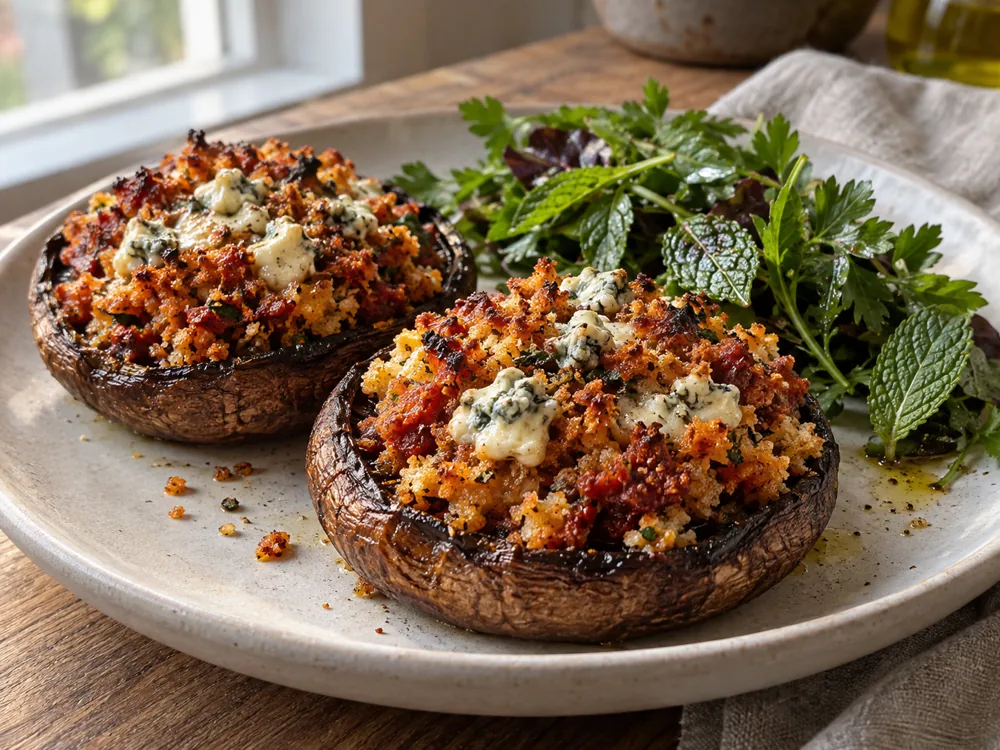
The producer's stuffed portobello mushroom recipe, by Mark Moriarty, uses 60 g of crumbled Cashel Blue plus extra for garnish. The cheese goes into a pan of 2 tablespoons of nduja melted with 30 g of butter and 70 g of breadcrumbs, and cooks for about a minute until it begins to melt through the crumbs.
The mixture is spooned into four large peeled portobello caps that were roasted for 10 minutes at 200 degrees. They return to the oven for another 10 minutes until golden brown, then get more crumbled cheese on top and a mixed herb salad.
The producer's other recipes use the cheese in three ways: melted into a soup or sauce, crumbled or sliced onto a cold dish, or mixed into a topping.
| Recipe | Cheese | How the cheese goes in |
|---|---|---|
| Leek, potato and Cashel Blue soup (Sarah Furno) | 75 g | Blended into the finished soup, then blended again, with crumbles as a garnish |
| Jerusalem artichoke and Cashel Blue soup (Phoenix Café) | 80 g | Stirred in just before the heat is turned off, then blended, with a little kept to crumble over |
| Butternut squash, Cashel Blue and saffron pappardelle (Clodagh McKenna) | 100 g | Whisked with 200 ml of crème fraîche in a pan on low heat and cooked 3 minutes until the sauce thickens |
| Irish mussels with Cashel Blue (Thomas Loisel) | 75 g, Cashel or Crozier Blue | Melted into warmed cream, then kept on a very low heat as the sauce |
| Fennel, orange and beetroot salad (Gareth Mullins) | 200 g | Crumbled over the beetroot, with the rest tossed through the salad uncooked |
| Steak sandwich (Donal Skehan) | 75 g | Sliced into a sourdough baguette with caramelised onion and rocket |
| Vegetarian beetroot burger (Sarah Furno) | 50 g | Mixed with 100 g of crème fraîche and a teaspoon of honey as the topping |
To melt it into a soup or sauce, follow the producer's recipes, which either use a low heat or add the cheese once the base is cooked. The artichoke soup stirs it in just before the heat goes off, the pappardelle sauce is whisked on low heat, and the mussel sauce stays on a very low heat once the cheese has melted into the cream.
The salad, the steak sandwich and the burger topping use the cheese uncooked.
In the leek and potato soup, the producer says the cheese complements the sweetness of the leek and blends with the creaminess of the potato.
It can also be crumbled over salads or melted into a sauce, and it works in recipes that call for blue cheese.
The producer's Q&A has uses for the rind too. Because the rind tastes saltier, it suggests blending it with butter as a topper for a burger or putting it in a pot of soup for a richer flavour.
If a piece has turned strong in your fridge, the producer calls it ideal for soup, risotto or mac 'n' cheese. It also gives a quick dip for wings: crème fraîche, an end of Cashel Blue and a squeeze of lemon juice.
How Does Cashel Blue Compare with Stilton, Roquefort and Gorgonzola?
The producer lists the blue mould Penicillium roqueforti among Cashel Blue's ingredients, the same mould Cheese.com names for Roquefort, so the cheese belongs with the other blue cheeses.
| Cheese | Milk | Texture | Ageing |
|---|---|---|---|
| Cashel Blue | Pasteurized cow's milk | Semi-soft and creamy | About three months |
| English Stilton | Pasteurized cow's milk | Creamy yet crumbly | A minimum of three months |
| French Roquefort | Unpasteurized sheep's milk | Crumbly, creamy and slightly moist | Three to five months in limestone caves |
| Italian Gorgonzola | Pasteurized cow's milk | Crumbly and soft or firm | Three to four months to full ripeness |
Roquefort is the one that differs on milk, since Cheese.com lists the other three as pasteurized cow's milk. Cheese.com calls Cashel Blue semi-soft and creamy, and it calls each of the other three crumbly.
If you avoid animal rennet, that separates the two: Cheese.com says Roquefort is made with animal rennet, while the producer and Cheese.com both give Cashel Blue vegetarian rennet.
Two of the other names are tied to places. Cheese.com says Stilton is made only in Derbyshire, Nottinghamshire and Leicestershire under a protected name, and that Roquefort carries a protected designation of origin and ages in the limestone caves of Roquefort-sur-Soulzon.
Cashel Blue has no protected designation of origin: the producer calls it a protected, family-owned brand made exclusively in Tipperary.
Cheese.com says Gorgonzola runs from mild to sharp with age and comes as Dolce or Piccante, two varieties that differ in age, whereas the producer gives Cashel Blue one usual ageing window of 2 to 3 months.
Size is the other difference: Cashel Blue wheels are smaller than Stilton's because Jane Grubb designed them to be easier to handle and care for.
How Does Cashel Blue Differ from Crozier Blue?
Crozier Blue is the farm's sheep's milk blue, crafted seasonally, in small batches, from 100% Irish ewe's milk at its own dairy.
The farm started milking sheep in 1993 for Crozier Blue, which the producer says was for a long time Ireland's only sheep's milk blue, and the sheep's milk now comes from two small, family-run Irish producers.
Because so few sheep are milked in Ireland, the producer says Crozier Blue is only available from cheese counters, and the cellars from one year typically run empty in March until the new season's release.
The producer describes Crozier Blue as gently creamy when young, from June to September, and velvety and fudgy as the season runs from October to March.
Cashel Blue is the cow's milk cheese, aged usually 2 to 3 months, and the producer says it is at most good food stores, independent cheesemongers and the main supermarkets, so if you are choosing between them, the practical difference is the milk, the season and where each can be found.
Which Cashel Blue Sizes and Versions Can You Buy?
The producer sells Cashel Blue in 125 g and 175 g packs and a 1.5 kg wheel. It says the cheese is widely available at most good food stores, independent cheesemongers and the main supermarkets.
Sheridans lists its Cashel Blue Mature in 200 g and 1.5 kg sizes and describes a whole wheel as 1.2 kg, so wheel weights differ between sellers and the weight printed on the pack is the figure to go by.
For portions, Sheridans sizes 160 g for two or three people on a cheese board and 320 g for four to six people as a starter or shared plate, and puts the whole 1.2 kg wheel at 12 to 16 servings.
If you are buying for a board, dividing those figures gives roughly 53 to 80 g a person for the two wedges and 75 to 100 g for the wheel.
The producer's best-eaten window runs from the first opening of the pack, so how fast you finish a piece limits the size worth buying: a 1.5 kg wheel is about 9 to 12 times the weight of a 175 g or 125 g pack.
Match the size to the headcount and to how fast an opened piece will be eaten: Sheridans puts 160 g at two or three people and 320 g at four to six, and the producer's packs start at 125 g.
The producer also makes an Organic Cashel Blue, made seasonally from a single herd of mixed-breed cows that it lists as Rotbund, Montbéliarde, Jersey, Norwegian Red and Friesian. It describes the Organic as a unique and intense cheese with a slow ageing over many months, which is longer than the usual 2 to 3 months of the Classic.
Classic and Organic differ in the breed of cow and the season.
The producer says tasting and grading keep the cheese typically the same wherever in the world you buy it.
How Much Fat, Salt and Protein Is in Cashel Blue?
The producer's label gives these typical values per 100 g, and Sheridans prints the same figures.
Of the 28.8 g of fat, the producer's panel lists 7.2 g as monounsaturated, 0.8 g as polyunsaturated and 1.0 g as trans fat, alongside the 18.4 g of saturated fat.
Scaled to a 30 g tasting portion, the label works out to about 104 kcal, 8.6 g of fat (5.5 g saturated), 6.1 g of protein and 0.6 g of salt. The panel also lists 0.9 g of carbohydrate per 100 g.
The label lists milk as an allergen, so anyone with a milk allergy should avoid Cashel Blue.
How Long Does Cashel Blue Keep in the Fridge?
Cashel Blue belongs in the fridge, and the CDC says to keep a refrigerator at 40°F (4°C) or below. Once you first open the pack, the producer says its blues are best eaten within 7 to 10 days, after which they become strong.
If you leave it out on a board, the CDC's rule for perishable food, which it lists as including dairy, is to refrigerate it within 2 hours, or within 1 hour if it has been above 90°F.
For freezing and wrapping, check the packaging of the piece you buy.
Is Cashel Blue Safe to Eat During Pregnancy?
It depends on how the cheese is served, and the answer comes from the NHS and CDC general rules on cheese in pregnancy.
The NHS says pasteurised or unpasteurised soft blue-veined cheeses, such as Danish blue, gorgonzola and roquefort, must be thoroughly cooked. The producer classes Cashel Blue as a semi-soft blue, so this soft blue-veined line is the NHS line that applies to it.
The CDC lists soft cheese made from unpasteurized milk, including blue-veined cheese, as riskier. Its safer list includes pasteurized soft cheeses heated to an internal temperature of 165°F or until steaming hot, and served cold, Cashel Blue is described as a pasteurized semi-soft blue-veined cheese, a type the CDC list does not cover, so ask a midwife or doctor.
The NHS says any cheese cooked until steaming hot is safe, including soft or blue cheese.
SOURCES & REFERENCES
The producer describes it as sumptuously rounded, with creamy savoury blue notes, a light salt edge and subtle hints of spice. Cheese.com calls it creamy with a mild flavour.
Yes. The producer lists pasteurized whole cow's milk, salt, vegetarian rennet, starter cultures and Penicillium roqueforti.
The producer says Cashel Blue is made with vegetarian rennet, and Cheese.com lists it as vegetarian. The producer's newer Toma No. 5 is a different cheese made with animal rennet.
Yes. The producer says the natural rind is edible but saltier than the paste.
The CDC says to keep a refrigerator at 40°F (4°C) or below, and the producer says to eat it within 7 to 10 days of opening the pack, after which it becomes strong.
No. Crozier Blue is the same producer's seasonal sheep's milk blue, made from 100% Irish ewe's milk and sold only through cheese counters, while Cashel Blue is made from cow's milk.