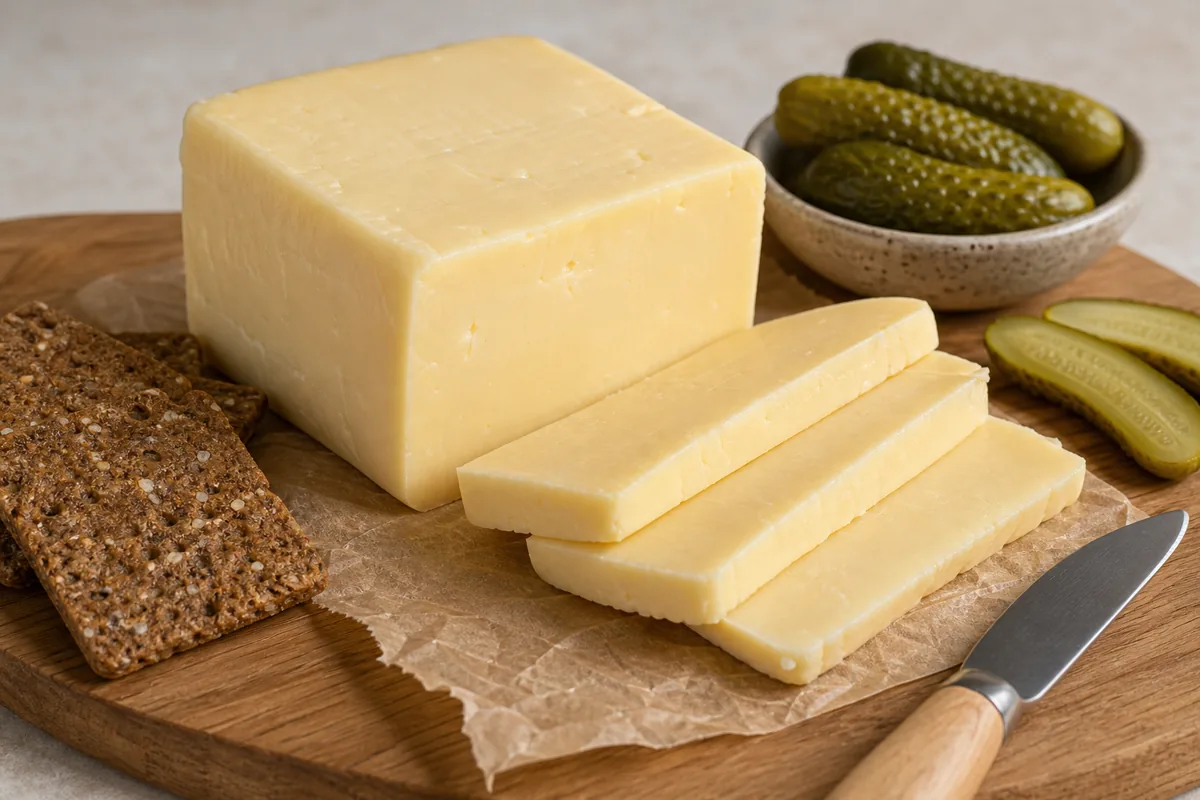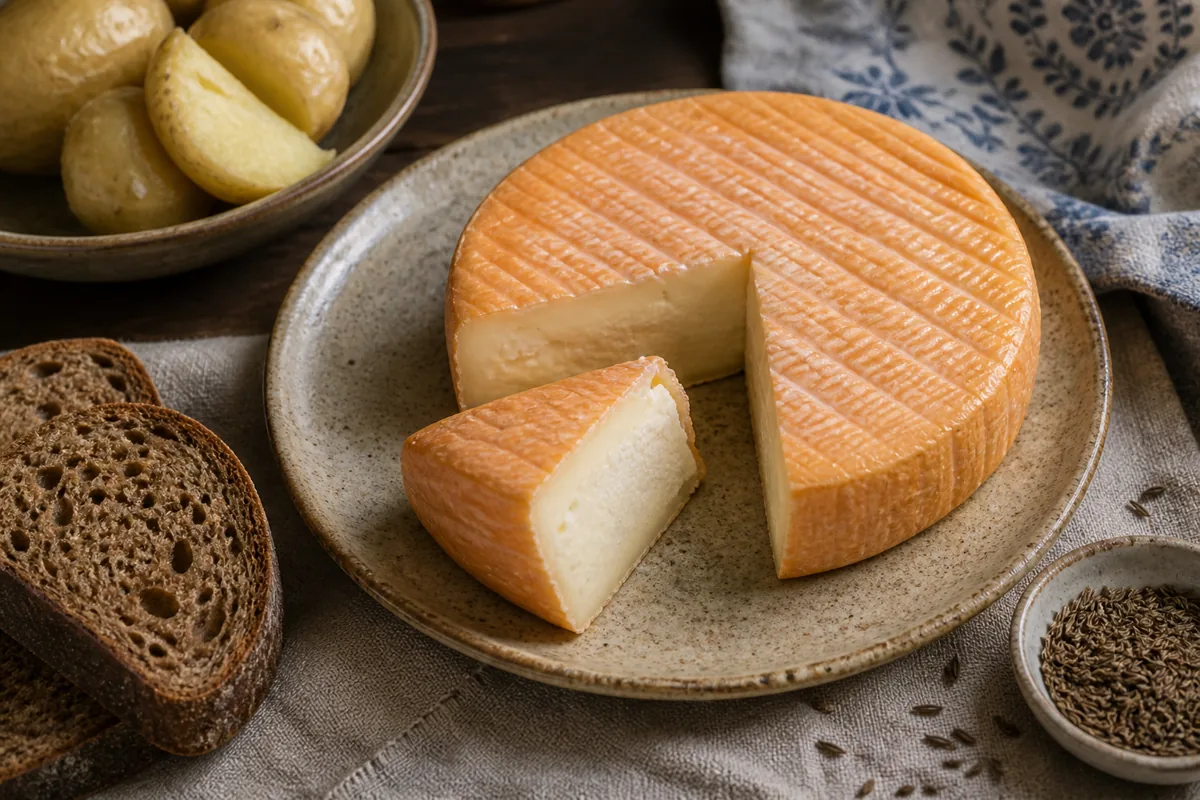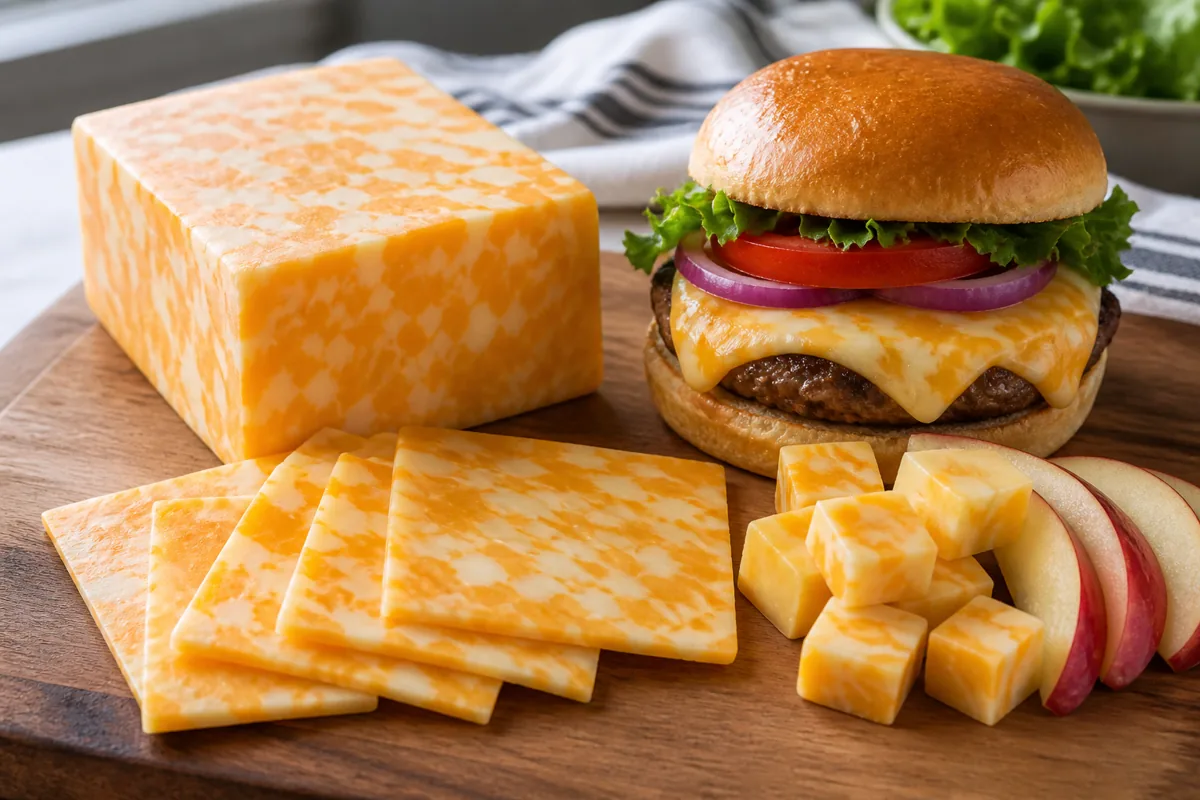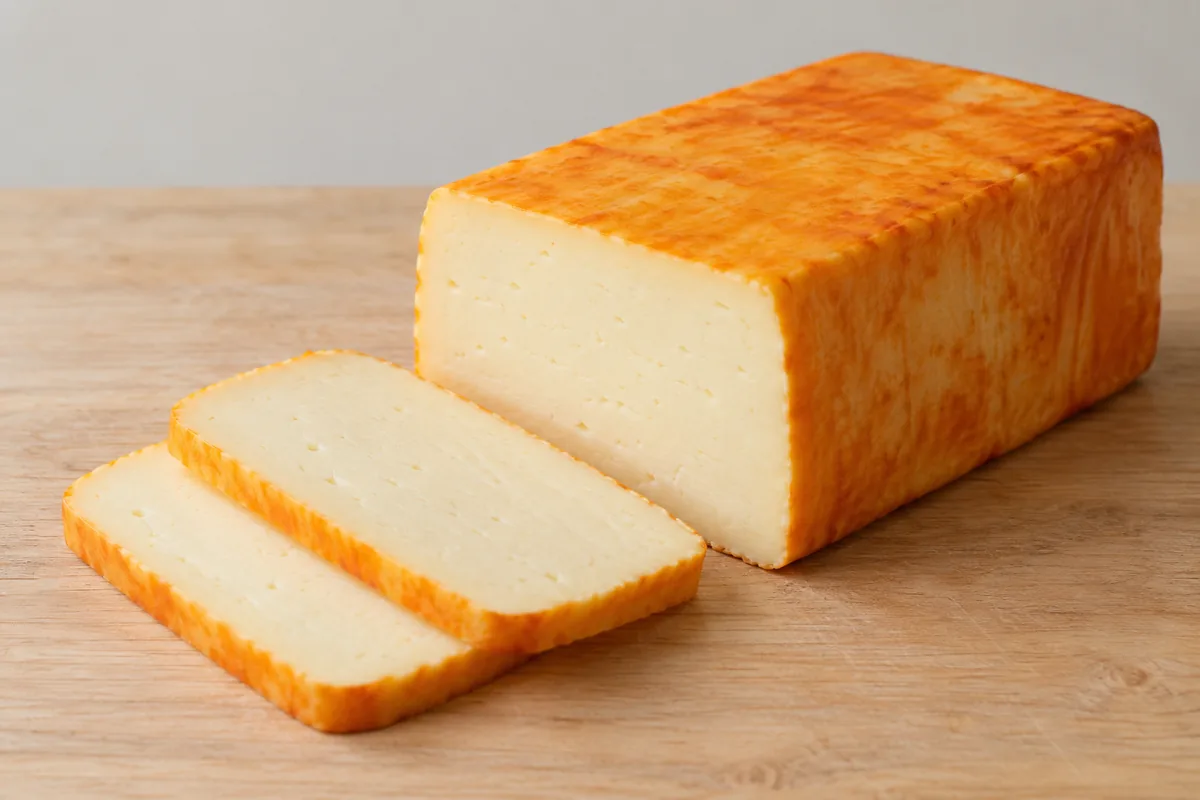
Muenster is a mild, semi-soft cheese made in the United States from pasteurized cow's milk, with a pale interior and an orange outside coloured with annatto. It melts well and goes on grilled sandwiches and cheeseburgers.
The spelling matters at the counter, because American Muenster and French Munster are two different cheeses.
In This Article
Muenster or Munster: Which Cheese Is on the Label?
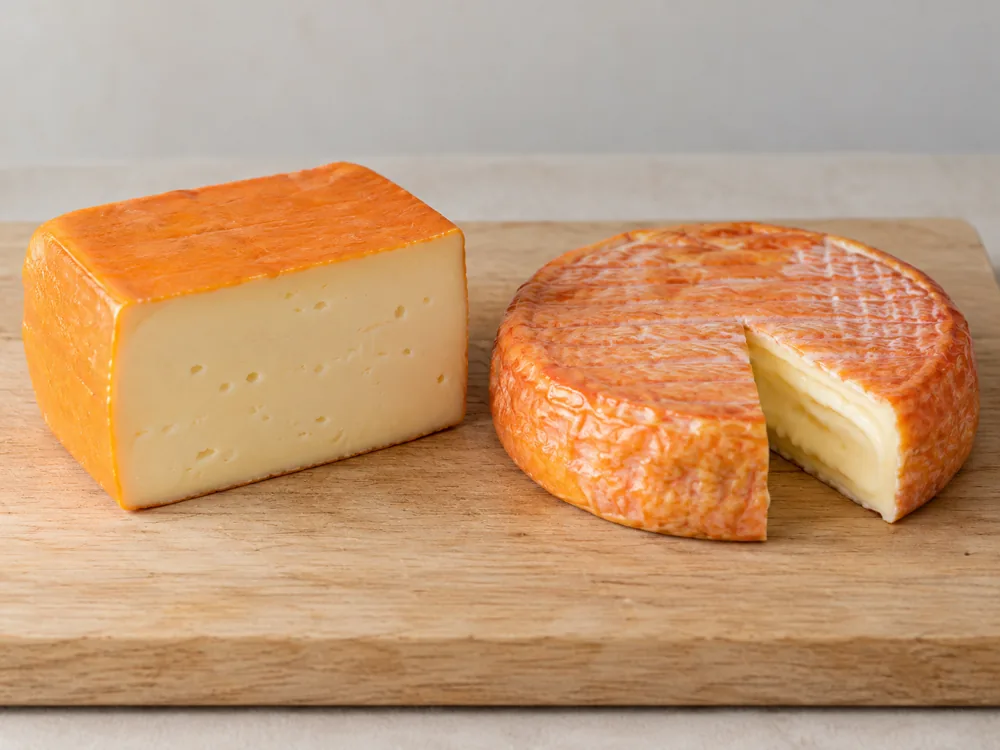
Wisconsin Cheese draws the line plainly: American muenster is much milder, is made from pasteurized cow's milk and does not use a washed-rind process. French Munster is protected as an AOP, and INAO describes it as a soft cheese with a washed rind.
The orange on each cheese has a different cause, and the milk rules and ripening times differ too.
| Point | American Muenster | French Munster (AOP) |
|---|---|---|
| Where made | United States (Cheese.com, English Wikipedia) | Alsace and Lorraine, around Munster and Gérardmer (INAO) |
| Milk | Pasteurized cow's milk (Cheese.com, English Wikipedia, Wisconsin Cheese) | Cow's milk (INAO) |
| Outside | Orange colouring from annatto | Washed rind, ivory-orange to orange-red (INAO) |
| Ripening | No figure in the sources checked | At least 21 days, or 14 days for Petit-Munster (INAO) |
| Size | Not specified | 13 to 19 cm across and at least 450 g; Petit-Munster 7 to 12 cm and at least 120 g (INAO) |
| Flavour | Mild, buttery, tangier with age (Wisconsin Cheese) | Powerful, slightly ammoniated smell; mild taste with milky and vegetal notes (INAO) |
Cheese.com adds that American versions are milder than their European counterparts and are sold younger.
INAO's text for the AOP gives a flat disc 2.4 to 8 cm high, while Wisconsin Cheese's handling notes talk about blocks and Sargento sells slices, so the shape on the shelf is itself a clue. The same text says the curd is neither washed nor kneaded, which means the washing in a washed rind is done to the outside of the cheese.
INAO says the rind is washed regularly during ripening, which helps the aromas develop, and that the humid conditions of the Vosges built the ripening skill that gives the Munster rind its colour. Wisconsin Cheese calls this the same washed-rind process used for stinky cheeses like Limburger and says it grows more bacteria on the outside, which is its explanation for French Munster's stronger aroma and flavour.
The AOP's second name, Géromé, is the Lorraine dialect name for the cheese, so Munster-Géromé on a label means the same French cheese.
Where Did American Muenster Come From?
Wisconsin Cheese calls muenster one of the country's first semi-soft cheeses and says French immigrants first made it in Wisconsin in the late 1800s. English Wikipedia says instead that it was popularized in the early twentieth century and may imitate the Alsatian Munster that German immigrants knew.
Cheese.com ties the name to an Alsatian abbey of Munster in the Vosges mountains of France, and English Wikipedia says it has no connection to the German places Münster in Westphalia and Munster in Lower Saxony or to the Irish province of Munster.
Wisconsin Cheese credits French immigrants and English Wikipedia points to German immigrants who knew Munster. Neither names a first maker or an exact year, so the origin story stays open.
The two dates answer different questions: Wisconsin Cheese dates the first Wisconsin batches, while English Wikipedia dates the cheese's popularity and cites a cheese column in the Fennimore Times of 7 December 1927. A column in print shows when readers knew the cheese, not when a maker first sold it, so both dates can be right.
Wisconsin Cheese says muenster was inspired by Alsace's washed-rind Munster and that the two cheeses are not similar today, while Cheese.com calls it an American imitation. None of the sources checked says when or why American makers swapped the rind wash for an annatto coating, so that step in the story is undocumented.
Wisconsin Cheese's muenster page lists 19 Wisconsin companies that make it. It describes the Wisconsin version as a bit firmer than European ones, ranging from mild to sharp.
Why Is the Outside Orange?
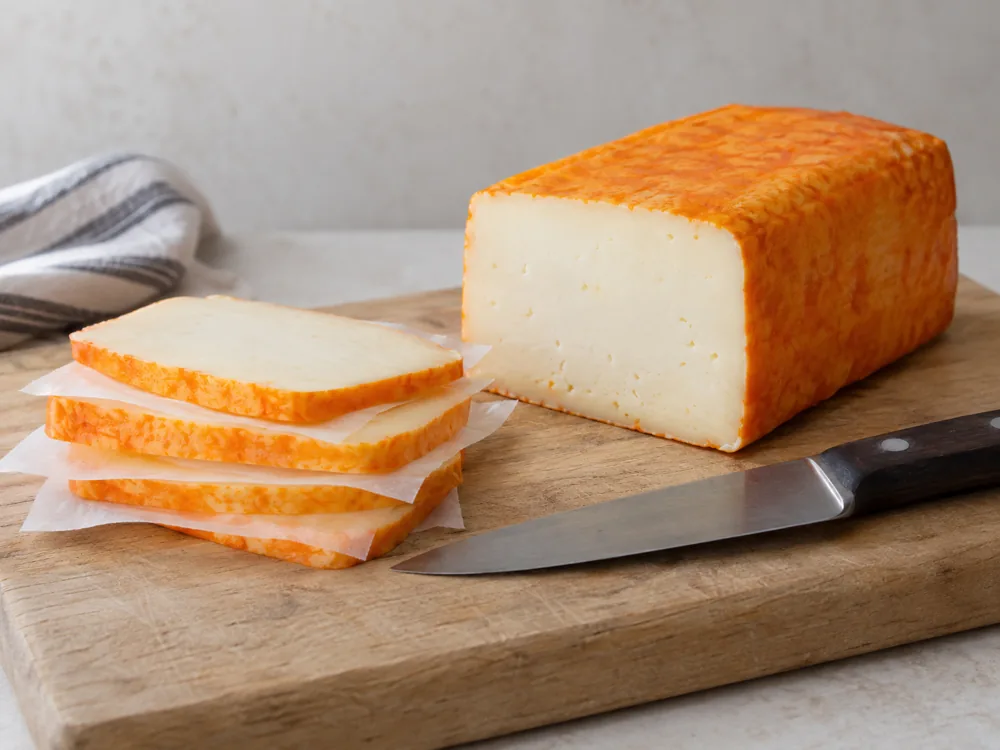
The orange on American Muenster is added colour. Cheese.com says it comes from vegetable colouring added during cheesemaking, and English Wikipedia names that colouring as annatto, a sweet and nutty seasoning used to add flavour and colour to cheese.
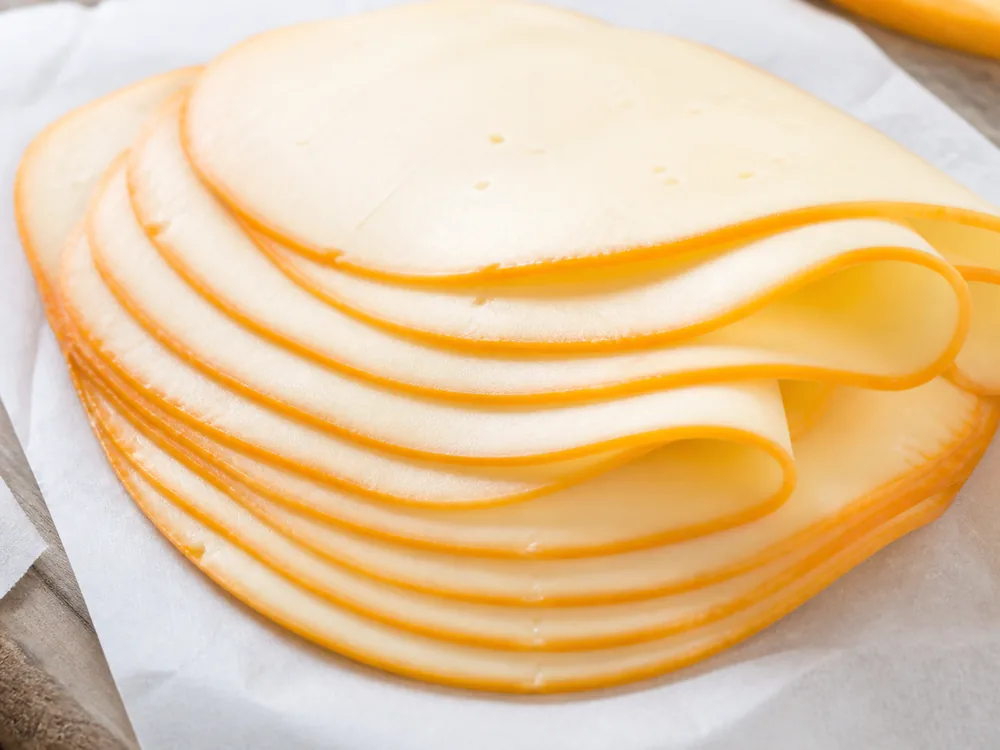
Packaged slices show it on the label. Sargento's ingredient list reads pasteurized milk, cheese culture, salt, enzymes and annatto (vegetable color), and the brand calls the outside a distinctive red-orange rind.
On French Munster the orange has another cause: INAO says the rind is rubbed or given other wet treatments and takes its colour from Bacterium linens.
The shades overlap, since Sargento calls its rind red-orange and INAO describes the AOP rind as running up to orange-red, so edge colour alone does not separate the two cheeses.
The pale paste gets three wordings, pale yellow from Cheese.com, creamy white from Wisconsin Cheese and simply pale from English Wikipedia, and none of them ties a shade to age or maker.
What Does Muenster Taste Like?
Most sources describe a mild cheese. Wisconsin Cheese calls the flavour mild and buttery, getting stronger and tangier with age, and Sargento calls its slices savory and mild.
Wisconsin Cheese uses two words for the same cheese: its main page says mild and buttery, while its cheese-directory entry says mild and nutty, and both say the flavour builds with age.
Cheese.com gives the widest range, from mild and bland like a classic white American cheese to sharp like Jack cheese.
Age changes the smell as well as the taste. Cheese.com and English Wikipedia both say a properly aged Muenster can develop a strong, pungent aroma, which explains why Cheese.com's aroma field reads pungent and strong while its flavour field reads mild.
INAO describes the French cheese the same way, with a mild taste of milky notes, hay, ripe fruit, nuts and a little wood or yeast on a slightly salted, supple paste, set against its powerful smell. On both cheeses a strong smell on opening is not a sign of a strong taste, going by what Cheese.com and INAO say.
The texture words line up more closely, though Cheese.com alone files Muenster as a soft, processed type.
- Wisconsin Cheese: semi-soft, smooth and elastic, with a creamy white interior.
- Cheese.com: moist and soft, with a smooth texture.
- English Wikipedia: pale, smooth and soft.
- Sargento: semi-soft, with an excellent melt.
How Is Muenster Used?
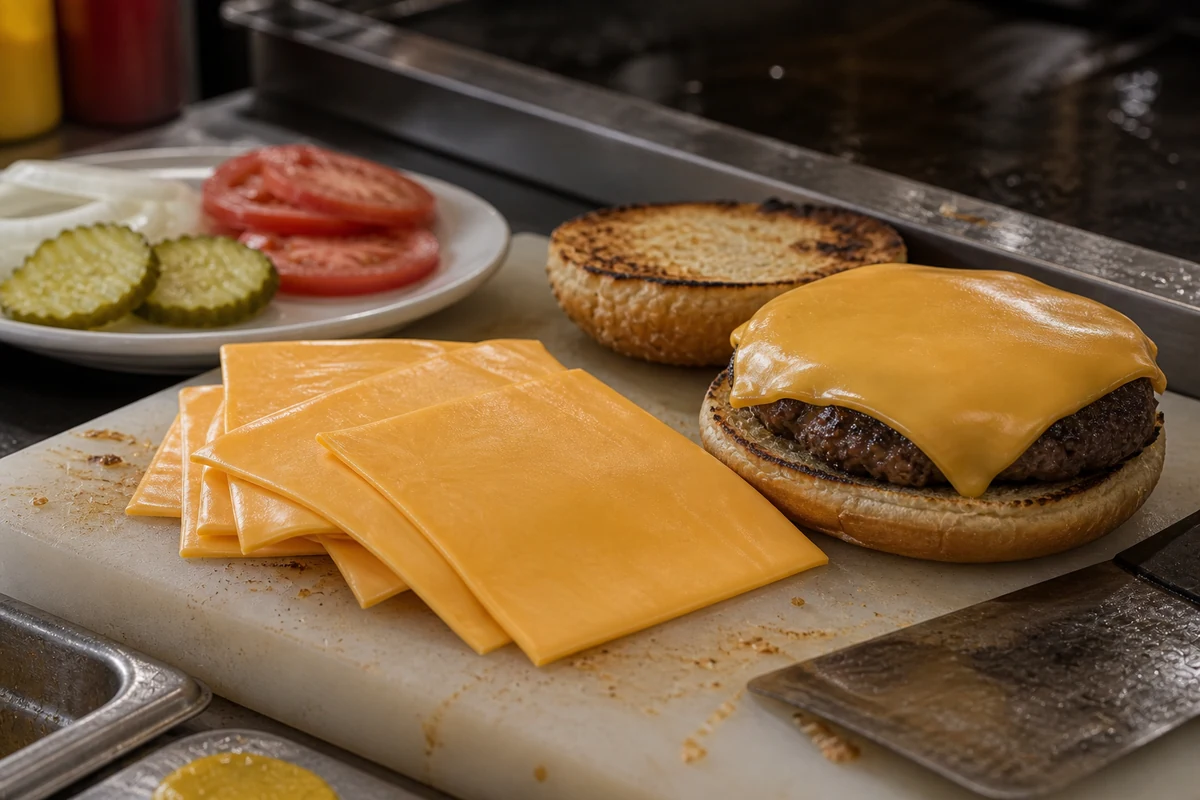
Every source that covers cooking praises the melt: Cheese.com credits its excellent melting properties, English Wikipedia says it melts well, and Wisconsin Cheese calls its meltability amazing. Cheese.com adds that the mild flavour suits dishes where the cheese should not overpower other ingredients.
| Use | How It Works |
|---|---|
| Grilled cheese sandwiches | Named by Cheese.com, English Wikipedia and Wisconsin Cheese. |
| Cheeseburgers | Named by Cheese.com, English Wikipedia and Wisconsin Cheese. |
| Macaroni and cheese | Named by Cheese.com and English Wikipedia; Wisconsin Cheese says it works in any macaroni and cheese recipe. |
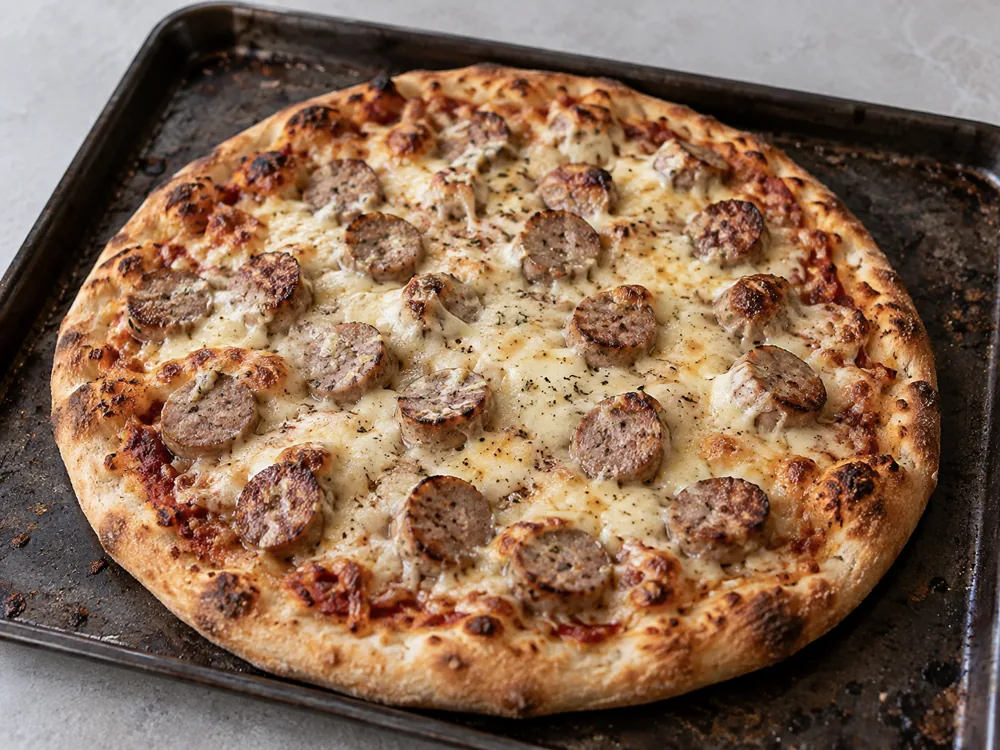
| Pizza | Named by Cheese.com and English Wikipedia. |
| Tuna melts and quesadillas | Named by English Wikipedia. |
| Snacking | Cheese.com and English Wikipedia call it an appetizer; Wisconsin Cheese suggests cubes with crackers. |
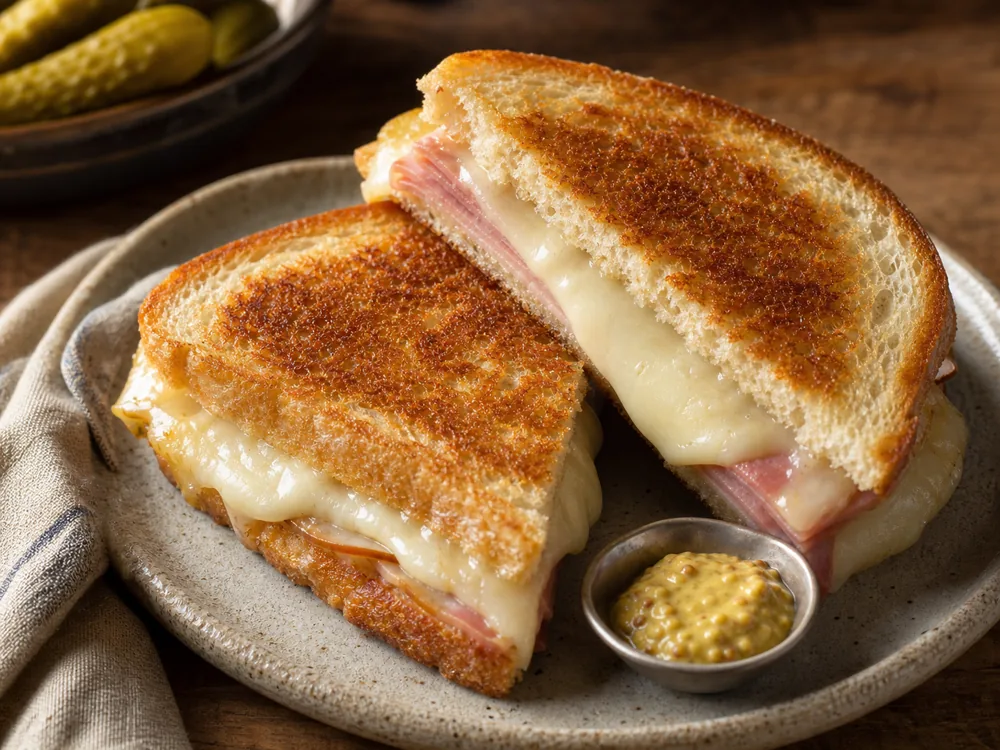
Sargento is the only source that gives a reason for the melt: it credits the semi-soft texture.
Beyond melting, Wisconsin Cheese suggests slicing it onto a ham sandwich, and Sargento suggests eating it with salami.
Sargento's hot list is short: grilled sandwiches, sliders and cheeseburgers. Wisconsin Cheese adds weekend scrambled eggs.
Sargento also pitches the slices for tailgates, picnics and road trips, packed in a cooler, and lists grilled chicken Muenster sandwiches, molletes and a mac and cheese among its related recipes.
Wisconsin Cheese's Muenster page features recipes for Muenster and fresh corn nachos, asparagus bundles with Muenster, an 'nduja grilled cheese and a Muenster cheese spread.
Wisconsin Cheese's most specific idea is a pizza topped with grated muenster and thinly sliced bratwurst. The same source melts it into beer cheese dip, cheese sauce and mashed potatoes.
What to Drink With Muenster
Cheese.com says Muenster is usually served with beer.
Wisconsin Cheese lists seven beer styles and nine wines that go with it, without ranking any of them.
The tags on Wisconsin Cheese's directory entry add amber, saison and Scotch ales to the beer list and name only six of the nine wines, so the two Wisconsin lists overlap rather than match.
The substitutes carry drink advice too: Cheese.com's Monterey Jack page suggests Pinot Noir and Riesling, both on the Wisconsin Muenster wine list, and its Brick page names Gamay Beaujolais for young Brick and porter for aged Brick, which also appear on that list.
| Pairing | Type | Why It Works |
|---|---|---|
| Stout and porter | Drink | Both on the Wisconsin Cheese beer list. |
| Pilsner and lager | Drink | Both on the Wisconsin Cheese beer list. |
| Pale, brown and Belgian ales | Drink | The rest of the Wisconsin Cheese beer list. |
| Chardonnay, Riesling, Sauvignon Blanc | Wine | White wines Wisconsin Cheese names, with Pinot Gris and Grüner Veltliner. |
| Pinot Noir, Merlot, Zinfandel | Wine | Red wines Wisconsin Cheese names, with Beaujolais. |
| Amber, saison and Scotch ales | Drink | Tagged on the Wisconsin Cheese directory entry but missing from its written list. |
What Can Replace Muenster?
No source checked ranks substitutes for Muenster, so the table sets Cheese.com's descriptions of three melting cheeses beside its Muenster entry. Cheese.com's Muenster entry already names one of them, comparing the sharper end of Muenster to Jack cheese.
| Cheese | Milk and origin | Texture and flavour | Melting and use |
|---|---|---|---|
| Muenster | Pasteurized cow's milk; United States | Smooth; mild | Excellent melting; sandwiches, macaroni and cheese, pizza, cheeseburgers |
| Monterey Jack | Pasteurized cow's milk; Mexico and United States | Creamy, firm, supple; buttery, mild | Melts really well; Mexican and Spanish cooking |
| Havarti | Pasteurized cow's milk; Denmark | Smooth, creamy; delicate and buttery, tangier with age | Melts exceptionally well; grilled cheese, casseroles, pizzas |
| Brick | Pasteurized cow's milk; Wisconsin | Open, smooth; mild and sweet young, pungent and tangy aged | Macaroni, potatoes au gratin |
Cheese.com describes Monterey Jack as buttery and mild, but classes it as semi-hard where it files Muenster as soft.
Cheese.com adds that Dry Jack is the aged version and Pepper Jack the pepper-spiced one, so plain Monterey Jack, which it says tastes and feels like Colby and Cheddar, is the mild stand-in.
Danish Havarti is the semi-soft option, and Cheese.com says its high moisture makes it melt exceptionally well. It has small, irregular holes and is aged about three months.
Cheese.com separates Havarti from Cream Havarti, which uses the same recipe with extra cream and a shorter ageing time for a milder taste and slightly higher moisture, and it lists flavoured Cream Havarti such as caraway, dill and garlic.
Brick is another Wisconsin cheese, first made by John Jossi around 1877, but it has a washed rind and turns pungent with age, so a young Brick stays closest to Muenster's mildness.
Cheese.com says Brick is smear-ripened with Corynebacterium and Arthrobacter bacteria, which makes it the American cheese in this table that shares French Munster's washed rind instead of Muenster's annatto coating.
On pizza the swap can run the other way, since Wisconsin Cheese suggests grating muenster over a pie in place of the usual mozzarella.
How Do You Choose Muenster at the Store?
Spelling and shape come first: English Wikipedia says the added e separates the American cheese from Munster, and INAO's French cheese is a flat disc rather than a block or a stack of slices.
Pack wording comes next, because Cheese.com files Muenster as a soft, processed type while Sargento sells its slices as natural cheese. Sargento also states that Pasteurized Process Cheese Food only has to contain 51% natural cheese, so a pack labelled that way may hold far less real cheese than one labelled natural.
Format then follows the dish: Sargento's 8 oz pack holds 11 slices and is pitched at sandwiches, while Wisconsin Cheese's grated pizza topping and cubes with crackers start from a piece.
Muenster with an added e is the American cheese, and a pack labelled natural cheese is the straightforward kind. Slices suit sandwiches, and a piece suits grating or cubes.
Nutrition and Storage
The USDA figures describe Muenster in general, while the Sargento numbers come from one brand's sliced cheese.
| Nutrient | USDA, per 100 g | Sargento slice, per 21 g |
|---|---|---|
| Energy | 368 kcal | 80 calories |
| Fat | 30 g | 6 g |
| Saturated fat | 19.1 g | 4 g |
| Protein | 23.4 g | 5 g |
| Sodium | 628 mg | 140 mg |
| Carbohydrate | 1.12 g | 0 g |
| Calcium | 717 mg | 10% Daily Value |
Scaled down to a 21 g slice, the USDA figures come to about 77 kcal, 6.3 g fat and 132 mg sodium, close to the Sargento label. USDA reports 1.12 g of total sugars per 100 g and does not list lactose separately.
On Sargento's label one slice supplies 20% of the daily value for saturated fat, against 10% for protein, 7% for cholesterol (20 mg) and 6% for sodium, so saturated fat is where a slice takes the largest share.
Sodium reads about 6% higher on the label, 140 mg against roughly 132 mg scaled from USDA, a gap small enough that the brand's slices and the database entry describe much the same cheese.
INAO sets minimums for French Munster of 45 g of fat per 100 g of dried cheese and 44 g of dry matter per 100 g of cheese, which works out to at least about 20 g of fat per 100 g as sold. That floor is measured on a different basis from USDA's 30 g for Muenster, so the two numbers do not show which cheese is richer.
Sargento prints the only time limit in the sources checked: use the slices within five days of opening for maximum freshness, with its easy-close FreshLock packaging meant to keep them fresh longer.
Wisconsin Cheese's tip for storing slices is a sheet of waxed paper between each one so they do not stick together.
Its slicing notes start with the block: firm, well-chilled blocks slice most easily, and oiling the slicer first helps. Because a bright orange annatto coating tends to smear, Wisconsin Cheese also suggests wiping the knife with a damp cloth between slices.
Is Muenster Safe During Pregnancy?
Every source checked describes American Muenster as made from pasteurized milk, but neither the NHS nor the CDC names Muenster in its cheese lists. The CDC lists unheated cheese sliced at a deli as a riskier choice and deli-sliced cheese heated to 165°F or until steaming hot as a safer one.
Pregnant women are 10 times more likely to get a Listeria infection, according to the CDC.
The NHS lists pasteurised soft cheeses such as mozzarella, feta and halloumi as safe, while pasteurised or unpasteurised mould-ripened soft cheeses with a white coating, such as brie, camembert and chèvre, must be thoroughly cooked. American Muenster has an annatto-coloured outside rather than a white mould coating, and the NHS list does not name it.
A raw-milk French Munster falls into the CDC's riskier group of soft cheese made from unpasteurized milk.
SOURCES & REFERENCES
Muenster Cheese FAQ
American Muenster is mild, and Wisconsin Cheese calls it mild and buttery. Cheese.com and English Wikipedia say a properly aged piece can develop a strong, pungent aroma.
No. American Muenster is a milder cheese of pasteurized cow's milk coloured with annatto, while French Munster is an AOP washed-rind cheese from Alsace.
The orange comes from annatto, a vegetable colouring added during cheesemaking.
Yes. Cheese.com, English Wikipedia and Wisconsin Cheese all praise how well it melts.
Cheese.com files it as a soft, processed type, but Sargento sells its Muenster slices as 100% real, natural cheese and says Pasteurized Process Cheese Food only has to contain 51% natural cheese.
Sargento says to use its slices within five days of opening for maximum freshness, and Wisconsin Cheese suggests a sheet of waxed paper between slices so they do not stick.
Every source checked describes American Muenster as made from pasteurized cow's milk. The CDC still lists unheated deli-sliced cheese as a riskier choice in pregnancy.