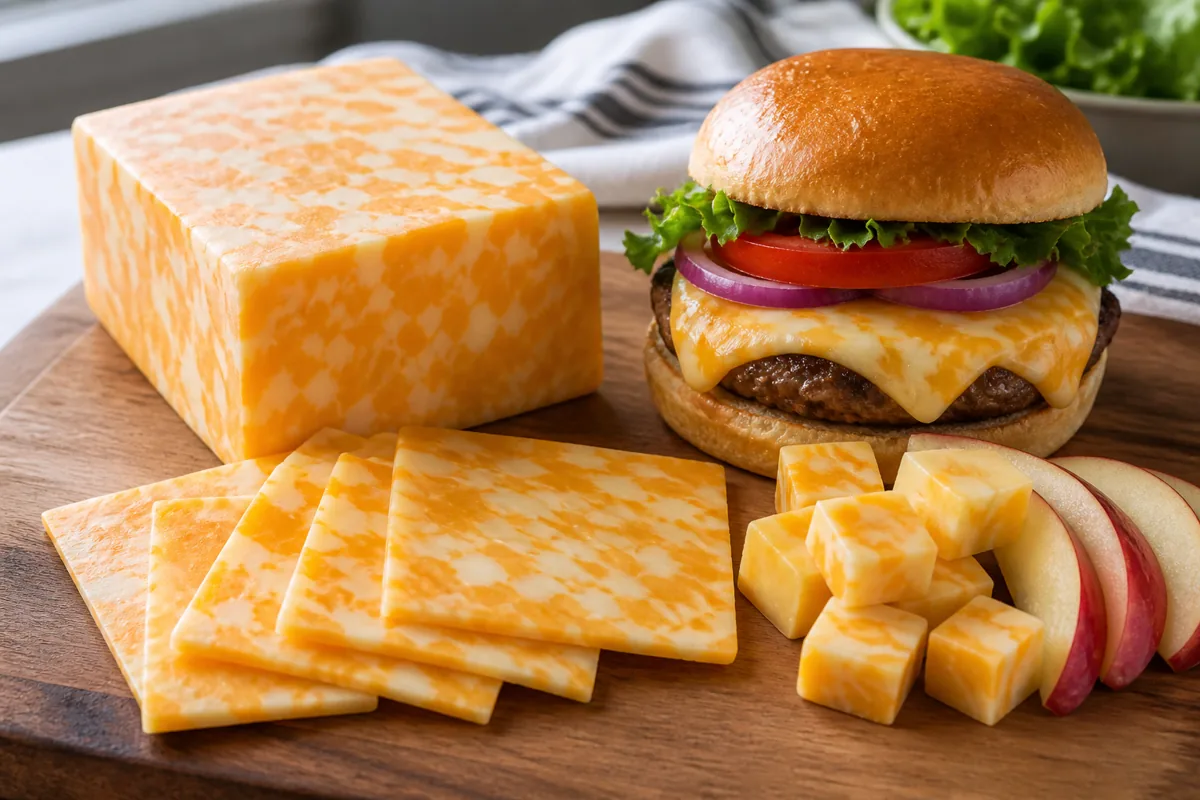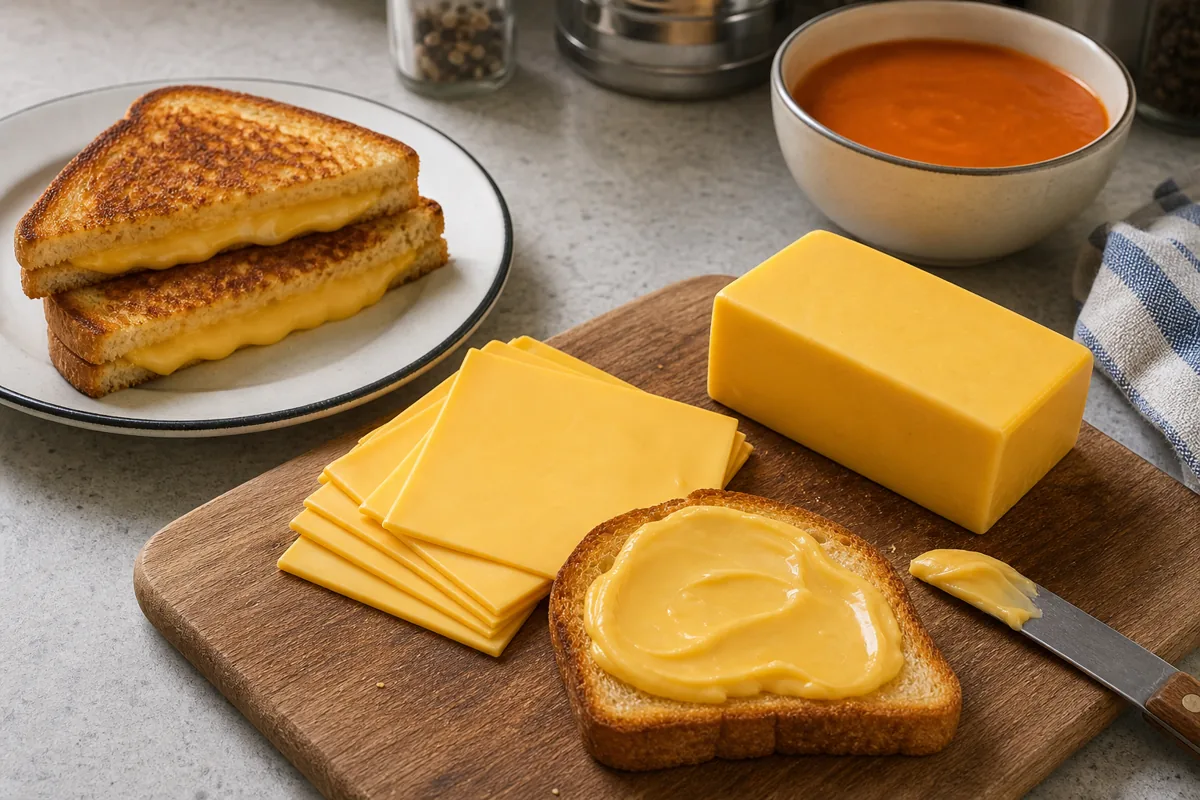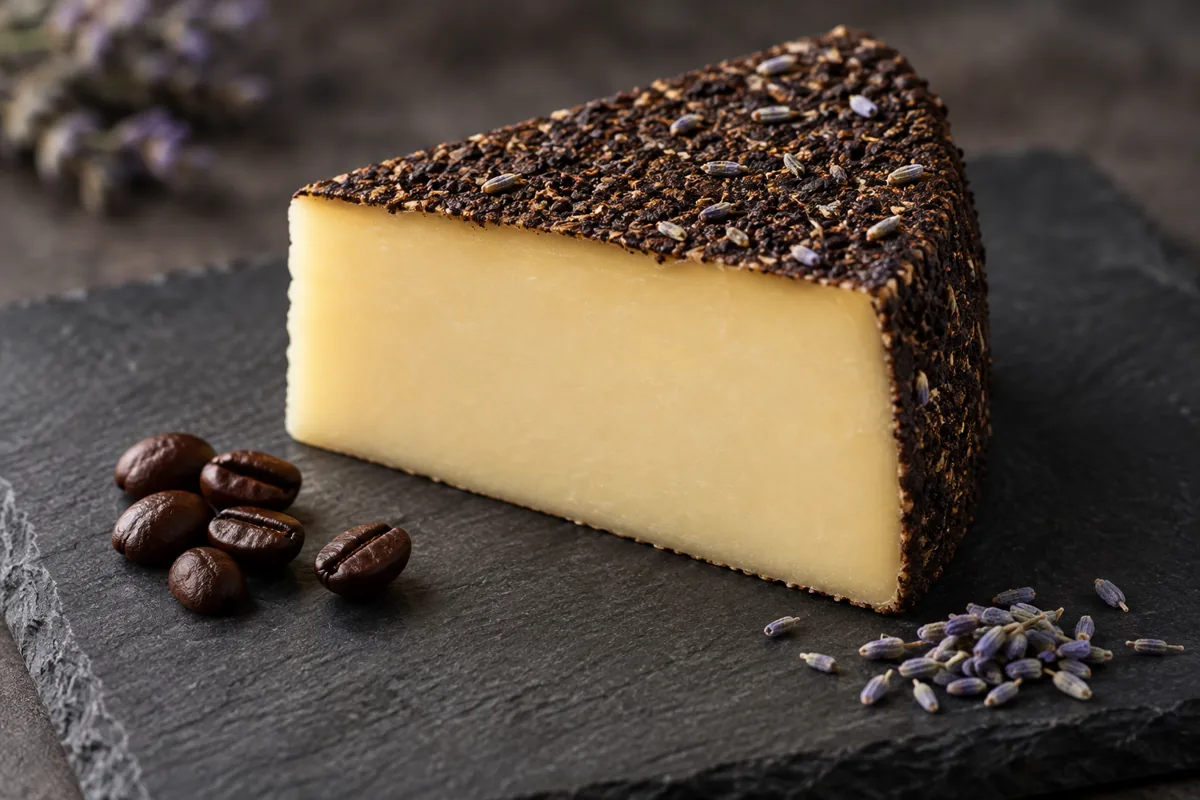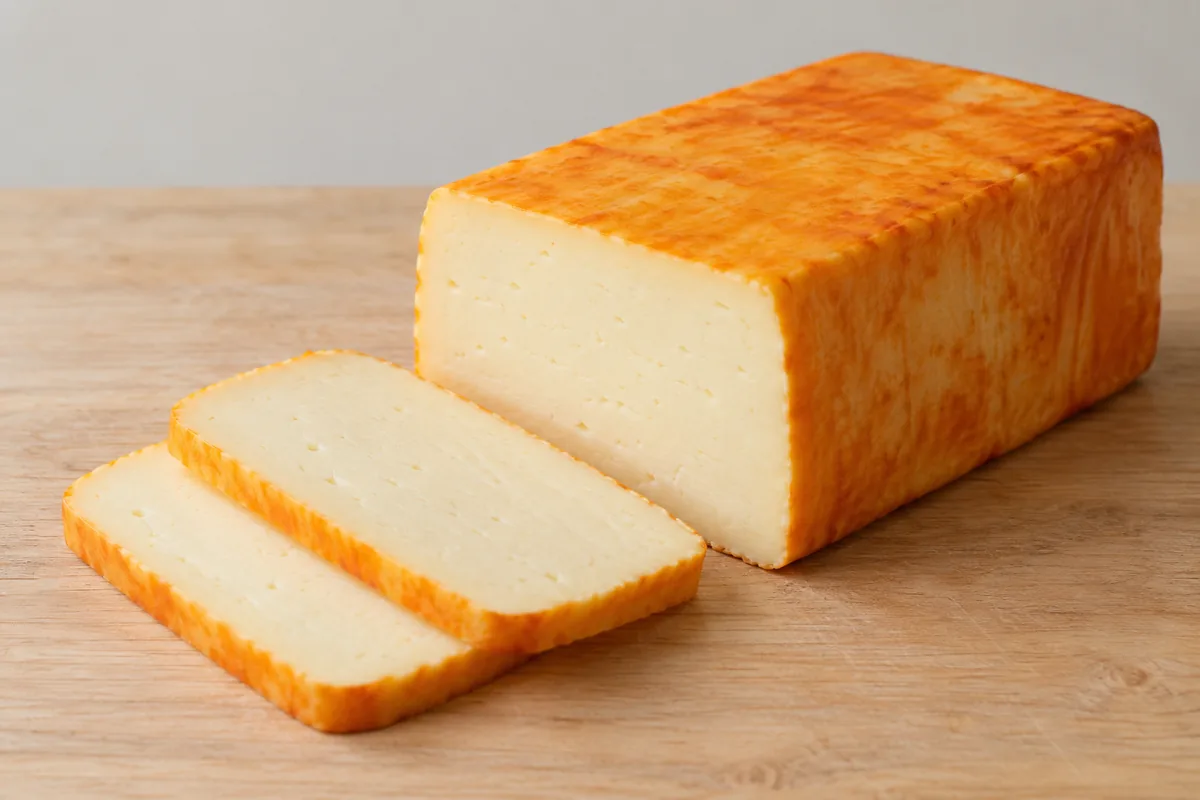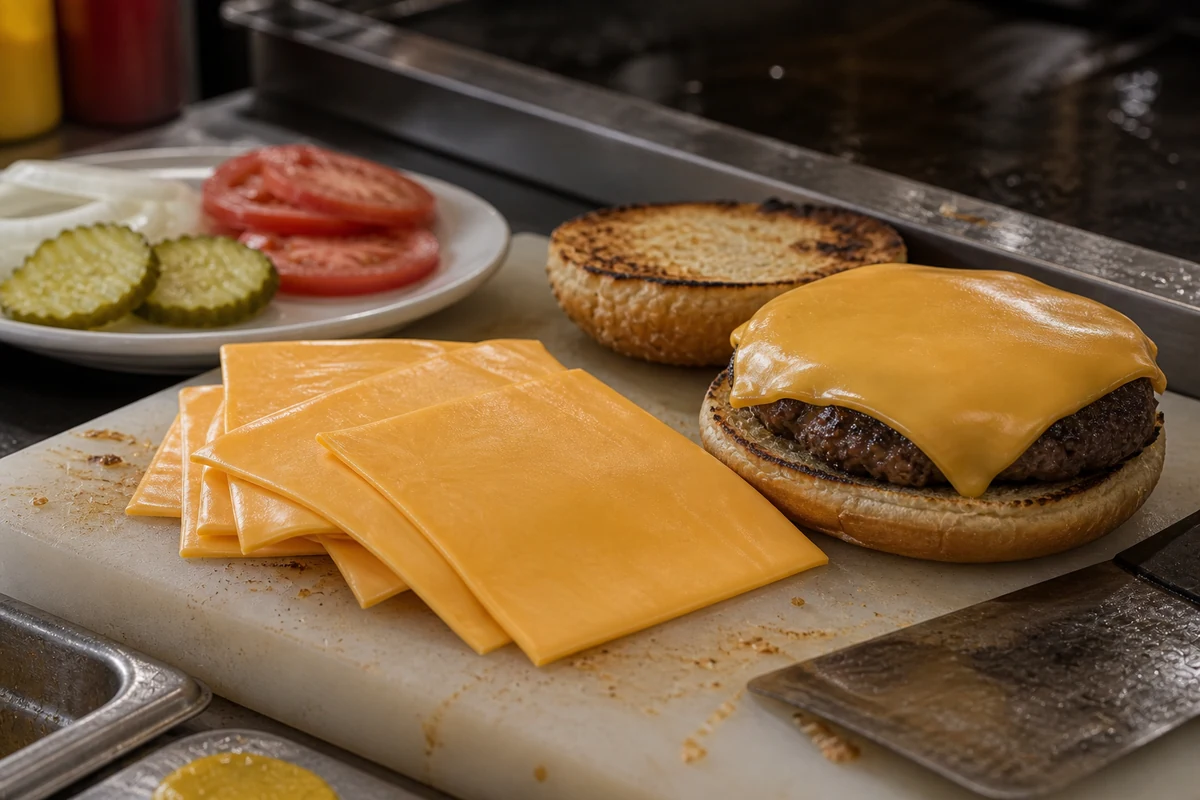
American cheese is processed cheese: cheddar, Colby or a similar cheese that is ground, mixed with an emulsifying salt such as sodium citrate, heated into a smooth mass and left to set again.
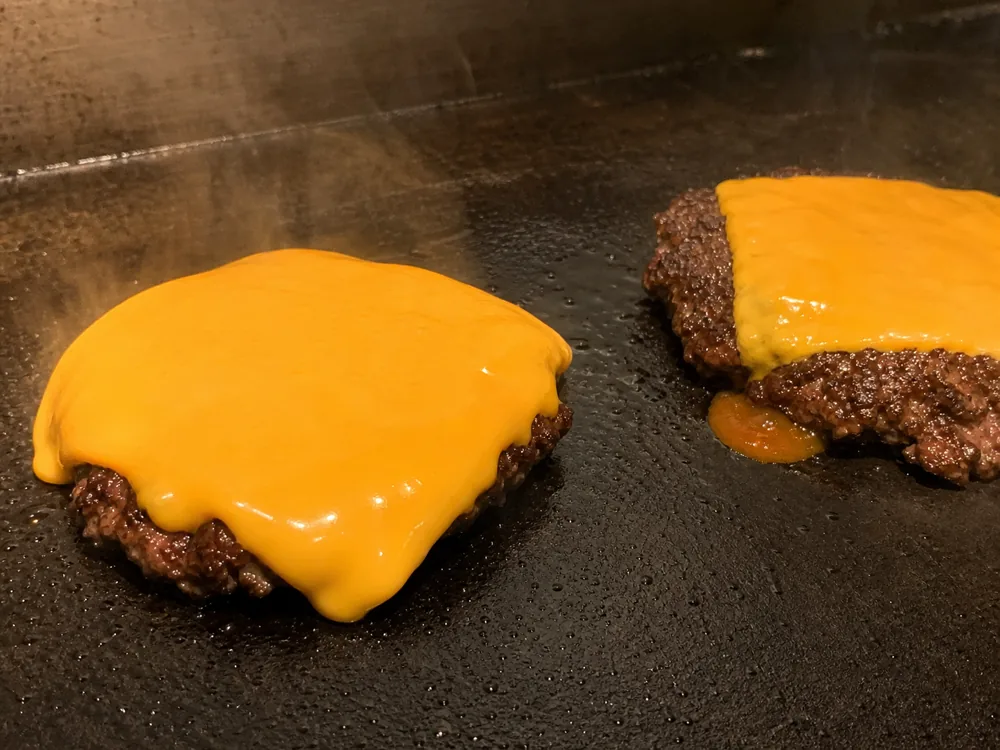
That salt explains the melt. It keeps the fat bound to the milk protein as the cheese heats, so a slice goes soft and glossy where a natural cheddar can turn greasy and lumpy.
In This Article
What Is American Cheese?
Wikipedia describes American cheese as mild, creamy and salty, with a medium-firm body and a low melting point. It is sold in yellow, which is colored with annatto, or in white.
The USDA purchase specification narrows the flavor range. It asks for the flavor of process cheese made from mild to medium cured cheddar, Colby or granular cheese, and allows only slight feed, acid or bitter notes in the natural cheese and skim milk in the blend.
The US federal standard fixes which cheeses may carry the name. A process cheese may be called "American cheese" only when its cheese comes from cheddar, washed curd or granular cheese, or from a Colby base, under 21 CFR 133.169.
The name is older than the processed product. Wikipedia cites the Oxford English Dictionary for its first known use, in a Kentucky newspaper in 1804, at a time when cheddar made in America was sold in England as American or Yankee cheddar.
Kraft Foods founder James Kraft patented his method for making processed cheese in 1916 and began selling it in the late 1910s. According to Wikipedia, the term then quickly came to mean the processed kind instead of the more expensive traditional cheddar.
The idea itself came from Switzerland, where Walter Gerber and Fritz Stettler added sodium citrate to melted Emmentaler in 1911 and found that the sauce set solid again as it cooled.
Longer shelf life drove both inventions. Wikipedia's processed cheese entry says Gerber and Stettler wanted a cheese that lasted longer, with fondue and cheese sauces as their model, and that Kraft's patent described a way of storing cheese that halts maturation by sterilization.
The same entry adds that the emulsifying salt does not preserve the cheese by itself. What it does is let heat sterilization, such as canning, be applied without the cheese forming lumps, and that heat treatment is what gives the longer shelf life.
In the UK, Wikipedia says, individually wrapped processed slices are often called American cheese whatever their origin or style, or singles. It adds that adjectives such as "cheesy" sometimes appear in the name of singles to get around laws on what can be called cheese.
A British pack called American cheese therefore says little about its base cheese, unlike the US name, which the federal standard ties to specific cheeses.
Why Does American Cheese Melt Better Than Cheddar?
Natural cheese holds its fat as tiny globules inside a web of casein protein, and calcium holds that web together. Wikipedia's entry on processed cheese explains that long heating leaves a lumpy protein gel with liquid fat on top.
The emulsifying salt in American cheese binds that calcium, so the casein can no longer lock together.
Smaller groups of protein then mix with the melted fat and hold it as microscopic droplets instead of large lumps. Cook's Illustrated describes the same swap: the sodium in sodium citrate takes the place of some of the calcium, and the freed proteins hold fat and water together as the cheese heats.
Wine does a version of this job in Swiss fondue: Wikipedia notes that the tartaric acid in the wine is a calcium-sequestering agent too.
Age makes natural cheese harder to melt smoothly. Cook's Illustrated says aged cheeses such as Gruyère lose water and their proteins clump into compact groups, so they can melt into a chewy blob of protein sitting in liquid fat.
The water loss matters twice. It raises the cheese's relative fat content, and with less water to hold up its side of the emulsion the fat is more likely to break out and puddle, according to Cook's Illustrated.
Cook's Illustrated sets that failure against young Monterey Jack, which softens, oozes and stretches smoothly. The difference between the two is age, so a young natural cheese is the better bet for a smooth melt.
That is why Wikipedia credits processed cheese for its place on cheeseburgers and grilled cheese sandwiches: it cooks evenly, spreads smoothly and resists congealing, unlike traditional cheddar.
The USDA writes the melt into its purchase rules. Process American cheese bought for its domestic food programs must reach Number 3 or higher on the Schreiber meltability test and have a smooth body free of lumps and graininess.
What Do Process Cheese, Cheese Food and Cheese Product Mean?
Three label names turn up on American-style slices in US stores, and only two of them follow a federal recipe.
Pasteurized process American cheese is nearly all cheese. Under 21 CFR 133.169 it may add no more than 3 percent emulsifying agent, and added cream or milkfat must stay under 5 percent of the weight.
Pasteurized process cheese food needs only 51 percent cheese under 21 CFR 133.173, and the rest may include cream, milk, skim milk, buttermilk or cheese whey.
Pasteurized prepared cheese product has no FDA standard of identity, according to Wikipedia. Makers that use this name can add milk protein concentrate, an ingredient the FDA does not allow in process cheese.
| Label name | Federal rule | Minimum cheese | Moisture and fat |
|---|---|---|---|
| Pasteurized process American cheese | 21 CFR 133.169 | All cheese apart from up to 3% emulsifier, added milkfat under 5%, salt, water, color and acidifier | See the FDA and USDA rules below |
| Pasteurized process cheese food | 21 CFR 133.173 | 51% of the finished weight | Moisture at most 44%, fat at least 23% |
| Pasteurized prepared cheese product | No FDA standard (Wikipedia) | Not set | Not set |
Figures for how much of a slice is cheese differ by source. Wikipedia's American cheese entry says the mix must include at least 51 percent cheese, and its processed cheese entry puts the typical share at 50 to 60 percent.
The 51 percent floor belongs to the cheese food standard in 21 CFR 133.173. The process American standard in 21 CFR 133.169 lists only emulsifier, small additions of milkfat and the other ingredients in the table, so a pack named pasteurized process American cheese is the nearer of the two to all cheese.
Both standardized products must be heated for at least 30 seconds at 150 °F or more while they are made. The USDA asks more of the process American cheese it buys, as the rules side by side show.
| FDA standard (21 CFR 133.169) | USDA purchase rules (May 2023) |
|---|---|
| Heated at least 30 seconds at 150 °F or more | Pasteurized at least 30 seconds at 165 °F or more |
| Moisture at most 40% for a blend of cheddar, washed curd, Colby or granular cheese | Moisture at most 40% |
| Fat in solids at least the base cheese's own minimum, never below 47% | Milkfat at least 50% of the solids |
| No salt limit; any acidifier must leave the pH at 5.3 or above | Salt at most 2.0%, pH 5.3 to 5.8 |
| Cheddar, washed curd, Colby or granular cheese | Cheddar, Colby or granular cheese, averaging at least 20 days old in the blend (ribbon-sliced cheese exempt) |
Kraft Heinz's page shows the split in practice: it names Kraft Singles American slices a pasteurized prepared cheese product, and its ingredient list puts milk protein concentrate after cheddar cheese, skim milk, whey and milkfat. Wikipedia names Kraft Singles as a product that uses the prepared cheese product term for that reason.
Wikipedia also records that after an FDA warning letter about milk protein concentrate in late 2002, some Kraft Singles varieties once labeled pasteurized process cheese food became pasteurized prepared cheese product.
The FDA also sets how blends are named: a process cheese made from two or more varieties carries their names in order of predominance by weight. Provel, which Wikipedia describes as made from cheddar, Swiss and provolone, is sold under those three names, not as American cheese.
The same standard lets a maker group cheddar, washed curd, Colby and granular cheese under the single name American cheese, in a name or an ingredient list, even in a blend that also holds other varieties. A pack that names American cheese beside another variety is therefore not all cheddar-type cheese.
21 CFR 133.169 allows 13 emulsifying agents, from sodium citrate and potassium citrate to several sodium phosphates and two tartrates. Kraft Singles American slices use phosphate salts, so the ingredient list, not the word American, tells you which one a pack contains.
How Is American Cheese Sold and Stored?
Wikipedia lists three forms: individually wrapped slices, unwrapped slices sold in stacks, and unsliced blocks.
Kraft brought out the first commercially available, shelf-stable sliced processed cheese in 1950, and the Clearfield Cheese Company introduced the first individually wrapped slices in 1956, according to Wikipedia. Stacked slices are often separated by wax paper.
Color is a choice between two finishes of the same product. The USDA purchase rules accept either a uniform medium yellow with an attractive sheen or white.
White American has a regional stronghold. Wikipedia reports that white American slices replaced the original provolone on Philadelphia cheesesteaks at many stands, and that the Philadelphia and South Jersey market made up 50 percent of Kraft's white American cheese sales in 2018.
The USDA rules also set how a loaf must behave under the knife: it slices freely into pieces about ⅛ inch thick without sticking to the knife or breaking, and ribbon-sliced packs hold 160 half-ounce slices that come apart easily from the stack.
A sound loaf in that specification is smooth, medium firm and resilient, with no pinholes, crystals or openings apart from those caused by trapped steam, and no visible mold is allowed.
The FDA allows two extras in slices or cuts sold in consumer-sized packs: a mold inhibitor, sorbic acid or a sorbate up to 0.2 percent or a propionate up to 0.3 percent, and lecithin up to 0.03 percent as an anti-sticking agent. Kraft's ingredient list for its American slices names sorbic acid as a preservative.
The USDA's kosher-certified version of the cheese replaces the lecithin with olive oil. Under an FDA temporary marketing permit that swap requires the label to say cheese product, so that name can reflect an oil change and not only the milk protein concentrate described above.
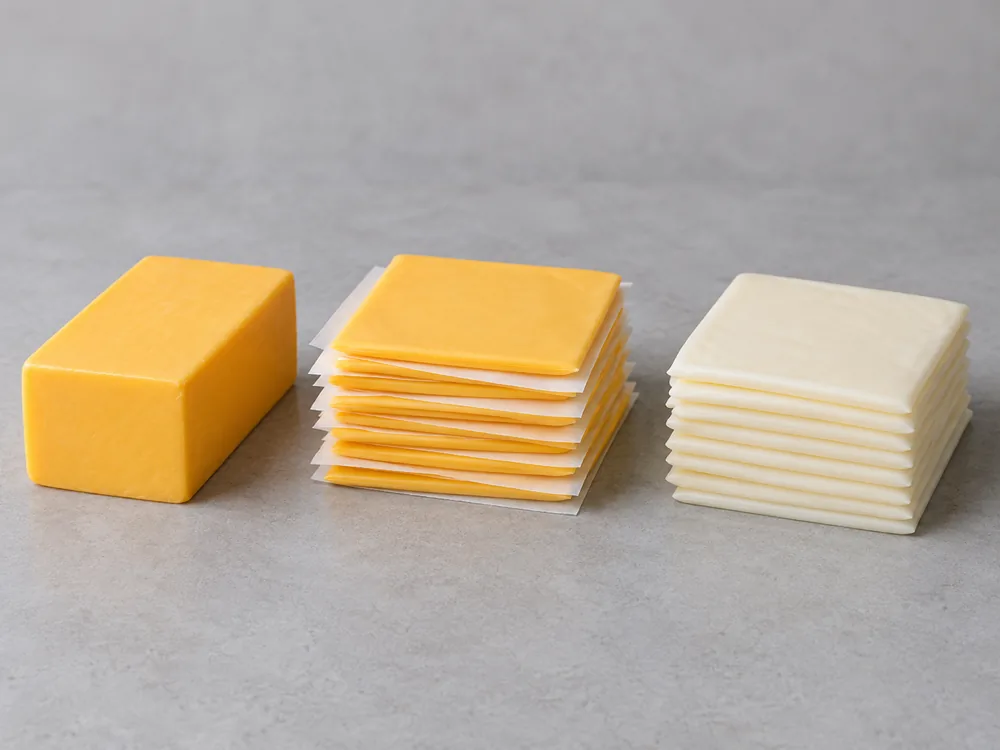
Kraft Heinz prints Keep Refrigerated and Do Not Freeze on its Kraft Singles American slices.
The USDA holds its own purchases to cold storage: ribbon-sliced cheese goes into storage at no higher than 40 °F right after packaging and must be no warmer than 45 °F on delivery. The same rules bar cheese made more than 60 days before delivery.
How Is American Cheese Used?
Wikipedia calls American cheese a common choice for sandwiches in North America, because its neutral flavor and soft texture go with many meats and other fillings.
- Burgers and fast food: the typical American cheeseburger, cheese dogs and chili-cheese fries, per Wikipedia.
- Melted classics: the grilled cheese sandwich and macaroni and cheese, named by Wikipedia.
- Breakfast: omelets, scrambled eggs and breakfast sandwiches, per Wikipedia.
- Toppings: cheesesteaks, and American cheese on nachos, per Wikipedia.
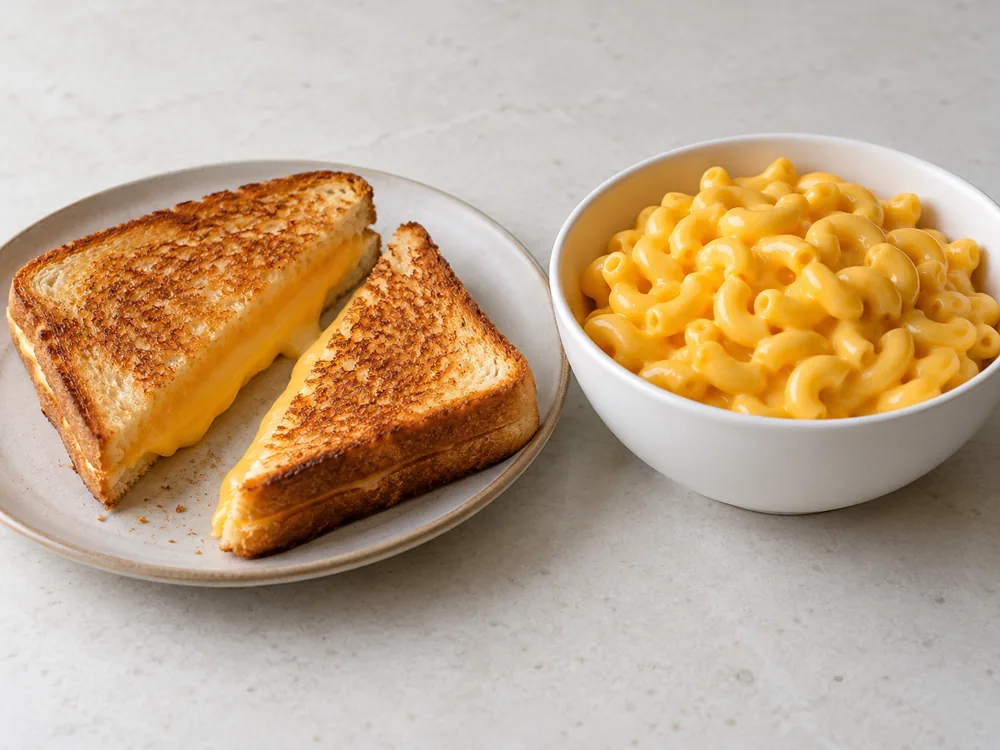
Kraft Heinz says its American slices can go on sandwiches cold from the pack or be melted on a dish, and it lists tuna melts with burgers, fries and breakfast sandwiches among its uses.
Home cooks can borrow the trick for a cheese with more flavor. Cook's Illustrated groups sodium citrate with the melting salts that help old or stubborn cheeses melt, and says a small amount of it is enough.
Cook's Illustrated describes the method as warming cheese with some liquid and a small amount of sodium citrate, which gives a smooth melt with no lumps or leaks that it calls perfect for fondues and cheese sauces. It adds that the salt is a white powder with a salty-sour taste that is not noticeable in the cheese.
How Much Sodium and Fat Is in American Cheese?
Process American cheese carries about two and a half times the sodium of cheddar, according to USDA FoodData Central reference values.
| Nutrient | Process American cheese | Process American cheese food | Cheddar |
|---|---|---|---|
| Energy | 366 kcal | 330 kcal | 403 kcal |
| Protein | 18.1 g | 16.9 g | 22.9 g |
| Fat | 30.7 g | 25.6 g | 33.3 g |
| Saturated fat | 18.1 g | 15.1 g | 18.9 g |
| Carbohydrate | 4.8 g | 8.6 g | 3.4 g |
| Sodium | 1,670 mg | 1,280 mg | 653 mg |
| Calcium | 1,040 mg | 682 mg | 710 mg |
| Water | 39.6 g | 44.0 g | 36.8 g |
Per 1-ounce (28.35 g) portion, that works out to about 104 kcal and 473 mg of sodium for process American cheese, by our arithmetic from the USDA figures. These are category values, and a brand's Nutrition Facts panel gives the figure for its own slice.
Kraft Heinz's label shows how far a brand can sit from those reference values. A 21-gram Kraft Singles American slice lists 50 calories, 3.5 g of fat, 230 mg of sodium and 330 mg of calcium.
Scaled to 100 g by our arithmetic, that is about 1,095 mg of sodium and 17 g of fat, well below USDA's 1,670 mg and 30.7 g for process American cheese. The skim milk, whey and milk protein concentrate in Kraft's ingredient list could explain part of the gap.
Calcium is the one row where the processed cheese comes out ahead: USDA lists 1,040 mg per 100 g for process American cheese against 710 mg for cheddar. Kraft Heinz's ingredient list also includes calcium phosphate.
Formulas can move a long way from that reference. The reduced-sodium process American cheese the USDA buys must land between 200 and 300 mg of sodium per 28-gram serving.
Is American Cheese Safe During Pregnancy?
The NHS lists processed cheese spreads among the pasteurised soft cheeses that are safe to eat in pregnancy, and says pasteurised or unpasteurised hard cheeses such as cheddar are safe too. It does not name sliced American cheese.
The CDC does not name processed or American cheese. Its table lists unheated cheese sliced at a deli as a riskier choice, and deli-sliced cheese heated to 165 °F or until steaming hot as a safer one.
The CDC also says pregnant women are 10 times more likely to get a Listeria infection.
SOURCES & REFERENCES
What Else Do People Ask About American Cheese?
A pack labeled pasteurized process American cheese is cheddar, Colby, washed curd or granular cheese with no more than 3 percent emulsifying agent. A pack labeled pasteurized prepared cheese product follows no federal standard.
It may. The federal standard allows sodium citrate or any of 12 other emulsifying agents, including several sodium phosphates, and the ingredient list names the one used.
It starts as cheddar, Colby or a similar cheese, but it is melted with an emulsifying salt and set again. Before Kraft's 1916 patent, "American cheese" did mean cheddar made in America.