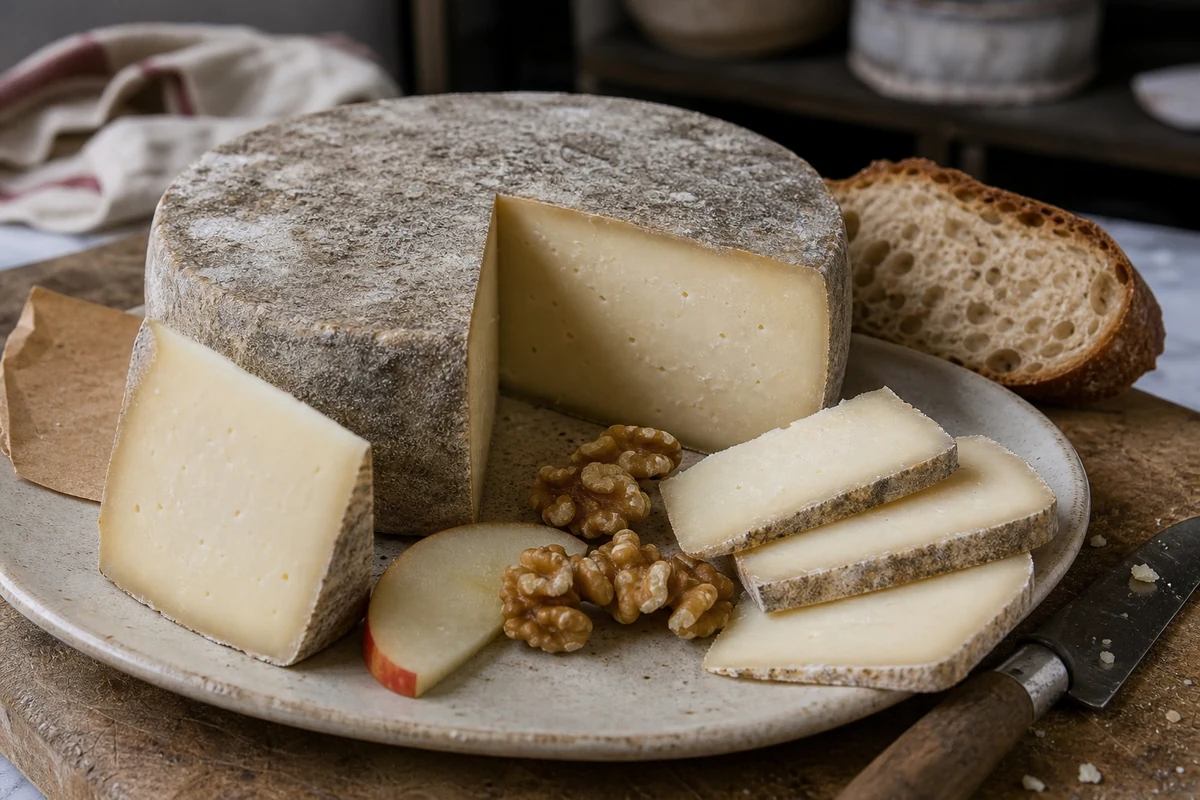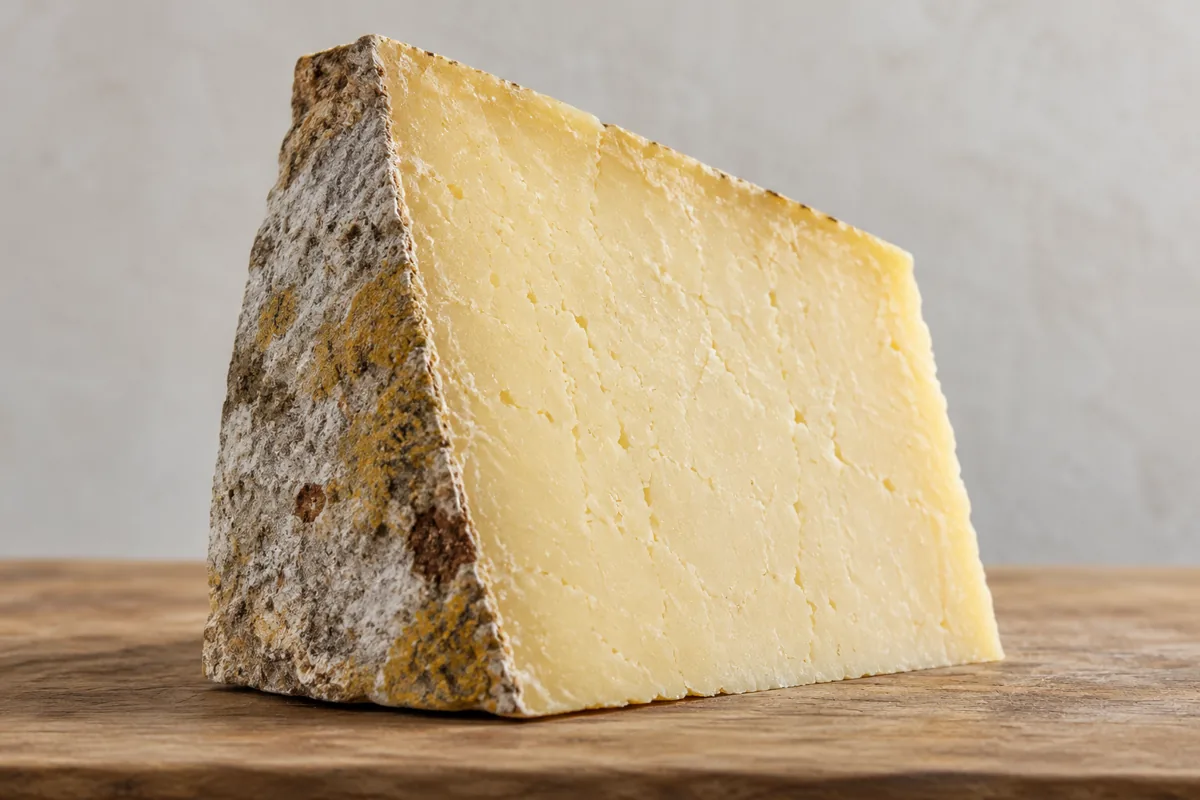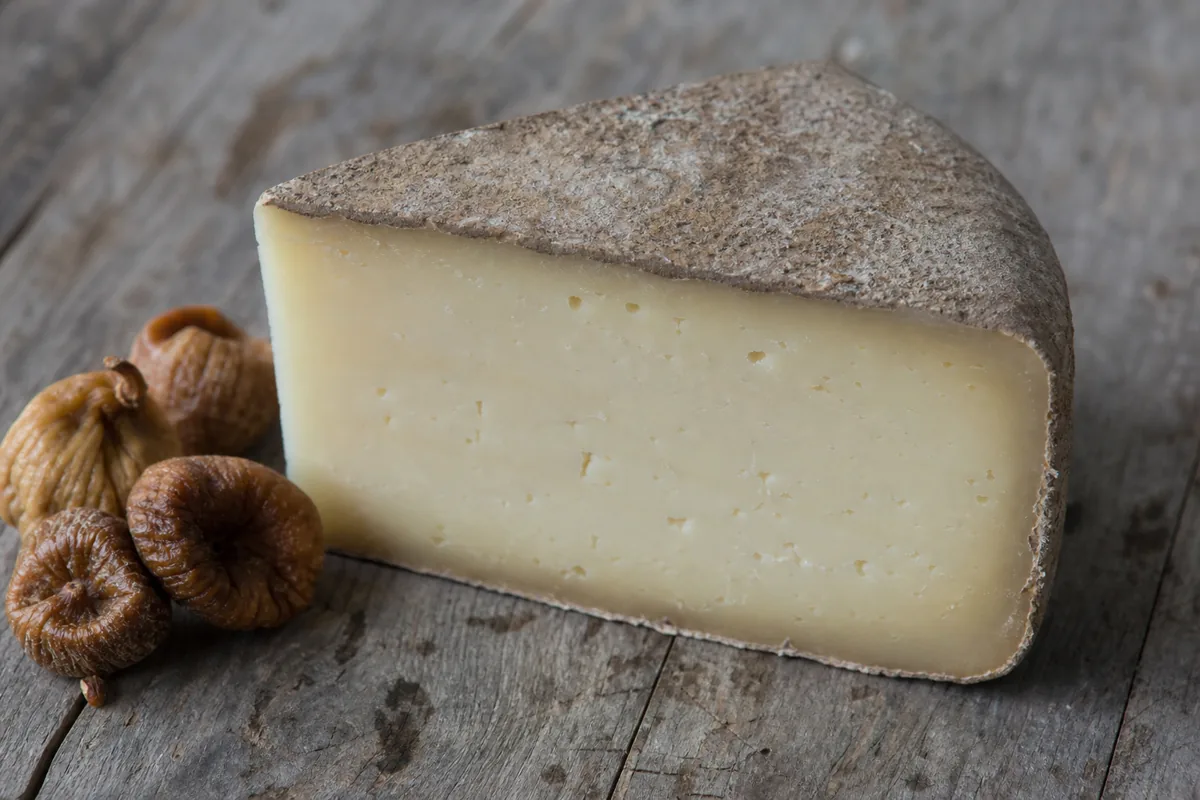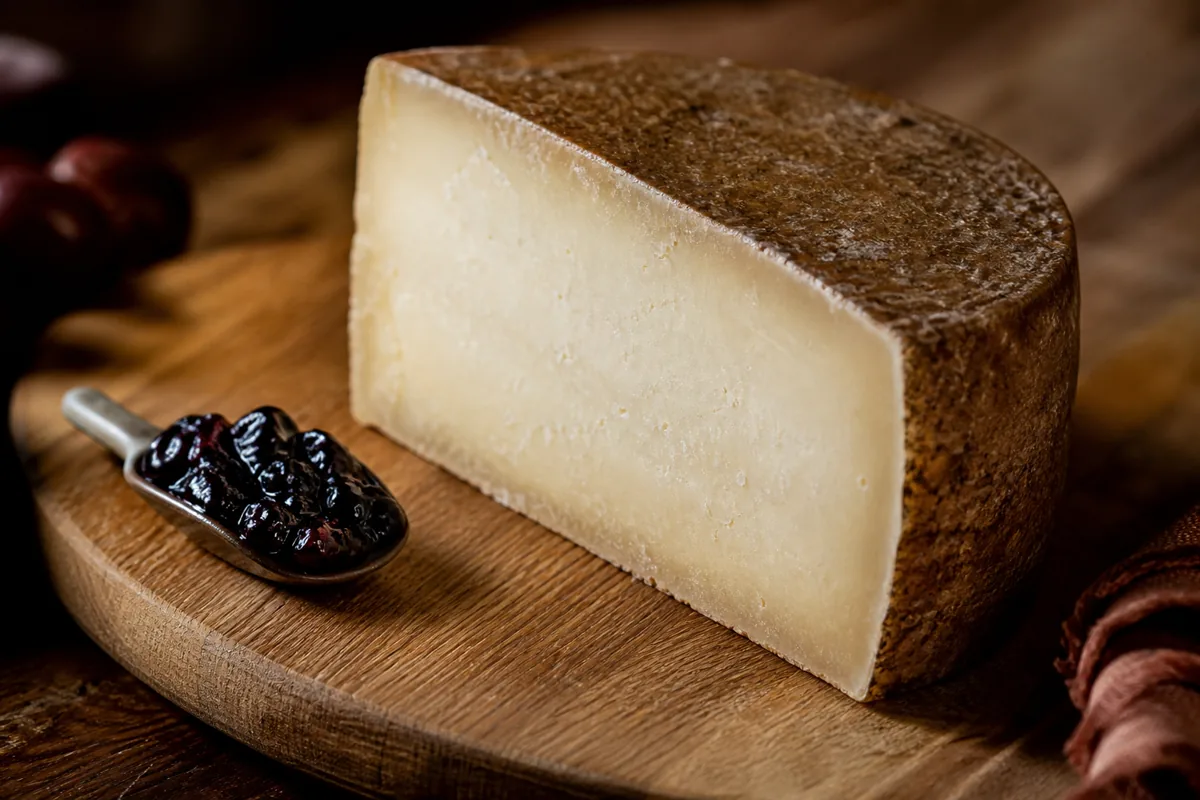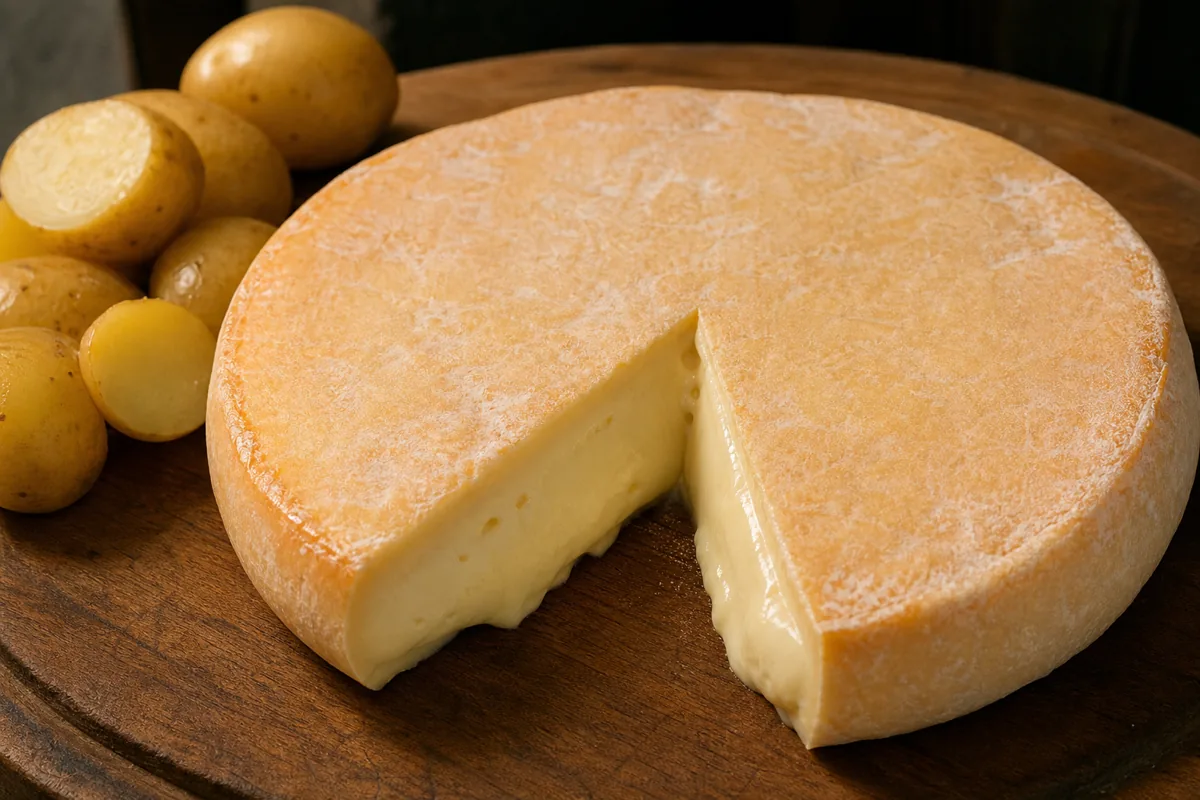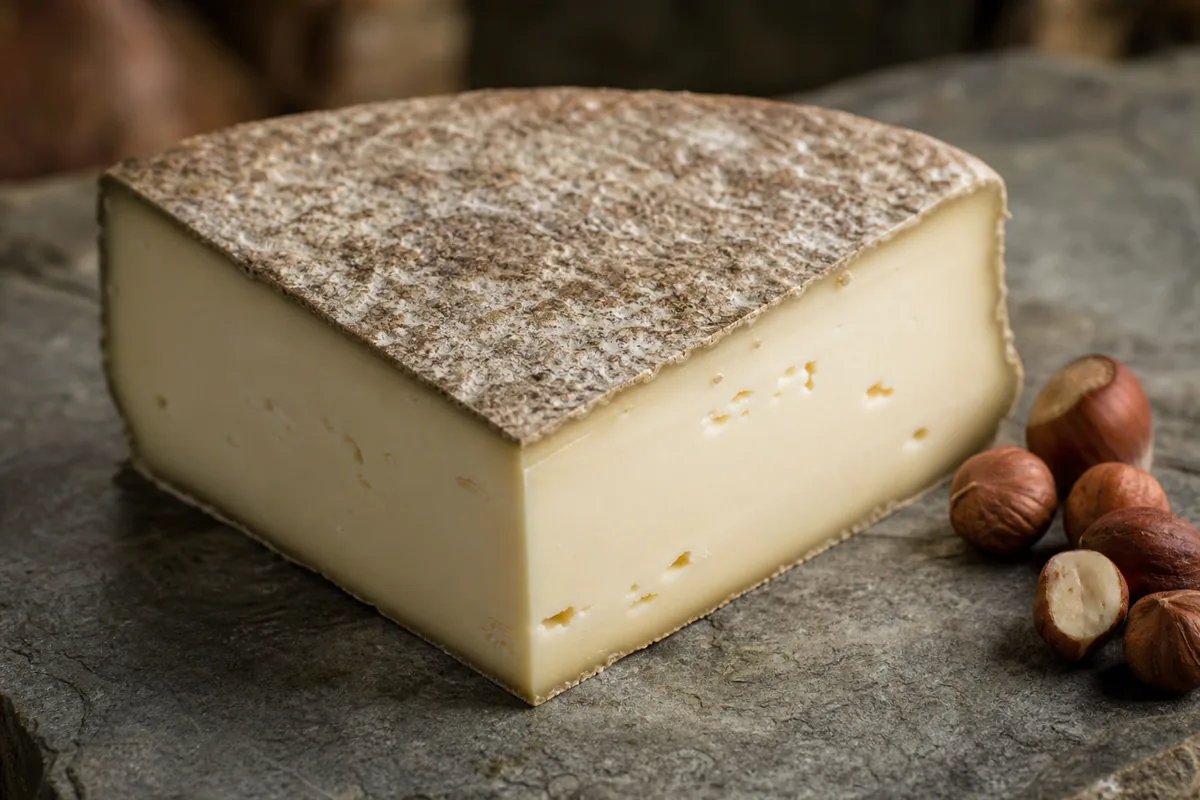
Saint-Nectaire is a pressed, uncooked cow's milk cheese from the Monts Dore in the Massif Central, protected as an appellation of origin since 1955. It is a low round cheese with a rind dotted with white, brown or grey mould and a supple ivory paste that gives under a finger.
Two kinds share the name. An oval green plaque in the rind marks fermier cheese made on the farm from raw milk, and a square plaque marks laitier cheese made in a dairy.
In This Article
What Is Saint-Nectaire?
The EU single document for the appellation defines Saint-Nectaire as a cheese made only from renneted cow's milk, with a semi-hard, pressed, uncooked paste that is fermented and salted. Milk production, cheesemaking and ripening must all happen inside the defined area.
That area covers communes of the Cantal and Puy-de-Dôme departments in central France, and the single document ties milk production and cheesemaking there to the conditions above 700 m. The 2014 INAO specification lists 69 communes, 50 in Puy-de-Dôme and 19 in Cantal.
The single document sets two sizes, and the small one needs less time in the cellar.
Older texts give lower weight ceilings. The 2014 INAO specification caps the standard cheese at 1.85 kg and the small one at 0.65 kg, and CNIEL still lists 1.85 kg and 600 g, while the current single document allows up to 1.95 kg and 0.7 kg.
A cheese of 1.9 kg can therefore be legitimate today, and the 1.7 kg that CNIEL gives is an average, not a limit.
CNIEL also dates the protection to 1996, where the single document says the court of Issoire recognised the appellation in 1955.
What Do Saint-Nectaire Cows Eat?
The single document makes grass the whole basic ration of the dairy cows and requires them to graze for at least 160 days a year. On grazing days it also bans feeding cut green fodder.
Outside the grazing period, dry grass fodder above 80% dry matter must make up at least 60% of the daily basic ration. Across the year, grass from the area must supply at least 70% of the total ration in dry matter, and supplementary feed from a fixed list is capped at 1,800 kg per cow per year.
The document admits that not all feed can come from inside the area, because altitude and climate make it technically impossible to grow enough, and says the limited outside feed has little influence on the cheese's characteristics. It bans transgenic feed and crops on every farm that supplies milk.
It ties the taste to the grass. Permanent grassland, rich in flowering plants such as thyme, yellow gentian, spignel, yarrow and alpine clover, covers at least 90% of a farm's grass area, and the document says the cows take in aromatic compounds such as terpenes from that forage.
The document credits those compounds, together with the maker's skill and the ripening care, for the milky, cellar and nutty notes it lists under taste.
What Is the Difference Between Fermier and Laitier Saint-Nectaire?
Fermier Saint-Nectaire is made on the farm from the raw milk of one herd, straight after milking, twice a day. Laitier Saint-Nectaire is made in one of four dairies from milk collected on farms inside the appellation.
The interprofession says the rules on feeding, rearing and milk production are the same for both, so the two kinds part ways at the vat.
| Attribute | Fermier | Laitier |
|---|---|---|
| Where it is made | On the farm, in the farm's own cheese room | In a dairy, from milk collected on approved farms |
| Milk | Raw and whole, made into cheese as soon as milking ends | Raw or heat-treated under the specification; the interprofession says pasteurised or thermised |
| Milk storage (2014 specification) | None; the milk goes straight to the vat | Chilled tank for up to 48 hours on the farm, or 24 hours if the dairy uses it raw |
| Plaque | Green oval, 45 by 30 mm | Green square, 35 mm a side |
| Rind and taste (interprofession) | Grey or brown rind, sometimes with yellow or orange flecks; delicate and complex | White to orange rind; lactic and buttery, often thought milder |
The plaque is pressed into one face during pressing and carries black marks: the word Saint-Nectaire, the cheese number, the workshop code, and fermier or laitier. The 2014 INAO specification sets the fermier oval at 45 by 30 mm and the laitier square at 35 mm a side.
The workshop code is built from the department number, capital letters for the workshop and letters for the commune where the milk was produced and the cheese made, so a plaque points back to a village. The plaques are made to stay legible until the cheese leaves the ripening cellar.
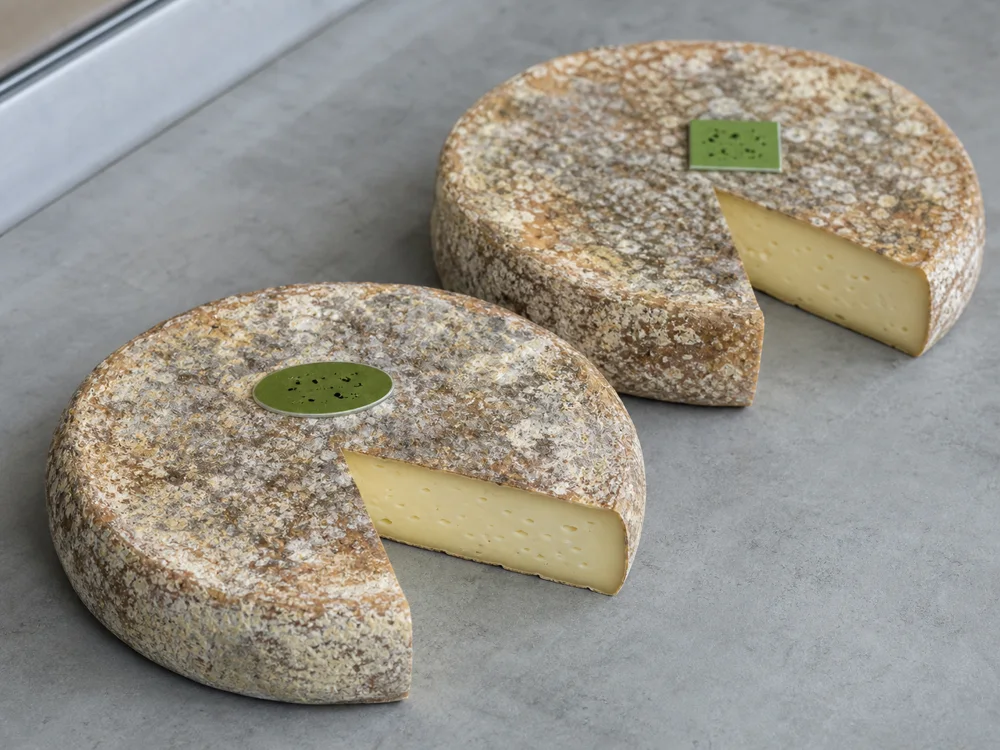
The interprofession's own pages call the laitier plaque square and translucent, while the specification says both plaques are tinted green.
A cut wedge may not show the plaque at all. The interprofession notes that the plaque is not always visible on the surface, but a whole cheese must carry one hidden in its rind, which it calls the surest guarantee of origin.
How Is Saint-Nectaire Made?
Both kinds start with rennet alone, added to the milk at 30 to 33°C, and the curd is pressed but never cooked. The 2014 INAO specification sets farm milk to set for 25 to 50 minutes and dairy milk for 18 to 35 minutes.
Beyond rennet, the specification allows only salt, calcium chloride, bacterial, yeast and mould cultures shown to be harmless and, in dairies, water at the end of delactosing. It bans concentrating the milk by removing water before it sets.
On the farm, the specification describes these steps after the milk sets.
Dairies differ in several steps. The specification lets them draw off some whey and add water at 30 to 33°C, which it forbids on the farm, and cut the curd by machine into grains of 2 to 5 mm.
A dairy cheese is pressed for at least 1 hour, or half an hour for the small size, against at least 10 hours on the farm. It is salted dry or in brine, and the brine must sit at pH 5.00 to 5.20 and 10 to 14°C.
The milk differs too. A dairy may standardise the fat in its milk but not the protein, and may heat-treat it only once, within 24 hours of arrival, with no more than 48 hours between arrival and renneting.
Most farm cheeses are not ripened by their maker. The single document says makers traditionally took them unripened to local markets, where specialist ripeners of Puy-de-Dôme and Cantal bought them and ripened them near the towns that ate them, and that unripened cheeses are now collected at the place of production.
That is why fermier describes where the milk became cheese, while “ripened on the farm” is a separate claim the single document allows on the label.
In the cellar, the specification requires at least two washings with salted or plain water, then rubbing and turning at least once a week, at 6 to 12°C and at least 90% humidity. Ripening boards are washed and dried for each batch, and brushes, cloths and washing solution are cleaned or changed between batches.
The INAO specification also lets unripened cheeses up to 10 days old be frozen between 1 April and 31 July and ripened later. Frozen cheeses made from unpasteurised milk cannot be kept more than 10 months, and all freezing, frozen storage and thawing must happen inside the area.
What Should a Saint-Nectaire Rind Look Like?
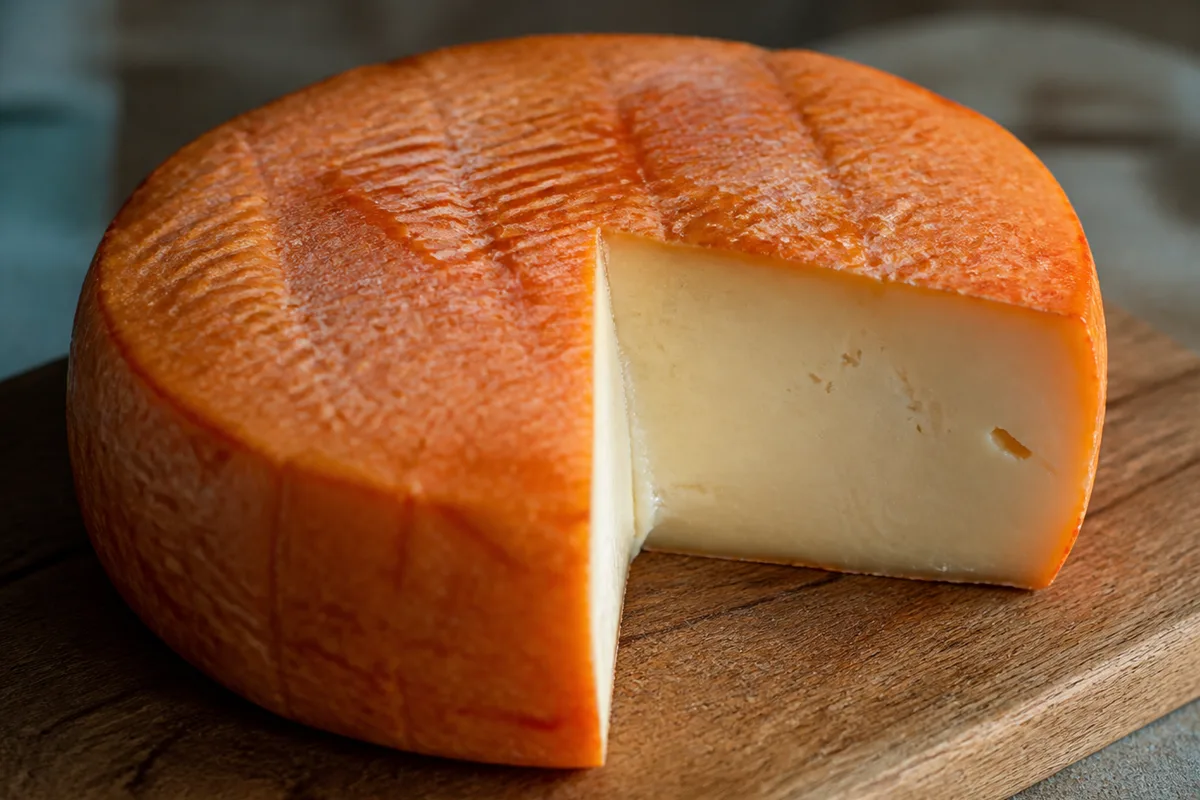
The single document describes a rind that is similar on both faces, dotted with low mould that is white, brown or grey depending on ripeness. A cream to orange background can show through, sometimes with yellow or red flecks.
Cheeses that are uniformly white, orange or black cannot use the name.
The single document says the ripeners' treatment determines how the surface mould develops, from whitish-grey to orangey-brown. The 2014 specification bans any antibacterial or antifungal agent on the cheese that could harm the surface flora, except on the plaque.
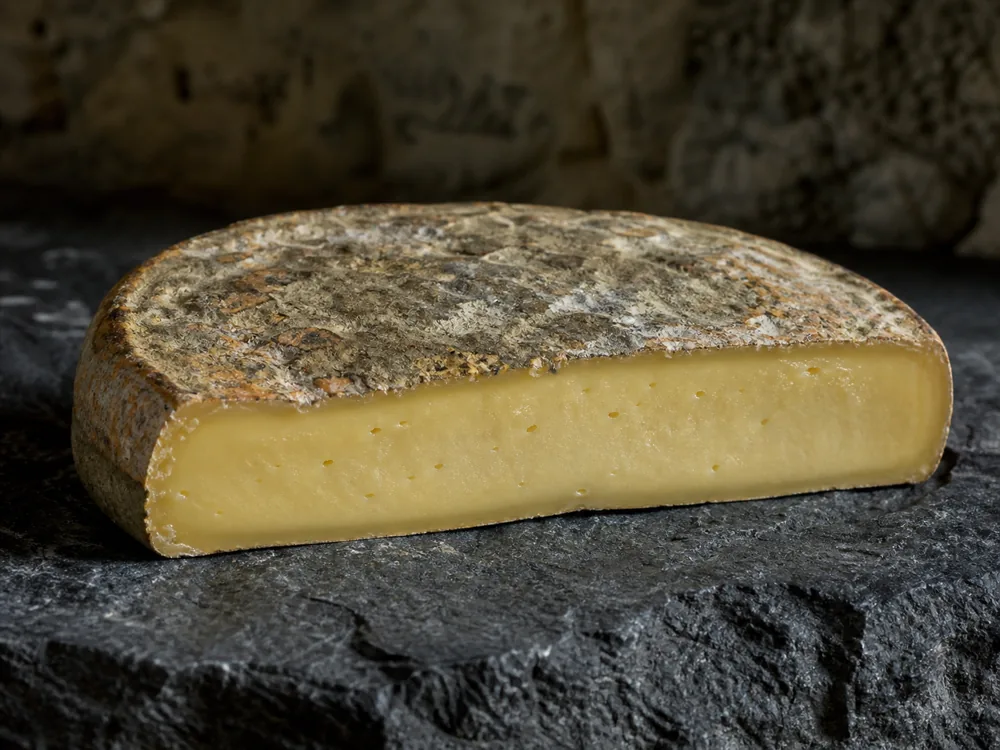
CNIEL, the French dairy council, describes rinds that range from moist pinkish orange to fully grey and downy, and says a speckled, many-coloured surface is best. It adds that a few straws stuck to the rind are common, left from ripening on a bed of rye.
What Does Saint-Nectaire Taste Like?
The single document describes the taste as clean, mild and slightly salty, without too much acidity. It lists milky notes of fresh milk, cream and butter, ripening notes of cellar, straw mats, earth or undergrowth, and often a subtle nuttiness.
CNIEL puts the earth on the rind and the milk in the paste. It describes a smell of damp earth like undergrowth from the rind, set against a paste that smells fresh and milky, and says that contrast balances the two.
| Point | AOP single document | CNIEL | Interprofession |
|---|---|---|---|
| Taste and smell | Clean, mild, slightly salty; fresh milk, cream, butter; cellar, straw, earth | Damp earth and undergrowth from the rind; fresh, milky paste with plant notes and hazelnut | Notes of butter, hazelnut and straw |
| Rind | Low white, brown or grey mould on a cream to orange background | Moist pinkish orange to fully grey and downy | Shades of grey that look like volcanic rock |
| Paste | Ivory, smooth and supple, with a few small holes | Bright cream, supple and unctuous, with a few holes | Cream-coloured, supple and generous |
The three agree on a supple paste and a nutty, milky taste. They differ in what they put first, which is why one page reads clean and mild and another reads earthy.
The interprofession adds that each Saint-Nectaire varies with the season, the farm, the maker's skill and the affineur's care, and that the rind, texture and intensity of a fermier cheese shift with the ripening.
What Should You Check When Buying Saint-Nectaire?
A Saint-Nectaire label must show the name and the EU AOP logo in the same field of view, and state farm or dairy origin in letters at least two-thirds the size of the name.
Other words next to the name are banned, apart from brand names and a short list of approved claims. Those claims are ripened in a natural cellar, on straw, on the farm, or on fir or spruce wood, milk only from Salers or Ferrandaise cows, a farm feed of grazing and hay only, and a ripening time longer than 28 days.
For the cheese itself, the interprofession's buying guide gives four checks.
A genuine label shows the name with the AOP logo, states farm or dairy origin at two-thirds the size of the name and uses only the approved claims. The cheese itself should have a rind similar on both faces, a paste that gives under a finger and a smell of natural cellar.
How Should You Serve Saint-Nectaire?
Take Saint-Nectaire out of the fridge at least 30 minutes before eating, a little longer for a big piece. The interprofession gives that minimum so the cheese can reach room temperature and release its aroma.
The interprofession cuts it like other round cheeses, with a long knife from the centre outwards. That cut gives every wedge both rind and paste.
The rind is completely edible, and the interprofession calls eating it purely a matter of taste. Eating it adds texture and flavour to each bite.
The interprofession puts Saint-Nectaire on cheese platters and serves it in cubes or canapés as an aperitif. It also sets it on country bread under a thin slice of cured country ham, pinned with cherry tomatoes, melon balls or black olives, or threaded on skewers.
What Goes With Saint-Nectaire?
For red wine, the interprofession suggests a Loire or Bordeaux wine. It says Chinon, made from Cabernet Franc, has fruit and fine tannins that charm the cheese without dominating it, and that a balanced Côtes du Rhône works on the same principle.
It keeps Pomerol, mostly Merlot with oak and vanilla notes, for a more aged cheese, because its aromas and tannins match the soft texture.
For white, it suggests Chardonnay, whose pear and citrus notes and subtle salinity it says suit a cheese with fruity, slightly salty flavours. For a light red, it names Chanturgue, which it says will not weigh the cheese down.
In autumn it pairs apples, pears or figs with the cheese, hot or cold. It also recommends redcurrant or blackcurrant jam, saying their slight acidity suits the soft paste.
| Pairing | Type | Why It Works |
|---|---|---|
| Hazelnuts | Food | The interprofession says their delicate taste recalls the soft, creamy paste. |
| Tomato | Food | Its gently acidic taste is liked cold in a salad or hot in a tart, the interprofession says. |
| Summer Fruit | Fruit | Melon, peaches, nectarines and apricots, from the interprofession. |
| Chinese Blue-Green Tea | Drink | Low in bitterness, with chestnut, honey and hazelnut notes that the interprofession says suit the soft paste. |
| Chardonnay | Wine | Pear, citrus and a subtle salinity, per the interprofession. |
| Pomerol | Wine | The interprofession's pick for a more aged, more concentrated cheese. |
How Do You Cook With Saint-Nectaire?
The interprofession serves Saint-Nectaire hot on toast, melted into gratins and in raclette, and calls its fine, unctuous paste easy to work with.
Its potato gratin for six uses 1 kg of thinly sliced potatoes part-cooked for about 10 minutes, 25 cl of seasoned cream and 150 g of Saint-Nectaire in slices on top. It bakes for 5 minutes at 240°C, then 50 minutes at 200°C.
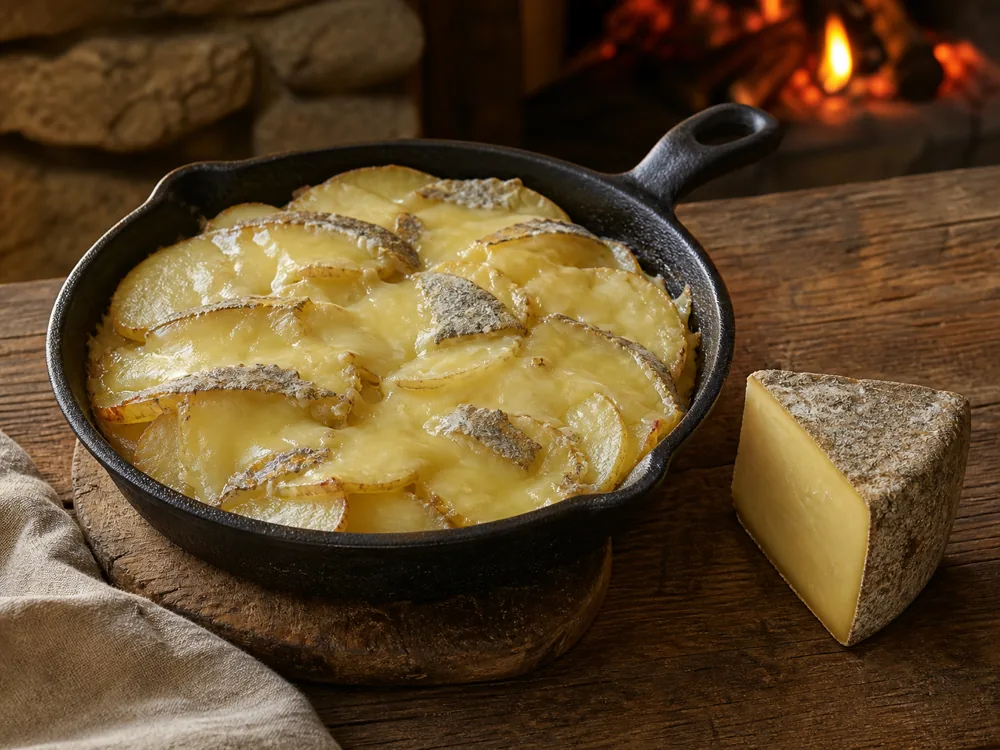
Its truffade for six uses only 100 g of Saint-Nectaire beside 500 g of tomme fraîche, both diced and stirred in to melt. They go into 1.2 kg of potatoes sliced about 3 mm thick, browned in butter and oil for 10 minutes and then cooked on lower heat under a lid in a large pan.
For a raclette for four, the interprofession uses half a Saint-Nectaire, about 700 to 800 g, with 1 kg of potatoes boiled in their skins. It serves them with Auvergne ham and sausage, mushrooms and broccoli.
Its fondue for six bakes a whole cheese with the rind cut from one face for 30 minutes at 180°C in a round ovenproof dish, with 1 kg of firm potatoes and charcuterie to dip. The recipe suggests small Saint-Nectaires for individual portions.
Per person, the recipes work out to about 17 to 25 g of cheese in the gratin, the truffade and the tomato tart, 63 g in the leek tart and 175 to 200 g in the raclette. A recipe that uses it as a topping or seasoning needs a small wedge, while raclette and fondue take a half or whole cheese.
| Use | How It Works |
|---|---|
| Tomato Tart | Puff pastry spread with mustard and breadcrumbs, 100 g of Saint-Nectaire and three tomatoes, baked 30 minutes at 210°C for four (interprofession). |
| Leek and Bacon Tart | Shortcrust pastry, three leeks, 250 g of diced Saint-Nectaire, two eggs, 150 ml of cream and 100 g of bacon, baked 50 minutes at 190°C for four (interprofession). |
| Bacon and Onion Tart | Puff pastry, crème fraîche, raw lardons, chopped onion and thin slices of the cheese, baked half an hour at 200°C (interprofession). |
| More Recipes | The interprofession's recipe list includes brioches, pizza, cordon bleu and Hasselback potatoes. |
Which Cheeses Are Related to Saint-Nectaire?
None of the pages cited here names a direct substitute for Saint-Nectaire. The single document does tie it to one other cheese.
It calls the size modest for a mountain cheese, at most 24 cm across and 5.5 cm high, and says that suited farms with a few cows as well as bigger farms that wanted to add value to a limited winter milk supply. Those farms used their more abundant summer milk for Fourme de Cantal.
How Do You Store and Freeze Saint-Nectaire?
The interprofession recommends storing the cheese in its own wrapping paper at the bottom of the fridge, ideally in the vegetable drawer. The CDC says to keep a refrigerator at 40°F (4°C) or below.
For keeping time, it points first to the label or the seller, and says best-before dates are usually about 45 days in the original paper.
Freezing also works, and the interprofession suggests it when you plan to cook with the cheese soon. Cut it into portions in separate freezer bags and put them in the middle of the freezer, where it says the temperature suits them best.
It thaws them for a few hours in the fridge on a plate lined with paper towel, so the cheese recovers its suppleness and aromas gradually, and it strongly advises against the microwave.
Is Saint-Nectaire Safe During Pregnancy?
Whether Saint-Nectaire is safe during pregnancy depends on the milk. Fermier is always raw milk and laitier can be raw or heat-treated, so check what the label or the seller says.
CNIEL advises pregnant women, children under five and people with weak immune systems not to eat raw-milk cheese, except cooked pressed cheeses. Saint-Nectaire is pressed but uncooked, so that exception does not cover it.
The NHS lists pasteurised semi-hard cheeses such as Edam as safe, says foods made from unpasteurised milk must be thoroughly cooked, and counts any cheese cooked until steaming hot as safe.
The CDC lists unpasteurized (raw) milk and dairy products made from raw milk as riskier and pasteurized soft cheeses heated to an internal temperature of 165°F or until steaming hot as safer. It says pregnant women are 10 times more likely to get a Listeria infection.
Served cold, pasteurized laitier Saint-Nectaire is described as a semi-hard, pressed uncooked cheese, a type the CDC list does not cover, so ask a midwife or doctor.
SOURCES & REFERENCES
What Else Should You Know About Saint-Nectaire?
Both. Saint-Nectaire is one of the communes in the appellation area that the INAO specification lists, and the single document says the cheese's name first appears in gastronomy in the 17th century.
Fermier Saint-Nectaire never is; it is made from raw milk. Laitier Saint-Nectaire may be raw or heat-treated, so the label or the seller has to tell you.
The single document names a breed only in the optional label claims for milk entirely from Salers or Ferrandaise cows. Without such a claim, the label does not tell you the breed.