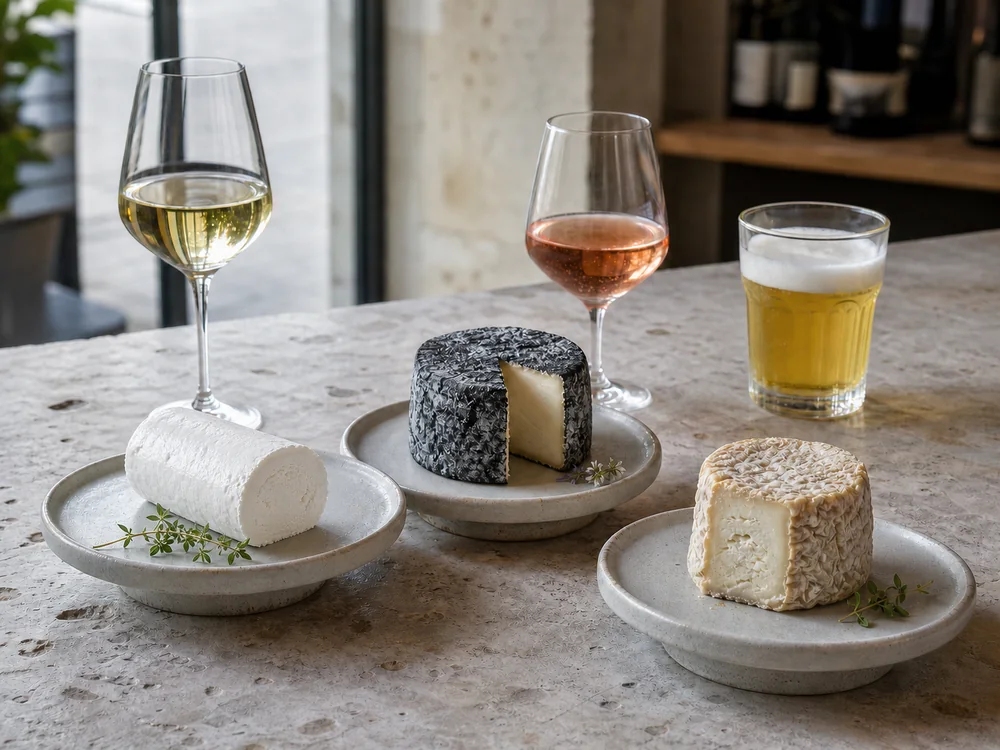
IntoWine's Ben Spencer calls Sancerre Sauvignon Blanc the classic wine pairing for goat cheese, and Vermont Creamery's Allison Hooper says fresh goat cheese and Sancerre both have acidity, so neither overpowers the other.
Most of the wine sources cited below name Sauvignon Blanc for goat cheese styles, and several single out Sancerre.
Advice on wine and cheese pairing shifts with the cheese's age, because the sources that sort goat cheese by style name different bottles for fresh, ash-rind and aged cheese. Beer, gin, honey, figs, beets and marmalade each have a named backer too, covered after the wines.
In This Article
Which Wine Pairs Best with Fresh Goat Cheese?
In IntoWine's 2008 round-up, Ben Spencer, a Wine & Spirit Education Trust diploma student, called Sancerre Sauvignon Blanc the classic wine pairing for goat cheese. He credits Sauvignon Blanc's ability to cut through the richness of the goat's milk.
Allison Hooper of Vermont Creamery tells VinePair that fresh goat cheese and Sancerre both have acidity, so neither overpowers the other.
Lauren Gitlin, an assistant cheesemaker at Twig Farm in Vermont, told VinePair that goat's milk is "higher in acidity and has a trademark goaty-ness," and that both stand out most in fresh cheeses such as supermarket chèvre logs. DeJong Cheese ties the wine choice to that tang, saying the wine's acidity should match or slightly exceed the cheese's tanginess.
Mulan Chan of K&L Wine Merchants recommended a vibrant, crisp Sauvignon Blanc for younger goat cheese in the same round-up. Chan's named bottle was a Sancerre from the commune of Chavignol.
The Loire goat cheese Crottin de Chavignol comes from the village of Chavignol in the Loire Valley, and Wikipedia says the classic dish of baked Crottin on a green salad is said to go well with a Sancerre wine from its home region.
DeJong Cheese lists Sauvignon Blanc, Sancerre, Pouilly-Fumé and Albariño for fresh styles. Vivino calls Sauvignon Blanc a go-to for fresh goat cheese and adds Chenin Blanc, Pinot Grigio and dry Riesling.
For a Sauvignon Blanc from outside Sancerre, Spencer points to a Saint-Bris, which he calls the only Sauvignon made in Burgundy.
What Wines Work Beyond Sauvignon Blanc for Aged Goat Cheese?
Sources that sort goat cheese by age or rind name a different wine for each stage.
| Source | Cheese described | Wines named |
|---|---|---|
| Mulan Chan, IntoWine (2008) | Younger goat cheese | Crisp Sauvignon Blanc such as a Sancerre |
| Mulan Chan, IntoWine (2008) | Aged goat cheese | A Loire Chenin Blanc from Savennières |
| VinePair (2016) | Salad with fresh goat cheese, such as a log | A pale, crisp Provençal-style rosé, such as one from Bandol |
| Allison Hooper, VinePair (2016) | Ash rind that is more complex and aged | Cabernet Franc |
| Caleb Ganzer, VinePair (2016) | Chèvre du Colline, a fairly young Loire ash-rind cheese | Blanc de Blancs Champagne; Sancerre Rouge |
| Lauren Gitlin, VinePair (2016) | Cheese with bright, lemony acidity | A riper, rounder white such as Chenin Blanc or an off-dry Riesling |
| DeJong Cheese | Fresh goat cheese | Light-bodied reds such as Pinot Noir and Beaujolais |
| DeJong Cheese | Goat brie with a white bloomy rind | Chardonnay or white Burgundy |
| DeJong Cheese | Firmer goat cheese | Medium-bodied reds with soft tannins, such as Grenache or young Tempranillo |
| Vivino | Aged goat cheese | Oaky Chardonnay, Cabernet Sauvignon, Merlot |
Red wine appears in five of these rows, and the sources scale its weight to the cheese. DeJong Cheese gives light-bodied Pinot Noir and Beaujolais for fresh goat cheese because their low tannin will not clash with the creamy texture, and soft-tannin Grenache or young Tempranillo for firmer cheese.
Vivino reaches for Merlot and Cabernet Sauvignon only with aged goat cheese, and says the structured Cabernet suits cheese with a strong bite.
Sparkling wine is the other style the sources return to. DeJong Cheese names Blanc de Blancs Champagne for fresh goat cheese, Cava for goat brie and Prosecco for light appetisers, and says the bubbles cleanse the palate between creamy bites.
Laely Heron of Heron Wines steps outside chèvre to Gjetost, a firm, brown Norwegian cheese that Heron describes as sweet like caramel yet savory. Heron tried it with very dry Champagnes and Madeiras, but names Vin Jaune from the Jura, a dry, nutty yellow wine matured under a film of yeast, as the strangest and tastiest match.
For a tasting, Vivino suggests one fresh goat cheese, one aged and perhaps one with herbs or ash, offered with at least one white, one red and one wildcard such as a sparkling wine or rosé.
How Rind and Age Change the Pairing
Beerwulf says goat's cheese ripens very quickly: after a month it tastes like an old cheese made from cow's milk. The wine sources likewise treat fresh and aged goat cheese as different foods.
Crottin de Chavignol shows the whole range in one cheese. Wikipedia describes a young jeune with a solid, compact dough and a white rind, a ripening bleuté with a stronger flavour and a harder rind, and a fully mature affiné with a crumbly dough and a bluish rind mould.
Wikipedia adds that the cheese is marketed and eaten at all three stages, so the name alone does not tell a buyer which one is on the counter.
A cheese sold as Crottin de Chavignol must come from the area around Chavignol and meet the AOC production criteria, and Wikipedia lists a minimum ageing of four weeks. The label therefore settles origin and a minimum age, but not whether the cheese is young or mature.
Vivino pairs Crottin de Chavignol with Sancerre and says the wine's minerality enhances the cheese's earthy depth, especially as the cheese ages and becomes firmer. For aged goat cheeses in general, Mulan Chan chose a Savennières Chenin Blanc, whose steely structure and subtle fruity, earthy notes balance an aged cheese's earthier, more pronounced flavours.
VinePair says the wrinkly, brain-like mould on many goat cheeses is Geotrichum candidum, and that the rind is part of the cheese's flavor profile.
Ash rinds come from the Loire, where VinePair says cheesemakers rolled goat cheeses in ash, often from burned grape vines, to preserve them and improve ripening, and where food-grade ash is used today. It adds that ash-rind goat cheeses can be incredibly complex and often quite tangy.
Allison Hooper ties her red wine to the older version: Cabernet Franc is better with an ash rind that is more complex and aged, and as such a cheese breaks down it gets softer under the rind.
Ash does not always mean an old, tangy cheese. Caleb Ganzer, head sommelier at the Manhattan wine bar Compagnie de Vins Surnaturels, describes Chèvre du Colline as a fairly young Loire ash-rind cheese that is mild rather than tangy, with a creamy texture and a chalkiness.
He pairs it with Blanc de Blancs Champagne, whose lean, chalky quality and bright acidity echo the cheese, and with Sancerre Rouge, a Pinot Noir whose tart dark red and black fruit contrasts with the chalk while its supple texture embraces it.
Where the Sources Disagree on Oak, Acid, and Tannin
The sources disagree on how much oak, acid and tannin goat cheese can take. The matrix sets each source's caution against the cheese it targets.
| Source | Advice | Cheese it targets |
|---|---|---|
| Bartholomew Broadbent, IntoWine (2008) | Choose white wine such as Sauvignon Blanc from the Loire or New Zealand; avoid any wine with excessive oak | Goat cheese in general |
| Michael Cervin, IntoWine (2008) | A partially oaked Chardonnay with some acidic backbone | Goat cheese served with popcorn |
| DeJong Cheese | Avoid heavily tannic wines, which create an astringent sensation against the cheese's acidity | Fresh goat cheese |
| Lauren Gitlin, VinePair (2016) | Avoid intensely acid-driven wines | Cheese with bright, lemony acidity |
| Vivino | Keep the wine light and zippy, nothing too oaky or buttery | Fresh goat cheese |
Sorted by cheese age, the split is smaller than it looks. The cautions cover goat cheese in general or fresh goat cheese, while the table above shows the oaky Chardonnay and Cabernet Sauvignon are named only for aged goat cheese.
Cervin's reasoning for his Chardonnay is that the goat cheese's dryness and the popcorn's salt call for a mildly acidic wine, and he picks a partially oaked bottle that is not a full-blown oak-and-butter style and does not go through a full malolactic fermentation.
Acid is the one point where the advice runs in opposite directions. Hooper and DeJong Cheese want a wine with acidity to match the cheese, while Gitlin, speaking about a young Vermont goat cheese with a floral Geotrichum rind and "bright, lemony acidity," steers away from intensely acid-driven wines and suggests a riper, rounder white.
Gitlin's warning is tied to one very acidic cheese and Hooper's Sancerre advice to fresher styles in general, so the deciding question for a buyer is how sharp the cheese itself tastes.
Broadbent goes further than the matrix. He told IntoWine that he is of the school that red wine does not go well with cheese, other than Port with Stilton.
Does Baked, Herbed, or Honeyed Goat Cheese Need a Different Wine?
DeJong Cheese says preparation changes the wine: fresh goat cheese spread on crusty bread suits lighter wines, while baked goat cheese can handle wines with more body and complexity.
When the cheese carries its own flavouring, DeJong matches the wine to it. Honey-infused goat cheese gets slightly sweet wines such as off-dry Riesling or Gewürztraminer, and truffle-flavoured cheese gets aged white Burgundy or light reds with earthy notes.
| Pairing | Why It Works |
|---|---|
| Black pepper-crusted | DeJong Cheese says a peppery Côtes du Rhône complements goat cheese crusted with black pepper. |
| Herb-coated | DeJong Cheese pairs herb-coated goat cheese with earthy Pinot Noir, and lists Grüner Veltliner or rosé for herb-crusted styles. |
| Herb-infused | DeJong Cheese says Vermentino's herbal undertones complement herb-infused goat cheese. |
| Forest mushroom | DeJong Cheese suggests a light Nebbiolo or aged Rioja for goat cheese with forest mushroom flavours. |
Vivino offers sweetness for aged goat cheese too, a sweet dessert wine for what it calls a salty-sweet combination.
Should You Pair Goat Cheese with Wine from Its Home Region?
VinePair calls Loire Valley wines a no-brainer for goat cheese because pairing by terroir is simple: what goes together, grows together. The Academy of Cheese adds that vineyards in the region raised goats and made cheese as far back as the 16th century.
Vivino repeats the rule with other regions, calling local pairings a safe starting point while encouraging readers to mix across borders. It matches Banon, a creamy goat cheese wrapped in chestnut leaves, with a dry rosé from Provence, saying the wine's red berry notes and herbal undertones echo the wild herbs of the region.
For Garrotxa, a semi-firm aged goat cheese from Catalonia with a delicate mushroomy rind and a mild, milky flavour, Vivino suggests a dry Cava, whose bubbles cleanse the palate while its brioche and green apple notes suit the cheese's gentle complexity.
Fresh Caprino from Tuscany goes with Vermentino, which Vivino describes as citrusy and floral with a hint of salinity. Vivino also pairs California goat cheeses with a cool-climate Sauvignon Blanc from Sonoma or Mendocino.
IntoWine's Mulan Chan likewise says California makes some phenomenal young goat cheeses that suit a crisp Sauvignon Blanc.
Do Beer, Gin, and Cider Work with Goat Cheese?
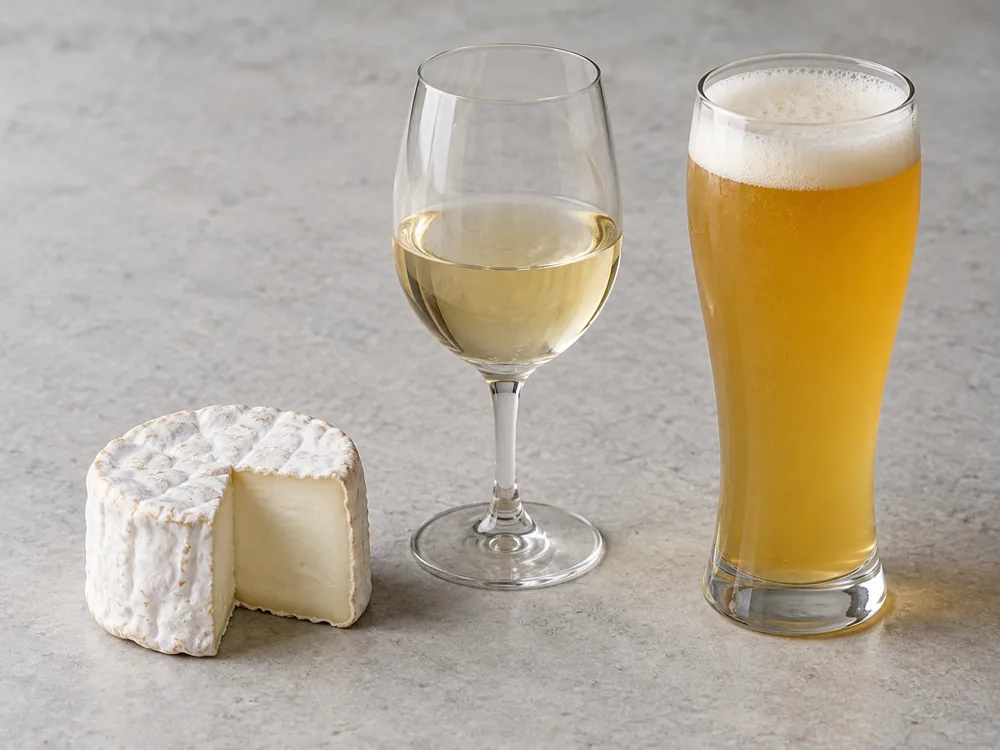
Beerwulf calls goat's cheese intense, powerful and creamy, and says its slightly sharp, tangy character suits softer, sweeter or sour beers such as saisons, blond ales and tripels.
Beerwulf explains the mechanism: the carbon dioxide in beer rinses the greasy film that cheese leaves on the mouth and tongue, and the alcohol cuts through the cheese fat, so each sip resets the palate for the next bite.
| Pairing | Type | Why It Works |
|---|---|---|
| Saison | Beer | Beerwulf says soft, creamy goat's cheese can be spread finely on a piece of toast and combined with a saison. |
| Gin | Drink | Ecole du Fromage lists Sancerre, wheat beer, gin and elderflower for Crottin de Chavignol. |
| Cider | Cider | VinePair suggests a fresh Vermont cider such as Shacksbury's with high-acid cheese, and sweet ice ciders alongside chalky, aged goat cheese. |
| Blended Scotch | Spirit | VinePair's writer paired Vermont Creamery's Bijou, a Crottin-style cheese, with Black Grouse blended Scotch, which is not too peaty but smoky enough for the cheese's chalky texture and nutty rind. |
VinePair also names Belgian-style beers, especially wild-fermented lambic, for tart and chalky goat cheese, and Beerwulf adds tripel, porter, geuze and Brettanomyces beers such as Orval.
Beerwulf attaches beers to dishes: a goat's cheese quiche with Bullebak, a quiet tripel low in carbon dioxide, and dates stuffed with soft goat's cheese with Texels Wit, or with St. Feuillien Grand Cru once the dates are wrapped in bacon.
Are Honey, Figs, Beets, and Walnuts Good Pairings for Goat Cheese?
Sidonie Maroon, a culinary educator at The Food Co-op, sorts her goat cheese partners into a sweet list and a savory list.
- Sweet: honey, figs, cherries, pears, persimmons
- Savory: beets, almonds, walnuts, olives, chives, fennel, thyme
Maroon pairs firm goat cheese such as goat Gouda or Tomme de Chèvre with fresh fruit and keeps soft, spreadable chèvre for salads or crackers. She also suggests serving dried and fresh fruit at the same meal.
Her extra ideas lean on acid and zest: lemon, orange, balsamic vinegar and sherry vinegar.
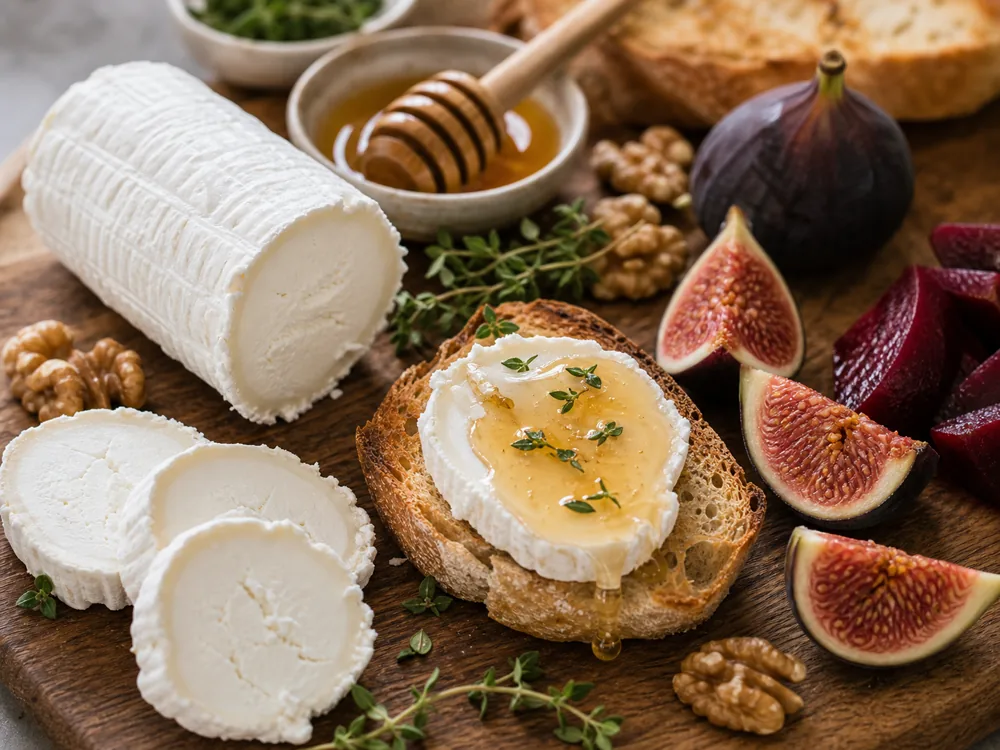
Beerwulf suggests dipping pieces of hard goat's cheese in honey or beer syrup.
In IntoWine's round-up, winemaker Loren Sonkin matched a roasted beet salad with goat cheese croutons to a German Riesling Spätlese, writing that the wine's sweetness balances the goat cheese well. He adds that the acidity suits the beets and that the lower alcohol works well early in a meal.
VinePair suggests a mesclun salad with fresh chèvre, dried cranberries, toasted almonds and balsamic vinegar.
Why Does the Academy of Cheese Serve Crottin with Clementine Marmalade?
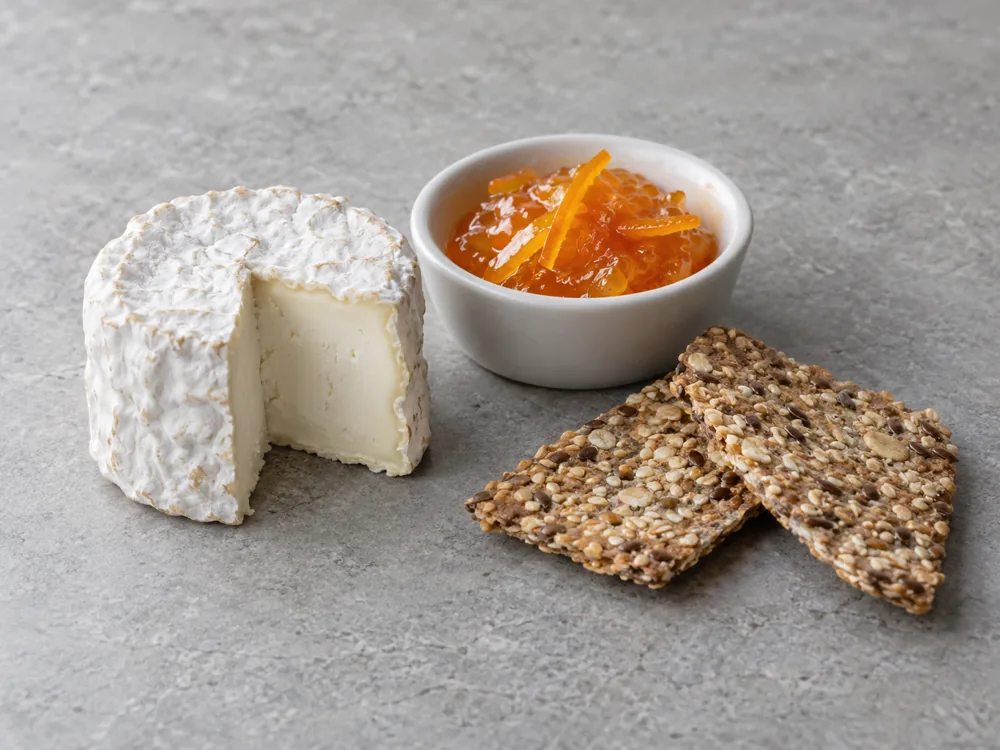
The Academy of Cheese pairs its bloomy white Crottin de Chavignol with a dollop of clementine marmalade served with crunchy crispbreads. It describes the cheese as a lactic goat cheese from the Loire Valley, set over several hours mainly by acidification of the milk with a small quantity of rennet.
Wikipedia adds that Crottin de Chavignol, though commonly served as a baked starter, is also often found cold on cheese boards.
How Should You Serve Goat Cheese?
Wisconsin Cheese puts room temperature for most cheese at 67 to 70°F and advises about 30 minutes out of the refrigerator. It notes that soft cheeses warm up faster than hard ones.
DeJong Cheese sets the serving temperature by goat cheese style, for the cheese and for the wine.
| Goat cheese style | Cheese | Wine |
|---|---|---|
| Fresh or spreadable | Room temperature | Chilled |
| Ripened or brie-style | Slightly cool | Well chilled |
| Aged or firm | Room temperature | Room temperature |
| Herb-crusted | Cool | Chilled |
VinePair's rule is simpler, saying all artisanal cheese should be served at room temperature to get the most flavor. DeJong keeps that for fresh and aged cheese and cools ripened and herb-crusted ones slightly.
DeJong puts well-chilled sparkling wine at 6 to 8°C (about 43 to 46°F) to preserve its bubbles.
Wisconsin Cheese's advice for storing soft and fresh cheeses is clean airtight containers, and it names the produce drawer as a good spot because its higher humidity keeps cheese moist and separates it from foods that could pass on unwanted flavors.
SOURCES & REFERENCES
What Else Do People Ask About Goat Cheese Pairing?
Most sources name Sauvignon Blanc for fresh goat cheese, and IntoWine's Ben Spencer calls Sancerre the classic match. For aged goat cheese, Mulan Chan suggested a Chenin Blanc from Savennières in the Loire.
The sources that name a red scale it to the cheese: DeJong Cheese gives light Pinot Noir or Beaujolais for fresh goat cheese and Grenache or young Tempranillo for firmer cheese, Allison Hooper picks Cabernet Franc for an aged ash rind, and Vivino names Merlot and Cabernet Sauvignon for aged cheese. Bartholomew Broadbent prefers white wine with chèvre.
Beerwulf names saison, blond ale and tripel and adds porter, geuze and Brettanomyces beers, VinePair names lambic, and Ecole du Fromage lists wheat beer for Crottin de Chavignol.
The Food Co-op's Sidonie Maroon lists figs, cherries, pears and persimmons, and the Academy of Cheese pairs Crottin de Chavignol with clementine marmalade.
The Food Co-op lists pancetta among its savory partners for goat cheese, and Beerwulf wraps dates stuffed with soft goat's cheese in bacon and serves them with St. Feuillien Grand Cru.