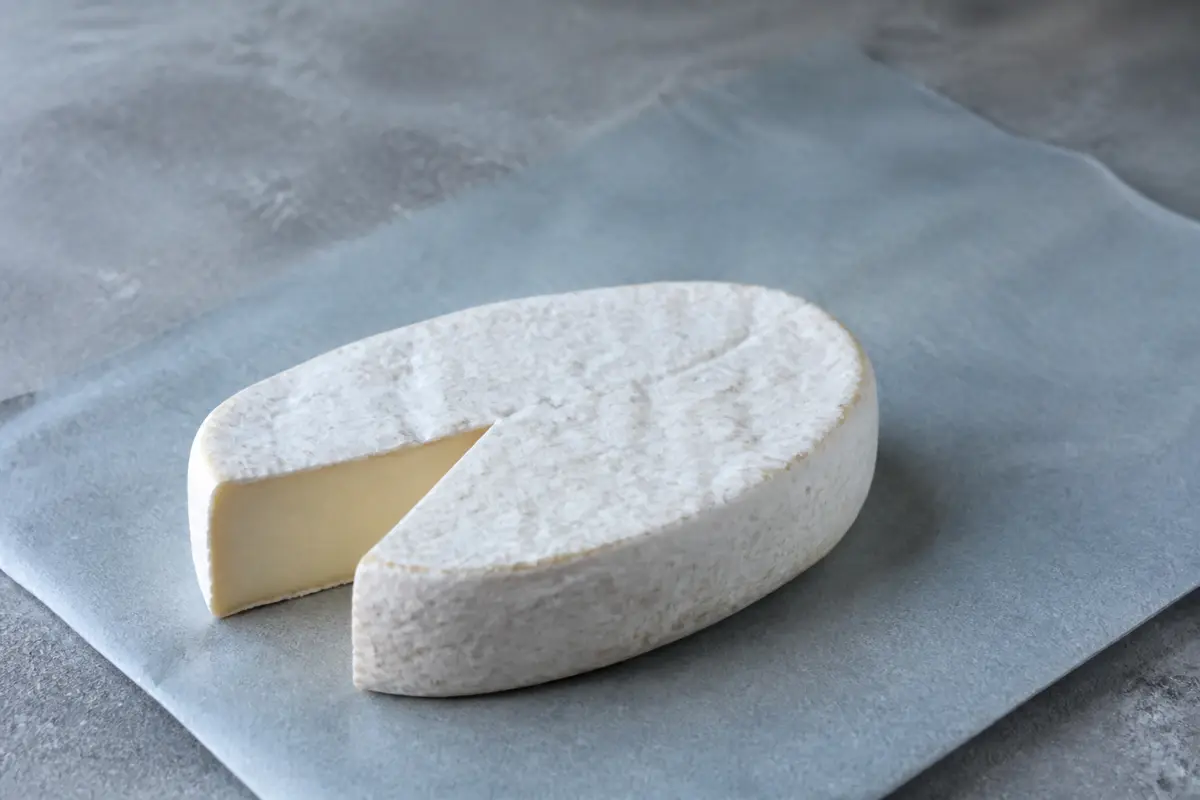
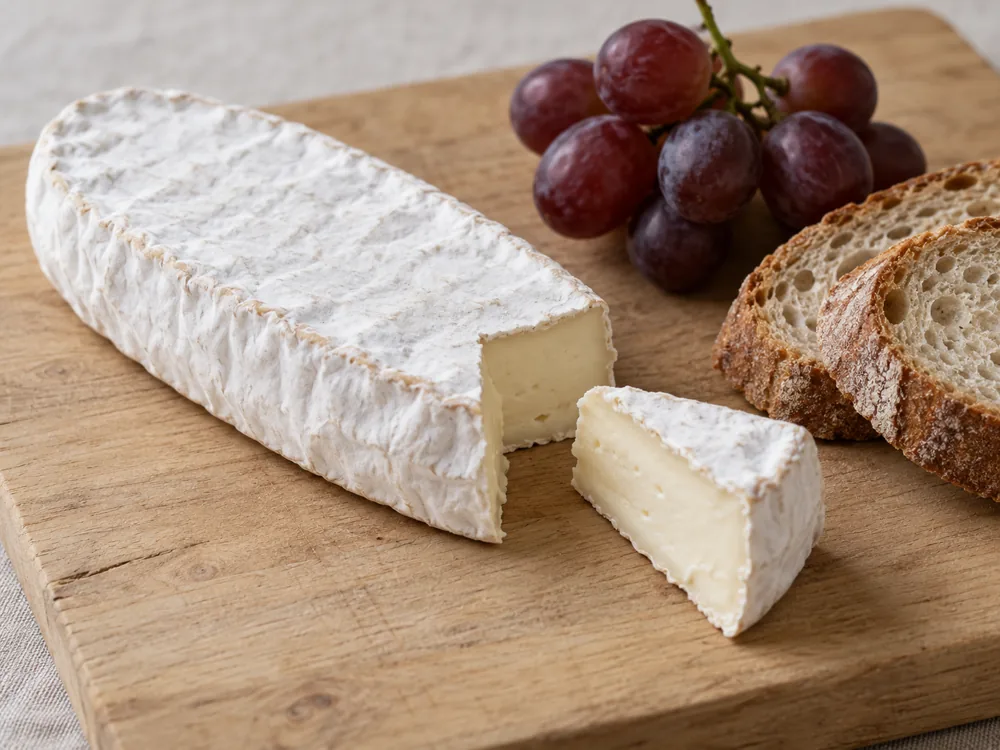
Caprice des Dieux is a branded French soft cheese with a thin white bloomy rind, made from pasteurized cow's milk and cream and shaped as an oval. Savencia, which owns the brand, says the first box was sold on 21 June 1956.
The two questions in the title have short answers. The sources give a dairy timeline of 11 days to about three weeks and say nothing about ripening after packing, and a retailer's product text calls the rind edible.
In This Article
What Is Caprice des Dieux Cheese?
Jean-Noël Bongrain created Caprice des Dieux in 1956 at the family dairy in the village of Illoud, in the Haute-Marne, after five years of research, according to The Cheese Lover, the brand's UK website. Savencia says the recipe, the oval shape, the blue box and the name set it apart from other cheeses of the time.
The Cheese Lover calls the oval shape and the blue color a nod to the round and square cheese boxes of the time.
Fromagère.fr files it as a brand cheese (fromage de marque), and French Wikipedia lists its appellation as none because the name is a commercial trademark, so no protected designation such as PDO applies. Cniel and French Wikipedia both give the milk as pasteurized cow's milk.
Fromagère.fr places it in the accessible premium segment, calls it one of the first industrial cheeses with a strong marketing identity and says it is still a best-seller among premium industrial soft cheeses.
The Cheese Lover says it reached supermarket cheese counters from 1959, then crossed to Belgium, Switzerland and Canada, and had sold a billion cheeses by 1984.
How Is Caprice des Dieux Made?
Savencia gives the recipe as 98% milk, cream, a pinch of salt and lactic ferments.
It adds that the cows are at pasture most of the year and that two thirds of the fresh milk is collected within 70 km of its two cheese plants.
French Wikipedia says the chilled raw milk is bought and collected every two days, and The Cheese Lover says it is collected the day before the cheese is made and pasteurized and homogenized when it arrives. Fromagère.fr answers the raw-milk question directly: the cheese is made from pasteurized milk.
The Cheese Lover says Caprice des Dieux has been produced only in Illoud since 1956, Savencia's page speaks of two cheese plants, and French Wikipedia describes one Savencia plant supplied by farms in three regions, Haute-Marne, the Mâconnais and Anjou.
The Open Food Facts record for the 200 g oval ties its traceability code, FR 52.247.001 CE, to Illoud, so Illoud is the one origin the sources support for the oval on that record. Cniel places it in Champagne, at Illoud-en-Bassigny, and says the cheese is made in the Haute-Marne.
The cheesemaking process takes 11 to 13 days until packing, according to The Cheese Lover. Fromagère.fr names Penicillium camemberti as the mold behind the white rind and sums up the steps as coagulation, molding, draining, seeding the rind and a short ripening.
The three ingredient lists below name the same four things, milk, cream, salt and lactic ferments, and differ only in how much they say about the milk. None of them says how much cream there is.
| Source | Ingredients listed |
|---|---|
| Savencia brand page | Milk, cream, a pinch of salt, lactic ferments |
| Open Food Facts, 200 g record | Cow's milk, cream, salt, lactic ferments (milk) |
| EuropaFoodXB, 125 g | Pasteurized cow's milk and cream of France, salt, lactic ferments |
Why Is Caprice des Dieux So Soft and Creamy?
Cniel describes a paste enriched with cream, very soft and very mild, and French Wikipedia likewise says the cheese is made from milk enriched with cream.
For the soft bloomy-rind family, Fromagère.fr describes a soft curd that is molded gently to keep the paste supple and drained slowly to keep it creamy. It adds that the industrial process of this cheese assures regularity and a melting texture.
As the rind blooms in tempered, humid cellars, Fromagère.fr says, the paste softens from the edge toward the heart.
That order of softening is consistent with the fresh, melting heart The Cheese Lover describes for the 200 g oval, since the center is the last part reached.
The Cheese Lover also credits the ferments, which it says are cultivated at its cheese factory, with the cheese's texture and taste.
When Is Caprice des Dieux Ripe?
The two timelines count different things. The Cheese Lover gives 11 to 13 days of cheesemaking until packing, while Fromagère.fr gives about 2 to 3 weeks as the average ripening time.
The date and storage line on your own pack are the guide to when to eat it.
For the soft bloomy-rind family, Fromagère.fr contrasts a young cheese that is firm and milky with a more ripened one that is runny with mushroom notes. Cniel's fresh-milk scent and very slight mushroom taste sit nearer the milky end of that scale.
Can You Eat the White Rind?
Yes, according to the product text from the retailer EuropaFoodXB, which calls the 125 g oval's rind soft and edible.
Cniel, the French dairy trade body, describes the rind as very downy, white and regular, covering a shiny, smooth, cream-colored paste. It gives the taste as very mild with a very slight mushroom note at the surface.
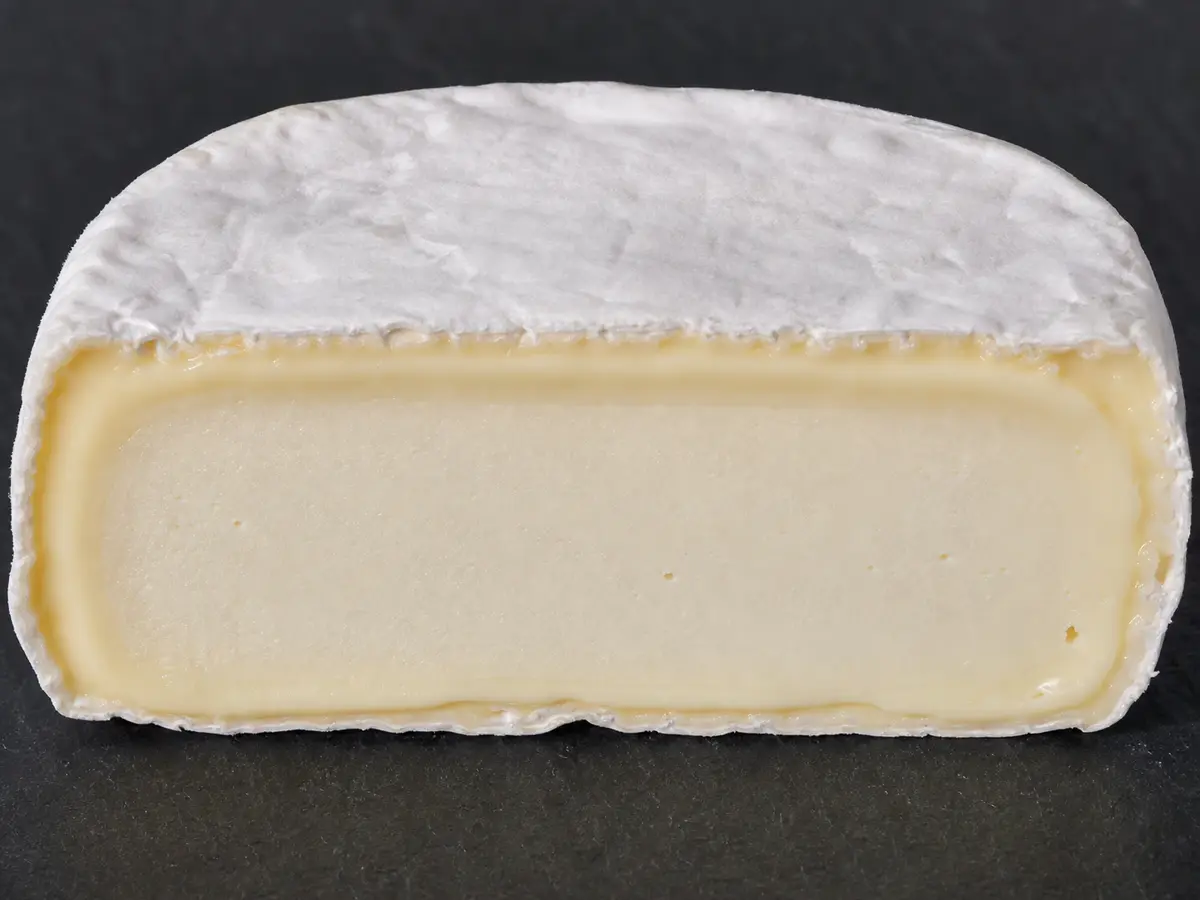
That mushroom note is the only rind flavor any source describes, and none of them tells you to peel the oval. Pregnancy is a separate question, covered below.
What Does Caprice des Dieux Taste Like?
Every source places Caprice des Dieux at the mild, creamy end of French cheese. The disagreement is how much butter or tang to expect.
Butter and tang each come from one retailer listing, so treat them as single-source impressions. The shared words are cream, fresh milk and a light mushroom edge, and on smell Cniel's delicate fresh-milk scent and Fromagère.fr's discreet odor agree.
How Should You Serve Caprice des Dieux and What Goes With It?
Fromagère.fr's serving advice is to take Caprice des Dieux out of the refrigerator 1 hour before eating and to cut regular slices.
It says the cheese is eaten mostly raw, on a cheese board or in a gourmet sandwich, and it also lists hot recipes. Savencia suggests its En Cas de Caprice slices for a small snack, with pre-dinner drinks or in a salad.
| Use | How It Works |
|---|---|
| Puff pastry | Fromagère.fr's first recipe suggestion is a Caprice des Dieux feuilleté. |
| Breaded | Fromagère.fr also suggests a breaded Caprice des Dieux. |
| Potato croquettes | The third Fromagère.fr recipe puts the cheese inside potato croquettes. |
By their names, the three hot recipes put the cheese inside pastry, breadcrumbs or potato.
For drinks, Fromagère.fr names a dry white such as Chardonnay, a light red and a light blonde beer. EuropaFoodXB's listing, which is a retailer's cross-sell rather than a tasting note, shows a red wine and quince paste under its "Best pairs with" heading.
| Pairing | Type | Why It Works |
|---|---|---|
| Dry white wine | Wine | Fromagère.fr names a dry white such as Chardonnay. |
| Light red wine | Wine | Fromagère.fr's red wine suggestion. |
| Light blonde beer | Drink | Fromagère.fr's beer suggestion. |
| Country bread and grapes | Food | Fromagère.fr's accompaniments. |
| Quince paste | Food | Listed under EuropaFoodXB's Best pairs with products. |
What Sizes Does Caprice des Dieux Come In?
The brand's range page lists the oval in 125 g, 200 g and 300 g formats, and Cniel gives 200 to 310 g. Cniel puts the 200 g oval at 14 cm long, 6 cm wide and 3.5 cm thick.
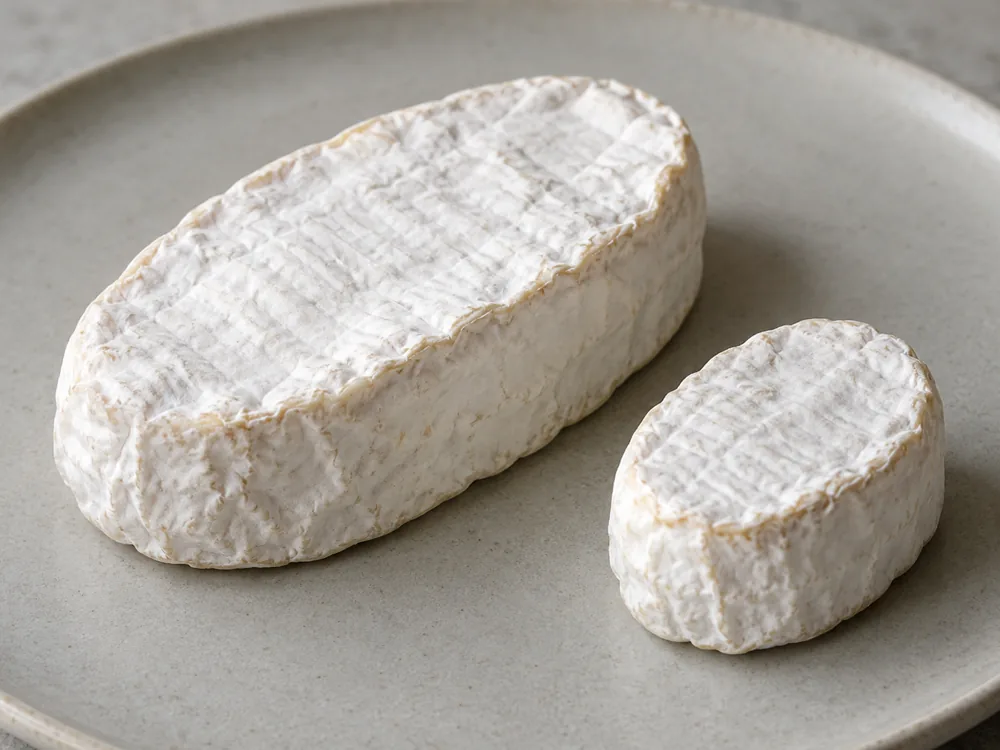
Savencia sells more than the oval, so check the exact name on the label. Mini Caprice measures 6.5 by 4 by 3 cm according to Cniel, a little under half the length of the 200 g oval.
Cniel says the downy white rind covers the oval's variants as well, the 50 g Mini and the 15 g slices of En Cas de Caprice. It does not list Caprice des Anges, which the brand's range page calls a fresh cheese (fromage frais), finely salted.
Is Caprice des Dieux the Same as Brie?
No. Fromagère.fr puts it in the same bloomy-rind family as traditional Brie but says it has its own recipe, and that it was designed to be smaller, softer and more modern than a traditional Brie.
French Wikipedia puts it at 60% fat in dry matter, against 45% for a Camembert de Normandie.
French Wikipedia gives 60% as fat in dry matter. Cniel lists 30%, and the Open Food Facts label record gives 30 g of fat per 100 g of cheese, which matches a French Wikipedia footnote saying current labelling gives fat on the actual cheese rather than on dry matter.
By our arithmetic, if both figures describe the same cheese, 30 g of fat being 60% of the dry matter puts dry matter at about 50 g per 100 g, which would leave roughly half the cheese as water.
What Can Replace Caprice des Dieux?
Fromagère.fr lists Brie de Meaux, Coulommiers and Chaource as similar cheeses, in that order, without saying what the list matches on.
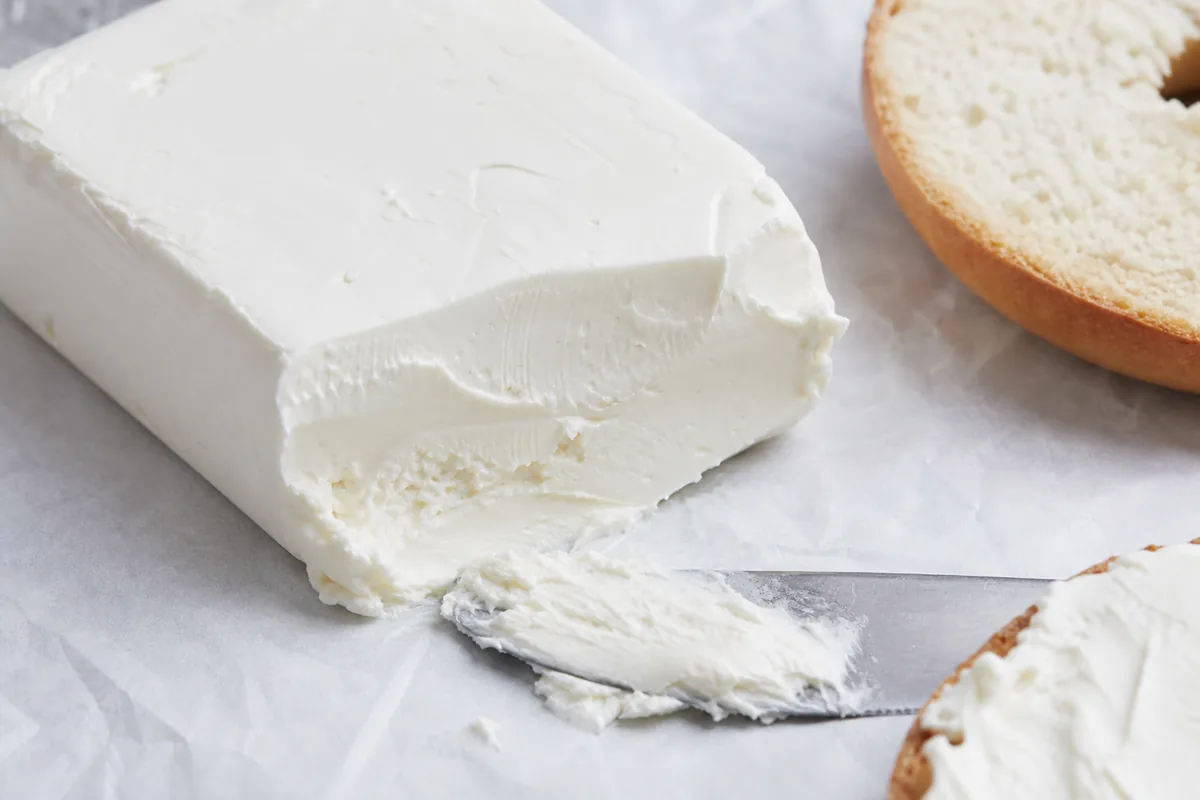
French Wikipedia draws a different comparison: it says 60% fat in dry matter is equivalent to St Môret and to the North American cream cheeses such as Philadelphia.
The two sources point to different replacements, so the choice depends on whether the rind or the richness is what you are replacing.
Is Caprice des Dieux Safe in Pregnancy?
The sources describe pasteurized milk, but the NHS wording does not turn on pasteurization for this style. It says pasteurised or unpasteurised mould-ripened soft cheeses with a white coating on the outside, such as brie, camembert and chèvre, must be thoroughly cooked.
The CDC, which says pregnant women are 10 times more likely to get a Listeria infection, lists soft cheese made from unpasteurized milk as riskier. Served hot, a pasteurized soft cheese such as this one moves to the CDC's safer list once it reaches an internal temperature of 165°F or is steaming hot.
Eaten cold during pregnancy, a pasteurized soft cheese with a white coating is a type the CDC list does not cover, so ask a midwife or doctor about Caprice des Dieux.
What Does the Nutrition Label Say?
The Open Food Facts record for the 200 g oval gives 333 kcal, 30 g fat, 21 g saturated fat, 15 g protein, 1.4 g salt and 350 mg calcium per 100 g, with a 25 g serving size and a Nutri-Score of D. The 25 g column below is our arithmetic from those figures.
| Nutrient | Per 100 g (label) | Per 25 g (calculated) |
|---|---|---|
| Energy | 333 kcal | 83 kcal |
| Fat | 30 g | 7.5 g |
| Saturated fat | 21 g | 5.25 g |
| Protein | 15 g | 3.75 g |
| Salt | 1.4 g | 0.35 g |
| Calcium | 350 mg | 88 mg |
Saturated fat makes up 21 g of the 30 g of fat per 100 g, which is 70% of the fat.
At 25 g a serving, a 125 g oval is five servings and a 200 g oval is eight servings, and a whole 200 g oval holds about 666 kcal.
Open Food Facts compares the record with the average of the products it files as double cream cheeses. Fat (30 g against 30.8 g) and saturated fat (21 g against 20.7 g) sit within about 3% of that average, while protein is 24% higher (15 g against 12.1 g) and salt 11% higher (1.4 g against 1.26 g).
The record also carries a no-lactose label and lists milk as the allergen, so the label addresses lactose but not a milk allergy. It lists 0.8 g of carbohydrate and 0.1 g of sugars per 100 g.
SOURCES & REFERENCES
What Else Do People Ask About Caprice des Dieux?
Open Food Facts' ingredient analysis finds no non-vegetarian ingredient among the four listed (milk, cream, salt and lactic ferments), and it says the analysis ignores processing methods, so ask the maker which coagulant it uses if you avoid animal rennet.
The Cheese Lover translates it literally as "Whim of the Gods". French Wikipedia adds that the European Parliament building in Brussels earned the nickname Caprice des Dieux because its form resembles the cheese's box.