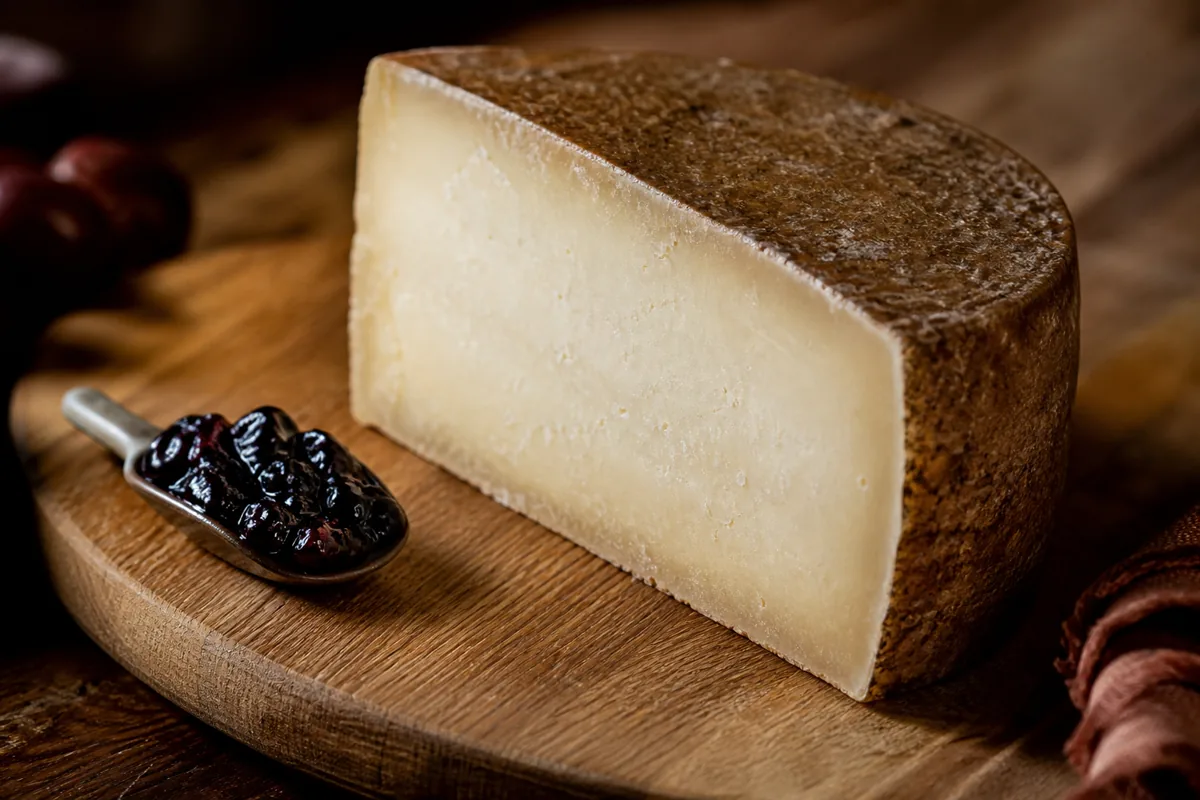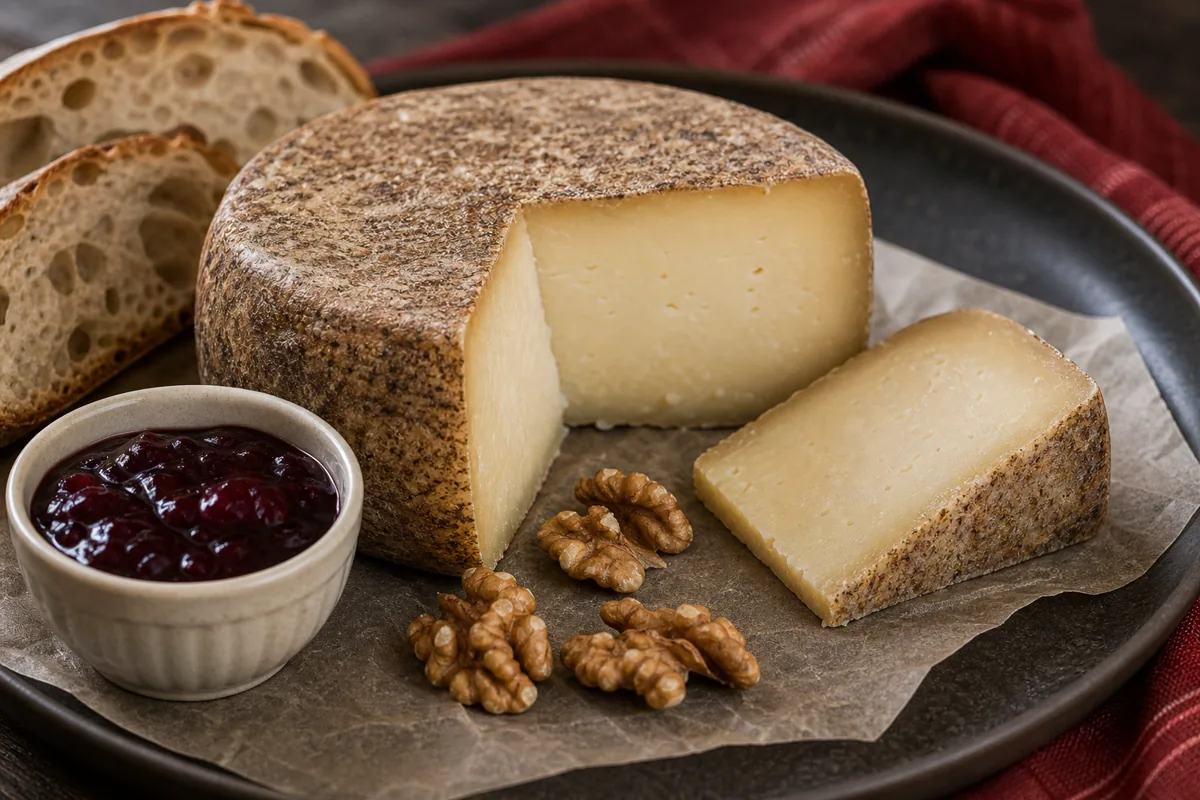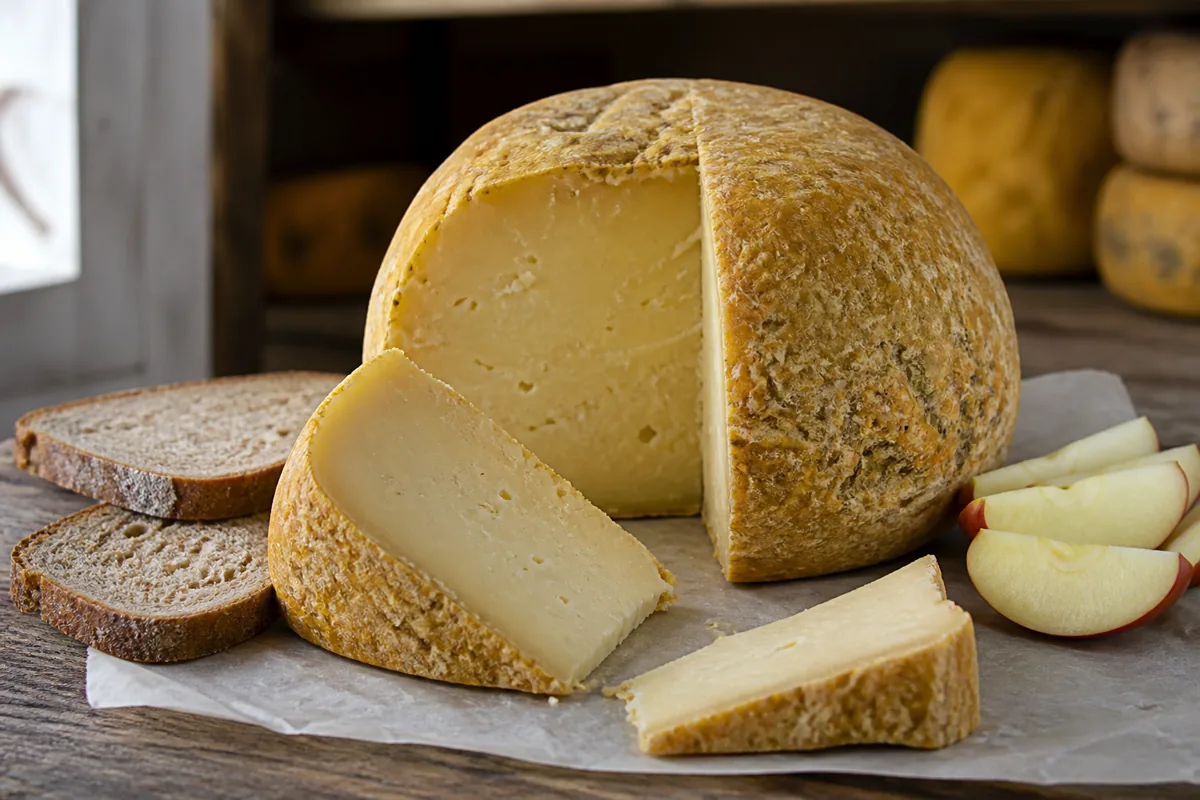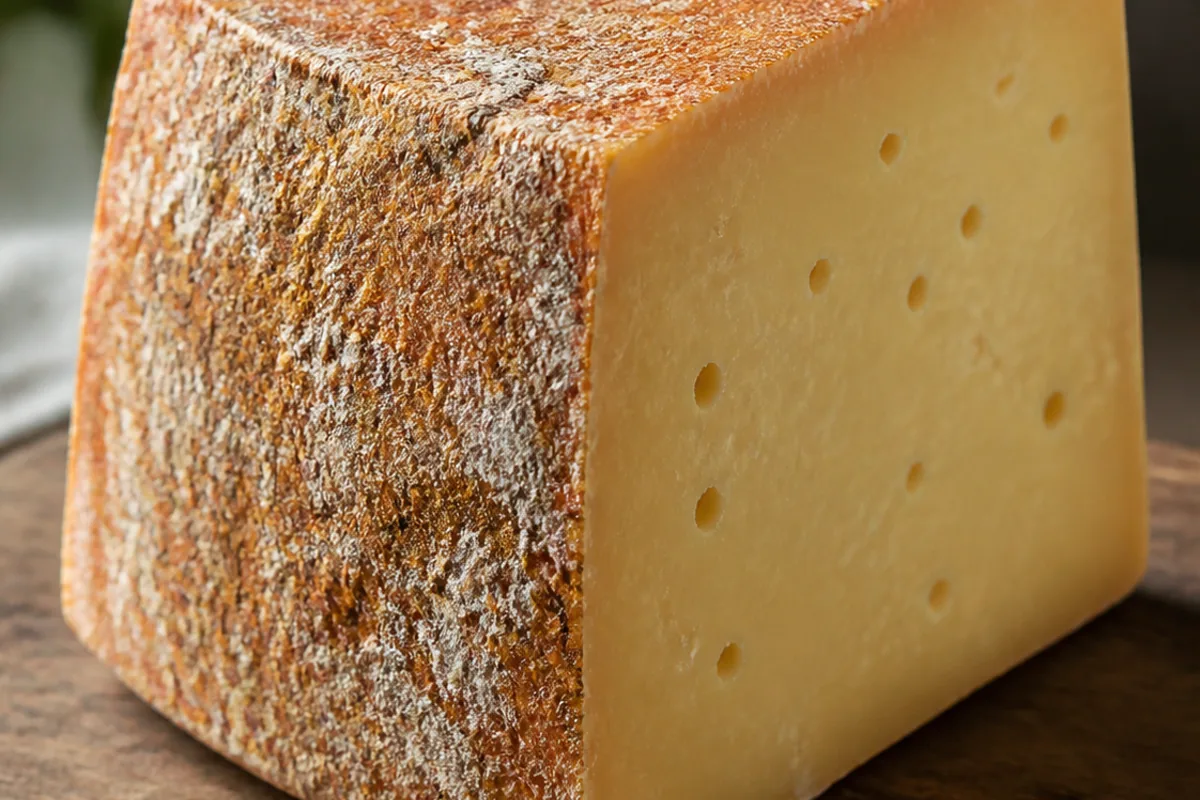
Etorki is a pasteurized sheep's milk cheese made in Mauléon-Licharre, in the French Basque Country, and its Basque name means "origin". Savencia, the group that owns it, describes a paste that is firm to the touch but tender in the mouth, with a mild hazelnut flavor.
Unlike Ossau-Iraty, the sheep cheese from the same region, Etorki is a brand with no protected name. Sources also disagree on its ageing, from about seven weeks to six months.
In This Article
What Etorki Tastes Like
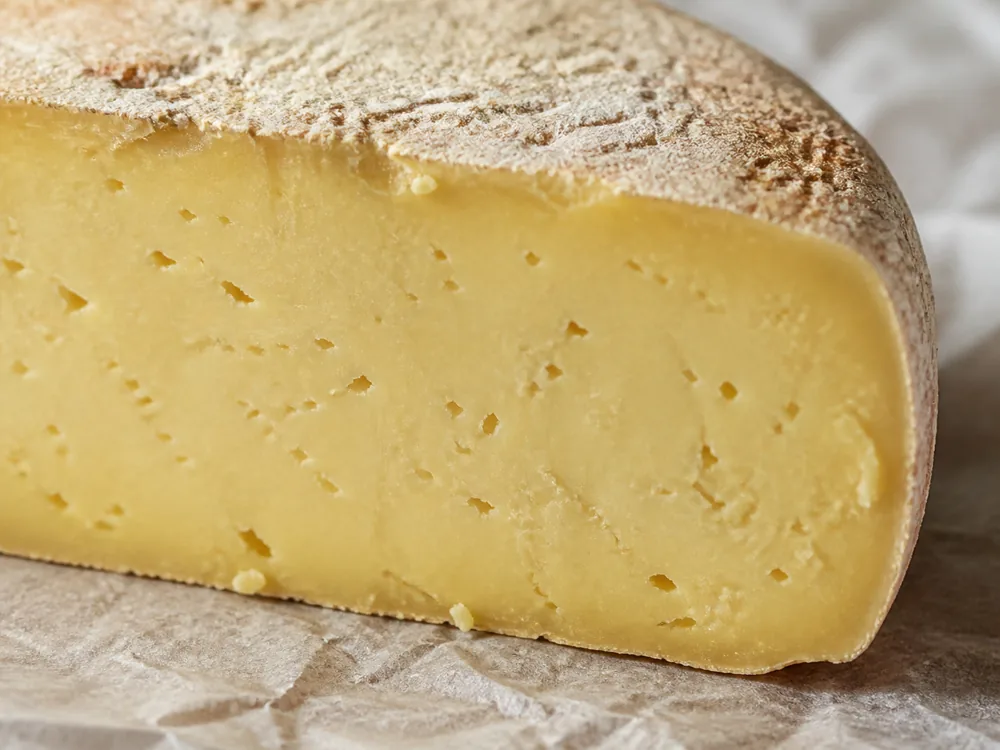
Culture describes the flavor as rich and sweet, with hazelnut and caramel notes, and the paste as smooth, supple and velvety with occasional holes. Savencia's French page gives the same picture: a sweet, mild hazelnut flavor with subtle sugary notes.
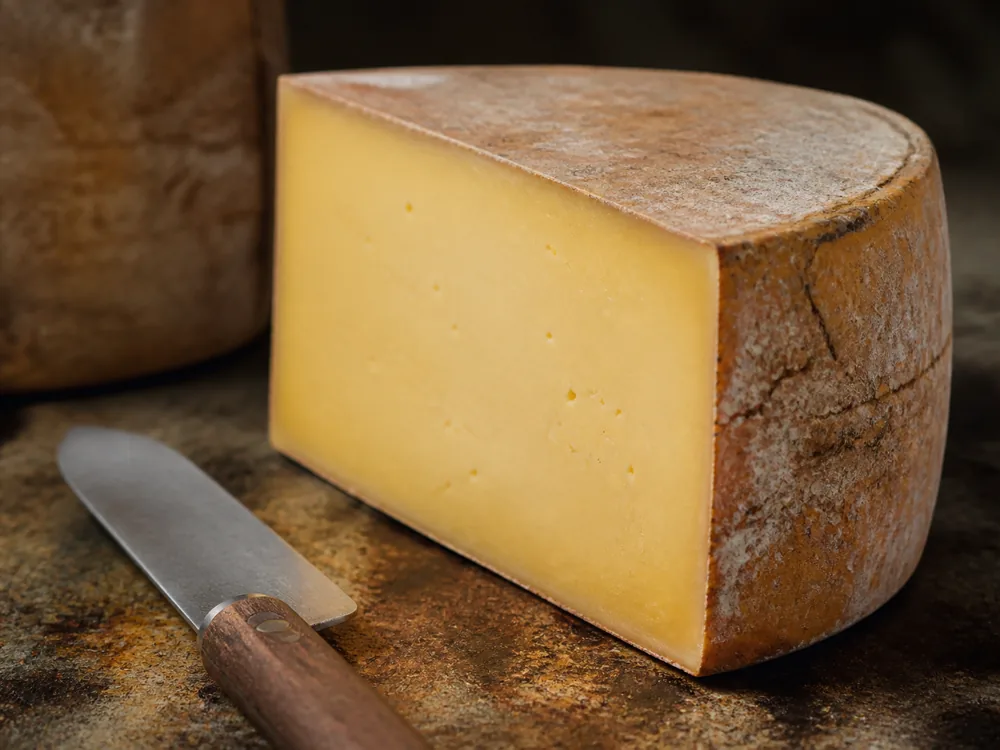
Taste With The Eyes calls it a cheese with a "smooth, velvety texture and rich, hazelnut (almost burnt caramel-like) flavor", and gives the aroma as sweet and buttery, where Culture's word for the aromas is earthy and sweet.
Savencia says the cheese was meant to be fine and subtle, without the spicy accents that sheep's milk cheeses sometimes carry. CooksInfo adds that the paste feels just a bit oily from its high butterfat content.
Paste color is described differently from source to source: golden ivory at Culture, light yellow at CooksInfo and yellow at French Wikipedia.
Who Makes Etorki, and Where?
CooksInfo dates Etorki to 1979 and quotes Savencia's page, which says the cheese was created to offer consumers a pure sheep's milk cheese. Savencia names the Fromagerie des Chaumes in Mauléon-Licharre as the maker.
French Wikipedia describes the Chaumes dairy as a subsidiary of Savencia, the group that traded earlier as Bongrain, and says the brand name was chosen to tie the cheese to the Basque Country.
Savencia adds that the name evokes the Basque Country and the Pyrenees, where local breeds of ewes have grazed for centuries.
Taste With The Eyes says Etorki has been produced in the Basque region for over 4,000 years, which cannot be squared with a 1979 creation. French Wikipedia calls it an industrial cheese, so the older figure fits the region's tradition of sheep's milk cheese better than this cheese's own history.
Why Is Etorki a Brand Instead of a Protected Cheese?
French Wikipedia says Bongrain developed Etorki to give the Pyrénées-Atlantiques a local cheese, unlike its widely sold brands such as Chaumes.
The cheese also gave the group a use for local ewe's milk and for surplus milk from the Roquefort dairy industry.
A company brand, the same page says, lets a group sell large volumes more easily than a protected name such as Ossau-Iraty, and Etorki sits on shop shelves beside the local Ossau-Iraty without the same production constraints.
The page describes the brand image as ewes raised in a natural setting by shepherds who practice transhumance, using traditional know-how. It calls the link to the terroir one that the brand built through a local-sounding name, a regional reference and a slogan.
Unlike Ossau-Iraty, then, Etorki has no outside body whose rules for milk, ageing or additives the sources describe, which leaves the producer's own statements and the pack as the evidence.
Where Etorki's Milk Comes From
Savencia says the milk comes from three local breeds, red-headed Manech, black-headed Manech and Basco-Béarnaise, and is collected within a maximum of 80 km of the Mauléon dairy.
Other sources name fewer breeds: Culture and Taste With The Eyes say black- or red-faced Manech ewes, and CooksInfo names only black-headed Manech. Savencia, the producer, is the only one of them to add Basco-Béarnaise.
Sheep's milk is scarce: Savencia says it takes about 22 sheep to match the milk of one cow, and Culture says one wheel takes six gallons of milk.
Savencia adds that ewe's milk is twice as rich in protein as cow's milk. Taste With The Eyes says the scarcity and the milking season of December to July partly explain why sheep's milk cheese costs more than cow's milk cheese.
Culture adds that shepherds make small quantities of their own cheese from the milk the factory does not collect before and after its season. French Wikipedia says Etorki is on sale all year.
Taste With The Eyes puts ewe's milk at over 98% of Etorki, leaving under 2% for everything else on the label, and a French pack today lists the milk origin as Pyrénées-Atlantiques.
How Etorki Is Made and How Long It Ages
Savencia and French Wikipedia both describe the paste as pressed and not cooked. CooksInfo adds that the curds are molded and pressed, soaked in brine for two hours, rubbed with salt and wrapped in cloths that were also soaked in brine.
Culture, describing the factory cheeses, says they are dry salted several times in the first week, then vacuum-packed and matured at 39°F, a low temperature chosen to produce a slow maturation.
French Wikipedia and CooksInfo give the wheel as 25 cm across and 11 cm high, and CooksInfo puts its weight at about 4.4 kg.
The ageing figure is where sources split, and the gap is wide.
| Source | Ageing figure |
|---|---|
| Savencia (Qui Veut du Fromage) | About 7 weeks, for a small wheel |
| Culture | 3 to 6 months at 39°F |
| CooksInfo | 3 to 6 months |
| French Wikipedia | Six months |
Savencia's figure is the producer's own, and it belongs to a small wheel. The longer figures from Culture and CooksInfo come with a wheel of about 4.4 kg, the weight Savencia lists for its cut-to-order Réserve, so size may explain the gap.
Does Etorki Contain Egg, and What Else Is on the Label?
A French pack of sliced Etorki, transcribed on Open Food Facts, lists pasteurized sheep's milk from Pyrénées-Atlantiques, salt, ferments, the preservative lysozyme from egg white, and the rind colorings annatto and caramel, and it declares eggs and milk as allergens.
French Wikipedia's composition entry names two preservatives, natamycin (E235) and lysozyme (E1105), and Culture lists the rennet as animal, which makes it a non-vegetarian cheese on that basis.
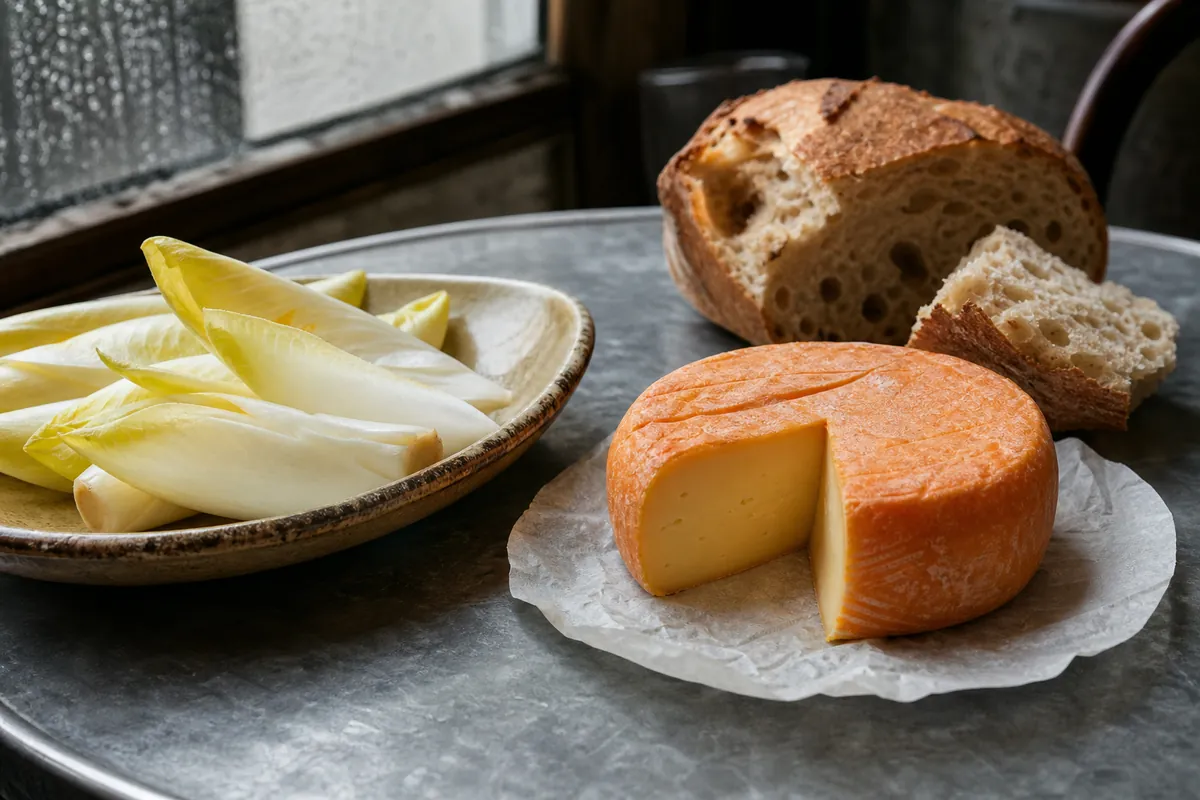
As for the rind, CooksInfo calls it thin and orangish, French Wikipedia calls it brown-red and Culture lists it as natural, and only the French pack mentions coloring it.
The French pack lists lysozyme from egg white and declares eggs as an allergen, and French Wikipedia lists lysozyme among Etorki's preservatives. Anyone avoiding egg should read the ingredient list on the pack in hand.
Is Etorki Safe During Pregnancy?
Savencia, Culture and French Wikipedia all give pasteurized sheep's milk as the milk. The NHS lists pasteurised semi-hard cheeses such as edam as safe, and the CDC lists hard cheese made with pasteurized milk among its safer choices.
Etorki is not on either agency's cheese list, and its classification as hard or semi-hard is open.
How to Use Etorki in the Kitchen
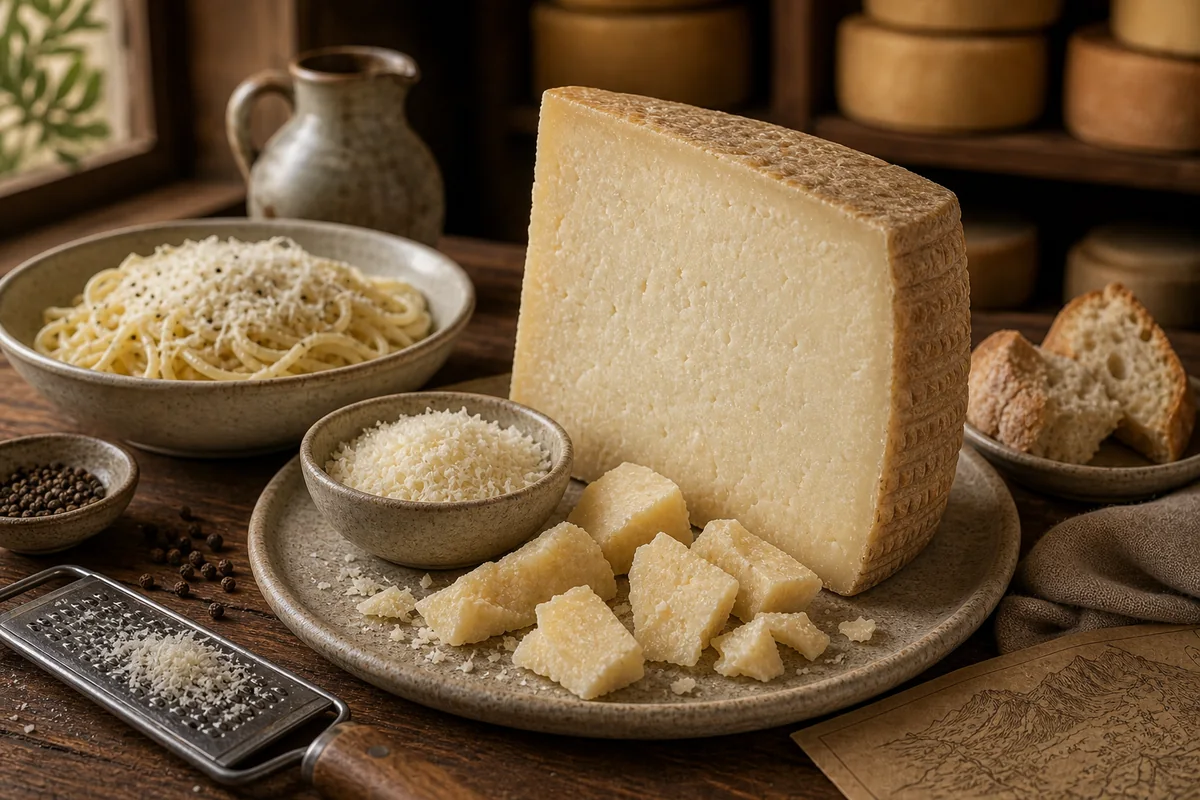
CooksInfo says Etorki grates and melts well, and Savencia says it melts elegantly into omelettes, cakes and quiches.
Savencia says thin slices of Etorki fill sandwiches, top toasts browned under the grill and flavor a pasta dish, and it adds tapas to go with the local aperitif.
Taste With The Eyes says the paste bends slightly without breaking, which makes it suitable for shaving with a vegetable peeler.
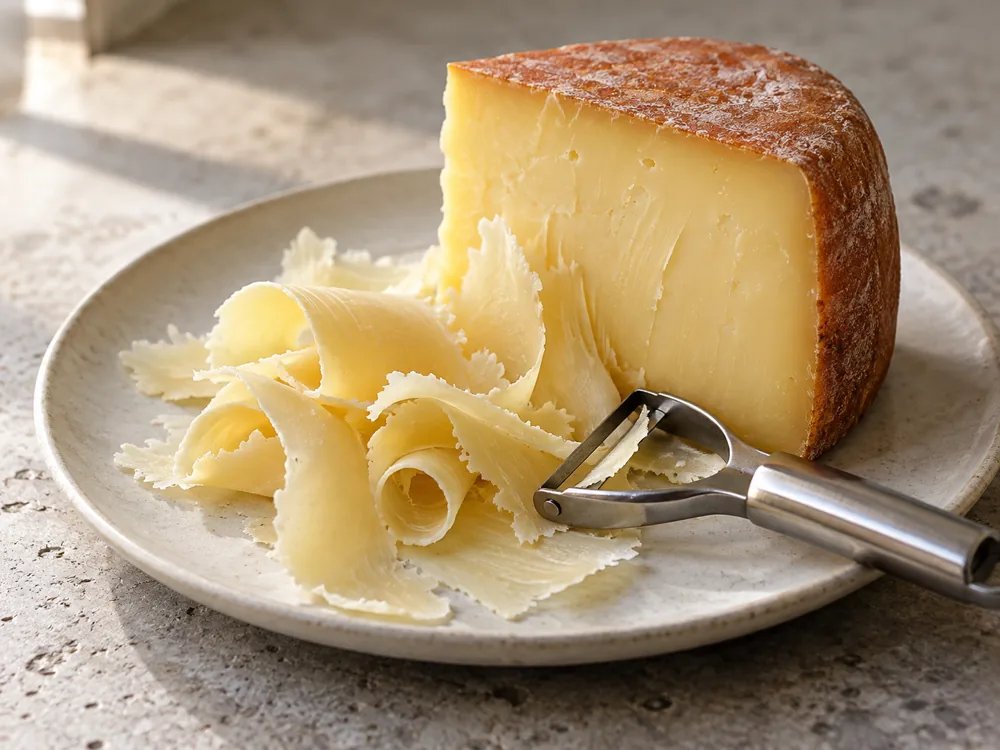
Its recipe dresses warm grilled squash, wild arugula and toasted tamari almonds with a vinaigrette, then tops the plate with shaved Etorki. The vinaigrette steeps minced shallot in late harvest Riesling vinegar and whisks in roasted almond oil at 3:1 oil to vinegar.
What to Eat and Drink With Etorki
Savencia and CooksInfo name black cherry preserve from Itxassou as the classic partner, with Savencia calling it the usual company for all Basque sheep tommes and CooksInfo calling the jam sour and saying that serving Etorki with it has become popular.
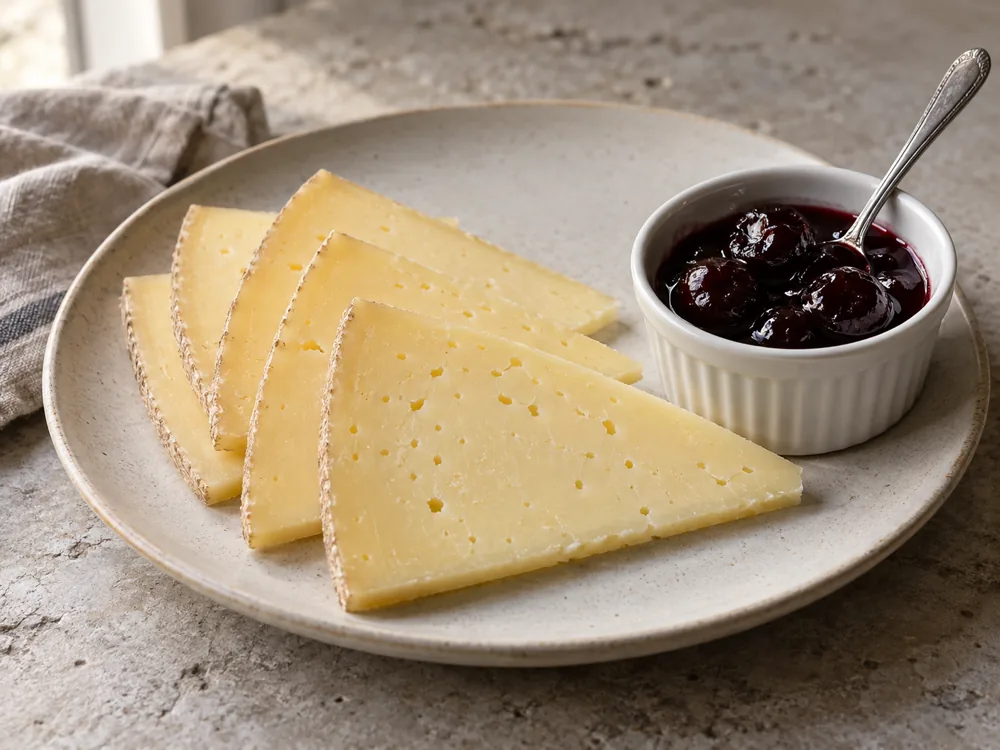
Savencia presents the cherry preserve as one case of a salty-sweet principle that also works with quince paste, chutney and fruit pastes, and names a sweet Jurançon moelleux as the cheese's closest companion from its own terroir.
Savencia says to eat it at room temperature, as part of a cheese board spread.
| Pairing | Type | Why It Works |
|---|---|---|
| Black cherry preserve from Itxassou | Food | Named by Savencia and CooksInfo. |
| Quince paste, chutney or fruit pastes | Food | Savencia extends its salty-sweet principle to these. |
| Country bread, with dried fruit | Food | Savencia names country bread, optionally with dried fruit. |
| Sweet Jurançon | Wine | Savencia calls a Jurançon moelleux the cheese's closest companion from its terroir. |
| Rich red wine | Wine | Culture lists a rich red, and Savencia names red wines. |
| Chardonnay or young muscat | Wine | Both are on Culture's list of wine matches. |
Etorki vs Ossau-Iraty
Both cheeses come from the Basque Pyrenees and use the same three sheep breeds, but only the protected Ossau-Iraty carries an AOC, granted in 1980, and an EU AOP, granted in 1996, according to the Ossau-Iraty interprofession.
| Attribute | Etorki | Ossau-Iraty |
|---|---|---|
| Status | Brand cheese, no protected designation | AOC 1980, EU AOP 1996 (interprofession) |
| Milk | Pasteurized sheep's milk (Savencia, Culture) | Raw, thermised or pasteurised sheep's milk; only farmhouse Ossau-Iraty must be raw (INAO specification, interprofession) |
| Breeds | Red-headed Manech, black-headed Manech, Basco-Béarnaise (Savencia) | The same three breeds (interprofession) |
| Ageing | About 7 weeks (Savencia) | At least 80 days for 2 to 3 kg tommes, 120 days for 4 to 7 kg wheels (INAO specification) |
| Flavor | Sweet, hazelnut and caramel (Culture) | Delicately sheep-flavored with a slight hazelnut note (interprofession) |
| Paste | Smooth, supple, velvety (Culture) | Supple to firm, neither sticky nor dry (interprofession) |
The flavor descriptions overlap, since the Ossau-Iraty interprofession calls its cheese delicately sheep-flavored with a slight hazelnut note. The milk does not separate them either, because the interprofession says Ossau-Iraty is made from raw, pasteurised or thermised milk, and only the farmhouse version must be raw.
The paste is close too: INAO describes Ossau-Iraty paste as ivory white to amber cream, smooth, firm to creamy and sometimes with small openings, much as Culture describes Etorki. The rind differs more, since INAO gives Ossau-Iraty a rind from yellow-orange to grey, where Etorki's is described as orangish or brown-red.
Age may separate them, depending on which Etorki figure is right. Savencia's seven weeks is shorter than the 80 days (about 11 weeks) that the smallest Ossau-Iraty must reach, while the 3 to 6 months from Culture and CooksInfo would overlap the Ossau-Iraty minimums of 80 to 120 days.
A 4.4 kg wheel, the size CooksInfo gives for Etorki, falls in the 4 to 7 kg class of Ossau-Iraty that must reach 120 days. The interprofession adds that Ossau-Iraty's taste strengthens with age, with 6 or 8 months counted as its sensory optimum.
If Etorki is not on sale nearby, Ossau-Iraty is the closest sourced alternative, with the same region and breeds. It differs in carrying a protected name and an ageing minimum of 80 days, and its milk can be raw, thermised or pasteurised, so the pack matters.
Which Production Rules Apply to Ossau-Iraty but Not to Etorki?
The INAO specification requires the EU AOP symbol on Ossau-Iraty labels, and the interprofession adds that the name Ossau-Iraty must appear whether the cheese is sold whole, cut or in pre-packed portions. INAO also requires each pre-packed portion to include a piece of the characteristic rind.
On additives, INAO bans rind colorants and natamycin on the surface of Ossau-Iraty, where Etorki's French pack lists rind colorings and French Wikipedia lists natamycin among its preservatives.
INAO describes Ossau-Iraty as made from milk used as it is, not standardised, whereas French Wikipedia calls Etorki's milk standardised, meaning adjusted to a set composition, as well as pasteurised.
INAO sets Ossau-Iraty ripening rooms at 6 to 15°C (43 to 59°F) with humidity above 75%, with the cheeses turned and brushed, where Culture says factory Etorki is vacuum-packed and held at 39°F.
On the farm, the specification limits milking to 265 days a year, bars milking and cheesemaking in September and October, and requires ewes to graze at least 240 days per campaign.
On a pack, Ossau-Iraty must show its name and the EU AOP symbol, while Etorki is a brand with no protected designation. INAO bars rind colorants on Ossau-Iraty, and the French Etorki pack lists them.
Which Etorki Sizes and Formats Can You Buy?
Savencia sells Etorki in these formats:
- 180 g classic and 250 g family pieces in self-service
- A 120 g sliced pack, sold since 2017
- Réserve and Grande Réserve wheels cut to order, with the Réserve listed at 4.4 kg
Savencia says the Réserve and Grande Réserve are wheels selected and aged with care by its master cheesemakers.
Check the pack for storage instructions and keeping time.
How Many Calories and How Much Fat Are in Etorki?
Open Food Facts transcribes a French 120 g sliced pack, and the matrix shows its figures per 100 g beside the same figures scaled to a 28 g ounce.
| Nutrient | Per 100 g | Per 28 g, scaled |
|---|---|---|
| Energy | 393 kcal | About 110 kcal |
| Fat | 33 g | About 9 g |
| Saturated fat | 23 g | About 6.4 g |
| Protein | 24 g | About 6.7 g |
| Salt | 1.5 g | About 0.4 g |
| Carbohydrate | 0.5 g | About 0.1 g |
Open Food Facts is a user-contributed database, so the pack in your hand is the final word.