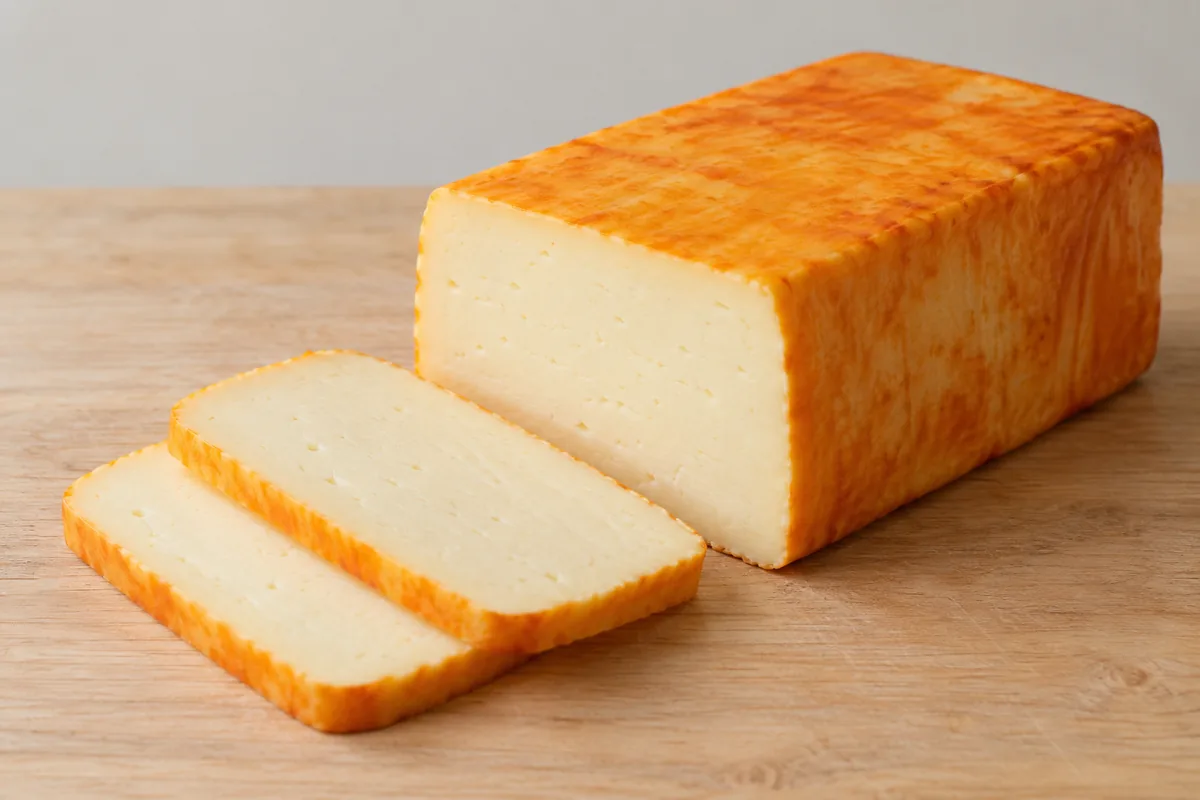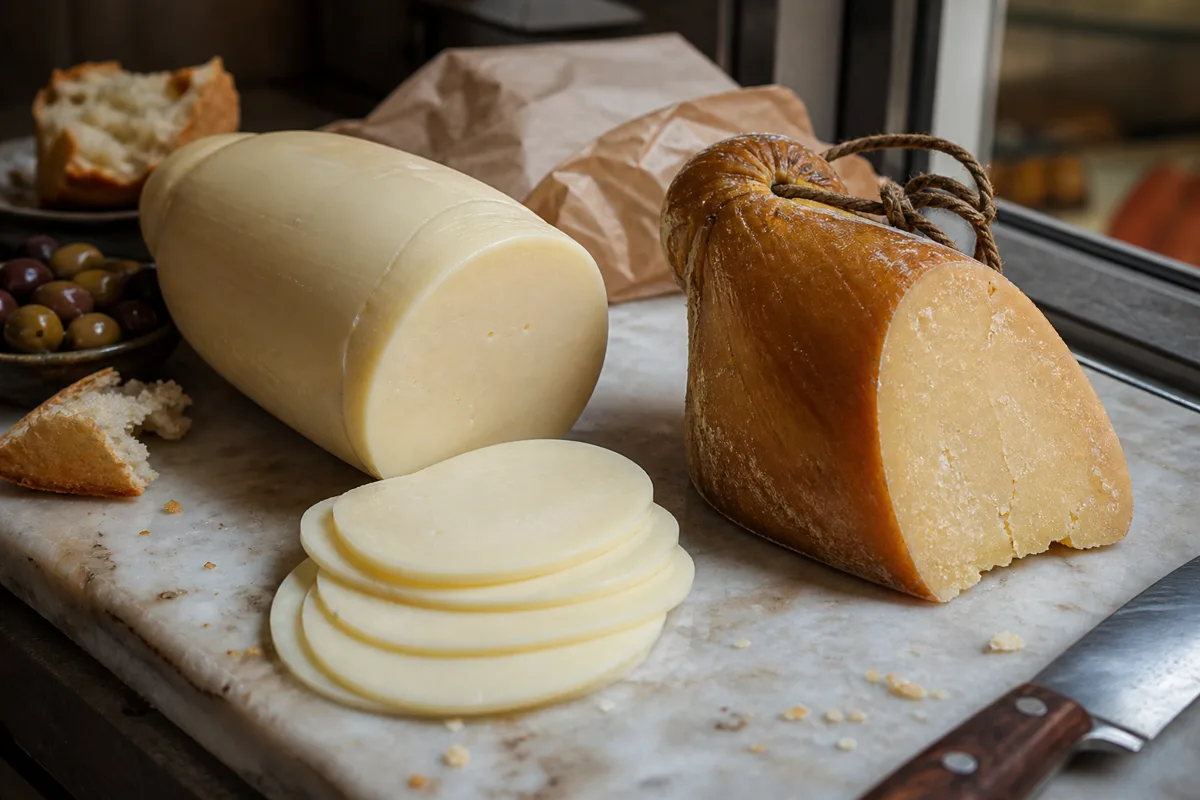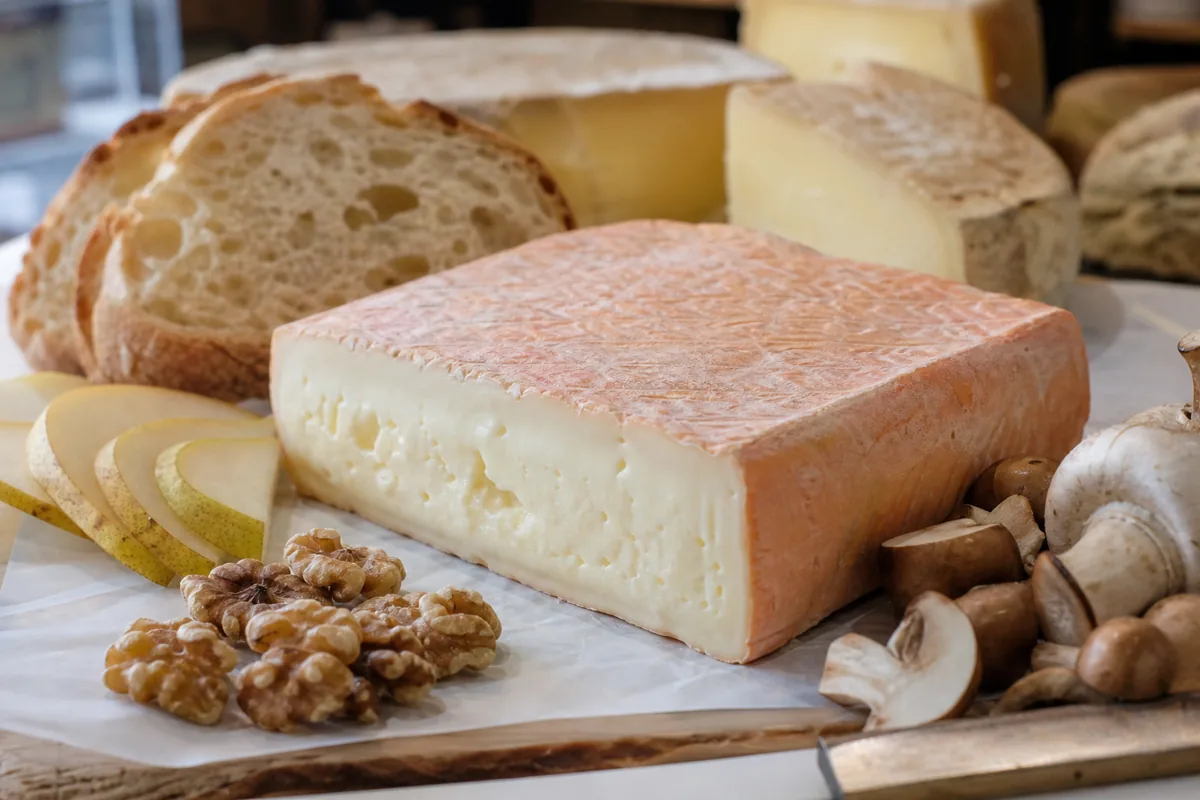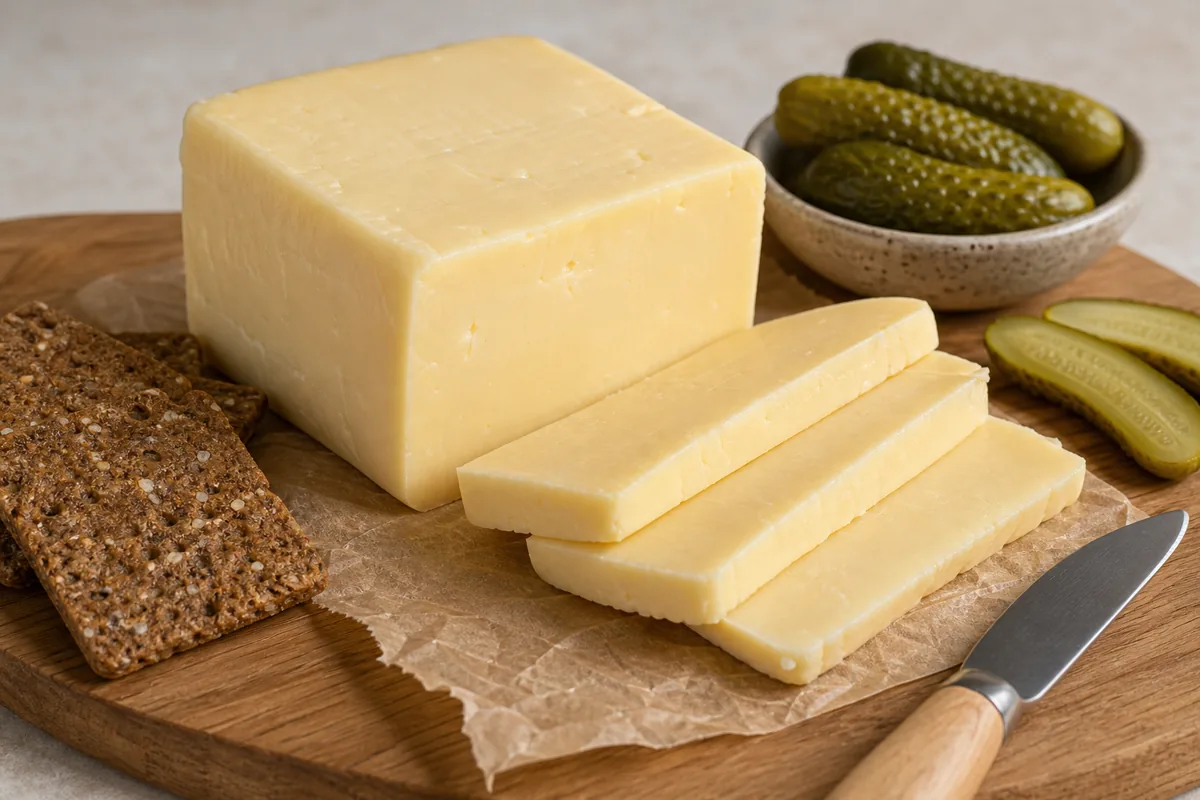
Brick is a cow's milk cheese from Wisconsin, first made in 1877, and it is sold both young and aged. Young Brick is mild and sweet, and aged Brick turns pungent and tangy, so the age on the label decides what the cheese is good for.
In This Article
Why Is It Called Brick Cheese?
Cheesemaker John Jossi made the first Brick, in 1877 according to Wisconsin Cheese and around 1877 according to Cheese.com.
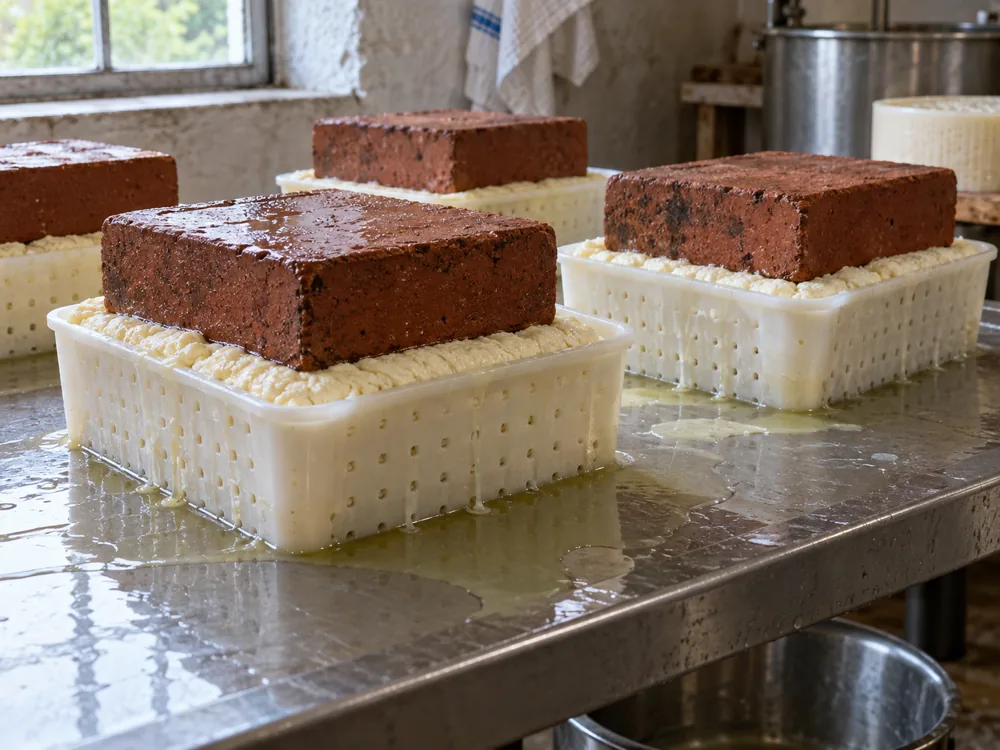
The name is literal: Wisconsin Cheese says the cheese was named for the bricks used to press the curds. What the bricks did depends on the account, with Wisconsin Cheese, Cheese.com and Widmer's describing them as pressing moisture or whey out of the curd, while Wikipedia says actual bricks originally formed the brick shape.
A weighted mold shapes and drains the curd in one step, so the two accounts can describe the same step from two sides.
Widmer's Cheese Cellars, founded in Theresa, Wisconsin, in 1922, still works this way. The curd is moved by hand into molds that are turned three times on the first day, and actual bricks weight it to press out the whey.
The company makes 360,000 pounds of traditional Brick a year with the same recipe, open vats and clay-fired bricks that Joe Widmer's grandfather used in the 12,000-square-foot system he bought in 1922. The name is still literal at that scale, and Widmer's calls itself one of the few makers that still produce the original version.
How Does Brick Change as It Ages?
Brick gets stronger as it ages: the three descriptions in the table call young Brick mild and aged Brick pungent, more complex or stronger-smelling.
| Source | Texture | Young Brick | Aged Brick |
|---|---|---|---|
| Cheese.com | Semi-hard; open and smooth | Mild and sweet | Pungent and tangy with a touch of nuttiness |
| Wisconsin Cheese | Not stated | Mild with a touch of nuttiness | More complex, pungent and tangy |
| English Wikipedia | Medium-soft; softer than Cheddar | Sweet and mild | Stronger smell and a nuttier taste |
Brick is considered ready after two weeks and can stay in cold storage for up to five months, according to Wikipedia.
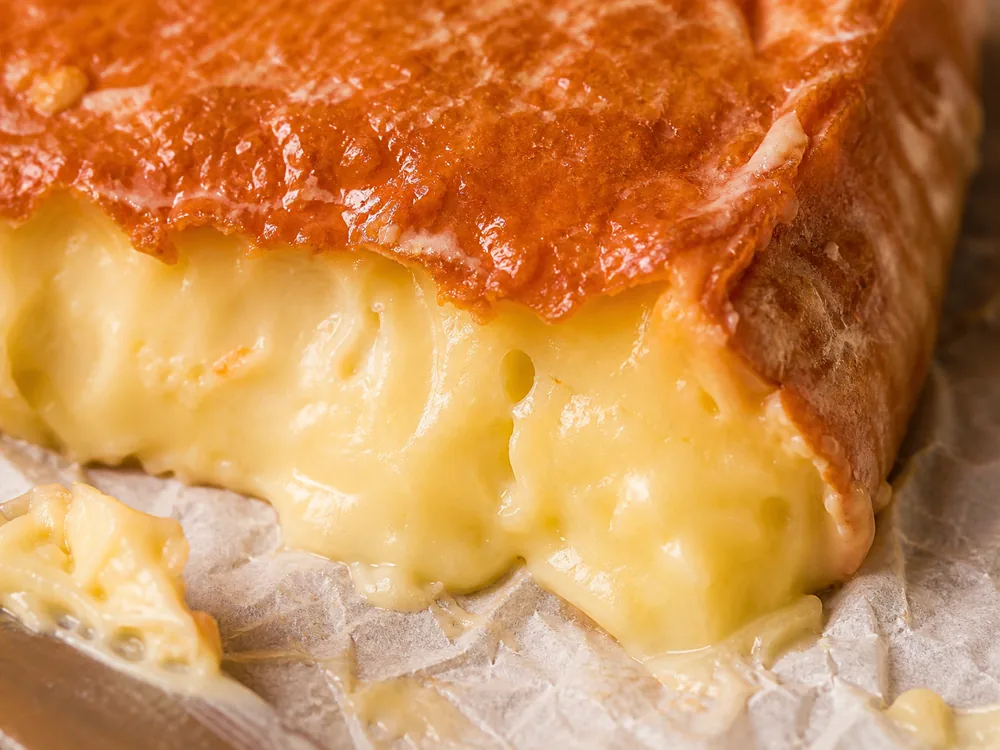
The stronger flavour comes from the surface. Wisconsin Cheese says traditional Brick is brined, moved to a warm room to encourage the bacteria that give it flavour, and then washed with brine by hand.
Widmer's gives the same order: a brine bath that lets the cheese take up salt and bacteria cultures, a rest in a warm room, and then washing with brine to encourage bacteria on the rind.
Brick is washed with brine in the main text of Wisconsin Cheese's Brick page and at Widmer's, but with a mix of water and whey in that page's FAQ and on Wikipedia.
The bacteria behind that surface differ by account: Wikipedia names Brevibacterium linens, the same one that ages Limburger and many French cheeses, while Cheese.com credits Corynebacterium and Arthrobacter bacteria. Both call the result a smear, Wikipedia as cheesemakers' word for the growth and Cheese.com by listing Brick as smear-ripened.
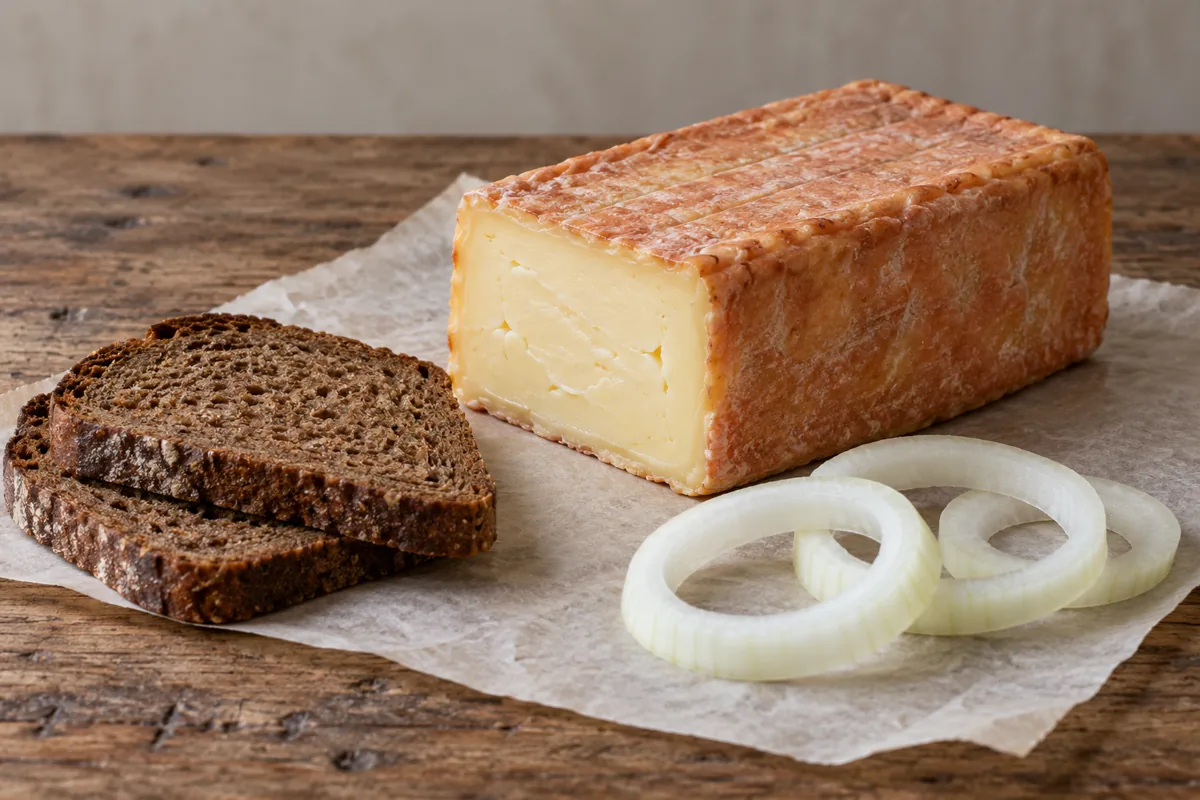
Brick's paste is pale yellow to white with an orange rind in Wikipedia's description, and Cheese.com calls it ivory in its fact box and creamy yellow in its description.
If you want a pungent Brick, buy an aged block: Wisconsin Cheese says Brick given time to ripen develops serious pungency and tang.
Widmer's sells mild Brick and aged Brick as separate cheeses. If a label says only aged, ask the seller how long the block was kept.
Is Brick Closer to Limburger or to Cheddar?
Wikipedia and Cheese.com both say Brick's make is borrowed from white American Cheddar. Wikipedia adds that the slightly higher culturing temperature gives a marginally higher fat content, a slightly altered protein structure and a slightly softer texture.
Cheese.com sums up the result as a slightly soft and distinctly sharper tasting cheese.
On the Limburger side, Wisconsin Cheese says early German immigrants to Wisconsin treated Brick as a fine substitute for Limburger, strong enough to satisfy the craving but less pungent than its European ancestor.
Widmer's says why it is tamer: Brick is made with lower levels of Brevibacterium linens, which are rubbed on the rind, so it is a milder version of Limburger, a famously aromatic cheese.
The two comparisons describe different parts of the cheese. The Cheddar link covers how the curd is made, and the Limburger link covers the rind and the smell, which Wisconsin Cheese sums up as a somewhat softer taste with a sharper finish.
Cheese.com adds Germany's surface-ripened Beer cheese, or Bierkäse, as a third reference point, another German relative beside Limburger that many people associate with Brick.
What Is Brick Cheese Made Of?
In the United States, Brick has a federal standard of identity, 21 CFR 133.108, and it sets these limits:
- Milkfat: at least 50% of the solids by weight.
- Moisture: no more than 44% by weight.
- Milk treatment: pasteurized, or the cheese is cured at not less than 35°F for at least 60 days.
- Make: the milk is brought to about 88°F with a bacterial culture, then stirred and heated slowly to about 96°F.
- Optional ingredients: coloring, calcium chloride up to 0.02%, clotting enzymes and antimycotic agents.
After the clotting enzyme sets the milk, the mass is cut into cubes about ⅜ inch on a side and stirred while it heats toward 96°F. Once the curd is firm, part of the whey is removed and the mixture is diluted with water or salt brine to control the acidity.
The curd is then drained in forms, pressed and turned, salted after drainage, and given the surface cultures characteristic of Brick before curing.
The standard also accepts any other procedure that gives a cheese with the same physical and chemical properties, and Wikipedia points out that its fat and moisture limits do not account for the surface ripening with B. linens that Brick is supposed to have.
So the standard's numbers guarantee fat and moisture, while the rind depends on how the maker works, which is why the brining and washing a maker describes tell you more about the smear than the name does.
The 60-day rule allows Brick made from unpasteurized milk, so the milk treatment is a label question. Cheese.com lists Brick as made with pasteurized cow's milk and marks it as not vegetarian, while the standard allows rennet or other clotting enzymes, so vegetarian status comes down to the maker.
The label also gives less than it seems to on that question: the standard lets enzymes of animal, plant or microbial origin be declared simply as enzymes, so the word on your label does not show which kind was used.
Why Does Detroit-Style Pizza Use Brick?
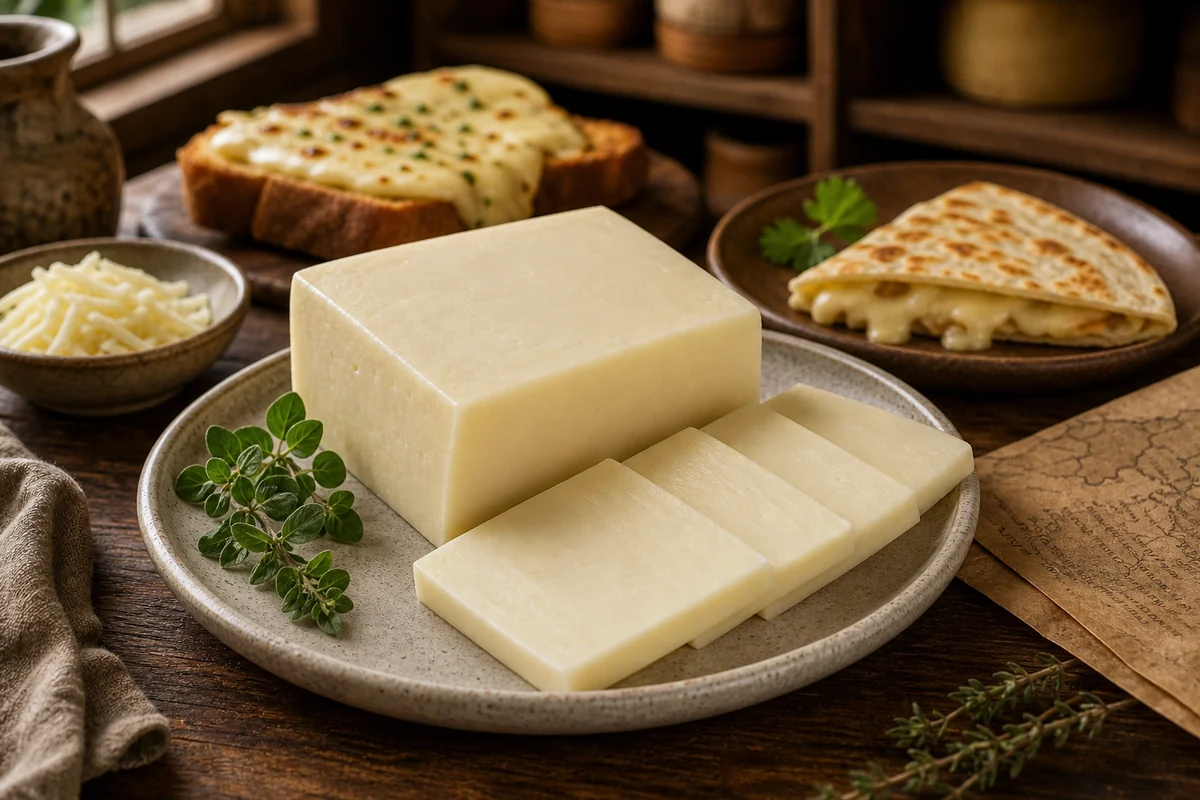
English Wikipedia calls Brick the traditional cheese for Detroit-style pizza, which is topped to the edges with mozzarella or Wisconsin Brick. The cheese caramelizes against a high-sided, heavyweight rectangular pan and gives the crust a lacy, crispy edge.
This pizza style dates to 1946 at Buddy's Rendezvous in Detroit, owned by Gus and Anna Guerra.
The Takeout's Dennis Lee calls Brick a mild white cheese with plenty of fat and creaminess and an ideal melting cheese. He says the crisp edge forms when the cheese melts between the crust and the pan.
Loui's Pizza puts the pepperoni down first, covers it with almost a pound of Brick and bakes at 700°F (370°C).
Brick can withstand that heat because of its heavy butterfat content. Another Detroit pizzeria bakes much cooler: Shield's Pizza bakes for 13 minutes at 440°F (225°C).
Wikipedia credits the crust's buttery flavor to a small quantity of oil and the melting properties of the mozzarella and Wisconsin Brick.
The crisp cheese edge is called frico, and the sauce goes on top for the reason The Detroit News gives: the crust does not get soggy and the cheese stays anchored to the rim.
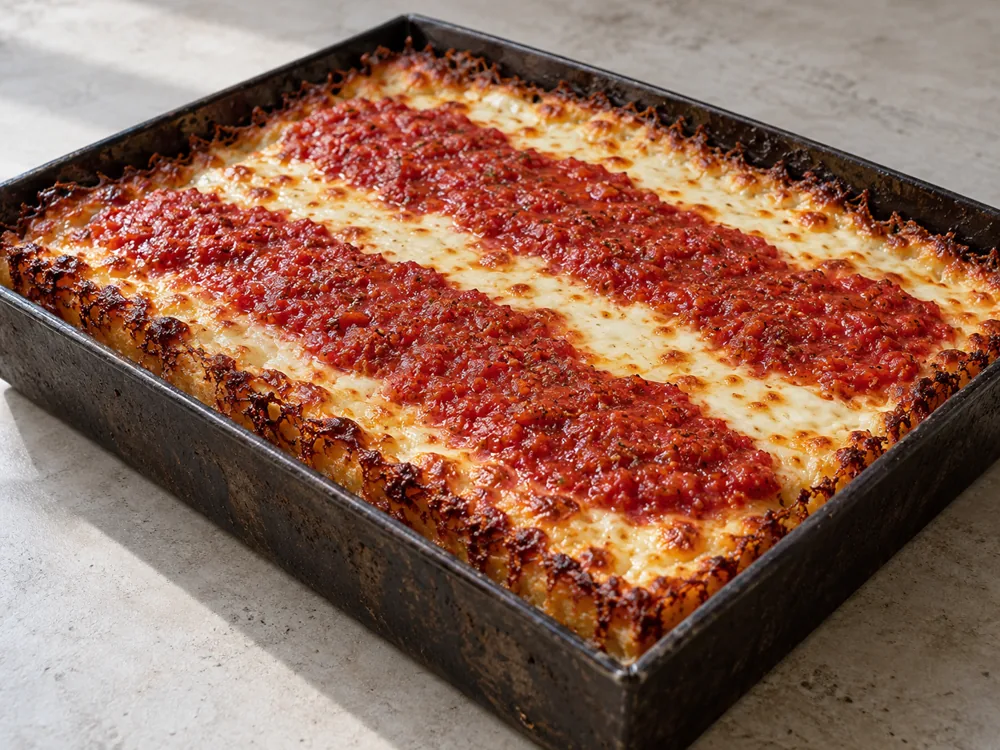
The Takeout calls Brick a niche cheese that is hard to find in most grocery stores outside Detroit and Wisconsin, and says low-moisture mozzarella is a perfectly good substitute that still makes the savory cheese edges. The Detroit-style chain Jet's Pizza uses mozzarella rather than Brick, and The Takeout adds that Brick does resemble mozzarella and is often sourced directly from Wisconsin.
What Goes with Young and Aged Brick?
Wisconsin Cheese slices young Brick onto a meat and cheese platter, and it names macaroni and potatoes au gratin for young Brick too. It also suggests slicing Brick for sandwiches or melting it with polenta.
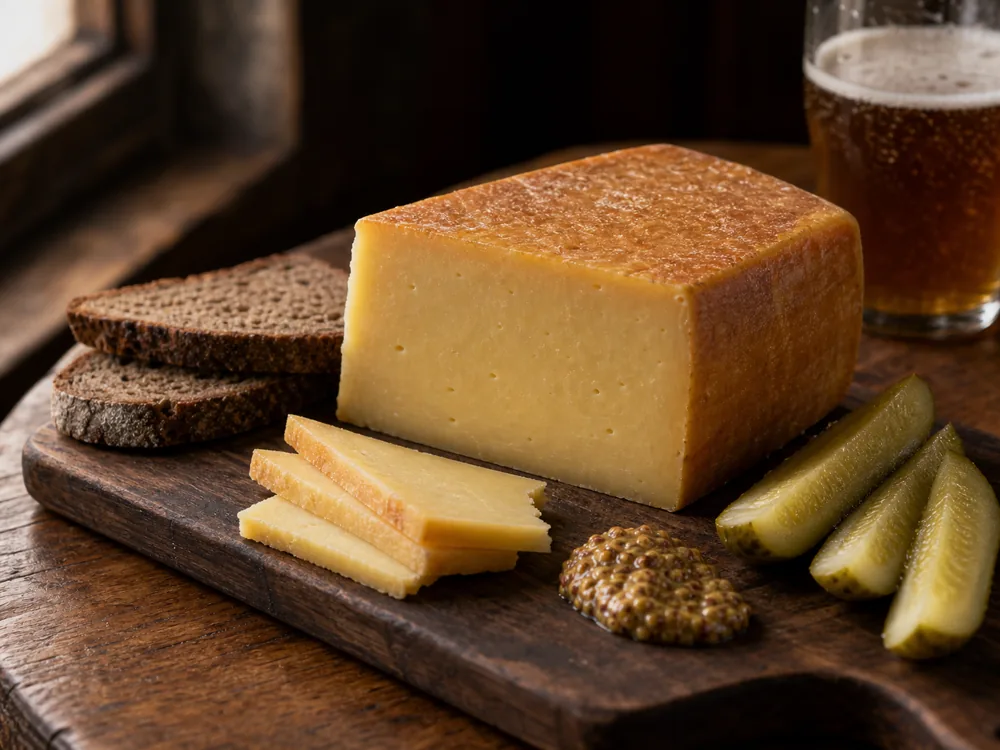
Aged Brick gets stronger partners. Wisconsin Cheese puts mature Brick on rye with spicy pub mustard and sautéed onion, and Widmer's suggests a slice of its aged Brick on crusty bread with stone ground or spicy pub mustard.
| Pairing | Type | Why It Works |
|---|---|---|
| Macaroni and potatoes au gratin | Food | Young Brick, per Wisconsin Cheese; Cheese.com names both for Brick. |
| Rye, pub mustard and sautéed onion | Food | Mature Brick, per Wisconsin Cheese. |
| Crusty bread and stone ground mustard | Food | Widmer's pick for its aged Brick. |
| Pickled vegetables and toasted Italian bread | Food | Cheese.com, for Brick. |
| Light red wine, Gamay Beaujolais | Wine | Cheese.com, for young Brick. |
| Porter ale and robust beers | Drink | Cheese.com, for aged Brick. |
Cheese.com also names hard cider for aged Brick.
For beer, bock, pale ale, porter and stout are on both Wisconsin Cheese's list for Brick and Widmer's, which says its Brick wants a solid partner. Wisconsin Cheese adds weiss beer and brown ale.
For wine, Wisconsin Cheese and Widmer's both name chardonnay, pinot noir, riesling, sauvignon blanc and Grüner Veltliner, and Widmer's adds merlot, champagne, Beaujolais and pinot gris.
Porter is the one drink Cheese.com, Wisconsin Cheese and Widmer's all name, and Beaujolais links Widmer's list to Cheese.com's light red pick for young Brick, which also gets sweet pickles.
For leftover Brick, The Takeout says it makes some really great beer cheese dip.
Which Brick Cheese Should You Buy?
Widmer's sells Brick as mild Brick, aged Brick, Brick flavored with caraway and jalapeño pepper, and an aged Brick Cheese Spread that combines washed-rind Brick with aged white cheddar.
For melting, Wikipedia ties the sweet, mild flavor and the suitability for melting to unaged Brick, and Wisconsin Cheese puts young Brick in macaroni and potatoes au gratin. So if you are making Detroit-style pizza, the melting note points to young Brick.
Wisconsin Master Cheesemaker is a title from a three-year program for cheesemakers who have made their chosen cheese for at least 10 years, and fewer than 100 people hold it. Joe Widmer holds it for brick, cheddar and colby, which makes it a credential for the maker's experience rather than a mark on any one block.
The young and aged flavor descriptions are for plain Brick, not for the caraway-and-jalapeño Brick or the spread.
What About Brick Cheese Nutrition, Lactose and Pregnancy?
USDA reference data for Brick, as republished by NutritionValue.org, gives these values per 100 g:
The water figure of 41.1 g sits under the 44% moisture ceiling in the federal standard.
The fat figure lines up with the standard too: 29.7 g of fat in the 58.9 g that is not water works out to about half of the solids, right at the federal minimum.
Scaled to a 28 g slice, the same data comes to 105 calories, 8.4 g of fat, 5.3 g of saturated fat and 159 mg of sodium.
The same data lists 0.5 g of sugars per 100 g. If you manage lactose intolerance, read the nutrition panel on the exact product you buy.
The NHS lists pasteurised semi-hard cheeses such as edam and pasteurised soft cheeses as safe to eat in pregnancy, and says foods made from unpasteurised milk must be thoroughly cooked.
Pregnant women are 10 times more likely to get a Listeria infection, according to the CDC. The agency lists unpasteurized (raw) milk and dairy products made from raw milk, and soft cheese made from unpasteurized (raw) milk, among the riskier choices.
Served cold, Brick is described as a pasteurized semi-hard or medium-soft cheese, a type the CDC list does not cover, so ask a midwife or doctor. The CDC lists pasteurized soft cheeses heated to an internal temperature of 165°F or until steaming hot as safer.
SOURCES & REFERENCES
What Do People Ask About Brick Cheese?
No. Brick is a washed-rind Wisconsin cheese first made in 1877, and Detroit-style pizza uses either one, with The Takeout calling low-moisture mozzarella a perfectly good substitute.
No. Widmer's calls Brick a tamer, milder version of Limburger, made with lower levels of Brevibacterium linens on the rind.
Bricks were used to press the curds. Widmer's Cheese Cellars in Theresa, Wisconsin, still presses its curd with actual bricks.
Cheese.com says the mild, sweet flavour turns pungent and tangy with a touch of nuttiness as Brick matures.
Cheese.com lists pasteurized cow's milk. The federal standard also allows unpasteurized Brick cured for at least 60 days, so the label settles it.