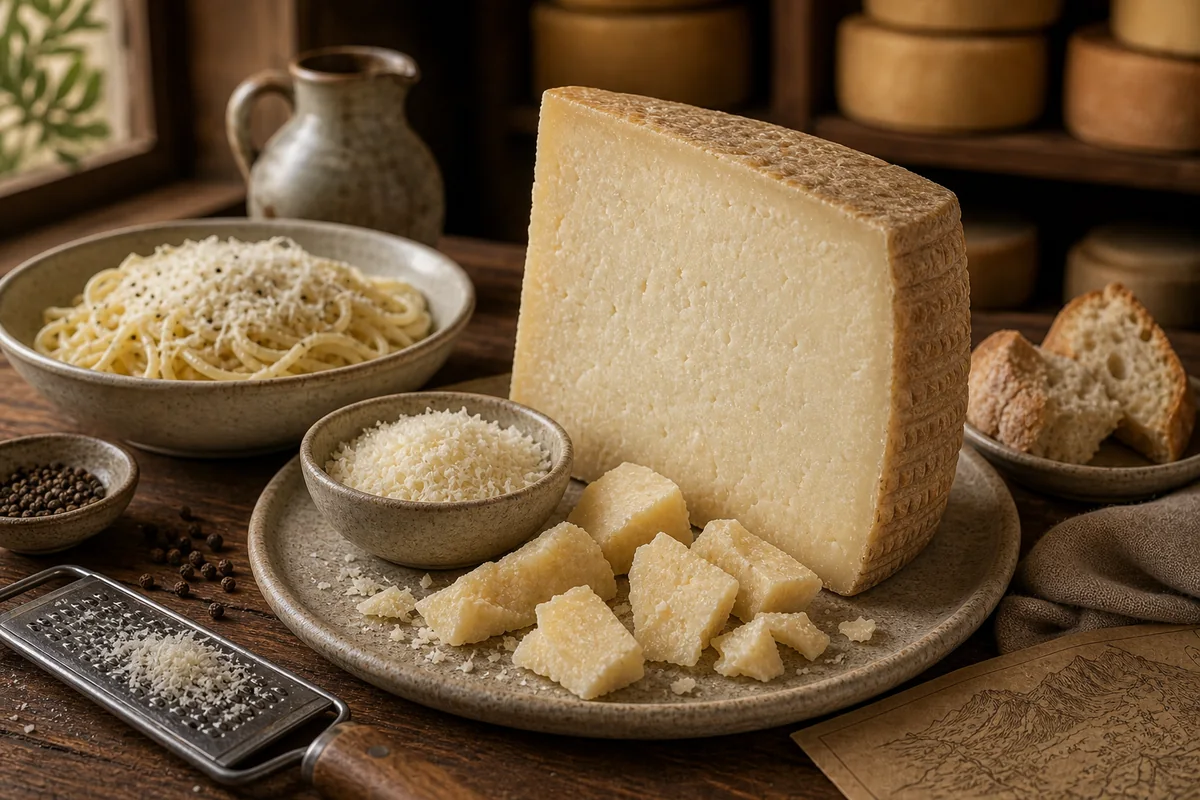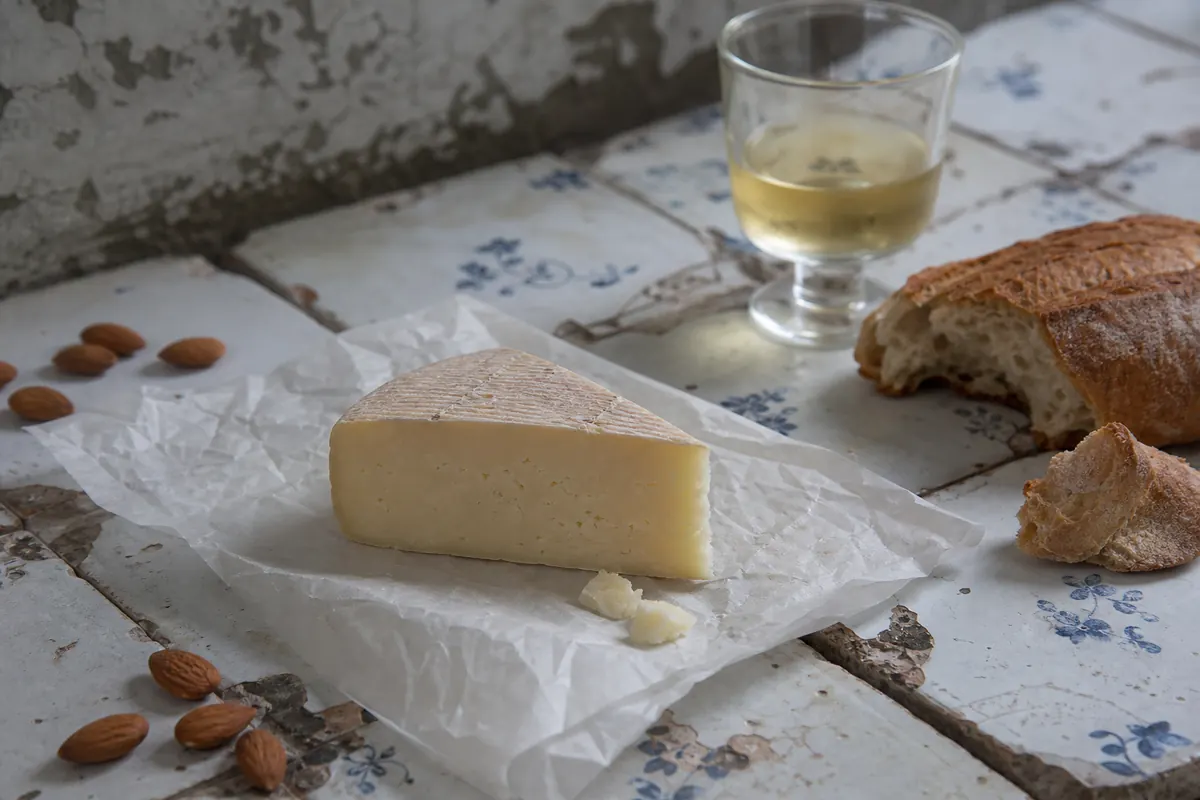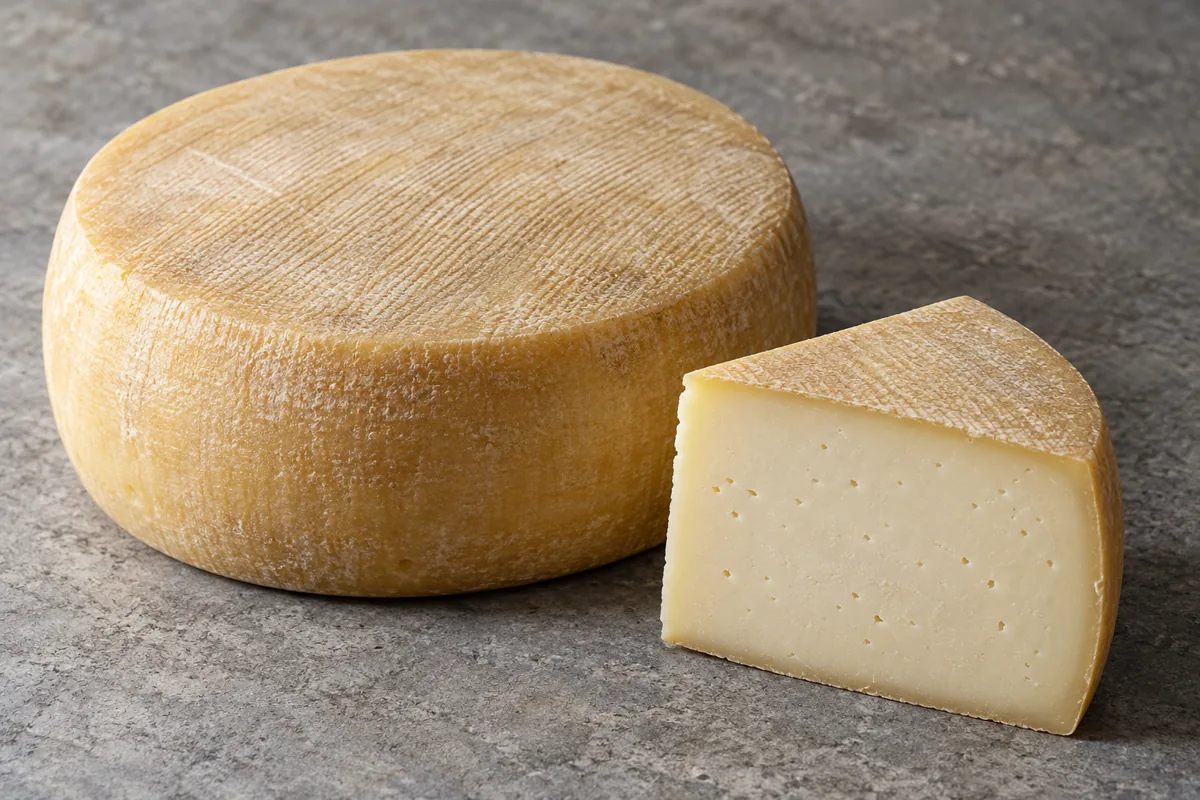
Idiazabal is a pressed cheese made only from raw sheep's milk of the Latxa and Carranzana breeds in the Basque Country and Navarre, in northern Spain. Every wheel ripens for at least 60 days, and smoking is an optional last step.
Both styles share the milky, rennet and toasted notes the official specification lists, and a smoked wheel adds a smoke note that the rules keep between weak and medium.
In This Article
What Is Idiazabal Cheese?
The Spanish specification for the protected designation, the pliego de condiciones, defines Idiazabal as cheese made exclusively from raw Latxa and Carranzana sheep's milk, with a pressed paste and at least 60 days of ripening.
The milk must come from registered flocks in Álava, Bizkaia, Gipuzkoa and Navarre, leaving out the municipalities of the Roncal valley. Making and ripening happen inside the same area.
The breed rule covers the whole farm, because the specification lets a holding supply milk only when its sole dairy sheep are Latxa, Carranzana or both. English Wikipedia reports that some Basque farmers have begun using hybrid Assaf sheep, which some people say does not meet the denomination.
The name comes from Idiazabal, a small town in the Goierri district of Gipuzkoa. According to the specification, shepherds who grazed the Urbía and Aralar ranges in summer sold their cheese there before taking their flocks back down to winter pasture.
Older local names tied to single mountain ranges, such as Urbía, Entzia, Gorbea, Orduña and Urbasa, are protected under the same rules.
A Basque government order gave the designation provisional status on 30 September 1986, and Cheese.com dates the full Spanish denomination of origin to 1987.
| Measure | Specification (MAPA) | Foods and Wines from Spain | English Wikipedia |
|---|---|---|---|
| Height | 8 to 12 cm, ±10% | 8 to 12 cm | Not given |
| Diameter | 10 to 30 cm, ±10% | 10 to 30 cm | Not given |
| Weight | 1 to 3.5 kg, ±10% | 1 to 3 kg | 0.9 to 1.8 kg |
| Fat | At least 45% of dry matter | Not given | Not given |
| Dry matter | At least 55% | Not given | Not given |
| Protein | At least 25% of dry matter | Not given | Not given |
| pH | 4.9 to 5.5 | Not given | Not given |
Weight is where the sources differ most, from 0.9 kg on English Wikipedia to 3.5 kg in the specification. The specification describes a cylinder with flat faces and slightly convex sides, and English Wikipedia adds that some wheels are cone-shaped or octagonal.
The regulatory council also gives 1 to 3 kg and calls the cheese small to medium, so three of the four sources stop at 3 kg or less and only the specification stretches to 3.5 kg. Foods and Wines from Spain adds that the corners are rounded on small cheeses and sharp on large ones.
Should You Buy Smoked or Unsmoked Idiazabal?
The choice comes down to one extra note. The specification gives every Idiazabal the same intense milky, natural-rennet and toasted aroma, and adds a smoke note of weak to medium intensity only for smoked wheels.
Smoke comes at the very end. A wheel may be smoked a few days before it leaves the dairy, using smoke from burning untreated natural wood.
Unsmoked is the bigger seller: the specification says more unsmoked Idiazabal is sold today than smoked, and that smoking is now done on purpose and under control.
The old link between Idiazabal and smoke started in the shepherds' huts. They had no chimney, so the hearth fire smoked the ripening cheeses by accident, which the specification says once led people to treat smoke and Idiazabal as the same thing.
The regulatory council says smoked cheese is widespread, unlike in Urbasa, Entzia and other towns that traditionally do not smoke it. It also notes that people often identify Idiazabal with the smoked style, above all outside the production area, even though the specification says more unsmoked cheese is sold.
Sources disagree on how strong the smoke is. The specification gives weak to medium and Foods and Wines from Spain light to medium, adding that smokiness in the paste should not be too pronounced, while English Wikipedia calls the smoked version somewhat drier and stronger.
The specification asks only for untreated natural wood a few days before dispatch, and English Wikipedia says the intensity depends on the wood and the smoking time, so the smoke note can vary between dairies inside the weak-to-medium range.
| Source | Smoke and wood | Rind colour |
|---|---|---|
| Specification (MAPA) | Untreated natural wood, a few days before dispatch; smoke weak to medium | Pale yellow or whitish grey, up to dark brown when smoked |
| Foods and Wines from Spain | Beech or alder, applied days before sale | Yellowish beige or whitish grey natural; brownish ochre or tan smoked |
| English Wikipedia | Beech, birch, cherry or white pine; intensity varies with the wood and the time | Dark brown |
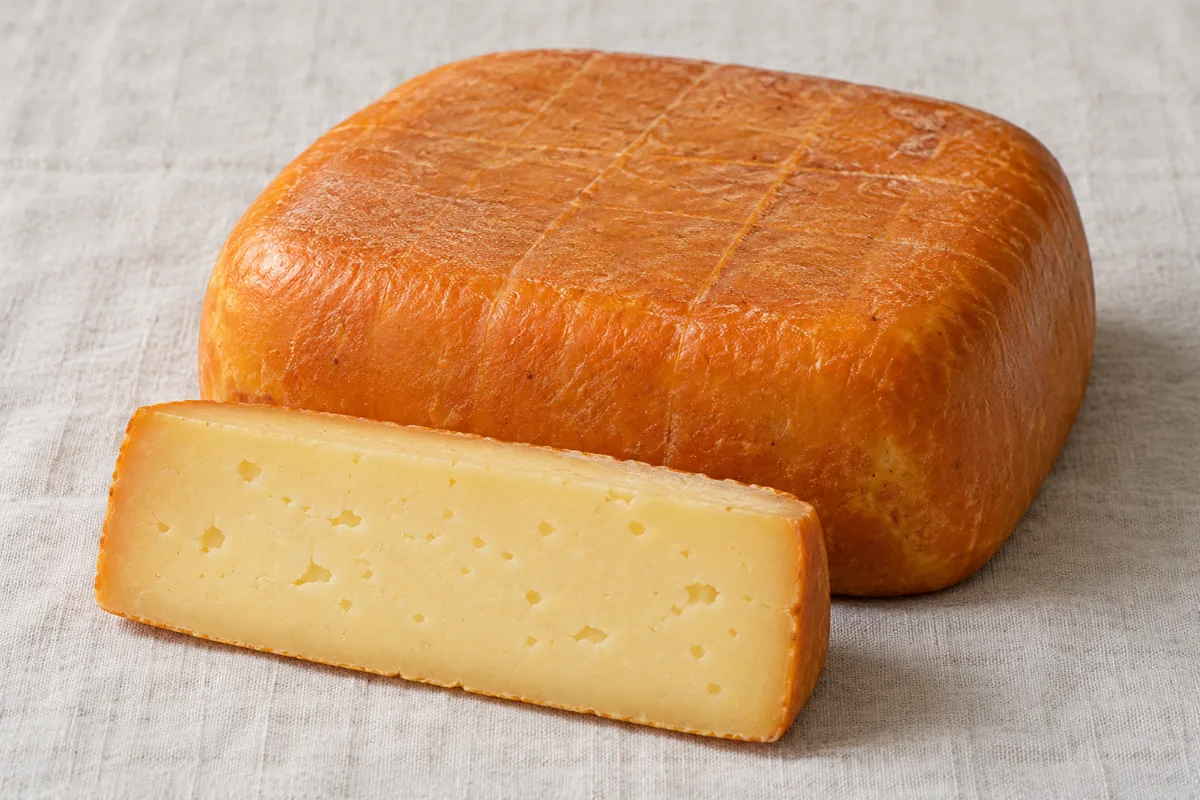
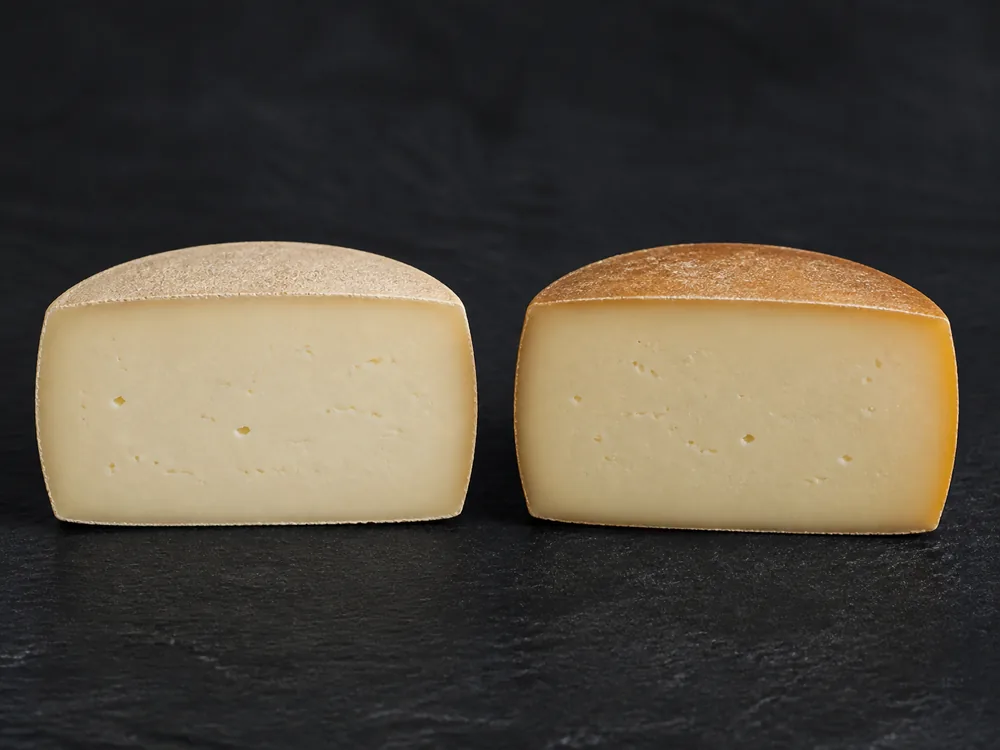
On a whole wheel, the rind is the quickest clue, since the specification reserves the dark brown end of its colour range for smoked cheese.
For unsmoked cheese, Foods and Wines from Spain ties the rind colour to brushing: yellowish beige after brisk brushing with water, whitish grey after gentler dry brushing. It adds that cheeses are washed carefully before they are smoked.
A cut wedge carries the same clue under the rind, since Foods and Wines from Spain and English Wikipedia both describe the narrow strip there as brownish in smoked cheese.
What Does Idiazabal Taste Like?
The Foods and Wines from Spain trade site calls the flavour intense, full and balanced, with a marked taste of ripened ewe's milk and a hint of natural rennet.
The specification spells that out for a tasting panel. A batch that fails the accredited sensory test cannot be certified as Idiazabal.
- Smell and aroma: intense and penetrating, with milky, natural-rennet and toasted notes
- Taste: sweetness none to weak, acidity weak to medium, medium saltiness, no bitterness
- Bite and finish: piquancy weak to medium, with a pronounced, long finish
- Texture: elasticity weak to medium, firmness medium to high, graininess weak to medium
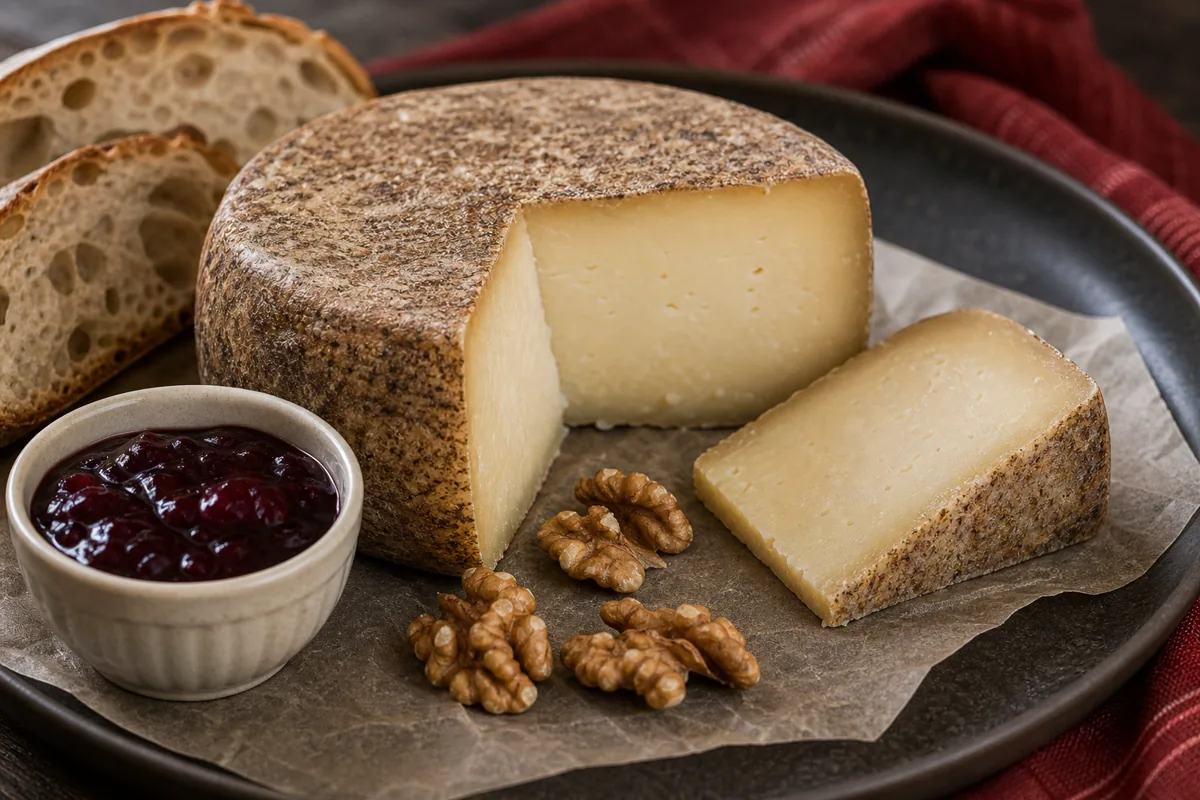
- Inside: ivory to straw-yellow paste, a narrow and slightly darker rim, few irregular holes smaller than a grain of short rice, no cracks
Other references use their own words: Cheese.com lists buttery, nutty and smoky and compares the taste to burnt caramel and bacon, and English Wikipedia says it turns nutty and buttery after a few months of ageing.
How Does Idiazabal Change With Age?
The cheese loses water as it ripens, and Foods and Wines from Spain says the longer that goes on, the less elastic, more crumbly and harder the paste becomes.
The same source says acidity rises throughout ripening, which helps the cheese keep, and that the paste moves from ivory toward straw yellow.
The narrow, slightly dark strip under the rind widens and darkens with ripening, and it is usually broader on larger wheels, according to Foods and Wines from Spain. That makes it a rough age cue only between wedges cut from wheels of similar size.
The legal floor is 60 days, yet Foods and Wines from Spain and the regulatory council both put the best eating at four to eight months and say the choice within that range depends on personal taste.
English Wikipedia describes cheese aged longer than a few months as firm, dry and sharp, and says that version can be used for grating.
Does Where the Ewes Graze Change Idiazabal?
The specification reports pasture effects as a saying rather than a measurement. It calls the soils fairly uniform, yet repeats that cheese from ewes on the chalkier Urbasa and Andía soils tastes sweeter and cheese from the more acidic Aralar soils tastes more piquant.
The Latxa is a hardy dairy breed that grazes almost permanently, moving between valley floors and mountain tops with the seasons. The specification says it eats wild forest and scrub vegetation in winter and high mountain grassland in summer, with barn rations only when grazing is difficult or during lactation.
The Carranzana is found mainly in Bizkaia, above all the Carranza valley, and the specification gives it 160 to 170 litres of milk in 150 days. Local farmers tell the breeds apart, calling the Carranzana the sheep of the meadows and the Latxa the sheep of the brambles.
On the rough pastures the specification counts four to five sheep per hectare a year, mostly in Álava. It says the oceanic climate and these soils let natural meadows grow, with over 1,200 mm of rain a year in the Atlantic north, while Rioja Alavesa and Ribera Navarra in the Mediterranean interior have few Latxa sheep.
Making follows the ewes. The usual season runs from March to June, which the specification says is when milk output peaks and the temperature and humidity suit both making and ripening.
It describes two kinds of shepherd-cheesemaker: those who turn all their milk into cheese from December to August or September, and those who make cheese for only two or three months, usually while the flock is up in the sierra.
Foods and Wines from Spain says the aroma carries different degrees of piquancy, acidity and sweetness depending on the time of year, the production area, the techniques used and the ripening period.
The regulatory council adds that production routines change little, so Basque sheep's cheeses are essentially the same, with differences that come from season, pasture area and the cheesemaker's technique.
How Is Idiazabal Made?
The milk goes into the vat raw and unchanged. The specification bans standardising it and allows only four additions: dairy cultures, lysozyme, rennet and salt.
That rennet must be animal rennet, so Idiazabal is not vegetarian, which Cheese.com also states. Foods and Wines from Spain and English Wikipedia name lamb as the source, where the specification says only animal origin.
Before the vat, Foods and Wines from Spain says the milk is kept below 10 °C after milking. It adds that the setting time within the 20 to 45 minutes depends on the acidity of the milk and the time of year.
| Step | What the specification sets |
|---|---|
| Setting the curd | Animal rennet, milk at 28 to 32 °C, set in 20 to 45 minutes |
| Cutting | Curd cut into grains of about 5 to 10 mm |
| Stirring and reheating | Reheated to 35 to 38 °C |
| Moulding and pressing | Cylindrical moulds, then pressed to the final size and composition |
| Salting | Dry or in brine, with common salt only |
| Airing | Optional, before the cheeses enter the ripening rooms |
| Ripening | At least 60 days at 8 to 14 °C and 80 to 95% relative humidity, with turning and cleaning |
Foods and Wines from Spain says the grains are stirred slowly while the vat warms to about 37 °C, which helps the whey drain and leaves only the milk's fat and protein. The cheesemaker stops the heat when the grains are judged firm enough, and they then sink under the whey.
After moulding, the same source describes pneumatic presses at 1.5 to 4 atmospheres for 5 to 6 hours, then brine for 24 hours on small cheeses and 48 hours on large ones.
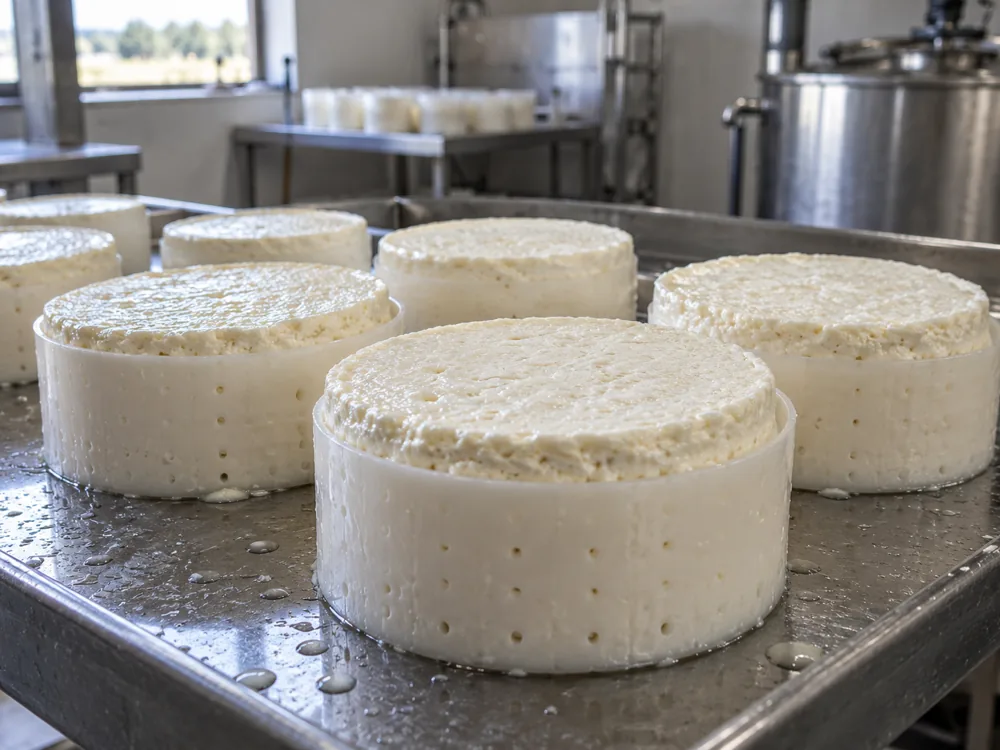
Foods and Wines from Spain gives a narrower ripening room of 8 to 10 °C at 85 to 90% humidity, and the regulatory council says about 10 °C and 90%, both inside the specification's wider range.
The sources also start the 60-day count at different points: the specification counts from a wheel's entry into the controlled chambers, while Foods and Wines from Spain counts from moulding. The specification's packing rule also uses moulding, so a wedge packed at a registered dairy has passed 60 days by that count.
The Valle del Baztán smoked cheese sold by Espagne Gourmet lists lysozyme from egg and labels it a preservative. The regulatory council nonetheless describes the cheese as a natural product without preservatives or colourings, so the lysozyme the specification allows can still appear on an ingredient list.
In the shepherds' huts the work was done by hand. The specification describes milk filtered through a funnel packed with nettles, rennet from the flock's own suckling lambs, and curd pressed for 10 to 12 hours, then rubbed with fine dry salt for one or two days.
The hut method differed from today's rule. The shepherd beat the curd with a holly-wood whisk to grains between rice and maize size and reheated it to as much as 40 °C, against today's 35 to 38 °C, according to the specification.
Ripening took place in a separate, well-insulated room of the hut, the gaztandegui, whose small north-west window caught cool, damp wind. Cool, damp air is what the modern rules specify too, at 8 to 14 °C and 80 to 95% humidity.
How Can You Tell a Wedge Is Real Idiazabal?
Every certified wheel carries three identifying marks, set out in the specification and on the regulatory council's own site.
- Casein plate: a serial-numbered plate fixed into the rind at moulding or pressing, whose number traces the wheel
- Numbered back label: a unique serial counter-label carrying the word Idiazabal, which the council describes as holographic
- DOP logo: printed on the commercial label, with a control number on its red band according to the council
The dairy's daily register ties each plate number to a lot, which the specification defines as every wheel from a single coagulation in one vat.
The back label is coded for the size and format of the cheese it certifies and is applied so that it cannot be used twice, while the council says the hologram exists to prevent forgery.
Wedges are covered by the same rules. Cutting and packing must happen in registered dairies inside the area, and the one exception is a shop counter that cuts the cheese in front of the customer at the moment of sale.
Pre-packed wedges are labelled at the registered dairy, and the specification extends the numbered back label to portions, so a pre-wrapped wedge without that label does not meet the rules.
A registered dairy that also makes uncertified cheese must keep raw materials, processing, storage and handling of the two apart and run a separate traceability system for each. Ripening itself is allowed only in registered dairies.
A label that adds baserrikoa, or de caserío, beside the DOP logo means the dairy made the cheese only from its own flock's milk. Wheels that fail certification can still leave the dairy with a casein plate, but without any Idiazabal label or back label.
Dairies log those failures themselves in a self-disqualification register that names the lot, the reason, the number and weight of the wheels, their plate numbers, the date and the person responsible.
How Do You Serve and Store Idiazabal?
Espagne Gourmet recommends room temperature for its Valle del Baztán smoked cheese, cut into thin slices or small cubes.
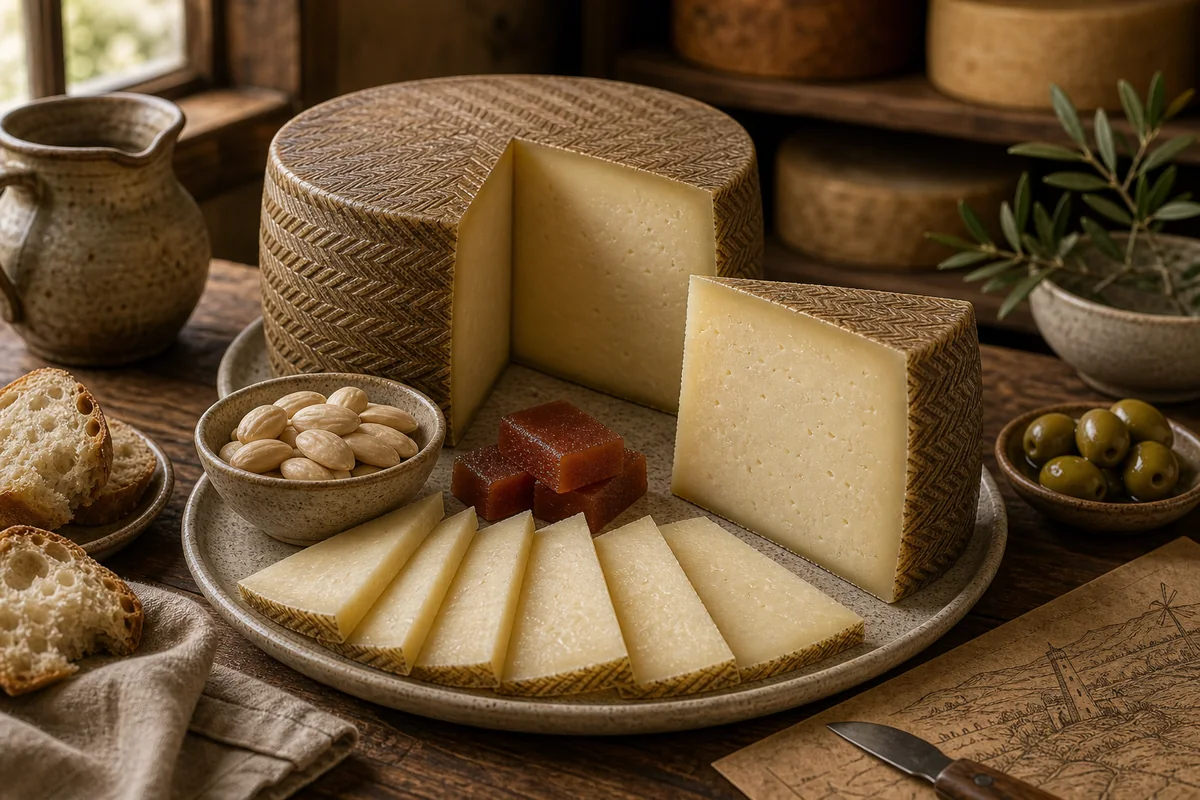
The seller's suggested company on a cheese board is bread, nuts or honey.
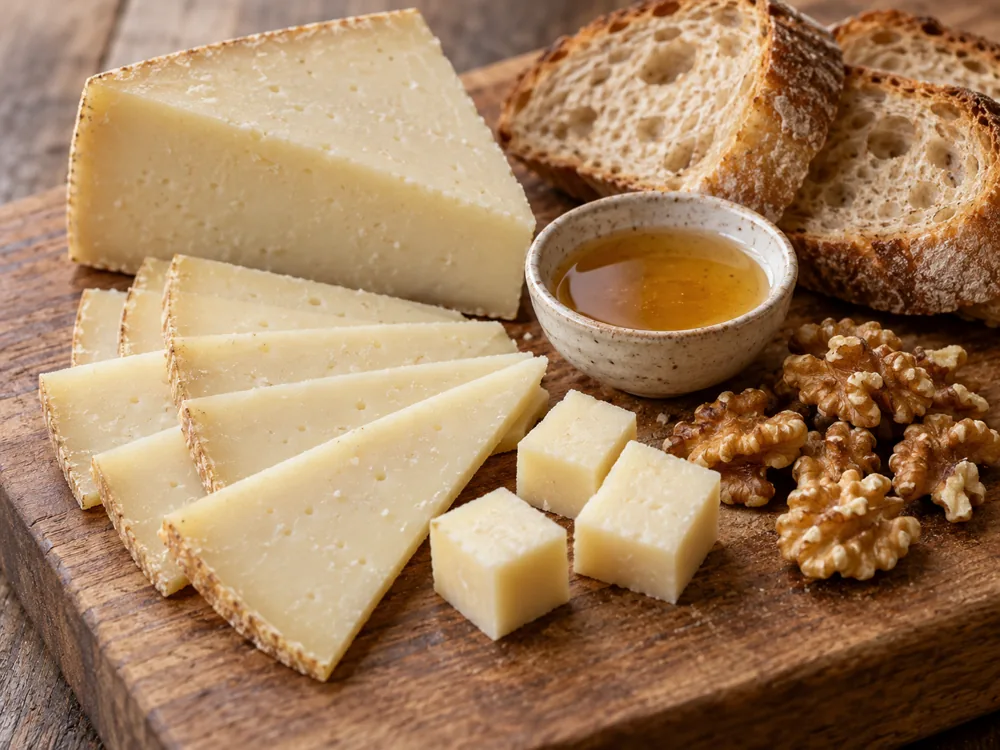
English Wikipedia says Idiazabal is often eaten fresh with quince jam.
Cheese.com says Idiazabal pairs well with red wine and cider.
| Pairing | Type | Why It Works |
|---|---|---|
| Quince jam | Food | English Wikipedia says fresh Idiazabal is often eaten with quince jam. |
| Bread, nuts or honey | Food | Espagne Gourmet lists these with thin slices or cubes of the 1 kg Valle del Baztán smoked cheese. |
| Red wine | Wine | Cheese.com says Idiazabal pairs well with red wine. |
| Cider | Cider | Cheese.com lists cider beside red wine. |
Cut the rind away before serving. The Valle del Baztán ingredient list calls it non-edible, and English Wikipedia calls it inedible.
Keep it in the refrigerator between servings. The CDC says to keep a refrigerator at 40°F (4°C) or below.
Serving at room temperature has a limit, because the CDC says perishable food, which it lists as including dairy, should not be left out for more than 2 hours, or 1 hour above 90°F.
What Is on the Idiazabal Nutrition Label?
Two kinds of figure exist: the label on a 1 kg Valle del Baztán smoked cheese sold by Espagne Gourmet, and the regulatory council's figures for cheese ripened six months.
| Source | Energy | Fat | Saturated fat | Carbohydrate | Protein | Salt | Calcium |
|---|---|---|---|---|---|---|---|
| Valle del Baztán smoked, via Espagne Gourmet | 429 kcal (1,777 kJ) | 36 g | 25 g | 0.2 g | 25 g | 1.7 g | Not given |
| Regulatory council, six months ripened | 385 kcal | 33 g | Not given | Not given | 21 g | 1.8 g | 1,873 mg |
The two sets differ by 44 kcal, 3 g of fat and 4 g of protein per 100 g, and neither source says why. Foods and Wines from Spain says ripening dries the cheese, so any per-100 g figure moves with how much water a wheel has lost, which makes the label on the pack in hand the better guide.
The specification states fat only as a share of dry matter. At least 45% of at least 55% dry matter works out, by our arithmetic, to a floor near 24.8 g of fat per 100 g, and both published figures sit above it.
By our arithmetic from the Espagne Gourmet label, a 30 g piece carries about 129 kcal, 10.8 g fat, 7.5 g protein and 0.5 g salt. The council's six-month figure puts the calcium in the same portion at roughly 560 mg.
Is Idiazabal Safe in Pregnancy?
Idiazabal is always made from raw milk, because the specification allows nothing else, so advice on eating cheese during pregnancy depends on which health agency you follow.
The NHS lists pasteurised or unpasteurised hard cheeses, such as cheddar, gruyère and parmesan, as safe to eat in pregnancy. The CDC lists hard cheese made with pasteurized milk among its safer choices, and its list does not include raw-milk hard cheese.
Cheese.com classes Idiazabal as hard, so by our reading it falls in the NHS hard-cheese group but outside the CDC's safer list.
The CDC also says pregnant women are 10 times more likely to get a Listeria infection.
What Can You Buy Instead of Idiazabal?
Manchego is the other protected Spanish sheep's-milk cheese in this group, made from Manchega sheep's milk instead of Latxa or Carranzana.
| Measure | Idiazabal (specification) | Manchego (English Wikipedia) |
|---|---|---|
| Milk | Raw Latxa and Carranzana sheep's milk only | Manchega sheep's milk, raw or pasteurised; raw may be labelled artesano |
| Minimum ageing | 60 days at every size | 60 days, or 30 days for cheeses up to 1.5 kg |
| Longest ageing named | None in the specification | 2 years |
| Weight | 1 to 3.5 kg | 0.4 to 4.0 kg |
| Size | 8 to 12 cm high, 10 to 30 cm across | Up to 12 cm high, up to 22 cm across |
| Rind | Hard, pale yellow or whitish grey, up to dark brown when smoked | Inedible, yellow to brownish-beige |
| Smoke | Optional | Not described |
| Seal | Serial-numbered casein plate and numbered back label | Casein tab and a numbered council label |
The milk rule is the biggest difference for a shopper, since Idiazabal is always raw and English Wikipedia says Manchego may be made from pasteurised or raw milk.
Manchego's curado stage, at 3 to 6 months, sits nearest the four-to-eight-month window given for Idiazabal. Its viejo stage, aged 1 to 2 years, is the one English Wikipedia says grates well.
None of these sources describes a smoked Manchego, so no swap here covers the smoke note.
SOURCES & REFERENCES
Idiazabal Cheese FAQ
No. Smoking is optional under the specification, and it says more unsmoked Idiazabal is sold today than smoked.
At least 60 days. Foods and Wines from Spain and the regulatory council say it shows best at four to eight months.
No. The specification requires animal rennet, and the Valle del Baztán label we checked also lists lysozyme from egg.
The Valle del Baztán ingredient list calls the rind non-edible and English Wikipedia calls it inedible, so cut it away.
No. Idiazabal is made only from raw Latxa and Carranzana sheep's milk, while English Wikipedia says Manchego is made from Manchega sheep's milk, raw or pasteurised.