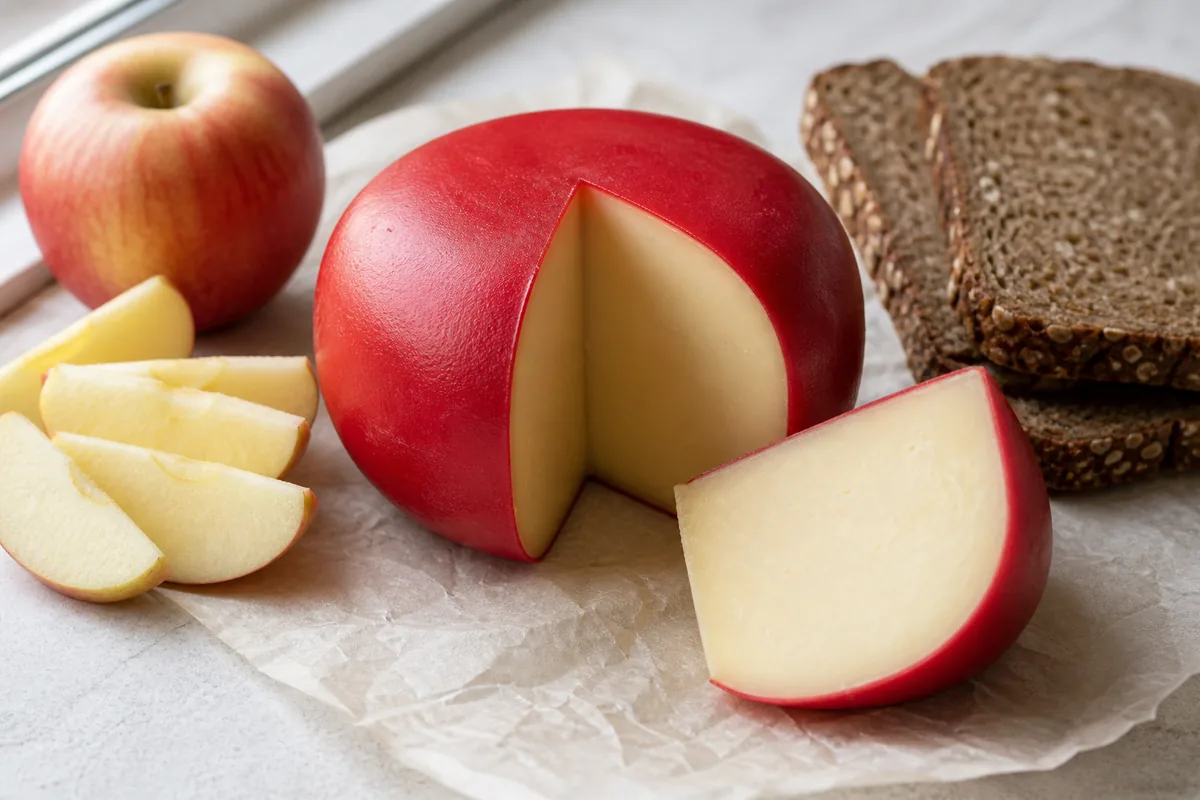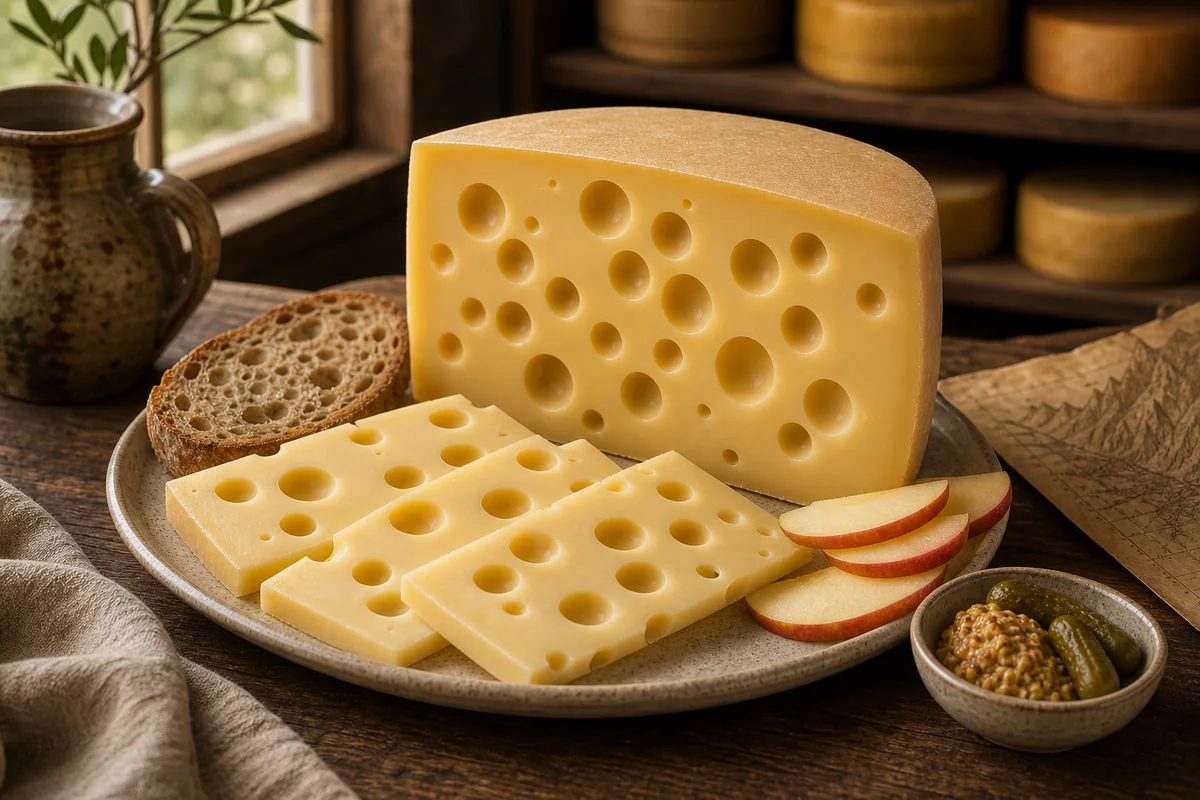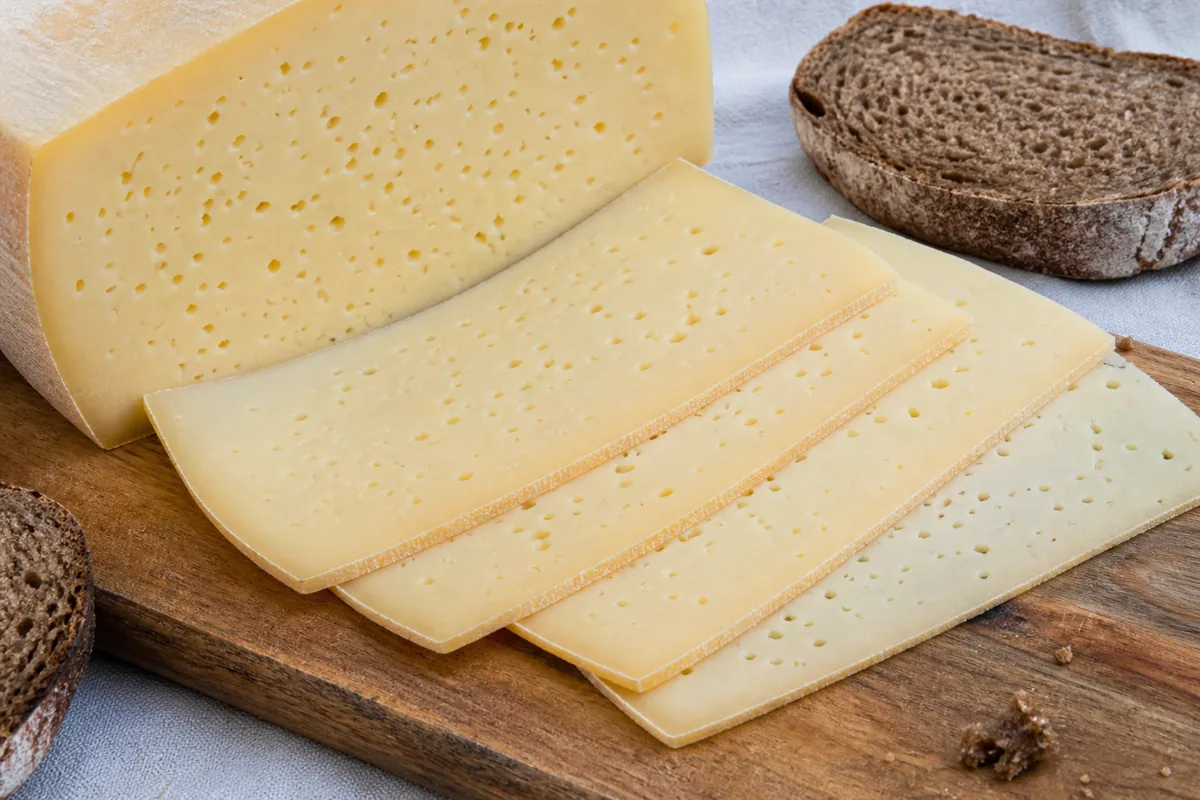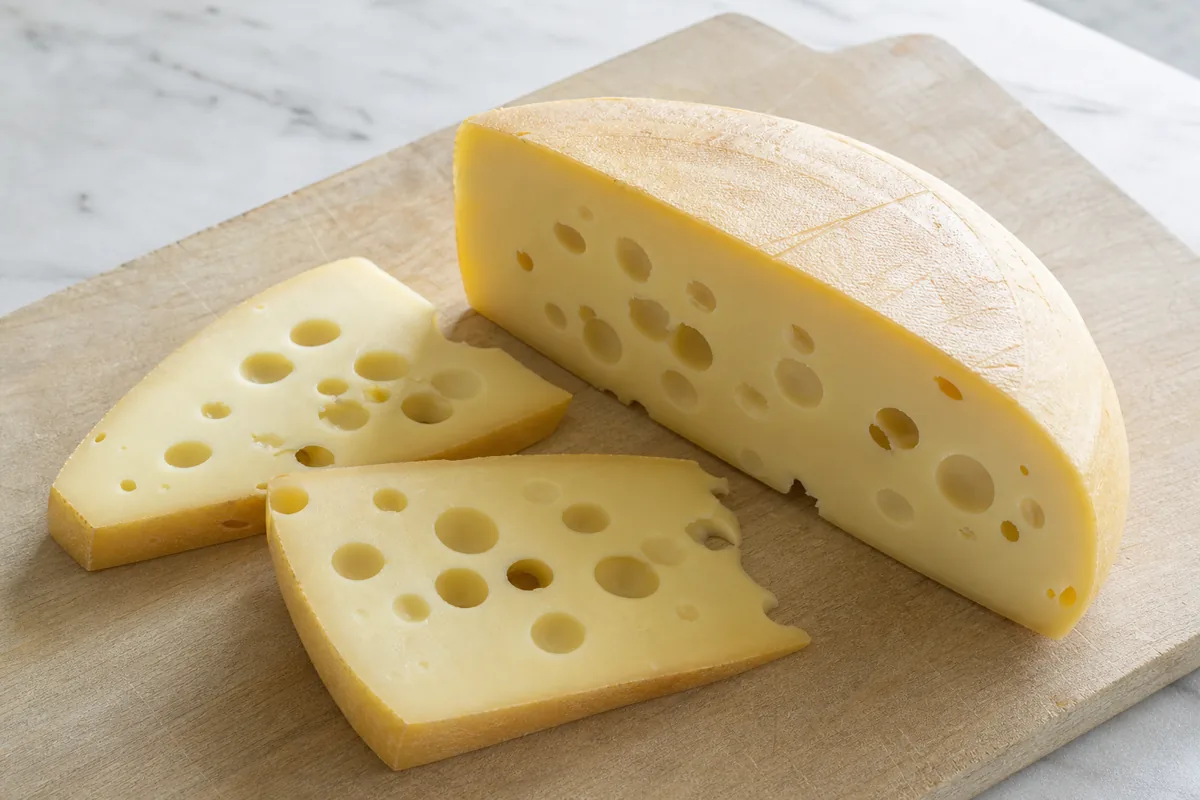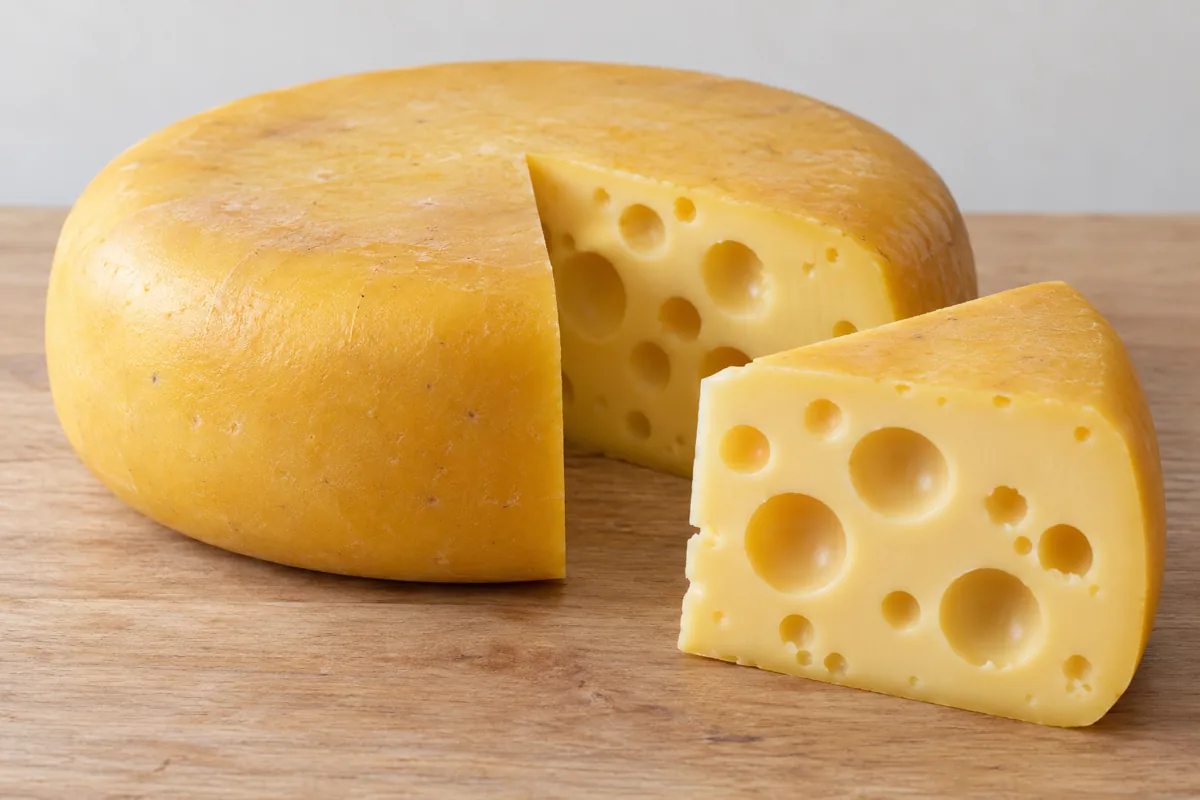
Maasdam is a Dutch cheese with round holes and a sweet, nutty taste, first sold under the Leerdammer brand. Its holes come from the same kind of bacterium that makes the eyes in Emmental, but Maasdam is softer, and English Wikipedia says it was created to be cheaper and quicker to make.
In This Article
What Is Maasdam Cheese?
Cheese.com describes Maasdam as a semi-hard cheese made from pasteurised cow's milk. English Wikipedia names it after the village of Maasdam in the province of South Holland.
When you buy Maasdam, you are buying a style rather than one maker's product: English Wikipedia says several Dutch companies now make cheese sold as Maasdammer.
Its family ties run in two directions. The Tetra Pak handbook groups it with Gouda and Edam in the same washed-curd, round-eyed class, while Cheesemaking.com describes it as a Dutch reboot of the classic Swiss Emmentaler.
When Did Maasdam Start as Leerdammer and Why Do the Dates Disagree?
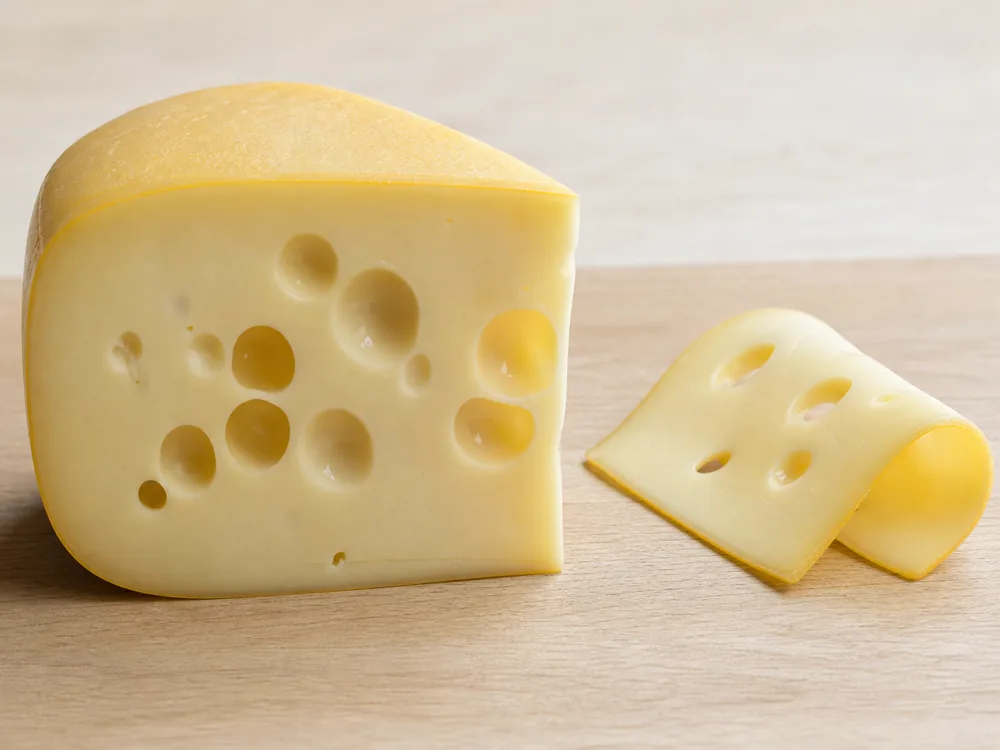
Maasdam began as a branded cheese. English Wikipedia says the Baars company introduced the style in 1984 as the trademarked Leerdammer cheese.
English Wikipedia's Leerdammer page tells the story with other dates, naming Cees Boterkooper, who had owned a small dairy in Schoonrewoerd since 1914, and Bastiaan Baars, who ran a cheese shop in a nearby village. The two met in 1970, and the same page gives 1977 as the launch year.
| Source | Date given | Stated aim |
|---|---|---|
| English Wikipedia, Maasdam | Introduced in 1984 by Baars as Leerdammer | Compete with Swiss Emmentaler by being less expensive and quicker to produce |
| English Wikipedia, Leerdammer | Makers met in 1970; launched in 1977 | Compete with Gouda and Edam; the page's opening also says it was made to resemble Emmental |
| Dutch Wikipedia, Maasdammer | No year given | Compete with Swiss emmentaler, which it says could be made faster and cheaper than other Dutch hard and semi-hard cheeses |
| Cheesemaking.com, recipe | 1980 | A Dutch reboot of the classic Swiss Emmentaler |
| The Cheese Atlas | The 1980s | A domestic alternative to Swiss Emmental |
So English Wikipedia's own pages differ by seven years: its Maasdam page dates the Leerdammer introduction to 1984, and its Leerdammer page dates the launch to 1977.
The dates split by subject. The page about the brand says the 1970s, while the three pages about Maasdam say 1980, the 1980s and 1984, and one reading is that the Leerdammer page dates the brand and the Maasdam pages date the style that other dairies later made under the Maasdam name.
The stated aims differ too, in a way that changes what the dates mean. English Wikipedia says the style is cheaper and quicker to produce than Swiss Emmentaler, whereas Dutch Wikipedia's sentence puts the speed and low cost on the Swiss side.
Read the English way, Maasdam is the cheaper cheese; read the Dutch way, the Emmental method was the cheaper route for a Dutch dairy to copy.
How Is Maasdam Made?
The Cheese Atlas gives the commercial order as pasteurisation, cultures and rennet, cutting and cooking the curd, moulding and pressing, a brine bath and then ripening in climate-controlled facilities. The other sources fill in two of those steps, the curd wash and the ripening.
The Tetra Pak Dairy Processing Handbook says hard and semi-hard cheeses such as Gouda, Havarti, Tilsiter, Maasdam and Edam need their curd grains washed. Washing lowers the lactose in the curd and controls the final pH, which the handbook calls a major factor in the typical smooth texture.
If you make Maasdam at home, Cheesemaking.com's recipe shows what the wash looks like at kitchen scale. It removes 30% of the whey and replaces it with 140°F water, which brings the curd to 102°F.
Taking out lactose removes the food the bacteria live on, so the culture slows its acid production, and the recipe says this leads to a sweeter cheese.
After the wash, the recipe presses its 4-pound cheese lightly, with 8 to 12 pounds of weight, and turns it every hour for 3½ to 5 hours, until the whey no longer tastes distinctly sweet at about pH 5.6. It then brines the cheese for about 8 hours, at 2 hours per pound, and dries it for 12 to 24 hours before ripening.
Ripening then runs in three phases: cool, warm, then cool again.
| Phase | Temperature and humidity | Time | What the recipe says it does |
|---|---|---|---|
| Initial cool ageing | 52 to 54°F, 80 to 85% humidity | About 10 to 14 days | Initial protein changes build the elasticity that will trap the gas |
| Warm ageing | 64 to 68°F, 85 to 90% humidity | About 10 to 14 days | The propionic culture makes carbon dioxide bubbles that form the holes and swell the cheese |
| Final cool ageing | 52 to 54°F, 80 to 85% humidity | 2 to 4 months | Develops the final flavour and character |
The cool phase comes first because, in the recipe's reasoning, the paste needs elasticity before the gas arrives. During the warm phase the recipe turns the cheese once or twice a day to keep the holes evenly distributed.
How Do the Eyes Form?
The holes, called eyes, are pockets of carbon dioxide. The Tetra Pak handbook says the gas is essential for creating holes in round-eyed cheeses, a group it says includes Emmenthal, Maasdam, Gouda and Edam.
Two kinds of bacteria can supply that gas. The handbook credits gas-producing starter bacteria for round eyes in general and propionic bacteria for the big eyes of Emmenthal, while Cheesemaking.com's Maasdam recipe credits its propionic culture for the distinctive holes.
The draining step decides where the gas can collect. When the curd is kept under the surface of the whey during draining and pre-pressing, the handbook says the result is a round-eyed cheese, and its account of eye formation says curd compacted below the whey holds microscopic cavities.
Gas from the starter bacteria first dissolves in the liquid. As growth continues the liquid becomes oversaturated in places, and the gas comes out as small holes.
Once gas production stops for lack of a food such as citric acid, diffusion takes over and enlarges some of the holes while the smallest ones disappear. A large hole takes less gas pressure to enlarge than a small one, and some carbon dioxide escapes from the cheese altogether.
The sources describe the holes differently. The handbook files Maasdam under round eyes, while The Cheese Atlas calls the holes large and irregular.
Because gas enlarges big holes at the expense of small ones, a single wedge you buy can carry eyes of several sizes, which may be what the Atlas means by irregular.
In a home batch, the recipe lists what limits the holes: too much acid before the wash, excess salting that limits the gas producer, curds dried out too far, and too little of the initial cool or warm ripening. It also prefers a 4-gallon batch because the larger mass can better contain gas development.
The same recipe warns that home cheeses may not reach the large holes of commercial Maasdam, and may have smaller ones or none.
Unwanted gas is a separate problem. The handbook names Maasdam among spore-sensitive cheeses, those with low salt, high moisture and ripening at raised temperatures.
Spores of Clostridium tyrobutyricum can make a cheese blow and give it an unpleasant flavour, the handbook says. Sodium nitrate has traditionally been added to prevent this, but because chemical additives have been widely criticised, mechanical removal of spores has been adopted.
For spore-sensitive cheeses such as Maasdam, one pass through a spore-removing separator is not always enough. Two separators in series reduce Clostridia spores by more than 99%, the handbook says.
How Long Is Maasdam Aged?
Cheese.com, English Wikipedia and Dutch Wikipedia all give four weeks as the minimum. The upper end depends on who you ask.
| Source | Ageing given |
|---|---|
| Cheese.com | At least four weeks |
| English Wikipedia | At least four weeks in the text; 1 to 3 months in the infobox |
| Dutch Wikipedia | At least 4 weeks in the text; 1 to 3 months in the infobox |
| Frico, Maasdam Mild wheel | 4 weeks |
| Cheesemaking.com, home recipe | About 2 months in the summary; its three phases add up to longer |
| The Cheese Atlas | About four to twelve months |
| English Wikipedia, Leerdammer | Around 3 to 12 months |
English Wikipedia says Maasdam ripens faster than other cheeses made in the Netherlands, and The Cheese Atlas adds that young Maasdam is creamier and milder while aged versions develop deeper, more complex flavours.
The widest gap is between four weeks and twelve months. The Atlas range sits close to English Wikipedia's 3 to 12 months for Leerdammer, so the long end may describe aged examples of the style.
The recipe's own schedule shows how the numbers relate. Its first two ripening phases take 20 to 28 days, roughly the four-week minimum, and the 2 to 4 months of final cool ageing are where the recipe says the final flavour develops.
Four weeks is the minimum all the sources share, and Frico states 4 weeks on its wheel. Longer figures, from 1 to 3 months in the infobox to four to twelve months at The Cheese Atlas, are ranges for the style rather than an age for any one wheel.
What Does Maasdam Taste Like?
Cheese.com, Frico, The Cheese Atlas and Cheesemaking.com all call Maasdam sweet and nutty. They differ on how strong it is and how the texture feels.
- Cheese.com: a slightly sweet, nutty flavour with a creamy and soft texture.
- Frico: a sweet, nutty and pronounced taste; tender, with a hint of sweetness and a springy texture.
- The Cheese Atlas: mild and nutty with a slightly sweet finish; smooth and creamy with a slight elasticity.
- Cheesemaking.com: creamy and sweet, with buttery, nutty and even subtle fruity notes.
The tasting words do not line up with age. Frico calls its 4-week wheel pronounced, while The Cheese Atlas, which gives the longest ageing range, calls the cheese mild with a slightly sweet finish.
What you can count on is the shared pair of words, sweet and nutty, while strength reads as one writer's judgement. The one cause the sources give for the sweetness is the curd wash described above.
Maasdam vs Emmental
If you are choosing between the two, start with texture: Maasdam is softer than Emmental, and English Wikipedia puts that down to its higher moisture.
| Point | Maasdam | Emmental |
|---|---|---|
| Country | Netherlands | Emmental's home country of Switzerland |
| Milk | Pasteurised cow's milk (Cheese.com, Frico) | Traditional Swiss Emmenthal is a raw milk cheese (Tetra Pak handbook) |
| Curd | Washed with warm water; a home recipe takes it to 102°F (Tetra Pak handbook, Cheesemaking.com) | Scalded at 50 to 56°C (Tetra Pak handbook) |
| Texture | Softer, with more moisture (English Wikipedia) | The firmer cheese of the two |
| Holes | Round-eyed (Tetra Pak handbook); large and irregular (The Cheese Atlas) | Big eyes from propionic bacteria (Tetra Pak handbook) |
Emmenthal's curd is scalded at 50 to 56°C, and the handbook says only the most heat-tolerant bacteria survive that. One that does is the propionic bacterium it calls very important to the character of Emmenthal.
Maasdam's recipe takes a gentler route. After the wash the curd reaches only about 39°C (102°F), and the propionic culture goes in with the starter cultures at 92°F.
The handbook puts Maasdam in the same washed-curd, round-eyed group as Gouda and Edam, which fits Cheese.com's Gouda-family label. The propionic culture and the warm ripening phase in the recipe are the steps that tie it to Emmental.
Is Maasdam the Same as Leerdammer?
Leerdammer is the trademarked brand and Maasdam the generic name. English Wikipedia says Leerdammer is produced exclusively by the Bel Group, that its name is a trademark of Bel Leerdammer B.V., and that generic cheese in this style is sold as Maasdam.
On 22 March 2021, according to the same page, Bel announced it was handing the Leerdammer brand and its related assets to Lactalis in exchange for most of the shares Lactalis held in Bel.
The page describes Leerdammer as pale yellow and creamy, made to resemble Emmental in appearance and flavour, with a sweet and somewhat nutty flavour that becomes more pronounced with age. It gives Leerdammer a longer ageing time than Maasdam's four-week minimum, as the ageing table shows.
Leerdammer is made in Schoonrewoerd, in Dalfsen in Overijssel and in France, the page says, while Maasdam is made by several Dutch companies.
When you compare packs, Leerdammer names one brand's cheese and Maasdam names the style. So the label's own age, milk and rennet lines are the only way you can tell one Maasdam from another.
How Can You Use Maasdam in Sandwiches, Hot Dishes and Salads?
The Cheese Atlas names ham and cheese sandwiches, paninis and grilled cheese among Maasdam's uses, and it says the semi-hard texture makes Maasdam easy to slice or grate.
For hot dishes, the Atlas says Maasdam's melting characteristics suit sauces, pasta dishes, baked recipes and pizza toppings. It also suggests shredded or cubed Maasdam in a mixed green salad with nuts and dried fruits.
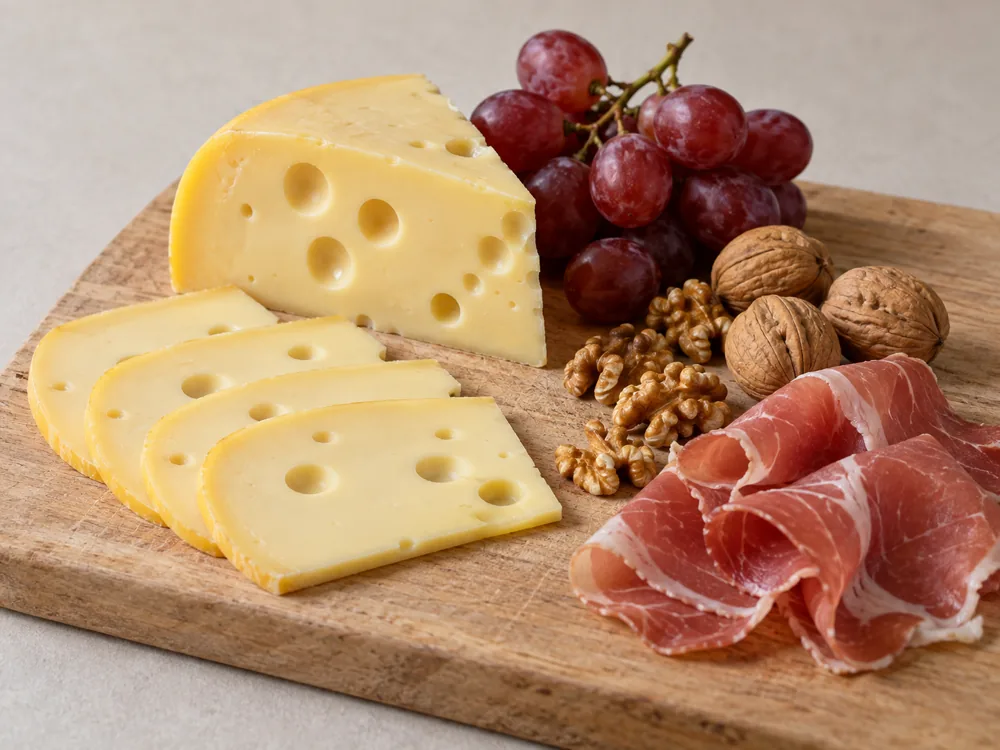
The Atlas adds that Maasdam's mild flavour and appearance suit a cheese board, and Frico's page calls the texture tender and springy.
What Goes with Maasdam?
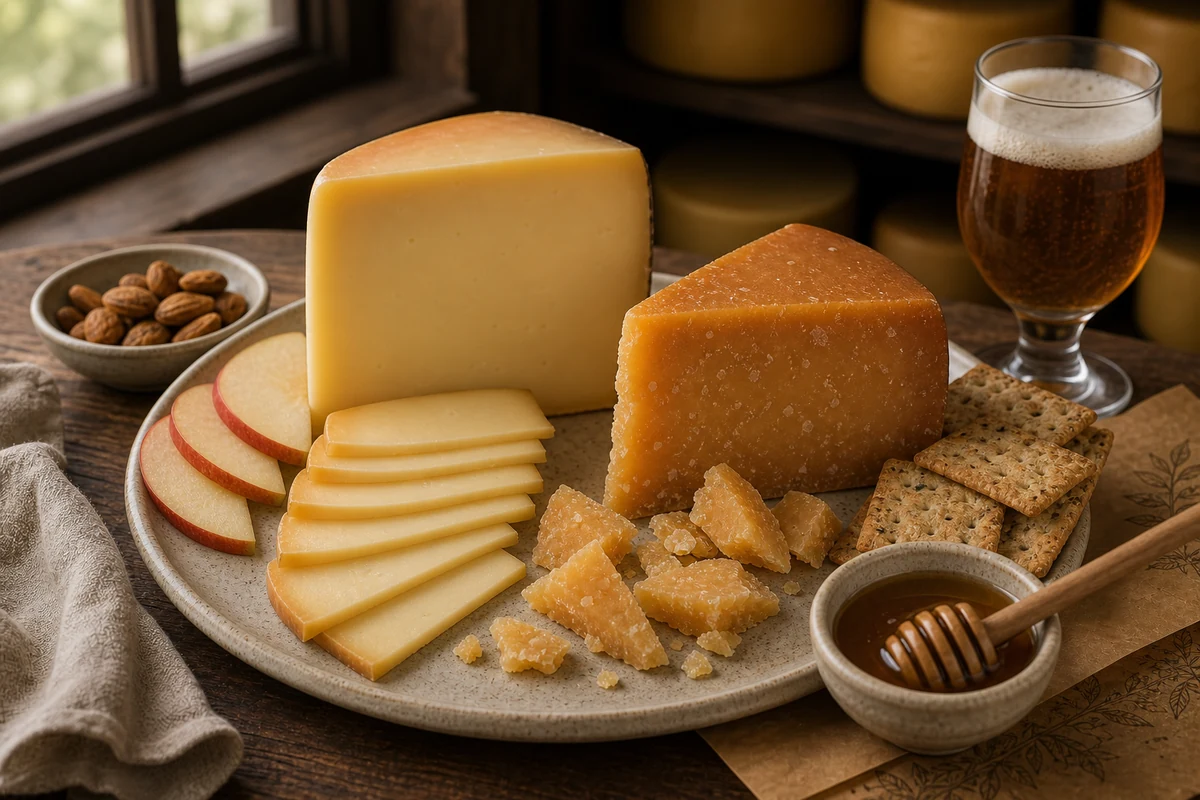
For a drink or a sweet partner, the named pairings below come from The Cheese Atlas, and Cheese.com adds fruit and nuts in general.
| Pairing | Type | Why It Works |
|---|---|---|
| Honey or sweet chutney | Food | The Cheese Atlas says either drizzled or spooned over Maasdam enhances its natural sweetness. |
| Riesling or crisp Chardonnay | Wine | The Cheese Atlas suggests a light, fruity white wine. |
| Pinot Noir | Wine | The Cheese Atlas pick for red wine drinkers, medium-bodied, said to complement the nuttiness. |
| Apple cider | Cider | The Cheese Atlas lists it as a refreshing non-alcoholic option. |
| Light herbal tea | Drink | The Cheese Atlas lists it alongside cider as a non-alcoholic option. |
The Atlas's reasons follow the sweet and nutty flavours the tasting notes above share. Honey and sweet chutney lean on the sweetness, and the Pinot Noir is chosen for the nuttiness.
For serving Maasdam on a cheese board, The Cheese Atlas suggests fruits, nuts and a selection of cured meats alongside it.
What Should You Check When Buying Maasdam?
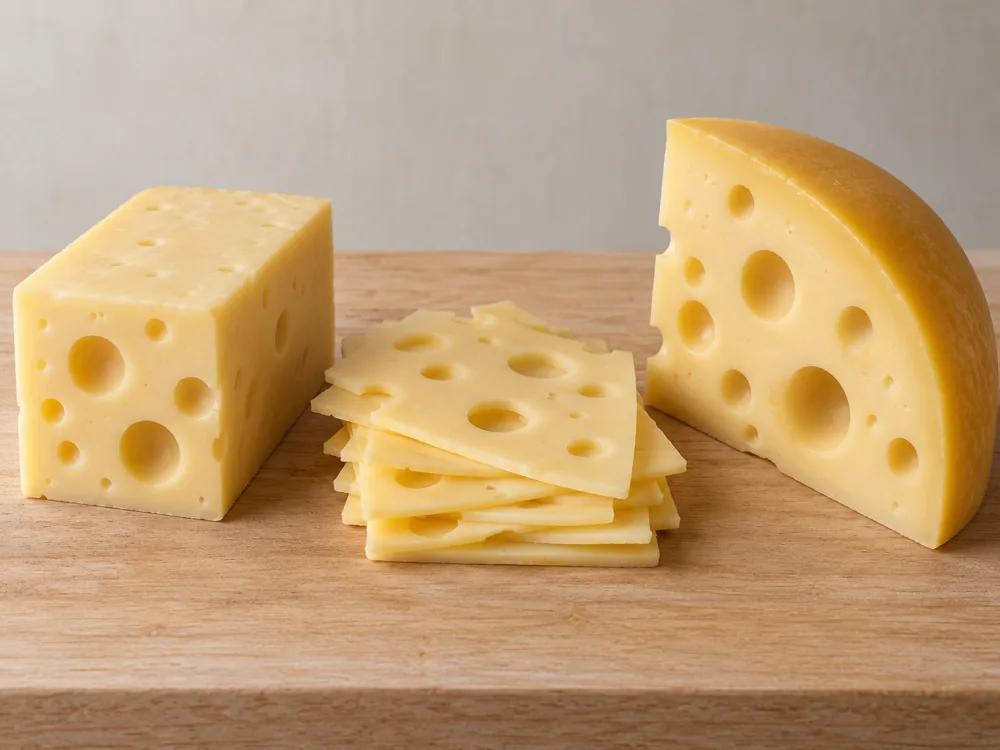
You can buy Maasdam in many shapes. Frico lists its Maasdam Mild as a wheel, slices, a loaf, a slices multipack, a rindless block and wedges.
The ingredient list is short. Frico's label reads pasteurised cow's milk, salt, starter culture and microbial rennet.
That rennet detail belongs to one brand, so if you avoid animal rennet, check the ingredient list on any other Maasdam. You can also check the rind, which English Wikipedia describes as smooth and yellow.
What Are the Nutrition Facts for Maasdam?
Frico's label gives 27 g of fat and 26.5 g of protein per 100 g of its Maasdam Mild wheel, as the table shows.
| Per 100 g | Wheel |
|---|---|
| Energy | 1,473 kJ / 354 kcal |
| Fat | 27 g |
| Saturated fat | 19 g |
| Carbohydrate (of which sugars) | 0 g (0 g) |
| Protein | 26.5 g |
| Salt | 1.2 g |
| Calcium | 859 mg |
| Vitamin B12 | 1.9 µg |
English and Dutch Wikipedia give Maasdam 45% fat, a figure not to be read as 45 g in every 100 g. Frico's label shows 27 g of fat in 100 g of its wheel.
Is Maasdam Safe During Pregnancy?
The NHS lists pasteurised semi-hard cheeses, such as edam, as safe to eat in pregnancy, but it does not name Maasdam. Cheese.com calls Maasdam semi-hard and English Wikipedia calls it medium-hard, so the NHS list does not settle it.
The CDC safer list names hard cheese made with pasteurized milk and certain pasteurized soft cheeses; it names neither Maasdam nor semi-hard cheese. Cheese.com, English Wikipedia and Frico's label describe Maasdam as pasteurised, but a midwife or doctor can confirm it for your pregnancy.
The NHS gives the reason: unpasteurised or soft ripened dairy foods may contain listeria, which can cause miscarriage or stillbirth, or make a newborn baby very unwell.
The NHS list of cheese safe during pregnancy also includes pasteurised or unpasteurised hard cheeses, such as cheddar, gruyère and parmesan.
SOURCES & REFERENCES
What Else Do People Ask About Maasdam?
These short answers cover Maasdam's link to Leerdammer, its holes, its age, its rennet, its milk and its taste, each with its source.
Not quite. Leerdammer is a trademarked brand, and English Wikipedia says the Maasdam style began as Leerdammer and that generic cheese in the style is sold as Maasdam.
Carbon dioxide gas collects in the curd and forms the holes. The Tetra Pak handbook calls Maasdam a round-eyed cheese, and Cheesemaking.com's recipe credits a propionic culture in the warm ripening phase.
At least four weeks according to Cheese.com and both Wikipedias. Frico ages its Maasdam Mild wheel for 4 weeks, and The Cheese Atlas gives about four to twelve months.
Frico's label lists microbial rennet. For other brands, check the ingredient list on the pack.
Cheese.com, English Wikipedia and Frico's label all describe Maasdam made from pasteurised cow's milk.
Sweet and nutty in every cited source. Frico calls the taste pronounced, while The Cheese Atlas calls it mild with a slightly sweet finish.