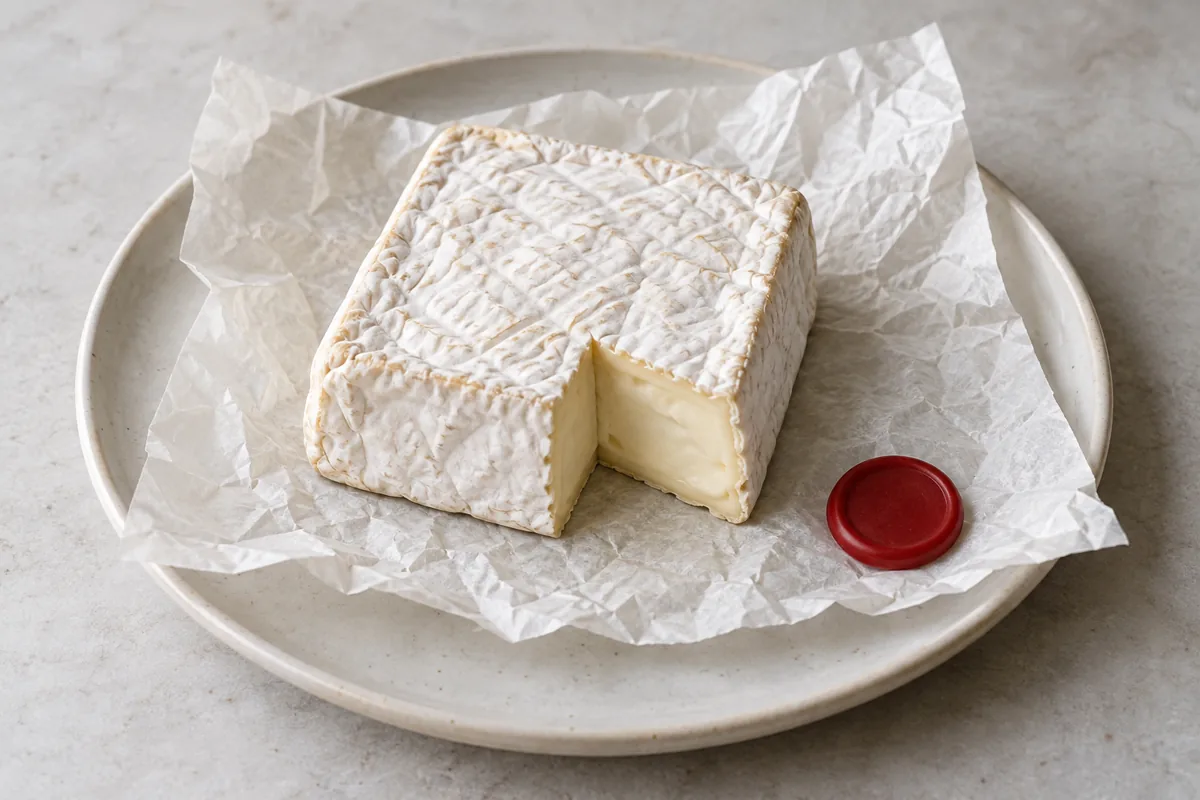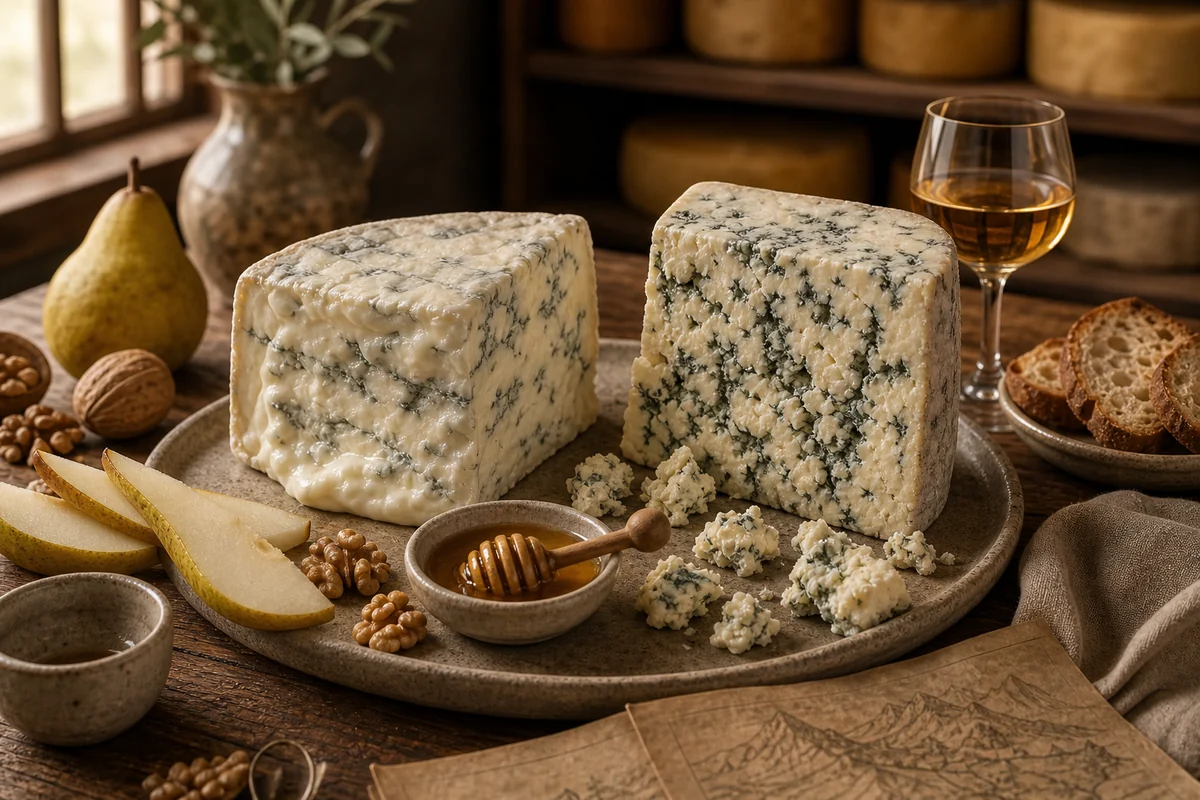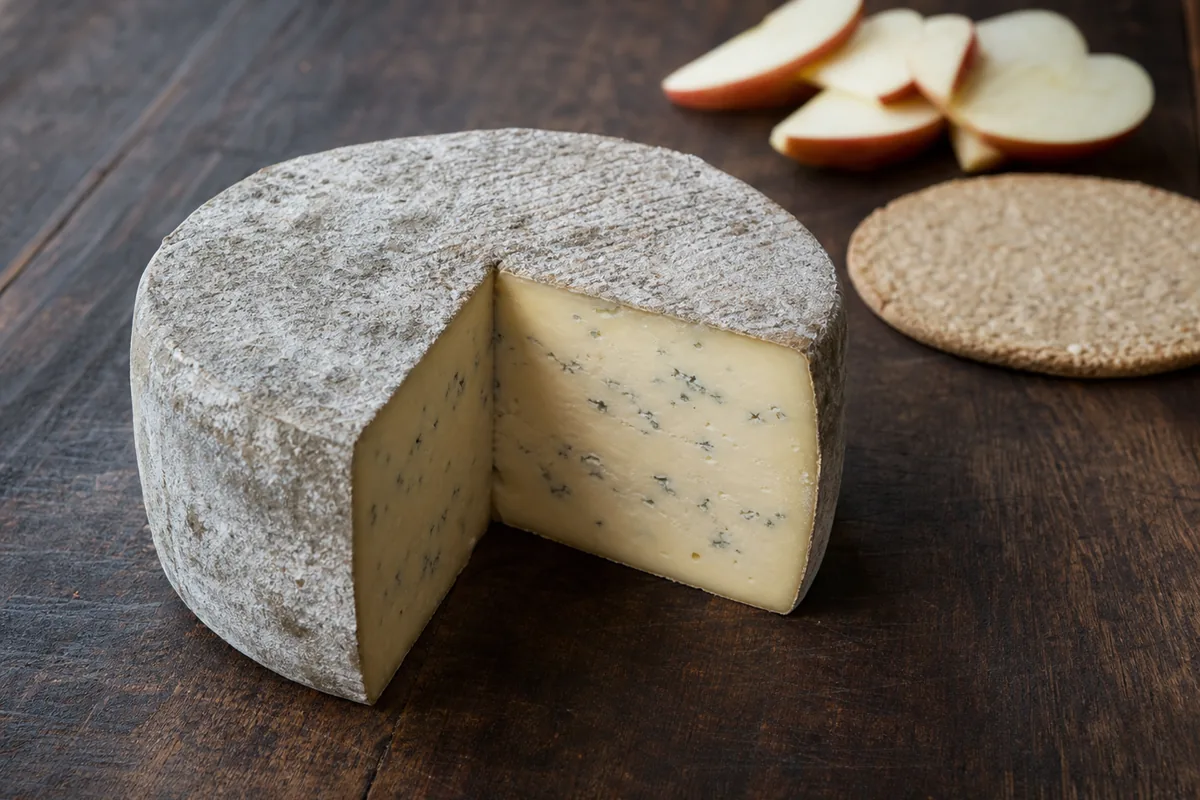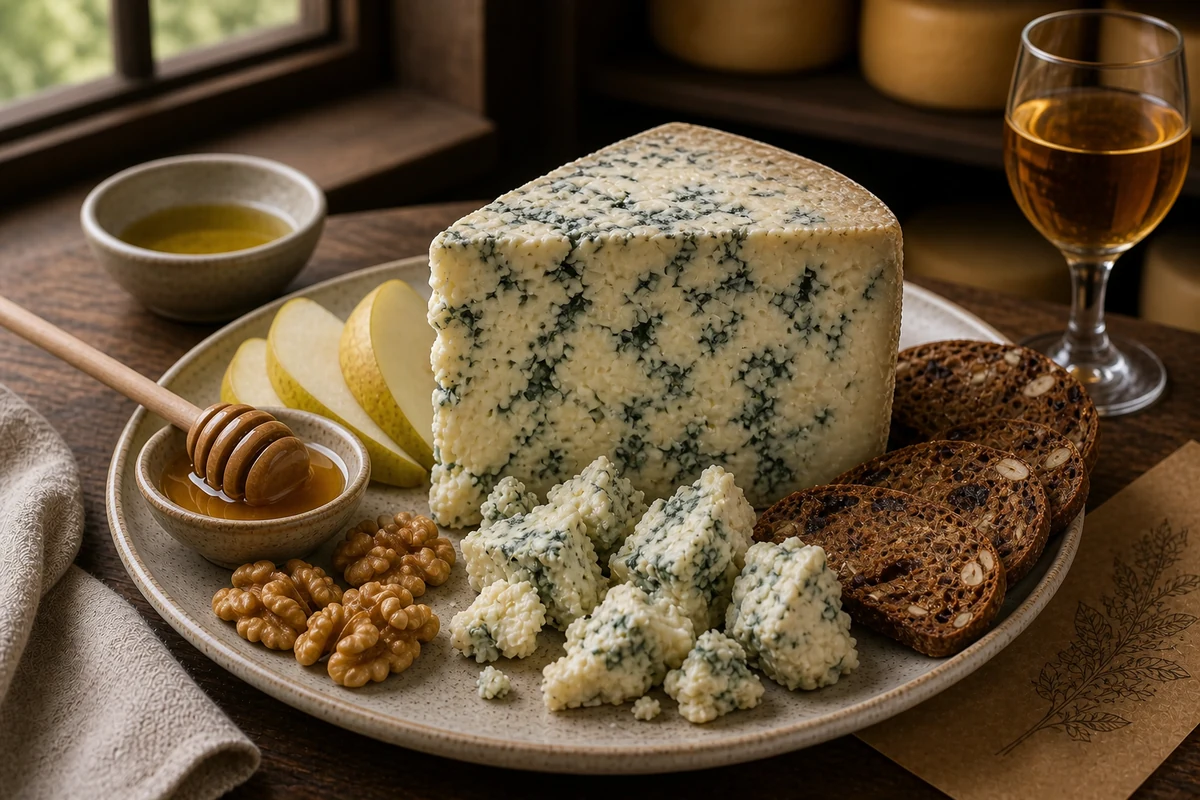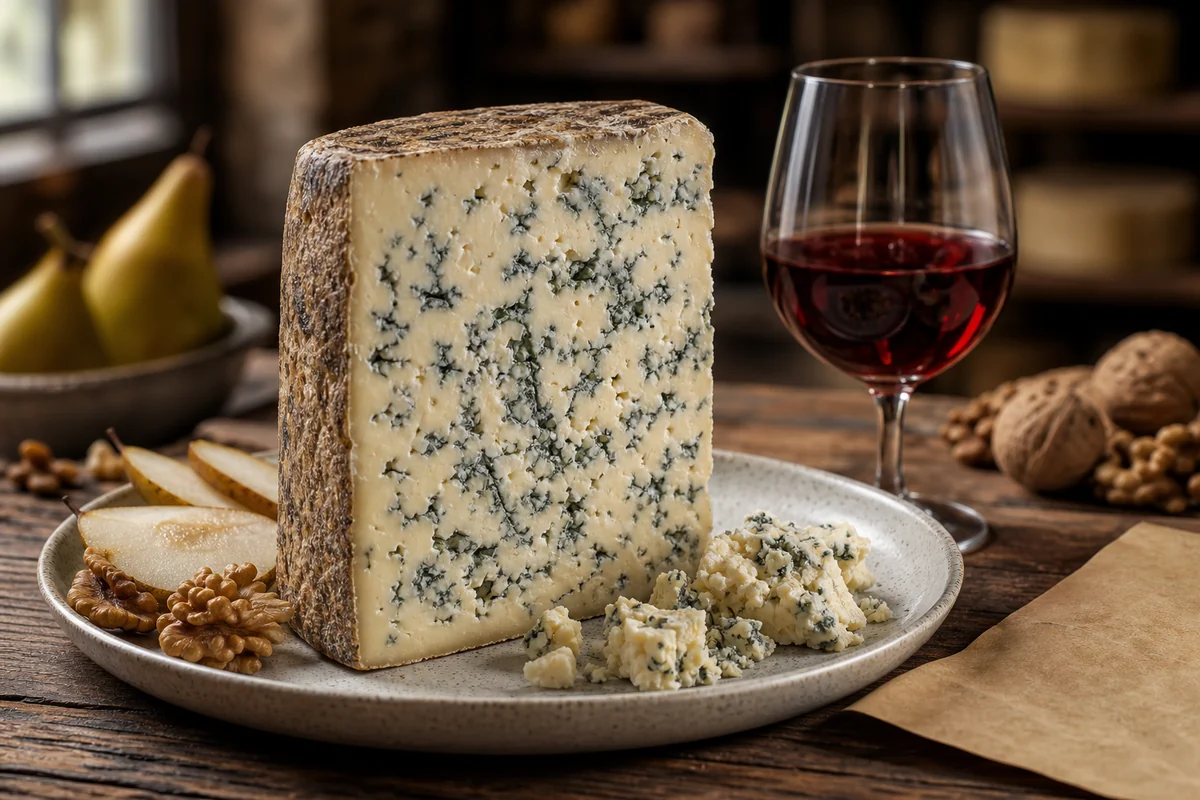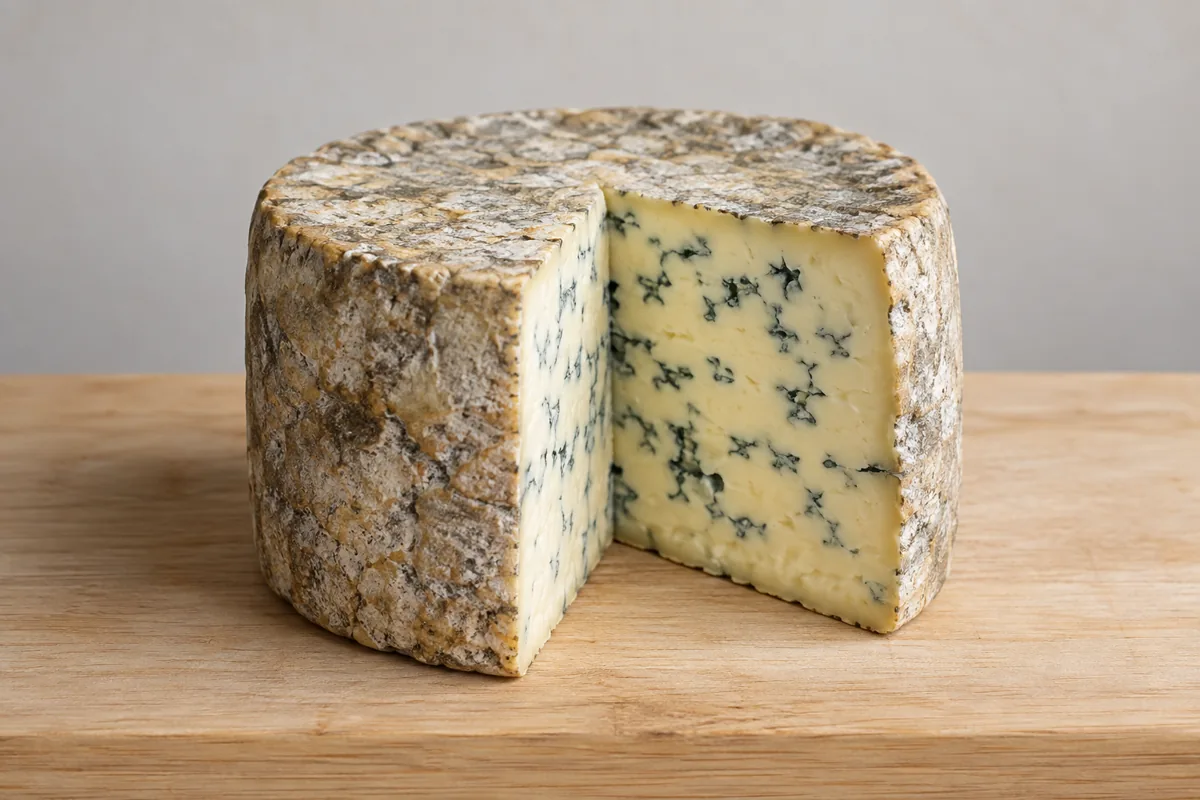
Bath Blue is a pasteurised organic cow's milk blue cheese made by Bath Soft Cheese Co. at Park Farm in Kelston, near Bath, and ripened for eight to ten weeks.
The producer says it follows a traditional Stilton recipe, yet it cannot carry the Stilton name, and it contains animal rennet, so it is not vegetarian.
In This Article
What Is Bath Blue Made From?
Park Farm makes Bath Blue from the milk of its own cows, and Fine Cheese Co. prints the ingredients as organic cows' milk, sea salt, animal rennet, mould culture and starter culture. The milk is pasteurised: the producer's FAQ says it is heated and held at 63°C for 30 minutes, and that the company sells no raw milk.
Pong Cheese says the company is registered with Organic Farmers and Growers, which bars fungicides, pesticides and artificial fertilisers. The Cheese Shed says the milk has been certified organic since 2002, and the Morning Advertiser quoted Graham Padfield in 2014 giving a herd of 160 organic cows.
If organic certification is the reason you are buying it, look for it on the label of the piece you choose.
The producer's FAQ says Bath Blue and Bath Soft Cheese contain traditional rennet and are not vegetarian, while its Wyfe of Bath and Kelston Park are, so a vegetarian buying from Park Farm can look at those two instead.
Four generations of Padfields have worked the land at Park Farm, and Hugh Padfield's great-grandmother made what was most likely a simple Cheddar in the farmhouse kitchen.
His father Graham revived cheesemaking there in the 1990s, and the two of them began experimenting with a blue cheese around 2007 to 2008.
Why Can't Bath Blue Be Called Stilton?
Bath Blue is made at Park Farm, near Bath in South West England, which lies outside the three counties where Stilton must be made, so the name is closed to it however closely the recipe is followed.
Wikipedia says Stilton has been a protected designation of origin since 1996, and that it must be made in Derbyshire, Leicestershire or Nottinghamshire from pasteurised local milk. Place is a stricter test than method: Stilton cannot even be made in the village of Stilton, because the village lies in Cambridgeshire.
Milk is a second, separate test. Academy of Cheese says the PDO forbids unpasteurised milk, and Wikipedia calls Stichelton virtually identical to Blue Stilton but barred from the name because it does not use pasteurised milk.
Bath Blue uses pasteurised milk, so it fails on place only. The producer sells it under its own name, Bath Blue Traditional English Blue Cheese, and that is the name to look for when you want it.
| Bath Blue | PDO Stilton |
|---|---|
| Kelston, near Bath | Derbyshire, Leicestershire or Nottinghamshire |
| Pasteurised | Pasteurised, unpasteurised forbidden |
| Eight to ten weeks per the producer | Nine to twelve weeks, nine as the minimum, per Wikipedia |
How Is Bath Blue Made?
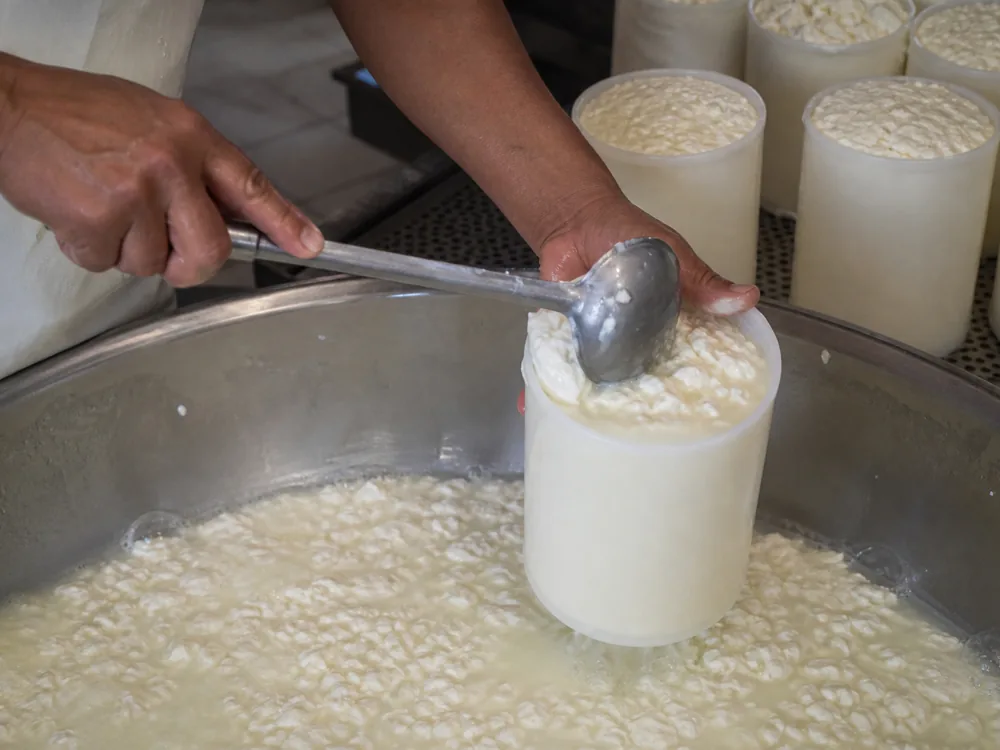
Bath Blue is made in very small batches, in a vat about half the size of the smallest Stilton maker's and then in individual buckets.
The producer says every stage is done entirely by hand, and The Cheese Geek describes the curds as hand-ladled. In 2014 Graham Padfield told the Morning Advertiser that the curds are milled by hand and that the cheese is made without any mechanisation.
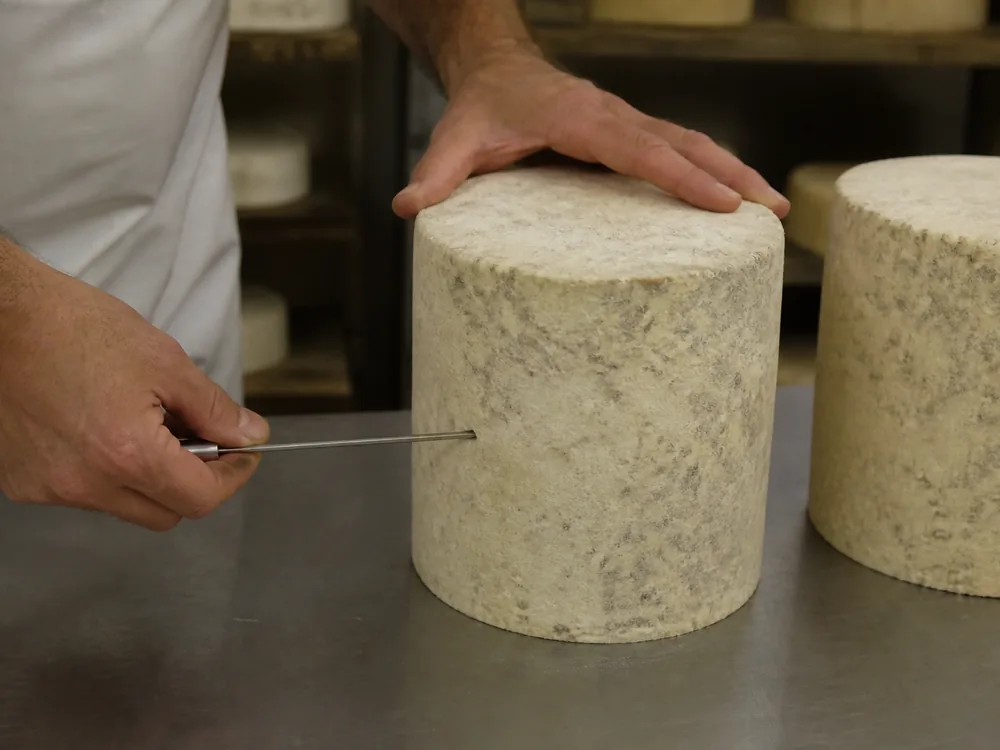
The Cheese Geek says every cheese is pierced by hand, so the seven cheesemakers can feel the moisture and adapt the piercing to each one. Cheese.com places the ripening that follows in traditional stone-built rooms.
What Does Bath Blue Taste Like?
Expect a creamy blue: creamy is the word Park Farm, Cheese.com, The Cheese Shed and Fine Cheese Co. use for it.
| Source | Words used |
|---|---|
| Park Farm | Creamy, tangy flavour |
| Cheese.com | Creamy and smooth texture, cream colour, creamy flavour, clean aroma |
| The Cheese Shed | Creamy, smooth, evenly-spaced blue veins, clean aroma |
| Fine Cheese Co. | Creamy with even blueing throughout, single cream and light vegetal notes |
| The Cheese Geek | Sharp saltiness balanced by richness, a long lingering toasted hazelnut and melted butter on toast finish, strength listed as strong |
| Bristol Cheesemonger | Softer texture than Stilton, a citrusy note on the palate |
How strong it tastes depends on who describes it: The Cheese Geek rates Bath Blue strong, while Park Farm and Cheese.com stress creaminess, so treat the strength as unsettled until you taste a piece. The Cheese Geek also describes sharp saltiness balanced by richness, with a long lingering toasted hazelnut and melted butter on toast finish.
If you know Stilton, Bristol Cheesemonger's comparison helps: it describes Bath Blue as softer in texture than Stilton, with a citrusy note on the palate.
Fine Cheese Co. calls the blueing even throughout and the flavour single cream with light vegetal notes, and Cheese.com lists the rind as natural.
What Did Bath Blue Win at the 2014 World Cheese Awards?
Bath Blue was named Supreme Champion at the World Cheese Awards in 2014, and Park Farm says it is one of only six British winners of that title still made today.
The awards ran alongside the BBC Good Food Show at London Olympia on 14 November, and Bath Blue was the last cheese the super jury tasted, winning by only two points.
The field was more than 2,500 cheeses from 33 countries by the Morning Advertiser's count, or 2,700 by Pong Cheese's, which dates that figure to the 2014/15 awards. The title describes the cheeses judged on that day in 2014.
Is Bath Blue Safe During Pregnancy?
Bath Blue is pasteurised and creamy with blue veins, so it fits differently into pregnancy cheese advice depending on which guidance you follow.
The NHS says pasteurised or unpasteurised soft blue-veined cheeses, such as Danish blue, gorgonzola and roquefort, must be thoroughly cooked. The same page lists hard cheeses such as cheddar, gruyère and parmesan as safe whether they are pasteurised or not.
CDC lists soft cheese made from unpasteurized milk, with blue-veined cheese among its examples, as a riskier choice. It lists pasteurized soft cheeses heated to an internal temperature of 165°F or until steaming hot as safer.
Retailers call Bath Blue creamy and softer than Stilton, and it is blue-veined, so the NHS line for soft blue-veined cheeses above is the one to follow, and it must be thoroughly cooked. Served cold, Bath Blue is described as a pasteurized creamy, smooth blue-veined cheese, a type the CDC list does not cover, so ask a midwife or doctor.
What Sizes Does Bath Blue Come In, and How Long Does It Keep?
You can buy anything from Park Farm's 200 g segments to an 8 kg whole cheese at The Cheese Shed, and no two sellers list the same set.
| Seller | Sizes listed |
|---|---|
| Park Farm | 200 g segments, 1.5 kg wheel |
| Bristol Cheesemonger | 250 g, 500 g, 750 g, 1 kg |
| Fine Cheese Co. | 250 g, 500 g, 1 kg |
| The Cheese Shed | Wedges of 200 g, 300 g, 600 g and 1.2 kg, a 2 kg wheel, a 4 kg half cheese and an 8 kg whole cheese |
A wheel weighs 1.5 kg at Park Farm and 2 kg at The Cheese Shed, so check the weight on the listing when you order one. For smaller pieces, Fine Cheese Co. lists 250 g at £10.68, 500 g at £21.35 and 1 kg at £42.70.
Park Farm prints a use-by date on each wrapper and says its cut pieces carry at least 7 days of shelf life from the date of dispatch.
Keep it refrigerated below 8°C. Eat pieces of 500 g or more within 14 days of receipt, and smaller pieces within 10 days.
SOURCES & REFERENCES
What Else Do People Ask About Bath Blue?
It follows a traditional Stilton recipe, but it cannot be sold as Stilton. The name is limited to Derbyshire, Leicestershire and Nottinghamshire, and Park Farm is near Bath.
Pong Cheese, The Cheese Shed and Fine Cheese Co. all describe it as organic, and Pong Cheese says the company is registered with Organic Farmers and Growers. If certification matters to you, check the label of the piece you buy.
No. The producer's FAQ says Bath Blue contains traditional rennet and is not vegetarian, and Fine Cheese Co. lists animal rennet.
It is pasteurised, but the NHS says pasteurised or unpasteurised soft blue-veined cheeses must be thoroughly cooked. Served cold, Bath Blue is described as a pasteurized creamy, smooth blue-veined cheese, a type the CDC list does not cover, so ask a midwife or doctor.
Park Farm gives eight to ten weeks, and Cheese.com places the ripening in traditional stone-built rooms.