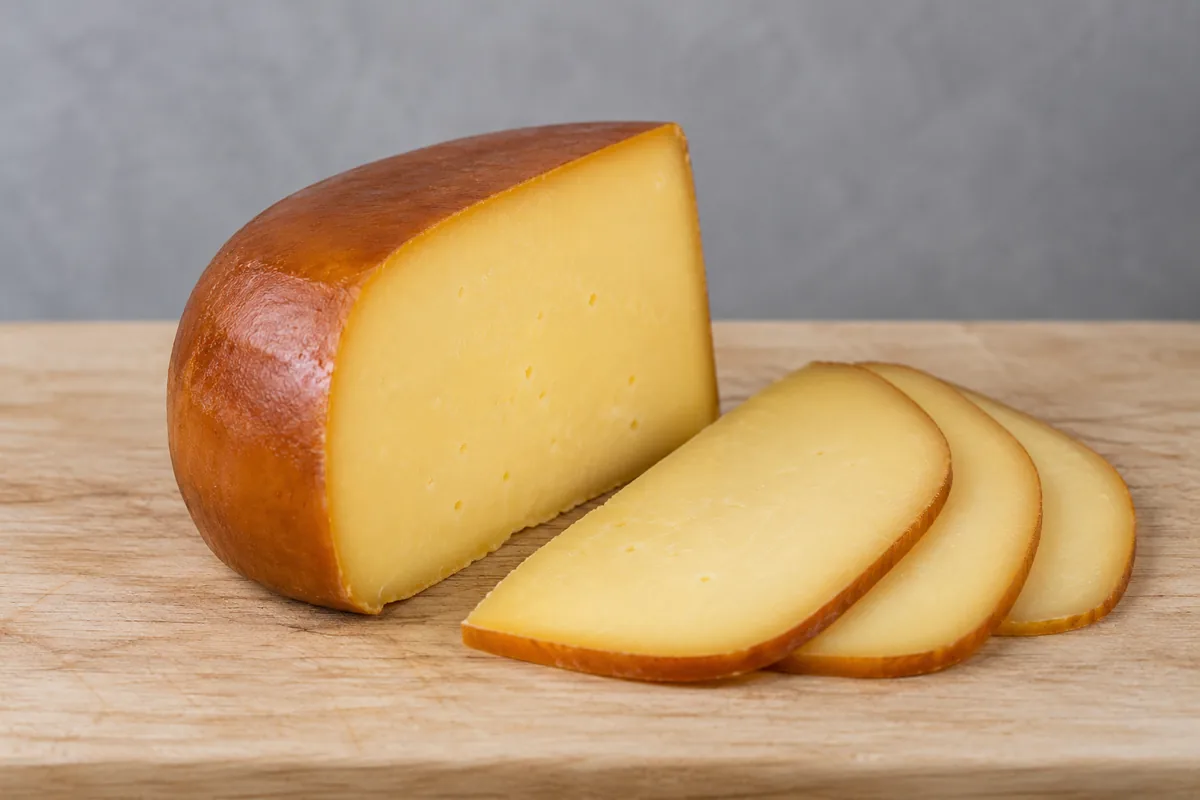
Smoked Gouda is Gouda that has been smoked, usually over hardwood such as hickory, which gives the creamy yellow cheese a darker outside and a smoky finish.
The method changes from maker to maker: some smoke the finished cheese, one smokes the curd, and cheaper smoked cheeses may get smoke flavoring instead of smoke.
In This Article
What Is Smoked Gouda?
Cheese.com lists smoked Gouda as a cheese from the Netherlands, smoked with hardwood chips or sawdust in a smokehouse or smoking chamber. It gives the milk as pasteurized or unpasteurized cow's, goat's or sheep's milk; Saxelby Cheesemongers lists Marieke's as raw cow's milk, while Castello's label says only pasteurized part-skim milk.
The base cheese is plain Gouda, which Cheese.com says originates in the Dutch city of Gouda.
Wisconsin Cheese describes Holland-born Gouda as creamy, washed-curd and slightly sweet, and the Gouda made in its own state as cultured and buttermilk-rich.
Two of the smoked Goudas checked for this article come from Wisconsin. Castello has made Gouda in Hollandtown since 1936, and Saxelby Cheesemongers says Marieke Penterman's Hollands Family Cheese makes its smoked Gouda in northern Wisconsin.
Castello says it was the first U.S. manufacturer to install an authentic Gouda forming system, in the 1990s. Saxelby adds that Marieke Penterman's family moved from the Netherlands and milks Holstein-Friesian cows, a breed it says was developed for dairying in Holland.
Saxelby also lists American Cheese Society (ACS) placings for Marieke's smoked Gouda: second in 2025, first in 2024 and second in 2023, in a category it labels smoked Gouda, all milks.
How Is Gouda Smoked?
English Wikipedia's smoked cheese article gives two temperature ranges for smoking food. Cold smoking runs at 20 to 30°C (68 to 86°F) and can take up to a month, while hot smoking runs at 40 to 90°C (104 to 194°F) and partly or fully cooks the food.
Cheese.com adds that the time in the smoke controls how strong the flavour gets.
The makers checked here describe three routes to the same result, and all three use hickory.
| Source | What is smoked | Wood | Milk |
|---|---|---|---|
| Castello Smoked Gouda | Finished Gouda, lightly smoked | Hickory wood chips | Pasteurized part-skim milk (species not named) |
| Hilmar TruSmoke Gouda | The curd, during manufacturing | Hickory | — |
| Marieke Smoked Gouda (Zingerman's Deli) | Farmhouse Gouda aged 60 days | Hickory | Raw milk; cow's milk per Saxelby |
| Cheese.com | The cheese, in a smokehouse or smoking chamber | Hardwood chips or sawdust | Cow's, goat's or sheep's; pasteurized or not |
Hilmar's method is the odd one out. Smoke goes into the curd before the cheese is formed, so Hilmar says the flavour runs evenly through the block and the outside does not darken.
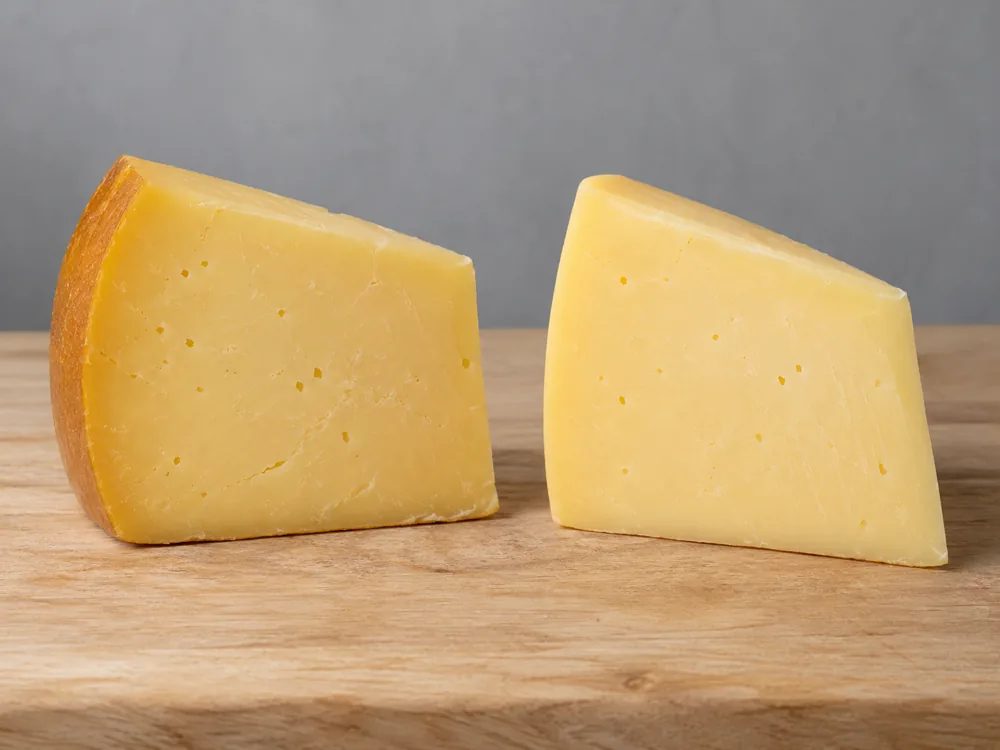
Hilmar's page invites readers to contact a sales manager, ask about ingredients or request a sample, and it says the cheese is not available for export. Castello's page lists 7 oz and 8 oz retail packs.
Cheese.com places the smoke after the curds are cut, cooked and pressed and says the cheese is usually aged afterwards, while Zingerman's says Marieke's Gouda is aged 60 days first and smoked after that. Hilmar smokes the curd, earlier than either order, so there are three different moments for the smoke to meet the cheese.
Zingerman's also calls Marieke's cheese specifically formulated batches of farmhouse Gouda, which suggests the cheese is made with smoking in mind.
Hilmar calls its smoking slow and Castello calls its smoking light. The cold and hot ranges above describe smoking in general and do not show which one a given Gouda gets.
Cheese.com's own pages differ on the fuel: the main page describes brick ovens over hickory chip embers and, elsewhere, hardwood chips or sawdust, while the substitutes page says hickory or mesquite wood chips.
Does Smoked Gouda Use Real Wood Smoke or Smoke Flavoring?
English Wikipedia says less expensive smoked cheeses often get artificial smoke flavoring, plus food colouring so the outside looks as if it had been smoked the traditional way. Real smoking, by the same account, leaves a yellowish-brown outer layer called a pellicle.
Colour alone is therefore weak evidence, and the maker's wording carries more.
- Brown outside: fits real smoking, but cheaper cheeses can get the same look from food colouring.
- Pale outside: does not rule smoke out, since Hilmar's curd-smoked cheese has no darker outside.
- Named wood and method: the clue every maker checked here gives, and Hilmar adds that its smoke puts no extra ingredient on the label.
Hilmar's page names liquid smoke as the other route and claims its wood-chip smoke gives a better cheese than both liquid and traditional smoking.
Castello's ingredient list runs milk, salt, culture, microbial rennet and annatto, with nothing that names smoke flavoring.
Can You Eat the Rind or Wax on Smoked Gouda?
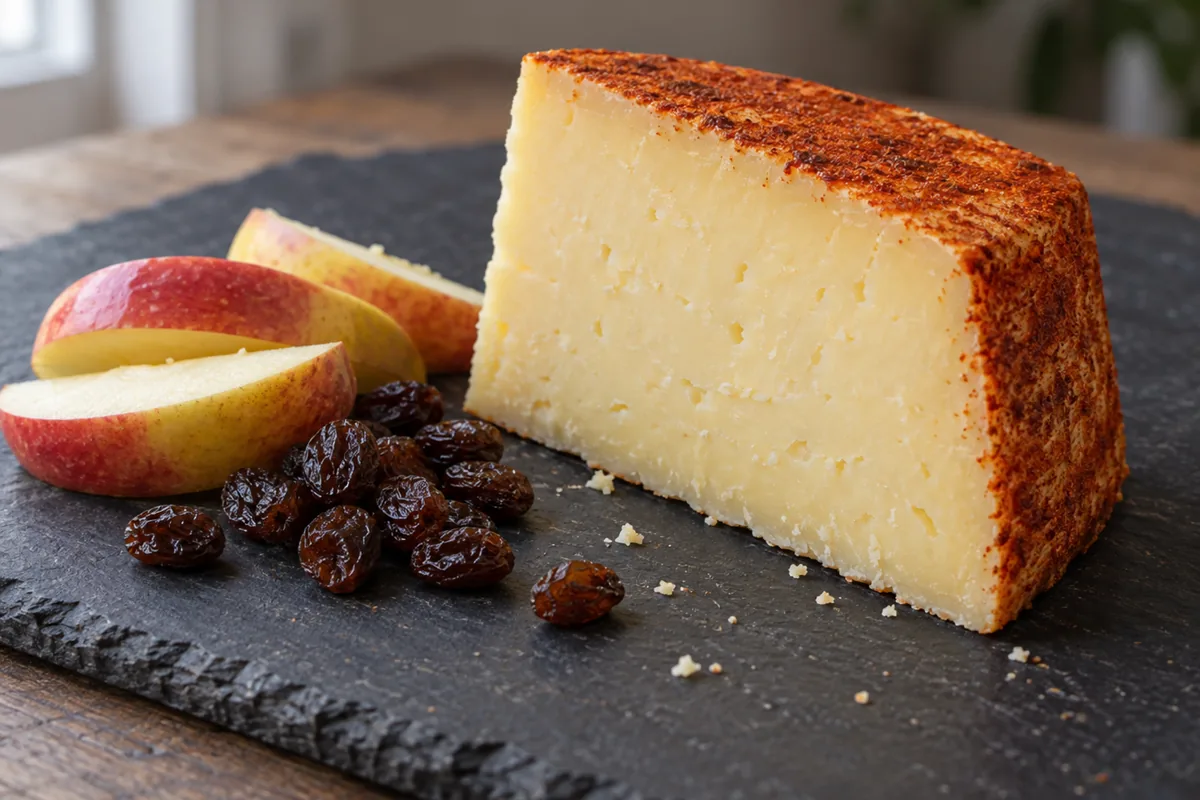
Cheese.com describes smoked Gouda as a firm cheese with an edible brown rind around a creamy yellow interior.
Wisconsin Cheese says Gouda in general often carries a red, yellow, black or brown wax coating.
Wisconsin Cheese says to remove Gouda's thick paraffin wax coating before serving.
Brown appears on both lists, so a brown outside does not show by itself whether a wedge has an edible rind or a wax coat that comes off.
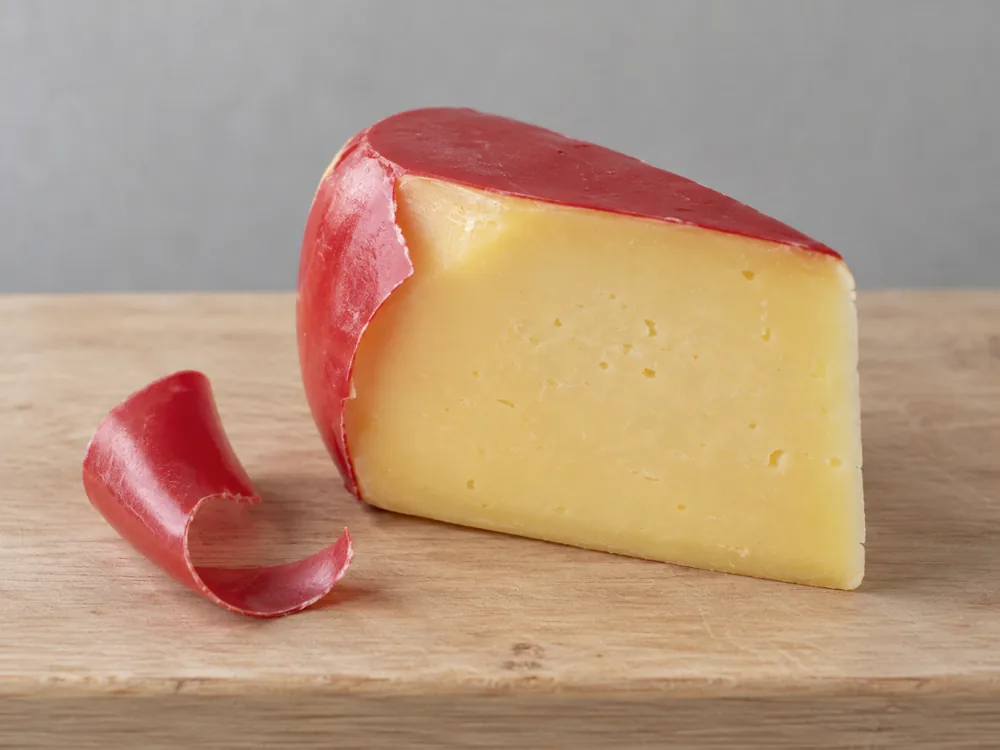
Before serving a branded smoked Gouda, check the pack or ask the seller whether its outside is an edible rind or a wax coat to remove.
For choosing a wedge, Cheese.com describes a slightly firm texture with a creamy consistency, and a rind that is smooth and free of mould or discoloration.
Is Smoked Gouda Young or Aged?
Saxelby calls Marieke's smoked Gouda young, and Hilmar lists its TruSmoke Gouda as a semi-hard, young Gouda.
Cheese.com describes an older one, saying smoked Gouda is aged for several months, which fits the crystals it reports but not the young cheeses Saxelby and Hilmar describe.
The base cheese sets the texture. Wisconsin Cheese describes young Gouda as sweet, springy, smooth and creamy, and aged Gouda as complex, dense and slightly crystalline.
By that description, crystals in the paste mark the older kind of smoked Gouda, and a smooth, springy wedge points to the younger kind.
What Does Smoked Gouda Taste Like?
Cheese.com calls smoked Gouda slightly sweet, buttery and smoky with a subtle tanginess, and gives it a distinct campfire aroma. Its texture is creamy with a firm body, and crystals form as the cheese ages.
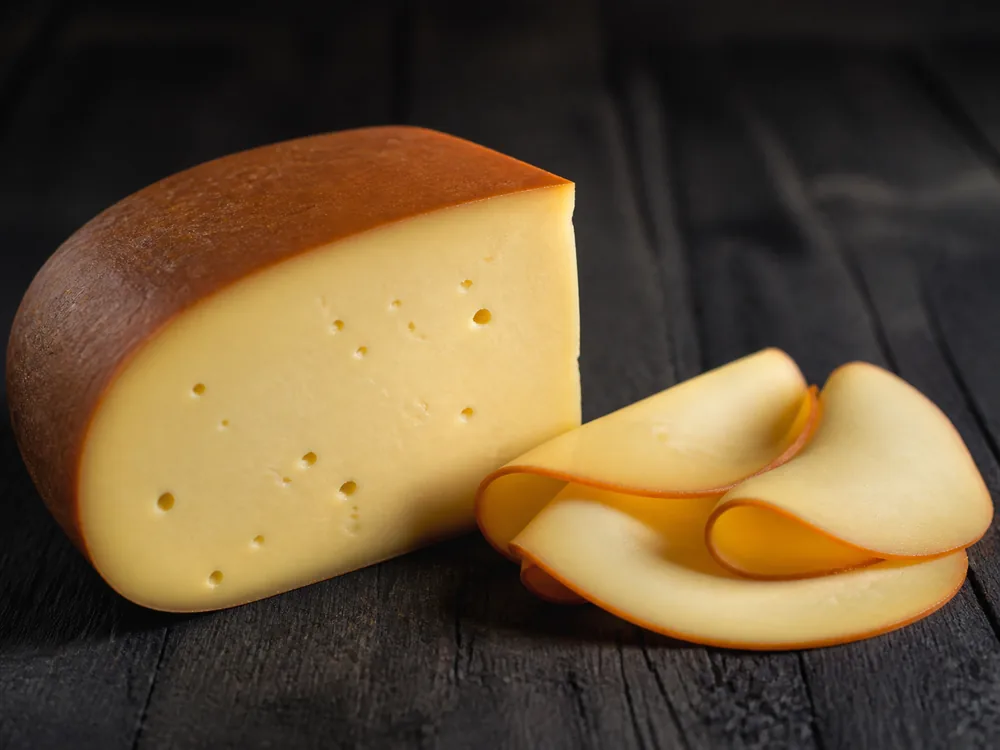
Castello rates its smoked Gouda 2 out of 6 for strength, which it calls mild, and lists buttery, nutty, rich and creamy notes with subtle smoke.
Castello lists the texture as creamy, smooth and melting in the mouth.
Saxelby Cheesemongers describes Marieke's raw-milk version as rich and creamy, with a measured savory smoke.
Castello's mild 2 out of 6 and Cheese.com's campfire aroma sit far apart, and because Cheese.com says the time in the smoke sets the strength, the name smoked Gouda alone does not tell a buyer how smoky a wedge will taste.
How to Cook With Smoked Gouda
Cheese.com names grilled cheese sandwiches, macaroni and cheese, sandwiches, burgers and pasta as uses for smoked Gouda.
Cheese.com, Castello and Saxelby all name smoked Gouda as a burger topping, and each maker adds other dishes.
| Use | How It Works |
|---|---|
| Gratin | Saxelby calls Marieke's smoked Gouda a melter for gratin. |
| Hot chicken or turkey sandwiches | Wisconsin Cheese's suggestion, along with grilled meats. |
| Shredded topping | Castello suggests shredding it over favourite recipes. |
| Snacking | Castello lists eating it as a snack. |
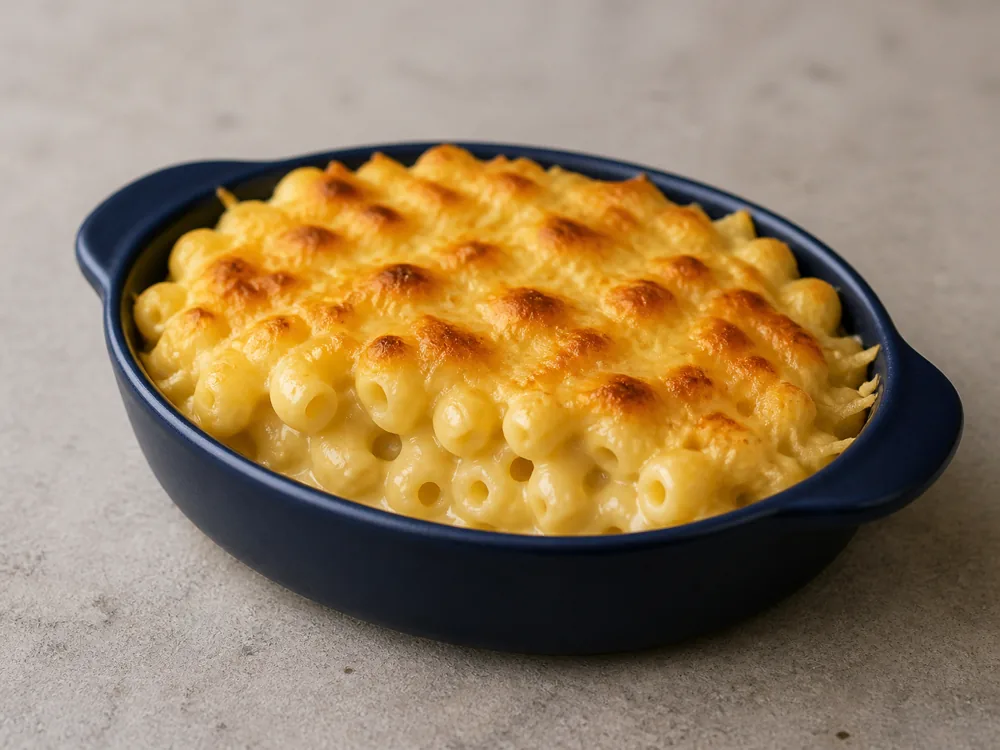
Age bears on melting: Wisconsin Cheese calls young Gouda an excellent melting cheese for casseroles, gratins and pastas, and says young and aged Gouda both suit a sandwich, snack or dessert board.
Saxelby and Hilmar describe young cheese, which puts their smoked Goudas on the melting side of that line.
Castello's recipe list includes a mac and cheese that uses smoked Gouda and smoked Havarti together.
What Can You Use Instead of Smoked Gouda?
Cheese.com's substitutes page names eight cheeses and says they may not replicate the exact smoky taste: Gruyère, Muenster and Provolone offer similar melting, while Edam, Emmental, Monterey Jack, Fontina and Havarti offer comparable textures.
| Substitute | What it keeps | What it lacks |
|---|---|---|
| Smoked Provolone | A taste that closely resembles smoked Gouda, and good melting | Nothing the page names; plain Provolone has no smoky undertones |
| Gruyère | A rich, robust flavour, a smooth creamy texture and good melting | Smoky undertones |
| Muenster | A creamy consistency and good melting | The bold smoky taste; it is milder |
| Edam | Texture and meltability | Smoke; its flavour is lighter and less pronounced |
| Emmental | A semi-hard texture that melts quickly, with a nutty flavour | Smoky undertones |
| Monterey Jack | Versatility and smooth melting | Smoke; its flavour is less bold |
| Fontina | Texture and meltability, creamy and gooey when melted | Smoke; its flavour is milder |
| Havarti | A mild, creamy taste and gooey melting | Smokiness |
Smoked Provolone is the one stand-in Cheese.com says tastes close to smoked Gouda, because the smoked version of that cheese carries smoky undertones.
Hilmar's TruSmoke range puts hickory smoke into Cheddar, Provolone and Mozzarella as well as Gouda, so smoked versions of those bases exist.
English Wikipedia names smoked Gruyère, Rauchkäse, Scamorza, Sulguni, Oscypek and Fynsk rygeost among the smoked cheeses commonly sold, which widens the list beyond what Hilmar makes.
The choice therefore depends on what the dish needs: the plain cheeses on Cheese.com's list can supply the melt, and the smoke itself has to come from a smoked cheese.
What to Pair With Smoked Gouda
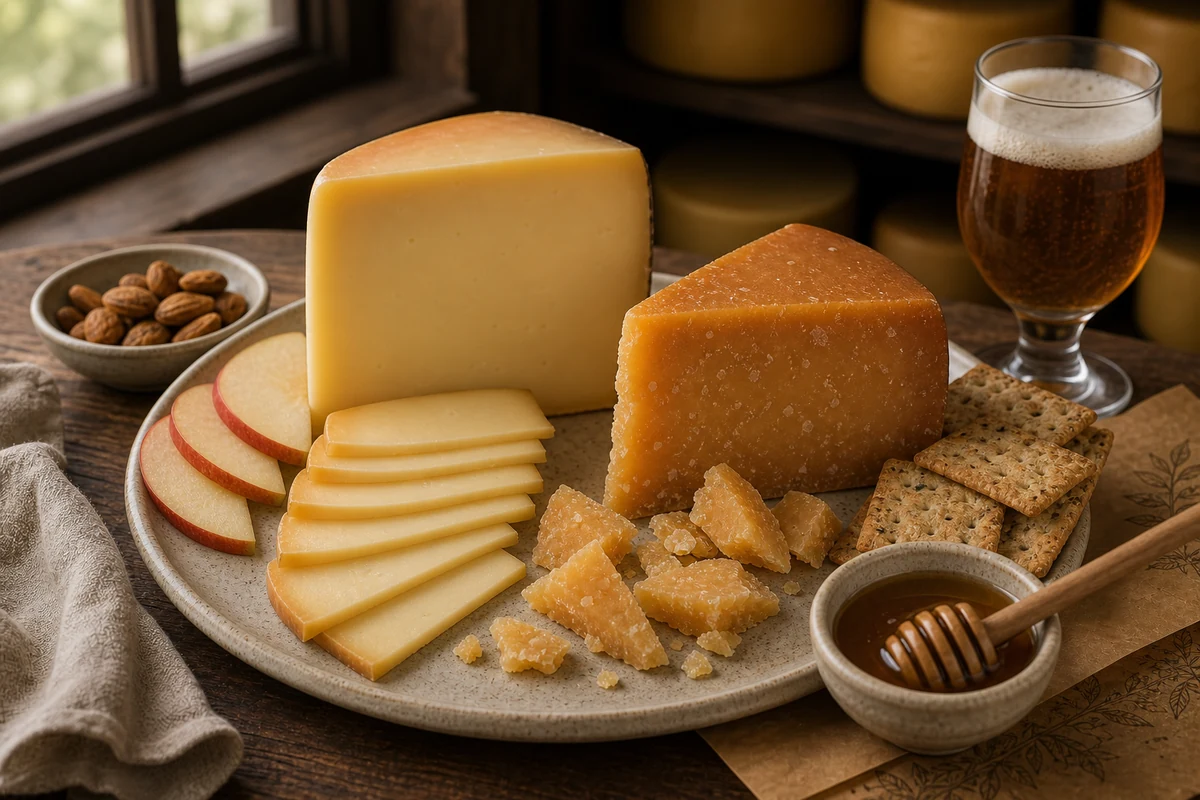
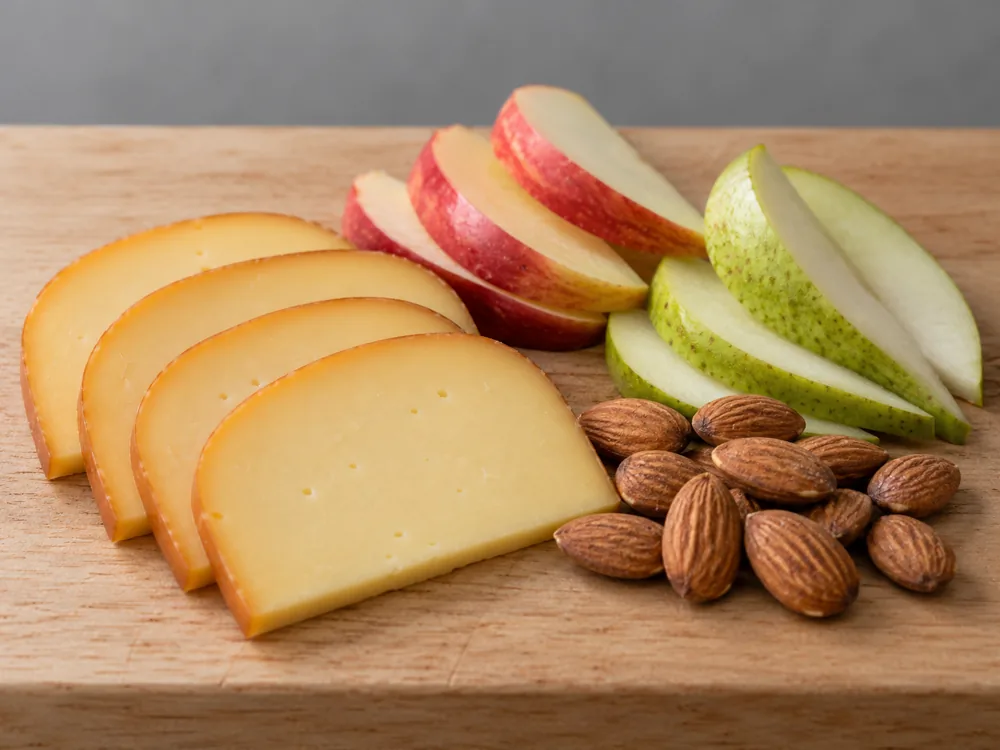
Cheese.com pairs smoked Gouda with apples, pears, nuts and dark chocolate.
Cheese.com's reason for the fruit is contrast: it says apples and pears add sweetness and acidity that bring out the cheese's flavours.
For drinks, Cheese.com names red wine and hoppy beer, and Castello narrows those to Chianti and IPA.
The slightly sweet drinks Wisconsin Cheese suggests for Gouda in any form, smoked included, are chosen to complement its nutty, slightly fruity flavour.
The Wisconsin Cheese notes name bock, brown ale, farmhouse cider, gewürztraminer, müller-thurgau, riesling, champagne or cava and sherry.
Castello's food list overlaps on nuts and adds grilled vegetables and spicy meats. The maker also suggests putting the cheese on a cheeseboard.
| Pairing | Type | Why It Works |
|---|---|---|
| Apples and pears | Food | Named by Cheese.com. |
| Nuts | Food | Named by Cheese.com and Castello. |
| Dark chocolate | Food | Named by Cheese.com. |
| Grilled vegetables and spicy meats | Food | Named by Castello. |
| Red wine, Chianti | Wine | Cheese.com names red wine; Castello names Chianti. |
| Hoppy beer, IPA | Drink | Cheese.com names hoppy beer; Castello names IPA. |
| Riesling, bock, farmhouse cider, sherry | Drink | Wisconsin Cheese names these slightly sweet drinks for Gouda in any form. |
How Should You Store Smoked Gouda, and What Does Its Label Show?
Cheese.com gives smoked Gouda 2 to 3 weeks of refrigerator storage at 35 to 40°F, and says it is best eaten within one to two weeks.
Cheese.com's storage note is to keep the cheese in its original packaging, or in parchment paper under tight plastic wrap, which it says stops drying out and the pick-up of other odours. Its Q&A summary on freezing says freezing is possible but may alter the texture and flavour.
The two sets of nutrition numbers checked for this article agree closely, but one of them sits under a confusing heading.
| Nutrient | Cheese.com, per 1 oz (28 g) | Castello page, heading reads per 100 g |
|---|---|---|
| Energy | 101 calories | 101 kcal (419 kJ) |
| Protein | 7.1 g | 7 g |
| Fat | 7.8 g | 8 g, of which 5 g saturated |
| Carbohydrate | 0.6 g | 0 g |
| Calcium | 198 mg | Not listed |
Castello's figures almost match Cheese.com's numbers for one ounce, which is less than a third of 100 g.
Cheese.com says smoked Gouda is typically not vegetarian because traditional production uses rennet. Castello's ingredient list names microbial rennet while Saxelby lists animal rennet for Marieke's, so the label settles it for any one cheese.
Is Smoked Gouda Safe During Pregnancy?
Smoked Gouda is sold made from both pasteurized and raw milk: Castello lists pasteurized part-skim milk, while Zingerman's Deli says Marieke's smoked Gouda starts as raw milk farmhouse Gouda.
The CDC lists hard cheese made with pasteurized milk as a safer choice in pregnancy. It lists unheated cheese sliced at a deli as riskier, and deli-sliced cheese heated to 165°F or until steaming hot as safer.
The CDC says pregnant women are 10 times more likely to get a Listeria infection; with smoked Gouda, the first thing to check is the milk line on the label.
The NHS lists pasteurised or unpasteurised hard cheeses such as cheddar, gruyère and parmesan as safe, along with pasteurised semi-hard cheeses such as edam. It also lists any cheese cooked until steaming hot as safe.
Neither agency names smoked Gouda, and Cheese.com files it as hard while also calling it semi-soft. A pasteurized smoked Gouda counts as safe on the NHS list if it is a hard or semi-hard cheese; a raw-milk one sits there only if it counts as a hard cheese.
SOURCES & REFERENCES
What Else Should You Know About Smoked Gouda?
Cheese.com calls it slightly sweet, buttery and smoky with a subtle tanginess and a campfire aroma. Castello rates its own smoked Gouda mild, 2 out of 6 for strength.
Castello, Hilmar and Marieke all use hickory smoke. English Wikipedia says less expensive smoked cheeses may use artificial smoke flavoring and colouring instead.
Not always. Castello uses pasteurized milk, while Marieke's smoked Gouda is made from raw milk.
Cheese.com gives 2 to 3 weeks in the refrigerator at 35 to 40°F and says it is best within one to two weeks.
Cheese.com says it is typically not, because traditional production uses rennet. Castello's label lists microbial rennet, and Saxelby lists animal rennet for Marieke's.
Cheese.com calls the brown rind edible. Wisconsin Cheese says to remove the thick paraffin wax coating that Gouda often carries.
Cheese.com lists eight substitutes, including Gruyère, Muenster, Provolone, Edam and Fontina, and says only smoked Provolone has a taste that closely resembles smoked Gouda, since the others lack the smoke.