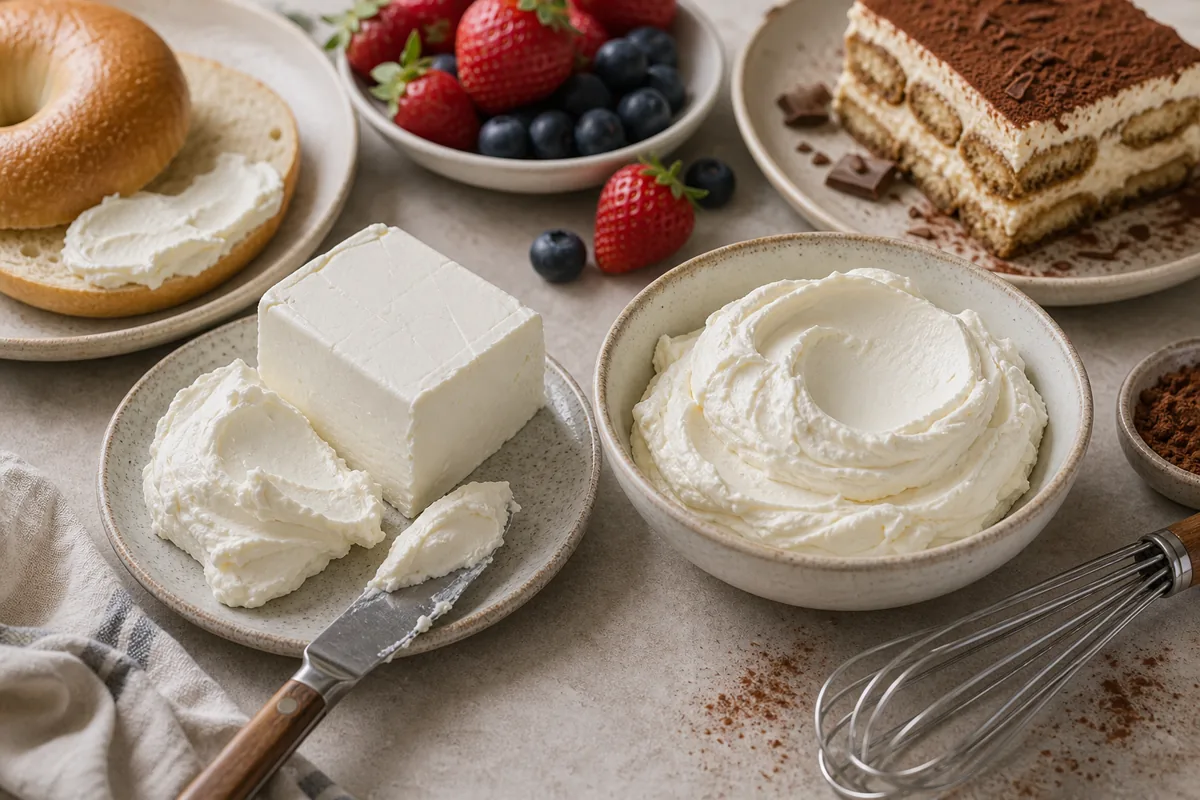
The two tubs look alike, but they are made in different ways. Cream cheese is milk and cream soured by a bacterial culture, while mascarpone is cream set with acid and heat.
That difference in base and method runs through the rest of this comparison: the tang, the behavior in the oven and the gap in fat.
In This Article
What Is the Difference Between Cream Cheese and Mascarpone?
In the United States, cream cheese has a legal definition. Under 21 CFR 133.133 it is a soft, uncured cheese made from pasteurized milk, nonfat milk or cream, set with a lactic acid-producing culture and clotting enzymes.
The same rule requires at least 33% milkfat and no more than 55% moisture in the finished cheese, and it caps stabilizers at 0.5% of the weight.
Wikipedia explains why makers use stabilizers: cream cheese is rich in fat, fat repels water, and the water tends to separate from the cheese, so commercial producers add gums such as guar or carob to prolong shelf life.
Mascarpone skips the culture. Italian Wikipedia describes it as cream coagulated with citric acid, or with lemon juice or vinegar in the craft method, and BelGioioso lists only pasteurized milk and cream plus citric acid on its label.
Mascarpone comes from Lombardy in northern Italy, around Lodi.
Italian Wikipedia notes that mascarpone's casein does coagulate, so it could be called a cheese. Yet Italy's agriculture ministry lists it among traditional agri-food products (PAT) as one of the dairy products rather than cheeses, because acid and heat set it and no lactic fermentation is involved.
That acid-and-heat step also explains the body: Italian Wikipedia says this different way of coagulating is what gives mascarpone its creamy consistency.
Wikipedia still calls cream cheese more comparable in taste, texture and production methods to Boursin and mascarpone than to soft cheeses such as Brie.
| Attribute | Cream Cheese | Mascarpone |
|---|---|---|
| Dairy base | Pasteurized milk, nonfat milk or cream (21 CFR 133.133) | Cream (Italian Wikipedia); pasteurized milk and cream (BelGioioso) |
| How it sets | Lactic acid-producing culture plus clotting enzymes | Acid and heat, no rennet (Italian Wikipedia); citric acid on the BelGioioso label |
| Process temperature | Fermentation at about 22 °C (Wikipedia) | 5 to 10 minutes at up to 90 to 95 °C (Italian Wikipedia) |
Which Is Richer? The Fat Numbers by Source
Mascarpone is the fattier of the two, but the size of the gap depends on which source you read.
Cream cheese has a legal floor of 33% milkfat, and Wikipedia's figures of 342 kcal, 34 g of fat and 19 g of saturated fat per 100 g sit right at it.
Mascarpone has no single number. Italian Wikipedia puts most production at 35% to 42% fat and the best artisan batches above 50%.
| Source | Cream cheese | Mascarpone |
|---|---|---|
| 21 CFR 133.133 (US rule) | At least 33% milkfat | Not covered by this rule |
| English Wikipedia | 342 kcal, 34 g fat, 19 g saturated per 100 g | No figure given |
| Italian Wikipedia | No figure given | 35% to 42% fat, above 50% in the best artisan batches; about 450 kcal per 100 g |
| Tasting Table | No figure given | At least twice the fat of cream cheese, no figure |
| Baker's Authority | At least 33% milk fat | 60% to 75% |
The 60% to 75% range from Baker's Authority sits well above even the best artisan batches in Italian Wikipedia, so we give it the least weight. Tasting Table's "at least twice as much fat" points the same way, since twice a 33% cream cheese is 66%.
Italian Wikipedia's split between ordinary and artisan batches is the better guide to what a tub can hold.
For one particular tub, the nutrition panel settles it: grams of fat divided by grams per serving gives the fat by weight, and a tub sold as cream cheese in the US should land near or above the 33% floor.
How Do They Taste Different?
Cream cheese is the sharper of the two because its culture makes acid. Wikipedia puts its pH at 4.4 to 4.9, and mascarpone gets no culture at all.
Baker's Authority describes cream cheese as tangier and slightly salty, and mascarpone as mild, sweet and slightly nutty, buttery but without acidity.
The sources are not unanimous on acid in mascarpone. Italian Wikipedia gives it a delicate sweetness with a faint acidic aftertaste, carried by notes of cream, butter and fresh milk and sometimes a hint of hay or nuts, so the gap between the two is one of degree.
BelGioioso lists its classic mascarpone as slightly sweet and buttery, while Wikipedia calls cream cheese a usually mild-tasting fresh cheese, which puts the tang in proportion: it is the sharper of two mild cheeses.
That small difference still counts in a recipe, because Baker's Authority gives the tang a job: in a classic cheesecake its acidity keeps the filling from feeling too heavy, and in a carrot cake frosting it balances the sugar.
Swapping in mascarpone without adjusting for the lost acidity often gives a result that is richer but less interesting, according to the same source.
Which One Holds Its Shape in Baking?
Cream cheese is the one to bake with when the result has to stand up. Baker's Authority says it keeps a firmer structure and holds up well to baking, while mascarpone gives silky, delicate results that need gentler handling.
The same source ties this to fat: cream cheese carries less of it, which makes it denser and more stable, and that firmness lets it whip into a stiff frosting that stays put at room temperature far longer than mascarpone would.
The form matters as well. Philadelphia sells its brick mainly for cooking and baking, and it made the soft tub spread for jobs that need easy spreading.
Philadelphia also explains why recipes ask for softened cream cheese: it blends with sugar without lumps, and lumps are much harder to smooth out once the eggs go in.
For a baked cheesecake, Philadelphia describes the finish as a slightly puffed edge and a filling set everywhere except a small soft, jiggly patch in the center. It suggests checking at the minimum baking time by gently shaking the pan, so the cake is not overbaked.
How Do You Keep Mascarpone From Splitting?
The fat that makes mascarpone silky also makes it easy to break. Baker's Authority says overbeating it, or beating it cold straight from the fridge, can make it split and turn grainy.
The same source gives the order of work for mixing it into a recipe:
- Let the mascarpone come to room temperature before mixing.
- Stir it gently by hand to loosen the texture.
- Add the other ingredients gradually.
- Mix just until combined.
Heat is the second way to lose it. In baked applications mascarpone can split at high oven temperatures, and Baker's Authority says Italian-style cheesecakes made with it often call for folded whipped egg whites to add the structure that the lower-acid, higher-fat cheese cannot provide on its own.
Which One Does Cheesecake and Tiramisu Need?
Baked cheesecake points to cream cheese. Baker's Authority calls it the firm, tangy backbone of a classic New York cheesecake and lists baked cheesecakes that need a firm, sliceable structure among its jobs.
Mascarpone still turns up in cheesecake, but Baker's Authority points it to no-bake cheesecakes and chilled tarts, where nothing asks it to survive an oven.
Tiramisu points the other way. Italian Wikipedia counts mascarpone among its essential ingredients, and says that combined with liqueur, coffee, biscuits, sugar, cream and eggs it is the base of many sweet creams.
BelGioioso's own suggestion follows the same pattern, combining its mascarpone with espresso, sugar, eggs and cognac.
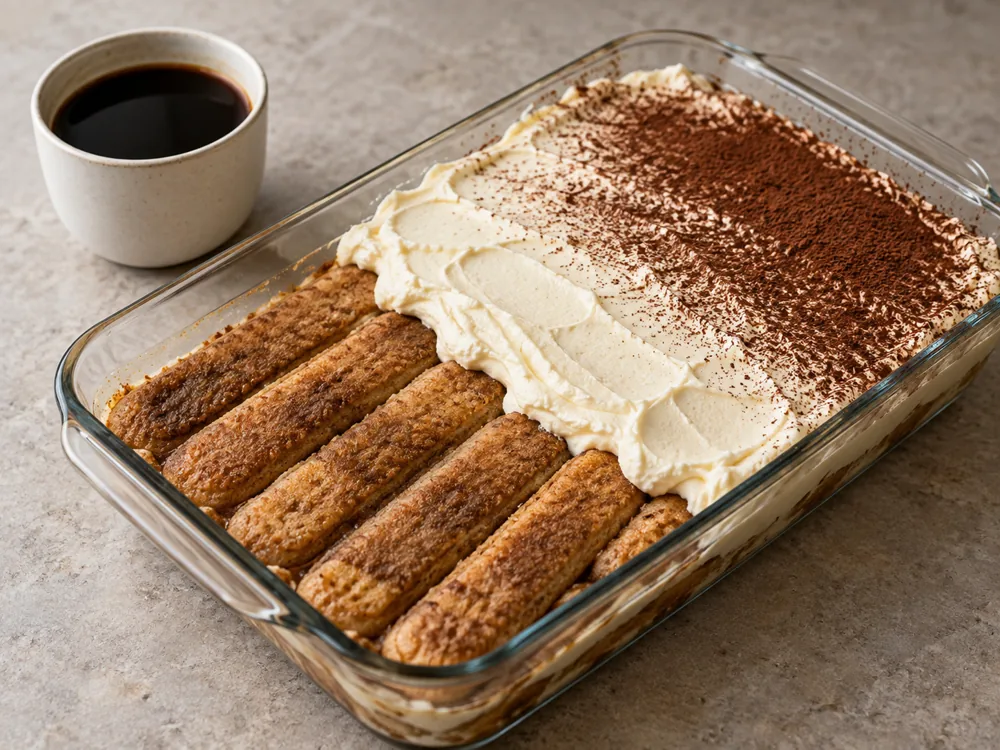
Putting cream cheese into tiramisu changes the dessert. Baker's Authority says the result comes out firmer and denser than the mascarpone version after chilling, and that its tang competes with the coffee and cocoa in a way mascarpone does not.
| Dessert | Better base | Named by |
|---|---|---|
| Baked cheesecake | Cream cheese | Baker's Authority |
| No-bake cheesecake and chilled tarts | Mascarpone | Baker's Authority |
| Frosting | Cream cheese | Baker's Authority |
| Tiramisu | Mascarpone | Italian Wikipedia, Baker's Authority, BelGioioso |
| Mousse and whipped fillings | Mascarpone | Baker's Authority |
| Cannoli | Mascarpone | BelGioioso (recipes) |
How to Turn Cream Cheese Into a Mascarpone Stand-In
Among substitutes for mascarpone, the one Tasting Table gives is full-fat cream cheese loosened with heavy whipping cream.
Tasting Table frames it as a use-up problem: mascarpone is not a kitchen staple, so a cook who buys a tub for one recipe often uses a spoonful or two and discards the rest. A cream cheese tub is far more likely to be finished in other dishes.
Its ratio is ¼ cup of heavy whipping cream to 1 cup of cream cheese, with the cream cheese at room temperature and stirred loose first. One cup of the blend then replaces one cup of mascarpone.
The cream is there to close the fat gap. Tasting Table says mascarpone starts from whole cream and carries at least twice the fat of cream cheese, while cream cheese alone is lighter and more acidic because of its lactic acid.
Tasting Table puts heavy whipping cream at up to 40% fat, so no blend of the two can exceed that: it reaches the lower part of Italian Wikipedia's 35% to 42% for most mascarpone, but not the 60% to 75% Baker's Authority quotes.
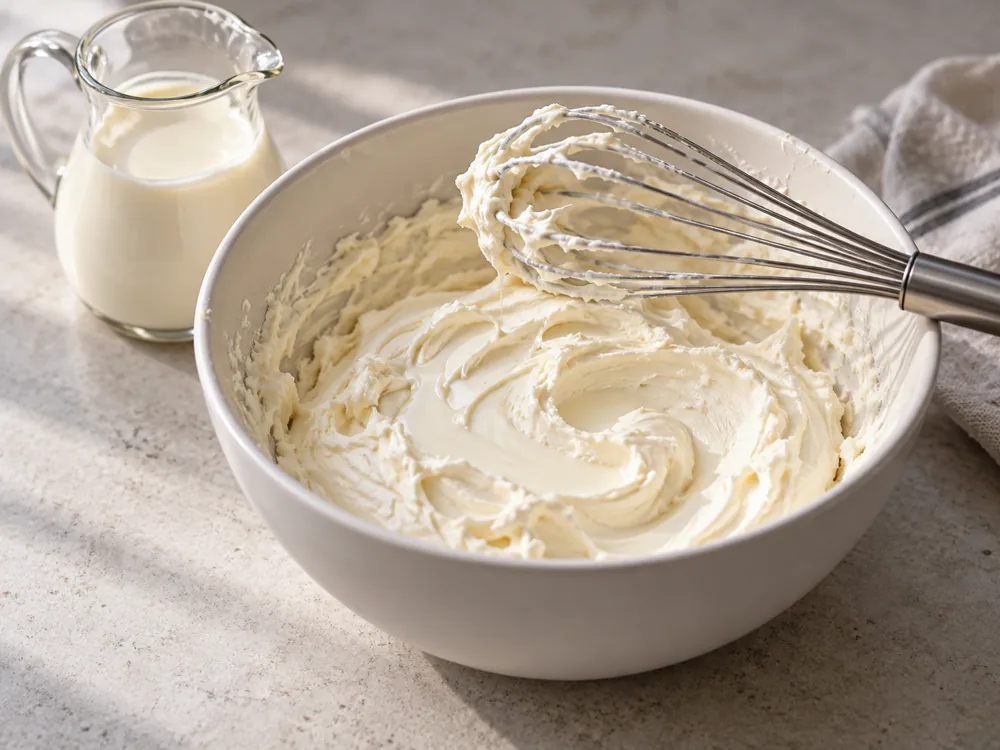
Chilling the blend firms it if you have time. For desserts, Tasting Table adds a little sugar to bring it closer to the light sweetness of mascarpone.
For savory dishes, Tasting Table swaps the heavy cream for full-fat sour cream in equal parts, a tangier blend that it suggests keeping to savory recipes such as lobster ravioli.
None of these steps removes the culture, so the blend keeps some of the tang that sets cream cheese apart.
Tiramisu is the dish where Baker's Authority finds the swap hardest: the texture difference is large enough that most bakers who care about the result source real mascarpone.
The reverse swap needs acid instead of fat. When mascarpone replaces cream cheese, Baker's Authority adds a splash of fresh lemon juice to bring back some brightness.
The same source expects the result to come out richer, softer and less tangy, which often works in a no-bake recipe but can make a baked cheesecake heavier and denser.
Lemon restores the brightness but not the firmness, so mascarpone is a weak pick among substitutes for cream cheese for anything that must hold a slice.
Which One Works in Savory Cooking and Everyday Spreads?
Mascarpone's savory uses lean on its cream. BelGioioso suggests melting it into a fresh tomato sauce or into a creamy sauce for pasta.
To melt cream cheese into a sauce, Philadelphia recommends cutting it into small cubes first and whisking until it melts completely.
Mascarpone also has a few less common jobs. Baker's Authority lists finishing sauces and risotto for richness, and BelGioioso's recipe collection includes a butternut squash risotto, roasted vegetables with mascarpone and a mascarpone and Gorgonzola sandwich.
On the cream cheese side, Baker's Authority points to dips and spreads that stay firm when chilled, the same firmness it credits for baked cheesecake.
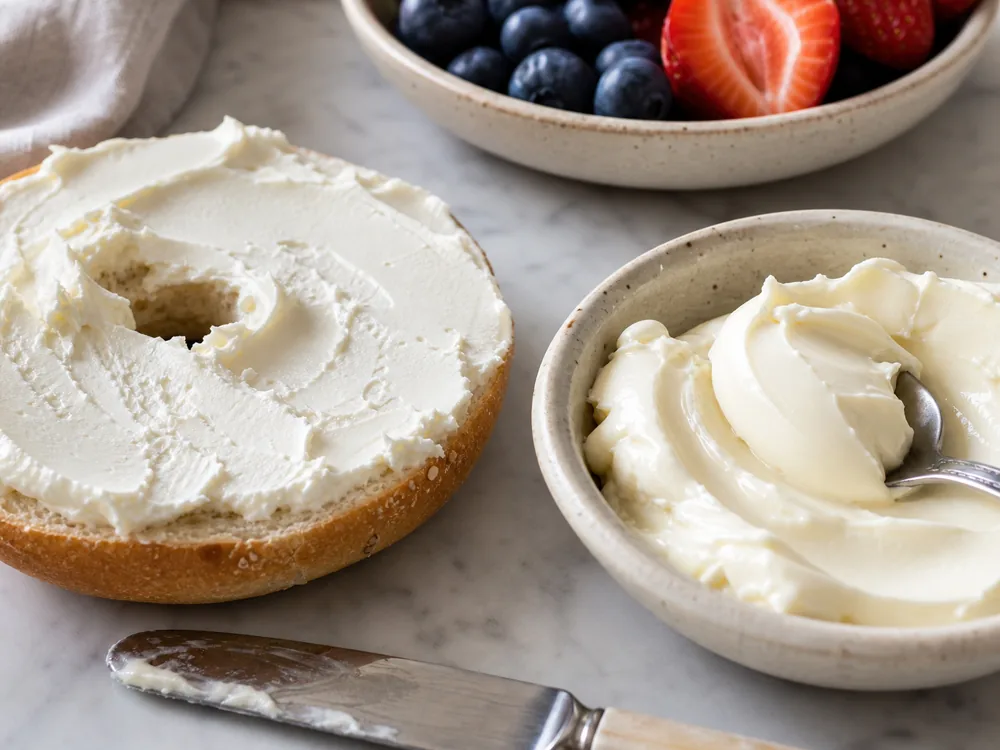
| Pairing | Why It Works |
|---|---|
| Bagels, toast and crackers | Cream cheese: Philadelphia developed its soft tub spread for these and for dipping vegetables. |
| Eggs, pasta and taco beef | Cream cheese: Philadelphia suggests stirring it into all three. |
| Risotto | Mascarpone: Baker's Authority names it for finishing risotto, and BelGioioso publishes a butternut squash risotto with it. |
| Fruit and berries | Mascarpone: BelGioioso mixes it with maple syrup for fruit and pairs its vanilla version with fresh fruit. |
| Bread | Mascarpone: BelGioioso suggests spreading it in place of butter and says its classic version has half the calories of butter. |
How Long Does Each Keep After Opening?
Opened cream cheese keeps two to three times as long as opened mascarpone, going by the two producers' own rules.
BelGioioso ties the mold risk to its recipe. Its mascarpone is made with no preservatives, so bacteria from hands or used utensils give mold a good chance to grow.
Italian Wikipedia adds a second reason for the short window: mascarpone tends to go rancid quickly and should be eaten fresh. It records that the traditional product was made only from November to March, because the cold slowed the oxidation of the fat and the unwanted fermentation that spoils it.
| Point | Philadelphia cream cheese | BelGioioso mascarpone |
|---|---|---|
| Once opened | Use within 10 days or by the date on the pack, whichever comes first | Use within 3 to 5 days, kept in the original cup |
| Fridge | Keep at normal fridge temperature of 40 °F | Return to the fridge as soon as you are done |
| Handling | Re-seal and return to the fridge right after use | Peel back only a little of the film and use a clean utensil |
| Freezing | Not recommended, because it affects quality | Not recommended for any variety |
The two producers treat the printed date differently once a pack is open. Philadelphia keeps the stamped date in force, so a tub opened near its date can run out before the 10 days, while BelGioioso says its best-by date covers only unopened packages, which leaves the 3 to 5 days to count from opening.
Finished desserts have their own limit: Philadelphia gives cheesecake made with its cream cheese up to 5 days in the fridge.
Are Cream Cheese and Mascarpone Safe in Pregnancy?
The NHS list of cheeses that are safe in pregnancy names pasteurised cream cheese and mascarpone, and the CDC lists cream cheese made with pasteurized milk as a safer choice.
Eaten cold, pasteurized mascarpone is a type the CDC list does not cover, so ask a midwife or doctor. The CDC lists soft cheese made from unpasteurized (raw) milk as riskier and pasteurized soft cheeses heated to an internal temperature of 165°F or until steaming hot as safer, and it notes that pregnant women are 10 times more likely to get a Listeria infection.
The US cream cheese standard requires pasteurized dairy ingredients, and BelGioioso's mascarpone label lists pasteurized milk and cream.
What Should You Check on the Pack Before Buying?
Gums are the main difference an ingredient list can show. BelGioioso says many ricotta and mascarpone cheeses on the market have added preservatives, gums and fillers, and that its own mascarpone has none.
In BelGioioso's account, gums and carrageenan keep the moisture together, since temperature swings change how much water a cheese holds, but they are not a traditional cheesemaking ingredient and they change the flavor.
The same label logic applies to cream cheese. Under 21 CFR 133.133 each ingredient has to be declared on the label, so a stabilizer such as the carob bean gum or carrageenan that Wikipedia names shows up on the list of any cream cheese that contains one.
BelGioioso's mascarpone page also lists flavored versions, and their ingredient lists show what changes.
| Version | Listed ingredients | Appearance and body |
|---|---|---|
| Classic | Pasteurized milk and cream, citric acid | White, creamy, slightly sweet and buttery |
| Crema di Mascarpone | Pasteurized milk and cream, citric acid | White, creamy; a little sweeter, with a more textured and whipped body |
| Vanilla | Mascarpone, vanilla extract, sugar, vanilla beans | White with vanilla bean specks |
| Chocolate | Mascarpone, sugar, cocoa | Light brown, creamy |
| Espresso | Pasteurized milk and cream, citric acid, coffee, sugar | Creamy light brown |
Crema di Mascarpone lists the same ingredients as the classic, so what differs is the texture and sweetness BelGioioso describes, which it presents as a base for cupcake frostings and sweeter mascarpone uses.
The vanilla, chocolate and espresso versions already carry sugar, which a recipe that sweetens its own cream would double. BelGioioso describes the espresso one as its classic mixed with real coffee and sugar, giving it the flavor of a tiramisu.
Color is a second check on the shelf. Italian Wikipedia describes plain mascarpone as white or pale yellow, while BelGioioso describes its classic as white, so a faint yellow tint falls inside the range one source gives for the plain product.
Plain and Crema di Mascarpone list only milk, cream and citric acid, while vanilla, chocolate and espresso add sugar, so a recipe that measures its own sugar starts from the plain tub.
Cream Cheese or Mascarpone: Which Should You Buy?
Buy brick cream cheese when the recipe has to set, slice or hold a frosting, or when you want tang and a little salt.
Buy mascarpone when the cheese has to fold into something soft or melt into a sauce. Plan to finish the tub within a few days of opening it.
Price points the same way: Baker's Authority calls mascarpone generally pricier and cream cheese affordable and widely available.
- Must set or slice: brick cream cheese.
- Must fold in soft or melt into a sauce: mascarpone.
- Must taste tangy: cream cheese, or mascarpone with lemon juice.
- Recipe names mascarpone but you only have cream cheese: the cream-and-cream-cheese blend above.
- Opened tub has to last more than five days: cream cheese.
If you want the cream cheese style with less fat, Philadelphia describes Neufchatel as similar in flavor and texture but with less fat and more moisture.
SOURCES & REFERENCES
Cream Cheese vs Mascarpone FAQ
Italian Wikipedia says mascarpone is made without rennet and is used in vegetarian cooking, and BelGioioso lists its mascarpone varieties among its vegetarian cheeses.
It depends on the enzyme. The US standard allows clotting enzymes of animal, plant or microbial origin and lets the label say only enzymes, so the word alone does not show which kind was used.
Philadelphia says its cream cheese is gluten-free, and BelGioioso says all its cheeses are naturally gluten free. Both are producer statements, so check the pack if you must avoid gluten.
No. The US rule sets at least 33% milkfat, Canada sets at least 30% according to Wikipedia, and Wikipedia adds that other countries define it differently and may require a considerably higher fat content.