Guide

How Is Cheese Made, and What Makes Each One Different?

Every cheese comes from the same five steps. Learn how curdling, curd size, salting and ageing decide whether milk becomes Brie, Cheddar or Parmesan.

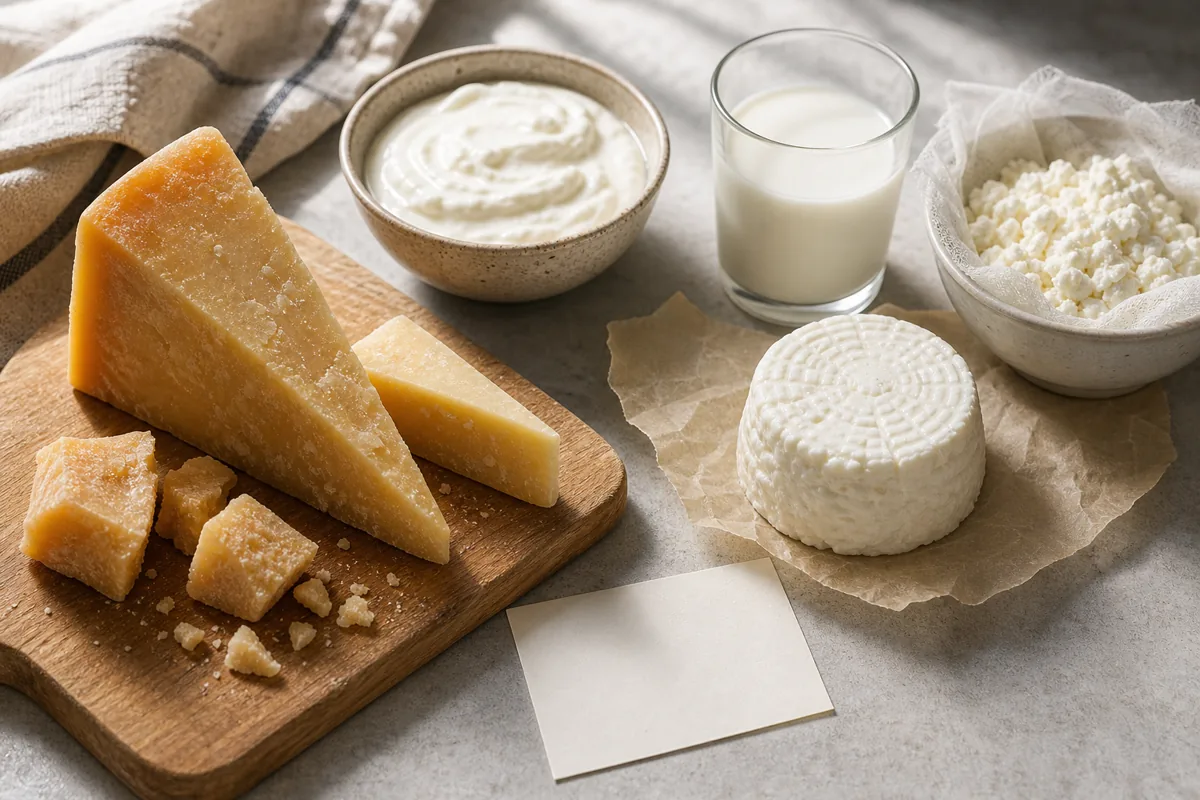
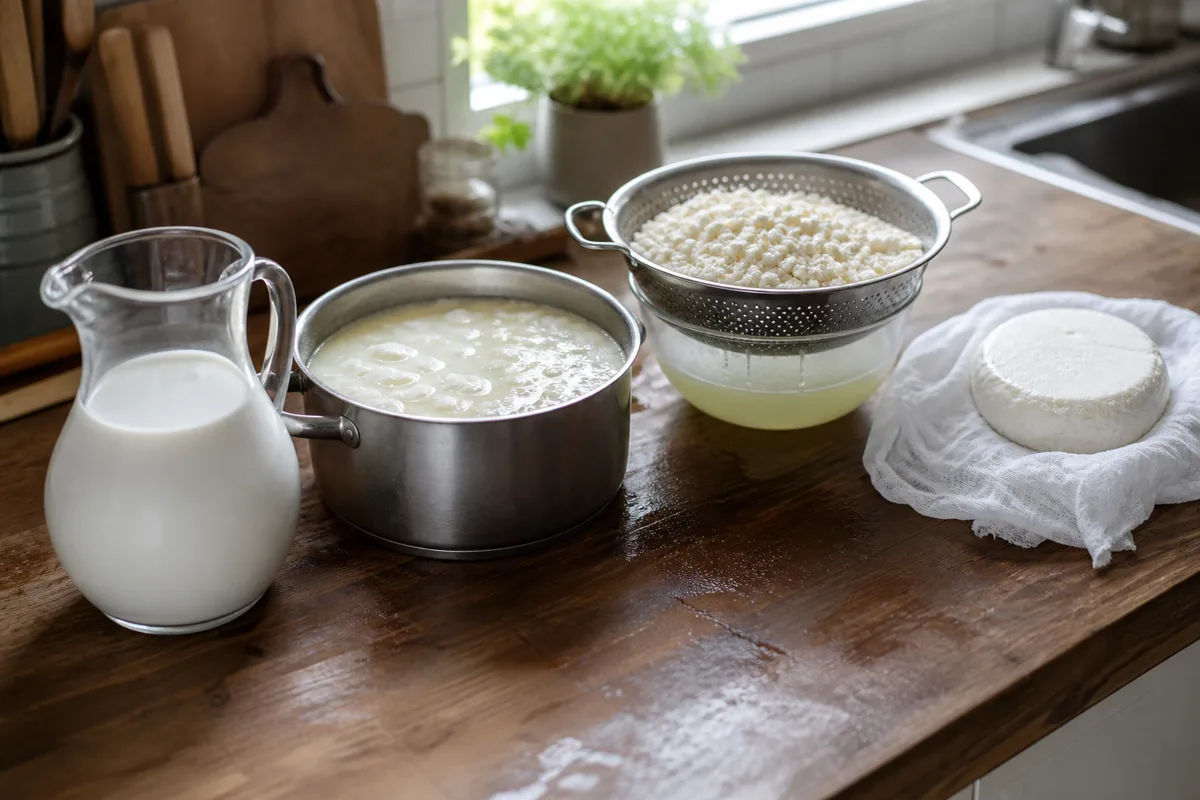
A kitchen counter showing milk, set curd, draining curd, and a small pressed round - cheesemaking | KnowTheCheese
QUICK ANSWER
Cheese is milk with the water taken out and time added. Five decisions separate every cheese from every other one, and this guide walks them in order so you can look at any wheel and work backwards to how it was made.

Every cheese on a counter came from the same five steps, in the same order.

Milk is soured with cultures, set into a curd, cut and drained, salted and pressed, then aged. What separates Brie from Parmesan is not a different process but different decisions inside that one.

Roughly ten pounds of milk becomes about one pound of hard cheese, and almost all of the difference is water leaving at different speeds.

Every Cheese Comes From the Same Five Steps

The spine of cheesemaking is short enough to memorise. The same five steps run in the same order for a curd eaten the day it is made and for a wheel opened after four years.

  • Acidify: bacterial cultures turn milk sugar into lactic acid
  • Coagulate: rennet or acid sets the milk into a gel
  • Cut and cook: the gel is cut into curd and heated to drive out whey
  • Salt and press: salt goes in, whey comes out, the shape is fixed
  • Age: microbes and enzymes build flavour over days or years

Before any of that, the milk is filtered and standardized so the fat and protein sit where the maker wants them.

Pasteurization, where it happens, is a heat step aimed at pathogens rather than a flavour decision, though it does change what the finished cheese can taste like by removing some of the milk's own microbes.

Everything after that is a series of choices about moisture.

The Milk Sets the Ceiling

Before any culture goes in, the milk has already decided how much cheese there will be.

Fat and protein are what become cheese, and the water around them is what leaves, so a richer milk simply yields more from the same volume.

Milk Fat Protein Fresh cheese yield
Sheep About 7 percent Around 4.6 to 5.7 percent 22.9 percent
Buffalo About 7 percent Around 3.8 to 4.4 percent 25.5 percent
Cow About 3.9 percent Around 3.3 to 3.4 percent 15.4 percent
Goat About 3 to 4.5 percent Around 3.2 percent 11.9 percent

The gap is larger than most people expect. Buffalo and sheep milk return roughly twice as much fresh cheese per litre as goat milk does, which is a large part of why sheep and buffalo cheeses cost what they cost.

Milk is then filtered and standardized before anything else happens, with the fat, cream, or protein adjusted to whatever the target cheese needs.

Two dairies making the same style from the same herd can still start from different milk, because standardizing is a choice rather than a fixed recipe.

Starter Cultures Come Before Anything Sets

The first working ingredient is bacteria, not rennet. Starter cultures go into the milk and ferment lactose, the milk sugar, into lactic acid.

That acidification is what starts turning liquid milk into something that can hold a shape.

Acid also does quiet flavour work that shows up much later.

The cultures a maker chooses shape which compounds develop during ageing, which is why two cheeses treated identically afterwards still taste different.

Skip or rush this step and the rest fails. A curd set without enough acid development drains badly and ages into something flat.

What Rennet Actually Does

Rennet is an enzyme that coagulates milk, turning it into a thick curd.

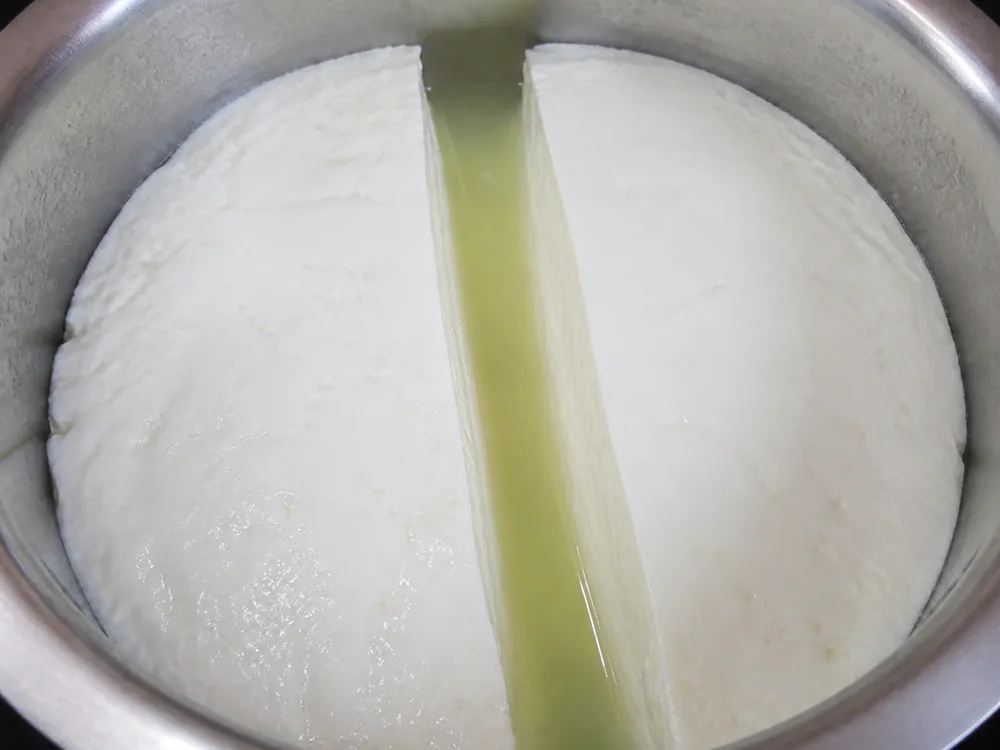
A clean break drawn through set curd with pale whey rising into the channel - cheesemaking | KnowTheCheese
A clean break means the curd holds its edge and the whey running in stays translucent.

It works in a specific window. The enzyme begins acting between 85 and 105 degrees Fahrenheit and is not deactivated until the milk reaches 140, which is why cheesemaking happens at warm blood temperatures rather than on the stove.

85-105 F
Where rennet starts working
140 F
Where rennet is deactivated
~90%
Chymosin in calf rennet
~10:1
Milk to hard cheese by weight

The source of that enzyme is the question most shoppers actually care about.

Animal rennet comes from the stomach of a calf, lamb, or goat and runs at roughly 90 percent chymosin, the active enzyme. Microbial and vegetable versions are produced from moulds instead and are what make a cheese suitable for vegetarians.

The choice is not neutral for long-aged cheese.

Calf rennet is generally preferred where a cheese will mature for a long time, while vegetable rennet can turn slightly bitter after around six months of ageing because it breaks down protein more aggressively.

That is worth knowing when a label says vegetarian on a cheese sold as well aged. The two claims are not contradictory, but they do interact.

Not Every Cheese Uses Rennet

Roughly a quarter of the cheese made in the world never sees the enzyme at all.

Acid-set cheese is curdled either by natural souring from lactic acid bacteria or by adding an acid directly, and it accounts for about 25 percent of global output against 75 percent for rennet-set cheese.

The mechanism differs in a way you can taste. Acid lowers the pH until the casein proteins lose the negative charge holding them apart, so they clump on their own without an enzyme cutting them.

The curd that results is fragile rather than springy. Acid-set curds cannot be stretched, will not survive high cooking temperatures, and do not age for long, which is why almost every cheese in this group is eaten fresh.

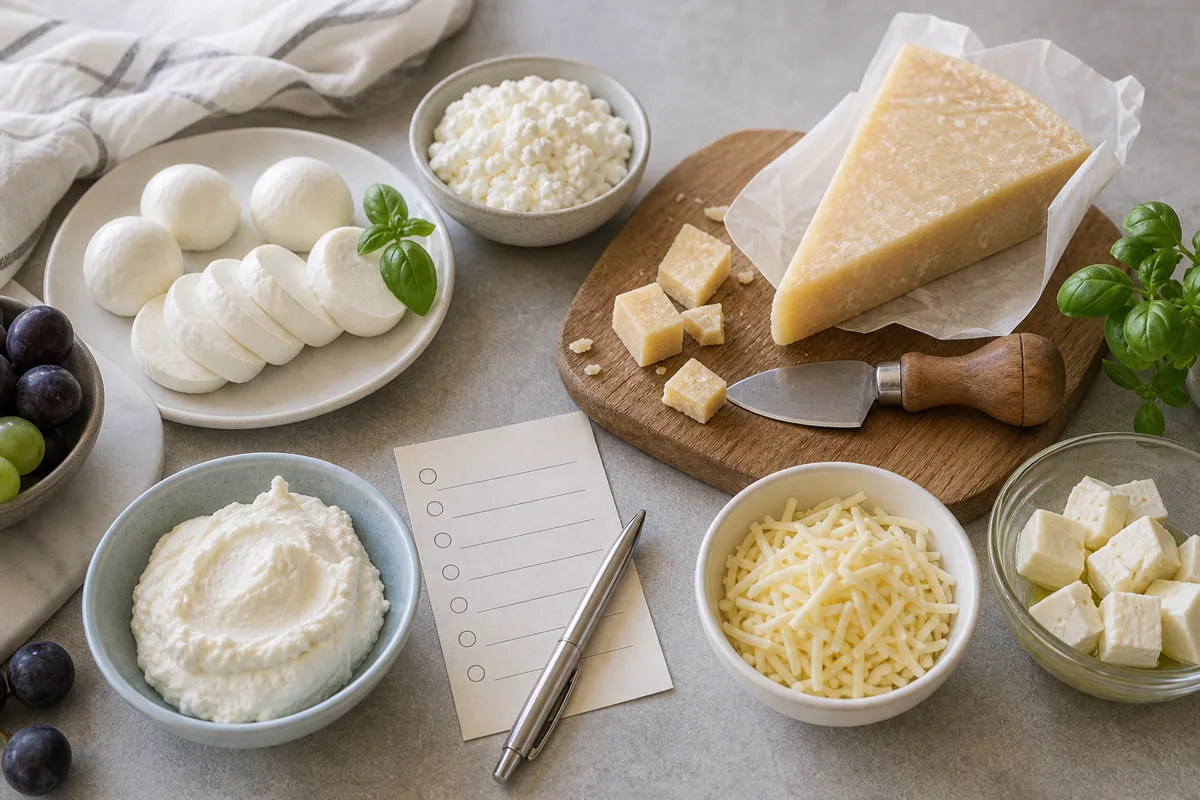
The list is more familiar than the term. Ricotta, paneer, queso blanco, quark, and cream cheese all belong to it.

Ricotta shows the method most clearly, with the milk heated to around 90 to 92 degrees Celsius before lactic, citric, or acetic acid goes in.

Melting behaviour follows directly from the setting method. Acid-set cheeses do not melt evenly, which is why paneer holds its cubes in a hot curry while a rennet-set cheese would slump.

There is a practical upside for shoppers. A cheese set with acid rather than animal rennet is vegetarian by construction rather than by substitution.

Curd Size Decides Almost Everything

If you only remember one variable, make it this one.

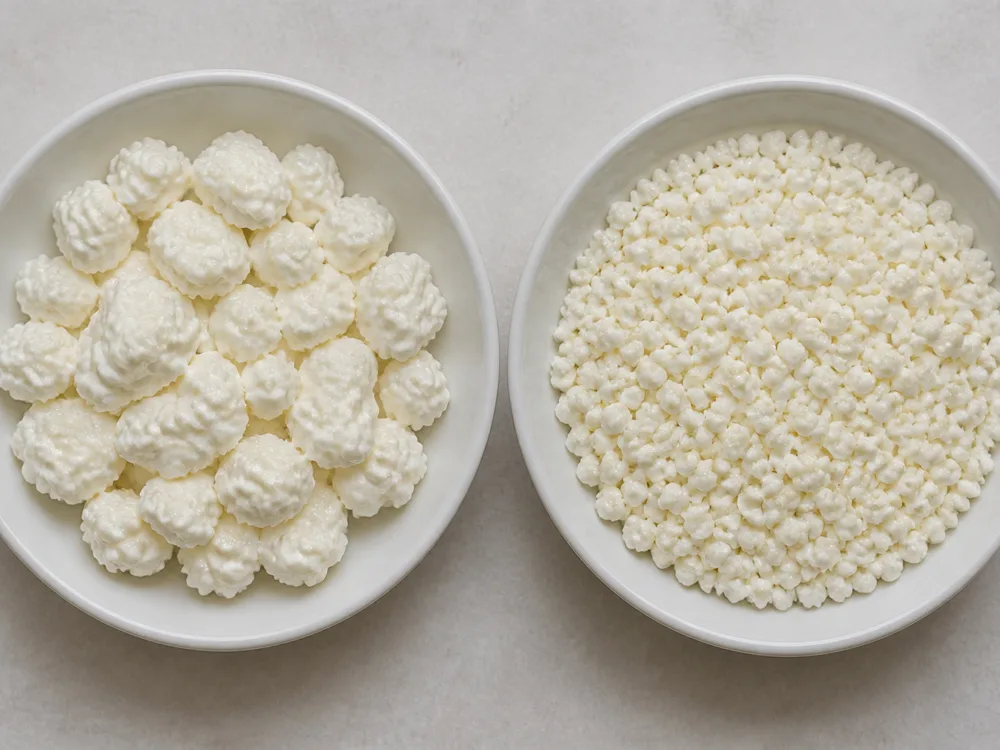
Two bowls of curd, one cut large and one cut small, showing the size difference - cheesemaking | KnowTheCheese
Large curds keep moisture in and make a softer cheese; small curds drain harder and dry.

Once the milk has set, it is cut into curds, and how small those pieces are decides how much whey escapes. Smaller curds release more whey and produce drier, firmer cheese, while larger curds hold their moisture and produce softer cheese.

Curd handling Whey released Resulting cheese Example
Cut fine, cooked hot, stirred long Most Dry, hard, long-keeping Parmesan
Cut medium, cooked moderately Middle Firm but sliceable Cheddar
Cut large, barely cooked Least Soft, high moisture Brie

Heat and time compound the effect of the cut. The curds are stirred and gently warmed after cutting, and both actions push more whey out of the pieces.

This is why texture is largely settled before the cheese has a shape at all. A maker aiming at a hard grating cheese has committed to it at the moment the harp goes through the vat, and no amount of ageing afterwards turns a wet curd into Parmesan.

The Extra Steps That Create Whole Families

Between cutting the curd and pressing it, some cheeses take a detour, and each detour founds a family.

Cheddaring is the best known of them. Drained curd is left to knit into slabs, then those slabs are stacked and turned so their own weight presses out more whey and the texture shifts from grainy to layered and meaty.

The cheese took its name from the step rather than the other way round.

Stretching founds the Italian pasta filata group, a phrase that translates as spun paste. Fresh curd is heated in hot whey or water, then kneaded and pulled until it turns elastic and stringy.

Buffalo mozzarella reaches around 95 degrees Celsius during that stage.

The chemistry behind it takes one sentence. Calcium is deliberately drawn out of the curd, which makes the casein micelles repel each other more strongly and lets the paste extend instead of tearing.

Mozzarella, provolone, caciocavallo, scamorza, burrata, and halloumi all come out of that single technique.

Washing the curd is the Dutch move. Part of the whey is drawn off and replaced with warm water, which removes lactose before the bacteria can turn it into acid.

Less acid means a sweeter, milder, more supple cheese, which is why gouda and edam taste rounder than a cheddar of the same age.

Piercing makes blue cheese possible at all. The mould needs oxygen, so a young wheel is skewered with needles to open air channels into the paste, and the veins grow along those channels rather than at random.

That is why the blue in a blue cheese so often runs in lines instead of spreading evenly.

A second fermentation creates the holes in Alpine cheese. Propionibacteria added to the milk produce carbon dioxide as the cheese matures, and the gas has nowhere to escape inside a dense pressed paste.

The bubbles it leaves behind are the eyes in Emmental, which makes the holes a by-product of a living process rather than a design feature.

Salting, Pressing, and Shaping

Salt arrives late and does three jobs at once. Its timing matters as much as its quantity, because salt slows the starter bacteria down, and adding it early stalls the acidification the curd still needs.

A cheese pressing in a cloth-lined mould with whey running into a bowl below - cheesemaking | KnowTheCheese
Pressing is about moving whey out, so the run-off should still be visible while the weight is on.

It seasons, it preserves by making the cheese less hospitable to unwanted microbes, and it draws out yet more whey through the surface.

There are two ways in.

Curds can be salted directly before pressing, which distributes salt through the body, or the finished cheese can be floated in brine afterwards, which works inward from the rind over hours or days.

Pressing then fixes the form. Curds go into moulds and are pressed with a pressure and duration that vary by type, which both shapes the cheese and expels whatever whey is left.

A soft cheese may barely be pressed at all, while a hard wheel spends hours under real weight, and that gap is visible in the finished paste.

Where the Whey Goes

For every pound of hard cheese, roughly nine pounds of liquid leaves the vat.

That liquid is whey, and it still carries protein, sugar, and some fat, which is why traditional dairies never treated it as waste.

Ricotta is the clearest answer to the problem. The name translates as recooked, because the classic version is made by reheating the whey left over from another cheese until the remaining proteins come out of solution.

Whey also feeds the next batch in some traditions. A dairy that keeps back fermented whey as a starter is using its own resident bacteria rather than a purchased culture, which is how many farmhouse cheeses stay regionally distinct.

The rest goes to animal feed, to protein powder, or increasingly to industrial uses, and the volume involved is the reason large plants sit near whey processors.

Ageing Is Where the Flavour Arrives

Maturation is production, not storage. Under controlled temperature and humidity, microbial and enzyme activity keeps working on the fat and protein in the paste, and that activity is what creates the flavours the cheese is sold for.

Time ranges enormously. A fresh cheese may be eaten within days of being made, while a hard wheel can spend years in a cellar before anyone cuts it.

Texture keeps changing throughout. Long ageing breaks proteins down far enough to leave the crunchy crystals people find in old gouda and hard grating cheeses, which are a sign of age rather than a fault.

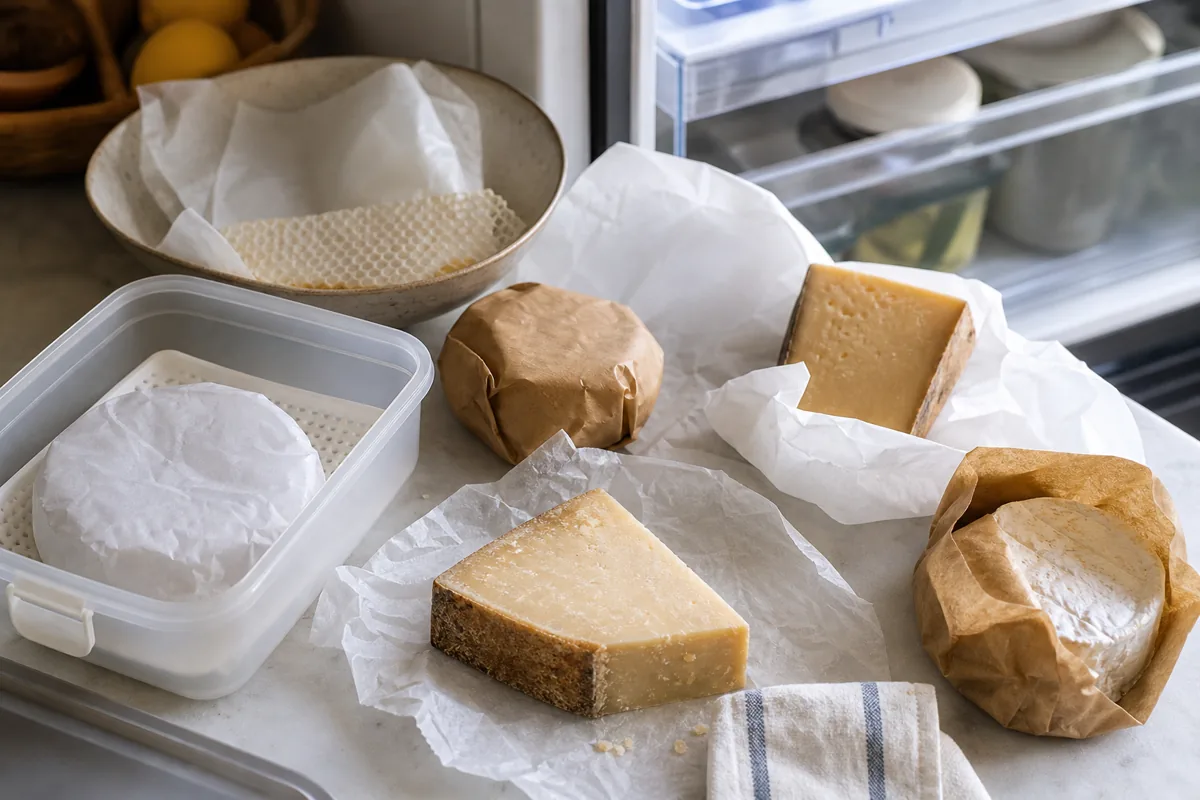
The rind is part of this stage too. Whether a cheese is waxed, wrapped, washed in brine, or left to grow its own natural crust changes how fast moisture leaves and which microbes get to work on the surface.

Why Some Cheeses Melt and Others Refuse

Melting is not a property a cheese either has or lacks. It is the sum of three decisions already made earlier in this article.

The first is how the curd was set. A rennet-set curd holds its calcium and its protein network in a form that loosens with heat, while an acid-set curd has already been stripped of that structure and simply firms up instead.

That is why paneer browns in a pan without collapsing, and why it is the cheese of choice where a cook wants cubes that survive a sauce.

The second decision is moisture. A high-moisture paste has water available to carry fat and protein into a flow, while a very dry aged cheese has little left to mobilise and tends to separate into oil and grit instead.

Fresh mozzarella and a two-year Parmesan sit at opposite ends of that scale, and neither is failing at anything.

The third is calcium, which is where stretching comes back. Removing calcium during the pasta filata step is what lets those cheeses extend into strands rather than tear, and it is the reason a pizza behaves the way it does.

Age works against all of this over time. As protein breaks down through long maturation, the network that would carry a melt breaks with it, so the same cheese melts less willingly at two years than at six months.

Put together, the rules become predictable. Rennet-set, moderately moist, and not too old is the combination that melts, and any cheese missing one of those three will behave differently in a pan.

For which specific cheeses to reach for, our guide to the best melting cheeses ranks them by job rather than by mechanism.

What the Rind Is Doing

The outside of a cheese is a working surface rather than packaging. It controls two things at once, how fast moisture leaves the paste and which microbes get to live on the cheese while it matures.

  • Bloomy: a white mould is encouraged on the surface and ripens the paste inward, softening it from the rind toward the centre
  • Washed: repeated brine washing favours orange bacteria that build strong aroma and a sticky surface
  • Natural: the surface is left to dry into its own crust, the oldest and least controlled option
  • Waxed: a sealed coat that nearly stops moisture loss, so the cheese ages slowly and evenly
  • Clothbound: cloth and fat let the cheese breathe while protecting it, giving a drier and more savoury result
  • Rindless: foil or vacuum keeps air off entirely, so every change happens inside the paste

Read the rind and you can usually infer the ageing conditions. A sticky orange surface tells you somebody was washing that cheese by hand every few days, and a smooth black wax tells you nobody touched it after it went into the coating.

How the Same Five Steps Make Brie and Parmesan

Two cheeses at opposite ends of a counter make the framework concrete. Brie and Parmesan can start from the same cow's milk and still end up as different foods, and every difference between them was settled at one of the five steps.

Brie takes large curds, minimal cooking, almost no pressing, and a short maturation where the work happens at the surface under a white bloom. Moisture stays in, so the paste softens as it ripens.

Parmesan takes the same milk through the same five steps and answers every question the other way.

The curd is cut to grains, cooked hot, pressed hard, brined for a long period, and then aged for years until it is dry enough to shatter under a knife.

Neither cheese uses a secret ingredient the other lacks. They are the same five decisions taken in opposite directions.

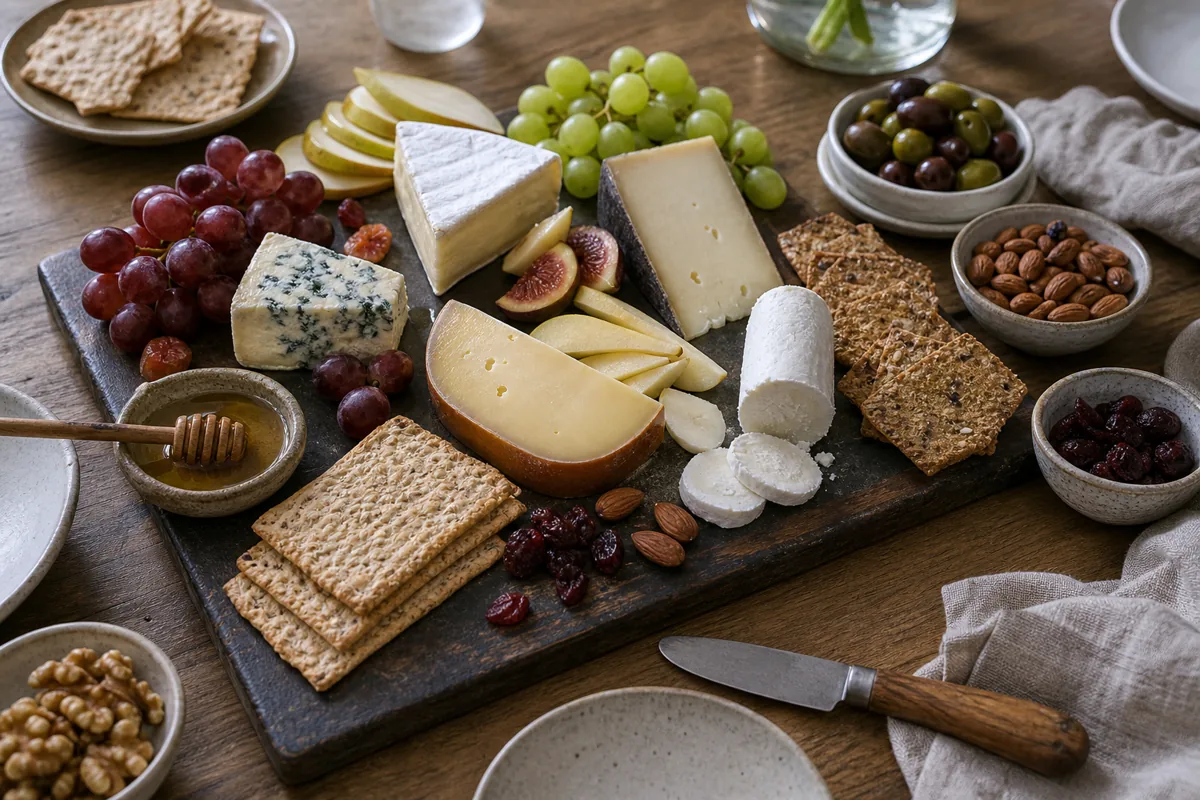
Once you can see that, most of a cheese counter becomes readable. A soft high-moisture cheese was cut large and pressed lightly, and a dry crystalline one was cut fine and left alone for a long time.

What This Guide Does Not Cover

This is an explanation rather than a set of instructions. It deliberately carries no quantities, no equipment list, and no batch temperatures, because reading how cheese is made and making it safely at home are different projects with different requirements.

Raw milk rules in particular vary by country and change over time, so anyone moving from understanding to doing should work from current local guidance rather than from a general explainer.

SOURCES & REFERENCES


1.
U.S. Dairy, 2026 industry
Used for the ordered process from milk collection and standardization through pasteurization, starter cultures and rennet, curd cutting and whey separation, pressing and shaping with dry salting or brining, and ageing, plus the relationship between curd size and finished moisture.

2.
Cheese Making Supply Co., 2026 industry
Used for rennet as the coagulating enzyme, calf rennet at roughly 90 percent chymosin, animal rennet sourced from calf, lamb, or goat, vegetable rennet produced from mould, the 85 to 105 F working window, the 140 F deactivation point, and the bitterness vegetable rennet can develop after about six months of ageing.

3.
Wikipedia, 2026 Reference
Used for acid-set cheese being curdled by natural souring or added acid, the roughly 25 percent share of global production against 75 percent rennet-set, the named examples including queso blanco, quark, cream cheese, paneer, and ricotta, and the 90 to 92 C heating step for ricotta.

4.
Wikipedia, 2026 Reference
Used for pasta filata meaning spun paste, the heating of curd in hot whey or water followed by kneading, the 95 C stage for buffalo mozzarella, the calcium removal that increases casein repulsion and allows stretching, and the family list including mozzarella, provolone, caciocavallo, scamorza, burrata, and halloumi.

5.
Journal of Dairy Science, 2021 Journal
Used for the milk fat and protein comparison across species and the fresh cheese yields of 25.5 percent for buffalo, 22.9 percent for sheep, 15.4 percent for cow, and 11.9 percent for goat milk.