Craft Beer and Brewing says the bold flavours of hoppy beers stand up to sharp cheddar. CraftBeer.com adds that bitterness cuts through fat and carbonation cleanses the palate.
Cheddar is one of the easiest cheeses to match with beer. The cheesemonger The Courtyard Dairy says cheddar and the classic harder British cheeses "love most beers and can handle a bit more strength."
Craft Beer & Brewing calls IPA the most popular pairing for sharp cheddar because the bold flavours of hoppy beers stand up to the cheese's intensity.
One cheese shop reports an IPA clashing with a very old cheddar, and every other IPA pairing below uses a younger one.
In This Article
Which Beer Styles Pair with Cheddar?
Every style below has at least one named source that pairs it with cheddar. The matches come from the Brewers Association's CraftBeer.com style pages, the beer writer Jeremy Storton, two cheesemongers, two cheddar makers and the dairy trade group Wisconsin Cheese.
| Pairing | Type | Why It Works |
|---|---|---|
| English-style IPA | Ale | The Brewers Association lists aged cheddar as this style's cheese. The Courtyard Dairy says a citrusy IPA opens up the flavours of both. |
| British bitter and mild | Ale | Jeremy Storton names British bitters first for cheddar on CraftBeer.com, and The Courtyard Dairy pairs Dale End Cheddar with mild bitters. The Brewers Association lists mild cheddar for English-style dark mild. |
| Pale ale | Ale | The Brewers Association matches American pale ale with mild or medium cheddar. |
| Amber ale | Ale | Quicke's pairs its Mature Cheddar with an amber ale from Wiper and True, and the Brewers Association lists medium cheddar for American amber ale. |
| Stouts | Stout | The Brewers Association lists Irish cheddar for Irish-style dry stout, aged cheddar for English-style oatmeal stout, buttery cheddar for milk stout and sharp cheddar for American stout. |
| Porter, brown ale, Irish-style red | Ale | Storton names porters, browns, Irish-style reds and Scottish ales for cheddar, and the Brewers Association also lists cheddar for Irish-style red. |
| Saison or Belgian ale | Ale | Wisconsin Cheese pairs aged cheddar with a slightly sweet, off-dry saison or Belgian ale. |
| Amber lager and pilsener | Lager | The Brewers Association lists white cheddar for American amber lager and German-style pilsener, and mild white cheddar for Bohemian-style pilsener. |
Storton ties his list to one rule: "if it grows together, it goes together." Cheddar is of British origin, so British bitters, stouts and porters lead his picks.
Craft Beer & Brewing makes the same point about IPA, saying the cheese and the beer style share an English ancestry that adds another layer beyond flavour.
The table shows twelve Brewers Association style pages that list cheddar, ordered by the cheese wording on each page from mild to sharp.
| Beer style | Cheese listed | Bitterness (IBU) | Alcohol (ABV) | Serving temperature |
|---|---|---|---|---|
| English-style dark mild | Mild cheddar | 10-24 | 3.2-4% | 50-55°F (10-13°C) |
| Bohemian-style pilsener | Mild white cheddar | 30-45 | 4.1-5.1% | 40-45°F (4-7°C) |
| American pale ale | Mild or medium cheddar | 30-50 | 4.4-5.4% | 45-55°F (7-13°C) |
| American amber ale | Medium cheddar | 25-45 | 4.4-6.1% | 45-55°F (7-13°C) |
| American amber lager | White cheddar | 18-30 | 4.8-5.4% | 45-50°F (7-10°C) |
| German-style pilsener | White cheddar | 25-50 | 4.6-5.3% | 40-45°F (4-7°C) |
| Irish-style red | Cheddar | 20-28 | 4.0-4.8% | 45-55°F (7-13°C) |
| Irish-style dry stout | Irish cheddar | 30-40 | 3.8-5% | 50-55°F (10-13°C) |
| English-style milk stout | Buttery cheddar | 15-25 | 3-6% | 50-55°F (10-13°C) |
| English-style IPA | Aged cheddar | 35-63 | 5-7% | 45-50°F (7-10°C) |
| English-style oatmeal stout | Aged cheddar | 20-40 | 3.8-6% | 50-55°F (10-13°C) |
| American stout | Sharp cheddar | 35-60 | 5.7-8.9% | 50-55°F (10-13°C) |
Read by cheese wording, the strongest beer on each group of pages climbs with the cheese: 5.4% ABV for mild (counting the pale ale's "mild or medium"), 6.1% for medium, 7% for aged and 8.9% ABV for sharp.
That matches the intensity rule Storton and Wisconsin Cheese state, though each Brewers Association page only lists the cheese.
Bitterness does not climb the same way: the pale ale for mild or medium cheddar reaches 50 IBU, above the 40 IBU ceiling of both the dry stout (Irish cheddar) and the oatmeal stout (aged cheddar). English-style IPA, matched with aged cheddar, holds the table's top figure at 63 IBU.
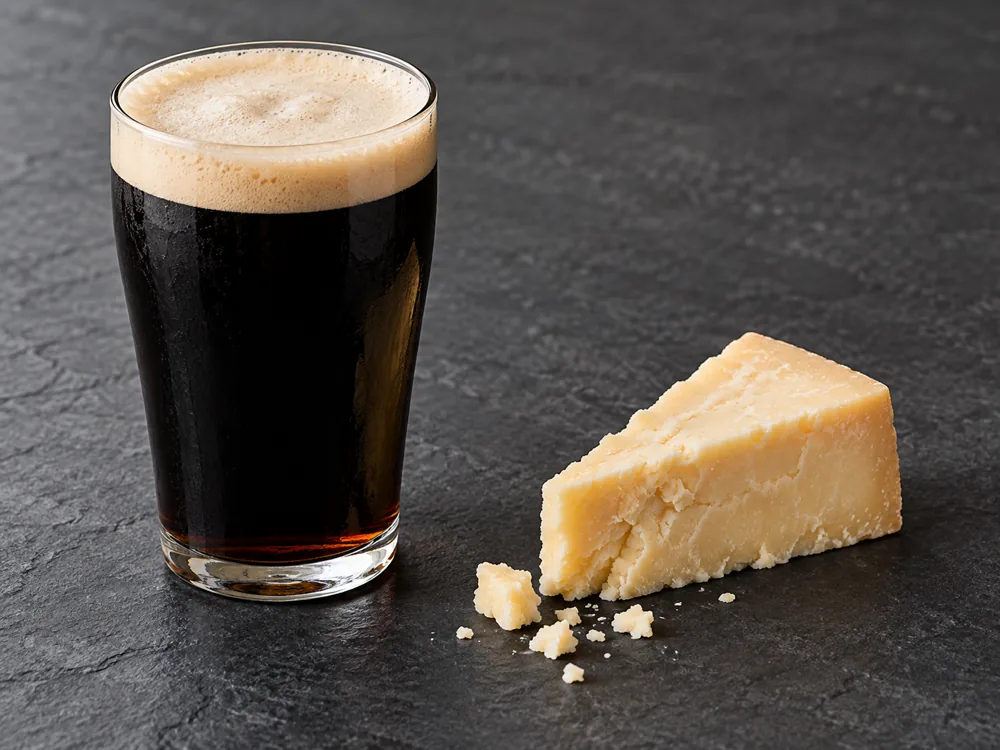
Why Do Hops, Malt and Bubbles Suit Cheddar?
Storton describes aged cheddar as "sharply bitter, pungent, earthy, creamy, sweet, even hazelnutty."
His rules for beer and cheese pairing are to complement shared flavours, contrast opposing ones, and cut and cleanse. Bitterness "can effectively cut through the fatty cream," and carbonation scrubs the palate before the next bite.
The Brewers Association's English-style IPA page says the same of its beer and strong English cheeses: the higher alcohol, hops and carbonation "all work to cut through fat and cleanse the palate."
Craft Beer & Brewing likewise says IPAs suit high-fat cheeses because hop bitterness helps cut through the fat, and Wikipedia gives cheddar 34% fat, 37% water and 23% protein.
The Brewers Association credits American pale ale's food-friendliness to simple ingredients, toasty pale malt and a clean-fermenting ale yeast, with American hops as the counterbalance that teases out flavour or cleanses the palate.
Malt does a different job. Quicke's says the buttery and caramel notes of its Mature Cheddar work "in harmony with the ale's sweet malt and fresh citrus" when paired with an amber ale.
The Brewers Association gives American amber ale the same caramel side, saying its caramel and crystal malts lend a toasted, toffee flavour. Its Irish-style red page lists caramel, toffee and sometimes low-level diacetyl, a butter note that echoes the notes Quicke's finds in its cheese.
Strength sits over all of these rules. Storton's advice is to pair light cheese with light beer, and Wisconsin Cheese says stronger cheeses need a more intense partner.
The Craft Beer & Brewing report on The Welsh Rabbit's picks adds that beer and cheese age in opposite directions: beer typically mellows, while cheese flavours tend to turn sharper, funkier and more focused.
Hines also says to think about texture as well as taste. The stouts the Brewers Association lists for cheddar differ in body: dry stout is often served from nitrogen taps for a smooth, creamy feel, milk stout gets more body from lactose, and oatmeal stout gets a rich, oily body from oatmeal.
How Does Cheddar's Age Label Change the Pour?
Wikipedia says cheddar sold in the UK is usually labelled mild, medium, mature, extra mature or vintage. Extra-mature or vintage cheddar needs 15 months or more of maturing.
Age changes the texture too, since Wikipedia notes that mature cheddar often holds calcium lactate crystals that form after more than six months, and it links cheddar's "sharpness" to bitter peptides.
American labels use different words. Storton describes cheddar as mild, sharp or extra sharp, and Cabot adds its own names such as Seriously Sharp and 3-Year.
Wikipedia lists the American varieties as mild, medium, sharp, extra sharp, New York style, white and Vermont, and says New York style is particularly sharp or acidic yet somewhat softer than the milder kinds.
White and Vermont are colour and place words, not age words: Wikipedia says cheddar without annatto is frequently labelled "white cheddar" or "Vermont cheddar" whether or not it was made there. The white cheddar that the Brewers Association lists for American amber lager and German-style pilsener therefore says nothing about how old the cheese is.
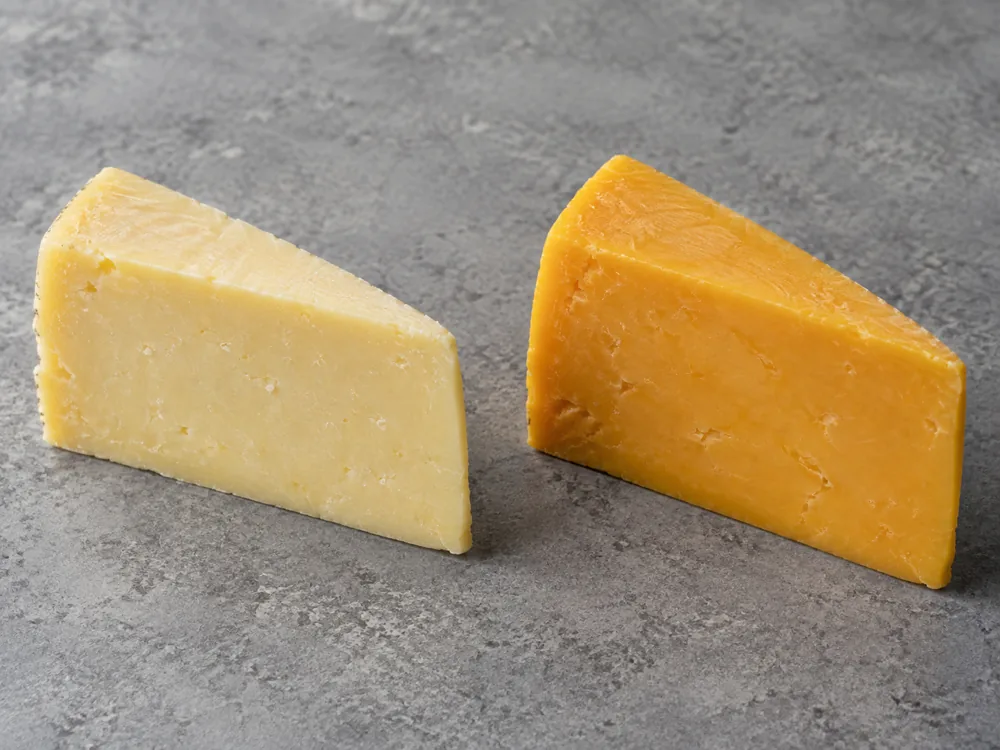
Wikipedia also says cheeses similar to Red Leicester are sometimes marketed as "red cheddar."
It places Colby among the cheeses similar to cheddar that contain annatto, and Wisconsin Cheese names mild Colby among easy-going cheeses that get along with a variety of beers.
The cheddar name itself is loose: Wikipedia says it is not protected under EU or UK law and that the style and quality of cheeses labelled cheddar vary greatly.
Two versions carry protected names, West Country Farmhouse Cheddar from Somerset, Devon, Dorset and Cornwall milk and Orkney Scottish Island Cheddar. Storton adds that cheese flavours vary within a style as much as beer does.
Cabot's beer guide covers the widest spread, pairing beer with everything from its Mild Cheddar to its 3-Year, each matched to a style by Cabot's own labels.
| Cabot cheese | Drink Cabot names |
|---|---|
| Mild Cheddar | Belgian-style wheat beer |
| Extra Sharp Cheddar | Pale ale |
| Seriously Sharp Cheddar | IPA, or a crisp pilsner |
| Vermont Sharp Cheddar | IPA, or hard cider |
| Farmhouse Reserve Cheddar | Sour or gose-style beer |
| 3-Year Cheddar | Hard cider |
| White Oak Cheddar | Fruity hard cider |
Cabot gives texture as part of the reason: the crumbly texture and sharp bite of Seriously Sharp hold their own against an IPA's hop-forward bitterness, while the same cheese, aged to a dense and slightly crumbly texture, combines easily with a crisp, easy-drinking pilsner.
Wisconsin Cheese describes aged cheddar as "complex, flaky, and sometimes tangy" and says it needs a partner that can keep up with its intensity.
Beyond a saison or Belgian ale, it names a drier cider, which lines up with Cabot's hard cider for its 3-Year Cheddar, whose bold, distinct flavour Cabot says the cider's hoppy sweetness cuts and balances.
When Do Beer and Cheddar Clash?
The Courtyard Dairy warns that a poor match can ruin both a good drink and a great cheese, and only one clash with cheddar appears below.
In a 2015 Craft Beer & Brewing report, Cody Cook of The Welsh Rabbit cheese shop in Fort Collins, Colorado, tried one fresh-hopped IPA against two cheddars.
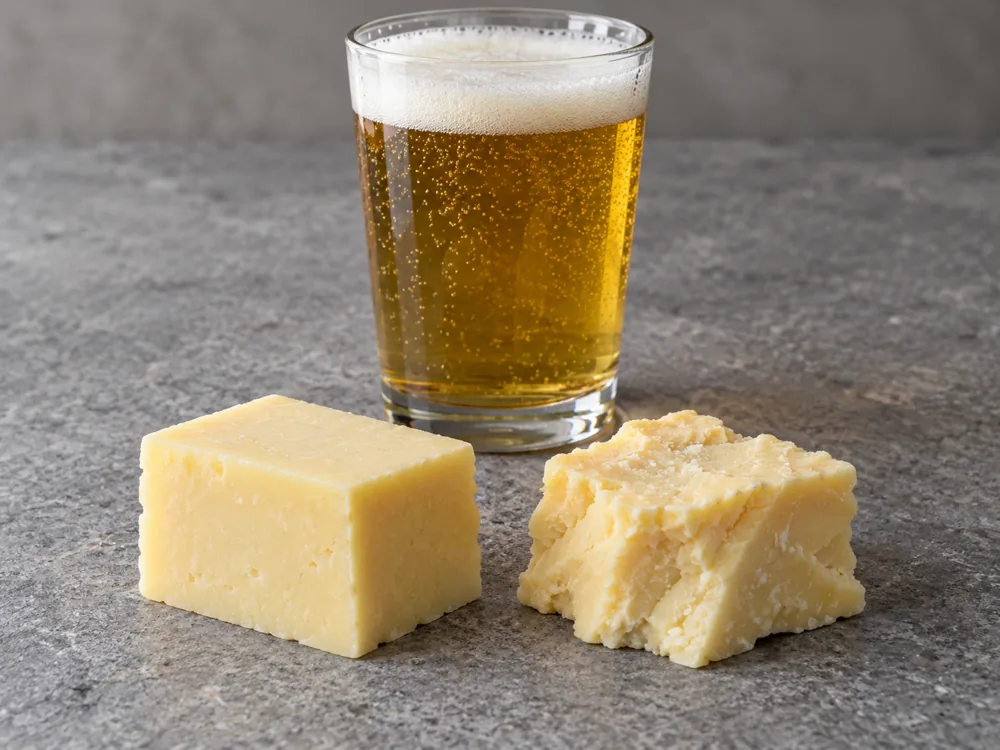
The beer "paired incredibly well" with English Westcombe cheddar, and Cook calls the cheese's "mineral character" a great match. Beside a 4-year-old Grafton cheddar, it "brought too much tanginess to the beer."
Cook's rule from that test is to "match the hop strength to the sharpness of the cheddar."
Younger aged cheddars do have IPA backing. Quicke's pairs its Vintage, matured for up to 24 months and described as running from umami to buttery to salted caramel, with an IPA whose hop bitterness it says balances the cheese's savoury side.
Cabot's non-alcoholic guide pairs Free Wave Hazy IPA with its 3 Year Aged Cheddar, which Cabot ages for a minimum of 36 months. Both cheeses are younger than the 4-year Grafton, and no other source pairs an IPA with a cheddar that old.
Sour beer has one backer: Cabot pairs its Farmhouse Reserve Cheddar with "the tang and pucker of a sour or gose-style" beer.
The Brewers Association pairs barleywine with English Stilton and strong blue cheeses, not cheddar.
The same Craft Beer & Brewing report lists barleywine among the strong beers that can stand up to older, more pungent cheeses, but it also says certain aged beers, barleywines among them, are better enjoyed without food.
The Brewers Association's English-style brown ale page names aged Gouda instead, but Storton and Cabot both name brown ale for cheddar, and Cabot suggests "a sharp cheddar with a malty, mellow brown ale."
Which IPA Goes With Cheddar, English or American?
The Brewers Association's cheddar match for IPA sits on its English-style IPA page, which lists aged cheddar. Its American IPA page lists blue cheeses, not cheddar.
The two pages describe different beers. The English style has earthy, floral hops, fruity English yeast and a balance of malt and hops that the Brewers Association says gives a more rounded flavour, at 35-63 IBU and 5-7% ABV.
The American style is, in the Brewers Association's words, "all about hop flavor, aroma and bitterness," with floral, fruity, citrus-like, piney or resinous American hops at 50-70 IBU and 6.3-7.5% ABV.
An English-style IPA can therefore be lower in measured bitterness than any American one, which gives Cook's rule of matching hop strength to the cheddar's sharpness a gentler setting to work with. The two ranges overlap only between 50 and 63 IBU.
Makers and cheesemongers name IPAs without a style. Quicke's pairs its Vintage with Harbour Brewing's Puffin Tears IPA from Cornwall, which it describes as full and well balanced, with stoned-fruit and citrus aromas and a full mouthfeel, while Cook's test beer was a fresh-hopped IPA from Comrade Brewing in Denver.
Which Beer Suits Smoked, Spiced or Beer-Soaked Cheddar?
Flavoured cheddars add a second thing to match, because the smoke, spice or beer in the cheese sits on top of its age. Wikipedia notes that some versions of cheddar are smoked, and the sources name a beer for four flavoured cheddars.
| Cheddar | Beer a source names |
|---|---|
| Quicke's Oak Smoked Cheddar | Arbor Ales Dunning Krugor, a pale ale |
| Cabot Horseradish Cheddar | Double IPA |
| Cabot Habanero Cheddar | Amber ale |
| Vermont Farmstead Alehouse Cheddar | IPA or hoppy pale ale |
Quicke's says the pale ale's mango, passionfruit and lime flavours cut through the smoked cheddar's subtle smoky notes, and that the beer is brewed with American and Australian hops.
Cabot's two spiced cheddars take different routes. It says the big hop flavour of a double IPA needs a bold cheese and that Horseradish Cheddar's kick of spice complements it, while an amber ale's flavourful, balanced taste is its match for the spicy kick of Habanero Cheddar.
Two writers describe what hops do to heat in other spiced cheeses: Craft Beer & Brewing says IPAs give peppered fresh goat cheeses maximum heat because hop bitterness amplifies the spice, and Storton says bitter hops can intensify the spiciness of pepper jack.
Beer can also be in the cheese itself. Craft Beer & Brewing says the curds of Alehouse Cheddar are soaked in two Harpoon Brewing beers during cheesemaking, and it calls that a chance to pair for "pure complementary flavors" with IPAs and hoppy pale ales.
How Do You Serve a Cheddar and Beer Tasting?
Cabot's beer guide gives the cheese and body rules, and the Brewers Association table above supplies the beer temperatures.
- Cheese out 30 minutes early: Cabot says cheese is at its best at room temperature and takes it out of the fridge 30 minutes before serving.
- Beer not ice cold: Cabot says beer gives its fullest flavour when it is not ice cold, and the Brewers Association serves its pilsener styles at 40-45°F and its stouts at 50-55°F.
- Light to heavy: Cabot starts with lighter cheeses and lower-alcohol beers before heavier, higher-alcohol ones.
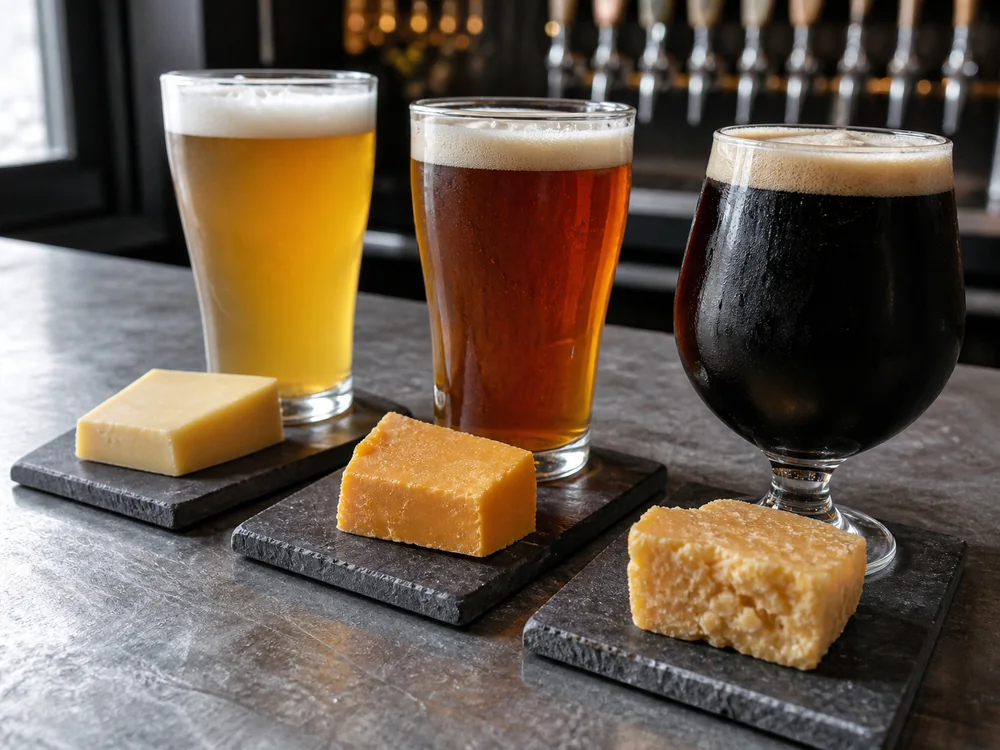
On a mixed cheese board, that order puts a mild cheddar with pale ale ahead of a sharp cheddar with American stout.
Craft Beer & Brewing suggests trying one cheese with several beer styles, or one beer with several cheeses, and reports that the pairings its staff expect to work often become the group favourites while individual tasters just as often prefer another.
SOURCES & REFERENCES
Is Ale or Lager Better for Cheddar?
Most styles the sources name for cheddar are ales, from bitter and IPA to stout and porter. Lager has narrower backing: the Brewers Association lists white cheddar for American amber lager and German-style pilsener and mild white cheddar for Bohemian-style pilsener, and Cabot pairs its Seriously Sharp Cheddar with a crisp pilsner.
Most pairing sources pair cheddar by age or sharpness, not colour, and the Brewers Association's white cheddar listings for two lagers do not say how white differs from orange. Orange cheddar is coloured with annatto, which Wikipedia says may also add a sweet, nutty flavour, so two cheddars of the same age can still taste slightly different.
Cabot thinks so. Its non-alcoholic guide pairs Run Wild IPA with Seriously Sharp Cheddar and Atlética with Extra Sharp Cheddar, and its rule is to match the brew's intensity to the cheese: lighter non-alcoholic beers for milder cheeses, stronger ones for sharp or aged cheeses.