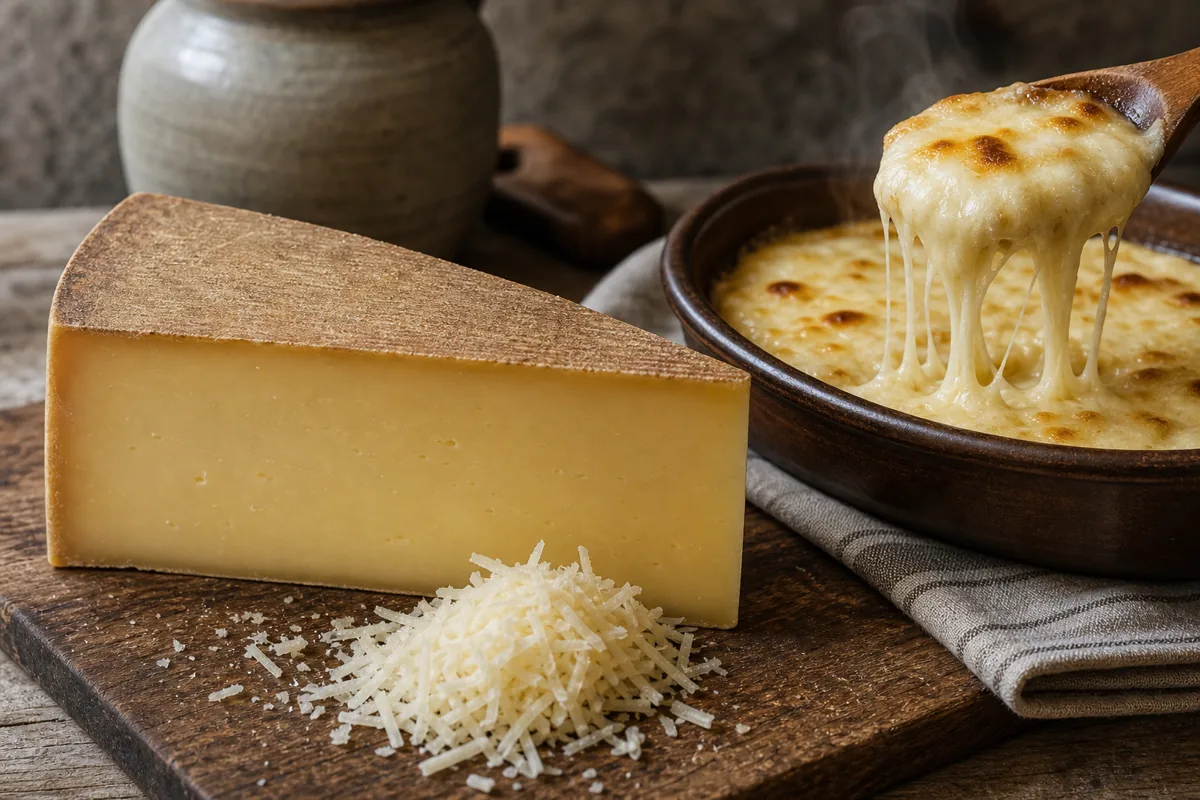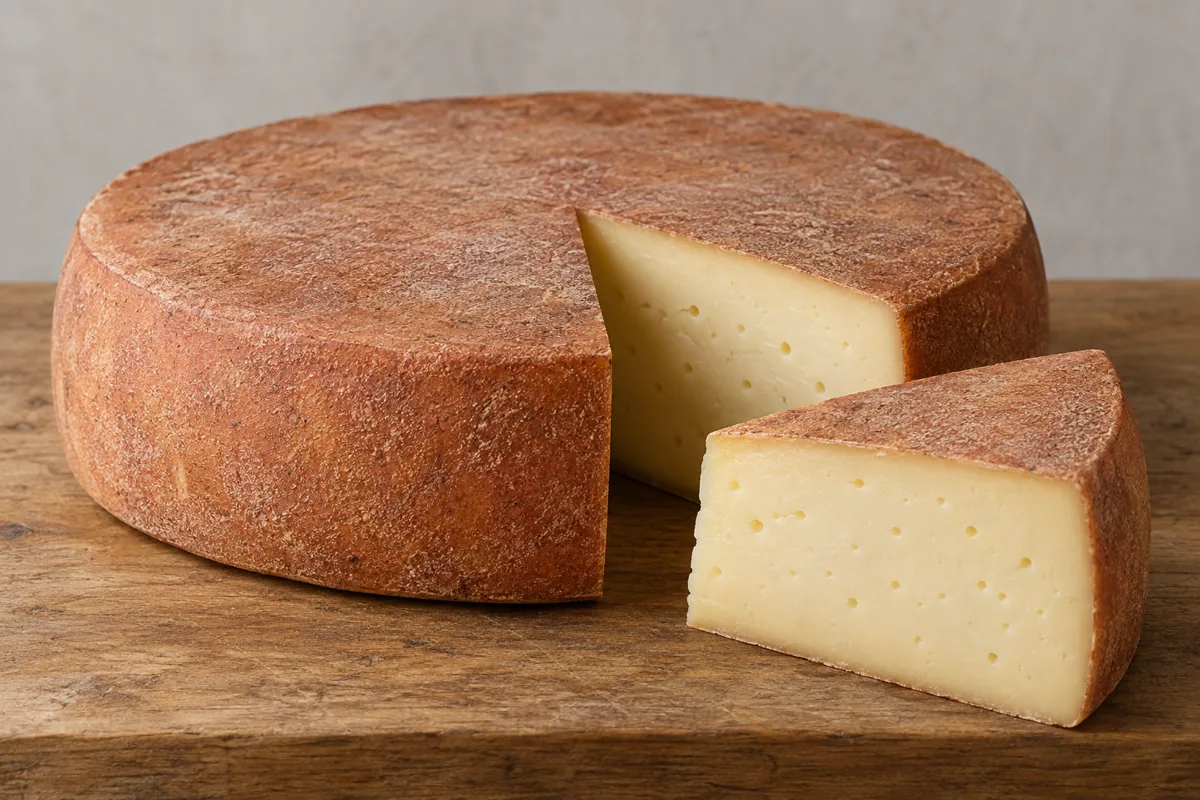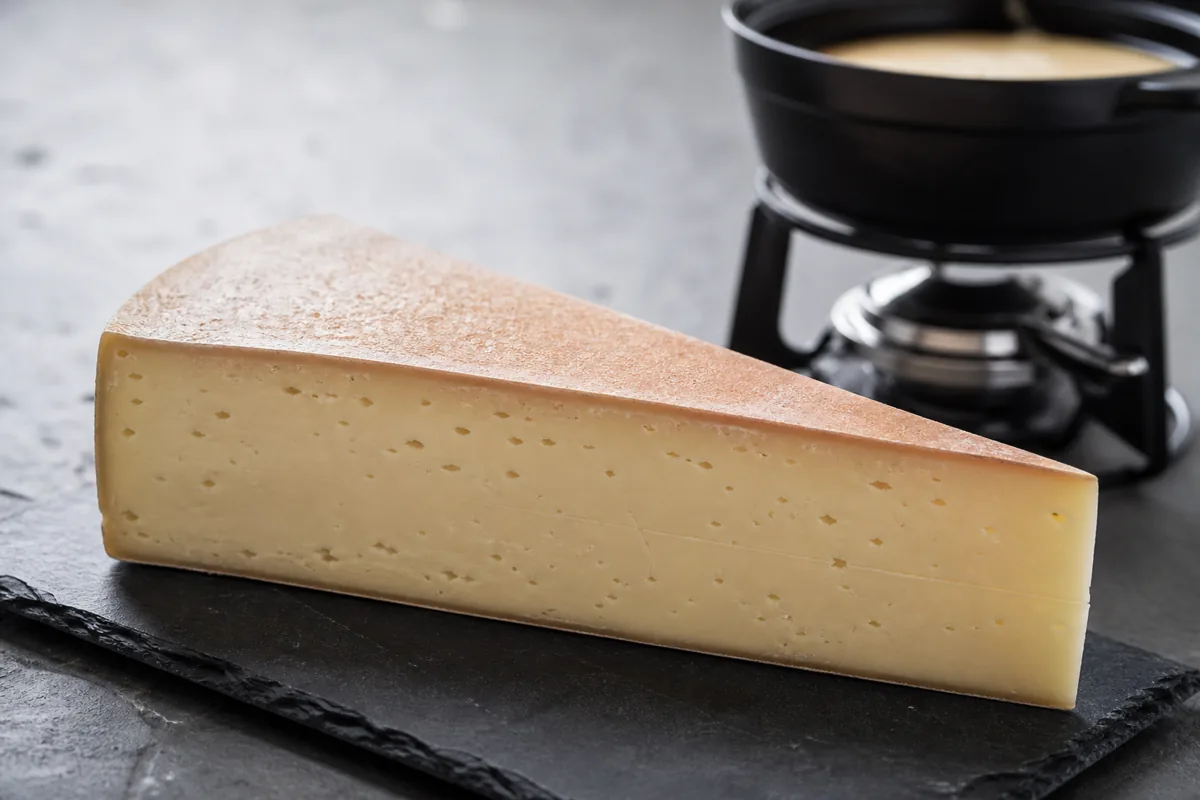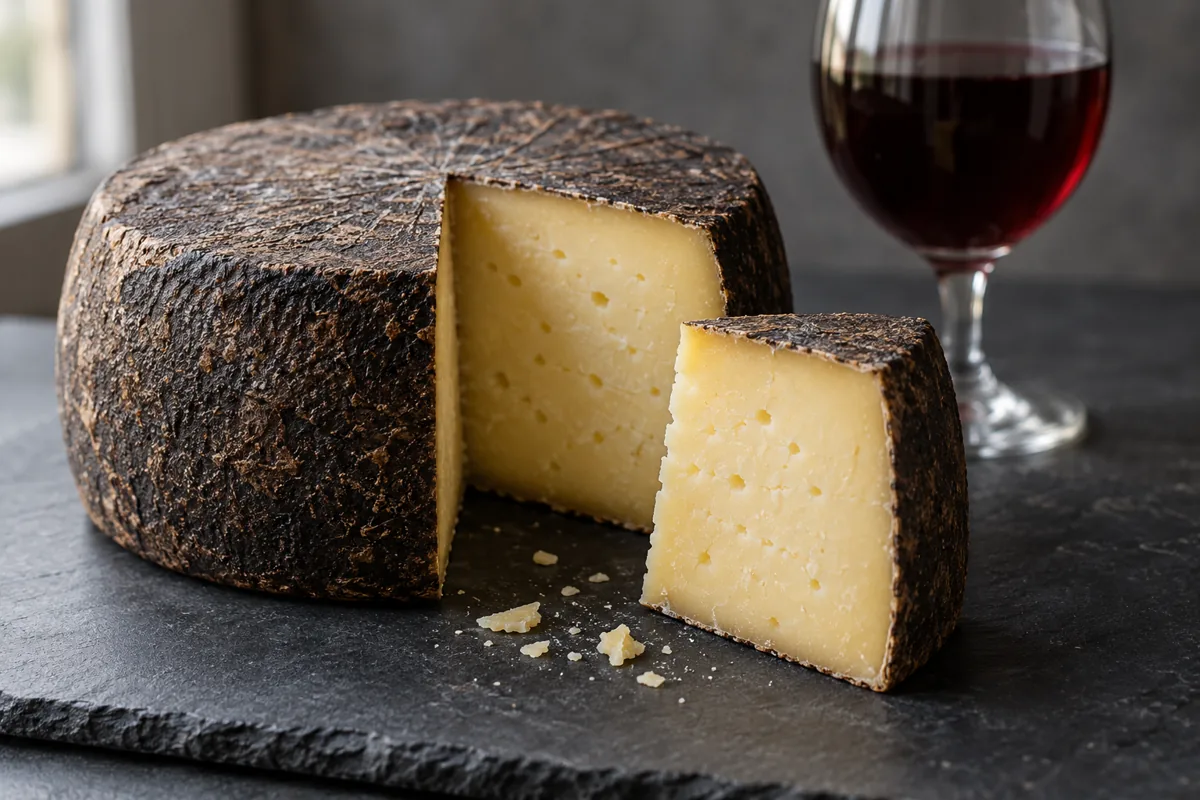
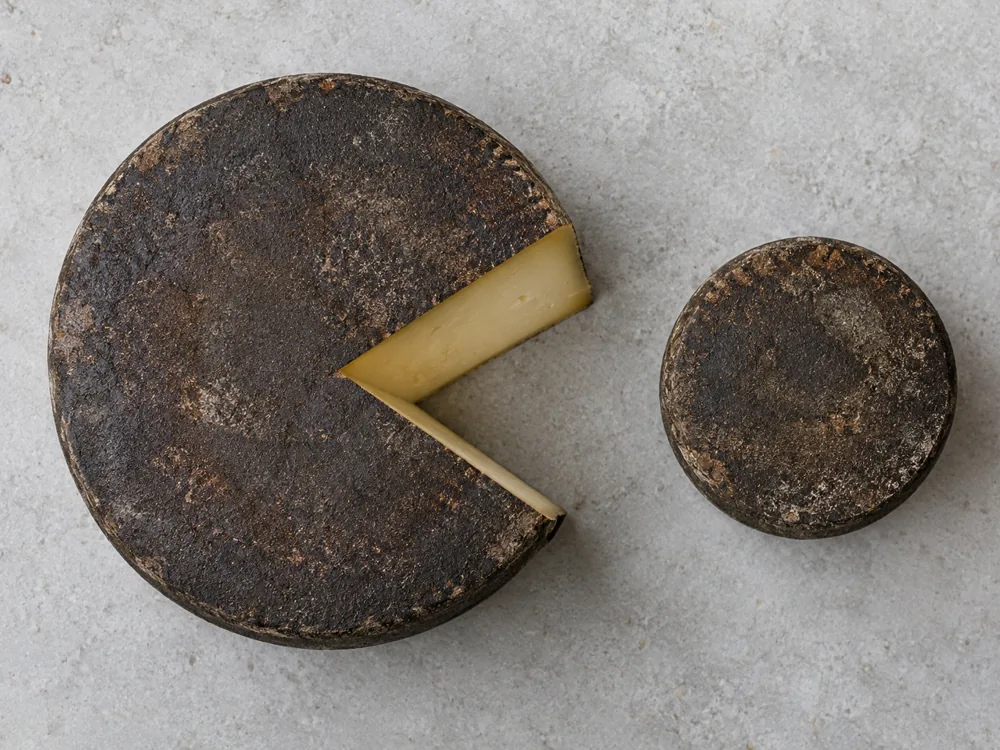
Rotwein Bargler Extra Wurzig is a hard Swiss cheese from the mountains of the canton of Bern that the affineur Walo von Mühlenen matures with red wine for 12 months. Cheese.com and Walo both describe raw cow's milk and a black-brown rind, and Walo adds that the rind is dry and the paste yellow-white.
Walo calls the flavor strong and spicy with a slightly sweet finish, and Cheese.com suggests a glass of strong red wine beside it. The milk matters beyond flavor, because the NHS and the CDC sort raw-milk hard cheese differently, as the pregnancy section shows.
In This Article
Is Rotwein Bargler the Same Cheese as Red Nose Gold Label?
Cheese.com files the cheese as Rotwein Bärgler Extra-Würzig, names Walo von Mühlenen AG as the producer and lists the synonym "Extra spicy red wine Bärgler". Walo's English catalogue has no entry under that name.
What the catalogue does list is a 12-month red-wine hard cheese from the mountains of the canton of Bern called Red Nose Gold Label. Walo's award list files results from 2012 to 2021 under Rotwii Bärgler.
Age, rind, milk and the 2012 Super Gold match across Cheese.com and Walo's pages, so the published details point to one Walo mountain cheese described under several names. No page states the renaming outright.
Cheese.com adds that the cheese is "characteristically a real mountain cheese", and Das Käseportal's copy of the older Walo text gives the same verdict as "ein echter Bergkäse".
How Is Rotwein Bargler Made and Aged?
Walo tells the origin on the Red Nose Gold Label page. He first looked for this style of mountain cheese in French-speaking Switzerland, where it is mainly made, and found nothing.
He then remembered buying mountain cheese in the Emme valley as a child and searched high in the mountains until he found a dairy making raw-milk Emmentaler. Its cheesemaker said he had never made a mountain cheese, and the two worked it out by trial and error.
In that account the dairy makes the cheese and Walo, an affineur, handles the affinage. Walo's specification gives the ingredients as milk, salt, rennet and natural starter cultures.
The 12 months with red wine leave a smeared, dry, black-brown rind on a round wheel of 60 cm and 33 kg. Cheese.com calls the wine local, but no page names the grape or says how the wheels are treated, so the glass beside the cheese is a free choice rather than a match.
What Does Rotwein Bargler Taste Like?
Walo's English catalogue describes the cheese as strong and spicy with a slightly sweet finish and a hint of red wine. Its specification adds "strong-mature, smooth with a hint of red wine".
Cheese.com is blunter about intensity, tagging the flavor "full-flavored, pronounced, spicy" with a strong aroma and describing an "extra-spicy taste", which is how Extra Wurzig reads in English.
The wine note is faint on Walo's account, because the same words, a hint of red wine, appear on its 4-month raclette and its 6-month farmer cheese. The dark rind therefore promises more wine than Walo's own flavor wording does.
Walo's guide to which cheese suits which dish lists Rotwein Bärgler as "kräftig, würzig", strong and spicy, among hard and mountain cheeses. The older Walo text on Das Käseportal calls the cheese "kräftig, extra-würzig", so Walo's own wording for the Extra differs from one document to the next.
The guide's grades do not form a reliable ladder: it gives its 14-month Le Gruyère AOP extra "kräftig, extra würzig" and a 16-month Emmentaler extra "mild, würzig", while the catalogue calls its 14-month Emmentaler AOP extra strong and spicy. For the Extra, the catalogue's strong and spicy is the wording to go by.
Texture is where the pages split. Walo's specification calls the paste "yellow-white, sometimes small holes, smooth, flexible", its story on the same page calls the cheese "Strong, creamy", and Cheese.com says "creamy and crumbly".
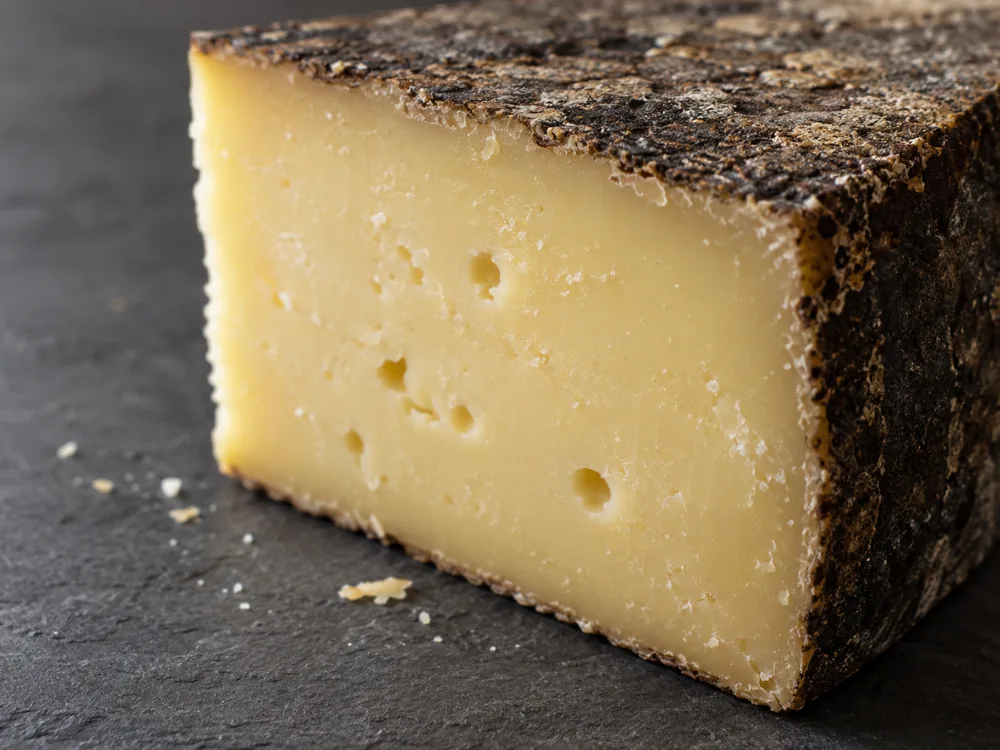
Creamy appears in two of the three descriptions and crumbly only in Cheese.com's. A flexible paste bends before it breaks and a crumbly one breaks first, so a cut face at the counter settles which fits the wedge in front of you.
Why Do the Sources Disagree on Fat, Salt, and Weight?
Cheese.com, Das Käseportal and Walo's current Red Nose Gold Label page each give figures for this cheese, and no two of them agree on everything.
| Detail | Cheese.com | Das Käseportal (older Walo text) | Walo, Red Nose Gold Label page |
|---|---|---|---|
| Fat | 45% | At least 45% of dry matter | At least 48% of dry matter |
| Dry matter and water | Not given | 64% and 36% | 64 g and 36 g per 100 g |
| Salt | Not given | 2% | 1.5 g per 100 g |
| Energy per 100 g | Not given | 399 kcal | 384 kcal |
| Wheel | Not given | 30 to 35 kg | 60 cm round, 33 kg |
| Texture | Creamy and crumbly | Not given | Smooth, flexible |
| Region | Bern | Switzerland | Central Switzerland in the specification, canton of Bern in the description |
Das Käseportal credits an earlier Walo product page for its text, and that text agrees with Walo's current page on 64 g of dry matter and 36 g of water per 100 g, so moisture is not in dispute.
A revised specification would explain the gaps in fat, salt and energy, though no page says one was issued.
The 33 kg wheel falls inside the older 30 to 35 kg. For a label, nutrition or fat decision, Walo's current page and the pack in hand outrank the older figures.
Walo's current page also lists, per 100 g, 26 g of protein and 32 g of fat, of which 19 g is saturated and 1.4 g is trans fat. Cheese.com and Das Käseportal give no protein or fat totals.
Has Rotwein Bargler Won Cheese Awards?
Walo's award list gives this cheese 17 certificates under Rotwii Bärgler between 2012 and 2021, from the World Cheese Awards and the Nantwich International Cheese Show.
| Year | World Cheese Awards | Nantwich International Cheese Show |
|---|---|---|
| 2012 | Super Gold, Best new cheese, World champion new products | None listed |
| 2013 | Silver, Bronze | None listed |
| 2014 | Bronze | None listed |
| 2015 | Super Gold, Silver, Bronze | Silver |
| 2017 | Silver | None listed |
| 2018 | None listed | Gold |
| 2019 | Gold, Bronze | Bronze, Highly recommended |
| 2021 | None listed | Bronze |
The top results came early: Super Gold and the best-new-cheese title at the 2012 World Cheese Awards, then another Super Gold in 2015. Cheese.com repeats only the 2012 Super Gold and the 2013 Silver.
A "best new cheese" title in 2012 means the cheese was new that year, though no page gives a launch date.
The list is Walo's own, so it shows what the maker entered and won rather than an independent ranking, and it does not say which class each certificate came from.
How Is Rotwein Bargler Served and Cooked?
Cheese.com says the cheese goes best with a glass of strong red wine. Das Käseportal's copy of Walo's older product text adds that it tastes best at room temperature.
Room temperature has a limit. The CDC says perishable food should not sit out for more than 2 hours, or 1 hour above 90°F, so a tasting plate comes out for the tasting rather than for the evening.
Walo's Red Nose Gold Label page calls the cheese ideal as a dessert cheese and in warm cuisine. No page names a bread, fruit or nut to serve with it, so the only sourced partner is the wine.
For storage, the CDC says to keep a refrigerator at 40°F or below. No maker page gives a keeping time for an opened wedge or a wrapping method.
For cooking, Walo's guide to which cheese suits which dish, published on Fleischnet and reproduced on Walo's site, lists Rotwein Bärgler among the hard and mountain cheeses. That group goes into salads, pizza, gratin, Swiss cheesecake, omelettes, soufflés and sauces.
| Use | How It Works |
|---|---|
| Dessert board | Walo's catalogue calls it ideal as a dessert cheese. |
| Gratin and cheesecake | Walo's guide places hard and mountain cheeses in gratin and Swiss cheesecake. |
| Omelette and soufflé | The same guide lists omelettes and soufflés for this group. |
| Salads, pizza and sauces | The guide also names salads, pizza and sauces. |
The guide's extra-hard group, Parmesan, Sbrinz and Bernese Hobelkäse, melts poorly and works almost like a spice, and Rotwein Bärgler is not placed there. For hard and mountain cheese in general, Walo von Mühlenen says he would use only flower-meadow cheese from untreated raw milk.
No page gives a melt test, a cooking temperature or a fondue use for this cheese, so how it behaves in a hot pan or a fondue pot rests on the hard-cheese category and Walo's general guidance.
Can You Eat Rotwein Bargler While Pregnant?
The milk decides most of the answer: Cheese.com says unpasteurized cow's milk and Walo's specification says raw cow's milk.
The NHS lists pasteurised or unpasteurised hard cheeses, such as cheddar, gruyère and parmesan, as safe to eat, and Walo classes this cheese as a hard cheese.
The CDC draws the line differently. Its safer list names hard cheese made with pasteurized milk, and its riskier list names dairy products made from raw milk.
So the NHS list covers this raw-milk wedge, while the CDC lists do not place it among the safer choices. The NHS also says any cheese cooked until steaming hot is safe to eat.
The CDC adds that pregnant women are 10 times more likely to get a Listeria infection. Neither agency names this cheese, so a pregnant reader can ask a midwife or doctor to confirm.
What to Check When Buying Rotwein Bargler
Cheese.com names Walo von Mühlenen AG as the producer, so a listing under Rotwein Bärgler, Rotwii Bärgler or Red Nose Gold Label that names another maker describes a different product.
Walo's red-wine cheeses share a dark rind, so age and type separate them: 12 months and hard here, 6 months and semi-hard for the Red Wine Farmer Cheese, and 4 months for the Redwine Raclette.
Wheel size separates them too. The farmer cheese comes in 30 cm, 6 kg wheels against 60 cm and 33 kg here, a wheel more than five times as heavy.
Walo's specification lists the rennet as animal, which matters to vegetarian buyers. The fat, salt and energy figures on the pack settle the differences the earlier table shows.
None of the pages says whether the rind is eaten or trimmed, so the seller is the one to ask about a specific piece.
No page gives a price or says which shops stock the cheese, so availability has to be confirmed with the seller.
Match three things before buying: Affineur Walo as the maker, 12 months of age on a hard cheese, and the pack's own fat, salt and rennet details.
Which Cheeses Come Closest to Rotwein Bargler?
Walo's English catalogue is the one source that describes several comparable cheeses in the same terms, so the table draws on it alone.
| Cheese | Age | Type | Matured with red wine | Walo's description |
|---|---|---|---|---|
| Red Nose Gold Label (Rotwein Bärgler) | 12 months | Hard | Yes | Strong and spicy, slightly sweet finish, a hint of red wine |
| Red Wine Farmer Cheese | 6 months | Semi-hard | Yes | Strong and spicy, a hint of red wine |
| Redwine Raclette | 4 months | Semi-hard | Yes | Mildly spicy, a hint of red wine |
| Gallus | 12 months | Hard | Not mentioned | Strong and spicy, a mixture of semi-hard and hard cheese |
| Jura Mountain Cheese | 12 months | Hard | Not mentioned | Delicate, strong, spicy, tender melting, creamy |
| Le Gruyère AOP extra | 14 months | Hard | Not mentioned | Strong and spicy, a typical Gruyère |
| Emmentaler AOP extra | 14 months | Hard | Not mentioned | Strong and spicy, sweetish nutty flavor |
For the red-wine rind, the Red Wine Farmer Cheese is the nearest by Walo's wording. Its story calls the flavor a light red wine one with a lot of character, and its specification lists 41 g of water per 100 g against 36 g for the 12-month cheese.
Its page gives 6 months of red-wine maturing in the text but 8 to 10 months of affinage in the specification, so its age depends on which line is meant.
For a 12-month hard cheese without wine, Gallus is the closest in strength, while the Jura Mountain Cheese goes the other way and is described as delicate and creamy.
Walo's cooking guide puts Le Gruyère extra in the same hard-cheese group as Rotwein Bärgler. Walo describes all of these cheeses, and no independent page compares them with Rotwein Bargler, so each match rests on the maker's own wording.