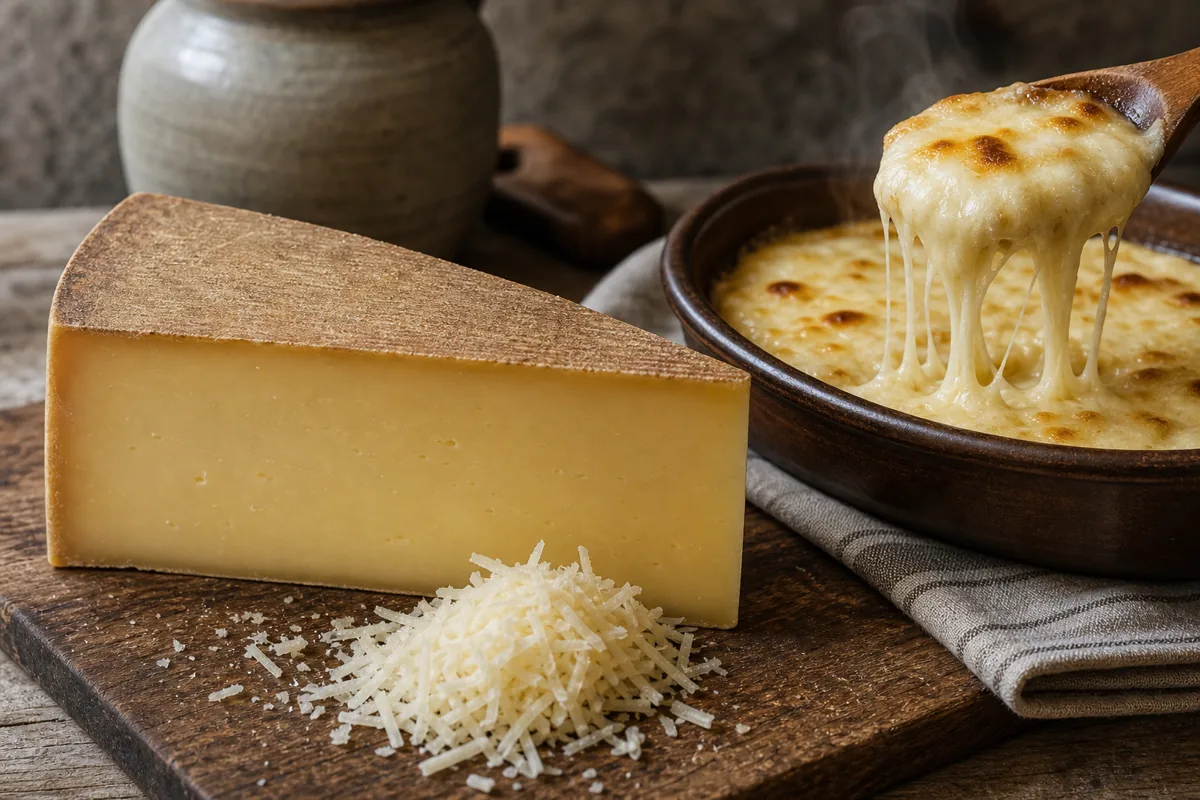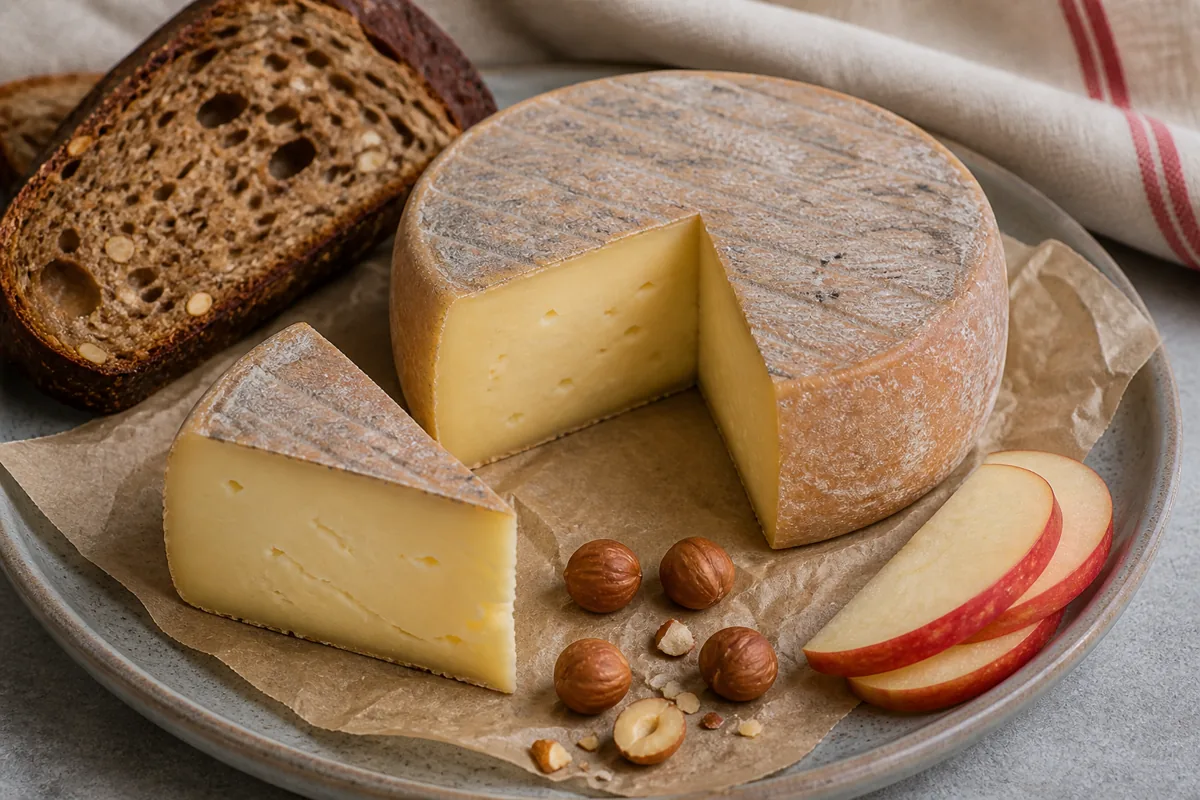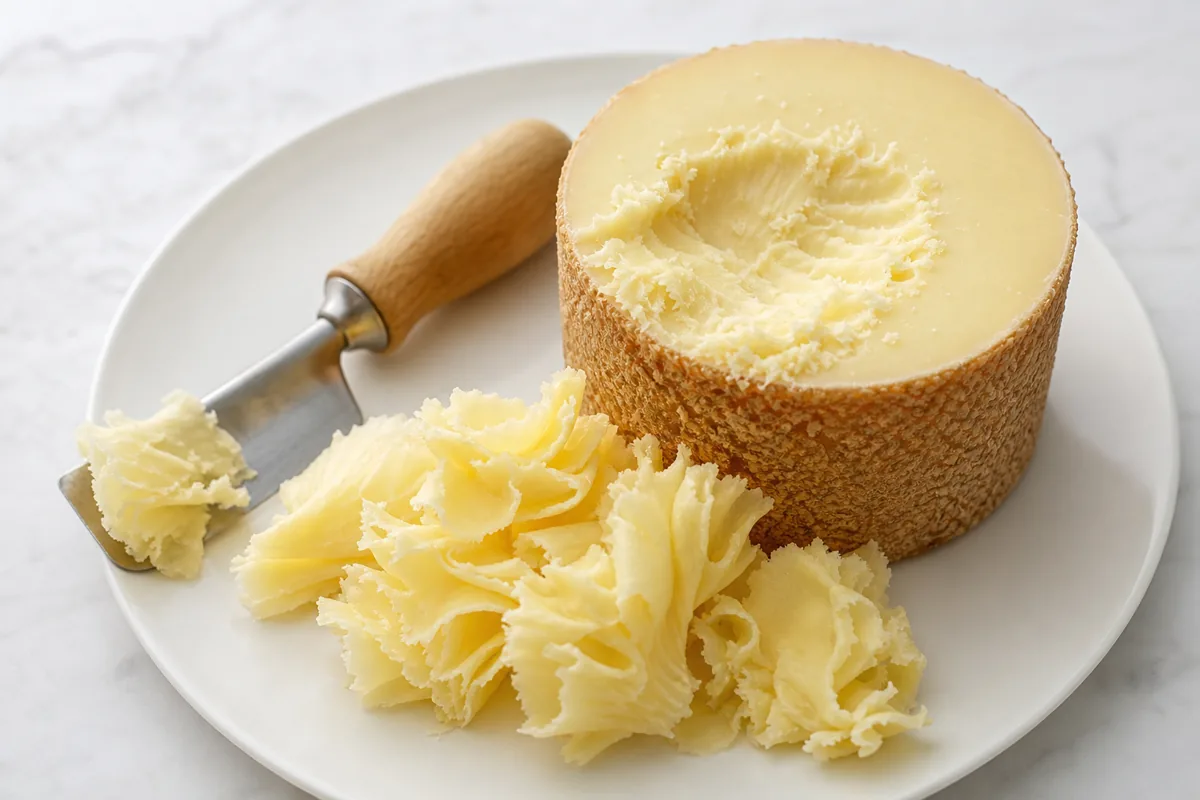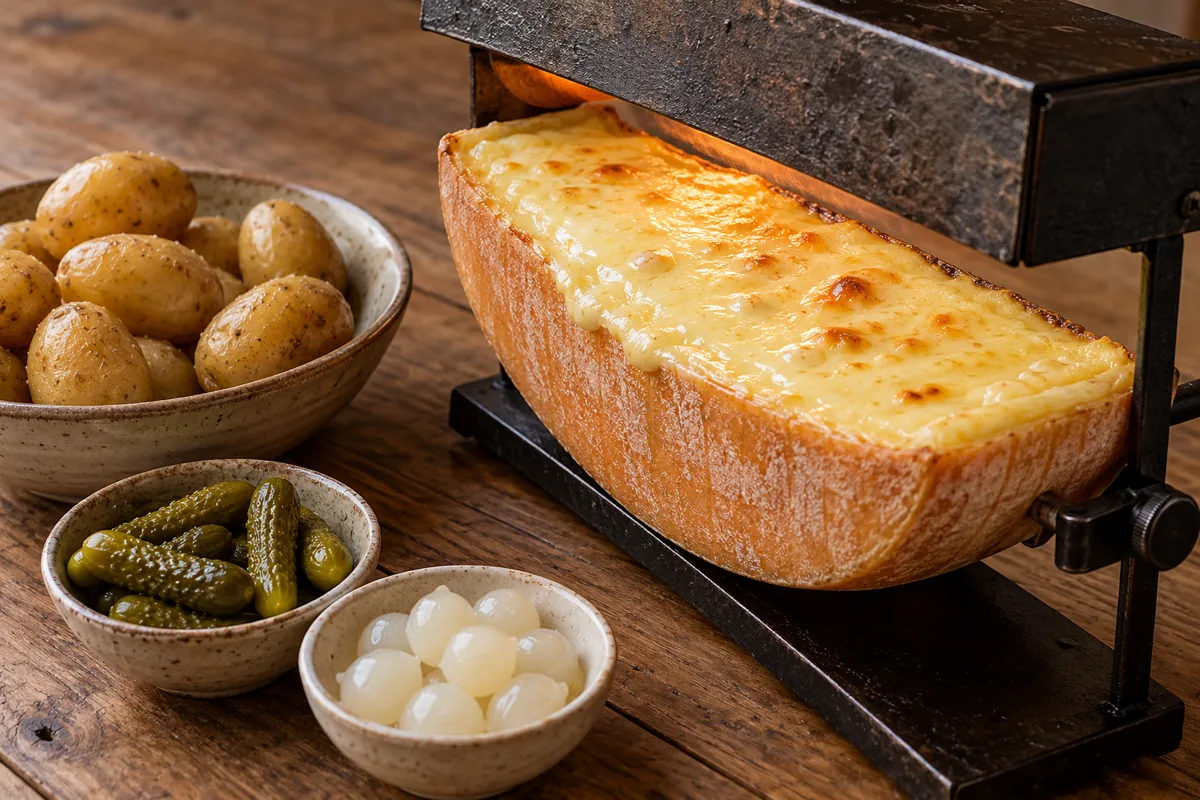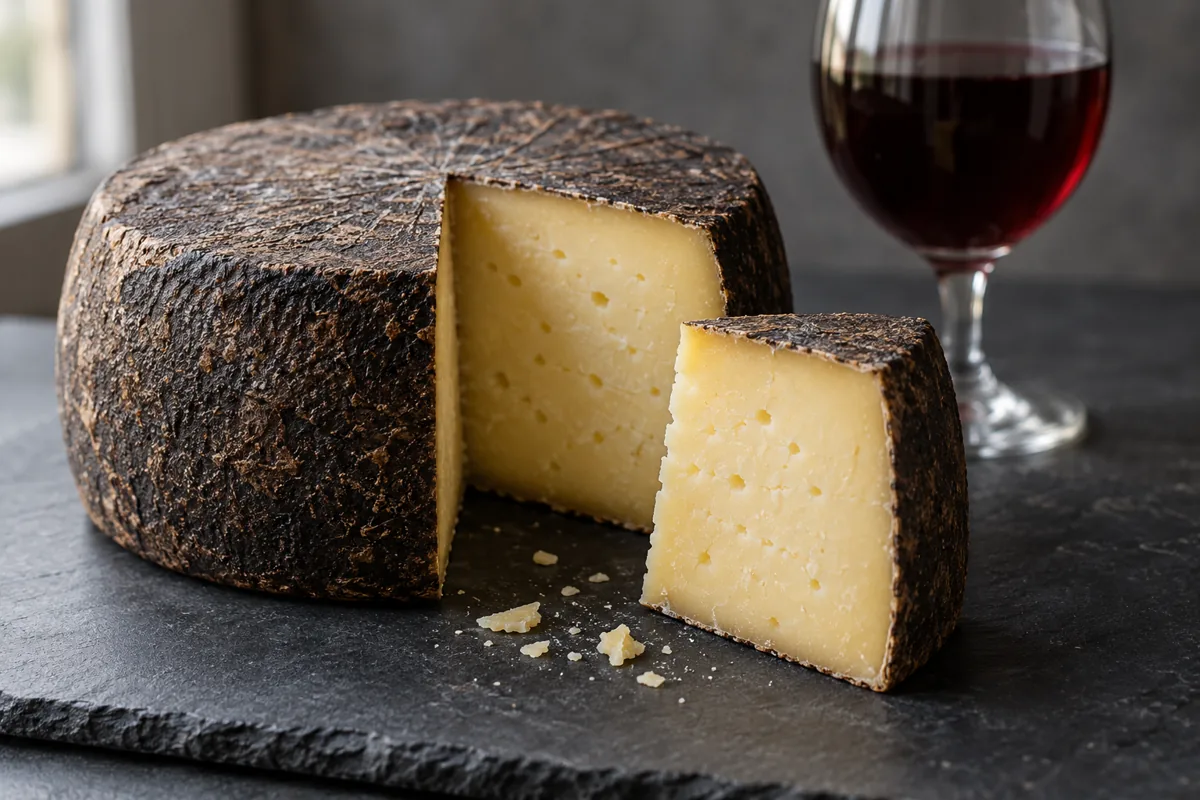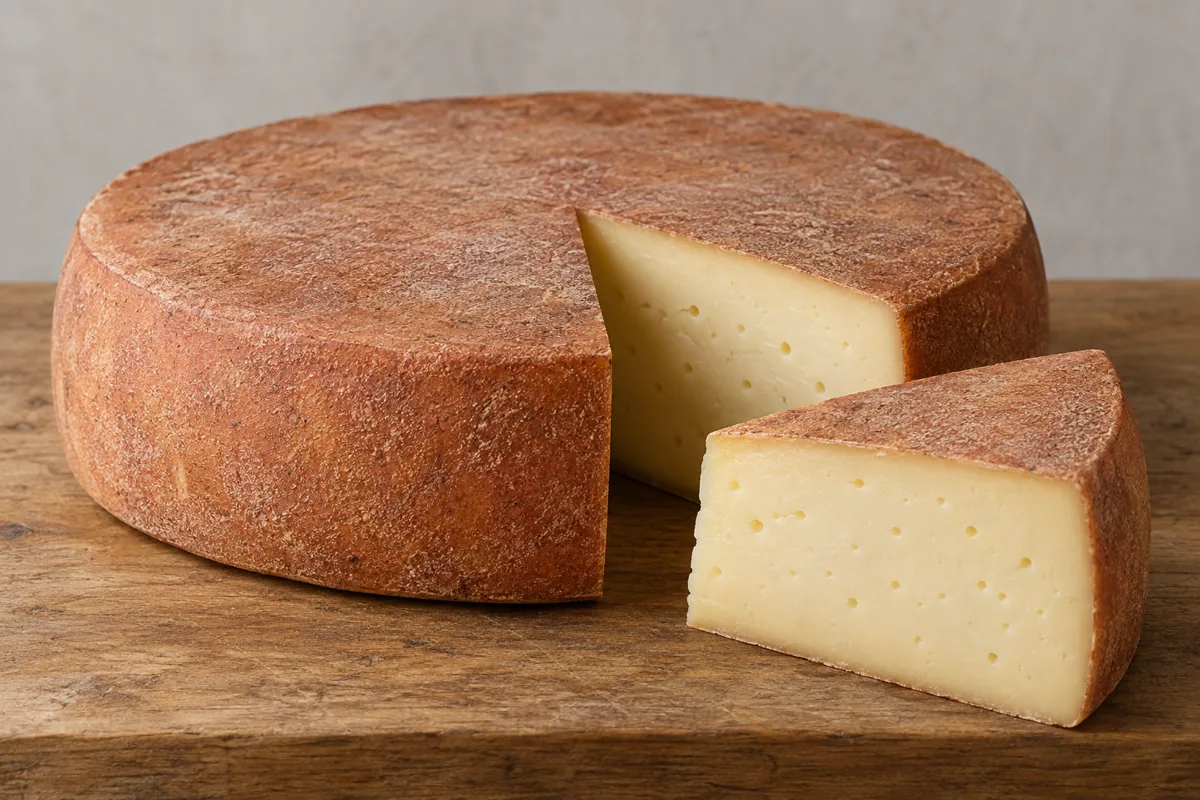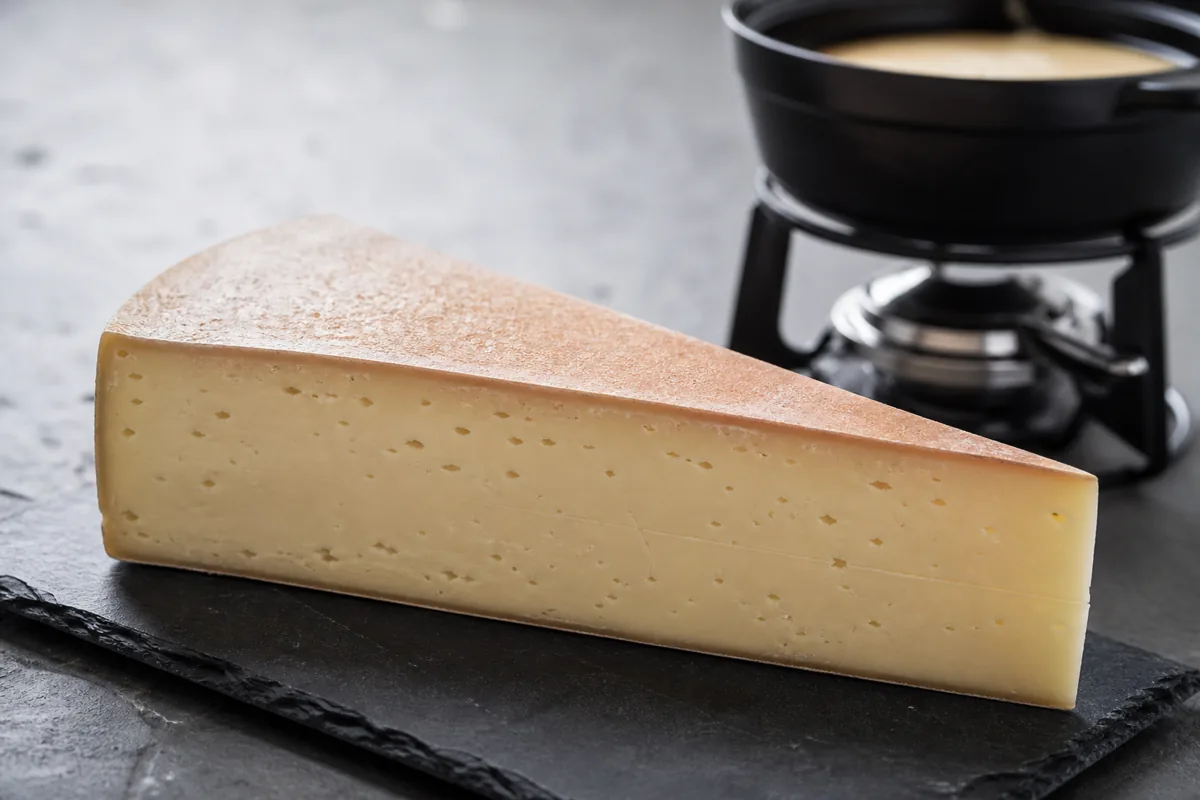
Vacherin Fribourgeois is a half-hard Swiss cow's milk cheese, and it is the creamy half of the classic moitié-moitié fondue with Gruyère. Its paste is creamy and ivory to pale yellow, and the Swiss specification makes melting part of the AOP rules.
Choose the style first, because the six styles differ in age and in how the milk was produced. Classic is the style the interprofession recommends for fondue, Extra and Rustic suit a cheese board, and Alpage, Montagne, and Bio add production rules.
In This Article
What Is Vacherin Fribourgeois?
Vacherin Fribourgeois AOP is one of the Swiss cheeses made in the canton of Fribourg and in the Bernese municipality of Münchenwiler. Milk production, cheesemaking, and ageing all happen inside that area, and the ageing cellar must stand in the canton of Fribourg.
The Federal Office for Agriculture registered the protected designation of origin by a decision dated 22 December 2005. The Swiss PDO-PGI Association lists the registration as 28 February 2006.
The specification has been amended four times since that decision, on 27 May 2014, 11 July 2018, 6 June 2019, and 22 February 2023, so the current text dates from 2023.
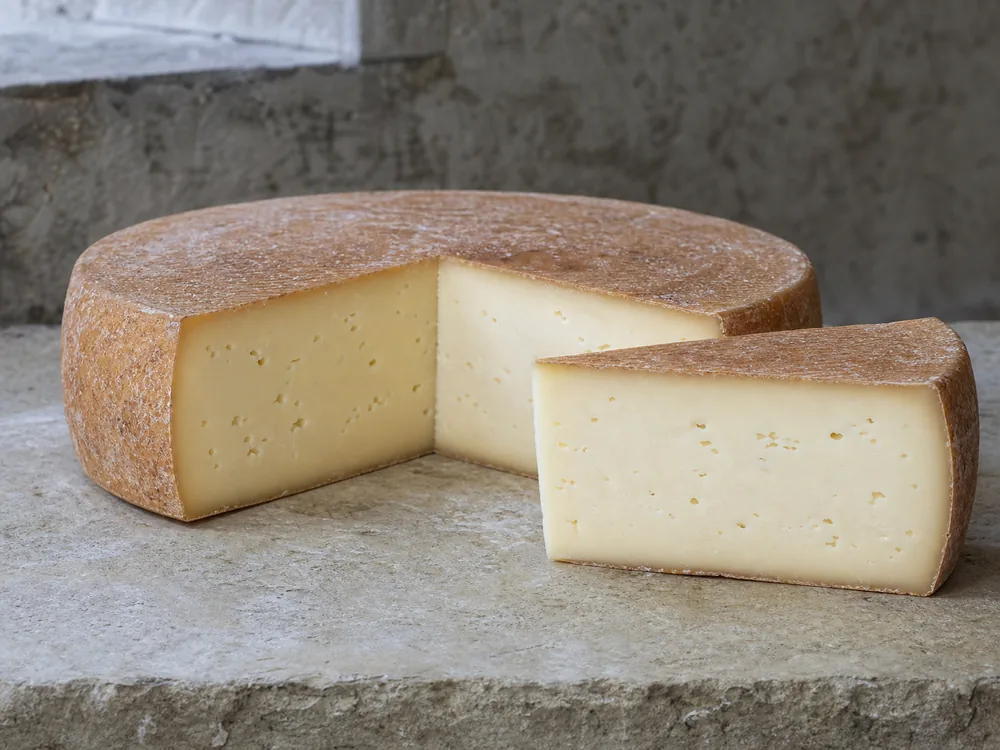
The wheel is round with a straight to slightly convex heel, closed by a gauze band or a spruce-wood belt. Its rind runs from yellow-brown through gray-brown to red-brown, and it can be smooth, wavy, or wrinkled.
Inside, the paste is ivory to pale yellow, creamy and tender, with small holes that are usually irregular in shape.
Vacherin Mont d'Or is a different cheese, and Fromagère calls Vacherin Fribourgeois firmer and less woody than it. The specification describes the Fribourgeois paste as half-hard and pressed uncooked, suited to cutting.
The Swiss PDO-PGI Association traces the name to the Latin-derived Vaccarinus, meaning little cowherd, and says the word Vacherin goes back at least to 1420.
How Is It Made?
The specification allows raw cow's milk, with a single thermization permitted, and it bans silage of any kind in the cows' ration. At least 70 percent of the ration, measured in dry matter, must come from the farm's own forage area.
The silage ban covers more than the word suggests. The specification counts beet pulp and leaves, chopped maize stored for more than 24 hours, pea leaves, brewery grains, wrapped forage bales, and forage kept for weeks in makeshift stores, and it treats wet grain preserved with propionic acid or other additives the same way.
Urea and ammonium salts are also prohibited feeds. Young stock may exceptionally get maize silage, but only where their housing and feed store are separate from the dairy cows', and the milk is tested for butyric and propionic bacteria on top of the usual quality checks.
Vat work or thermization must take place within 24 hours of the oldest milking. The cheese must be made in copper vats, and older stainless steel vats that were in use before 22 August 1997 may stay in service until they are replaced.
The only change allowed to the milk's composition is fat standardisation, with no reincorporation, and mechanical treatments such as microfiltration and ultrafiltration are banned. Starter cultures cannot be genetically modified, the milk is seeded only with cultures specific to Vacherin Fribourgeois from a list the applicant group keeps, and no other additive is allowed.
For the first 30 days each wheel stays in a warm cellar at 12 to 18°C and 88 to 96 percent humidity. It then moves to a cooler cellar at 10 to 16°C and 90 to 96 percent humidity, and all of the ageing happens on spruce boards.
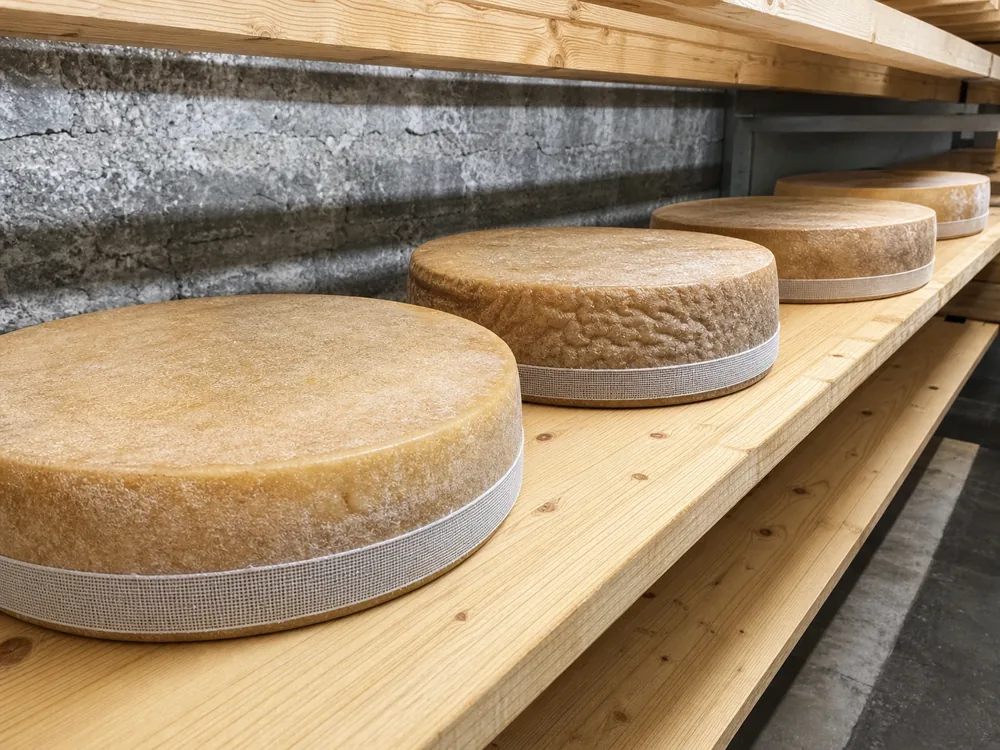
Cellar workers turn each wheel several times a week at first and at least once a week later.
They rub it with water that already carries morge, the smear that builds on the rind, or with lightly salted water. The specification allows salt and Brevibacterium linens cultures in that water and bans antimicrobial agents.
How Is a Wheel Checked Before It Carries the Name?
A five-member tasting commission, with members from cheesemaking, ageing, and the applicant group, grades each maker's production at least three times a year, either at the dairy or in the ageing house. Alpage is the exception: the specification excludes it from that routine.
Grading uses five criteria: taste and smell, physical features, chemical features, bacteriology, and melting ability. Each earns up to 5 points, and a cheese needs 17 of 25 with no mark under 3 to use the name.
Because the floor is a mark of 3 on each criterion, a wheel can pass with the lowest allowed melting mark as long as its other four marks total at least 14.
The commission also takes samples from every maker for bacteriological checks under food law, and the certifying body is the Organisme Intercantonal de Certification (OIC). Makers buy the gauze band or spruce belt from the applicant group at one price for all, which covers the band, certification, and the defence of the appellation.
Which Style Should You Buy?
Six styles share one specification and differ in age, milk, or certification. They do not form a ladder from young to old, because Alpage, Montagne, and Bio describe production rules as well as age.
| Style | Age and Production Rule | Best Use Named by the Interprofession |
|---|---|---|
| Classic | 9 to 12 weeks | Fondue, pure or with Gruyère, and eating by hand in thin slices |
| Extra | At least 12 weeks | Cheese boards, savory tarts, vegetable soup, jacket potatoes, and a stronger fondue |
| Rustic | 12 to 25 weeks | A dessert cheese at the end of a meal |
| Montagne | 9 to 25 weeks; made above 900 m according to the AOP association | A dessert cheese, young or after a few months of ageing |
| Bio | At least 9 weeks; Swiss organic production | Eating by hand in thin slices, or with bread or a green salad |
| Alpage | 12 to 25 weeks; raw milk from high pastures, made over the summer | Autumn, by hand with seasonal fruit, and cheese boards |
Sources disagree at the edges of these ranges. The AOP association gives Classic as 9 weeks and Rustic as 12 to 24 weeks, while Wikipedia lists Classic from 6 weeks, which is below the 9-week minimum in the specification, so the table follows the interprofession's pages.
Fromagère gives yet another range, 6 to 16 weeks, and says the cheese was historically eaten young, sooner than Gruyère, which may explain why some descriptions list ages below today's minimum. For a buyer, the specification's 9-week floor is the figure that holds for any wheel sold under the name.
The interprofession's range page sorts the first three styles by degree of ageing and labels them mild for Classic, medium for Extra, and strong for Rustic. Montagne, Bio, and Alpage are grouped by production method and carry no strength label.
The interprofession names Classic as the partner of Gruyère in moitié-moitié and as the base of a fondue made from Vacherin alone.
It adds that Extra goes well with a younger cheese in that pure fondue, and its own recipe blends Classic, Extra, and Rustic.
Extra has a 12-week minimum with no stated ceiling, and Rustic also starts at 12 weeks, so in that overlap the style name does not pin the age down.
Ask for the style and the age. The interprofession says ageing runs from nine weeks to six months, depending on the type of cheese, the cellar, and the season.
The interprofession says Rustic is recognisable by a delicately pleated rind, and the AOP association links that wrinkled rind to the damp cellar. The specification allows smooth, wavy, or wrinkled rinds on any wheel, and the interprofession describes Alpage rinds as alternately pleated or smooth, so a pleated rind hints at Rustic without proving it.
Montagne and Alpage are not interchangeable: the AOP association says Montagne is made above 900 meters and Alp cheese is made near Fribourg from May to October. The interprofession says Alpage is made by hand throughout the summer with raw milk, while its Montagne page describes the milk going down to the dairy every morning and evening.
What Does It Taste Like?
The Swiss specification describes a creamy, tender paste with a buttery aroma that strengthens with age and a fruity note. It calls the taste pleasant, regular, and aromatic, with an acidic tendency and a slight bitterness.
Fromagère reports a mild, milky, slightly tangy taste with a supple to very creamy texture, and Wikipedia compares the slightly acidic, resiny flavor to Fontina.
Age changes texture along with flavor: Fromagère says a young wheel is firm and mild, and an older one becomes very melting, sometimes almost creamy, with more marked aromas.
Fromagère describes the smell as delicate, milky, and slightly fermentary, while Wikipedia says the smell of ammonia strengthens with age because of microorganism activity.
Style changes the balance, and the interprofession calls Extra franker, with a longer finish, and Rustic floral and intense.
Rustic shows mature elegance from 12 weeks and full development at 5 to 6 months.
The interprofession describes Montagne as soft and floral when young and rounder and fuller after a few months of ageing, and Bio as melting and delicate with a slight, refreshing acidity.
Alpage is aromatically complex, with a paste that moves from firm to very creamy as it ages, and Wikipedia says Vacherin d'alpage has a much richer taste.
The interprofession credits Fribourg pasture for the floral notes of Rustic, Montagne, and Alpage.
The interprofession says Classic develops its aroma when it is cut into thin slices.
Why Does It Melt So Well?
Melting is part of the Swiss specification: the paste must melt in the presence of water below 48°C.
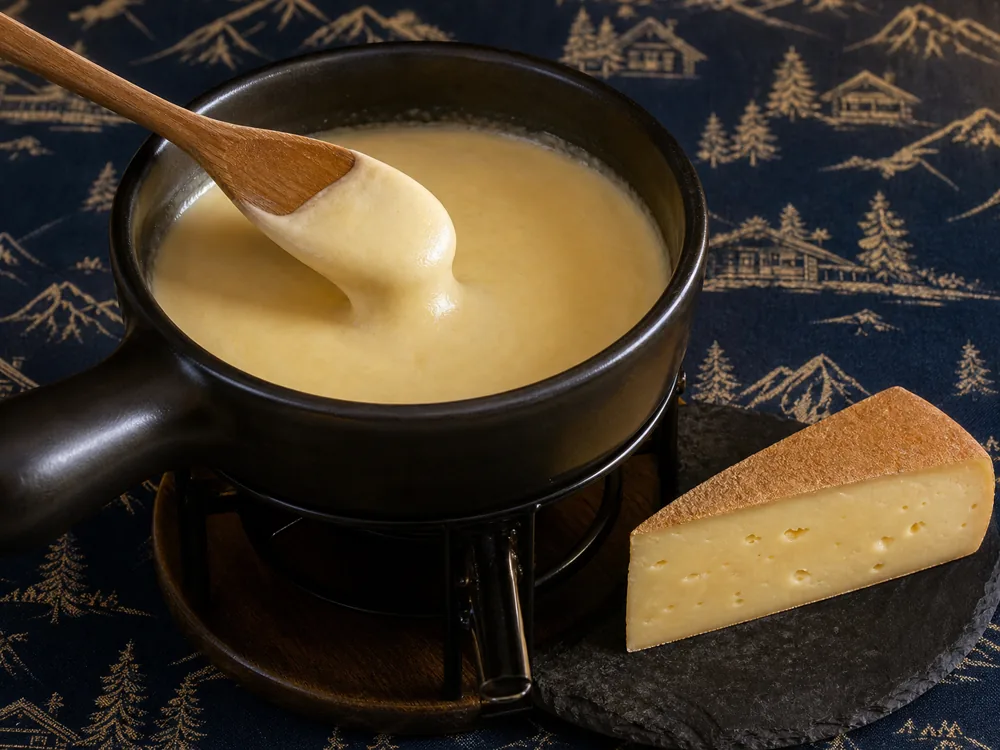
Fromagère ties the melt to the method: the curd is cut without hard cooking, pressed lightly, salted in brine, and aged for a short to medium time, a process it says is meant to keep a supple paste with excellent melting ability. The specification's curd heating of 30 to 36°C fits that description of a pressed uncooked cheese.
Fromagère says the cheese melts evenly without stringing or turning greasy, and it calls it one of the best melting cheeses in the world for fondue.
Fromagère contrasts that melt with firmer alpine cheeses such as Gruyère or Beaufort.
Just Hungry's fondue recipe prefers Vacherin Fribourgeois to Emmentaler for a similar reason. It has a full, distinctive flavor and does not make the sauce stringy.
What Goes Into a Moitié-Moitié Fondue?
The name moitié-moitié means half and half, as Just Hungry notes, and its recipe pairs 400 g of Gruyère aged at least 8 to 12 months with 400 g of Vacherin Fribourgeois, which the recipe lists as an alternative to Emmenthaler. A "Fondue Moitié-Moitié" label, created by the Vacherin Fribourgeois and Gruyère interprofessions, protects the original recipe and guarantees the fondue's traceability.
That recipe serves four as a main course and adds 300 ml of young, slightly sour white wine such as Chasselas, and 2 teaspoons of cornstarch dissolved in 50 ml of kirsch. It also rubs the pot with a garlic clove and stirs in one portion of spreadable cheese, which Just Hungry says helps the cheeses melt together and stay together.
The sauce is cooked on the stove over medium heat for about 20 minutes, until smooth and bubbly, before it moves to a burner. Just Hungry says the burner should keep it only just seething on the surface, because hotter heat burns the cheese on the bottom.
At the table each diner scrapes the sides and bottom of the pot with the bread at least once, which Just Hungry says stops the sauce from sticking or burning. The same recipe adds that a rounded pot is easier to scrape clean than one with sharp angles, and that the crust of burnt cheese left at the end is the final treat.
What gets dipped differs by source: Just Hungry says only bread is dipped in Switzerland, with vegetables or fruit served alongside, while the interprofession serves its pure fondue with potatoes or bread.
How Should You Use It?
In the traditional Fribourg fondue Vacherin Fribourgeois is the only cheese, and the interprofession says that pure fondue is eaten lukewarm with potatoes or bread.
| Use | How It Works |
|---|---|
| Pure Vacherin Fondue | Vacherin alone in the pot, with the style choices given under the style heading. |
| Moitié-Moitié | Half Vacherin Fribourgeois and half Gruyère AOP, the famous half-and-half fondue. |
| Potatoes and Gratins | Extra with jacket potatoes, per the interprofession, while Fromagère lists potato gratin and creamy cheese sauces. |
| Tart and Soup | The interprofession says Extra livens up a savory tart or a vegetable soup. |
| Cheese Boards and Dessert | Extra, Rustic, Montagne, and Alpage, eaten by hand with wine or fruit. |
Fromagère recommends cubes on a board, and its recipe suggestions include a potato gratin and Vitelotte gnocchi in a creamy Vacherin sauce.
Each pairing below comes from the interprofession's style pages, Fromagère, or Just Hungry, and the text names who suggests it.
| Pairing | Type | Why It Works |
|---|---|---|
| Chasselas or Fendant | Wine | Fromagère suggests Chasselas, Fendant, and other dry Swiss white wines, and Just Hungry says the young Chasselas used in the pot also suits the table. |
| Full-Bodied Wine | Wine | The interprofession serves Rustic at the end of a meal with a full-bodied wine. |
| Black Tea | Drink | Fromagère lists light black tea, while the cook behind Just Hungry's recipe served strong black tea with the fondue as a palate cleanser. |
| Light Blonde Beer | Drink | Fromagère lists light blonde beers and artisanal apple juice. |
| Dark Chocolate | Food | The interprofession suggests a square of dark chocolate with Rustic. |
| Chestnuts and Figs | Food | The interprofession puts chestnuts or figs with Rustic on a cheese board. |
| Apple and Walnuts | Food | The interprofession pairs Montagne with apple, chestnuts, or walnuts. |
| Potatoes and Rustic Bread | Food | Fromagère names potatoes and rustic bread as the usual accompaniments. |
The strongest style gets the fullest wine and the dark chocolate, while the lightest drinks come from Fromagère, whose description is of a mild cheese.
The interprofession recommends Extra on a cheese board with wine, and it calls Alpage a fixture of cheese boards.
How Can You Buy a Good Wedge?
On a whole wheel, the specification requires a casein mark on the rind and a marked gauze band or spruce belt. The casein mark carries the name Vacherin fribourgeois or VF, the date of manufacture or lot, and the approval number of the production site.
Whole wheels, half wheels, and prepacked cut pieces must show one of the two official logos and either the words protected designation of origin or the PDO logo. That label is the check available on a cut wedge.
The specification also describes the rind as clean and rubbed with morge, in yellow-brown, gray-brown, or red-brown, which gives a buyer a range to compare a wedge's rind edge against.
Ask the seller whether the rind of a table wedge is meant to be eaten.
How Should You Store It?
A cut wedge belongs in the refrigerator, and the date on its label is the guide to how long it keeps.
Fromagère's one-hour tip counts toward the CDC's limit for perishable food of 2 hours (or 1 hour if exposed to temperatures above 90°F), so a wedge taken out for tasting uses part or all of that window.
What Can Replace It?
The sources set three cheeses beside Vacherin Fribourgeois, each for a different reason.
- Emmentaler: Just Hungry says Emmentaler makes a fondue sauce very stringy and somewhat gooey, and it prefers Vacherin Fribourgeois for that reason.
- Fontina: Wikipedia compares the flavor of Vacherin Fribourgeois to Fontina, which is a flavor comparison and not a tested swap.
- Reblochon: Fromagère lists Gruyère, Montasio, Reblochon, and Vacherin Mont d'Or as similar cheeses.
Fromagère and Just Hungry both value Vacherin Fribourgeois for a melt without stringing, so the swap that changes a pot most is Emmentaler, while Fontina rests on flavor alone.
What Are the Nutrition and Pregnancy Facts for Vacherin Fribourgeois?
The Swiss specification sets at least 26 g of fat per 100 g and at most 2 g of salt, while the interprofession publishes typical fat figures, so the two columns below differ at the edges.
| Measure | Specification | Interprofession Range Page |
|---|---|---|
| Fat | At least 26 g | 28 to 33 g |
| Fat in dry matter | 48 to 54.9 percent | At least 45 percent |
| Water | At most 46.5 g | Not stated |
| Salt | At most 2 g | Not stated |
| Water in the fat-free cheese | 54.1 to 65.0 percent | Not stated |
The interprofession's dry-matter floor of 45 percent sits below the specification's 48 percent, and the specification is the registered text a wheel must meet.
For calories or protein, read the nutrition label of the specific product.
The specification permits raw milk or milk thermized once, and sources disagree about what a given wheel uses. Wikipedia says thermized, while the AOP association, the interprofession's range page, and Fromagère say either, depending on the maker.
Vacherin Fribourgeois is half-hard and made from raw or thermized milk, neither of which is pasteurised. The NHS lists pasteurised semi-hard cheeses such as edam as safe to eat during pregnancy, and says foods made from unpasteurised milk must be thoroughly cooked.
The NHS says pasteurised or unpasteurised soft blue-veined cheeses, and mould-ripened soft cheeses with a white coating such as brie, camembert, and chèvre, must be thoroughly cooked. It lists any cheese cooked until steaming hot as safe to eat.
The CDC lists unpasteurized (raw) milk and dairy products made from raw milk as riskier, and the Vacherin Fribourgeois specification allows only raw milk or milk thermized once, neither of which is pasteurized. The CDC says pregnant women are 10 times more likely to get a Listeria infection.
The CDC also lists pasteurized soft cheeses heated to an internal temperature of 165°F or until steaming hot as safer, a line that does not cover a raw or thermized half-hard cheese, so for US advice on a cooked wedge, ask a midwife or doctor.
SOURCES & REFERENCES
What Else Do People Ask About Vacherin Fribourgeois?
The Swiss specification describes a creamy paste with a buttery aroma, a fruity note, and an acidic tendency with a slight bitterness. The interprofession calls Extra franker with a longer finish and Rustic floral and intense.
The specification requires the paste to melt in water below 48°C, and Fromagère says it melts without stringing or turning greasy. In moitié-moitié it makes up half of the cheese, with Gruyère as the other half.
The interprofession recommends Classic, aged 9 to 12 weeks, for pure Vacherin fondue and for moitié-moitié. It says Extra, aged at least 12 weeks, adds a more intense note when it is mixed with a younger cheese.
No. Vacherin Fribourgeois is a half-hard pressed wheel from Fribourg, and Fromagère calls it firmer and less woody than Vacherin Mont d'Or.
The specification allows only raw milk or milk thermized once. Check the label, because sources report both raw and thermized wheels.
This half-hard cheese is made from raw milk or milk thermized once, and the NHS says foods made from unpasteurised milk must be thoroughly cooked. The CDC lists unpasteurized (raw) milk and dairy products made from raw milk as riskier, so check the label for the milk treatment and ask a midwife or doctor.