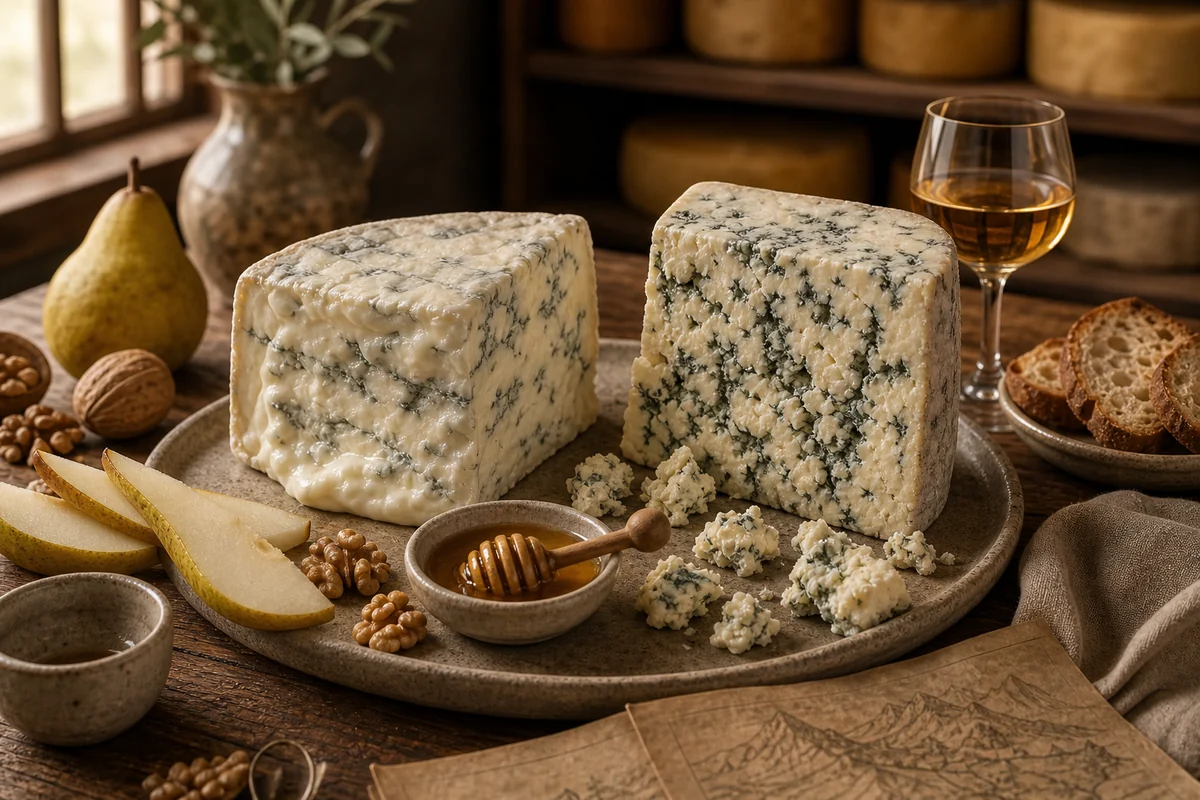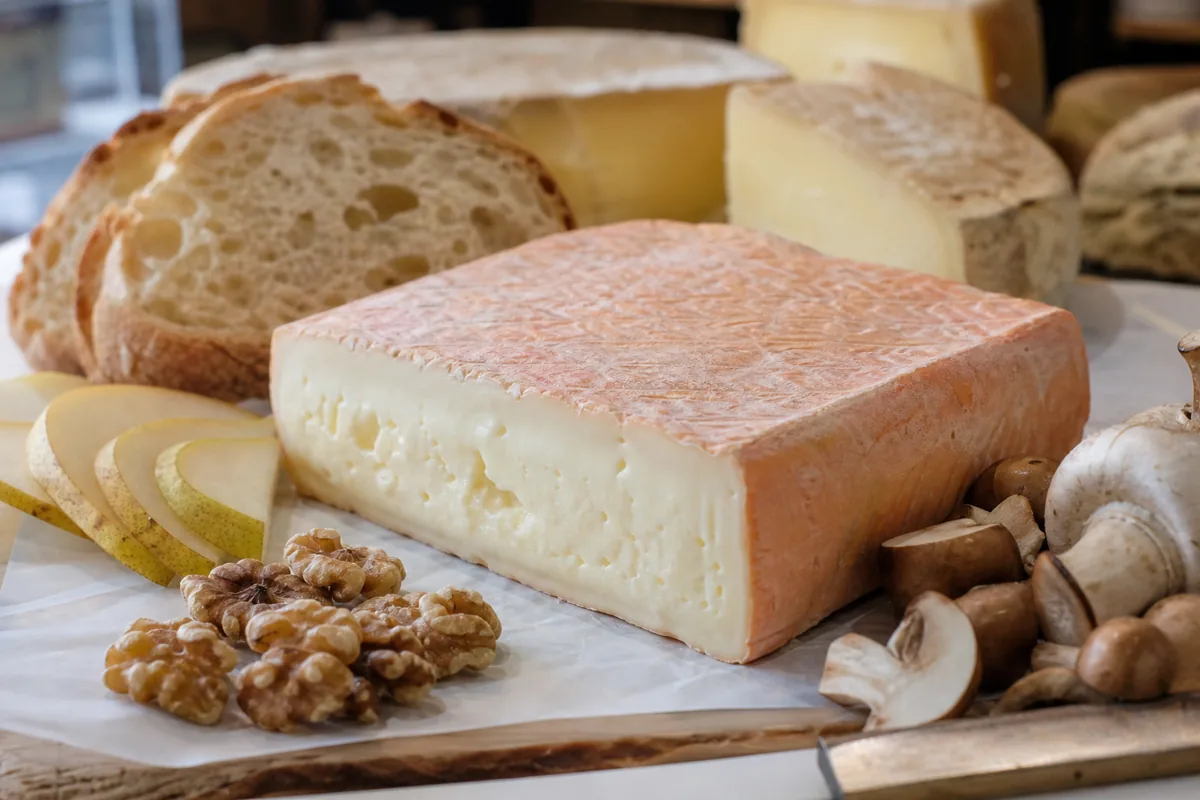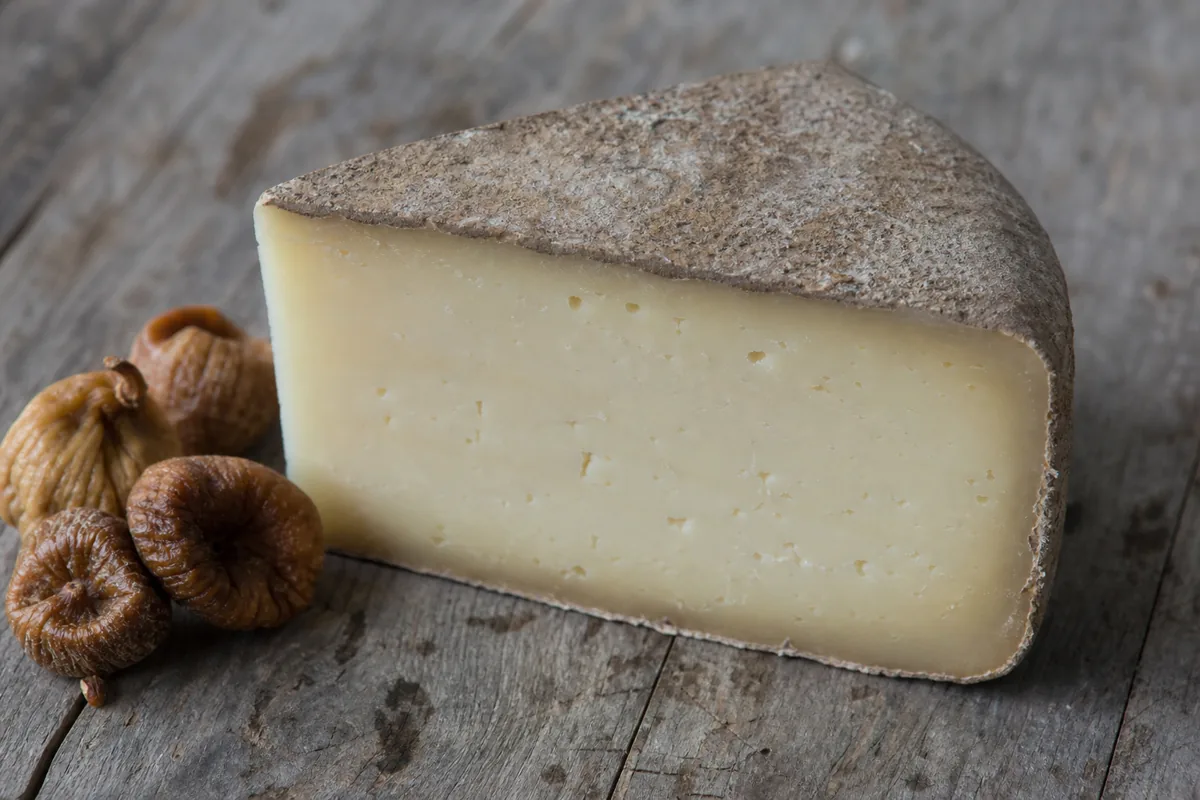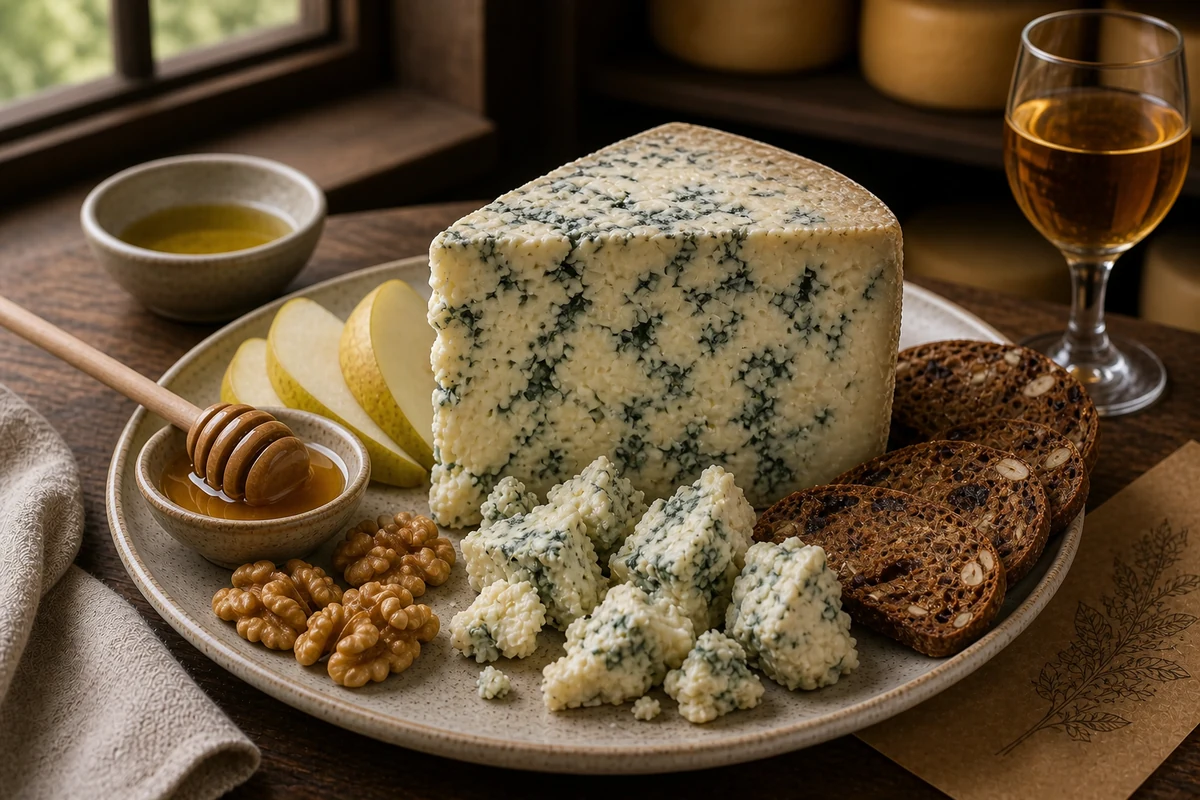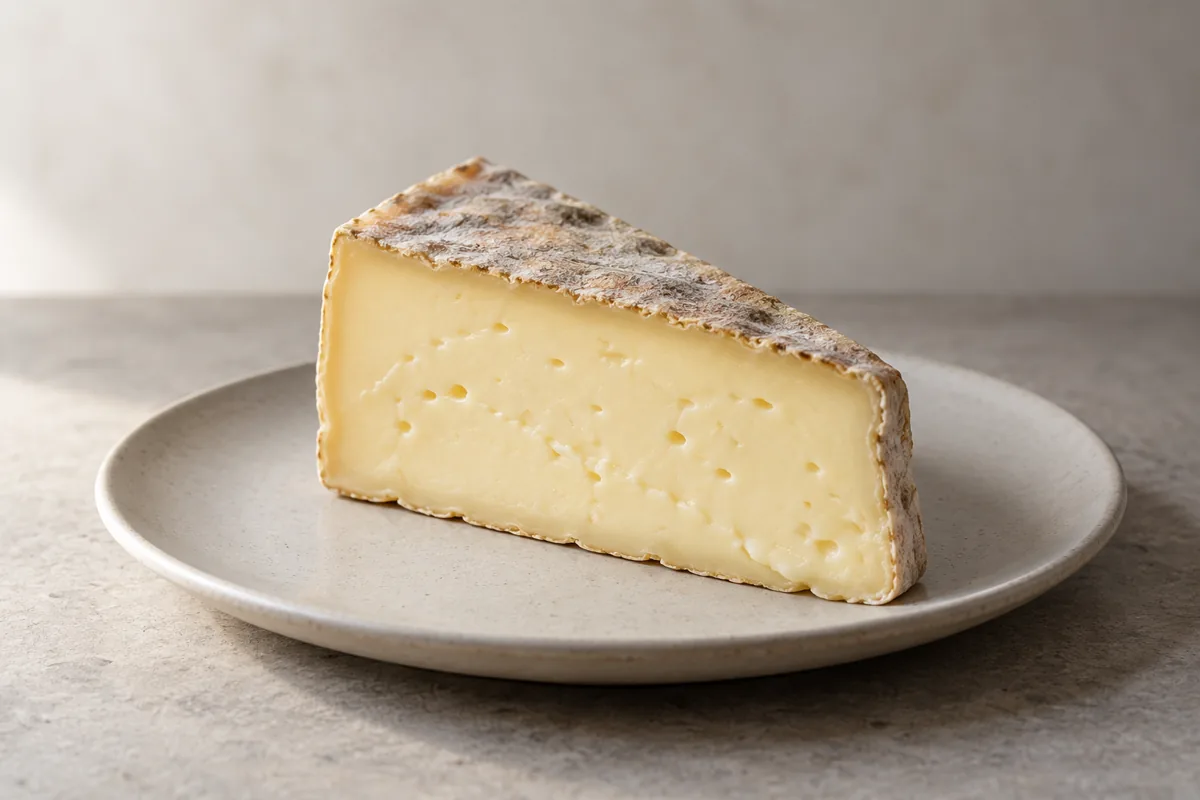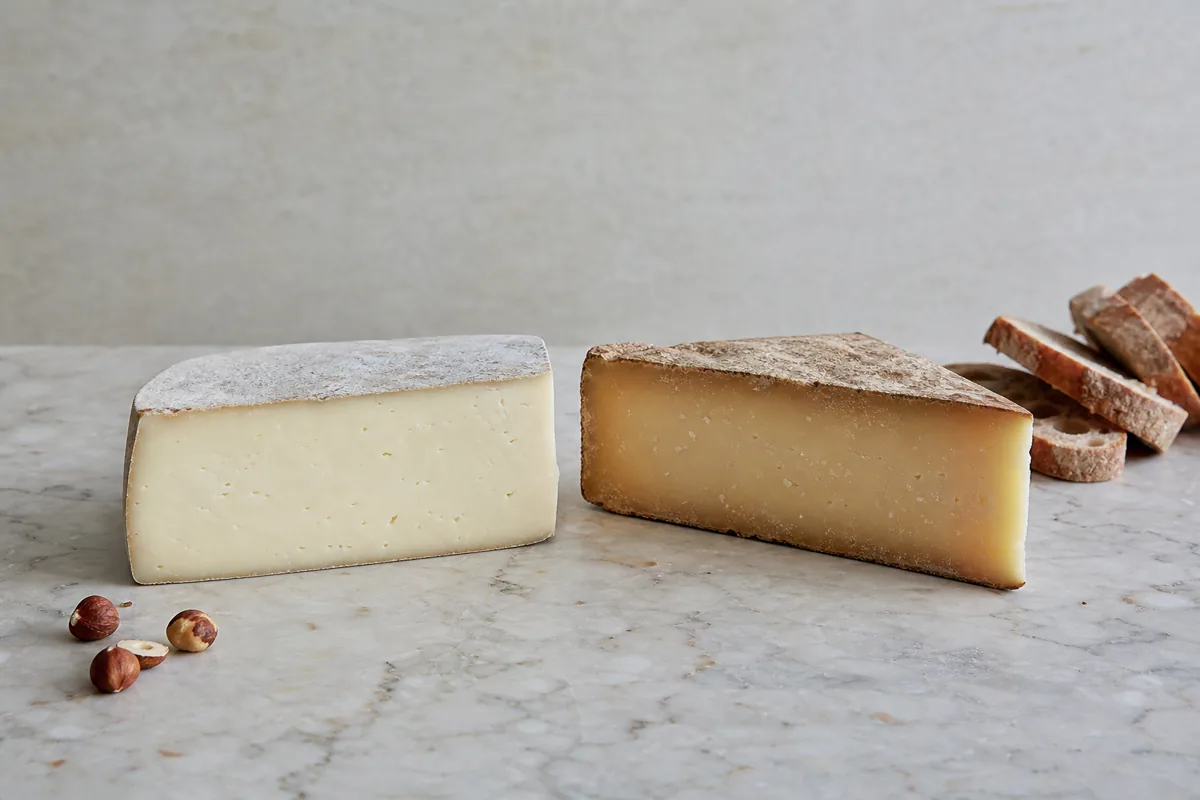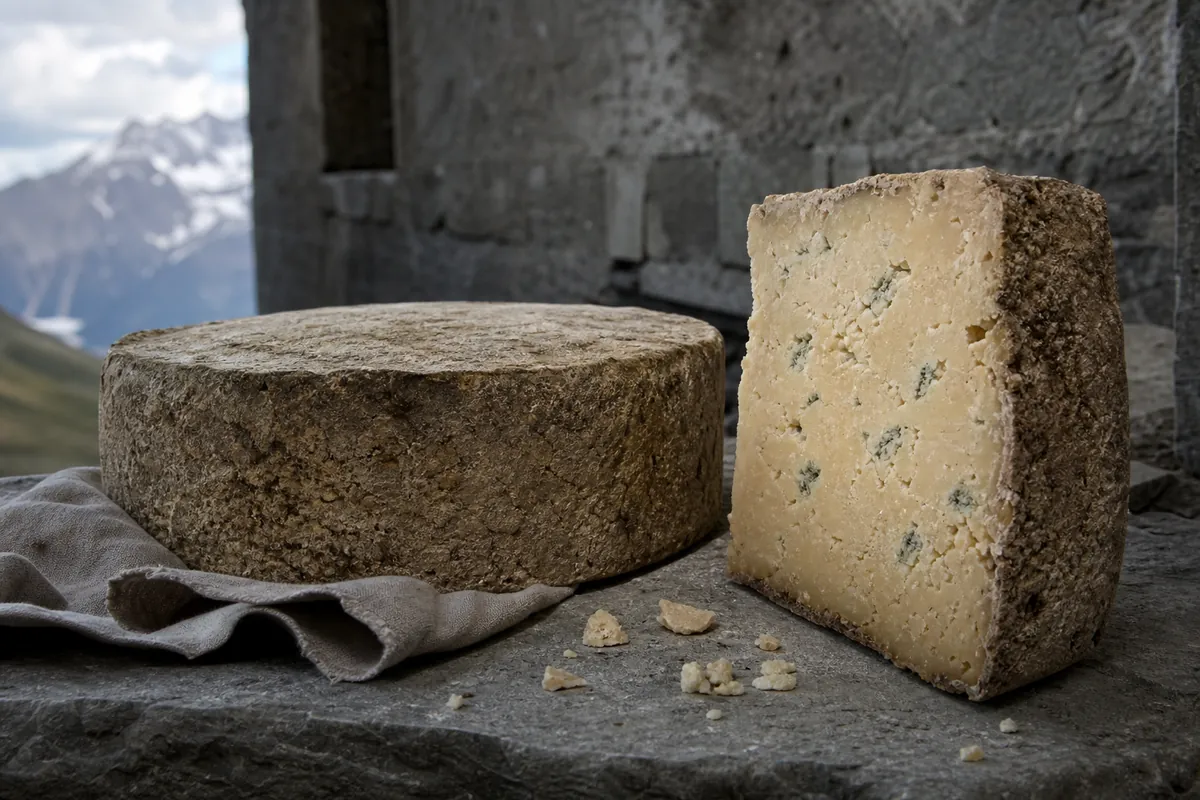
Castelmagno is a raw-milk PDO cheese made and aged only in the communes of Castelmagno, Pradleves, and Monterosso Grana in Cuneo province, Piedmont. The Italian PDO specification sets a minimum of 60 days of ageing and lets the paste develop blue-green veins as it matures.
Readers expecting a blue cheese such as Gorgonzola may be surprised, because the producers' cooperative describes young Castelmagno as pearly white or ivory and friable. Ochre paste, and sometimes green or blue veins, comes only with age.
In This Article
What Makes Castelmagno a PDO Cheese?
The specification, published by Italy's agriculture ministry, requires raw cow's milk and bans pasteurisation, thermisation, and starter cultures. It also sets a minimum of 34% fat in dry matter.
That 34% is measured on the dry matter, not on the wedge as sold: Langhe.net lists 33.45 g of fat per 100 g and Cheese.com 34.2 g per 100 g of whole cheese, so the similar-looking figures sit on different bases.
Sheep's or goat's milk may be added at 5% to 20%, so a batch can be a blend. The producers' cooperative describes cattle only, and Cheese.com lists pasteurized or unpasteurized cow's, goat's, and sheep's milk, which the specification does not permit.
The Pasta Project says the milk comes only from Piemontese cattle, but the specification names eight cattle types, among them Bruna, Pezzata Rossa, Montbeliard, and Valdostana, and allows their crosses. That makes the single-breed claim narrower than the rule.
Up to four consecutive milkings may go into a batch, and the cows are milked no more than twice a day. The producers' cooperative describes two consecutive milkings, morning and evening, and Langhe.net says two daily milkings, so both are narrower than the rule.
The specification fixes the wheel's shape, size, and weight.
Where Can Castelmagno PDO Be Made?
Production and ageing are limited to Castelmagno, Pradleves, and Monterosso Grana, and the milk must come from the same three communes. The producers' cooperative places the three villages in the middle and upper Valle Grana, in Cuneo province.
The cooperative was formed in 2000 and makes the cheese at its dairy in Pradleves, which the mountain community owns, with milk collected from members at Frise and Monterosso Grana.
The specification sets the animals' base feed as green or hay forage from meadow and pasture, mostly from those communes, and it bans corn silage. Supplementary feed is limited to cereals, legumes, mineral salts, and vitamins that the law allows.
Italy Segreta says the earliest known mention of this Italian cheese dates to 1277, when court records required wheels of it as payment to the Marquis of Saluzzo for the use of pasture lands in the Grana Valley.
Langhe.net describes the same 1277 ruling as the end of a pasture dispute between the communes of Castelmagno and Celle di Macra, with seven wheels as the penalty, each worth about twelve denarii.
What Does Castelmagno di Alpeggio Mean?
Every PDO wheel carries one of two label wordings. Because all production sits above 600 metres, the specification has labels read "prodotto della montagna", and when the milk is produced and the cheese made above 1,000 metres the label says "di Alpeggio" instead.
The "di Alpeggio" wording also requires milk only from cows, goats, and sheep kept on alpine pasture from early May to the end of October, fed at least 90% local flora, with the whole process on the pasture.
Pastures used for Alpeggio milk go on a register kept by the control body, which estimates how much milk each can sustain from its plants, timing of use, and animal load. That estimate caps the milk per species counted toward authorising the mark, and herders report each year when grazing starts and ends.
Slow Food's presidium for the alpine wheel sets tighter limits than the PDO wording, and the sources differ on the details. Langhe.net dates it to 2008, limits production to June through September, and says the cows graze freely without silage, genetically modified feed, or industrial by-products, while Italy Segreta puts the pastures above 1,600 metres.
| Wording | Altitude | Season | Paper mark |
|---|---|---|---|
| Prodotto della montagna (PDO specification) | All production above 600 m | Year-round | Yellow with a blue field |
| Di Alpeggio (PDO specification) | Milk and cheesemaking above 1,000 m | Early May to end of October | Yellow with a green field and DI ALPEGGIO on the four helices |
| Slow Food presidium (Langhe.net, Italy Segreta) | Pastures above 1,600 m (Italy Segreta) | June to September (Langhe.net) | Not described |
Few makers share the alpine wheel, though the count varies: Italy Segreta mentions a couple of herders, Langhe.net says the presidium brings together small producers and one affineur, and Guffanti says alpine production is essentially one cheesemaker.
Italy Segreta says the 1982 protection left valley-dairy wheels and alpine-pasture wheels both sold as Castelmagno, and it gives the alpine wheel's limited availability and cultural value as the reason for its presidium. Guffanti calls the 1982 rule the Italian DOC and dates the EU PDO to 1996, the year Langhe.net also gives.
How Is Castelmagno Made?
The specification lets the raw milk be stored cool, though not below 6 °C, and be skimmed by letting the cream rise before heating. Cheese.com calls Castelmagno semi-fat, and Guffanti lists raw, skimmed milk for its Alpeggio wheel.
Under the specification, the milk is heated to 30 to 38 °C and set within 30 to 90 minutes with liquid calf rennet. Because that rennet comes from calves, Cheese.com and the Pasta Project both list Castelmagno as not vegetarian.
The curd is turned and broken inside its whey, coarsely first and then finer, until the grains run from corn-kernel to hazelnut size. In the vat the mass keeps stirring for 10 to 15 minutes, with pauses allowed, to help the curd separate from the whey.
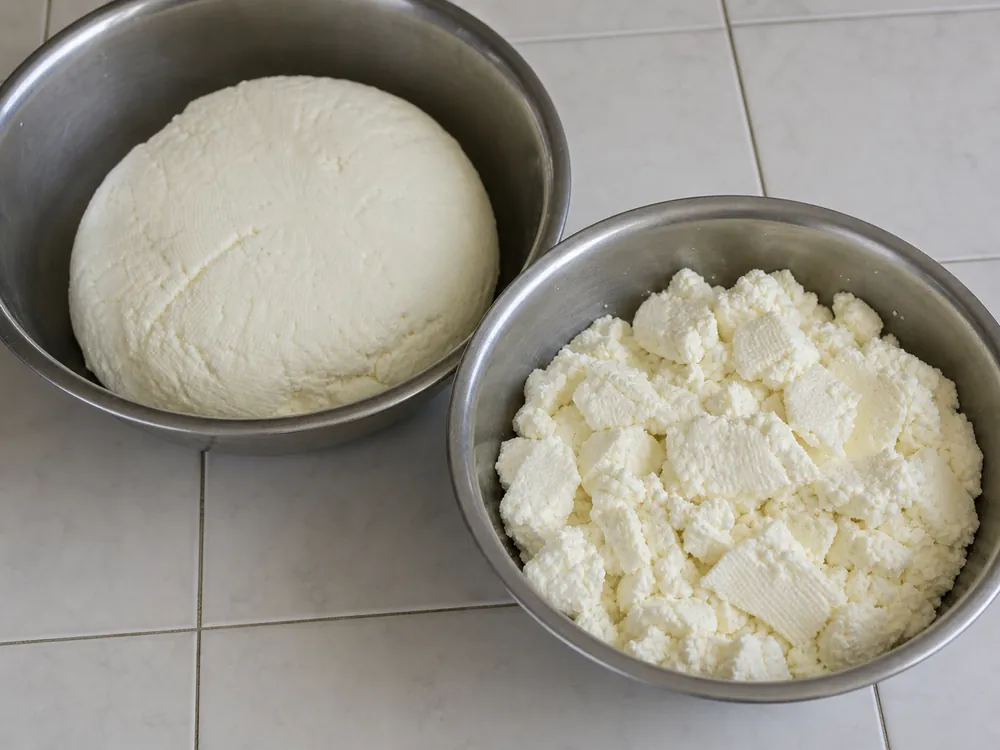
The grains then rest in a dry cloth called the risola for at least 18 hours, while the whey drains without pressing. The cloth may be hung or laid on a sloping surface, and the curd may be cooled during the rest.
Next the curd sits submerged in whey from earlier batches, at 10 °C or warmer, for 2 to 4 days of regular fermentation. Italy Segreta gives three to four days, and Langhe.net says the curd ripens and acidifies for up to six days.
The specification bans added starters, so this soak in whey from earlier batches is the fermentation step it names.
After that the curd is broken again, finely chopped, mixed, and salted. It is wrapped in cloth and pressed in moulds for at least a day.
The specification requires ageing in cool, damp natural caves, or in rooms that copy those conditions, for at least 60 days on wooden boards, at 5 to 15 °C and 70% to 98% humidity. Wheels may be dry-salted to give the rind colour and firmness, and brushed or washed with natural substances that do not colour it, to hold back unwanted moulds and mites.
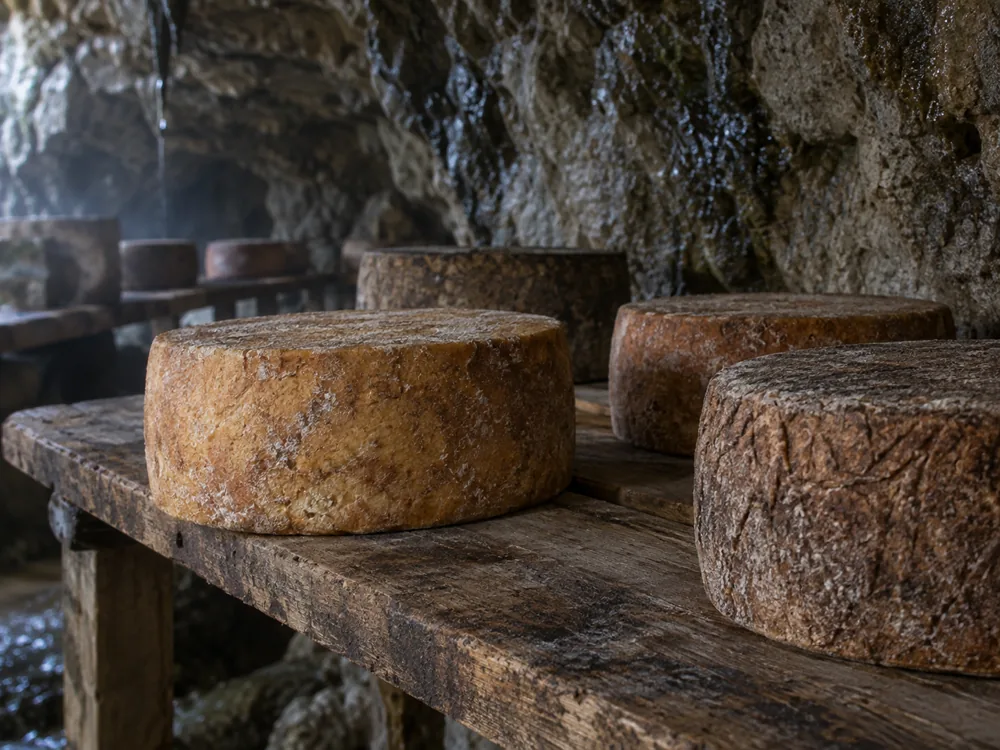
The specification gives the purpose of those temperature and humidity ranges as letting the natural moulds typical of Castelmagno develop correctly.
When Does Castelmagno Turn Blue?
Cheese.com places Castelmagno in the blue cheese family, yet the specification describes blue-green veins as possible and tied to age. It adds that the veins can also come from piercing the wheels by hand with long iron rods, the traditional technique.
The Pasta Project says the milk is inoculated with penicillium spores, so veins may or may not develop, while the specification mentions no added mould and lists the veins as a possibility that comes with ageing. Veins are therefore something a buyer may find, not something the specification promises.
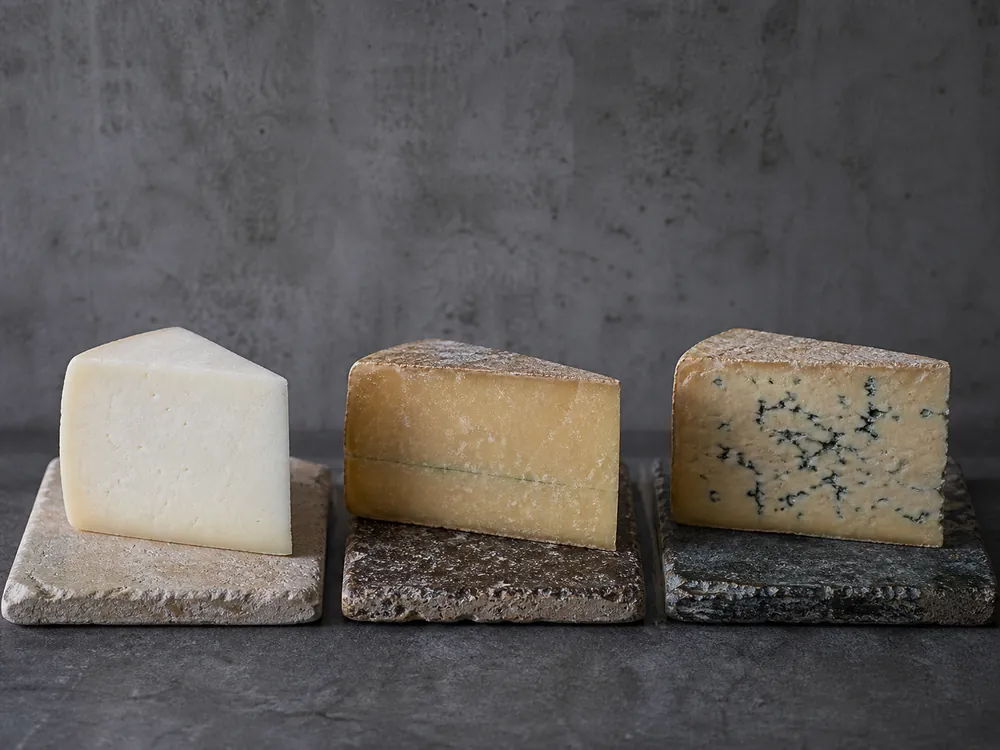
| Trait | At the 60-day minimum | With longer ageing |
|---|---|---|
| Rind | Thin, yellow-reddish, smooth, rather rigid and regular | Darker, thicker, and wrinkled |
| Paste | Pearly white or ivory | Ochre-yellow, with possible blue-green veins |
| Structure | Friable | More compact |
| Flavour | Fine, delicate, moderately salted | More savoury |
How Long Is Castelmagno Aged?
The PDO minimum is 60 days, but the other sources describe longer ages and do not agree with one another.
| Source | Age it gives | What it adds |
|---|---|---|
| PDO specification | At least 60 days | In natural caves or rooms that copy them |
| Producers' cooperative | 2 to 5 months, 6 to 12 months, and over 1 year | The age stages it offers |
| Cheese.com | Two to five months | Stronger, spicier, and sharper over time |
| Langhe.net | Two to five months | For the mountain-product type, in natural, cool, moist caves |
| Italy Segreta | At least 120 days | Gives its best after about six months |
| Guffanti (retailer) | 1 to 6 months | Says at least six months shows its character |
A cut wedge can therefore be a few months old or more than a year old and still carry the same PDO name, so the age the seller states is the detail that separates them.
What Does Castelmagno Taste Like?
The specification calls the young cheese fine, delicate, and moderately salted, and says the flavour turns more savoury with ageing. The producers' cooperative calls the aged cheese strong and piquant.
- Langhe.net lists aromas of lactic fermentation, dry mountain fodder, and moist cool rooms, with fermented milk standing out in fresher wheels and strong, spicy notes in more seasoned ones.
- Italy Segreta describes aged Castelmagno as tangy, grassy, and peppery, with a crumbly texture and blue-green veining.
- Guffanti describes its Alpeggio wheel as strong and intense, with light notes of stables and a strong hint of penicillin when properly aged.
The sources agree that age drives the sharpness but not on how strong the result is. The Pasta Project calls Castelmagno milder than other blue cheeses, while Cheese.com calls it sharp and strong.
Texture is described just as unevenly. The specification and Langhe.net call young wheels friable and older ones more compact, Guffanti describes a mature wedge as compact and grainy, and Italy Segreta lists a crumbly texture for the aged cheese, so a crumbly texture alone does not date a wedge.
How Do You Cook Gnocchi With Castelmagno?
The producers' cooperative names gnocchi with Castelmagno as the best-known dish. Two published recipes melt the cheese in butter and cream over low heat, then add the gnocchi once they float.
| Point | Occelli (butter and cheese brand) | The Pasta Project (blog) |
|---|---|---|
| Potato gnocchi | 1 kg | 21 oz |
| Castelmagno | 200 g | 7 oz |
| Cheese per part of gnocchi, by weight | 1 to 5 | 1 to 3 |
| Butter | 50 g | 1 oz unsalted |
| Cream | 200 ml cooking cream | 7 fl oz fresh cream |
| Finish | Optional Parmigiano Reggiano topping and a brief bake | Toasted hazelnut granules or nutmeg |
Occelli, a Piedmont butter and cheese brand with its own Castelmagno DOP, removes the rind and cuts the cheese into small cubes or flakes. It stirs the sauce on low heat until the cheese has completely melted, then adds a little cooking water while mixing in the gnocchi if needed.
Both recipes leave the sauce's salt until the cheese has melted, and the Pasta Project says why: Castelmagno is quite salty, so it suggests tasting the finished sauce first and cutting back the salt in the gnocchi water when the butter is salted.
The Pasta Project notes that Castelmagno is so crumbly that grating does not work, so it cuts or crumbles the cheese, and it allows another melting cheese in its place. Its list runs from Gorgonzola and Stilton to firm Asiago or Fontina, and it warns that the flavour will differ.
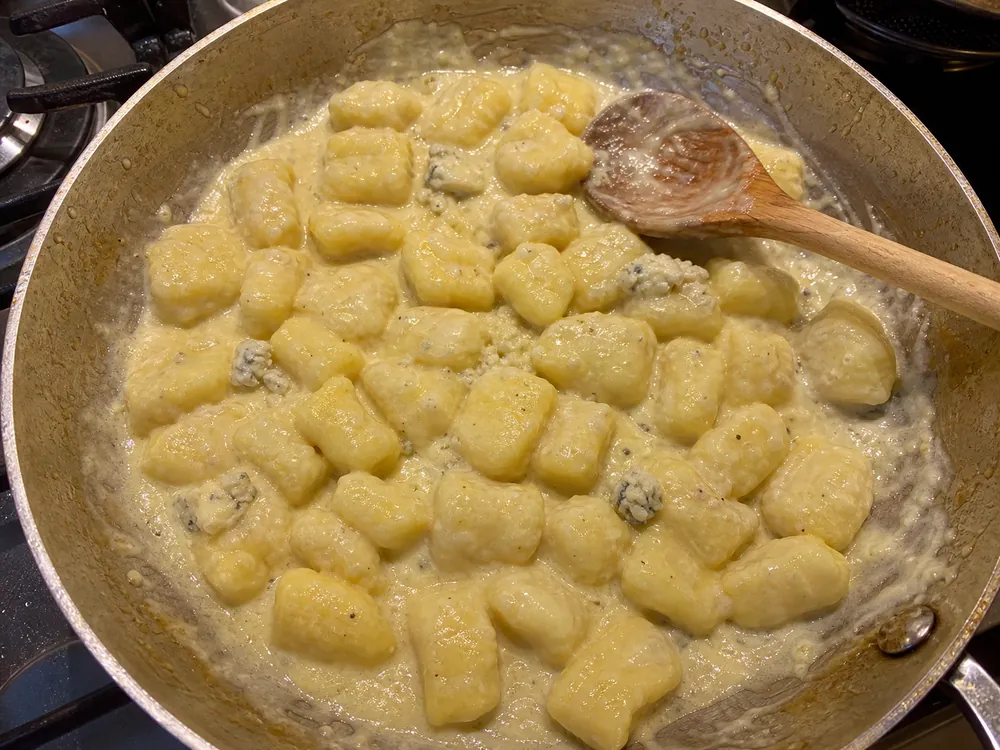
Langhe.net rates Castelmagno at its best in pasta dishes, and names gnocchi fondue and risotto mantecato with honey and walnuts as the all-time favourites.
| Use | How It Works |
|---|---|
| Gnocchi | The producers' cooperative calls it the best-known dish, and Langhe.net suggests a sprinkling of nutmeg on the fondue. |
| Risotto | Langhe.net names risotto mantecato with honey and walnuts. |
| Main courses | Langhe.net names pies, fondue with toasted bread croutons, and polenta. |
| Table cheese | Cheese.com says it is appreciated as a table cheese, and Italy Segreta serves the aged form that way. |
Which Age of Castelmagno Suits Which Use?
Italy Segreta splits the use by age: young, milky, ivory Castelmagno is mostly cooked, melted over gnocchi or risotto, while the aged form goes on the table with its brown rind, tangy and peppery flavour, and crumbly texture.
The traits the specification gives for young wheels suit that use: the paste is friable and the flavour moderately salted, and the two recipes cut or crumble the cheese into small pieces before melting it.
For the board, Guffanti ties its six-month threshold from the ageing table to a market habit: the current trend, it says, is to sell the cheese very young.
The producers' cooperative describes its 2-to-5-month wheel as having a thin white rind, ivory paste, and a fine, delicate, lightly salted flavour, and its 6-to-12-month and over-1-year wheels as having a dark rind, ochre paste with possible blue veins, and a decided, slightly piquant flavour.
The cooperative's white rind for the youngest stage differs from the yellow-reddish rind the specification gives for the minimum age, so rind colour alone is a weak age cue.
Neither published gnocchi recipe names an age, so the cooking advice rests on Italy Segreta alone.
Italy Segreta uses young, milky wheels for melting and aged wheels for the table. Guffanti says at least six months of ageing lets Castelmagno fully show its character.
What Should You Pair With Castelmagno?
Cheese.com and Langhe.net both name Barolo, and Guffanti points to full-bodied, aged red wines.
Langhe.net matches the wine to the cheese: robust local reds such as Dolcetto di Diano d'Alba or Grignolino d'Asti in general, and for a long-aged wheel wines with balance, smoothness, and warmth, namely Nebbiolo, Barbaresco, or Barolo.
Guffanti also names sweet and fortified wines for its Alpeggio wheel.
| Pairing | Type | Why It Works |
|---|---|---|
| Barolo | Wine | Named by both Cheese.com and Langhe.net. |
| Recioto della Valpolicella and Chianti | Wine | Cheese.com lists both alongside Barolo. |
| Dolcetto and Grignolino | Wine | Langhe.net names Dolcetto di Diano d'Alba and Grignolino d'Asti among robust local reds. |
| Barbera | Wine | Italy Segreta pairs aged Castelmagno with Barbera. |
| Honey | Food | Langhe.net names linden or honeydew honey. |
| Cognà | Food | Italy Segreta names this local preserve for the aged form. |
| Mustard, jam, rye bread and polenta | Food | Guffanti lists white watermelon mustard, blueberry jam, rye bread, and polenta. |
How Can You Verify a Castelmagno Wedge?
Genuine Castelmagno carries two marks on the same face. The mould stamps the stylised C with alpine peaks, and a round paper mark with four helix-shaped cut-outs, the "sventolina", is added before sale.
Cut and pre-packed portions must keep both marks recognisable, so a wedge cut from a wheel should still show them.
Behind the portion label sits a paper trail. The specification requires registers of breeders, producers and agers, packers, and portioners, production and packing records, and a monthly report, due by the 10th, of how many wheels each business made or aged.
Can You Eat Castelmagno Rind?
The specification calls the rind not edible, and the paper mark repeats it with "crosta non edibile". Occelli's gnocchi recipe removes the rind before cutting the cheese.
Cheese.com and Langhe.net classify the rind as washed, while the specification only allows wheels to be brushed or washed with natural substances that do not colour it.
For storage time, follow the date on your wedge and the general rules for storing cheese.
Is Castelmagno Safe During Pregnancy?
Castelmagno is always made from raw milk, and its specification calls it a semi-hard cheese. NHS lists pasteurised or unpasteurised hard cheeses as safe but only pasteurised semi-hard cheeses, and it says pasteurised or unpasteurised soft blue-veined cheeses must be thoroughly cooked.
The CDC lists hard cheese as a safer choice only when it is made with pasteurized milk, lists soft cheese from unpasteurized milk, including blue-veined cheese, as riskier, and says pregnant women are 10 times more likely to get a Listeria infection.
A raw-milk semi-hard wedge is on neither agency's safe list and neither names Castelmagno, so ask a midwife or doctor about the pregnancy rules for cheese.
SOURCES & REFERENCES
It can develop blue-green veins as it ages, which the PDO specification calls possible rather than required. Young Castelmagno is pearly white or ivory, and Cheese.com files it under blue cheese.
Yes. The PDO requires raw milk, bans pasteurisation, and allows 5% to 20% sheep's or goat's milk.
The PDO minimum is 60 days. The producers' cooperative offers 2 to 5 months, 6 to 12 months, and over 1 year.
It marks a wheel whose milk and cheesemaking both sit above 1,000 metres, with the animals on alpine pasture from early May to the end of October.
No. The specification requires liquid calf rennet, and Cheese.com lists it as not vegetarian.
The specification calls the rind not edible, and the paper mark says "crosta non edibile".
The producers' cooperative names gnocchi with Castelmagno as the best-known dish. Langhe.net also names risotto with honey and walnuts.